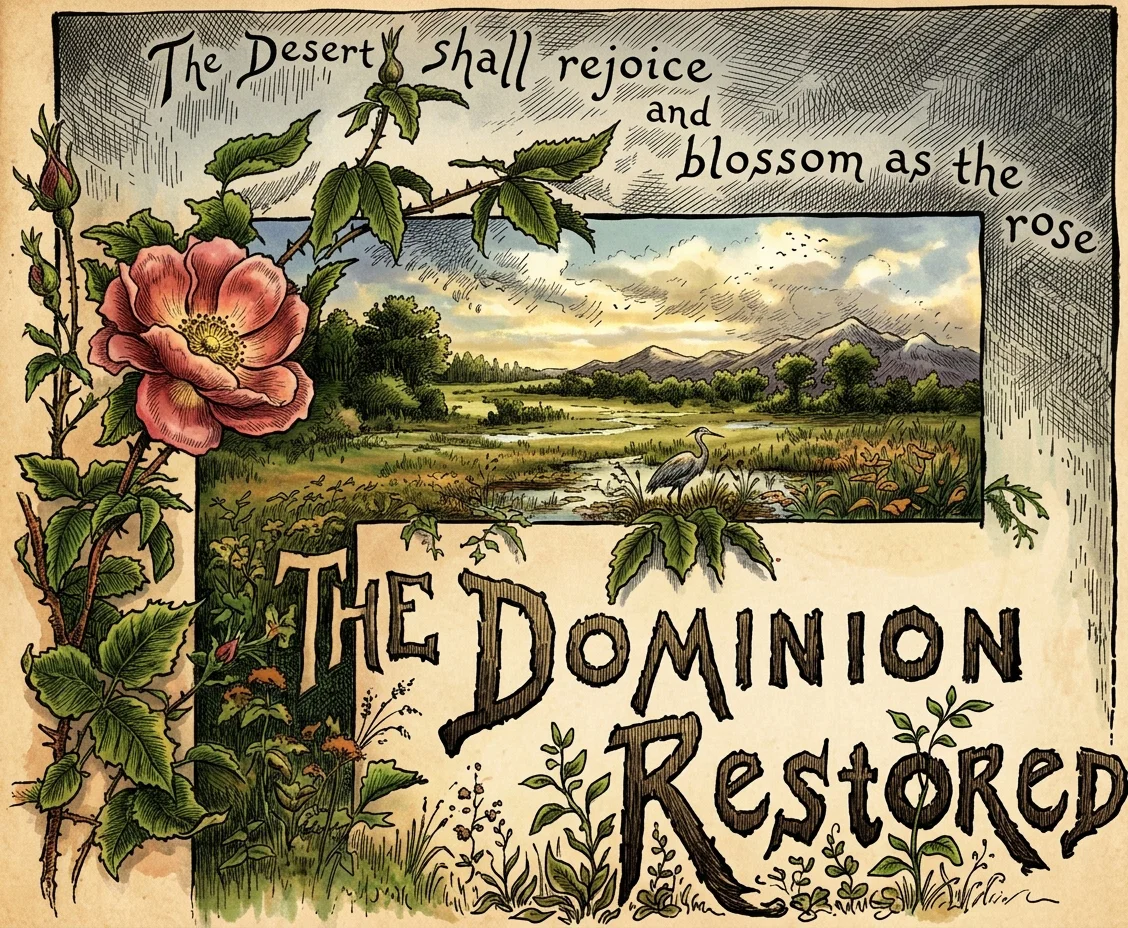
I know that the effects of human apostasy from God are very deep and far-reaching, perhaps much more so than we sometimes think. The whole earth has been involved in it. “The whole creation groaneth and travaileth in pain” in consequence of it. But with the deep depths of the distress which has been struck into all the pulsations of sublunary nature by reason of man's iniquities, the Scriptures do furnish the sublime hope that it shall all be again extracted. There is a time of restitution coming. There is a day of deliverance at hand. That universal wail, which has been going up for the past 6,000 years, shall yet be hushed and lost amid strains of “hallelujah” that shall never end. Luther says: “It is important for us to recur to Adam's original condition, as we expect all things to be brought back again to that.” “All things are now disordered and decayed; whence Peter says that the heavens must receive Christ until the time when all things shall be restored again to what they were in Paradise, thus agreeing with Paul that the whole creatureship has been made subject to vanity, and that it is to be hoped that not man only, but the earth and heaven, shall be again brought back to their Edenic state.”
“In that day shall there be upon the bells of the horses, HOLINESS UNTO THE LORD; and the pots in the Lord's house shall be like the bowls before the altar.” “The creature itself shall be delivered from the bondage of corruption into the glorious liberty of the children of God.” “The wolf also shall dwell with the lamb, and the leopard shall lie down with the kid; and the calf and the young lion and the fatling together; and a little child shall lead them. And the cow and the bear shall feed; their young ones shall lie down together; the lion shall eat straw like an ox. And the sucking child shall play on the hole of the asp, and the weaned child shall put his hand upon the cockatrice' den. They shall not hurt nor destroy in all my holy mountain.” “Moreover the light of the moon shall be as the light of the sun, and the light of the sun shall be sevenfold, as the light of seven days, in the day that the Lord bindeth up the breach of his people, and healeth the stroke of their wound.” “Then the eyes of the blind shall be opened, and the ears of the deaf shall be unstopped. Then shall the lame man leap as an hart, and the tongue of the dumb sing; for in the wilderness shall waters break out, and streams in the desert. And the parched ground shall become a pool, and the thirsty land springs of water; in the habitation of dragons, where each lay, shall be grass with reeds and rushes.” “Instead of the thorn shall come up the fir tree, and instead of the brier shall come up the myrtle tree.” “And the inhabitant shall not say, I am sick.” “And there shall be no more death, neither sorrow, nor crying, neither shall there be any more pain; for the former things are passed away.”
These are glad and glorious descriptions; and they are given by the Spirit of God. Whatever meaning people have attached to them, all agree that they set forth a condition of things which is yet to be realized upon this earth. Some say we must take them literally; others interpret them figuratively. . . . But one thing is settled and incontrovertible,—they include a physical as well as a moral redemption. They describe the lifting off of the curse from all creation around us, as well as from the souls within us. They exhibit suffering and disordered nature once more free, harmonious, congenial, restored, and forever at rest. They portray vast and happy changes in things spiritual and things physical, animate and inanimate, human, animal, vegetable, and elemental. They show us the earth with its deserts fertilized, its elements harmonized, its inhabitants made congenial to each other, its products rendered abundant and sanatory, and its possessors invested with perfect happiness and immortality. Some have looked for their fulfillment in a fancied millennium previous to the Saviour's coming. They would have us believe that these sublime predictions relate only to the universal triumph of political freedom, general wisdom, and exalted piety. But how will the mere reign of righteousness and love in the hearts and conduct of mankind extend redemption into the physical world, or work a deliverance to the animal and other kingdoms? Knowledge, holiness, and liberty combined, and spread over the earth from one end thereof to the other, can not save a man from bodily aches, decay, and death. They can not take the taint from the atmosphere, nor the malaria from the earth. They can not cover Sahara with fertility, nor hush the storm and tempest, nor close the volcano's crater, nor stop the maelstrom's whirl, nor stay the earthquake's giant tread, nor relieve the creature of its groans. Make every meal a sacrament, and every day a Sabbath, and every thought a prayer to God; and all that, of itself, can not take away the curse with which God has cursed “the ground” for man's sake, nor relieve these dying bodies from their many ills.
The case calls for greater changes in earth, air, and sea, and in the whole present constitution of terrestrial things, than can by any possibility result from existing processes, or from mere natural developments. We must have special electric influences to quiet the atmosphere and adapt it better to the wants of humanity. We must have volcanic or some other action in and upon the earth, to change some of its surface, consume its impurities, and renew its wastes. We must have a complete revolution in the present order of things. In a word, we must have another putting forth of divine power upon this world. It must be retouched by the hand that made it. It must come under a renewing potency which can raise the dead. And all this shall be only when the Son of God shall again come from the heavens.
Accordingly, we read that when the times of restitution come, “God shall send Jesus Christ.” “And then shall they see the Son of man coming with power.” And “he shall call to the heavens from above, and to the earth, that he may judge his people.” “He shall have dominion also from sea to sea, and from the river to the ends of the earth.” “He shall send forth his angels, and they shall gather out of his kingdom all things that offend, and them which do iniquity,” and “destroy them that corrupt the earth.” “The Lord shall go forth as a mighty man, he shall stir up jealousy like a man of war; he shall cry, yea, roar; he shall prevail against his enemies.” “The Lord also shall roar out of Zion, and utter his voice from Jerusalem; and the heavens and the earth shall shake.” “They that are in their graves shall hear his voice, and come forth.” “Them also that sleep in Jesus will God bring with him.” “Who shall change our vile body, that it may be fashioned like unto his glorious body, according to the working whereby he is even able to subdue all things unto himself.” “Then shall be brought to pass the saying that is written, Death is swallowed up in victory.” “And there shall be no more curse.”
“Write,” says the Son of God, “for these words are true and faithful.” It is not a poetic dream, but a divine revelation. God hath spoken it by the mouth of all his holy prophets since the world began. It was the hope of Adam as he went forth an exile from Eden. It was the light that illumined the tents of the pilgrims of old with a sweeter halo than the recollections of Paradise. It was the stay of faithful Abraham as he sojourned in tabernacles with Isaac and Jacob, the heirs with him of the same promise. It shone in the serene imagination of Isaac, and supported the dying head of Jacob, and caused Joseph to turn away from Egypt's mausoleums, and ask that his bones might be carried up to the land of the redeemed. It shortened the centuries in which the Lord's chosen toiled in servitude, and cheered the house of affliction with songs. It kindled glad expectations amid the darkness of gentile apostasy, and taught even the heathen to prophesy of deliverance. It fired the hearts and tongues of all Judah's minstrels, as they swept from the harps of inspiration those lofty anthems which filled the home of the Shekinah with praise. And thousands upon thousands have not counted their lives dear unto them for the excellency of this hope, and were tortured, not accepting deliverance, that they might obtain the better resurrection. —Extracts from a sermon by J. Seiss, D.D., Lutheran.
REMARKS ON “MILLENNIAL DAWN.”
By W. G. Moorhead
BY PROF. W. G. MOORHEAD.
Two VOLUMES of a book, with the title given above, have been published. The first volume, it is announced on the cover, has reached the “thirty-seventh thousand.” An orthodox premillennialist will not read far into it without perceiving that the title is a misnomer—that a more appropriate one would be “Nocturnal Hallucinations!”
One would be indisposed to say anything about the book if it were not for the fact that it is being pushed into the hands of the public with remarkable persistency. Agents carry it from house to house and sell it at the ridiculously small sum of twenty-five cents per volume. That it has done harm can not be doubted; that it is calculated to do much evil to a truth precious to the hearts of many Christians is certain; for it is packed full of fundamental error. That your readers may be warned of its danger is the purpose of this brief review.
The character of the book will appear from the following summary of the more glaring errors and heresies which it contains, and which are here set down without comment:—
1. Jesus was a spirit-creature, higher than the angels in his preëxistent state. Vol. 1, pp. 174, 176, 184.
2. On becoming man, Jesus dropped the “spirit-nature he had before” and was human only. Vol. 1, pp. 174, 176.
3. In the incarnation our Lord had only one nature, not two. Vol. 1, p. 175. We quote: “Neither was Jesus a combination of the two natures—human and spiritual. The blending of two natures produces neither the one nor the other, but an imperfect, hybrid thing, which is obnoxious to the divine arrangement. When Jesus was in the flesh, he was a perfect human being; previous to that time he was a perfect spiritual being, and since his resurrection, he is a perfect spiritual being of the highest or divine order.”—Vol. 1, p. 175.
4. Jesus twice experienced a change of nature,—“first from spiritual to human”—i. e., from a creature as pure spirit; afterward, from human to the highest degree of spiritual nature—the divine. Vol. 1, p. 176.
5. The body of Jesus was not raised up. Vol. 1, pp. 126–129. To explain the disappearance of the crucified body, the book says: “Our Lord’s human body was, however, supernaturally removed from the tomb. . . . Whether it was dissolved into gases or whether it is still preserved somewhere as the grand memorial of God’s love, of Christ’s obedience, and of our redemption, no one knows; nor is such knowledge necessary.” Vol. 2, pp. 129, 130.
6. After his resurrection, Jesus became divine. Vol. 1, pp. 1, 173–176; vol. 2, p. 132. The book teaches that it was in consequence of his perfect obedience that Jesus was exalted to be divine.
7. The parousia, or presence, of the Lord has already taken place, i. e., in 1874. Jesus then came in an invisible way, and is now known only to the few who are waiting for him. Vol. 2, pp. 158–172, 240.
8. The millennium also began in 1874. Vol. 2, chap. 2.
9. The end of the present order of things takes place in 1914. Vol. 2, chap. 4.
10. At the resurrection, which is simultaneous for all the dead, all those who never had an offer of Christ during their earthly life will then have it, and the great mass will accept him and be saved. Vol. 1, chaps. 6, 9.
As a specimen of the exegesis of the author, the following is submitted (vol. 2., p. 146: “With a shout.” The Greek word here translated ‘shout’ is keleusma, which signifies a shout of encouragement, . . . a public message for the ears of a mixed multitude. The aspect of affairs in the world for the past fifteen years very strikingly corresponds with this symbol, in the outbursts of the world-wide encouragement for all men to wake up. . . . Where on the face of the earth is the civilized nation that has not heard the shout, and is not influenced by it?” That is, the restlessness and dissatisfaction of the world, the quarrels of labor and capital, the “trusts,” the cry of the socialist, and the savage growl of the nihilist and anarchist, are the proof that the “shout” of 1 Thess. 4:16 has been sounding for the past fifteen years. Match that interpretation if you can.
Such is the “Millennium Dawn”—a mixture of Arianism, second probation, restorationism and the Swedenborgian method of exegesis of Scripture. Perhaps the most charitable view of the book is that it is the product of insanity.
What infinite dishonor it does the Son of God, whom it first makes a spiritual creature, then a mere man, and finally tries to compensate for so great a loss by exalting him after his death to be divine! Shocking—most shocking! He who died on Calvary was a man, only a man. He who is now at the right hand of God has nothing human about him, for his body, we are told, was never raised. How much better is this than the words of the infidel, Renan, “The stone from his sepulcher was never rolled away.” And yet there is inscribed on the cover of the first volume, “The Plan of the Ages;” and on the second, “The Time is at Hand.”
Carlyle speaks of having been compelled to read certain “dropsical books.” This book is worse—it is hydrophobic.—The Truth.
THE TOUCH OF CHRIST.
By J. R. Miller
DURING the civil war word came to a mother that her boy had been wounded. She found her way to the hospital at the front. The doctor said to her: “Your boy is fast asleep. If you go in and wake him, the excitement will kill him. By and by, when he wakes, I will break the news to him gradually.”
The mother, with her great hungry heart yearning to see her boy, looked into the doctor’s face: “He may never awaken. If you will let me sit by his side, I promise not to speak to him.”
The doctor consented. She crept to the side of the cot, and looked into the face of her boy. How she longed to embrace him! She could not resist laying a gentle, loving hand on his forehead. The moment her fingers touched the boy’s brow, his lips moved, and he whispered, without opening his eyes, “Mother, you have come.” Even in his sleep he knew the touch of love.
The human touch on lives that need comfort, healing, and blessing, carries wonderful power. But shall we not bow our heads for the touch of Christ himself? He lays his hand gently and lovingly upon our brow. Some of us may be in sorrow; some are in care; some have their burdens. But do you not recognize that soft touch of Christ’s hand—the hand that the nail pierced? May the touch give joy and a blessing to every one.—J. R. Miller.
THE SCRIPTURES AND CREEDS.
The following excerpt from the address of Dr. A. H. Quint, retiring moderator of the Congregational Triennial Convention, recently held in Syracuse, is worthy of consideration. After speaking of such great men as Luther, Calvin, and Wesley, he says:—
Great men were these, mighty men, and their life has been infused into the Christian church, and their teachings have added to the great wealth of Christian thought. But we look above them, to their Lord and our Lord, and bow only to the name of Him who sitteth upon the throne forever and ever.
It would be needless for us to tell the world that the word of God, expressed in the Sacred Scriptures, is to us authoritative. It is exclusively authoritative. Men have said, plainly by way of disparagement, that the church existed before the New Testament Scriptures, and gave us those Scriptures. But we recognize the fact that without those Scriptures we should not know that there was a church. We should not know even that there was a Christ. “Men spake from God, being moved by the Holy Ghost.” Here are the teachings of the unerring Christ, to whose slightest word, brought to the remembrance of the apostolic writers by the Holy Spirit, as Jesus himself promised should be done, we listen in profound submission. But, for this very reason, we find ourselves obliged to refuse submission to such as claim authority to impose upon us their own creeds and confessions of faith. Our creeds, when we must make them, are only our testimonies of belief. They are not statutes. We must hold to the truth; but we distinguish between the truth and the formulas in which that truth may be stated. It is a vital distinction. Even when the forms of statement of scriptural truths made by men who placed them in logical and orderly arrangement may satisfy us, we accept them because they seem to us to express facts, and not because there is any authority for requiring us to accept them. From them we continually recur to the Scriptures for the infallible word of God. The evangelical faith we find in various confessions, but we can not admit any one of these confessions to be authoritative or exclusive. It is easy to state the scriptural facts in simple language. But men have made great theological treatises—philosophical, metaphysical, inferential—which they have called confessions of faith. We study them, but Christ has given none of their authors commission to impose them upon his church.
The best of these forms of statement are human, and therefore imperfect in their language. They are incomplete, because human experience can not cover the complete truth of God. They are sectional, because framed by single sections of the whole church. They are conceived in the spirit of a particular age, and, so far as thus conceived, may not be fitted to the age which follows. The truth in them is eternal; the outward expression of that truth is transitory. There is no logical ending to the search for authoritative and unchangeable creeds till we reach the Vatican.
I have quoted from the words of John Robinson that more light is yet to break forth from the word of God. More than once has it been assumed as the significance of Robinson’s expression that the word of God itself was to be superseded. Nothing could more completely misrepresent that devout man. The light is come from the word of God. The word itself is to be luminous. The experience of the church is to understand it better from age to age. The great facts involved in redemption are to stand out more and more clearly.
These are important principles; they speak out genuine Protestantism and Christianity. We stand with Congregationalists in the above utterances. There “is a vital distinction” between creeds and the word of God. The former are founded in the wisdom of men. They are men’s imperfect conception of God’s truth. They can not save, and there is no more power in them than in the men behind them. But most of the framers of creeds are dead, and that is the case with the creeds; they are simply dead, cold expressions of thought. Not so God’s word; it is vital, living, and, being living, it imparts life to all those who will receive it by faith, who come into harmony with its operative power, or inherent life. And this is loyalty to every part of God’s word.
OMINOUS TENDENCIES.
By W. N. G.
Quite a sensation was recently created by the United States Secretary of State, who intimated that he might invoke an ancient press-muzzling law against the enterprise of the New York World. That paper secured by cable a brief expression of sentiment from the Prince of Wales regarding the position of the President on the dispute between England and Venezuela, and an expression of Baron Rothschild on the prospect of selling in England a proposed new issue of United States bonds. The publication of these expressions was displeasing to the administration, and Secretary of State Olney, together with some senators, proposed to call up this old law of 1799 and enforce it against the proprietor of the World. Some of the provisions of the act (known as the Alien and Sedition Law) expired by express limitation; but other parts, even then unpopular and since deemed obsolete, are still available for evil.
It is thought that all such laws are made void by the First Amendment to the Constitution, which provides that Congress shall make no law abridging the freedom of speech or of the press. But the Supreme Court, in its decision of a case under the Lottery Law, February 1, 1892, recognizes the right of Congress to deprive a citizen, without a legal trial, of the right to send his communications (or papers) through the mail. The court that would thus ignore a plain provision of the Constitution in one instance would not hesitate to do so in another, no matter how ancient the law in question might be.
The squelching of the iniquitous lottery business was a most desirable object, but to do so in a manner to leave Congress the power to forbid the carrying of printed matter through the mails on any pretext or caprice, was a most dangerous precedent, and one which must be the precursor of tyranny. It is on the same principle as the condition in Canada, where the postmaster general may exclude from the mails any paper or matter whose teaching he may deem injurious to the public.
One of the most dangerous doctrines extant is that the Supreme Court is “the highest authority in the land.” This is an assertion that we hear so often, and from so many quarters, that it is coming to be deemed an actual fact. It so far obtains that many people suppose the Supreme Court is the interpreter of the Constitution for all the other departments of government; but as a matter of fact it is only a coördinate branch of the government, deciding constitutional questions when they come before it in actual cases. Andrew Jackson contended that when he, as President, took the oath to support the Constitution, he was obligated to support it according to his own understanding of it, and not as understood by some one else. So he vetoed the National Bank Bill passed by Congress during his term, on the ground that it was unconstitutional, although the Supreme Court had previously decided that the measure was constitutional.
The idea that the Supreme Court is the highest authority in the land leads to all manner of false conclusions, not the least of which is that its mere dictum is law, and that, as in the Louisiana lottery decision and in the “Christian nation” decision, its rulings or decisions may warrant Congress in taking steps not warranted by the Constitution.
This idea that the Supreme Court is the highest authority in the land, so generally imbibed by the people, seems to have taken hold of the court also; hence the tendency to add extraneous opinions to legitimate decisions, giving in advance the position of the court on questions discussed but still undecided among the people. In this way the court indicates in advance what actions of Congress it would indorse, thus becoming a virtual monitor not only of the legislative branch of the government, but of the executive branch also. To assume that it is the highest authority is to assume that it is a veritable oligarchy, with unlimited power; and the assumption that its mere dictum has legitimately the force of law, is to assume that the court has the power to make law which is not even subject to a veto. Such a doctrine virtually lays the Constitution on the shelf, and subjects the country to the caprices of the Supreme Court. W. N. G.
A QUESTION FOR OUR YOUNG PEOPLE.
By Vera
BY “VERA.”
The late afternoon sun was casting its last lingering rays upon the western windows of the great school buildings in N. Within all was deserted and silent, save in the office of the superintendent, where the graduating class had assembled for the last rehearsal of orations before the grand consummation. The rehearsal had been satisfactorily completed; now they sat waiting for the signal of dismissal.
Mr. Hart, the superintendent, glanced over the flushed and excited faces before him; six bore traces of deep anxiety. Silence fell upon the group, as he arose and said:—
“It has been the custom of this institution for some time in the past, to graduate its classes upon Friday evening; but the circumstances are such as to necessitate a change from this custom. I hold in my hand a petition, in which it is stated that the undersigned have been members of this school for a number of years, obeying its rules, and passing all required examinations, entitling them to graduation; but should the class follow the usual custom of graduating upon Friday evening, they will be obliged to forego that pleasure and withdraw from the class, as their religious convictions will not permit them to engage in such things on the Sabbath of the Lord; therefore they respectfully request that the time be so changed that all may receive alike the reward for the years of faithful labor. This is signed by six worthy members of this class.
“Now, as the public school is purely a ‘creation of the civil government,’ and ‘rests upon the foundation of political necessity,’ and is not ‘maintained in the interest of, nor in opposition to, religion,’ but is ‘of the people and for the people,’ whether Protestant, Catholic,10or infidel, and as it holds out the same inducements to all, regardless of color, caste, or creed, it is but just and right that this request be granted, and they permitted to enjoy the honor of finishing their school course in the usual way. For this reason the graduating exercises will be held upon Thursday evening, instead of Friday, as previously announced.”
A loud hiss resounded through the room, followed by a death-like silence. Then the question was asked, “What right have you to thus decide in favor of one religion to the exclusion of all others?”
“I have no right, nor have I so done,” clearly replied the superintendent. “Had I appointed this exercise for Sunday evening, thus excluding the majority of the class from the privilege of graduation, I would be ‘deciding in favor of one religion to the exclusion of all others’; as it is, I am only carrying out the principle upon which the public-school system is founded, namely, equal rights for all. This is a question of personal right, not of religion.”
The signal for dismissal was given; the class passed out with flushed and angry faces. Many unkind and scornful remarks were directed to the unhappy six.
The following morning a protest from the parents of the other members of the class was received by Mr. Hart, in which it was stated that if he stubbornly adhered to his purpose, showing such marked partiality for the religious opinions of the Adventist members of the class, they should consider it their duty to forbid their sons and daughters taking any part whatever in the exercises. They sincerely hoped he would reconsider his decision, and not depart from the fixed customs of the school.
Mr. Hart was a man who stood firmly for principle when convinced that that principle was right. So this protest only served to strengthen his determination to stand firm for the principle, and not give way to prejudice and bigotry.
The morning paper contained a notice of the change made, also the names of the twenty-six graduates.
Mr. Hart now called upon the pastor of the M. E. Church, and invited him to offer the invocation, and was much surprised at his flat refusal. The minister stated that under the existing circumstances his conscience would not permit him to officiate.
The same reply was given by every Protestant divine(?) in the place.
Mr. Hart was not a Christian. He hardly knew what to do, but he was determined to have a prayer offered for that class. It finally occurred to him that the Catholic priest might help him. He sought the reverend father, and laid the whole case before him, then invited him to officiate. He kindly accepted.
Thursday evening came, and with it every member of the class, all graduating with honor; but liberty-loving, noble-spirited, kind-hearted Mr. Hart was requested to resign, which he did.
Now, my dear young readers, this is not fiction, but a fact. Many of our public schools throughout the United States follow this custom. No doubt many who read this article will soon be called upon to decide this very question—some all alone. Shall we compromise our faith, sever our allegiance to God, for the few moments of pleasure and honor a worldly custom offers us, at such an exorbitant price? or shall we stand firmly for principle and right, choosing rather to suffer scorn “than to enjoy the pleasures of sin for a season”?
Christ is our pattern. Did he not know the meaning of self-denial, ignominy, and scorn?—Ah, yes! “The servant is not greater than his Lord.” Remember, “one with God is a majority.”
IT IS CHURCH AND STATE.
By H. F. Phelps
Proved by Their Own Statements.
This city, St. Paul, Minn., seems to be rather conservative on the Sunday enforcement question; yet the virus is here to poison the body politic. A League has been formed, called the Christian Citizenship League. Whether this is the same as the Sunday-law Observance League, that was successful in the prosecution of the Sunday baseball team, or not, is not known to the writer. But the Christian Citizenship League is now organized as an auxiliary to the national League of the same name. Article 2 of the Constitution says:—
“The objects of the League shall be the enforcement of the laws of the city and the state; to combat existing evils, especially such as result from violation of the liquor laws, unlawful Sunday labor, gambling, and the keeping of disreputable places; to arouse a healthy and intelligent interest on all questions concerning the welfare of our city and state, and to shape public opinion toward securing the nomination and election of competent and trustworthy men for public offices without respect to party lines.”
A series of meetings called mass meetings is proposed, and one meeting has been held in the interests of the League and its work. The writer was in attendance; and it could hardly be called a mass meeting, for it is evident by their absence that the masses are not interested. If they were interested, or understood what is to be the direful results of the suppression of all “unlawful Sunday labor,” there would, no doubt, be created an enthusiasm that might result in the defeat of that part of the work of the League. But, being unaware of this, they are sleeping, while they are surely being bound and deprived of their liberties, through well-meaning but terribly mistaken organizations.
At the meeting in question, one of the speakers, a prominent clergyman, said that there was in some manner a sort of a feeling that this work was church and state; he declared it was “as free from church and state as the laws against murder.” Yet in almost the same breath he made two statements that proved the denial to be without a foundation. In considering the Sunday saloon, its evils, and why it should be closed on Sunday, he said: “The great body of the American people keep Sunday.” And again, “We are simply saying, You can’t buy it [liquor] on Sunday.” An analysis of this proves conclusively that if there ever was a union of church and state, this is and will be such.
Why do people keep Sunday? And why do those who keep it demand the enforcement of the laws against those who do not keep it? There is but one answer. It is because the Sunday is recognized by the church as a sacred day—an institution of the church. Were it not for this, we should never have heard of these leagues. More than this: These Sunday laws were secured through the influence and power of the church. Were this not so, we should never have heard of a Sunday law; for there is no other save the statute Sunday laws. Therefore, it stands like this: The church considers that Sunday should be observed as a day of rest. The church secured the statute Sunday laws. The church now demands their enforcement against dissenters. But they can not be enforced except by civil authority. If, therefore, the state, through civil officers, shall accede to these demands, it will be nothing less than a union of the two. And without this union, the demands of the church and this object of these Leagues would fall to the ground.
In all this we impugn no one’s motives. They are no doubt sincere, but terribly mistaken. This we do know, and so we ask that the church should depend upon the power of the Gospel, and not on the power of the civil arm. H. F. PHELPS.
EVENING MEDITATION.
By L. H. Christian
BY L. H. CHRISTIAN.
WHEN in quiet of evening all nature is hushed,
And solitude reigns over all,
And the cares of the day that were hurried and rushed
Are past as the dark shadows fall,—
Then the soul undisturbed with its God can commune,
Lifted high as the stars where they shine;
Then the heart seems to chord with a heavenly tune
To melodies truly divine.
For about us all nature—the temple of God—
Is still in the silence of prayer;
Her voices are hushed, her feet are unshod,
While she bows in the cool, dewy air.
And the moon pours a flood of her soft, silver light
Like a chanting of song o’er the land,
Which enraptures the soul in a sense of delight
As from echoes of music most grand.
There is naught so ennobling, so heavenly sweet,
As to meditate then on the Lord;
There is nothing which brings in a joy so complete
As in silence to think on his word.
Union College, Neb.
IT IS GOOD TO KNOW.
That one of the very best ways to treat a severe case of sunburn is to bathe the face constantly for fifteen or twenty minutes with soft water as hot as it can be borne. This treatment takes out the redness and removes the sting, and the skin returns to its normal state much sooner than if left alone. After bathing in this way apply a pure cold cream that contains nothing that will irritate the skin.
That refrigerators should be thoroughly cleaned once a week, everything removed, shelves and racks washed in warm soda water, wiped dry, and sunned if possible, doors left open until all is dry inside, hot soda water poured down the outlet pipe to take off any slime that may have gathered, the receiving pan washed out. Vinegar and water will take off stains. Never set any food in the refrigerator until entirely cold.
That wash-boilers when a little rusty may be cleansed with sweet milk.
That cotton may be distinguished from linen when one is buying handkerchiefs by moistening the tip of the finger and pressing it to the handkerchief. If it wets through at once, it is linen, while if any cotton enters into its manufacture it will take several seconds to wet through the threads. Also in linen the threads are more uneven than in cotton.
That to clean bottles take a number of pieces of toilet paper, roll them each lengthwise, and put them into the bottle with a good hot suds. Let stand till the paper is thoroughly moistened. Then shake well for a few minutes and the bottle will be thoroughly clean. In emptying the bottle care must be taken not to do so in a wash-basin or bottlers’ tray, as the paper would cause a stoppage, probably. A little house sand put into soapsuds and shaken in a bottle is also a good way to clean it.
That a porch divan may be easily constructed out of a spring cot with the legs sawed down and a mattress laid over it. This mattress may have a simple valance of the bed-ticking, or it may have an extra cover of blue denim. A dozen good pillows with washable covers, preferably of Japanese material, makes the couch complete. A tea table of willow ware and some porch rockers, the whole concealed by Japanese curtains hung between posts of the porch, help to convert the porch into an out-of-door room.
That umbrellas will last much longer if they are always placed, when wet, with the handle downward to dry. The moisture then falls from the edge of the frame, and the fabric dries uniformly. When it stands handle upward, which is commonly the case, the top of the umbrella holds the moisture, and not only takes a long time to dry, but it soon injures the silk or other fabrics used for the cover, and rusts the steels. This is the cause of this part of the umbrella wearing out before any other part. Umbrella cases are also responsible for the rapid wear of the silk. The constant friction causes the tiny holes that appear so provokingly early. When not in use, leave the umbrella loose.—Selected.