[Surgeon-General G. M. Sternberg, U. S. A., in Youth’s Companion.]
ALTHO man from the earliest times has recognized that the radiations of the sun—light and heat—are essential for the continuance of life upon our planet, only within the last twenty years has it been demonstrated that sunlight is fatal to some of the lower forms of living things, including certain disease germs which are the cause of some of the most fatal infectious diseases that afflict the human race. In fact, the greatest disinfectant in nature is light, or, to be more exact, the radiations of the sun, including heat rays, light rays, and the invisible rays at the violet end of the solar spectrum.
An infectious disease is one which may be contracted by the introduction into the living body of living disease germs, which may be contained in different kinds of infectious material. Thus the disease germ (bacillus) which produces diphtheria is contained in the “exudate” or “false membrane” deposited in the throat or nasal passages of those suffering from this disease; and the material coughed up by a patient with diphtheria is infectious material. In cases of pulmonary consumption, the germ (also a bacillus) is contained in material coughed up from the lungs—sputa.
What Is a Disinfectant?
In cholera and typhoid fever the discharges from the bowels contain the germ, and are consequently infectious material. In smallpox and scarlet fever the germ is present in material detached from the general surface of the body.
Now the object of disinfection is to prevent the extension of infectious disease by destroying the specific infectious agents—germs—which give rise to them; and this is accomplished by the use of disinfectants. Having, as I hope, made this clear, I desire to call attention to the fact that the term disinfectant is popularly used in a much broader sense.
Any chemical agent which destroys or masks bad odors is commonly spoken of as a disinfectant, and there are a large number of so-called “disinfectants” in the market which are simply deodorants, and which are entirely untrustworthy for the destruction of infectious material—that is, of material containing living disease germs.
These disease germs belong to the class of low vegetable organisms—microscopic plants—known as bacteria, which, as a rule, thrive better in the darkness than when exposed to daylight; and some of them are quickly destroyed by exposure to direct sunlight. In experiments made by me in 1893 it was demonstrated that the cholera bacillus is infallibly killed by exposure to direct sunlight for an hour or two; and the distinguished German bacteriologist, Dr. Robert Koch, has shown that the bacillus of consumption—tubercle bacillus—is destroyed by similar exposure in a time varying from a few minutes to several hours—depending upon the thickness of the layer of material in which it is embedded.
As a result of this, it is evident that the material coughed up by patients with consumption, and containing tubercle bacilli in vast numbers, is far less dangerous to the community in regions where the patient can live out of doors, and where the sun shines every day in the year, as is the case in portions of Colorado, New Mexico, Arizona, and California, than in sections of the country where climatic conditions are unfavorable to an outdoor life, and where the skies are clouded a considerable part of the time.
The Dried-up Germs.
I may be permitted, also, to call attention to the favorable influence of an outdoor life in an elevated and dry region, where the sun is rarely obscured by clouds, upon patients suffering from pulmonary consumption, especially in its early stages.
Some disease germs, which are not killed outright by exposure to the sun’s rays, are greatly restrained in their development. This is true of the bacillus of typhoid fever. Altho it has been shown by carefully conducted experiments that certain disease germs are promptly destroyed by the luminous radiations from the sun, and especially by those at the violet end of the solar spectrum, it is also true that the heat rays play an important part in the destruction of harmful bacteria.
This is partly due to the fact that certain disease germs are quickly destroyed by being deprived of all moisture—by desiccation. Thus the germs of cholera and of pneumonia quickly perish when completely dried.
Other germs, however, as those of typhoid fever, of diphtheria, and of consumption, may retain their vitality in a dried condition for several months. But the germs of all these diseases are destroyed by a comparatively low temperature. In experiments which I made several years ago, I ascertained that the germs of pneumonia and of cholera were killed by exposure for a few minutes to a temperature of one hundred and twenty-six degrees Fahrenheit.
A still lower temperature is effective if the time of exposure is prolonged. It is, therefore, evident that prolonged exposure to the direct rays of the sun would destroy these germs, independently of the disinfecting power or germicidal action of the luminous rays, or the fatal results of desiccation.
Other disease germs require a higher temperature for their destruction. The typhoid bacillus and the bacillus of diphtheria are killed by exposure to a temperature of one hundred and forty degrees Fahrenheit for ten minutes. In general, it may be stated that this temperature is fatal to all the most important disease germs, with the exception of the tubercle bacillus, which requires a somewhat higher temperature.
The facts stated furnish a scientific basis for practical disinfection, and it is evident that when sunshine is available no chemical agents are essential for the destruction of disease germs. Any article of food or drink which has been heated for a few minutes to something near the boiling point of water is absolutely safe so far as any danger from disease germs is concerned; and any article of clothing which has been put through the ordinary operations of the laundry is as safe as if it had been placed for an hour in an expensive steam disinfector or immersed in a strong disinfecting solution.
It will be seen that scientific investigations fully justify the practice of good housewives, who at frequent intervals expose their blankets and articles of woolen clothing which can not be placed in boiling water without injury, to a prolonged sun-bath; who scald out milk-pans and kitchen utensils, and place them in the sun to dry; and who open up their sleeping apartments for the admission of sunlight and fresh air. The fresh air displaces the air which has been confined in the room, and sweeps out into the sunlight many disease germs which may be suspended in it.
How Infectious Diseases May Travel.
No doubt it is largely due to the disinfecting power of the sun’s rays that infectious diseases are rarely, if ever, conveyed any considerable distance through the air. A case of smallpox or of diphtheria or of typhoid fever across the street does not place the occupants of neighboring houses in any special danger, so far as the transmission of these infectious diseases through the air is concerned. But there are other ways in which disease germs may be carried, and by which they are usually conveyed from the sick room to other and often to distant localities.
They may be carried in clothing sent out of the house for laundry, or they may be attached to the clothing of those who have visited the sick-room, or may adhere to the hair of pet animals, or to the feet of that domestic pest, the house-fly, which is now supposed to be responsible for the occurrence of many cases of infectious disease, the origin of which could not be traced.
One very common and widely distributed infectious disease is carried through the air for considerable distances, but in this case the germ does not travel independently, and is not exposed to the dangers of being killed by sunlight and desiccation. It is carried in the body of an “intermediate host,” the mosquito. The disease is malarial fever, which has been proved to be due to a blood parasite that is introduced into the human body by means of the puncture made by infected mosquitoes.
It is well to remember that the best disinfectant is that supplied by nature—the light and heat which travel ninety million of miles from the great central star of our planetary system, to irradiate the earth and make it fruitful and habitable for man.
THE LESSON IN EVERY-DAY LIFE.
By Charles Frederic Goss
[Charles Frederic Goss, D.D., in S. S. Times.]
The spirit of Moses is born again and again. Every day and everywhere heroic souls struggle from obscurity and poverty into renown and power.
We “white folks” think the obstacles in the way of our success are mountain high. But they are mole-hills compared with those which a black man has to climb.
Moses was the son of a slave, and so was E. C. Berry of Athens, Ohio (the son or the grandson). Let me tell you his story.
One day, when he was a little “shaver” eight or ten years of age, Berry was stumbling along the street with a tremendous basket on his arm. He bent sideways under its weight, to keep his equilibrium, until he looked like a carpenter’s square.
A kind-hearted white man met him on the village street.
“Little man,” said he, “you have a pretty heavy load.”
“Yes,” replied the sturdy youngster, rolling up his black eyes, and showing his white teeth in a happy smile, “but I’ll get there.”
And he did.
When he had grown to manhood, a banker in Athens lent him fifty dollars to start a confectionery business, and he and his faithful wife began their struggles with poverty, prejudice, and bigotry on the main street of a country town. They made the best sweetmeats, fried the best oysters, and baked the best “flapjacks,” of any one in the county.
By and by the guests of the village hotel began to leave its very ordinary table and steal across the street to fill their hungry stomachs with “Brer” Berry’s toothsome viands.
“Why don’t you start a hotel of your own?” asked one of them at last.
I can imagine how it made the black man’s heart beat. I can hear him talking it over with his wife when the shop had been closed that night, and they were seated on the back piazza, with the fragrance of the honeysuckle wafted from the garden, the stars shining down from the sky on “the just and the unjust11,” the white and the black, alike, and the “chilluns” asleep in the cradle.
“Who would sleep under the roof of a tavern kept by ‘niggers’?” “What is the use of black folks ever hoping to be anything more than slaves?” “Nothing can overcome the prejudice of blood.” “We can’t make bricks without straw.”
Over and over again, night after night, day after day, they traversed these hot and beaten paths of their thought, but at last courage rose with danger, purpose with difficulty.
“Let’s try,” they said.
To-day they keep the best country hotel in the United States of America. I spent last Sunday there, and saw the names of sixty traveling men registered on the book. Trust them to find a good hotel! If they are anywhere within fifty miles of Athens, they make for “Berry’s.” Clean beds, refreshing baths, pure air, and such food as their mothers cooked when they were boys, or their sweethearts when they were married!
And there isn’t a bar on the premises! Berry doesn’t “advertise” to keep a “temperance” hotel,—he just keeps it, and the best men on the road patronize him. One night there were forty of these commercial travelers from Berry’s hotel at the evening service of the Presbyterian Church, and some men say that drummers are only devils with grip-sacks.
Behold this poor boy, then, like another Moses, “very great in the land of Ohio, in the sight of Pharaoh’s servants, and in the sight of the people,” revered by his black brethren and respected by his white.
A quarter of a century after the incident of his boyhood that kind-hearted man recalled it to the landlord’s memory.
“And you’ve got there,” he said.
“Yes,” replied the noble black man, “I’ve got there, but I am still bearing my burden.”
Like Moses in this also.
These great hearts never lay their burdens down. In fact (and don’t forget this, my little barefooted boy—black, white, red, or yellow), men “get there” by “bearing burdens.” Did you know that, if a horse gets “stalled,” he will “pull his load,” if you will only lay a heavy bag of wheat across his back?
Moses, Booker T. Washington, and E. C. Berry!
Such men belong in the same class. They surmount enormous obstacles, overcome terrific prejudices, bear intolerable burdens, but they “get there.”
Just such achievements as theirs still await accomplishment at the hands of just such indomitable spirits.
They have all drawn their strength from the same inexhaustible source. These men have believed in Providence. They believe in the right of every man into whom God has breathed the breath of life (irrespective of color, race, or previous condition) to take a man’s place in the world by doing a man’s part of the work of the world.
LITTLE KINDNESSES.
You gave on the way a pleasant smile,
And thought no more about it;
It cheered a life that was sad the while,
That might have been wrecked without it;
And so for the smile and its fruitage fair
You’ll reap a crown sometime—somewhere.
You spoke one day a cheering word,
And passed to other duties;
It warmed a heart, new promise stirred,
And painted a life with beauties.
And so for the word and its silent prayer
You’ll reap a palm sometime—somewhere.
You lent a hand to a fallen one,
A lift in kindness given;
It saved a soul when help was none,
And won a heart for heaven;
And so for the help you proffered there
You’ll reap a joy sometime—somewhere.
—Anon.
CONCERNING BABIES.
By Susan F. Howe
The advice has recently been given, “Do not take your baby in your arms when you are nervous.” If this is true when baby is well, it must be insisted upon when baby is sick. You have doubtless heard a loving, devoted mother say of a child that has died, “I did not let her go out of my arms from the time she was taken sick.” The mother's instinct makes her feel that her child is safest in her arms. It takes courage for a mother to leave a sick child in its bed, but there are times when a child must not be lifted out of its bed for days, and then only taken into the arms on its mattress.
Some mothers treat their babies as little girls do their pet kittens—tend them to death. Above all things, do not pat a sick child. Would you like some one to sit by and hit you on the back for hours at a time when you are weak and suffering? Yet gentle, loving mothers inflict this cruelty upon their helpless darlings. Every one can not always have good judgment, and in times of great emotional strain it seems cruel and hard to speak of cold reason, yet it is possible for the most impulsive of us to cultivate a habit of good sense in matters where life and health are at stake, and so acquire “sweet reasonableness.”—Susan F. Howe.
HUNGRY FOR LOVE.
By Hope
Here is a little verse to encourage those who have no means of doing good except a loving heart and a pleasant face—“the power of gentle lips and eyes.”
“In our foolish blindness
We despise
The small power of kindness
That within us lies,
The power of gentle lips and eyes;
And yet in loving human faces
God’s sunshine visits saddened places.”
Did you ever think that the only way God does visit sad homes and sad hearts is simply through other human hearts and hands and tongues? Dear, patient, humble brother and sister, go to work and scatter the love and kindness to others that God has put into your own heart. Some one is starving for just what you have to give, for God never sends out more provision than is needed. Perhaps it is your own child’s heart or your own neighbor’s heart that is breaking for the lack of the kind word you can speak.
Husband, did you notice the longing look on your wife’s face? She is drooping because she has lost your tender care and sweet words of praise that made her daily toil a joy. Man, how blind you are!
Dear, patient wife, give me your hand and let me ask you a question. Do you remember the glad welcome you gave your husband when he was only your lover? “Yes,” you say. Well, “fix up a little,” and to-night greet him in that old time way, and all will be well. What a shame that we let our work and hurry take all the sweetness and joy out of life. Be kind, be loving, and you will do better work and more of it. Any one, every one, can smile and say, “I love you.” Try it.—Hope.
Forgiveness in Marriage
“By a magnanimous act of forgiveness a wife may regain the love of her husband, and a husband that of his wife. An act of sublime generosity goes straight to the heart, and fixes it. The guilty one will then realize the enormity of the fault committed, and devote a lifetime to the atonement of it. Forgiveness is far-reaching, almost divine.”
*If I speak with the tongues of men and of angels,
BUT HAVE NOT LOVE,
I am become sounding brass, or a clanging cymbal.
And if I have the gift of Prophecy,
And know all Mysteries and all Knowledge;
And if I have all Faith, so as to remove Mountains,
BUT HAVE NOT LOVE,
I am nothing.
And if I bestow all my Goods to feed the poor,
And if I give my Body to be Burned,
BUT HAVE NOT LOVE,
It profiteth me nothing.*
*LOVE suffereth long, and is kind;
LOVE envieth not;
LOVE vaunteth not itself,
Is not puffed up,
Doth not behave itself unseemly,
Seeketh not its own,
Is not provoked,
Taketh not account of evil;
Rejoiceth not in unrighteousness,
But rejoiceth with the Truth;
Beareth all things,
Believeth all things,
Hopeth all things,
Endureth all things.
LOVE NEVER FAILETH:*
*But whether there be Prophecies, they shall be done away;
Whether there be Tongues, they shall cease;
Whether there be Knowledge, it shall be done away.
For we know in part,
And we prophesy in part:
But when that which is Perfect is come,
That which is in Part shall be done away.*
*When I was a child,
I spake as a child,
I felt as a child,
I thought as a child:
Now that I am become a man,
I have put away childish things.*
*For now we see in a mirror darkly;
But then face to face:
Now I know in part;
But then shall I know fully even as also I was fully known.*
*But now abideth
FAITH, HOPE, LOVE,
These three;
And the greatest of these is*
LOVE
Literary Notices.
The Concise Standard Dictionary. Abridged from the Funk & Wagnalls Standard Dictionary by James C. Fernald. 4¾ x 6½ in. Cloth, 480 pp., 60 cents. Funk & Wagnalls Company, New York and London.
The baby member of a noble, useful family is always welcome. True, they may sometimes turn out bad, through over-petting and unwise coddling, but that is not the case with our baby. First came the Funk & Wagnalls Standard Dictionary, with its 304,000 vocabulary terms, its 125,000 synonyms and antonyms, its encyclopedic features, its precise definitions and pronunciations, its beautiful colored plates, its 5,000 illustrations, and its splendid appendix—the dictionary par excellence. The next member in the family which came was “The Office Standard Dictionary,” the best abridged dictionary in its comprehensiveness ever published. The third member in the family to make its appearance was “The Comprehensive Standard Dictionary,” a little further abridged than its predecessor, yet giving in concise form the orthography, pronunciation, definition, and etymology of over 38,000 words and phrases, with 800 illustrations. The last in the series is the one named at the head of this notice. It contains 28,000 words and phrases selected from the Standard Dictionary, with special reference to the needs of the average man. Its system of pronunciation is accurate and easily understood; its appendix contains a list of geographical and historical names, foreign words and phrases current in literature, tables of weights and measures, including the metric system, list of common abbreviations, tables of current coinage, etc. We know no better dictionary of its size. It is a welcome child of a noble family.
Outlines of Modern Science and Modern Christianity. By Geo. E. McCready Price. Cloth, 272 pp., 75 cents, post-paid. Pacific Press Publishing Co., Oakland, Kansas City, New York.
Profoundly convinced of the truth of the Bible, the author, for many years a teacher and an indefatigable student in the things whereof he writes, takes strong ground against the vague, uncertain hypotheses of evolution, and geology, and the misty, unsupported traditions of the so-called “liberal” religion of the higher critics. He punctures many a scientific swelling by lances furnished by scientists themselves, and crushes many a pretentious-looking edifice under which men of unbelief are seeking refuge, by ponderous blows of facts furnished by noted men in scientific fields. Every minister, Christian worker, and student ought to read the book.
Rataplan, a Rogue Elephant, and Other Stories. By Ellen Velvin, F.Z.S., author of “Tales Told at the Zoo,” etc. Pictures by Gustave Verbeek. 12mo., cloth, ornamental, illustrated in color, $1.25. Philadelphia, Henry Altemus Company.
This is a beautiful book, exceedingly well printed, and superbly illustrated. It tells us in an entertaining way the characteristics and habits of not less than sixteen animals. Among these are the story that gives the name to the book: Siccatee, the Squirrel; Leo, the Lion; Hippo, the Hippopotamus. The giraffe, kangaroo, camel, chamois, jackal, porcupine, tigress, ostrich, seal, bear, monkey, buffalo, have all a part in this book. The book is marred by the introduction of the sex idea and the courtship between young animals, to an extent not only not necessary, but injurious. Sex-consciousness is developed altogether too soon among little boys and girls, not naturally, but through the teaching of foolish elders. Apart from this defect the stories are replete with useful, interesting instruction.
Jesus the Jew, and Other Addresses. By Harris Weinstock. 5½ x 7¾ in. Cloth, 220 pp. $1.00 net. Funk & Wagnalls Company, New York and London.
This volume is composed of a number of addresses by the author, “a liberal Jew.” He has endeavored to answer such questions as, “What is the modern Jewish idea of Jesus?” “Do the Jews look forward to the coming of a Messiah?” “Do they continue to look upon themselves as God’s chosen people?” “Does the modern Jew approve of intermarriage?” In the “Introduction,” by Prof. David Starr Jordan, Mr. Weinstock thinks Jesus a good man, a very good man, knowing simply Judaism. He learns this from the Gospels. But if Jesus is not all the Gospels teach Him to be, He is the greatest impostor the world has known. Mr. Weinstock fails to grasp the great essential principles and life of Christianity. It is to him but a system of ethics, of modified Judaism. Jesus and Paul were great, broad men, and they were—Jews. We are told in answer to the second question that “the enlightened thoughtful Jew of to-day” does not look for a personal Messiah, but for “a reign of universal peace,” “a messianic age.” The entire book, theologically, might have been written by a liberal Unitarian. To God through the Jews, Christians owe much. “Salvation is of the Jews” are the words of Jesus; but the generalizing, shapeless, lifeless theories of modern Judaism furnish no hope to the sin-sick soul. Not until the Jew shall see this hopelessness and embrace the best Jew that ever lived, as the way, the truth, the life, the True Witness of the Father, will he find rest.
The Blue Badge of Courage. By Henry H. Hadley. Cloth, 468 pp. Illustrated. Price, $1.25. The Saalfield Pub. Co., Akron, O.
In brief, this book, written while the writer was at the Battle Creek Sanitarium, or at least started there, is a striking sketch of the life of Col. H. H. Hadley, the noted mission worker. It is written, as he tells us, so as not to be “too respectable.” In other words, he has tried to make it intensely interesting to that class out of Christ who are non-church goers. He sometimes assembles incidents scattered over a period of time into a meeting or a day, but he assures us that the record of religious work is true. He gives his life, with its interesting incidents, from his boyhood in Ohio to his latest religious work in the slums of the great cities.
Botanic Gardens, Cape Town.
THE TRANSVAAL.
By G. W. Reaser
THE journey of a thousand miles by rail from Cape Town to the Transvaal is even more monotonous than traveling a like distance through the desert regions of western America, for the reasons that much of the scenery is unattractive, the progress of the African train—it would be improper to say speed—is much slower than the American, and the comfort and equipment of the latter is incomparably superior to the former.
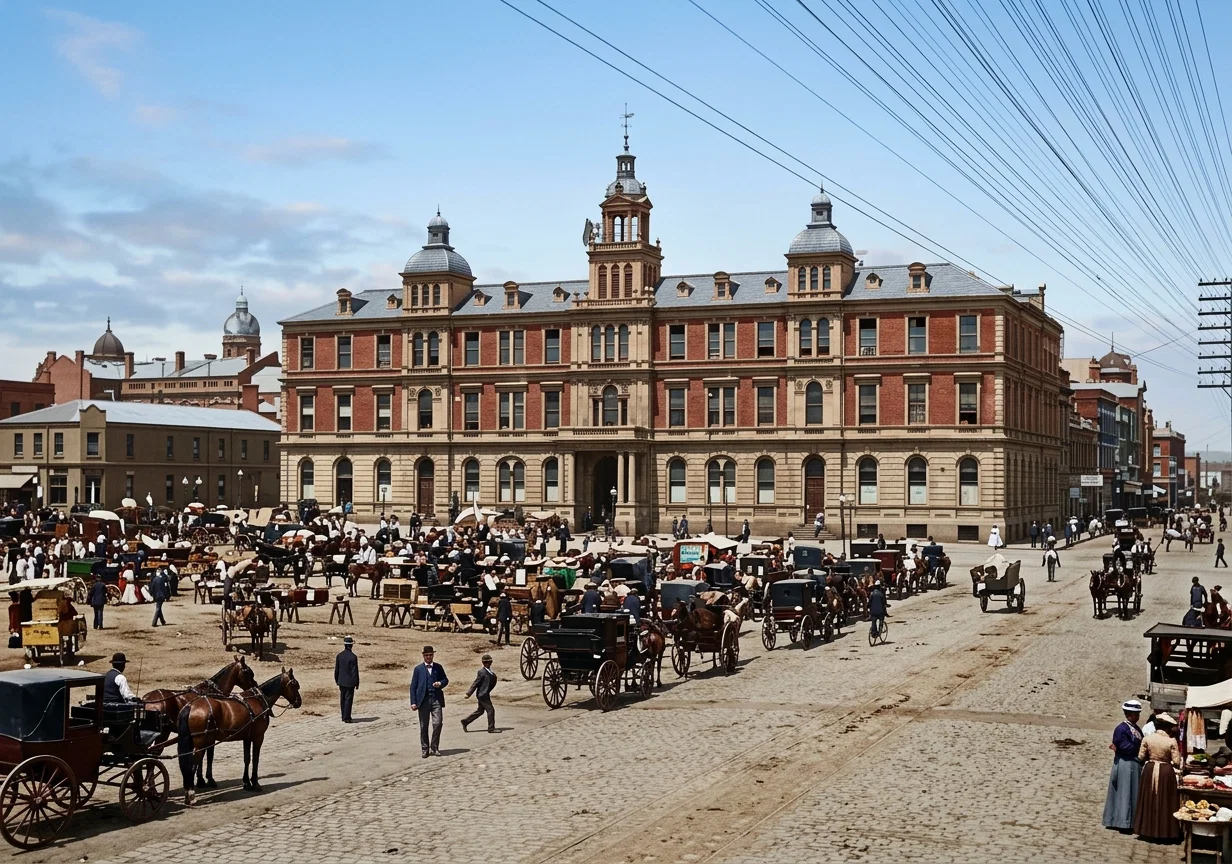
Post-office and Market Square, Johannesburg.
In an African passenger carriage one is shut up in a crowded compartment with from three to seven fellow-passengers, and altogether likely you are the only one of the party who considers tobacco smoking an unhealthful abomination; yet it would seem to the others to be extreme selfishness for one to politely plead for his right and privilege of breathing God-given, pure air, unadulterated by poisonous tobacco smoke, and thereby compel the other members of the company to deny, for the time being, the cravings of depraved appetites. So you perhaps hold your head out of the window till one of the smokers objects to the cold draught of air, or till, it may be, you feel that you are “taking cold” from exposure; then, closing the window, you sit and inhale the dense cloud of smoke till you feel that you are fairly pickled with the offensive odor. On all American trains there is a smoking carriage, where tobacco-users can burn incense to their god, to their “heart’s content,” without annoyance to their fellow-travelers; but in Africa, even a lady’s presence in a compartment of a railway carriage does not always deter the devotee of the “weed” from worshiping his idol.
There are exceptions to this general rule where such regulations are least needed, viz., in the local train service connecting the suburbs of the large cities with their centers, and where one would be on the cars but a few minutes before reaching his destination. Here the strong arm of the law takes the matter in hand and compels those who are determined to smoke to ride in a smoking carriage. But where you are making a journey which requires from a few hours to four or five days, the law leaves you to the tender mercies of the smoker. In this connection two questions may be worthy of consideration: First, can a man who smokes consistently claim to be a gentleman? Second, can a man be both a Christian and a smoker at the same time?
There are many things which break the monotony of a journey to Johannesburg, at this the beginning of a new epoch in the history of South Africa, and which furnish material for serious reflection. Chief among these are the long freight trains of open cars, such as are ordinarily used for the transportation of coal, now laden with soldiers going to the sea-board to take ship for home. As in this “high veldt” region bitter, biting frost makes nightly visits at this season of the year, one is impressed that there are many hardships in connection with the life of a soldier, and that, if never before, these will appreciate the cheerful firesides of Old England and the comfortable beds made ready by wives, mothers, and sisters, on their return.
Other scenes of interest which make one pensive are the desolated homes along the route of travel; the occasional Boer family, with the familiar “span” of eight yoke of oxen, “treking” back to lovely farms, now destitute of all life, except the wild birds, the jackal, or perhaps the family dog wandering, half-wild, over the once-cheerful estate; and on the other hand, the numerous groups of graves, whose occupants have been bitterly mourned in far-away Britain; and lastly, the ruins of once magnificent railway bridges, wrecked by their own builders, the Boers, in a vain attempt to stop the onward march of King Edward’s legions to the capital and strongholds of the Transvaal and Orange Free State.
The country across the Vaal River (which is the meaning of Transvaal), as well as that on the “Cape” side, now offers excellent opportunities for missionary farming, as the new government will compel the division of the many-thousand-acre farms which were in the possession of the Dutch farmers, by limiting ownership of land to the amount actually utilized in farming. This land, thus divided, will be offered at from $2.50 to $10.00 per acre, to actual settlers. In the old Transvaal there were a number of German missionaries who occupied farms, and gathered around them large numbers of natives, who became faithful in attending church services, and thus were brought under the influence of the Gospel. Christian farmers would find excellent fields for self-supporting missionary work at the present time in South Africa. The natives will settle in villages or “kraals” on the farms, if desired, and perform all kinds of farm labor for nominal wages, while at the same time the parents, and especially their children, can be given the “everlasting Gospel.” Some of them will develop into missionaries to their own people, thus preparing the way for that grand gathering of “every nation, kindred, tongue, and people,” before the throne. There is a degree of satisfaction in sowing seed in virgin soil that is not experienced in the cultivation of old and “weedy” land. The native who has never heard the Gospel of Christ frequently receives the “seed” sown, more readily and with more confidence in the Word of God than his better educated white brothers. He does not question the obligation as to keeping the true Sabbath, for God has spoken distinctly on that point; therefore his question is, “Why don’t all Christians obey God and keep the seventh day?” Is it possible that these natives of “darkest Africa” will rise up in judgment and, by their having obeyed the voice of God in Sabbath-keeping, condemn the more enlightened, who refuse to obey?
One of the extremely sad features of the outcome of the war, now happily past, is that many of the Boer people who before were a devout, church-going class, have thrown away their Bibles, ceased to attend church services, and become atheists, because of their disappointment at the outcome of the conflict. This result has come, at least partially, from basing their faith on certain scriptures which they believed taught that they would be victorious; and from failure to recognize that “the Most High ruleth in the kingdom of men, and giveth it to whomsoever He will.”
It seems to the writer to be a most favorable time to reach the Dutch people with the third angel’s13message. If they can first be shown wherein they misapplied the scriptures and thereby were buoyed up with false hopes of triumph in the war, their confidence may thus be restored in the Bible and in the Creator, and they be ready to receive additional light. Dutch workers are greatly needed to enter this field at once. We are praying the Lord of the harvest to raise up laborers to enter the ripening fields. Some are gladly responding to the voice of the Master saying, “Go work to-day in my vineyard.”
G. W. REASER.
Johannesburg, South Africa.
AT HIS FEET.
By Arthur T. Pierson
At Thy dear feet, once pierced for me
With cruel nails upon the tree,
I lay my life, for use by Thee,
Henceforth to know no anxious care,
With cheerful heart my loads to bear,
My soul resort—believing prayer.
No worry lest my work be stayed,
No hurry lest I be delayed,
By haste to prayerlessness betrayed.
Not careful to be praised of man,
But only to be taught Thy plan,
What Thou wilt have me do, I can.
No greed of gain, since Thou hast said
That if the beasts and birds are fed
Thy children shall not lack for bread.
How sweet to live alone in Thee,
In danger to Thy wings to flee;
The name of Jesus all my plea!
Before Thee let Thy servant stand,
To watch Thine eye, Thy beckoning hand,
And promptly move at Thy command.
So shall my life be one sweet day,
Lit up by heaven’s cloudless ray,
A walk with God—a radiant way.