The following extracts from a missionary’s letter to the Toronto Christian Worker will give our readers a good idea of the people and the customs with which a missionary to a new field comes in contact. This missionary had made a journey into the dense West African jungle to carry the Gospel to men and women sitting in the densest darkness. He says:—
After a hard tramp over mountains, wading of rivers and through dense forests, we arrived at last, about 5 o’clock, at the town. As we entered, the women and children screamed and ran and hid, for they were frightened at the donkey I was riding. After a short rest we partook of our evening meal. Now, at first this will be somewhat trying, tho amusing, to the new missionary, for the native does like to watch the mindele (literally, the clothed man) eat, and he can not understand why we eat each kind of food separately, for he puts everything into one pot. After tea everything was put away and things straightened up, and we went outside and had a service with the people, who crowded around to hear what Brother Page had to say. After he had finished, Vangu, the oldest native Christian and evangelist, who had come with us to take back the donkey, preached. He corroborated what Brother Page had said, and the people seemed very much interested. But there were no visible signs; the people silently received what we had to say.
Early the next morning the boys started back and we were left alone in a large heathen town. But we were not afraid, for we knew that the “God of heaven, the Creator of all things,” could control even the passions of the heathen. In a double sense we were not alone, for all day the people flocked to see us. Every move we made was noticed, and remarks passed about each. Every mouthful of food I took was discussed most exhaustively, they wondering what it was I was eating. This town is built in the heart of a great woods, for the purpose, I think, of hiding away from the State.
The king who had the most influence in the town had died and was lying in state. Early in the morning, about 4 o’clock, his wives, who sat around on the ground near his body all night, would wail and cry, tearing their hair and torturing their bodies in the most shameful way. This they had been doing for over a month. The men gather early in the evening and play on a horn, which each one carries, making the most doleful noise. The instrument is made from the horn of a large antelope.
At night we had a most wonderful service. At first I was doubtful if the people were coming to hear us, but fortunately the king had a large bell which he had bought from the traders at the river to use in his palavers or mambu, and hanging that up our cook boy rang it hard. Then, with the few that had gathered, I began teaching them a simple hymn, the words meaning, “Come to Jesus and receive life, mercy, and peace from our King.” But they persisted in saying “your King.” Again and again we sang it, the people in the meantime gathering, and each one as he learned, joining in the chorus. I told them to shout it so the people in the next town could hear, and it would have done your heart good to hear the people singing, those woods ringing and echoing the refrain, not of heathen yells in dances, but of the songs of Jesus the Saviour of the world. Again Mr. Page told the story of love, while the people listened very attentively.
Just as he was about to finish, one of the kings sprang forward, and, with a majestic gesture of his hand, he silenced the people. Then in true native style he preached the Gospel, at one time lifting his hands unto the heavens, then bending his body to the ground. We could do nothing to stop him, neither did we try, but simply stood and listened, rejoicing that, in pretence or in truth, the Gospel was preached (Phil. 1:18, R.V.). At last he closed by saying, “Hear, my brethren! From this night I receive the words of God and give up my idols.” The meeting closed somewhat in disorder, for this caused a division, the women, who are always harder to reach, taking the opposite side.
The next morning saw the reversal of things. The night before several had declared their intention of burning their idols, and, true to their word, as Brother Page began speaking, the people came and laid their idols at our feet. In fact, early in the morning the people from the surrounding towns brought their idols, for they had heard of the resolve of the people of Chinga. The people wanted us to burn them, but we refused, and made the two leading kings do it. I have a picture where they are piling the brush on and burning them.
Now the people wanted a teacher. They said, “If we do receive the words of God you will go away, and then we will forget the Way.” They said they would build a house for the teacher, a church and a school, and give three boys to carry our wood and water and cook our food. But we had to refuse them, for we had no one to go or to send. And remember, friends, they have built the house, first clearing away the grounds, and also the church and school, and are waiting for a teacher! Who will go?
The following Monday night the boys returned from Kinkonzi to take us back, and early the next morning we left, the people following us out for some distance from the town, shouting and calling after us as long as we could hear them, “Tata! Tata! Come back again and teach us!”
At noon we arrived at the station, tired, wet, and hungry. We had no more than got well settled in our rooms when on looking out we saw the three kings with their women and children, coming to ask for a teacher!
But again they were refused!
Dear ones at home who read this article, will you pray for these people? Pray also that the God of the harvest will thrust forth laborers into the vineyard.
OUR WORK AND WORKERS.
The baptism of four candidates at Wakamatese, Japan, is reported by Brother F. W. Field.
The tent-meetings recently held at Boonville, Mo., bore visible fruit in six converts to the faith.
That popular little book, “His Glorious Appearing,” is being translated into the Hungarian language.
The Minnesota Worker reports sixteen church-schools provided with teachers, with a number of others yet to be provided for.
A church-school is now under way in Halifax, N. S., with Miss Alberta McLeod, of that city, as teacher. The school opened with sixteen pupils.
The Bible Echo notes that six persons have recently accepted the Sabbath of the Lord in West Australia, the report being from Brother J. Pallant.
Fruit of the message bearing “the commandments of God and the faith of Jesus” is now seen in Bithynia, Galatia, Pontus, Iconium, Cilicia, Aleppo, and other places made prominent by the preaching of the apostles and their fellow-laborers. Brother B. Z. Baharian says: “Asia Minor is one of the most promising fields, but we need laborers in every province.”
At a general meeting to be held at Saranac Lake, N. Y., October 22-26, a church organization is to be effected. They have just completed a new house of worship.
Montreal has been selected as headquarters of the Canadian Union Conference, and Brethren W. H. Thurston (president) and S. D. Hartwell (secretary) have located in that city. Our source of information does not give the address.
At the session of the Quebec Conference held last month, officers were elected as follows: President, S. A. Farnsworth; secretary and treasurer, W. H. Libbey; executive committee—S. A. Farnsworth, H. E. Richard, Wm. Ostrander, John Ellis, Wm. Blythe.
Speaking of our new prophetic primer, “Things Foretold,” combined with Our Little Friend, the popular child’s paper, the New York Indicator says: “Our church-schools will find in this combination profitable literature with which to work.” This a good suggestion.
The Workers’ Bulletin states that on a recent Sabbath, Dr. George Daniells, a native of Kurdistan, spoke in the church in Des Moines, Iowa. “He gave an interesting and profitable talk on missionary work; and related how, from a captain of a band of brigands and from a home of plenty, he was converted to Christianity by the earnest efforts of a man whom he held up expecting to rob him. Dr. Daniells has suffered imprisonment twenty-two times for his faith, being confined in jail eight months at one time. But in spite of all opposition, his one desire is to work for God and humanity.”
At a recent meeting of the California Conference, in connection with the camp-meeting at Fresno, officers were elected as follows: President, Alonzo T. Jones; secretary, M. H. Brown; missionary secretary, A. J. Bourdeau; Sabbath-school secretary, Mrs. Carrie R. King; executive committee—A. T. Jones, J. O. Corliss, H. G. Thurston, A. S. Kellogg (State publishing agent), D. T. Fero, J. S. Osborne, M. E. Cady, C. H. Jones, and the medical superintendent of St. Helena Sanitarium. The following-named brethren were elected trustees of the California Conference Association: M. H. Brown, G. W. Mills, Reuben Gray, T. A. Kilgore, E. A. Chapman, C. H. Jones, E. G. Fulton.
“The keynote of the St. Peter [Minn.] camp-meeting,” says the Worker, “was that of dedicating all to the service of God. Sabbath, when Brother Flaiz asked all to stand who would give themselves to the service of God to be used anywhere God might indicate, whether in Africa, China, India, or the Islands of the Sea, some twenty-five of our young men and women arose. It was an impressive and inspiring sight, one that touched the hearts of fathers and mothers, and when they were asked how many were willing to give up their sons and daughters, a large number expressed themselves as glad to do so, while many said that they would return to their homes to farm for the Lord as they had not done before. May we have many such meetings.”
HINDU OPINIONS OF MISSIONS.
In the June number of the Missionary Herald, Rev. J. L. Barton, secretary of the American Board, has an interesting article composed mainly of words spoken to him while in India recently by both Hindus and Mohammedans in praise of missions. The following are representative of many such expressions:—
A Hindu community in Ceylon in its address testifies to “the noble ideals of duty and purity of life which have been set before the people of this country by the exemplary lives led by your missionaries.” A Brahman editor in Madura said, “The names of your missionaries become household words in this district by the love and sympathy they bring.” In the same district a Hindu official said, “The last and most important of the work done by the missionaries is the elevation of the moral tone and sense of duty imbibed in the midst of my countrymen by free intercourse and friendship with them.” And the same official gave expression to his satisfaction that Christianity was making many converts among the lowest and outcasts, for whom there is no provision in the rigid and unchanging Hindu social and religious system.
REASON FOR ENCOURAGEMENT.
When we consider the great extent of the missionary work being carried on in China, it is certainly a matter of wonder that so few missionaries fell victims to the fury of the Boxers; and to the Christian world it should be a cause of deep gratitude and encouragement that the lives of the missionaries have been precious in the sight of God. He certainly worked wonderfully for His servants in their hour of peril. At the outbreak of hostilities 54 Protestant missionary societies were conducting operations in China, with 527 ordained and 519 lay missionaries of European or American nationality. There was a total of 2,461 foreign workers, 470 stations, 80,682 communicants, and 30,046 day pupils. Many of these churches or mission stations were far removed from any means of human protection; yet their lives were spared, and their work is going forward now with added impetus. Surely the friends of Protestant missions have cause for rejoicing in this manifestation of God's care for His workers.
OCEANIC S. S. CO.
SAILING REGULARLY TO — Fleet
HAWAII — SIERRASAMOA — SONOMANEW ZEALAND — VENTURAAUSTRALIA — ALAMEDA
and — MARIPOSATAHITI — AUSTRALIA
— ZEALANDIA
Under mail contract with the United States, Tahiti, New Zealand, and Commonwealth of Australia.
Steamers sail THREE TIMES a month to Honolulu; every TWENTY-ONE days, via Honolulu to Samoa, Auckland and Sydney. Every THIRTY-SIX days to Tahiti.
TALOFA, illustrated in colors, tells something of Samoa, 20c in postage.
HAWAII, in colors, by STODDARD, 10c.
TAHITI, The Golden, by CHAS. KELLER, send 20c in postage.
“Round the World” folder, time-table, etc., free upon application.
(1) “And Jehovah spake unto Joshua, saying, (2) Speak to the children of Israel, saying, Assign you the cities of refuge, whereof I spake unto you by Moses, (3) that the manslayer that killeth any person unwittingly and unawares may flee thither; and they shall be unto you for a refuge from the avenger of blood. (4) And he shall flee unto one of those cities, and shall stand at the entrance of the gate of the city, and declare his cause in the ears of the elders of that city; and they shall take him into the city unto them, and give him a place, that he may dwell among them. (5) And if the avenger of blood pursue after him, then they shall not deliver up the manslayer into his hand; because he smote his neighbor unawares, and hated him not aforetime. (6) And he shall dwell in that city until he stand before the congregation for judgment, until the death of the high priest that shall be in those days; then shall the manslayer return, and come unto his own city, and unto his own house, unto the city from whence he fled.
(7) And they set apart Kadesh in Galilee in the hill-country of Naphtali, and Shechem in the hill-country of Ephraim, and Kiriath-arba (the same is Hebron) in the hill-country of Judah. (8) And beyond the Jordan at Jericho eastward, they assigned Bezer in the wilderness in the plain out of the tribe of Reuben, and Ramoth in Gilead out of the tribe of Gad, and Golan in Bashan out of the tribe of Manasseh. (9) These were the appointed cities for all the children of Israel, and for the stranger that sojourneth among them, that whosoever killeth any person unwittingly might flee thither, and not die by the hand of the avenger of blood, until he stood before the congregation.”
Golden Text.—“God is our refuge and strength, a very present help in trouble.” Ps. 46:1.
Special Helps.—“Patriarchs and Prophets,” Ch. 48, pp. 515-520.
SUGGESTIVE QUESTIONS.
(1) What special direction was given to the people through Joshua? To whom had God spoken before concerning this matter? Verses 1, 2; Deut. 4:41-43. (2) What was the purpose of these cities of refuge? Verse 3. Note 1. (3) On arriving at the city of refuge, what should the fugitive do? Then what should the elders do? Verse 4. (4) From whom should they protect him? On what conditions? Verse 5. (5) How long should the manslayer remain in that city? Then where should he go? Verse 6. Notes 2 and 3. (6) What three cities were set apart on the west side of Jordan? Verse 7. (7) What three cities were set apart on the east side? Verse 8. (8) Were these intended for Israelites only? Verse 9. Note 3.
NOTES.
1. Murder.—From the earliest time, murder has been deemed a capital offense. The murderer is considered a dangerous person in any community, and public safety has required that he be put out of the way. This principle was recognized in the government of Israel; but, unlike the heathen authorities, the Lord instructed His people to make a difference between the intentional and the accidental taking of life. The nearest of kin was still recognized as the official avenger of blood, but the cities of refuge were provided as a way of escape for him who had not contemplated murder.
2. “For Judgment.”—This implies that the slayer was to have a trial in the city of refuge, an opportunity to state his case, then it would be decided whether he should remain or be given over to meet his punishment. There were various things taken into consideration: If he hated his neighbor, or laid in wait for him (Deut. 19:11-13); or if he came upon him presumptuously or with guile (Ex. 21:12-15; Num. 35:15-29; or if he did it secretly (Deut. 27:24). No murderer could purchase his freedom with money; thus were the high and low, the rich and poor, treated without favoritism.
3. The Limit.—If a man were innocent, there must needs be some limit to his enforced stay in the city of refuge. The fact that he should remain at all after being declared innocent of criminal intent, would indicate a possible bitterness on the part of unreasoning relatives of the victim that would hardly be restrained. Hence the slayer would be unsafe for a time. He was therefore, and perhaps to teach a lesson of carefulness, required to remain until the death of the high priest of that time. But if he did not remain in the city of refuge, or within the prescribed limits, he would be liable to suffer the full penalty at the hands of the avenger of blood.
4. These Cities a Type.—The cities of refuge were a type of Christ. He is our only refuge from sin. But the type came short of the antitype, in that whosoever takes refuge in Him is safe. There is no limit to the guilt of the sinner beyond which he may not find protection. Isa. 1:18-20; Rev. 22:17. There is no type that can fully portray the mediatorial work of Christ. But the sinner who takes refuge in Christ must remain indefinitely. He may at no time forsake the Strong Tower (Ps. 61:3; Prov. 18:10) without danger of again falling into the hand of the enemy. “God is our refuge and strength, a very present help in trouble.” Ps. 46:1. As the cities of refuge were distributed so as to make them as easy of access as possible to all the people, so Christ is accessible at any place, at any time, in response to the cry of the penitent sinner. The cities of refuge were not for Israelites only, but for the stranger as well. So Christ offers Himself a refuge for the whole world.
Take a Tourist Car
—A Santa Fe tourist car—if you would enjoy your trip across the continent.
The cars are so comfortable, the route so interesting, the people so pleasant, the excursion manager so accommodating, the porters so obliging, and the meals so good, that you simply can't help being satisfied.
Personally conducted east and west three times a week—Mondays, Thursdays and Saturdays—to Chicago, Kansas City, Los Angeles and San Francisco.
Folder giving full information furnished on request by any Santa Fe Agent.
The Good Health Adjustable Waist
Affords ease, comfort and health. Retains symmetry and grace of the natural form. Its use will add years of pleasure to a woman's life. It dispenses with the corset. Supports all garments without harmful pressure. No stays to break. Thousands sold. Satisfaction guaranteed. Write for circular and prices. Agents Wanted.
Good Health Pub. Co. 354 W. Main St. Battle Creek, Mich.
THE SABBATH SCHOOL INTERNATIONAL SERIES
LESSON 6.—NOVEMBER 8.—THE KINGDOM OF ANTICHRIST.
The symbol of the little horn finds its fulfilment in a man. Dan. 8:8, 24. This is the “man of sin” (2 Thess. 2:3), the antichrist (2 John 7, R.V.). The distinguishing characteristics of this enemy of God’s kingdom are plainly set forth. He does not acknowledge the revelation of the Son of God in our flesh (1 John 4:3); he puts himself (humanity) in the place of God (Divinity) (2 Thess. 2:4); he speaks against God, persecutes His people, and thinks to change His law (Dan. 7:25). It is evident that these Scriptures all apply to one and the same system or person. Thus the seventh chapter of Daniel is a prophecy of the rise and work of the little horn, the man of sin, antichrist, who attempts to establish a kingdom with himself as king under the cover of a profession of loyalty to the kingdom of God.
In ancient Babylon there was undisguised opposition to the God of heaven. The temple and worship of Belus were entirely distinct from the temple and worship of God. Dan. 1:2. The creed of Babylon openly denied the very essence of Christianity. Dan. 2:11. The head of modern Babylon seeks to hide the real character of his work by assuming Christian forms and names. 2 Thess. 2:4. While pretending to be the vicegerent of God, he is in reality the vicegerent of “that old serpent, called the Devil, and Satan.” Compare Rev. 13:2 with Rev. 12:9. This system is called “the mystery of iniquity” (2 Thess. 2:7) in distinction from the “mystery of godliness” (1 Tim. 3:16). “The mystery of godliness” is the revelation of Christ in our flesh; the “mystery of iniquity” is the revelation of self (which is really the revelation of Satan) in our flesh. The one is the exaltation of Christ; the other is the exaltation of self. The one is Christianity; the other is Paganism. The one means a belief in God; the other means a belief in self. The one means justification by faith; the other means justification by works.
QUESTIONS.
What appearance did the little horn present to the prophet Daniel?
In the interpretation of the vision what was the little horn said to be?
What term does the apostle Paul apply to this same enemy of God’s kingdom?
What term is used by the apostle John in describing the same one?
What does the apostle John give as the essential mark of antichrist?
What does the apostle Paul say that the “man of sin” would do?
How does the prophet Daniel describe the career of the little horn?
What do these passages taken together show to be the real subject of the vision of the seventh chapter of Daniel?
How complete was the distinction between the religion of ancient Babylon and the true religion?
In what essential feature did the creed of Babylon differ from the truth of Christianity?
How does modern Babylon attempt to deceive the world?
What does the pope claim to be? What is he in reality? Show this from the Scripture.
What name does inspiration give to the Papacy?
With what is this in direct contrast?
What is the significance of each of these terms?
In what teaching does each one find its expression?
I Can Sell Your Real Estate
No matter where it is. Send description, state price and terms. Est. ’96. Highest references. Offices in 14 cities.
W. M. Ostrander, 1900 N. A. Bldg., Philadelphia
Refreshing Sleep Comes after a bath with Glenn's Sulphur Soap
It heals while it cleanses. Its medicative qualities render the skin free from impurities. Prickly heat, burns, cuts, dandruff, submit quickly to its healing effects.
CAUTION:—Glenn's Sulphur Soap (the only “original”) is incomparable and wonderful in its remedial effects. Take no other.
At all drug stores, or mailed on receipt of 30 cents by THE G. N. CRITTENTON Co., 115 Fulton Street, New York
Delighted with the Tablets
By Alfred Mallett
“Mr. Alfred Mallett, Nyack, N. Y. Dear Sir: I am delighted with the E-Z WASHING TABLETS. It don't seem as though I could ever wash again without them. I couldn't tell the time when I have been so rested after washing. MARTHA SEVERNS, N. Woburn, Mass.”
Send 10 cents for samples and try them.
Representatives wanted in every town. Good commission. Easy terms.
ALFRED MALLETT, Nyack, New York
WANTED
MAN who thoroughly understands quartz milling and amalgamation. S. D. A. preferred, one able to take charge of mill and men if necessary. Address Box 108 Gold Hill, Ore.
PURE FOOD MAKES PURE BLOOD
PURE FOOD MILL
A mill that enables your cook to do the work of three mills on one combination mill, is up-to-date and economical. It grinds grains, makes nut butter, cuts up meats, figs, dates, pulverizes coffee, drugs, salt, etc.
Price $4.00
For circulars, terms, etc., address _W. T. DAWSON_ 308 Ottawa Street, Grand Rapids, Michigan. Also Memphis, Tennessee.
BAPTISM: Its Significance, Its Nature, and the Necessity for It.
By Ellet Joseph Waggoner
By E. J. Waggoner. Bible Students' Library, No. 79. Pacific Press Pub. Co., Oakland, Cal. 16 pp.; 2 cents.
It is Surprising
To find how frequently our loved English Language is misused and even abused by speakers and writers. Some of our most common expressions are proved to be not only incorrect, but sometimes positively absurd and vulgar.
A most interesting book on this subject has just been published, entitled
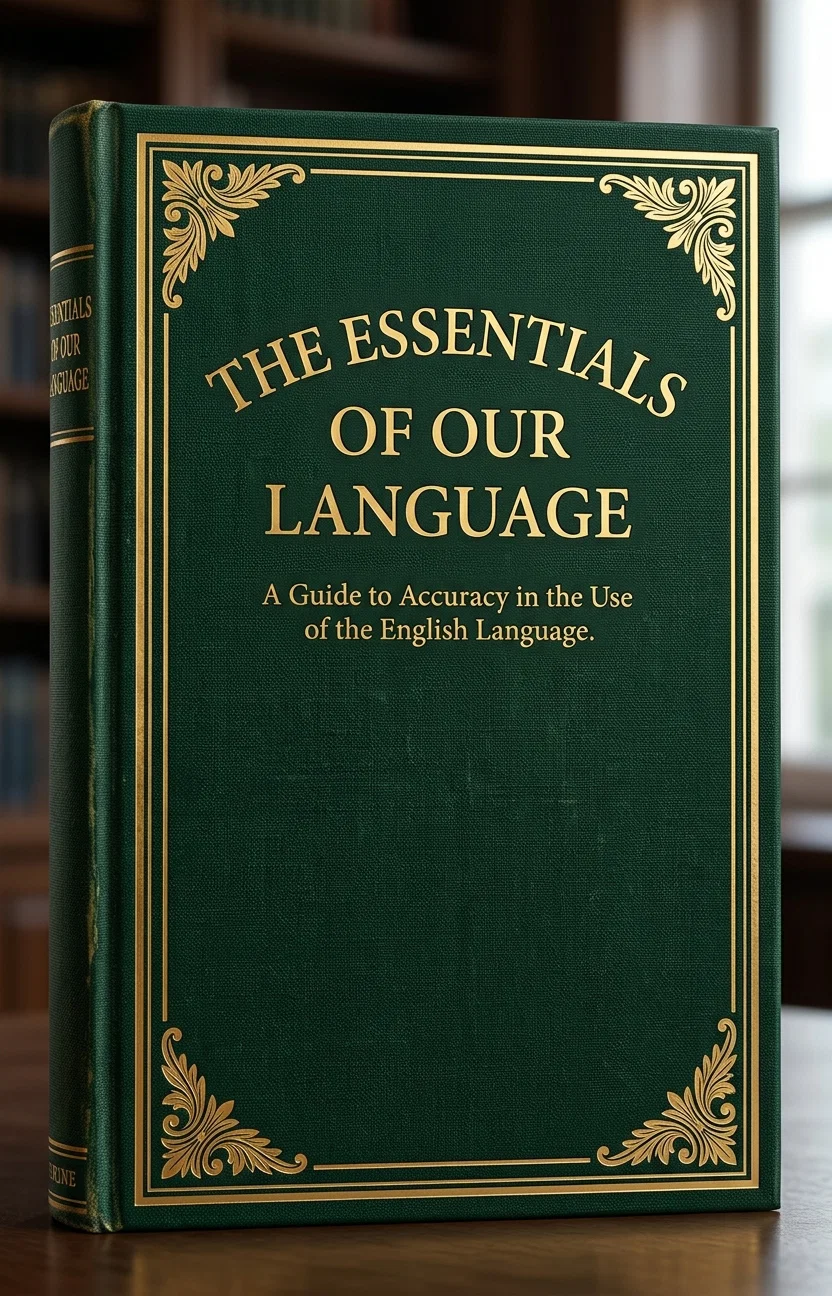
THE ESSENTIALS OF OUR LANGUAGE
A Guide to Accuracy in the Use of the English Language
By GEORGE W. RINE, B. L.
The work is not only invaluable to students, speakers, and writers generally, and to those especially who have missed educational advantages, but unlike most technical works, it is also very interesting. This is because of the many surprising errors in language, which are heroically revealed by the author.
Here are examples from Part I, which is entitled, “Accuracy in the Use of Words.”
Awful is a genuine English word, and a very useful one, too. It is thus defined by Webster: “Oppressing with fear or horror; appalling, frightful.” Further: “Fitted to inspire with reverential fear; profoundly impressive.” A violent storm at sea, especially after night, is an awful phenomenon. The scene on and around Mt. Sinai, at the giving of the divine law, as described in the book of Exodus, was an awful one. Hence, the utter nonsense of “What an awfully sweet baby.”
Blacken. One may blacken another’s name or reputation, but not his eyes or his boots. One blackens by means of calumny, slander, etc., but blacks by the use of his fist or his shoe-brush.
Depot. As depot is properly used to designate a storehouse, it is better to apply the word station to a stopping-place on a railway.
Firstly. No reputable writer sanctions the use of “firstly.” Secondly, thirdly, etc., are sterling English, but first must serve as both an adjective and an adverb.
“Mutual friend,” says Macaulay, “is a low vulgarism for common friend.” Mutual signifies reciprocity of feeling or sentiment, and so can relate to only two persons.
Raise. Parents who properly care for their children do not raise them, but rear them. Farmers raise chickens, calves, wheat, etc.
Resurrect—the verb form of resurrection—is a barbarism.
Retire. How much more restful the familiar locution “go to bed” sounds than does the more formal “retire.” Men retire from business, or from public life, but, as a rule, they go to bed when the day’s work is done.
Stays. One stays, not stops, at a hotel, at the home of a friend, or at his own home.
Try. We shall try an experiment. Read, We shall make an experiment. Experimenting is trying. No one tries a trying.
Under the head “Synonyms Discriminated” we find much similar instruction to the following:—
Distinguish, Discriminate. We distinguish with the eye, the sense of vision; we discriminate with the judgment or understanding.
Defective, Faulty. What is lacking in some respect is defective; what has something that it should not have is faulty. A defect must be supplied; a fault must be corrected.
Enough, Sufficient. We have enough when our desires are satisfied; we have sufficient when our needs are met.
Evidence, Testimony. Evidence is that which actually proves something; testimony is that which is intended to prove something.
Eternal, Everlasting. Everlasting now means without end; eternal without beginning or end. They are not, as formerly, interchangeable.
Little, Small. Little, means not much; small means not large. Little, when made to serve for small is a colloquialism.
These quotations will give some idea of the value of this book. It is really surprising how the reader’s interest is sustained from start to finish. We can heartily recommend the work to all who are anxious to become accurate speakers and writers. Even the best informed will find it a valuable and painstaking tutor.
It is withal a Christian book, the author using only examples and quotations which are helpful and elevating.
Price 75 cents
Pacific Press Publishing Company & Oakland, California
18 West Fifth Street, Kansas City, Mo. & 11 West Twentieth Street, New York, N. Y.
The Winning of Margaret
How Margaret and her skeptical friend Ralph were converted. A well-told story.
Price, $1.00 per 100.
PACIFIC PRESS PUBLISHING CO.
New York City Oakland, Cal. Kansas City, Mo.
The American Standard Revised Version
One of the many excellent things in the American Standard Revised Version is the greater uniformity of rendering the Greek words into English. For instance, “servant” sometimes comes from words meaning a bond-slave as well as a hired servant. This distinction of the bond-slave is indicated in the margin. “Hell” in our common version comes from these words, Hades, Gehenna, Tartarus, the latter but once. The Standard Version transfers Hades, the abode of the dead; renders Gehenna, the place of punishment, by “hell;” and in 2 Peter 2:4 places Tartarus in the margin. These are only illustrative instances of the superiority of the American Standard Revised Version.