Our steamer, of the German East African line, left Tanga, October 27, about eleven in the morning; by dark we had reached Mombasa, eighty miles to the north of Tanga. Next morning, after securing the necessary money from the Indian bank, at eleven o’clock we departed by train, en route to Victoria Nyanza.
Mombasa itself is an old Portuguese town, which has seen many vicissitudes and changes of masters during the four hundred years of its existence. From being one of the chief slave markets of the world, it has become the chief seaport of British East Africa. The town has a number of fine government offices, a bank, cathedral, hotels, two fine harbors, and a population of twenty-six thousand. Most of the natives are Swahilis.
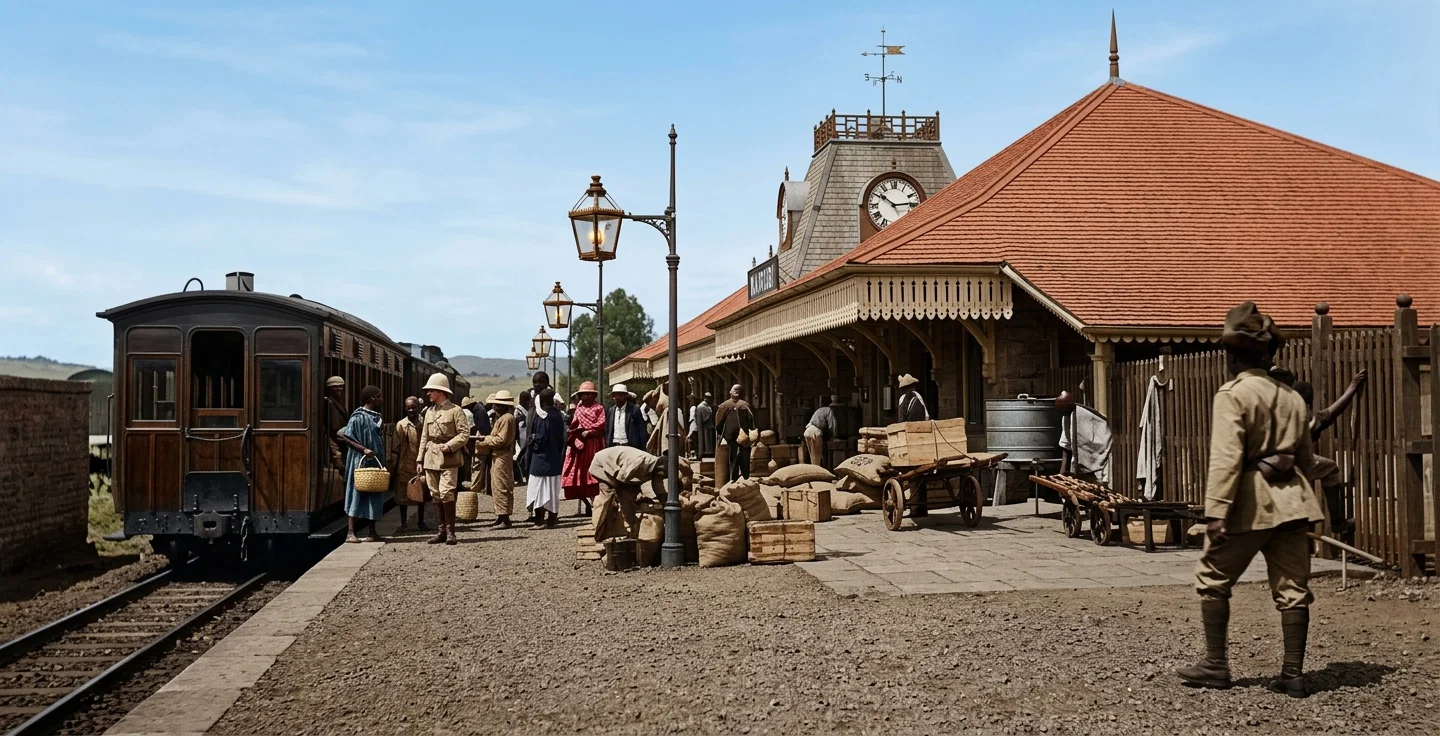
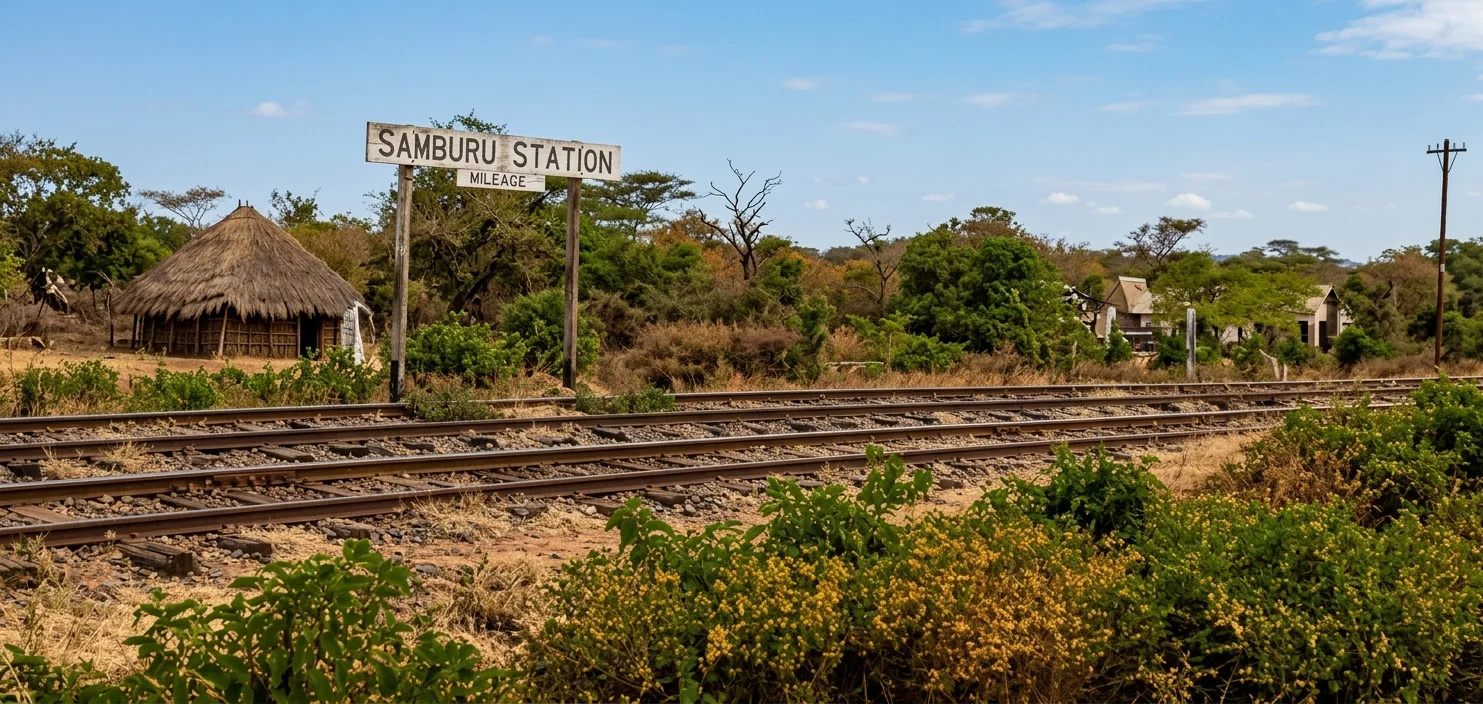
Our railway carriages were very comfortable. They are tourist sleepers. The return trip cost us about thirty dollars. It covered 1,168 miles. While the coast is studded with villages and small towns and good plantations, the scene changes as we go farther into the interior. Before the Uganda railway was finished, in 1902, it took from three to four months to make this trip, and the traveler was in the midst of great dangers at the hands of the natives, and from wild beasts, and because of a scarcity of water. At Voi, one hundred three miles from the coast, a number of passengers left us for the settlements around Mt. Kilimanjaro. This is the highest mountain in Africa. It is nineteen thousand three hundred feet high, and is about five days’ journey from this station; it is located in German territory. All we could see was the high peak, covered with eternal snow, although the mountain is upon the equator. From Voi the railway continually rises for the next hundred miles, when we reach Makindu, at an altitude of three thousand two hundred eighty feet; at this place we are on the borders of the “sportsman’s paradise.” Herds of zebra, hartebeeste, and gnu gallop along by the side of the railway. The plains are dotted with these animals, as well as with many species of graceful antelope, who hardly raise their heads as the train steams by. We also saw a number of ostriches, and some giraffes; now and then even lions and rhinoceroses are seen from the cars. This is one of the most unique sights in the world, and being a special reserve of the government, the herds of game increase rather than decrease. This reserve extends to Nairobi, a distance of over one hundred miles. It is at an altitude of five thousand four hundred thirty feet. Nairobi is now the capital of British East Africa, the headquarters of the railway, and a strong military post. It is situated on the border of the Kikuyu country. As the climate up here resembles our summers in England or in the States, and there are extensive tracts of grazing land, quite a number of large stockfarms have been secured by European settlers. A number of individuals from South Africa have also settled here.
RAILWAY STATION, NAIROBI, BRITISH EAST AFRICA
The tract from Nairobi to Escarpment Station has an elevation of seven thousand three hundred ninety feet, and is thickly settled by the Kikuyus, an agricultural race keeping some sheep and goats, but few cattle. They cultivate their fields with extreme care. They are a healthy people, and they like to work. Formerly they were in great dread of the warlike tribe of the Masais, who are more nomadic in their habits. We met quite a large number of them; the British government is now trying to locate them on reservations. From the edge of this escarpment, a wonderful view can be obtained of the great rift valley below, broken by the volcanic cone of Longonot, and bounded on the west by the Mau Escarpment.
The railway rapidly descends to Lake Naivasha, on which is situated quite a flourishing town of the same name, where our train stopped about five hours during the night, to renew its journey by daybreak. Again we passed two beautiful lakes, and crossed a large, open grazing country, surrounded by high hills and covered with large herds of game to the foot of the Mau Escarpment. Then the train once more climbed a steep ascent, until we reached, at the top of the Mau Escarpment, the highest point of the road, eight thousand three hundred twenty-seven feet. From there we could see, in the far distance, thousands of feet below us, the broad waters of Victoria Nyanza. The train now made its descent through as extensive a forest as may be found in Africa, winding its way down in great loops; and when we finally reached the plain below, we found it covered with small villages of the Kavirondos. In fifty hours the six hundred miles from Mombasa to Port Florence had been traversed, and we found ourselves at the head of the great lake. I arrived there on Friday afternoon, was met by Elder A. A. Carscallen, and taken over to the Indian bungalow to stop overnight. The government has erected bungalows, where the traveler may stop over one night free of charge at all the large stations. Board, at fixed rates, is also provided at the same places.
Port Florence is a growing town, and the portion inhabited by the whites is situated on quite an elevation. Victoria Nyanza is a beautiful, sweet-water12sea, three hundred miles long, and during two hundred miles wide. Three fine passenger steamers and one large freight steamer carry on the traffic of this lake. These are owned by the Uganda Railway Co. The “Winifred” and “Cybil” are six-hundred-ton steamers, well fitted up, and lighted by electricity. They make monthly circuits around the lake, one going in one direction, and the other in the opposite. The still larger steamer, “Clement Hill,” runs weekly to Entebbe, headquarters of the English governor of Uganda. The native king resides at Mengo.
As we had been very anxious to reach our station by Sabbath, and Brother Carscallen had been waiting for me for some time, we were happy indeed when we learned that a small steam launch owned by a merchant was going our way next day to secure a load of lime. Our landing place, Kendu, lies twenty miles south of Port Florence, on the Kongo Bay. We made the trip in about four hours. As our mission station is on an elevation of five hundred feet above the lake, we began to see the building when we were half way across. As we drew nearer, we could see that the whole country was dotted with little Kavirondo kraals. The government has lately erected quite a good landing place, and has also built a good road to the headquarters of their commissioner in the Kisi country, about fifty miles inland. Brother Baker and some of the mission boys met us at the wharf, and by Sabbath afternoon we were safely landed at another mission home.
Two weeks previously we made our first visit to our station in German East Africa, visiting the three stations there, and had since gone about seven hundred miles by boat and rail to our next station, in British East Africa. We were then right at the equator.
Hamburg, Germany.
ALONG THE UGANDA RAILROAD
ELLA L. FINSTER
By Ella L. Finster
From Australia to the Philippines
ELLA L. FINSTER
WE arrived at Townsville early in the morning, and were taken ashore about 9 A. M. by the government launch. From the boat the town looks very small; and we were therefore much surprised to find so many shops and so much business at this place. As the town is shut in from the sea by the hills and mountains, it does not get the benefit of the sea-breezes, and thus becomes very hot. The people seemed tired, and colorless except for the tan that comes from the tropical sun. The little children looked so thin and pale that one could not help wishing they might have a change to some cooler climate for a short time. We spent about three hours ashore, and were glad to be on the water once more, where the welcome breezes made us think that there could be more unpleasant places than the great, boundless sea.
We made a very pleasant run to Thursday Island. Some of the time we were very close to land, and at one place we were near enough to see the houses and cocoanut-palms of northern Queensland. This place is a pretty little spot, where a descendant of Captain Cook built a house.
We did not go ashore at Thursday Island, but used our eyes to as much advantage as we could. On one island four wrecks that lay upon the shore testified to the strength of wind and waves. I could not help noticing the “white men” of this place who work on the boats. They were as brown as any Malay. I certainly do not wonder that generation after generation of people turn brown or black in the tropics.
We had a very pleasant sail from Thursday Island to Manila, a run of13seven days. For nearly a week we had cloudy weather and sometimes heavy rains. This was very pleasant on the whole, as it made the atmosphere cool and refreshing. Only occasionally did we see land until we reached the southern end of the Philippines.
One morning I awoke to find, on looking out of my window, that we were near land, and that there were native houses along the beach, with rows of neatly planted cocoanut-palms. I soon went out on deck, and found that we were near a town of which the native houses were the outskirts. Mr. Finster directed my attention to a fine building farther on. To my great surprise I saw the stars and stripes floating upon the breeze. It was Zamboanga on the island of Mindanao. Here the government has a capitol, and schools, and an army corps is stationed there.
The people on this island are fanatical Mohammedans, who on hearing that the Americans were in the Philippines, sent an invitation to the latter to come down and fight them. They had been able to drive away every invader up to that time, and expected to do so again. The second day after the army landed, it had to fight. The Moros charged three times in the face of the batteries before they wavered. Two thousand Moros and two hundred fifty of the American soldiers were killed. Since then the Moros will kill whenever they get a chance. They are very savage, but some of them will yet be gathered to share a home in the many mansions.
An hour before midnight on December 17 we reached Manila Bay, and at one o’clock were just outside the breakwater. There we remained until morning. A notice told us that all must be ready for the doctor at six in the morning. This was not a very troublesome ordeal. The ship’s doctor could give a good report, so the passengers merely had to make their appearance to show that their numbers corresponded with the list, and that none were confined to their beds. Passing the customs was just as easy as passing the doctor. The custom officials are very courteous, and make it a rule to delay passengers just as little as possible.
We were pleased to meet Brother R. A. Caldwell once more after so long a separation. He came early to the boat and gave us a surprise, as we did not expect him so soon. We found both Brother and Sister Caldwell in good health, though this climate has made its impressions upon them to some extent. Of our ride through Manila, and of the sights, people, etc., we will tell you later.
We are grateful for our Father’s protection and a part in the work. We have commenced the study of the language, and trust that we may be remembered in this part of our work, that we may soon be able to speak to this people in their own tongue the words of life. Mr. Finster has started to hold studies with the English-speaking natives.
Manila.
Ethiopia
By JULIUS PERSSON
JULIUS PERSSON
Since the death of Abba Salama, the history of Ethiopia is very obscure, and the space of about five hundred years records merely a list of names of rulers. During that time, however, a great many convents were established, and monastic orders founded, and the Abyssinians became a Christian nation, according to the fashion and conception of the Middle Ages.
We now ask, “How was that doctrine introduced into Abyssinia?”—Mainly in the same way as in the Alexandrian church at the time of the later fathers of the church. The Abyssinian church has no symbolic books, from which its teachings might be understood. The most remarkable differences between it and the Protestants, in general, relate to the Holy Spirit, baptism, circumcision, etc. Circumcision has been preserved, also baptism. The male children are baptized forty days, the females eighty days, after birth.
Saint worship was not to be spoken of, and during the first period, but at present their saints are quite numerous.
The first book among these people was the Bible. But as this was written on pergaments, it never became a book for common people. It was written in Chez, the old, holy language of Abyssinia, and is still preserved. It is called Semania ahadu; namely, the book of eighty-one separate books. Besides our canonical books, it contains also the Apocrypha, and other writings, as, for instance, the apostolical constitutions and church establishments, letters of Clemens, Hermas, Herden, the Abyssinian ecclesiastical law, etc. From the Biblical catalogue of Ludolf, 1681, we know that at that time the Ethiopian Biblical canon was exactly the same as a Lutheran canon; and because of this, the change must have been made during the eighteenth century.
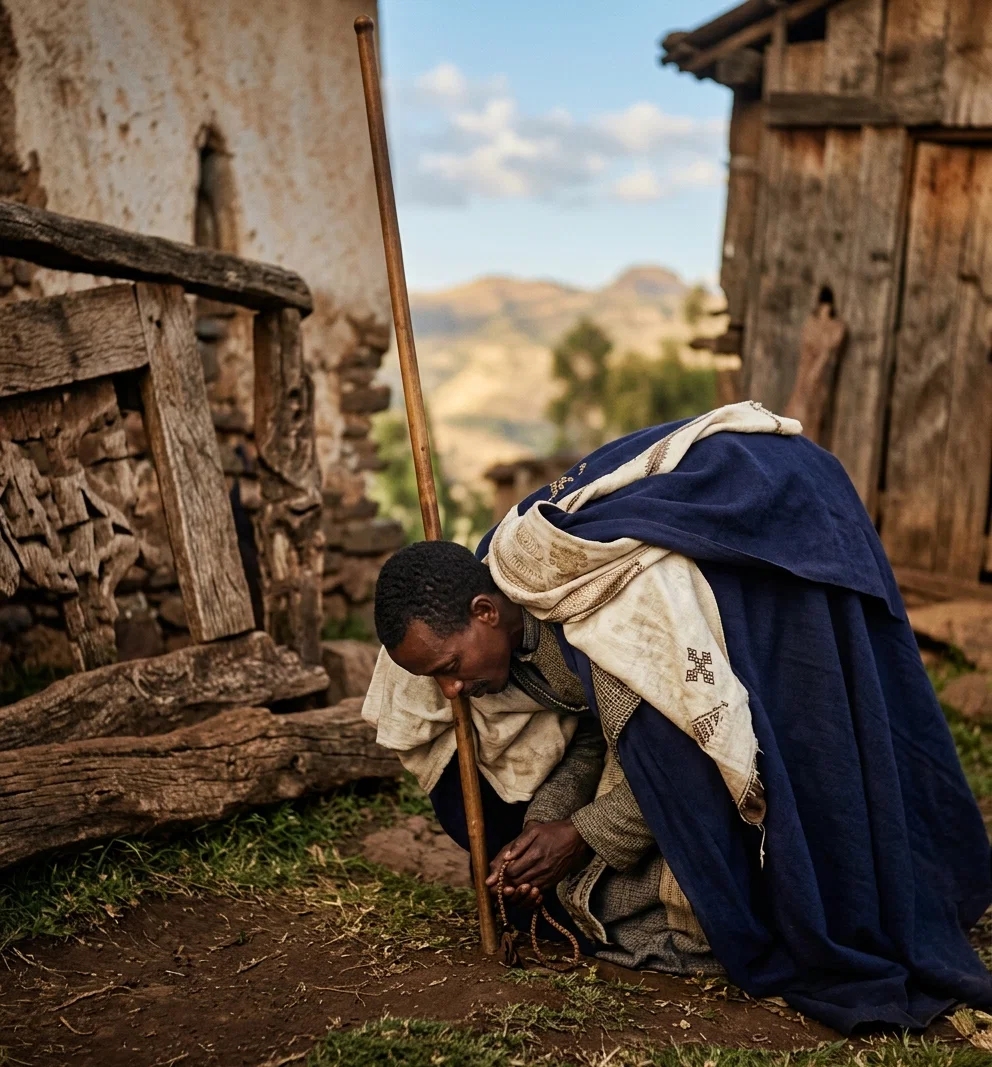
AN ABYSSINIAN MONK AT WORSHIP
But the Bible is not the only book of religious importance among the Abyssinians. The second on the list is “Fetha Negust,” that is, “The Kings’ Rules.” This contains statutes for the nuns and monks, as well as for the clergy in general; prescriptions for the holy supper, the baptism, the mass, etc.
The third is “Mary’s Miracles,” a large book with about seventy illustrations, showing what Mary can and will do for all who trust in her. After these come different volumes commenting upon some of the epistles of Paul, as those of Afe Work, Kerlos, and Epiphanes. The book of these last-mentioned authors is at present in my home. A friend of mine, a member of the Abyssinian church, has loaned it to me. It can be bought for about seventy dollars. There are also other, smaller books. In one called “Creation,” the author claims to know that God created Jerusalem in four hours, but that it took him five hours to create the air. Many of these books were written only to earn a few dollars and a reputation as learned.
Another peculiarity of their religious views is the observance of both Sabbath and Sunday. The first is called Kadam, which means the first or the small Sabbath; the latter Sembet, or the new. It is remarkable that Satan has succeeded here also to throw a shadow upon the memory of creation. Before I came here, I was informed that this was a Sabbath-keeping people; but, so far as I have been able to comprehend, the first, and not the seventh day of the week, is regarded as the day of rest, all kinds of work being performed on Sabbath as well as on Sunday.
Asmara, Eritrea.
Chile
By F. H. WESTPHAL
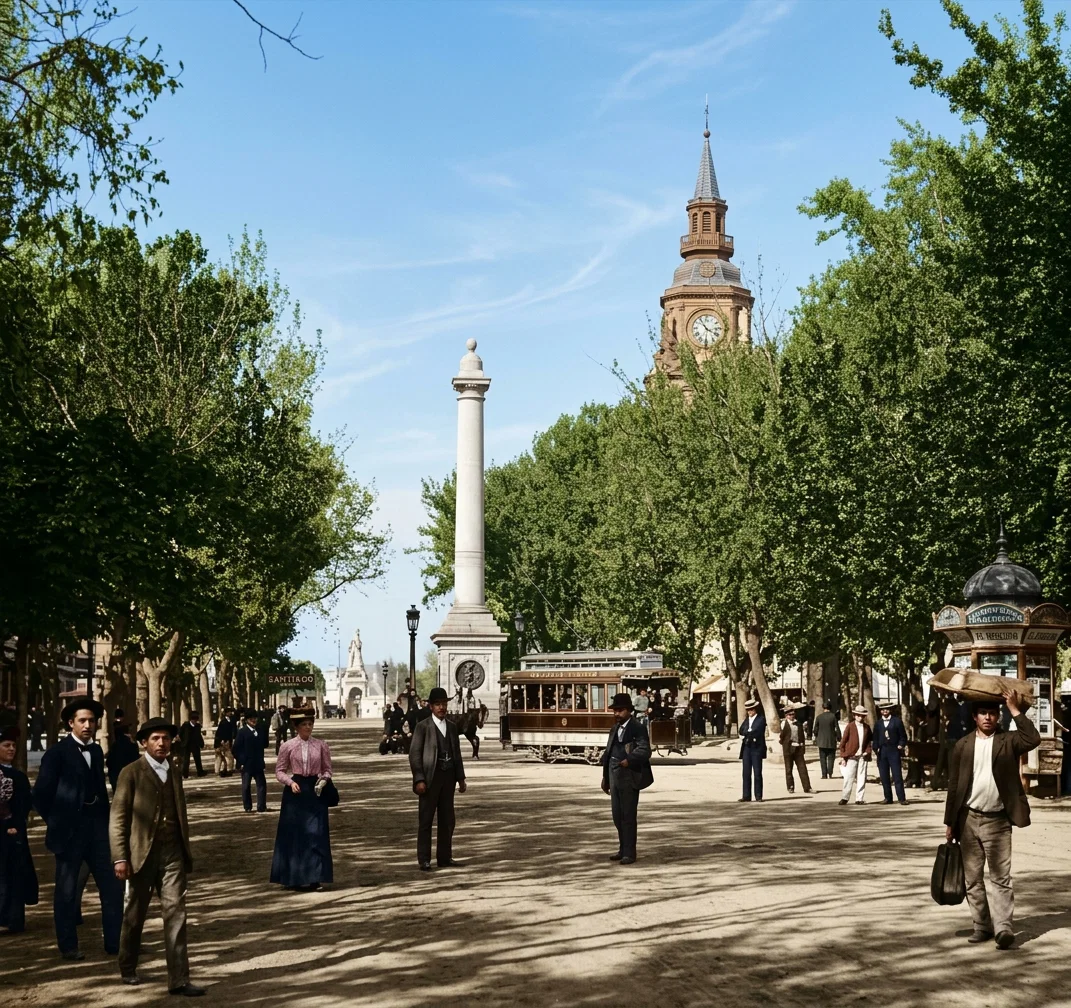
PUBLIC SQUARE IN ALAMEDA, SANTIAGO, CHILE
DURING the year 1908, we put into the field, among the people, one hundred two thousand five hundred copies of our Spanish paper, Señales de los Tiempos, published in Epejo, Chile. These were distributed as follows: in Ecuador, twelve thousand; Peru, twenty-four thousand; Bolivia, six thousand; Spain, twelve thousand; Cuba, nineteen hundred fifty; Chile, forty-six thousand five hundred fifty.
Notwithstanding the fact that the exchange was never so bad, there was an increase in the tithe, it amounting to twenty-two hundred dollars United States money. If the exchange rate had been as it was four years ago, the gold total would have been about four thousand dollars, which would have made the conference nearly self-supporting. We hope that the exchange may be better this year.
About seventy-five were baptized and received into the various churches, and there seems to be such an interest to hear the truth as we never saw in any time in the past. There is a great lack of laborers to meet the demands, and the many calls that come must be left unprovided for.
Our colporteurs worked the field from Punta Arenas, in the extreme south, to Iquique. These laborers were never so equally distributed as during the past year—one each in Iquique and the Pampas; Antofagasta, to the south; Taltal, still farther south; Valparaiso, Santiago, Concepcion, Valdivia, Osorno, and Union, Punta Arenas. The literature which tells the people that the Master is soon coming is being scattered from north to south. Our ministers are few in number, and are more than busy.
The school is only in its infancy as yet. The conference donated some money; and when we consider the means in the possession of our brethren, they donated very liberally to help this branch of our work. Our school should be put on vantage-ground.
Our printing work also should be helped. The message should be given to the cities, and our publishing work must do much to give the light to the people who are in darkness. Every year new Sunday laws are being enacted, and soon our liberties will be curtailed, as were those of the people in the Dark Ages. A few years ago nearly all the business places were open on Sunday, but it is not so now. In Valparaiso, Santiago, and all the large cities the business houses are now shut on Sunday. What does this mean?—It means that the influence of the Sunday movement is extending in other nations. The United States lead in this movement is casting a dark shadow on other nations, and we must hasten to give the last message to this dark world. Let us pray that the work may progress with great energy. Our periodicals and publications should be scattered like autumn leaves in all parts of this benighted land.
We ought to have medical help, also. We should have an Adventist doctor and some Adventist nurses. How far behind14Doctors without diplomas are occupied day and night in visiting the sick. Why should not others be in the field? Let those who have a medical education consider this situation. There is so much disease and suffering that we can not think along these lines without our hearts being touched to pity. We can only pray, Lord, send laborers into the harvest-field!
F. H. WESTPHAL.
Industrial Education in the South
By M. Bessie DeGraw
INDUSTRIAL education has had a lingering hold in the South since the days of the Wesleys, but the history of the movement we are now in dates back to the time of the war. Emancipation made necessary manual training for the negro. It also revealed the necessity of manual training for white youth. But some are only just beginning to see this. The Testimonies say that manual training will make masters of labor instead of slaves.
Prior to 1862, there were not more than six industrial schools in the United States, and they were inaccessible to the common people. But God put the ideas of true education into the hearts of men who were willing to devote their lives to the needs of the people, independent of public opinion.
I have said that emancipation of the negro called forth industrial schools for that race. Even before the race was freed, in 1853 Frederick Douglass wrote Harriet Beecher Stowe as follows:—
“The fact is that the colored man must learn trades; . . . or they must decay under the pressing wants to which their condition is rapidly bringing them.”
In 1868, when nearly four million colored people had been suddenly thrown upon their own resources, Gen. Samuel C. Armstrong, a noble hearted, philanthropic man opened an industrial school for negroes at Hampton, Va. That school still lives, and it is still true to the spirit of its founder.
Hampton Institute offers training in a variety of trades, and graduates from that school have done much to mold educational interests in the South.
Dr. Booker T. Washington, father of Tuskegee Institute, the most widely known exponent of industrial education for the negro, received his training in Hampton. Tuskegee, and the numerous schools started by its students, are increasing the sentiment in favor of industrial education.
If such a school can make independent workers of the children of slaves; if it can take children from the slavery of the rice-field, the cane-brakes, and the turpentine camp, and make them masters of labor, what will a similar training do for the boys and girls of the highland districts?
Workers in the mountain districts say that these people need a training that will elevate the home, and that will raise men and women above the conditions in which they now live, without removing them from locations whose natural advantages they are now incapable of utilizing. The farm school is their means of uplift. So teaches Miss Berry in her splendid effort for highland boys at Rome, Ga., and so say others.
But what is good for the highland boy or girl is proving equally advantageous to the factory boy and girl. The Secondary Industrial School of Columbus, Ga., is demonstrating this fact in that great cotton manufacturing center. I wish every REVIEW reader might have access to a description of this school, written by Prof. C. B. Gibson for the Industrial Education number of the Annals of the American Academy of Political and Social Science.
From a commercial standpoint, industrial education is advocated by the foremost periodicals of the day. As a means of reaching homes with the gospel, it is a most potent factor, and it is our privilege to take advantage of the popular wave in its favor.
One most encouraging feature to us is the broad invitation given by the spirit of prophecy to our people to have a part in this work. The well educated are needed, but the invitation is not alone to them. It includes fathers and mothers who may not have thought themselves capable of such a work—indeed, whole families. God bids them come also, for there is a work here for the home, and the home industrial school.
M. BESSIE DEGRAW.
Smashed
By Editor
For some time it has been evident that the Worker thermometer was in peril. The record for three quarters almost reached the mark designated as the goal for the year. The close of the fourth quarter brings a result apparent at a glance. We asked the Sabbath-schools in the United States and Canada to give fifty-two thousand dollars to missions during the year. They responded by giving $70,758.26. The Sabbath-schools in all the world gave to missions during 1908, $94,365.65.
The District of Columbia and Alabama are this quarter added to the list of conferences giving all their Sabbath-school donations to missions. Good old Vermont, the first conference to establish such a record, is still faithful. Alberta, Saskatchewan, Quebec, Western New York, West Texas, Montana, Alaska, ten in all, complete the honor roll.
In the foreign fields, fifty-eight conferences and mission fields have reached that ideal.
We congratulate our Sabbath-schools everywhere upon this excellent achievement. We believe that everybody is entirely ready for the new rally cry, “A hundred thousand dollars a year to missions from the schools in the United States and Canada!”—Sabbath School Worker for April, 1909.
Camp-Meetings in Australia
By O. A. OLSEN.
OUR meetings the present season have been times of blessing and great refreshing. I think we can freely say that all the meetings have been in advance of former years, in both attendance and general interest; though in some cases more than in others.
At the time of the late union conference many changes were made, and several of our conference presidents were moved. We are pleased to say that all these changes are proving a real blessing to the work.
Our camp-meetings in New Zealand, Victoria, and South Australia were times of victory and advancement in the work. I will not attempt a detailed report. In each case a good outside interest was developed.
During the Victoria meeting, at Box Hill, a suburb of Melbourne, there were ministers who took it upon themselves to go from house to house to warn the people not to go to the camp, and even to advise the storekeepers not to sell our people any goods; but all this, instead of hindering the work, proved a real help. Some came to the meeting who said that they would not have come had they not been warned not to do so.
In our closing meeting, Monday morning, a Baptist deacon was present, who stated in his testimony that while we were building our camp, there were all sorts of conjectures as to what kind of people we were, and also that some ridiculous things had been said about us; but that now they had found out what we really were, he and many others were very glad we had come; for our meetings had been a great blessing to them. He also stated that if he were now asked who we were, he would answer by referring them to Rev. 14:12. The interest is being followed up there, and I learn that they are having a very profitable time.
At the Victoria meeting we had the joy of seeing three of our brethren ordained to the gospel ministry,—A. W. Anderson, C. P. Michaels, and Arthur Smart. The blessing of the Lord witnessed to this move in a very marked manner.
The South Australian meeting is just closed, and this too has been a season of special refreshing. The last Sabbath will be long remembered on account of God's blessing and the working of the Holy Spirit among us. In the move to seek the Lord, some that had wandered far from the Father's house, returned with humble repentance and confession. Anxious parents were made glad to see sons and daughters turn to the Lord.15There were tears of penitence and tears of joy. We all felt that we were beginning to see what our souls have long desired to see. To the Lord belong the praise and glory.
The visit of Brother J. N. Loughborough to the Australian field has been a great blessing. His coming just now seems to be what was needed. The Lord has greatly used his testimony to the building up and the strengthening of the faith and courage of our people—because of the marked manner in which God has led in the message all the way from the beginning to the present. Brother Loughborough has also enjoyed a remarkable degree of health and strength. He has now visited all our conferences. The long journeys by land and sea have not worried him in the least. Indeed, he seems to be much stronger physically now than on his arrival last August. The Lord has sustained his aged servant in a very marked manner.
Our people have greatly enjoyed hearing from one who has been personally connected with the work for so long a period. Especially were they interested in his experience in connection with the spirit of prophecy. Personally, I have greatly appreciated the privilege of being associated with Brother Loughborough during these months that we have traveled and labored together.
On Monday, March 8, 1909, we parted company, he returning to Victoria to visit Warburton and North Fitzroy, and then, on March 26 to embark for South Africa. May the rich blessing of the Lord go with him and bring him safely to his destination.
O. A. OLSEN.