AFTER the conquests of Alexander the Great and the subsequent spread of the Greek language and civilization in so many regions of the East beyond the bounds of Greece proper, it is not surprising that the Lord chose the Greek language as a medium to convey the good news of salvation through the accomplished death and resurrection of Christ, to succeeding generations. Nor is it to be wondered at that we should find in this gospel message specific mention of a people whose intellectual and social influence was so wide-spread in the then civilized world.
We accordingly read that during the ministry of Jesus, “certain Greeks . . . came up to worship at the feast,” saying to one of the disciples, “Sir, we would see Jesus.” In response to this request Jesus uttered some very telling truths on the fundamental principles of Christian living (see John 12: 23-26), merging into a touching prayer to the Father for strength to pass through the approaching scenes of betrayal and death. His prayer was answered by an audible voice from heaven, which the people who stood by thought was thunder. But Jesus said, “This voice came not because of me, but for your sakes.” So the Greeks also were not left without very striking testimony from this Jesus whom they came to see.
When Paul was teaching in Thessalonica, both then and now a Greek city, it is recorded that “some of them believed, . . . and of the devout Greeks a great multitude.” As a result of his memorable visit to Athens, “certain men clave unto him, and believed.” In Corinth, he, “persuaded the Jews and the Greeks;” and further, “all they which dwelt in Asia heard the word of the Lord Jesus, both Jews and Greeks.” The young man who fell from a window in Troas, and was restored to life by Paul, was doubtless a Greek, as his name is substantially the same as a word we hear in daily use among modern Greeks. Finally, we hear Paul saying to the Christians at Rome, “I am debtor both to the Greeks, and to the barbarians.” “I am not ashamed of the gospel of Christ: for it is the power of God unto salvation to every one that believeth; to the Jew first, and also to the Greek.”
So much regarding the Greeks of the first century. As to the Greeks of to-day, their religion and their education both teach them to look backward—backward for their moral and social ideals and for the basis of their national pride. The nation bases its right to national existence on its illustrious past, and prides itself on all that remains of geography, customs, and ruins to remind the visitor that the modern Greeks are racially identical with the far-famed Hellenes of ancient history.
In language, the purist party, which is strongly in the ascendancy, points backward for its standard. A Greek who has stood high in government position, remarked to me one day about the language, “We are progressing backward; soon we shall attain our ideal”—the present language purged of every foreign element, and restored to the purity of at least the Greek of Xenophon.
As to religion, while we may well look backward to the life and teachings of Christ for our moral and spiritual ideals, yet if we must view them through a telescope darkened and blurred with the traditions of men; with the adoration of saints, relics, and pictures; with the literal use of crosses, holy oil, candles, feasts, and fasts; and with individual ignorance of the pure, simple teachings of the Word of God, looking backward ceases to be a virtue. It constitutes, rather, a serious impediment to the entrance of that gospel which points us forward to the blessed hope and the glorious appearing of our Lord and Saviour Jesus Christ.
Yet “the kingdom of heaven is likened unto a man which sowed good seed in his field.” It is only by patient continuance in sowing good seed that we can hope to gather the fruits of the harvest. The sterile, stony soil of Attica is seemingly a symbol of the unresponsiveness of men’s hearts when filled with the pride of the past and the cares and ambitions of the present. But “the Word of God is quick, and powerful, and sharper than any two-edged sword, piercing even to the dividing asunder of soul and spirit, and of the joints and marrow.” In this, and in this only, we trust for results in Greece.
And we are happy to announce that we have just received from the printer three thousand copies of our first tract in Greek,—“The Way to Christ,”—and have begun its circulation. It will be distributed not only in Greece proper, but a supply is already on its way to Brother R. S. Greaves, in Smyrna, and to our Greek brother in Albania, of whom I wrote in a previous article; so that from at least three centers the light will radiate to the Greek people. And there is not the least doubt that, as there were in Paul’s day “of the devout Greeks a great multitude” who believed, so there will also be of the devout modern Greeks not a few who will receive the truth.
I received a letter from our Albanian brother recently, urging me to return for our summer itinerary, and to bring Mrs. Howell with me. His two daughters, attending the school in Macedonia, will be at home to spend their summer vacation, and he writes that they are very desirous of seeing the Seventh-day Adventist missionary.
Enclosed in our brother’s letter were two others, a joint letter from two of the Jews with whom I studied the prophecies while there, and one from the Greek neighbor, who, on my departure, accompanied me for an hour, to talk concerning the truth. These thanked me for a tract sent them, and requested correspondence.
Let the readers of the REVIEW pray that God may increase these small beginnings, and that more means may be forthcoming to print more literature; for the gospel for our day must be given “also to the Greek.”
W. E. HOWELL.
East Bengal Meeting
By J. L. Shaw
OUR Sabbath-keepers in East Bengal were called together in meeting at Gopalgunje, January 27–31. Brother A. C. Mookerjee went on ahead from Calcutta to make preparation, and the services were held at his place, where commodious quarters were found. Other brethren in attendance were J. C. Little and A. G. Watson, and the writer. Brother Mookerjee has a good, substantial house, well raised from the ground on wooden posts, with board floors, cane walls and partitions, and a thatched roof caned underneath. The roof is high, making it very comfortable for hot weather, and the house is so located on the bend of a river as to get a delightful river breeze when the wind is blowing. A small church building, with three other smaller buildings suitable for native brethren to live in with their families, all go to make the location at Gopalgunje a very desirable place to carry on mission work. The buildings are together at the edge of the village, though far enough out to be private and separate.
We had a good meeting. Brethren came from several villages to be present,16and their fervent prayers and earnest testimonies were inspiring. We could not but wish that all our workers might have been present. Our dear leper brother came on his pony to the meeting. He had been pleading with God for his blessing from the time he heard of the appointment of a meeting at Gopalgunje, and his prayers were very surely and definitely answered.
Four services were held each day. Brother Little spoke twice through an interpreter, and Brother Mookerjee gave three lantern lectures on gospel themes. Many Hindus were present and appeared very favorable. In fact, they besought us to continue on in mission work at Gopalgunje. At one meeting when the signs of Christ’s coming were presented, an opportunity was given for those who wanted to get rid of sin and prepare for this great event, to arise, and seven Hindus stood up. At another time six arose, three of whom were head men of different villages near by. They afterward asked us to pray for them. The writer gave a series of Bible studies on the spirit of prophecy, for the benefit of our Sabbath-keepers. Several council meetings of the local committee for Bengal work were also held. All seemed to feel that the good work started at Gopalgunje should go forward and be strengthened. From all we heard while there, Gopalgunje is regarded as a healthful location. Barring the months of September, October, and November, it seems quite probable that workers with reasonable health will be able to work there and keep well. But after our workers have had more experience, we shall be better able to speak. It was decided to ask Brother Watson and family to locate at Gopalgunje for the present. There is surely a very large and encouraging field of labor before him. The Hindu population seems decidedly friendly. As many as two hundred were gathered at the evening meetings which were held, and a good interest was manifested. The literacy of the men of this district seems exceptionally high, being estimated at forty per cent.
On Sabbath, the last day of the meeting, Brother Poddar and the leper brother were baptized, Brother Little performing the rite. In the afternoon the ordinances were held for the first time with the East Bengal Sabbath-keepers. They greatly enjoyed the occasion. Our meetings terminated with a stereopticon lecture by Brother Mookerjee, who explained the parable of the ninety and nine, and showed a series of beautiful, soul-touching slides representing our Saviour’s effort in saving the lost. We believe God has planted a plant of truth in East Bengal which shall not be rooted up.
J. L. SHAW.
Burma
By J. C. Little
Burma
Dr. H. C. Menkel thoroughly enjoyed his visit to Burma. He spent about a week in Rangoon, and delivered a lecture each evening to a most enthusiastic audience. The keen interest shown in the principles of right living as presented was an inspiration to him. He writes: “Surely the Lord has a people in Burma who will receive all his truth, and be ready in both body and spirit to meet their Saviour.” Our workers in Burma are alive to the great work before them, and engage in it with determination. Dr. Menkel spent two days with Brother Stevens, in Meiktila, and was much interested in the school question there. One day was spent with Dr. Ollie Oberholzer. The Lord has blessed in her work. She has a neat little house, and is well prepared to do good work with the people.
J. C. LITTLE.
Canvassing in Chile
By Thomas H. Davis
Soon after the Chile conference in Santiago, the writer started north to visit the canvassers in the field. At Valparaiso I found Brother Farias and wife, who had but recently moved there from Santiago, much encouraged, especially in selling the Señales. Elder E. Balada had begun selling the two thousand he had ordered, and was being helped in the sales by his oldest son.
I then took a German steamer to Caldera, where I began selling books and taking subscriptions for the Señales. It had been about eight years since I was there, but I found it just as easy to sell books as then. At Copiapo, about three hours' ride by rail from Caldera, Brother Morales waited for me with his coach at the station. What a joy it was to me to meet some of these brethren, who were the first to accept the truth some years ago.
On leaving for the north, it happened that another rapid steamer was in port, and brought me to Taltal in about twelve hours, that being quicker time than is made by other steamers. Here at Taltal we have a canvasser who has worked for some time, but was somewhat behind. We worked together, and he was pleased to learn that he could take orders for large books. The last day we worked together, he took five orders, and I fourteen, before we had breakfast. The Friday before I had taken twenty-eight orders in five hours, valued at two hundred fifty-two dollars (Chilean). For the hours I put in, I averaged about four and a half orders an hour. These native brethren have gone out full of zeal, but without instructions, and it is surprising to see how they stay with the work.
There are at least three cities on the coast where we could use about six good American canvassers to advantage. Valparaiso in the south, and Antofagasta and Iquique in the north, are full of English-speaking people, so the workers could sell many books immediately, while learning the language. These brethren would be a help to the native canvassers.
From here I expect to visit Iquique, then go to Peru to help Brother A. N. Allen instruct some canvassers there. We expect soon to have the coast literally sown with our publications.
THOMAS H. DAVIS.
Fiji
By C. H. PARKER.
SINCE my last report, I have had some interesting experiences in different parts of this field, and the Lord has opened many hearts to inquire after the old paths and the good way. One man came from another island to see me at Buresala, and if it had not been for the direct leadings of the hand of the Lord, I would have been off on another island, many miles away. I had spent a week trying to reach that island, but wind, storm, and rain combined together to drive me back, and I finally had to abandon my trip. When I reached home, this man was coming across to meet me. He said that he had not read any of our publications or heard a sermon; he had heard only that there was a people teaching that the seventh day was the Sabbath. He felt impressed to come and study. We spent over a week together. He had a very bright mind, and it was not hard for him to grasp what the Scriptures said. He went back home, saying that he would obey the Lord whatever the cost might be. I have heard since that there is now another man in his town keeping the Sabbath, besides another in a near-by town.
On the boat on which I sought to reach the island, I had a fellow passenger, who was a Catholic (white). When he heard that I was a Seventh-day Adventist, he leveled his heaviest arguments against us as a people. The Lord helped in all this, and it was not many hours before we were studying God's Word together. Before we parted, we had covered many of the cardinal points of the message. He said that he had never seen his church in the light that the Scriptures spoke of her. His faith was shaken, and he gave expression to some of the doubts that had arisen in his mind. Toward the last, he eagerly read our papers and books. He said, in parting, “This meeting has been very pleasant and profitable to me.” How good it is to know that “when we walk with the Lord, in the light of his Word, . . . a glory he sheds on our way.”
Of course we have our Gethsemanes as well as our Olivets, but it is the hand of our kind Heavenly Father that is on the helm of circumstances, and we triumph still, because he abides with us.
We as workers are all well, and of good courage in the work of the message. Our new school year commenced in February, and all of the students are now back in their accustomed places. Others are coming, and more are preparing to come. Our girls' school has opened on a limited scale, but our motto is, “While we live, we will grow.” The girls' house is being built.
C. H. PARKER.
Virginia
By B. F. PURDHAM.
MOUNT WILLIAMS.—I held meetings with the Mount Williams church March 27 to April 3, closing with the regular quarterly meeting. The attendance and interest were good. I was glad to be with the friends at this place again, after an absence of about five years, and was deeply impressed with the many changes that so short a time had made. Some have died; others have moved away; but I am glad that some still remain to hold up the light of present truth, and I trust they will continue faithful till the work closes in glorious victory. I am of good courage in the Lord.
B. F. PURDHAM.
Colorado
By G. W. Anglebarger
COLORADO SPRINGS.—We came to Colorado Springs March 19, and were gladly welcomed by the church here. They had been anxiously looking for our coming, which was greatly delayed on account of my sickness, from which I have not fully recovered, though I am able to get out to the church services, and assist in the meetings. I praise the Lord that I am able to speak to the people on the Sabbath. Our church is well filled each Sabbath, and the interest is increasing. We have one hundred twenty-six members. We are already finding opportunities for presenting the truths of God's Word in the homes of the people. One woman has begun to observe the Sabbath.
We are also planning to begin Sunday evening services. There is a good opening for work in Colorado City, and we are expecting to erect a tent there in June. In Colorado Springs, Colorado City, and Manitou there are, altogether, about sixty thousand inhabitants. These cities, which are so closely connected as almost to seem one city, are a great resort, and nearly double their population during the summer months. We are hoping and praying for the Lord to do great things here.
Our people have purchased lots in a very central location in Colorado Springs, upon which we are preparing to erect a new church that will accommodate about four hundred people. Our present church building is entirely too small, and is located at one side of the city.
We ask the prayers of all of God's people for our health and for the work here. If in either of these three cities any of our people have friends upon whom they would like to have us call, we will do so on receipt of their names and addresses. Our address is 1024 Colorado Ave., Colorado Springs, Colo. G. W. ANGLEBARGER.
Field Notes
Five persons were baptized recently at Hogeye, Ark.
Four persons have recently accepted the truth at Madison, S. D.
Two persons were baptized at Hartford, Ark., on Sunday, March 21.
Five young people requested baptism on Sabbath, March 6, at Coshocton, Ohio.
A report from Burt, N. Y., states that four were baptized at that place on a recent Sabbath.
Brother Victor Thompson reports the baptism of two at Marion, Ind., and one at Kokomo.
Sunday, April 4, five persons were baptized and united with the church at Hygiene, Colo.
Six persons are keeping the Sabbath as a result of a series of meetings held at Smallwood, Md.
At Scottville, Mich., six persons have accepted the truth as the result of a series of meetings.
Sabbath, April 3, four adults were taken into the church at Hagerstown, Md., subject to baptism.
Sabbath, March 27, five were added to the church at Peru, Ind., and others are planning to unite soon.
Five persons have united with the church at Fort Wayne, Ind., since its reorganization in January.
Seven persons have accepted the truth at Mount Joy, Mo., and a number of others are deeply interested.
A report from Livonia, Mo., states that ten have accepted the truth; seven were baptized Sabbath, April 3.
Sunday evening, March 28, four persons were baptized and united with the First Philadelphia (Pa.) church.
Elder A. R. Bell reports that five members were added to the church at Harrisburg, Pa., subject to baptism.
A report from Brother C. M. McDonald states that four persons were baptized recently at Coody’s Bluff, Okla.
On Sabbath, April 3, eight adults, new converts to the truth, were baptized at the Chicago (Ill.) Forty-sixth Street church.
As the result of meetings held at Corsicana, Tex., two sisters have been added to the church, and four young men are candidates for baptism.
A report from Brother J. H. Seible states that there is now a company of five families keeping the Sabbath at Gackle, N. D.; others are much interested.
Brother A. P. Heacock reports the baptism of five adults at De Queen, Ark., and states that at Huntington five persons declared their intention to keep the Sabbath.
During the series of meetings conducted by Brother Thomas Hubbard in the Boggstown (Ind.) church, which closed March 28, eleven were added to the church.
At the quarterly meeting of the Lowell (Mass.) church, on April 3, thirteen persons were baptized. One sister who lives at Natick, and a Jewish brother, were among the number.
Brother E. B. Westbrook writes: “As a result of the efforts put forth in Hornell [N. Y.], from January 28 to March 25, eighteen precious souls are rejoicing in the blessed hope.”
There are fifteen new Sabbath-keepers at Smithsburg, Md., as the result of a three-weeks’ series of meetings; and a Sabbath-school of twenty-eight members was organized Sabbath, March 27.
Brother E. B. Hopkins, reporting from Tarpon, Tex., says: “Three sisters took their stand for the Sabbath, and I am quite sure the husband of one of them will take his stand also.”
On Sunday, March 21, five persons were baptized at Lone Wolf, Okla., and a church of seven members was organized. It is expected that others will be baptized and unite with the church soon.
Brother F. C. Clark, who is working in Leavenworth, Kan., reports that the Sabbath-school has been increased from eight to twenty-five, and that five have begun to keep the Sabbath, since he went there.
Writing recently from Rockford, Ill., Elder F. J. Harris says: “We had a good quarterly meeting last Sabbath. Three new Sabbath-keepers were taken into the church, and there are others to join soon.”
Brother John P. Gaede, reporting from Leesburg, Ohio, says: “Eight have signed the covenant, and others are in the balance, who we hope will decide soon. The interest is still increasing, even after the testing truths have been presented.”
As the result of a series of meetings held at Watseka, Ill., nineteen were added to the church March 27, four of whom were old Sabbath-keepers; seven were young people, children of Sabbath-keepers; and eight were converts from the outside. Others are interested.
An Interesting Mass-Meeting in Maine
By C. S. Longacre
[One of the most interesting experiences of the year in attacking the evils of Sunday legislation took place in Sanford, Maine, Sunday evening, April 18. The following account is taken from a personal letter from Elder C. S. Longacre. Although not written for publication, it presents a most interesting report of the crusade.—K. C. R.]
I HAVE just returned from Sanford, Maine, where I attended the most interesting and successful mass-meeting in all my experience. In that town, with a population of seven thousand, a most bitter Sunday-law crusade has been carried on for several weeks by the Christian Civic League of Maine. Everything was shut up. No one could sell cigars, drugs, newspapers, or anything else. The business men defied the law. The leading druggist was arrested, tried, and fined. The trial took place last Friday. He refused to pay the fine and costs, and appealed his case to a higher court. Most of the business men were lined up against the clergy and the Civic League. The town was divided, and the people were terribly wrought up over the matter. The churches were divided on the issue also.
Brother W. O. Howe, the secretary of the Religious Liberty Department of the conference, sent Brother J. W. Whitney, the State agent of Maine, to the town just at this interesting juncture, to sell Liberty, and see what could be done to offset the movement. He went to the druggist who was arrested, and gave him a copy of Liberty. The druggist looked it over, and at a glance saw what its object was.
“How did you happen to be here just now?” he asked. “I was sent here,” Brother Whitney replied. The druggist continued: “I am so glad you came. I wish we could get some one to come here to hold a big meeting, and hit this thing hard. I would gladly bear all the expenses myself.” Brother Whitney replied, “If you will bear the expense, I will furnish somebody to come.” He said, “I will pledge fifty dollars right now, and others will help. If you secure somebody, we will get the new town hall and furnish music and do all the advertising and pay all the traveling expenses and hotel bills, so that it will not cost your people a cent.”
They at once engaged me over the telephone, and laid the situation before me, and I promised to go the next Sunday evening to meet the appointment. I went to the Portland church and held a religious liberty rally there on Sabbath, and then left in the evening for Sanford. When I arrived, I was escorted to the Hotel Sanford, where I remained until Monday morning. The leading business men and city officials called upon me, and we had some interesting chats on the imminent situation that was confronting them. They had18advertised the meeting by circulating bills over the whole town, and all the newspapers, even to Portland, gave the mass-meeting a boom. It was said that the Catholic priest announced to his flock that he was going to the mass-meeting, and he wanted all his people to go. One of the Methodist churches made a similar announcement, and all the rest of the preachers wished to be there to see what was going to happen. I saw at once that we were going to have interesting times, and that I had to be discreet in my remarks. I prayed earnestly for more than mortal wisdom to know just how to proceed.
Brother Howe arrived just before the meeting opened, and we introduced ourselves under the auspices of the Religious Liberty Bureau, and Brother Howe acted as chairman.
The citizens had engaged an orchestra which furnished excellent music. The hall had been lately finished in operatic style, and seated fourteen hundred forty, including the gallery. The main part seated one thousand, and this was filled, with the exception of about one hundred seats. It was as fine a hall and audience as I ever faced.
Mr. Cumming, of Portland, spoke first, and gave a short talk on the civil version of Sunday laws. I followed, and spoke for one hour and five minutes. The Lord gave me great freedom in speaking.
Mr. Emery, the field secretary of the Civic League, who was back of the whole movement, and who resides in the town, was sitting near the front, and with him were his whole local committee and the hostile preachers of the city. The lawyers and the judge who prosecuted the case, and the chief detective who did the arresting, were also present. After the meeting, I was told by one of the druggists, who sat by the side of the chief detective, that he heard him ask a policeman, who sat on the other side, while I was making some point: “Do you believe what he says?” “Well,” answered the policeman, “I don’t want to believe it, but he is putting up some mighty tough propositions to us.” The detective then said, “I don’t like to see this thing go on, but I can’t stop it,” and he left his seat and went out. At the conclusion of the address, I read the following:—
“We, the citizens of Sanford, assembled in the new town hall on April 18, 1909, do solemnly declare our convictions by passing the following resolution:—
“Believing that Sunday laws are religious laws, and hence unconstitutional, and contrary to the American idea of free institutions; and,—
“Whereas, There are civil statutes, besides the special legislation for Sunday, that require every man to conduct himself civilly on each and every day of the week, including Sunday, therefore making special legislation for Sunday absolutely unnecessary; and,—
“Whereas, Religious institutions should be advanced only by moral suasion and individual choice and conviction, and not by civil force,—
“Therefore, be it resolved, That this assembly most solemnly protests against Sunday-law crusades and religious persecution, and the enforcement of religious institutions by the civil power under penalties and fines; and that we humbly petition the Maine Legislature to repeal all statutes of a religious character—not that we are hostile to religion and religious institutions, but believing that religion and the state are best served by operating separately instead of jointly.”
This resolution was passed by a rising vote of nine tenths of the audience, and the other one tenth did not dare to rise when the opportunity was granted to express dissent. I was told that the Catholic priest arose. Cries went up from all over the hall: “Rise, boys, rise; don’t be afraid to show your colors.” And they did rise as one man. An associate press reporter came a long distance to report the meeting.
The first Sunday of the Sunday-enforcement crusade, the Boston Sunday papers were all hauled to a barn and locked up. The Boston dailies threatened to send their own men from Boston to sell the papers the next Sunday if the citizens of Sanford were not allowed to sell them. Since then the Civic League has made some concessions.
The business men felt highly gratified over the results of our mass-meeting. They came to the hotel afterward, and said that they were sure the opposition would fear to do anything in the future. They paid all my expenses and the expenses of the meeting, which amounted to over fifty dollars. They were very anxious that I should come again. They promised to do the same for us as they had done this time, and would guarantee a house packed to its fullest capacity.
Brother Whitney said that it was the only topic of conversation in a large restaurant this morning where he took his breakfast, and that they rehearsed many of the points made in the address. He said he heard one man remark: “I felt too lazy last night to go, but my wife went, and she told me this morning what that professor said last night, and I have been kicking myself all the morning for not going.”
I know the Lord heard my earnest prayer and granted us favor. Mr. Brown, the druggist, said that the Catholic priest stated that he was highly pleased, and that he regarded me as the most fair-minded Protestant preacher he had yet heard; that I treated Catholics and Protestants alike, and told the facts just as they were.
I must not forget to mention one more item of interest. At the close of the meeting, as we were walking down the front steps of the hall, a nice-looking man stopped me and said: “I was in the meeting, and I want to ask you a question, and I am asking for information and not out of curiosity. I am the justice of the peace of this town. I have been asked to swear out warrants and afterward to commit these cases that have been prosecuted for a violation of these Sunday laws. I believe every word you said to-night is the truth, but what am I to do now in my position as justice of the peace when they bring cases to my notice in the future?” I cited to him a similar case in Wilkinsburg, Pa., where a justice of the peace had been in the habit of prosecuting similar cases, and after I had shown him these principles, he said, “I will never lower my dignity again by stooping to such a mean work.” And he also said that he would never hear another case on that issue. He thanked me, and said that from that day he would never hear another case for Sunday-law violation; that he would pronounce the whole procedure unconstitutional.
Christian Liberty
Reports, Notes, and Comments Pertaining to the Current History of the Rights of Conscience
Conducted by the Religious Liberty Bureau
K. C. RUSSELL . . . . . Chairman
W. A. COLCORD . . . . . Secretary
Scholarship Plans
By D. W. Reavis
Since the time our publishing houses, State tract societies, and schools joined interests in favor of a book scholarship plan, there has been marked improvement in both school attendance and book sales. Even the existence of a book scholarship plan seemed to inspire many young people with a stronger desire for an education. It has stood as a constant reminder of the possibility of even those who have no money securing an education. It has cemented the common interests of our educational and publishing institutions, and has brought better days for our young people, publishing houses, and schools. The scholarship plan has proved to be a great help to many of our young people. It has filled our schools with a very desirable class of hard-working, conscientious students, who could not have entered any of our schools without this help, but with it they were able to provide themselves with an education that will render them capable message workers. It has very materially increased the output of our publishing houses, and has given the message to thousands through the books sold.
The Magazine Scholarship Plan
While the book scholarship plan has proved to be a great blessing in many ways, and is still to be strongly promoted, and to be made more and more a constant source of encouragement to the young, there have come so many pleas, from a large class who can not sell books, for scholarships to be given on magazine sales, that the General Conference Publishing Department finally submitted to our publishing houses and schools the following magazine scholarship plan:—
The Plan
1. That our schools and publishing houses join in offering full-year and half-year scholarships, at a discount from regular cash charges, to all students who will earn such scholarships wholly by the sale of our ten-cent magazines.
2. That the publishing houses furnish the ten-cent magazines to such students at the regular agents’ rates, and tract society discount, but upon being notified by any State tract society or school that the required number of magazines has been sold, and that the money necessary for a scholarship or a half scholarship has been deposited by the student, to apply on said scholarship, the publishing house will remit direct to the manager of the school the student will attend, the difference between the amount paid for magazines, and three cents a copy, thereby making the final cost of the magazines to these students three cents a copy, regardless of the number ordered at any one time.
3. That schools make a discount of ten per cent from their regular charges on all such scholarships, it being agreed that the full amount of the scholarships shall be paid in cash before the19student enters upon his school work.
4. That any person desiring to earn a scholarship shall make full and satisfactory arrangements with the State tract society for doing so, ordering all his supplies through the tract society, and working in harmony with the society’s regulations, in order to be entitled to the scholarship benefits.
5. That, in case any student, after having earned a scholarship, is unable, through sickness or other misfortune, to attend school, his scholarship may be transferred to any one whom the officers of the State tract society may recommend, and whom the authorities of the school can accept as a student.
The Plan Appreciated
The leading publishing houses in the United States promptly adopted the plan as already given, and it is expected that our schools will report their adoption as soon as they can secure formal action by their boards. The prompt acceptance of the plan by the publishing houses and the schools will be seconded by a large number of promising young people who will take up the magazine work at once, and be ready to enter our schools in the fall.
On the part of the publishing houses the rate allowed in the plan is quite liberal. In fact, the final charge of only three cents a copy in small quantities, in addition to allowing the tract societies the usual five-per-cent discount, leaves practically no margin for the publishers on the magazines furnished to the scholarship workers. On the part of the schools the discount of ten per cent from the price of a regular scholarship is also liberal, yet the advantage of getting the money for the scholarship in advance, the sure result of increased attendance, and the general educational interest created and maintained throughout the school’s territory, by having a plan whereby it is made possible for the poorest of our young people to secure an education,—all this will far more than remunerate the schools for the small discount the plan provides for them to make on magazine scholarships.
Why It Is Needed
There are a large number now attending our schools, and a still larger number out of our schools, who can not or will not sell books, but who either want to sell our magazines to earn scholarships in some of our schools or can be induced to do it. If, therefore, the magazine plan was not provided, many of those who would never otherwise enter our schools, or those who are attending but can not remain in school, where they would be prepared for strong work in the cause, would themselves be lost to the message as workers; and the good they would do in the publishing of the message, while they earned their way through school, would be lost. The need of the plan, then, is evident from the standpoint of providing ways for the enlargement and development of a great number of workers, and of heralding the message through the circulation of our magazines.
The Scholarship Magazines
The magazines to be used in the magazine scholarship plan are the Signs of the Times Monthly, The Watchman, Life and Health, Liberty, The Protestant Magazine, and the special Temperance number of the Youth’s Instructor. Any worker may sell (one at a time) Life and Health, Liberty, The Protestant Magazine, or the Temperance number of the Instructor, and the combined sales of all will be allowed on the scholarship account. To illustrate: a worker may go into a town and sell the Temperance number of the Instructor, then go over the city with Life and Health, following with Liberty, and then with The Protestant Magazine. The sale of all these may be applied on the scholarship account.
The Simplicity of the Plan
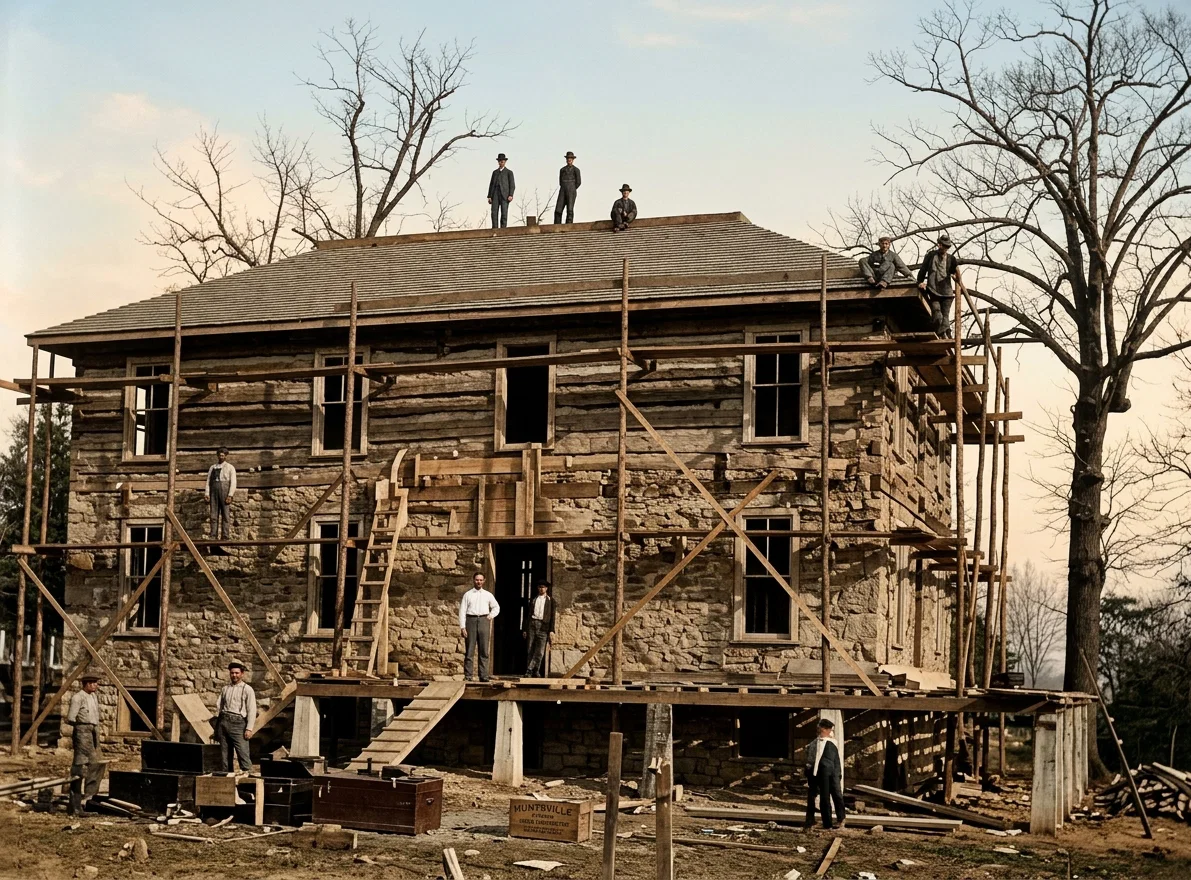
SANITARIUM BUILDING IN PROCESS OF ERECTION AT HUNTSVILLE, ALA.
The simplicity of any plan is the first requisite to its success. Complications bring confusion, and finally discouragement. The worker for magazines has only to arrange with the State tract society for the scholarship agency, a consignment of papers, and territory. The papers, together with a suggestive canvass, and a booklet, “How to Earn a Scholarship,” will be forwarded without delay; and after a short time devoted to studying the papers and the canvass, one will be ready to make a beginning.
Detailed Instruction
All State tract societies will have in stock all the different publishing houses’ printed detailed instructions for agents. These will be supplied on request; also any other information desired will be cheerfully furnished by all State tract societies. We invite all who are interested to send for the publishers’ booklets on plans for magazine work.
D. W. REAVIS.
The Publishing Work
Conducted under the auspices of the General Conference Publishing Department.