Your ShelfYour Projects

Review and Herald, Vol. 91, No. 10.

Protestant Magazine Distribution Records

Review and Herald

Mar 5, 1914

Review and Herald Publishing Association · Takoma Park Station, Washington, D. C. · Mar 5, 1914

Protestant Magazine Distribution Records

FOLLOWING are the interesting and encouraging records made by 34 of our local conferences in the sale and distribution of the February number of the Protestant Magazine up to Wednesday, February 25: (1) District of Columbia, 4,002 copies; (2) Massachusetts, 3,625; (3) East Michigan, 2,650; (4) Ohio, 1,737; (5) Upper Columbia, 1,600; (6) Eastern Pennsylvania, 1,430; (7) North Dakota, 1,349; (8) Iowa, 1,227; (9) New Jersey, 1,145; (10) North Missouri, 1,090; (11) Western Washington, 735; (12) West Texas, 730; (13) West Michigan, 713; (14) West Pennsylvania, 701; (15) Wisconsin, 627; (16) Southern New England, 580; (17) Southern Oregon, 548; (18) Central California, 446; (19) Southern Idaho, 437; (20) Minnesota, 427; (21) Wyoming, 405; (22) Western Colorado, 400; (23) Texas, 350; (24) Louisiana, 330; (25) Greater New York, 321; (26) Chesapeake, 320; (27) Virginia, 280; (28) Nebraska, 275; (29) Northern California, 273; (30) South Dakota, 268; (31) Eastern Colorado, 256; (32) West Kansas, 245; (33) South Missouri, 235; (34) Western Oregon, 202. A grand total of 29,959 copies, exclusive of subscription orders.
REV. AUGUSTUS E. BARNETT, rector of the Church of Our Redeemer, Sixteenth and Oxford Streets, Philadelphia, writes: "I wish to thank you for the good work you are doing, and for the splendid quality of your constantly improving magazine [Protestant]. At our great Trenton, N. J., meeting last Sunday [February 8] I advised 2,500 men to subscribe for it, and I am doing the same elsewhere." Dr. Barnett is lecturing in many of the large cities, under the auspices of the Guardians of Liberty.

Protestant Magazine Campaign Expands

Special "Protestant Magazine" Campaign Letter Head and Letter Sent Out by a Wide-Awake Tract Society Secretary
Brother Andrew Roode, secretary of the North Dakota Tract Society, Jamestown, N. Dak., reports a total sale of 1,349 copies of the February Protestant Magazine, containing the two great speeches of Rev. R. H. McKim, up to February 25. Copies of this great "Protestant Mass Meeting" and "Roman Mask Put On Again" number have been mailed to 767 Protestant clergymen in North Dakota. The Massachusetts Tract Society has also supplied this number to nearly 2,500 Protestant clergymen of that State; and since then one brother from the same State has written for immediate cash quotation on a lot of from 3,000 to 6,000 copies, to be distributed to men of influence. The Kansas City (Mo.) church has ordered 1,000 copies. Before it was off the press, the FOURTH LARGE EDITION (10,000 copies) OF THE FEBRUARY NUMBER HAD BEEN NEARLY ALL SPOKEN FOR! PLANNING TO RUN A FIFTH EDITION. TOTAL NUMBER PRINTED TO DATE, 50,000 COPIES! The great March or "President Wilson, Secretary Tumulty, and the People" number is also selling very rapidly. One Washington Missionary College student took 50 out last Friday, sold 12 quickly, and disposed of the remaining 38 to a lady physician, his next customer, receiving $3.80 therefor. LET CAMPAIGNS BE INAUGURATED EVERYWHERE BY OUR CONFERENCES, SCHOOLS, CHURCH OFFICERS, AND PATRIOTIC SOCIETIES, TO INTRODUCE THE GREAT FEBRUARY AND MARCH NUMBERS TO CLERGYMEN AND MEN OF INFLUENCE. SPECIAL "TRIAL" SUBSCRIPTIONS FOR FOUR MONTHS, ONLY 25 CENTS. SEND THE MAGAZINE TO FIVE DIFFERENT PERSONS FOR SIX MONTHS FOR ONLY $1.50 — REGULAR PRICE, $2.50. Send $1.00 for 20 or $2.00 for 50 copies of either the February or the March numbers, or mixed. Sell or give them away. Address all orders to your tract society or to Protestant Magazine, Washington, D. C.

THE WORK

AND

THE WORKERS

TELEGRAPH orders are still being received for the current numbers of Life and Health and the Protestant Magazine.

Orders Exceed Five Thousand Copies

SUNDAY, February 22, Washington's birthday, the mails brought us orders for over 5,000 copies of Life and Health, Liberty, and the Protestant Magazine.

400 Copies of Life and Health Ordered

HAVE just received a telegram for 400 copies of the March Life and Health from a lady who a few years ago sold 370 copies of this magazine in one day, and 1,000 in four consecutive days. Send $1.00 for 20 or $2.00 for 50 copies. Easy and profitable work.

New Magazine Agents Enrolled

DURING the past two weeks our magazine department has enrolled 102 new Protestant Magazine agents, besides 29 subscription agents; 12 new Life and Health agents, besides 7 subscription agents; and 10 new Liberty agents, besides 8 subscription agents.

Buffalo Protestant Mass Meeting Planned

Pastor E. L. Cardey and a prominent official of the Civic League, of Buffalo, are organizing the Protestant clergymen of that city preparatory to holding a great Protestant mass meeting similar to the one held in Washington, D. C., reported in full in the February Protestant.

Protestant Magazine Orders

Up to Wednesday, February 25, these five union conferences had ordered 24,233 copies of the February Protestant Magazine: Columbia Union, 9,791 copies; Atlantic Union, 4,734; North Pacific Union, 3,470; Northern Union, 3,271; Central Union, 2,967. Lists of subscriptions not included in this count.

Give the Baby a Chance

"GIVE the Baby a Chance" is the theme of seven excellent articles in the beautiful March Life and Health,—the one with the "Niagara Falls" cover—a beauty! "Healthful Cookery," "Questions and Answers Department," and many other valuable features might also be mentioned. Have you seen it? Did you ever try to sell this easy-selling magazine?

Business

A BUSINESS man in Massachusetts writes: "Will you kindly advise me what you could furnish 3,000 to 6,000 copies of the February number of the Protestant Magazine for, net cash? If you desire to furnish these, how soon could they be furnished? These will not be sold, but will be for gratuitous distribution to influential persons. Yours in the work for religious liberty." Let the good work go on!

Tattling Church Members

G. B. THOMPSON
IN his book entitled "The Soul-Winning Church," Rev. L. G. Broughton, D. D., says: "Not long since, I read an account of a man's conception of tattling church members. He drew a picture of the scene at the table where the rich man and Lazarus were,—Lazarus eating the crumbs, and the dogs licking his sores. Then he said, 'You people in the church that are constantly talking about one another remind me of those dogs.'"
It would be well if tattlers, busybodies, and scandalmongers everywhere would meditate on this statement. It is true that it is pretty strong, but the rebuke is no stronger than the case demands. Anybody can tattle; and tattlers and professional gossips are, as a rule, prevaricators. As they hand the morsel of scandal around to those who will lend their ears as a sewer for this purpose, it grows; and a very small bit of gossip, through the prevarications of those who indulge in this unholy and unchristian business, will soon be of sufficient proportions to damage the reputation, and to make trouble in the home, the neighborhood, and the church. All this suits tattlers well, as in this way the dirty pool around which they dance and from which they dip the slime which they peddle, will be replenished.
This wicked thing should be banished from the life of every one of the Lord's children. It will destroy our own prospects of sharing in the joys of the world to come, as well as the hopes of others. The Holy Spirit of God will never dwell in the life of any one addicted to such an evil habit. If ensnared by the enemy in this way, we should most earnestly pray for deliverance.

Prevailing Prayer

P. G. STANLEY
THERE is nothing that leads higher into the secrets of God's life, deeper into the secrets of God's Word, or deeper into the secrets of our own hearts, than prevailing prayer. Nothing else gives us such a view into the secrets of the amplitude and efficiency of the gospel of the Son of God, or reveals the amazing possibilities of faith, as does prevailing prayer.
By importuning prayer we receive of God's life and take on his character. We become like those with whom we have continuous and loving fellowship. "We shall be like him; for we shall see him as he is." We now behold him in the gospel glass, face to face, and are "changed into the same image from glory to glory even as by the Spirit of the Lord." As Christ prayed, "the fashion of his countenance was altered." So the fashion of our countenances and characters become changed as we draw near to God in prayer.
As ministers of the gospel, we must go into the holy of holies of God's presence by the way of prayer, and receive "all the fullness of God" for ourselves and for the salvation of others, and then return to the people with a blessing for them. Christ spent all the night in the mountain in prayer, that the next day he might return "in the power of the Spirit" with great blessings for the people.
Prayer is the mightiest arm of power that man can wield. Some of the greatest battles that have ever been fought in this world, and some of the greatest victories that have been won, have been won on the knee in prayer. A few years ago as present truth began to get a foothold in Australia, one of our ministers was pressed into a discussion. The battle was fought and a great victory won for the truth by the members of the church being on their knees in prayer at the time of each discussion. Esau was conquered while Jacob spent the night by the brook Jabbok on his knees. Peter was released from prison while the brethren at Jerusalem were on their knees. The lions' mouths were closed while Daniel was on his knees. Elijah locked up heaven by prayer, so that "it rained not on the earth by the space of three years and six months." Again he prayed, "and it came to pass in the meanwhile, that the heavens were black with clouds and wind, and there was a great rain."
When the idolatrous Israelites had made them a golden calf, and worshiped it, God determined to destroy them, and to make of Moses a great nation. But for the importuning and prevailing prayer of Moses, God would have destroyed the whole nation instead of cutting off but three thousand of the idolators. Strange as it may seem, the lives of this great multitude were saved by a man of faith on his knees in prayer. When Haman sought revenge on all the Jews in all the realm of Ahasuerus because Mordecai refused to render the homage demanded, and when it was decreed by the king that all the Jews should be put to death, this bloody plot was made known to Esther, and a fast was proclaimed. "Go, gather together all the Jews that are present in Shushan, and fast ye for me, and neither eat nor drink three days, night or day: I also and my maidens will fast likewise; and so will I go in unto the king, which is not according to the law: and if I perish, I perish."
When for three days and three nights the Jews had thus fasted and prayed, God answered and delivered them, and destroyed their enemy. What could have availed in this case but fasting and prayer? He who prays in faith enlists the help of the Almighty, all the armies of heaven, and every law of the universe in the interest of his cause.
Prayer is mightier than the monarchs of earth. God moved the lever of national events to the advancement of his truth while John Knox was on his knees, crying, "Give me Scotland, or I die!" When Bloody Mary said, "I fear the prayers of John Knox more than I fear all the armies of Europe," she paid the finest tribute to the power of prayer to be found on the pages of history. The great revival on the day of Pentecost was preceded by a prayer meeting by the whole church, lasting ten days. It was the prayer of this united church that made the truth in Peter's sermon on the day of Pentecost effectual in the conviction and conversion of three thousand souls. It was the power of God that came while Paul and Silas prayed and sang praises to God, that caused the earth to quake and sinners to tremble, and that opened the prison doors and the doors of wicked hearts. The power that did these things centuries ago, can do the same today. This power is placed at our disposal, in answer to the prayer of faith.
Marshfield, Mo.

Whiter Than Snow

WORTHIE HARRIS HOLDEN
Lightly gentle zephyrs blow, Falling eider down of snow. In their frolic on the way, Mirthfully the livelong day Whirling flakes make merry round Ere they rest upon the ground.
Fir trees brave the wintry storm, Clad in splendid uniform,— Guards unwearied through the night In their proud arrayment white, Keeping watch till daybreak breeze Shakes the fleecy sentry trees.
Drear no more the barren clod With its blanket-gift from God; Ermine fit for kings' array Robes the highland and the brae. Like some blitheful errant knight Comes this wonder-working white.
Whiter than unsullied snow God transforms my heart, I know,— Mantles with his robe divine, Rears within my soul his shrine,— Not alone for one brief day, But to prove his grace for aye.
Portland, Oregon.

The Faith of Jesus

A. R. BELL
"HERE is the patience of the saints: here are they that keep the commandments of God, and the faith of Jesus." Rev. 14:12. This scripture points to a faith developed beyond that manifested at any other period. The people having that faith live at a definite time, and that time immediately precedes the coming of the King of kings. Verse 14. But what does the Scripture say about that time? It tells us, in the words of the Saviour: "As the days of Noe were, so shall also the coming of the Son of man be." Matt. 24:37. The verses following show that God is not at all in their thoughts.
Again: the Lord, looking down through the centuries to the time of his second coming, asks: "When the Son of man cometh, shall he find faith on the earth?" Luke 18:8. The apostle Paul spoke of a time when men would "turn away their ears from the truth," and would "be turned unto fables." 2 Tim. 4:4. These conditions are everywhere present today. We are living in the very time to which they have pointed for nearly two millenniums.
Another scripture reads, "Faith cometh by hearing, and hearing by the word of God." Rom. 10:17. It is God who speaks to men in his Word. If men turn away their ears from the truth, they turn away from the Word (for the Word is truth, John 17:17), and in turning away from the Word, they turn away from the only agency that ministers faith to men. No wonder, then, that the Saviour asks the question, "When the Son of man cometh, shall he find faith on the earth?"
And yet, just before the Lord comes, in the fearful time of apostasy which is pointed forward to in the Scriptures, and in spite of it, a faith is developed above that of any other time or people, God himself takes note of it in a very marked manner. He says: "Here is the patience of the saints: here are they that keep the commandments of God, and the faith of Jesus."
In the language found in Heb. 11:1, faith is represented as practically grasping as an accomplished fact what God has promised. But if faith is practically grasping God's promise as an accomplished fact, are we to understand that to have faith means for us to sit down and with folded arms wait for the working out of the purposes of God? Some valuable lessons are given us in Heb. 11:32-34. We are told of men who "subdued kingdoms," who "waxed valiant in fight," who "turned to flight the armies of the aliens." How did they subdue kingdoms? How did they wax valiant in flight?—Why, by faith. But they fought. Theirs was a real fight. But real indeed as it was, it was "the good fight of faith," for verse 39 tells us, "And these all . . . obtained a good report through faith." It is very plain, then, from the Scripture that a man who has faith is a man who works; and the greater his faith the harder he works.
If we are to understand Rev. 14:12, as speaking of the remarkable faith possessed by the people to whom it refers,—a faith seemingly greater than that of any other time or people,—then surely it must mean that God is pointing out a people who are to do a work greater than that of any other time or people. Let us look upon the situation as it is. Rev. 14:12 points to us as a people. To this people has been given the mightiest work ever committed to men. To this people it is given to fight the most tremendous fight that can ever be fought. That mighty work, hard and trying though it is, is the work of faith. That tremendous fight is a fight of faith. And, thank God, we are going to finish that work; we are going to fight that battle to a finish.
In our own personal, individual experience, when God in his goodness sent us this blessed truth, the work and fight of faith began. The great blessing we have known through keeping God's commandments did not come without a struggle. The victory that overcometh the world in us is a hard-fought victory. But having taken our stand, taking God at his word, grasping as already accomplished the promises he has made, we became in the very nature of things inseparably lined up with that people marked out in the scripture we have been considering; and under the same mighty influence and power that first wrought in us as individuals, we go forth to work the works of him that hath sent us.
We cannot rest, we will not rest, until the whole host of the redeemed, saved out of "every nation, and kindred, and tongue, and people," shall sing, when the great work is finished, "This is the victory that overcometh the world, even our faith," and the Lord omnipotent can declare in all fullness and completeness, as the King of kings is about to ride forth upon the great white cloud: "Here is the patience of the saints: here are they that keep the commandments of God, and the faith of Jesus."

A. G. DANIELLS

Does the History of Turkey and Egypt Since 1798 Fulfill the Prophecy of Dan. 11: 40-44?—No. 20

A. G. DANIELLS
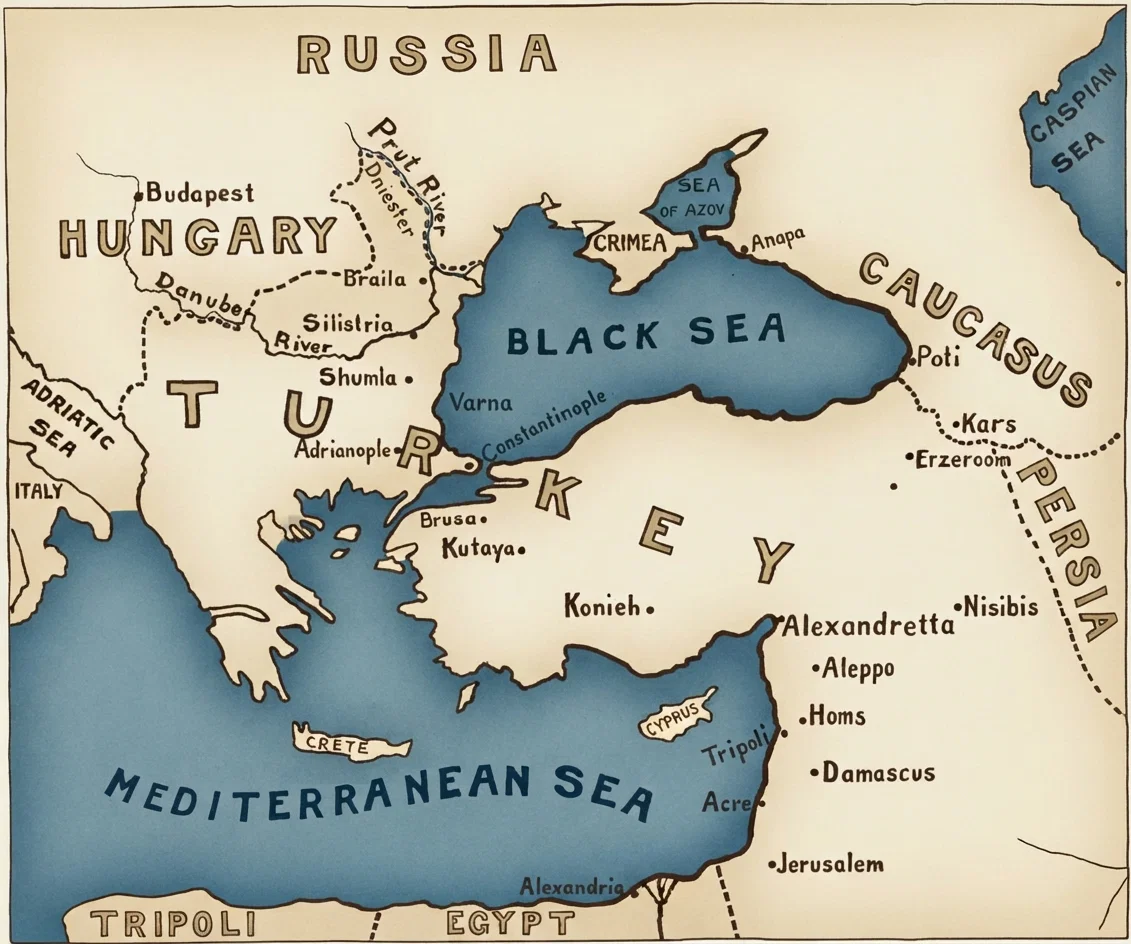
AFTER the defeat of the Turkish army at Beilan, on the eastern side of the Taurus, the war was transferred across the mountain range into Asia Minor. The forces met at Konieh for a decisive battle. Konieh is the Iconium of Galatia, where the apostle Paul preached the gospel on his first missionary tour.
"In the eyes of the Ottomans this place is invested with a semisacred character, from its having been—before Brusa, Adrianople, and Constantinople—the capital of Turkish power, and still containing the remains of the revered Mollah Hunkiar, with a university and mosques, associated with a religion considered orthodox, and such learning as the Ottomans possess and delight to honor. . . .
"Konieh was the easiest of all the conquests of Ibrahim—a victory without a battle, in which thirty thousand Egyptians drove nearly double that number of Turks before them, and menaced the sultan in his capital. It was on a thick, foggy morning, in the month of December, 1832, that the two armies met. Reeschid bravely led his men into the thick of the fight, while the Egyptians were enabled by the Turkish cannonade to find out the position of their adversaries, their own guns remaining silent; but he soon perceived that, in the fog, his Arnauats had failed to follow him. Bedouins near at hand, hearing a language they did not understand, took him prisoner. This event carried consternation into the Turkish ranks. The whole army of sixty thousand men took to flight, after a trifling loss on both sides. Ibrahim Pasha was thus master not only of Syria, but of Asia Minor, which was the center of the Turkish power and resources. . . .
"It is impossible to describe the consternation which was produced in Constantinople by the battle of Konieh, and the subsequent advance of the Egyptians. The Greek and Servian revolts, and the wars with Russia, were all on the borders and outlying provinces of Turkey; but, if any part of the empire could be considered a citadel of the loyalty and nationality of the Ottomans, it was Asia Minor. Yet the sacred Konieh had seen the military disasters of the sultan; and Kiutahieh, a great stage nearer to the Bosporus [one hundred miles], was immediately after the headquarters of Ibrahim, from which he menaced the capital."—"History of the Egyptian Revolution," by Paton, Vol. II, pages 98-100.
"The disaffected armies of raw recruits, badly officered and worse generated, which the sultan sent against the rebel Egyptian chief were beaten by Ibrahim in three great battles, at Ems [Homs] in Upper Syria, on July 6, 1832; at Beilan (in Cilicia, near the ancient battle field of Issus), on the twenty-ninth of the same month; and at Konieh, in Asia Minor, on the twenty-ninth of October.
DISTANCES FROM CONSTANTINOPLE
"The positions of these places indicate the rapid progress and bold designs of the Egyptian commander, who seemed to annex Asia Minor to Mehemet's dominions with the same ease as Syria; and whose advance upon Constantinople in the coming spring appeared to be inevitable and irresistible. In this agony of his house and empire, he sought aid first from England, but none, unhappily, was accorded. . . .
"Russia was watching eagerly for the opportunity which English folly thus threw in her way. Her troops, and her transports, and her ships of war were ready at Sevastopol and Odessa; and when Mahmud humbled himself to express to his ancient enemy a wish for a protecting force, prompt messengers were dispatched to the Crimean depot of the Muscovite power, and a Russian squadron of four ships of the line set out from Sevastopol, and landed six thousand of the emperor's troops near the mouth of the Bosporus, on Feb. 20, 1833.
"Meanwhile the forward march of Ibrahim had been temporarily stayed by a messenger from Admiral Raussin, whom the French government had sent with a fleet to help the sultan. A negotiation was entered into, but broken off after a few days; and in the beginning of March, Ibrahim again pointed his columns toward the Bosporus. But a second Russian armament from Odessa now had reached those straits, and on the fifth of April twelve thousand soldiers of Czar Nicholas were encamped on the Giant's mountain near Scutari.
"Ibrahim felt that any further advance on his part would be madness, and occupied himself in procuring the largest possible increase to his father's power in the negotiations that followed, in which England and France (now thoroughly alarmed at the advantages gained by Russia) took part with anxious zeal.
"The terms of compulsory reconciliation between the sultan and his overpowerful vassal were embodied in a firman of May the sixth, 1833, by which the Porte confirmed Mehemet Ali in his governments of Crete and Egypt, and added to them those of Jerusalem, Aleppo, Damascus, and Adana. This was virtually a cession to the Egyptians of nearly all the countries which the victories of Selim I had incorporated with Turkey, besides the important island of Candia, which it had cost the Porte a twenty years' war to wrest from Venice.
"At such a bitter cost was Mahmud compelled to purchase the removal from Asia Minor of his insurgent pasha; and before he could obtain the withdrawal of his equally formidable Russian friends, he was obliged to sign the treaty of Unkiar-Ikelessi on the eighth of July, 1833, which by its public articles bound him to an offensive and defensive alliance with Russia, and by a still more secret article, provided that the Ottoman Porte should, when required by the Russian emperor, close the straits of the Dardanelles against the armed vessels of all other foreign powers.
"It was the general opinion in Europe at this time that Turkey was irretrievably ruined, and that the attempts of her reforming sovereign to resuscitate her power had been the mere galvanizing of a corpse. . . . First the foreign invader, and, next, the home rebel, had rent from him his dominions, and had bowed him beneath the humiliation of treaties, worse even than those of Karlowitz and Kainardji."—"History of the Ottoman Turks," by Creasy, pages 521-526.
"Thus a great part of the empire was virtually severed from its trunk, and a power aggrandized that might at any time be turned against the remainder."—"History of the Egyptian Revolution," by Paton, Vol. II, page 101.
Such were the developments in the east and the north that brought serious "trouble" and great losses to the "king of the north."
Continue reading: America's Representative to the Papal States