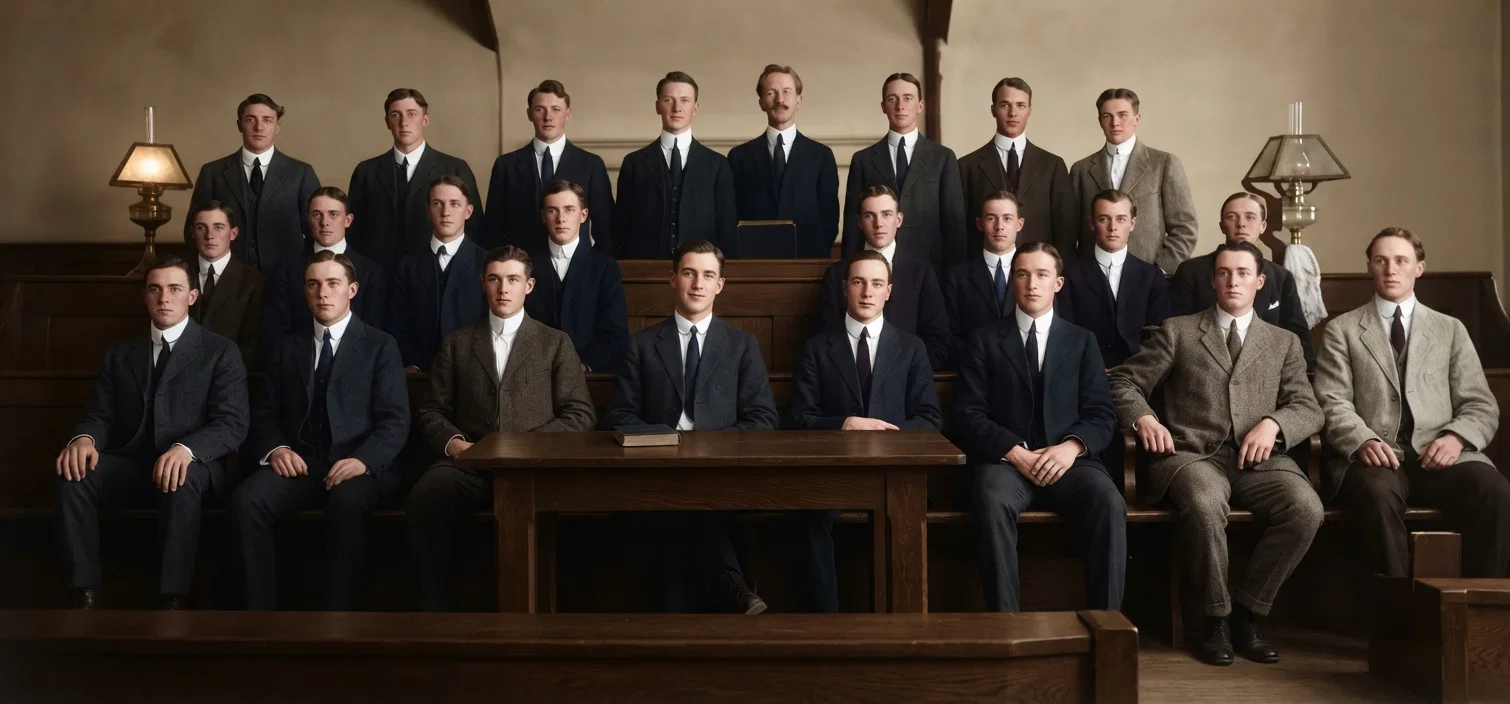
THE Lord has been gracious to the teachers and students of Pacific Union College. On the opening day of the school year it was evident that he had set his hand to bless the work. The increased attendance, amounting to sixty per cent in the academic and collegiate departments, the mature and excellent class of students, their helpful spirit of cooperation and good cheer, and withal the measure of the Holy Spirit they had brought with them were preliminary omens of a successful term. The conduct of the students has been good. It has not been necessary to dismiss a single student, and no serious case of discipline has occupied the attention of the faculty. As the blessing of God follows in the wake of obedience to his law, that school whose student body is willing and eager to cooperate with its teachers in conforming to a few simple but necessary rules for its guidance, is sure to reap the approval of God and be crowned with his blessing.
We, of course, looked forward to the week of prayer as a time when the work of grace would be strengthened in all our hearts, and we were not disappointed. The readings were given at the morning worship hour, accompanied by a season of prayer in which as many students took part as time would permit. The chapel hour was occupied with definite and connected instruction in Christian living, followed by social service. The evening worship hour was devoted to division meetings, in which teachers and students sought God together in small groups. These meetings were all very helpful in producing a real revival of Christian service.
Three Notable Meetings
At seven o'clock on Wednesday evening of the week of prayer, the entire school met in the chapel and listened to an impressive address by Prof. G. W. Rine. At its close, Elder E. J. Hibbard adopted the good old-fashioned plan of inviting all those who felt special need of spiritual help to come forward. Students began at once to respond to the invitation, and the next hour was a busy but solemn time, in which teachers and students were engaged in personal work for the unconverted and backslidden. An after meeting was called, and those who wished to go were dismissed. Probably three fourths of the audience remained, thereby signifying their desire to be classed with the seekers after God. In the social meeting that followed there were deep repentance and a full and free confession of sins, such as foolish words and actions, unkind thoughts toward teachers and fellow students, remissness in missionary activity, neglect of prayer and Bible study, dishonesty in work and study, and numerous other specific sins or faults. As usually happens when such things are laid upon the great Burden-Bearer, a peace and joy followed which the world could neither give nor take away. The meeting did not close until eleven o'clock. It was an occasion long to be remembered because of the presence of the converting power of God.
Before the students returned to their homes for the Christmas vacation, Elder Hibbard gave some very earnest counsel regarding the proper use of the time. The young people were counseled to resist the temptations which are so numerous and so strong during this season. They were advised to engage in active missionary work as a safeguard against the deceptions of the evil one. The testimonies given by the students after the holidays showed that many of them had been blessed greatly by engaging in active personal work for souls.
YOUNG MEN IN PACIFIC UNION COLLEGE PREPARING FOR THE MINISTRY
One company of a half dozen students had decided to spend the entire week in a series of meetings in a near-by town, for the purpose of reviving the local church and dispensing the bread of life to the unconverted in the vicinity. This company gave a report at the first missionary meeting of the new year. Their faces were aglow with joy and enthusiasm as they related how God had worked through them to the conversion of sinners, the reclaiming of the backslider and skeptic, and the healing of differences between brethren. They reported that the local pastors of other churches had made favorable mention of their work, and had advised the people to attend their meetings. These pastors had also invited the students to assist them in their services and to occupy their pulpits, and urged them to remain longer and help them in their week of prayer. Much personal work was done by visiting the sick, the discouraged, and those bound by the shackles of Catholicism. On the last Sabbath and Sunday of the meeting, Elder E. W. Farnsworth, the president of the conference, united with the company, and a special meeting of five hours' duration was held in which bitter feelings between brethren were laid aside, unchristian letters were burned, and love and concord once more reigned in the church. One strong feature of the services was the Spirit-filled singing.
The simple narration of the above facts and the singing of the songs used in the services produced a profound effect upon the school. There were no more recitations that day. Many students were soon on their feet to renew their consecration, to announce their determination to become soul winners, or to express a wish that they had spent their vacation in like manner. The meeting was an exemplification of the proverb that "he that watereth shall be watered also himself."
The nature of the third meeting was entirely different from the two preceding. The large increase in attendance had made it absolutely necessary to spend large sums of money in finishing new rooms, in purchasing furniture, machinery, scientific equipment and supplies, and in enlarging pumping and laundry equipment, heating facilities, etc. The local members of the board and the faculty had spent a day in earnest counsel concerning the needs of the school. The result of the meeting was a proposition that the members of the board present, the faculty, and the students attempt by personal solicitation to raise ten thousand dollars to be credited to the improvement fund of the college.
It was decided to set the plan before the school on the next day at chapel exercises. Elders E. E. Andross and E. W. Farnsworth led out by clearly explaining the proposition to the students. All were then asked to respond to the suggestion as it seemed best to them, "and this they did, not as we hoped, but first gave their own selves to the Lord;" for prior to the consideration of finances, an opportunity was given to the students to name the work each felt called to do. Twenty-eight young men signified by rising to their feet that they believed God was calling them to the ministry, ten young women expressed their desire to become Bible workers, fifty-three expressed a wish to become teachers, and thirty-three hoped to enter medical missionary work either as physicians or nurses. Still others expect to fit themselves to become clerical workers, secretaries, stenographers, bookkeepers, etc. About fifty students have had experience as canvassers, and a good proportion of these will enter the work for the summer vacation. In response to a general question relative to foreign missions, one hundred and forty-one signified their willingness to enter foreign mission work.
16The giving of themselves was an excellent introduction to the raising of funds. It was made plain to the students that they were not asked to pledge a certain amount, but were asked to do their best to solicit what they could for the upbuilding of the college. The members of the board and faculty led out with liberal sums, and the students took hold with enthusiasm. A final reckoning showed that we had agreed to do our best to solicit ten thousand dollars. Definite plans were also laid to prosecute the work intelligently and systematically. We then sang, "Praise God, from whom all blessings flow," and closed the meeting.
In view of what God has done for us, our dim vision is beginning to catch the glimmerings of a glorious light which will soon burst forth to gladden the eyes of those teachers and students who consecrate themselves to God in wholehearted surrender. C. W. Irwin.
"Win One Soul"
By H. A. Weaver
IN the Columbia Union Visitor of February 4, under the title "A Good Motto," Elder E. K. Slade, president of the Ohio Conference, has this to say:—
"At the Columbus convention a very neat and attractive motto was painted . . . and put in a prominent place, which read, 'Win One Soul for God.' This motto attracted much attention throughout the institute, and proved to be quite an inspiration to all. It would be well, if all our churches could have a similar motto, and thus keep the thought constantly before the members. The tendency of these times is to endeavor to reach the masses in a wholesale way and on a large scale. When our hearts are set on winning one soul, the way is open for that individual and personal work which is really the most successful of all. Winning one soul opens the way for still others."
This motto was not painted especially for the convention, but was adopted by the Columbus (Ohio) church the first Sabbath of the new year as a watchword for each member during the coming year. It was later adopted by the colporteurs in convention.
The idea of each member's winning one soul to the Lord during the year was first advanced by Elder I. H. Evans at the last General Conference at Washington, D. C. Some who were present caught the spirit of the suggestion, and it has since very naturally spread abroad. In his week of prayer reading, Elder G. B. Thompson made the idea more pronounced in the following words, which appear in the Review of Nov. 13, 1913:—
"It has been suggested that we set as a goal the doubling of our membership. It seems like a big task to talk of doing this. But it is quite possible if we all take hold of the work. It means simply that we each bring one soul into the truth, and the task is accomplished. Cannot we do this much the coming year? Is one soul a year too many in the days of the close of probation?—Surely not. Brethren, this can be done, and more. Shall we not consecrate ourselves to the work of bringing people to Christ as never before? Shall not each of us determine, God helping us, to bring at least one soul to Christ the coming year? This will bring new life into our own hearts, new life into our churches, new power into our work, and hasten the close of the work of God in the earth. How many will dedicate themselves to this work, and know no rest till they have brought some souls to Christ?"
The Home Missionary Department of the North American Division Conference has these words to say to encourage all in this direction:—
"We have decided to take for the Home Missionary Department aim, 'Every Sabbath keeper to bring at least one soul to Christ in 1914.' It seems as if some definite aim like this would help our people to work more earnestly for their neighbors than they are doing. Surely every Sabbath keeper could, by working faithfully all through the year for all he could reach, and praying in faith, bring at least one soul to the truth in a year, and this would double our membership. Those who had experienced the joy of soul winning would not stop when they had gained one soul, but would go on to seek for others."
MOTTO ADOPTED BY THE OHIO COLPORTEURS
The artistic motto which hangs back of the pulpit of the Columbus church was painted by a Seventh-day Adventist artist whose heart beats with desire to use his rare talent in the advancement of the message. I suggest that any church, church missionary society, or Young People's Missionary Volunteer Society anywhere in the United States or Canada, that would like to secure a motto copied from the motto which is referred to above, send its order to the artist through the address of the writer of this article (1424 West Broad St., Columbus, Ohio), accompanied by $1.75, and the motto will be painted and sent forthwith, carriage prepaid. The motto is six feet long by three feet wide, painted on pure white painter's muslin. The letters are beautifully shaded, and the motto in every way bears the marks of a skilled workman. The ordinary cost of such a motto is $3.50. The artist, however, in a missionary spirit, offers it at half its cost.
Kept constantly before our eyes as we worship from Sabbath to Sabbath, such a motto, painted by consecrated hands, will be sure to impress its message upon hearts. H. A. Weaver.
Won by Kindness
By W. E. Videto
As a people, we have been slow to learn that many who grow bitter under the sting of cutting arguments may be won to the truth by kindness. I was forcibly reminded of this some time ago on meeting a certain minister. He had been so bitter that several years before, when we were looking for a place to hold meetings, we thought it best not even to ask for a certain church when we learned that he controlled it.
The last time we met him, he seemed entirely changed; he was friendly, and even cordial, in his greeting. We learned that one of his sons had been helped by an Adventist neighbor in a time of serious trouble. Another son had gone to one of our sanitariums and left the institution practically a well man, enthusiastic over our health principles, and grateful for the kindness shown him. The father's heart could resist all argument, but it yielded to the kindness shown his sons. Are there not many seemingly hard hearts around us that can be touched by some little act of kindness shown to themselves or to their loved ones? W. E. Videto.
The Ohio Institute
By I. D. Richardson
THE colporteurs' institute held at Columbus, Ohio, January 12-27, was certainly a grand success from beginning to end. It opened with an attendance of about thirty-three and closed with forty-four present. The first Sabbath was a blessed day for all. The Holy Spirit came into the meeting, and instead of the service closing, as had been planned, at about noon, it continued until 5:30 P. M. The deep movings of the Spirit of God were felt by every one present. Sins were confessed and put away as each one felt the sacredness of the work for which he was to receive a training.
As we proceeded with the general instruction, especially along the lines of personal effort for the salvation of souls, every heart was touched. Some fasted, and prayed for a deeper consecration to service. All felt that it was good to be there.
One young woman from a Western State was converted as a result of attending the institute with her sister, whom she was visiting at the time the institute opened. Elder H. A. Weaver,17pastor of the Columbus church, with his faithful corps of workers (sisters in the church), provided splendid entertainment for the colporteurs, and on the last Friday arranged for us to meet Governor Cox at the State Capitol. While waiting to see the governor, the accompanying picture was taken on the Capitol steps. (See page 16.) The governor spoke very commendably of the work of placing good literature in the houses of the people. This occasion afforded Elder Weaver the opportunity of placing in the governor's hands a synopsis of our world-wide missionary movement, especially along the line of our publishing work.
Brother J. H. McEachern, and his assistant, Brother J. S. Randolph, have a great work before them of strengthening the weak hands and of leading on to success this large band of workers.
I. D. RICHARDSON, General Agent Columbia Union Conf.
Two Souls for Two Words
By Eugene A. Brown
"Heaviness in the heart of man maketh it stoop: but a good word maketh it glad." Prov. 12: 25. See also Prov. 15: 23.
Two incidents that bring to the writer's mind the text quoted above will no doubt prove an encouragement to others. They serve to remind us that the word of the Lord will not return to him void. What would have been accomplished today had every believer spoken the "good word" in due season? And what have become of the many discouraged souls to whom we failed to speak at the critical moment?
Several years ago, while eating at a lunch counter, I was impressed to inquire of the waiter as to his spiritual condition, and to offer a few words of friendly counsel. Time passed on, and the incident was forgotten. Recently a visitor at one of our meetings, who proved to be the stranger spoken to, related the experience, with the startling information that at that time he was laboring under a spell of such despondency that he had determined that night to end his life. The word spoken brought the first ray of light to his burdened heart. He followed the light until he found Christ. Today he is rejoicing in the truth.
Three months ago, meetings were begun at El Centro, Cal. I had concluded the discourse of the evening, and was meeting the strangers at the tent door as they passed out. A heavy-set stranger, evidently a man of some influence, approached me, and ridiculed the sermon. He declared that the Bible was worthless, that Christ was inferior to Confucius, who he believed was the nearest to perfection of any being ever on earth. He had had Christian training, but had studied Confucianism. "And don't you read your Bible at all?" I asked. He did not. "Well, good night, come again; the Lord bless you." And he kept coming, and has given his heart to Christ. He has since said that those words were the only ones that could have reached his heart. Every preacher he had before spoken to had so treated him as to drive him farther into darkness. In this case the Lord seems to have given the very words required, and just the manner, too, of offering them. He said, in asking about our effort here, "Did it pay you to come down here?" "Certainly! We should have considered ourselves well repaid if but one soul had been saved." "Well," he replied, "I am that soul."
EUGENE A. BROWN.
The Message in a Tent
By Bertha Iliff
I HAD my first view of a tent meeting when my mind was clouded with discouragement and nothing struck me forcibly but my own misery. However, there is a camp scene in my mind that will never be effaced—not as long as I remember my "first love."
This camp was located on a vacant corner lot. There were only three tents. The two in the rear were the dining tent and bedrooms of the gospel workers. These were small and screened, and scrupulously clean. The audience tent faced both streets. The ground was sodded with clean sawdust. Under the neatly arranged, canvas-folding benches were tufts of green grass. About the organ and the pulpit were house plants and green foliage. The altar was draped in blue and white, and suspended from the tent above and back of the pulpit was a chart representing the image of a man with a head of gold. Above the altar, written in white on blue, were these startling words: "Behold, I come quickly," and above these was the solemn inscription, "Prepare to meet thy God." These words seemed to burn into my soul. The solemnity, the simplicity, the spotlessness of this place seemed heavenlike. To my tired soul, here was something new under the sun. Yet the message delivered from the pulpit was the old, old story told in a new setting; told by unlearned lips, but lips touched with a living coal from off the altar.
The peace and quiet confidence of that minister's face, his plain clothes, and his simple, earnest manner revealed a life of faith that impressed me deeply. I shall never forget the first Sabbath spent on that tent ground. It was the brightest day of my life. The sun seemed brighter than I had ever seen it; the grass seemed a living green and the tents glistening white. There was a corresponding light on the faces of the gospel workers, reflected, perhaps, from the faces of the new converts.
Six years have passed since that blessed day. The cares of life have been allowed to cast their shadows. My Lord has tarried longer than I expected. But though he tarry, yet I know that he will surely come; and as the camp meeting season draws near, the desire grows strong to meet again with those whose faces shine with the blessed hope, and I long to hear again the gospel message in a tent. BERTHA ILIFF.
Using the Newspapers in Western Canada
By W. L. Burgan
THAT the workers in the Western Canadian Union Conference appreciate the importance of the newspaper in connection with their evangelistic efforts was shown by the many encouraging reports that were heard at the biennial session of this union which was held at Lacombe, February 11-22. The success of the efforts put forth last summer has given our ministers great courage, and they are planning on using the newspapers again during the coming tent season.
The thought was expressed by some that the newspapers in the four provinces comprising the Western Canadian Union Conference can play a most important part in carrying the gospel to remote places, because of the great prairie stretches over which it would be impossible for the living preacher to gather an audience to hear him. The city newspapers go to these places; and while engaged in an effort in a city, the minister can also reach the people in the country by having reports of his sermons published. The brethren in this union conference realize this, and last summer a number of those engaged in tent efforts depended on the newspapers to circulate the message, not only across the prairies, but also in the cities where the efforts were being made.
It was very encouraging to hear brethren say that reports of their sermons as much as one and one-half columns in length had been published. A report of this length can give many fundamental points of our doctrines, and we ought to praise the Lord that such liberality was shown by the editors. While our workers were perhaps preaching to an audience of only a few hundred, yet they gave the important points of their discourse to thousands of others, through the reports they had printed in the newspapers. It seems that the workers in the cities in western Canada realized that their message was new to the people in this part of the world, and seized the opportunity to use the papers, and thus herald the glad tidings far and wide.
This is a good point to remember, and one that a worker ought always to consider, that the newspaper is to take an important part in the minister's endeavors, especially in a new field.
Upon arriving in Calgary, on my way to Lacombe, a visit was made to the newspaper offices, and the editors of the two afternoon papers were well acquainted with the fact that a meeting was to be held in Lacombe. Though the place of meeting was one hundred and thirteen miles from Calgary, the editors said they wanted daily reports. They published announcements of the meeting, and thus thousands were informed that it was to be held. One editor asked that reports be sent in over the telegraph wire at the expense of his paper. Brethren, in many parts of America there are editors who appreciate this glorious advent movement, and will print articles for us. We ought to take advantage of every opportunity to use this powerful medium, and thus hasten the message.
Accounts concerning the meeting were sent to practically all the daily papers in western Canada, and the leading brethren in attendance cooperated in advertising the session, and also the progress of the work in that part of North America.
W. L. BURGAN.
A Reminiscence
By N. W. Vincent
About fifteen years before his death, Elder James White was in poor health, and it was feared that he might die. We had sweet, solemn seasons of prayer for him in Rochester, N. Y., in 1865. His wife, Elder J. N. Andrews, Hiram Edson, and others prayed for him in holy earnestness. Fifteen years seemed to be added to his very active, exemplary life.
At this time I was a novice in "present truth," but a thankful one. I had seen, while a Union soldier (from Ex. 24:12 and 31:18), that God called the ten commandments "a law" ("the law," Revised Version). I loved the Edenic Sabbath. Soon our other distinctive doctrines were precious to me; but how about their fruits in the people that embraced them? So I watched closely such men as Elders Albert Stone and A. S. Hutchins, of my native State, Vermont, and while in Rochester, Elders J. N. Andrews, James White, and J. N. Loughborough, and others.
I found them uniformly very conscientious, lovable men. Their children were amiable. Sister E. G. White was a humble, sympathetic, everyday Christian. Brethren R. F. Cottrell, D. T. and A. C. Bourdeau, Edson, and Place, I found to be men whom I could love more the longer I knew them. God's threefold message through them, though persecuted, was shining brightly.
How often have come to my mind these words of the hymn which I heard Elder James White read at a meeting in Stowe, Vt., in 1855:—
"So let our words and lives express
The holy gospel we profess!"
N. W. VINCENT.
Still Waiting and Watching
In a recent letter received, one of our aged and faithful brethren in the Southland (Dickson, Tenn.) speaks of his connection with this movement, and of the hope which still inspires his heart. After relating some of his earlier experiences in seeking for more light, and the difficulties encountered, he says:—
"We went to the true source,—the Bible,—and by diligent study found that we were for some reason, which we could not discern, keeping the wrong sabbath. We also found that the coming of the Lord was near, and our belief in the immortality of the soul was about lost. Conversing with preachers and others on these subjects, we thought their arguments were very lame compared with the Bible truth. The reason given for the change of the Sabbath was that it was changed by 'common consent.' Therefore we concluded that 'common consent' was not God's law; and having a sincere desire to be right and 'do his commandments,' we concluded to keep the Bible Sabbath, come what would.
"After beginning to keep the seventh day, we met bitter opposition, and even persecution, but, praise the Lord, he helped us to be steadfast and faithful. We did not know that there was another Adventist in the world.
"Some time before this we had operated a sawmill. During the busy season some dear brother or sister sent us two copies of the REVIEW AND HERALD. We did not take time to open them, and they were slipped into the bookcase, where they stayed for several years. But shortly after beginning to keep the Sabbath we found these papers, and rejoiced to learn that there was a Christian, Sabbath-keeping church, and also a conference in our State. What joy and peace came into our hearts when dear Brother Boyd came and instructed us more fully, finally baptizing my wife and myself, our three children, and one neighbor. We have distributed much of our precious literature in the community where we live, and have had the joy of helping several others to walk in the light.
"I am now past seventy-one, and hope I shall see our dear King coming in his beauty, and be numbered with the redeemed host at his right hand. I praise his holy name.
"THOMAS JOHNSTON."
My Experience
By Mrs. Lois J. R. Sage
IN 1842 I first heard the glad news of Christ's coming. I was then converted, and at the age of twelve was baptized and joined the Baptist Church, of which I remained a member until the second angel's message sounded. I then left that church, joined the Adventists, and passed through the 1844 movement in search of further light and truth.
In 1850, light on the third angel's message came. A peddler called at our house and gave me some tracts and papers which he said a woman in Valneg, N. Y., had given him. One tract was the "Seal of God," by Brother Joseph Bates; the other was "The Three Angels' Messages," by Brother James White; and the papers were copies of Present Truth. I read them, but so confident was I that I could prove from the Bible that the first day was the Sabbath, that I took my Bible, determined to settle the question for myself. With the aid of the concordance, I examined every text from Genesis to Revelation that says anything about the Sabbath or the first day of the week; and when through, I made up my mind that if I followed the Bible, I must keep the seventh day as the Sabbath, as there is no Bible proof that the first day of the week is the Sabbath. I was alone, had never seen a Sabbath keeper, and did not know that I ever should, but I said, "Although I stand alone, I must stand or fall for myself."
My mother had some of the tracts, but carried them with her on a visit to her son. The peddler's wife also had some. We did not see one another for a while, and when we came together, each had made up her mind to obey. So there were three of us keeping the Sabbath, each thinking she stood alone in doing so.
I took the REVIEW when it was first published, in Rochester, N. Y., and have been a reader of it ever since. When the press for printing the REVIEW was purchased, my mother, hearing they were in need of money to pay for it, sold her only cow and sent the money to Brother White to help pay for the press. We then expected the Lord to come soon, but here we are yet, watching, and praying, and waiting for his return. It is sixty-eight years since I began to keep the Sabbath. I am now in my eighty-first year, well and strong, thanks to the principles of health reform which I have tried to live. It is with deep interest that I have watched the onward progress of the truth from its commencement, and I can truly say, If this work had been of men, it would have come to naught. I have seen many a bright light go out in obscurity, and have been led to say, "How are the mighty fallen!" But the truth is still onward, and will yet go to every nation, kindred, tongue, and people. Then will our long-looked-for Saviour appear.
Mrs. Lois J. R. Sage.
The Call of the South
By R. A. Leslie
"We have a great work before us in the Southern field, a work that as yet we have only begun. We must not continue to stand as we have stood for years, dreading this work."
Angels, if permitted, would gladly do this work; but God in his mercy has left it for us to do, that we may enrich ourselves in that greatest asset---character.
Messengers of mercy are needed, not merely in a few places in the South, but throughout the whole field. Rich and poor, white and colored, are calling for light. What are we doing?
It is Satan's desire to hinder God's work in the South in every way possible. We should be thankful that God is willing to give us a part in his work; that he is calling you and me to help give this closing message of salvation.
When I went South, I attended a highland school, and had opportunity to come in daily contact with the people of the community. I was deeply impressed with the free and easy life of the mountaineers, as it is a strong contrast to the anxious, careworn, nervous existence in Northern climes. In most cases the mountaineer owns a small tract of land. Usually the family lives in a log house, and many times I have noticed the neat, comfortable appearance of these simple homes. One invariably finds the big, open fireplace, about which the members of the family gather for the evening. Meals served in these mountain homes are often very simple. The housewife bakes corn pone in a skillet on the hearth, and the big kettle swings from the crane over the fire. The family washing is done at the spring, and the clothes are boiled outdoors. The health of these people is ascribed to their outdoor life, to the open fireplace, which gives ventilation, and to the simple food that they eat.
The farmer cultivates a small garden, but depends principally upon his tobacco crop for cash. Tobacco exhausts the land. The shallow plowing of poorly cleared land, with a mule driven by a jerk line, the use of commercial fertilizers, and the failure to change crops keep the mountain farmer very poor.
The highlanders are the descendants of those liberty-loving people who fled from persecution in Europe. They still love freedom. They hated slavery, and that feeling drove them into the mountains in the days of slavery. Their years of seclusion make them today a primitive people; but they are seeking after truth, and appreciate the industrial schools and accompanying church privileges that are coming into their districts.
One whose life has been spent in the city will, if he hears the Lord's call to the South, appreciate his association with the simple, honest people of the highland districts. "In the South there is much that can be done by lay members of the church. . . . Let Sabbath keeping families move to the South, and live out the truth before those who know it not." The Lord desires the desert places of the South, where the outlook appears so forbidding, to become as the garden of God. Let our people arouse and redeem the past.
R. A. Leslie.
More Brief Statements From a Council of Workers
By L. A. H.
Among the questions receiving consideration by the workers in a recent council was that of the prevalence of error as regards healing. It was deplored that even among our own people there seems to be considerable uncertainty regarding the value of our sanitarium methods of treatment, and more or less seeking for help from various other things offering relief for physical ailments. Some of the statements made by various ones are here given:—
There is a Babylon of healing methods, as there is a spiritual Babylon. We are called out to stand for truth in one as well as in the other.
As a people, we occupy a distinct field in relation to the question of physical healing.
Any method that fails to make natural law plain and to call attention to the importance of its obedience is not a right method.
Here is the marked difference between our work and that of some others, between true methods of healing and false ones. Here it is that we must make ourselves known more forcibly. The false method ignores fundamentals. It does not reform the man. It does not point out to him his violations of natural law and the results, nor show him the importance of stopping his bad habits.
We need not apologize for our truths or for not believing error. That many may be following after false methods is no reason that we should do so. We must have the courage of Nehemiah, to build up our own wall and to be undisturbed by what others are doing.
A fundamental defect of most false methods is the lack of preparation for dealing with the sick. There is a failure properly to diagnose disease. There is lack of suitable equipment with which to treat it. There is a dependence upon one or two things for the treatment of all ailments.
There is danger in depending too much upon one or two things, and this principle holds good in relation to any method of treatment. For example, if a man puts his entire dependence in fomentations, he is making a mistake, just the same as the man who relies upon manipulation of some part of the body.
We should exalt principles rather than methods. It is a duty of our sanitariums to enlighten our people on correct principles of healing. It is far better to give instruction in the things that are true than to make attacks on the false. When people learn what these principles of truth will do for them, they will not be subject to the many prevailing errors.
The energy that we might use against error will accomplish more if used to establish right principles. Our business is to find the landmarks and stay by them. We must get right ourselves, follow right methods, develop efficiency, go on faithfully with our own work, and not bother ourselves about what others are doing. Truth will prevail over error.
But the people say they get results from these false healers, and it is results they want. One patient told me of visiting a magnetic healer who was able to put him to sleep in a little while, whereas he had not been able to get sleep before. I explained the danger of going to such a healer, and told him of the after results; but he replied that he had no care about after results; what he wanted was sleep, and the healer gave him that, so he was satisfied.
It is that way with many persons; they want results, and do not care how they get them. They do not recognize that it is more important to have good done to them than it is to feel good. We must instruct people that it is necessary for them to do right even though they do not see immediate results; that they must be willing to do right rather than to feel good.
It must be made plain that natural law requires obedience, and that without this we cannot expect real results; that the results that come without such obedience are not genuine and cannot be relied upon. We are in danger of looking to the world as having the methods that give success, and of depending upon worldly methods for our success. We are sure of success only as we depend upon what God has revealed as truth.
L. A. H.