CAN we not truthfully say that Christ was a foreign missionary? and a model missionary? And now he has made us ambassadors in his stead, and commands us to go into all the world, and preach the gospel to every creature. In order to fulfill this command, many of us must become foreign missionaries.
Any one contemplating taking up this work should first of all count the cost. He should learn all he can about the field he expects to enter, and the people for whom he is to labor. If it will be necessary to acquire a knowledge of a strange language, it would be a great advantage if the missionary enjoys study and learns language easily, and it would be well to take that matter into consideration when choosing one’s work.
The missionary should not only be able to say, “I’ll go where you want me to go, dear Lord,” but also, “I’ll stay where you want me to stay.” It is not so trying to go to a foreign land for a short visit. People of the world consider it a pleasure to do so, and do a great deal of traveling and sight-seeing at their own expense. But if one wishes to accomplish any good, he must plan to go to his mission field to stay. One or two years will be consumed in learning the language before he will be able to help the people. After acquiring a thorough knowledge of the language, he should remain to use that knowledge in teaching the precious gospel of salvation to the people, and in preparing literature for them.
The foreign missionary, as much as any one in the world, needs to exercise patience and perseverance. When he reaches his field and begins to prepare himself a home, he finds almost everything new and strange. The ways and customs of the natives among whom he has come may be very disagreeable to him, and the few white people he finds may be not at all like those in his native land. He has come from a school, a sanitarium, or a church or conference where he has been surrounded by friends and acquaintances who appreciated his ability and made much of him. But here he finds no brethren and sisters or relatives to rally around him, and perhaps no friends until he has made some. And so he needs to remember, “A man that hath friends must show himself friendly.” Our missionary represents a strange and unpopular religion, and because of this, many look askance at him and seek to avoid meeting him. It is well for him to lay aside his sensitiveness, and try to be friendly with the people, whether they act friendly or not. If he can do this, some who have been the most prejudiced will turn to be his best friends. I am sure that the Saviour manifested a friendly spirit toward all. One example of this is his talk with the Samaritan woman at the well. As he was a Jew, probably she was prejudiced against him and meant to ignore him, and was therefore surprised when he addressed her. To help the people spiritually, it is necessary first to gain their respect and confidence.
The first year in the mission field is liable to be one of the most trying experiences of one’s life. It is very natural for one to like his native country, its people, and their ways; but the missionary in the foreign country finds all very different. Many things may be quite contrary to his liking, and even obnoxious to him. Then, not knowing the language of the people, he misunderstands them, and they misunderstand him; and since he cannot use the language well enough to teach them the truth, he may feel that he is accomplishing nothing, and that he might better have remained in the homeland.
But better days are ahead. He is gradually becoming acquainted with the people and their language, and is learning to adapt himself to the customs of the country and to the climate. It takes time, but if he stays long enough, he may come to feel more at home in his chosen field of labor than he would in his homeland. When he becomes able to teach the truth to the people, and the Lord gives him some fruit of his labor, how he rejoices over these first precious souls! and what sweet communion he holds with them, because of their mutual interest in the Word and work of God! He loves to meet with them, and to plan with them for the work; and these dear brethren and sisters , his children in the Lord, form one of the strongest ties to bind him to the mission field.
So let the young missionary who is spending his first lonely year in a new field, read the words of the Lord in Joshua 1:5-9. These words are for him, and the Lord will do for him all that he promised to do for Joshua: “Only be thou strong and very courageous, that thou mayest observe to do according to all the law, which Moses my servant commanded thee: turn not from it to the right hand or to the left.” If one makes the Lord’s Word his meditation day and night, that he may observe to do according to all that is written therein, then his way will be made prosperous, and he will have good success.
Where Are the Dead?
By C. P. BOLLMAN
C. P. BOLLMAN
THIS is a subject that has always been full of interest to mankind. When brought low by sore bodily affliction, the patriarch Job thus voiced the ages-long and often-recurring question: “Man dieth, and wasteth away: yea, man giveth up the ghost, and where is he?” Job 14:10.
To this ever-anxious inquiry many and varied answers are returned. The Egyptians, who, according to Herodotus (ii. 123), were “the first who propounded the theory that the human soul is immortal,” answer that “when the body of any one perishes, it [the soul] enters into some other creature that may be born ready to receive it, and that, when it has gone the round of all created forms on land, in water, and in air, then it once more enters a human body born for it; and this cycle of existence for the soul takes place in three thousand years.”—Encyclopedia Britannica, Vol. XVI, article “Metempsychosis.”
Others of the old pagans imagined a nether world, or underworld, divided into two parts, one for the righteous, the other for the wicked; and in this place the souls of the dead were thought to be confined, pending a general judgment. Some of the Jews in the time of our Lord’s earthly ministry seem to have held this fantastic idea of the abode of the dead. Taking advantage of this fact, our Lord made their conception of the underworld the basis of one of his parables,—the rich man and Lazarus,—in which he at once reproved the pride and covetousness of the rulers, and rebuked their neglect of the Scriptures, which, had they but believed, would have made impossible the acceptance of any such absurd and fanciful notion of the state of the dead.
This same pagan figment still survives in the Roman Catholic doctrine of purgatory, “an intermediate state, or place, where by expiatory suffering, souls are made fit for heaven.” Protestants reject the idea of purgatory, and generally hold that souls go immediately after death either to heaven or to hell.
But the Bible doctrine of the state of the dead is at variance with all these8views. According to the Scriptures the dead do not go either to heaven or to hell at death; they do not go to purgatory; their souls do not go into some other body, but the whole man, the entire entity, goes into the grave and remains there until the resurrection.
It may be asked, Is not this a gloomy doctrine? We reply, By no means: why should it be gloomy? The Bible speaks of death as a sleep. As in sound sleep there is no consciousness of passing time, so with the dead, time ceases. When Abel comes up in the resurrection, it will seem to him that deliverance came at the very moment of his dire need. Instead of waiting six thousand years for deliverance, he apparently enters at once upon his reward; and so, too, with all who have died. With the living, time seems to move upon leaden wings; but to the dead, centuries are but moments. One instant the brittle thread of life is snapped asunder, the next apparently, life is resumed.
It is the doctrine of purgatory that is gloomy; it is the doctrine of immortal souls going at once to an eternal hell that is terrible to contemplate. Even the more modern view—namely, that the souls of the dead watch over the living—is gloomy compared with the truth as it is revealed in the Bible. For by this theory the pious, God-fearing mother not only carries the burden of the sins of her children while she lives, but even after her death she must still carry the same load of care, and see all the evil that comes upon her children because of their waywardness. Her son may end his career in the gutter, or perchance upon the gallows, and his departed mother witnesses it all, according to the views held by some. This pagan idea, and not the truth taught in the Scriptures, is the gloomy doctrine.
According to the Scriptures, the way-worn Christian pilgrim falls asleep; he rests from his labors. The patriarch Job says, “His sons come to honor, and he knoweth it not; and they are brought low, but he perceiveth it not of them.” Job 14:21. To the same intent the psalmist says, “Put not your trust in princes, nor in the son of man, in whom there is no help. His breath goeth forth, he returneth to his earth; in that very day his thoughts perish.” Ps. 146: 3, 4. The preacher says, “Whatsoever thy hand findeth to do, do it with thy might; for there is no work, nor device, nor knowledge, nor wisdom, in the grave, whither thou goest.” Eccl. 9: 10.
Coming down to the New Testament, we find our Saviour speaking of the dead, not as in heaven, nor in hell, but in their graves: “The hour is coming, in the which all that are in the graves shall hear his voice, and shall come forth.” The dead are not in the air, they are not conscious prisoners in the earth, they are not in purgatory; they are in the grave: and in the resurrection they are not called down from heaven, nor up from hell, nor out of purgatory, but they hear the voice of “the Son of man,” and come forth from the grave, just as Lazarus came forth, having been dead four days.
In 1 Cor. 15: 51-54 the apostle speaks of the dead as being asleep, and as being called from sleep at the resurrection; he says: “Behold, I show you a mystery; We shall not all sleep [that is, we shall not all die], but we shall all be changed, in a moment, in the twinkling of an eye, at the last trump: for the trumpet shall sound, and the dead shall be raised incorruptible, and we shall be changed. For this corruptible must put on incorruption, and this mortal must put on immortality.”
Again, in his first letter to the Thessalonians, the apostle writes: “I would not have you to be ignorant, brethren, concerning them which are asleep, that ye sorrow not, even as others which have no hope. For if we believe that Jesus died and rose again, even so them also which sleep in Jesus will God bring with him. For this we say unto you by the word of the Lord, that we which are alive and remain unto the coming of the Lord shall not prevent them which are asleep. For the Lord himself shall descend from heaven with a shout, with the voice of the archangel, and with the trump of God: and the dead in Christ shall rise first: then we which are alive and remain shall be caught up together with them in the clouds, to meet the Lord in the air: and so shall we ever be with the Lord. Wherefore comfort one another with these words.” 1 Thess. 4: 13-18.
The dead are brought, not from heaven, but from death, or the grave. “The God of peace, who brought again from the dead [or from death] our Lord Jesus” (Heb. 13: 20) brings “with him” the righteous dead from the state or condition of death—“Christ the first fruits; afterward they that are Christ’s at his coming.” 1 Cor. 15: 23. The same thought exactly is expressed in a prophecy of Christ and his work recorded in Isa. 26: 19: “Thy dead men shall live, together with my dead body shall they arise. Awake and sing, ye that dwell in dust: for thy dew is as the dew of herbs, and the earth shall cast out the dead.”
Preaching on the day of Pentecost, the apostle Peter said: “Men and brethren, let me freely speak unto you of the patriarch David, that he is both dead and buried, and his sepulcher is with us unto this day. Therefore being a prophet, and knowing that God had sworn with an oath to him, that of the fruit of his loins, according to the flesh, he would raise up Christ to sit on his throne; he seeing this before spake of the resurrection of Christ, that his [Christ’s] soul was not left in hell [in this text, the grave], neither his flesh did see corruption. . . . For David is not ascended into the heavens.” Acts 2: 29-34.
If it could be shown that David’s soul, “the real David,” went to heaven upon the death of his body, the force would all be taken out of Peter’s argument. The prophecy was a prophecy of Christ and of his resurrection, and was not spoken of David. The proof of this was that David was left in the grave, and saw corruption. The modern doctrine that the real man is an immortal entity called the soul, and that this real being, the soul, goes to heaven at death, is utterly unreconcilable with Peter’s argument in support of the resurrection of Christ. But no one challenged the apostle’s conclusion; for while the Jews were at that time tinctured more or less with pagan ideas, their sacred writings, which we now call the Old Testament, contained no hint of any future life except by a resurrection of the body. The doctrine of natural, inherent immortality, eternal life apart from Christ, is altogether pagan, not Christian nor even Jewish.
The assurance, the comfort, given God’s ancient people was not that death was “only change, or transition,” that the real man did not die, but it was that that which died should live again.
After raising the question concerning the dead, “Where is he?” the patriarch Job says of himself, “If I wait, the grave is mine house.” Job 17: 13-16. And then, after being further reproached by Bildad, Job again expresses his confidence in God, saying:—
“Oh that my words were now written! oh that they were printed in a book! that they were graven with an iron pen and lead in the rock forever! For I know that my Redeemer liveth, and that he shall stand at the latter day upon the earth: and though after my skin worms destroy this body, yet in my flesh shall I see God: whom I shall see for myself, and mine eyes shall behold, and not another; though my reins be consumed within me.” Job 19: 23-27.
Thus it is seen that Bible writers are agreed that the dead are in the grave, where they remain until called forth in the resurrection—the righteous to everlasting life, the wicked to suffer the second death.
Some Plain Reasons Why Man Is Required to Pay Tithe
By H. LOUIS MIGNOT
Tithing — No. 1
Some Plain Reasons Why Man Is Required to Pay Tithe
H. LOUIS MIGNOT
As long as man would remain faithful to the command, “Of every tree of the garden thou mayest freely eat: but of the tree of the knowledge of good and evil, thou shalt not eat of it,” just so long he would live. But when he partook of the fruit of that tree, he disobeyed God, and death was the result. And just as surely as the appropriation of the Lord’s portion by the first man brought death upon him, just so truly will all those who today take the tithe to themselves bring upon themselves eternal ruin and death. Therefore it is necessary for all to see the great importance there is in rendering to God his own. It is not a matter with which to trifle.
When Adam sinned, God gave a plan whereby man could, through faith and obedience, walk in the original path. That way is the plan of salvation, through Jesus our Saviour. Therefore every one who accepts it must stand on9the same platform of obedience on which Adam in his unfallen state stood. He must also acknowledge the same original test — God’s mark of ownership — which Adam acknowledged before he sinned.
Satan through craft usurped the dominion over the earth which God had given Adam. The mission of the Saviour to this world was “to seek and to save that which was lost.” By his death, whereby his blood was shed, the ransom was paid for man and his lost home. 1 Cor. 7:23; 1 Peter 1:18, 19; 1 Tim. 2:6. They were originally his by creation, and they are also his by the ransom which he paid for them. So it is plain that he has a double claim upon the earth and man. “Ye are not your own, for ye are bought with a price.” The fullness of the earth — “every beast of the forest, . . . and the cattle upon a thousand hills; . . . all the fowls of the mountains,” “the silver” and “the gold,” “and all the tithe of the land” (Ps. 50: 10-12; Haggai 2:8; Lev. 27:30) is the Lord’s by the right of creation and the right of redemption.
Every one who claims to be Christ’s servant, ought carefully to consider the matter of tithe paying. To refuse to return to the Lord the tithe, is to dispute his original right as owner, and also to deny the fact of his new claim, that of redeemer, — which his lifeblood has assured him, and which has given him a double right to the earth and its fullness. The death of Jesus has, therefore, made the matter of the payment of tithe of double importance.
The true Christian will stand by God’s original plan of ownership. In standing by the new claim which the death of Jesus warrants, the true Christian acknowledges Christ’s double right to the ownership of the world and all things that are therein.
Other Reasons Why We Should Pay Tithe
But there are other reasons why we should pay tithe. It is the Lord’s appointed means for the support of his ministry upon earth. The apostle Paul, when speaking of its support, said: “Who goeth a warfare any time at his own charges? who planteth a vineyard, and eateth not of the fruit thereof? . . . Say I these things as a man? or saith not the law the same also? For it is written in the law of Moses, Thou shalt not muzzle the mouth of the ox that treadeth out the corn. Doth God take care for oxen? . . . Do ye not know that they which minister about holy things live of the things of the temple? . . . Even so hath the Lord ordained that they which preach the gospel should live of the gospel.” 1 Cor. 9:7-14. From the preceding scripture we learn that God, who is the essence of mercy, justice, and love, has made abundant provision for the support of his servants, who are treading out to dying sinners the corn of life — the gospel of Jesus Christ our Saviour. The plan of God made provision even for the support of dumb animals used by the Jews in the plowing and sowing of the land, and this provision was made an object lesson in the care of the Lord’s servants who today are sowing the gospel seeds. “Doth God take care for oxen?” “Thou shalt not muzzle the mouth of the ox that treadeth out the corn.”
Now the plan of the support of the ministry is clearly stated in the expression, “Even so hath the Lord ordained.” The verb “hath ordained” turns our minds to something that was already existing, not to something that was just springing up in the apostle’s day. He referred to the plan of the past dispensation which Jehovah had designed for the support of his ministry. When the Aaronic priesthood was organized, the tithe of the land, as well as the several offerings, was given by God for its support. And so we read: “And the Lord spake unto Aaron, Thou shalt have no inheritance in their land, neither shalt thou have any part among them: I am thy part and thine inheritance among the children of Israel. And, behold, I have given the children of Levi all the tenth in Israel for an inheritance, for their service which they serve, even the service of the tabernacle of the congregation. . . . The tithes of the children of Israel . . . I have given to the Levites to inherit.” Num. 18:20-24. It is therefore plain that the paying of tithe is God’s appointed plan for the support of his ministry on earth.
In the past, when God’s people became delinquent in the matter of the payment of the tithe, there was a financial dearth upon his cause. His ministers, the Levites, having no sustenance, became disheartened, forsook his service, and sought some other means of supporting their families and themselves. For so we read, “I perceived that the portions of the Levites had not been given them: for the Levites and the singers, that did the work, were fled every one to his field.” Neh. 13:10. The same cause, nonpayment of tithe, will today produce the same effect as in the days of Nehemiah. For this reason every believer in this final work for the world ought carefully to consider the importance of paying to God a faithful tithe of his income or increase, that the work of God may go on triumphantly until this message reaches earth’s remotest bounds, and the end comes.
“Choose Ye This Day”
By H. S. Anderson
H. S. ANDERSON
MAN is closely allied by heritage, intelligence, choice, and will power to the Source of his being. Two forces, life and choice, are inherent in every soul. Life means consciousness and activity; while the exercise of will power is the balancing rod which determines our personal destiny.
Only divine love and good will could plan this beautiful world, and give it to men and women to do with as they choose; hence, a failure to use well—misusing and abusing—the powers that were given to be only a blessing, is the source of much that is to be deplored in this present world; and just how we relate ourselves individually to the little duties that daily present themselves fixes the character which in the great day will reveal our finished work. If we do our duty faithfully today, we shall be led where we are needed tomorrow. Whether we like our places in life or not, there is real blessing in them.
Some vainly plead the law of heredity as an excuse for wrong traits of character which they allow. But where sin abounds, grace does much more abound. True, we inherit from hundreds of ancestors. The blood of many families, tribes, and races may be in our veins. This being so, it is possible that a man may resemble any of his ancestors, but which one he shall pattern after he chooses for himself by a thousand silent moral preferences which spell choice.
Each one must, each one does, determine by God's grace his own destiny. Looking at it from the standpoint of eternity, with its possibilities, its consequences, one most important daily business should be the wise conduct of our physical, intellectual, and spiritual forces in the threefold relation to God, our fellow men, and ourselves. “Choose now.”
Inaccurate People Are Dishonest
It is not safe to trust people who are habitually inaccurate in their work. Even with the best intentions in the world, they become dishonest. Before they are aware of it, the habit of inaccuracy extends to their statements. They do not take pains to be thorough in anything they undertake, even in clearly expressing the truth.
These people never carry much weight in a community, however honest in principle they may be, because no reliance can be placed on their words or work. You cannot depend upon what they tell you. If they are orators, they are discredited; if they are at the bar, the judges always take their statements cum grano salis; if in the pulpit, they do not win the respect of the congregation. In fact, whatever those people do they are placed at a disadvantage because of their habit of inaccuracy.—Selected.
Following Christ to Heaven
“Dr. VAN DYKE gives the following definition of heaven: Heaven is like the life of Jesus with all the conflict of human sin left out. Heaven is like the feeding of the multitude in the wilderness, with everybody sure to get ample to eat. Heaven is like the woman sinner from the street who bathed the feet of Jesus in her tears and wiped them with her hair. I do not want to know more than that. It is peace, joy, victory, triumph — it is life. It is love, it is tireless work — faithful and unselfish service going on forever. The way to achieve all this is to try to follow Christ today, tomorrow, and the day after, through prayer and right living.”
Perfection in Ordinary Things
“PERFECTION consists not in doing extraordinary things, but in doing things extraordinarily well.”
A Visit to Colombia
By F. H. RALEY
F. H. RALEY
It was a pleasant morning in July when our steamer drew up to the wharf at Cartagena, Colombia. On the pier were various shades of faces in black and brown awaiting our arrival, as well as a miniature locomotive and coaches to take the passengers over to the city about one mile distant.
A group of men, women, and children pressed close to the edge of the wharf, trying to secure buyers for their wares. And what were they selling?—Parrots, monkeys, tortoise, coral, sea shells, tusks of swordfish, native wood, canes, sponges, etc. And the prices asked by these Spanish-speaking salesmen were according to whether they were selling to a first-, second-, or third-class passenger—of course always more than they expected to get.
Cartagena has a population of over twenty thousand, and is the seaport to an extensive interior, rich in undeveloped resources. The Republic of Colombia has untold wealth within its extensive area of 461,606 square miles, and had a balance of trade in its favor in the year 1913 of nearly six million dollars. The population of this great state is more than that of the combined populations of California, Oregon, Washington, Idaho, and Montana, and yet this republic is but one of the four republics
included in one local conference in the West Indian Union. Self-supporting workers have been in this field; but until a few weeks ago no regular conference work had ever been opened there, to enlighten the darkness of a Catholic state religion. “Pray ye therefore the Lord of the harvest, that he will send forth laborers into his harvest.”
The city of Cartagena consists of two sections—that within the wall, and the later buildings, more modern and recently built, without the wall. One feature especially noticeable to the visitor is the names on the more elaborate residences; most noticeable were the Bible names—“Bethany,” “Canaan,” “Judea,” “Bethpage,” “Galilee,” and many others. The business center is located within the wall. Here also are an old Catholic institution, and a tall monument, bearing the date of 1823, and mounted with old-time cannon.
Though the sun's rays beat down so directly that the streets and pavements
are most uncomfortable, yet there is a delightful coolness under the courts of the old brick and adobe buildings hardly to be imagined. The covered courts are in the rear of the buildings, and these are overgrown with large shade trees and vines, and as a general rule there is a fountain within the court, decorated with potted flowers and plants.
For a section of from two to five blocks wide and ten or twelve blocks long the old city is inclosed by a high wall of brick and cement. On the sea front this wall is perhaps twenty-five feet high and has a thickness of twenty to forty feet, with approaches, and driveways on the top. The sentinel stands are quite intact, and direct one's mind to the times of defense against the buccaneers who pirated the seas in the early history of the Caribbean waters. Brethren, pray that the Colombians may not long be without the last gospel message.
Cristobal, C. Z.
Progress in South Africa
By W. B. WHITE
W. B. WHITE
THE work in this field is onward, and we have many reasons for praise and thankfulness to God. We have now about 5,600 yearly subscriptions to the Sentinel and De Wachter, and are printing each month about 25,000 copies of these papers. They are making a deep impression on many minds which seem to be opening to the truth. Some who have been reading are beginning to obey, and in different parts of the country Sabbath keepers are springing up as the result of reading. This is very encouraging to us, and we are more determined than ever before to push forward our home missionary work.
Brother G. H. Clark, formerly our field missionary agent, is now giving his whole time to the circulation of our papers, tracts, and small books, and we look for large results the coming year from this work.
Brother George C. Jenks and family, of Arkansas, have reached us, and he is taking right hold of the work of training agents for our subscription book business. His coming to this field was very timely, and we are certain it will greatly stimulate the sale of our publications.
Elder George McNay, who has recently reached us from the Iowa Conference, is already hard at work in the city of Durban, and we are sure that he will be successful in gathering sheaves for the Master.
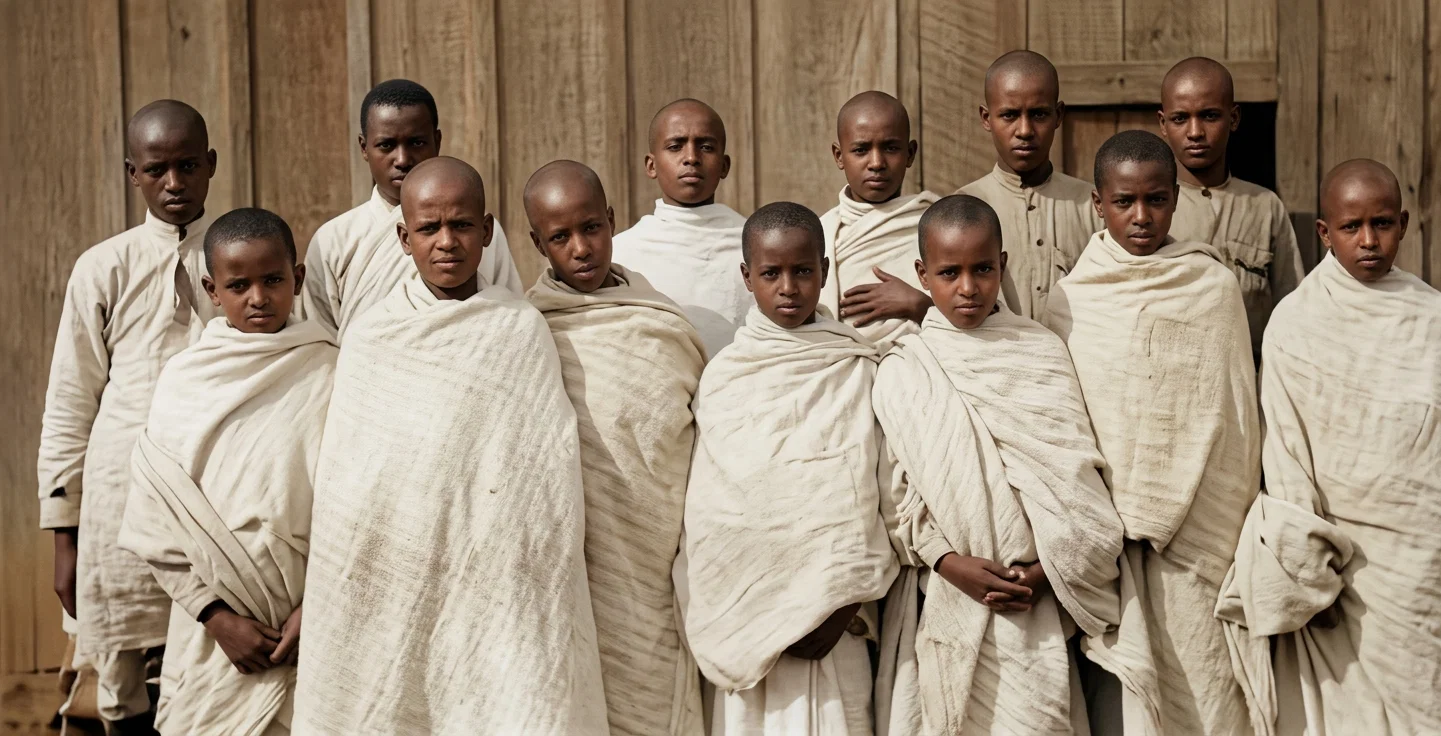
ASMARA BOY'S SCHOOL, ABYSSINIAN MISSION
We wish to thank the Iowa and Arkansas Conferences for sending us this splendid help in our time of need, and also desire to express our appreciation to the Pacific Union for the helpful and hard-working band of young people it has recently sent to Africa. They have all found their places, and are rendering excellent service.
Elder M. C. Sturdevant, who recently was obliged to relinquish mission work on account of failing health, located in the city of Johannesburg, where he began labor among both whites and natives. Already six Europeans have begun to keep the Sabbath, and many others are interested. Plans are now being laid to build a church in this city, which is much needed, for at the present time there is no appropriate place in which to hold services for those not of our faith.11
We are now appealing to the General Conference to send us a good minister for work among the Europeans in the Cape Conference, one who can work in the cities and towns. Many ears are open to hear the truth, and we believe now is the time to carry it to them. Brother Barend de Beer is laboring among the Dutch in the Cape Conference, and recently twelve or fourteen have begun to keep the Sabbath in the vicinity of Oudtshoorn. For all these that are coming to the truth we thank and praise God; but our hearts long to see a greater ingathering to the fold.
In our native work also we have much to encourage us. Among the Kafirs the work is going as never before, and continually some are receiving the truth. Brother A. P. Tarr, who recently has been acting as superintendent of the Tsungwesi Mission, and who has a thorough knowledge of the Xosa, is moving his family to the heart of Kafirland, where he will engage in evangelistic work as the way may open. Other workers will soon follow, and we trust that erelong a great light may be kindled among this powerful tribe.
During the past week an influential chief by the name of Khama has sent word to us desiring to see our representative men, as he wishes us to come and establish work on land that he may grant to us. We feel that the Lord may be opening a door for us here, and we shall enter in and see what he has for us.
We are glad to say also that our native work in Basutoland and the Orange Free State has reached a place where a superintendent is needed to look after its interests. The union conference has recently appointed Brother J. R. Campbell to this position, and he will enter at once upon his duties. The Lord has recently given us a Dutch minister, who has command of the Basuto language. He has been keeping the Sabbath for two years, and will now begin labor among the Basutos, to whom he is greatly attached.
We are planning to extend our work farther northwest in Rhodesia, toward the Kongo border, by planting out schools and by establishing a small station in that region.
The recent visit of Brother Spicer to our field has given a new inspiration to our work, and has been highly appreciated by us all. We in Africa feel that God is assisting us in the work, and we desire to be faithful until it is finished.
Truth Never Dies
TRUTH never dies. The ages come and
go;
The mountains wear away; the seas
retire;
Destruction lays earth’s mighty cities
low,
And empires, states, and dynasties expire;
But caught and handed onward by the
wise,
Truth never dies.
Though unreceived and scoffed at
through the years;
Though made the butt of ridicule and
jest;
Though held aloft for mockery and jeers,
Denied by those of transient power
possessed,
Insulted by the insolence of lies,
Truth never dies.
Truth answers not; it does not take
offense,
But with a mighty silence bides its
time:
As some great cliff that braves the ele-
ments,
And lifts through all the storms its
head sublime,
So truth, unmoved, its puny foes defies,
And never dies.
— Young People’s Weekly.
Abyssinian Mission
By Hans Steiner
HANS STEINER
RECENTLY we had quarterly meeting services here at the mission. The Lord was with us, and our hearts were stirred by the good testimonies of the young people.
Our school is making good progress. We hope soon to be able to start some outschools, to be conducted by our older students. We are sending the picture of some of our students. We accept all who express a desire for instruction, whether boys or men. We can give them plenty to do on the mission farm, and this gives us the opportunity to test the sincerity of their desire to know the truth. Abyssinians in general like to sit around and talk, rather than work. They are not very fond of study. But our school work and mission farm give opportunity for finding and developing the genuine among them. And the Lord is thus helping us to find some precious jewels.
Sabbath our little chapel was very full. Many visitors met with us, and some were present from Abyssinia itself. I spoke from Rev. 10: 5-9 in connection with chapter 14: 6-12. They listened very attentively.
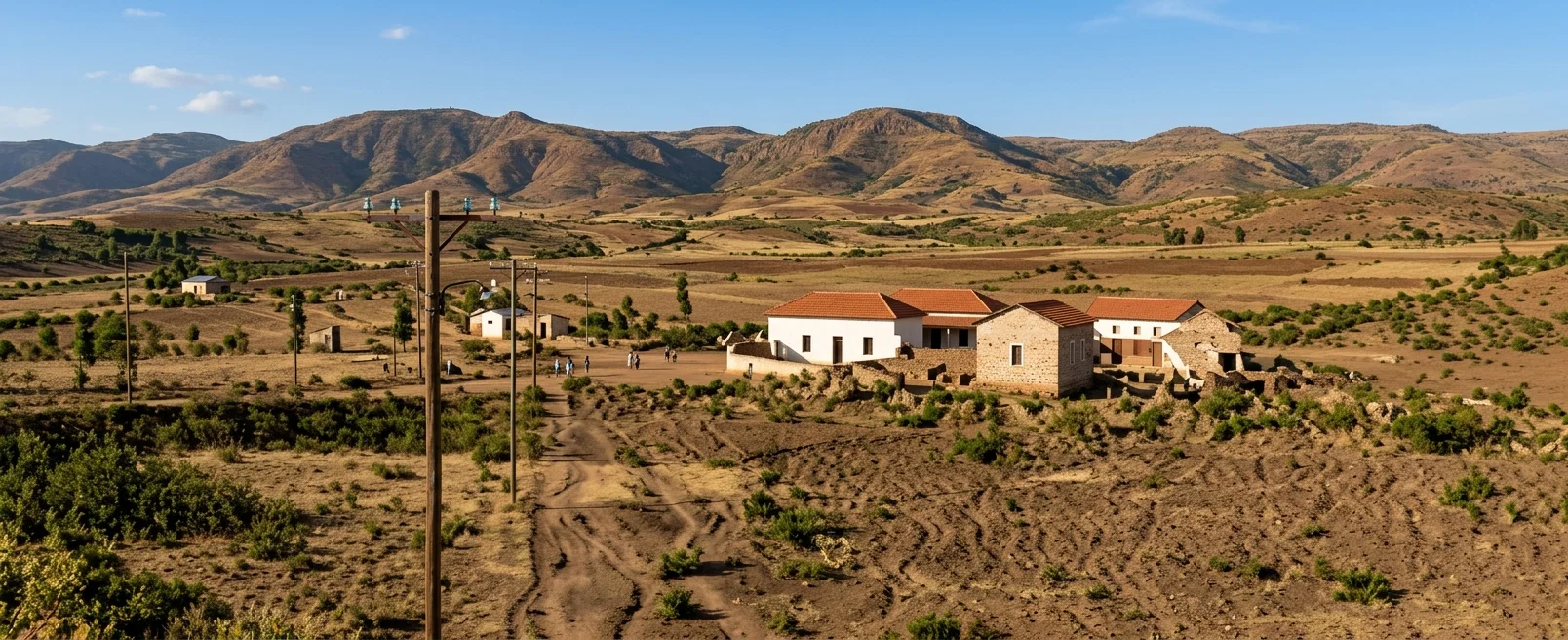
VIEW OF THE ASMARA MISSION
We now have an Abyssinian Seventh-day Adventist church. We certainly rejoice in this, and give God all the honor and glory. It has been through much travail of soul and earnest work that this result has been realized. We feel that nothing can now stop the onward progress of the true gospel here. Our prayer is that the work of God may develop and grow more and more, and that the saving message of truth shall sound throughout all these regions round about until a people from Abyssinia shall be ready to greet the Lord with joy when he comes. Join with us, dear brethren and sisters, in prayer that this may be so.