Your ShelfYour Projects

Review and Herald, Vol. 92, No. 53.

The Time of Trouble
Earlier text: Front Porch Visits

The Influence of Our Sanitariums

There can be no doubt in the mind of any one who has been connected with the work of the third angel’s message for any length of time that our sanitariums have exerted an influence which has been helpful in breaking down prejudice and in making friends with a superior class of people. Ministering to the sick is a work that will always commend itself to honest men and women. How much we owe to these institutions for the many openings we have had in home and foreign fields we may not be able to calculate, but we do know that the work they are doing is bearing the divine credentials. To the question of the messengers sent from John, “Art thou he that should come? or look we for another?” Jesus replied, “Go your way, and tell John what things ye have seen and heard; how that the blind see, the lame walk, the lepers are cleansed, the deaf hear, the dead are raised, to the poor the gospel is preached.” His deeds furnished the only reliable and convincing evidence that he was the Sent of God. Today this same ministry is to carry conviction, wherever the third angel’s message is proclaimed.
The impression made upon patients may be best illustrated by citing a few incidents from actual experience.
While in England a gentleman of means, after visiting the United States in search of health, was advised by his friends to call on me at my office in London for examination and advice. We were just opening our work, and in the absence of office equipment I examined him on the floor on my knees. The fact that I examined him on my knees may have had something to do with the results. After the examination, I gave him the best advice I could; and being a man of means, he handed me ten dollars. He started for his home in Australia.
At that time I had not dreamed of going to Australia, but two years later found me on my way to that continent. After my arrival, his friends notified him of it, and he at once looked up our sanitarium. He came for treatment, and was so impressed with what he saw and heard that he investigated the truth, and began the observance of the Sabbath.
He had in his employ a large force of men. One of the hardest tasks before him was to tell his foreman and employees of the change in his religious views, and that after this the Sabbath would be observed. He hardly knew how to proceed. On the arrival of his train at his home station, he was met by his foreman. He stepped off the train, shook hands, and at once, with trembling, said: “I wish to tell you I have begun to keep the seventh day of the week as the Sabbath.” To his surprise, the foreman replied: “Well, you are right. I have for some time been convinced that Saturday is the right day to keep.” The Lord gave him favor with all his employees. Some time later one of our ministers was called on to baptize seventeen persons as a result, directly and indirectly, of this man’s godly influence.
Later, a young man very much emaciated came for treatments. He improved in health, and was so favorably impressed with the spiritual atmosphere of the sanitarium that he, too, decided to keep the Sabbath and cast his lot with the people who were engaged in ministering to the sick. His mother, a most estimable woman of considerable means, had heard unfavorable reports about Seventh-day Adventists, and was naturally greatly troubled about her son. She said to me while visiting in Melbourne, her home city, “I fear he has not studied into your doctrines, but has been influenced by the lives of those who minister to him.” I advised her to visit him at the sanitarium and ascertain the facts, assuring her we had brought no pressure on him. She came soon after this, and brought her daughter with her. Together they studied the Bible, with the result that her daughter, too, decided she must keep the Sabbath. The mother, more perplexed than ever, hardly knew what to do; but being an honest searcher after truth, she was later led to see the importance of this message, and threw her all into the work. Her daughter afterwards took the nurses’ course, and later was sent as a missionary to Singapore. She was one of the most noble Christian young women we had the privilege of training while in Australia. The mother and the son have done much active missionary work, and have greatly assisted the cause with their means and influence.
During our stay in Australia, we were able to count thirty-three persons who had accepted present truth directly through the sanitarium work, not counting those who were brought into the truth through the individual effort of these converts. Among these were men of influence and means whom it would have been difficult to influence in any other way to investigate the truths we were advocating. There are other experiences as interesting as the ones already mentioned, but my purpose is merely to give a glimpse of what our sanitariums have done in the past, and what they, under the special blessing of God, may do in the future.
D. H. KRESS, M. D.

Noble Thoughts

“THEY are never alone who are accompanied by noble thoughts.”

Medical Missionary Department

W. A. RUBLE, M. D. - - General Secretary
L. A. HANSEN - - Assistant Secretary
H. W. MILLER, M. D. - - N. Am. Div. Secretary

More About the Oklahoma Trial

The conscientious keeping of God’s commandments is no longer to be admitted as a defense against religious laws in Oklahoma, if the decision of the court in the case of the State against J. G. and I. G. Krieger is allowed to stand. This trial, as many of our readers know, occurred at Watonga, Okla., August 3 and 4.
The statute which was intended to protect Seventh-day observers, and under which these men could hope to claim exemption, reads as follows:— “It is a sufficient defense for proceedings against servile labor on the first day of the week to show that the accused uniformly keeps another day as holy time,” etc.
The State constitution also makes the following declaration against the enforcement of religion:— “Perfect toleration of religious sentiment shall be secured, and no inhabitant of this State shall ever be molested on account of his or her mode of religious worship.”
These statutory and constitutional guaranties would certainly seem sufficient protection to the conscientious observer of the seventh-day Sabbath. We shall speak later of the weakness of these two provisions, supposed to guarantee liberty in religion. We wish to show that they failed entirely in this trial to supply the protection which they are supposed to give. The reason will be apparent as we proceed.
All through the trial, whenever the attorney for the defense asked a question that was calculated to show that the accused belonged to a church which keeps another day as holy time, and that they did in fact uniformly and conscientiously keep that day, it was opposed with the utmost determination. In the first part of the trial some of these objections were overruled by the court; later, things seemed to turn, and all testimony bearing on the subject of the religious faith of the individuals was ruled out entirely.
We give herewith a few questions bearing on this feature of the trial as they appear in the transcript of the evidence from the court records:—
“Direct examination of Isaac Krieger by Attorney Woolman for defendants:—
“Question.—What is your name?
“Answer.—Isaac G. Krieger.
“Ques.—Where do you live?
“Ans.—At Hitchcock.
“Ques.—How long have you lived there?
“Ans.—Little over ten years.
“Ques.—Are you one of the defendants in this case?
“Ans.—Yes, sir.
“Ques.—State to the jury of what religious faith you are.
“By Mr. Boardman: State objects to the question as incompetent, irrelevant, and immaterial; not defensive matter to the issue in the case.
“By the court: Sustained.
“By Mr. Woolman: Excepted.
“Ques.—Did you on the twentieth of June, 1915, belong to any religious sect?”
We quote only the following questions, as the State’s attorney made the same objections to each question, and the court sustained the objection, which was declared irrelevant by the court:—
“Ques.—I will ask you if at that time you kept and believed in another day as holy day, except Sunday, commonly called the first day of the week? . . .
“Ques.—Did you at that time and were you observing your day as holy day, and doing so from a conscientious belief of your religion? . . .
“Ques.—I will ask you, if you on June 20 and at any time within the last three years, have you ever performed any secular work on Saturday, commonly known as the seventh day of the week?”
At this juncture, the attorney for the defense asked that the jury be excused from the room while he made a statement to the court. In this statement he showed why he wished to produce the evidence which was being ruled against by the court. He showed that these men were conscientious observers of the seventh day, and that in no case had they violated the day they kept as holy time, and that for this reason they claimed the right to continue their work on the first day of the week. To all this the State’s attorney objected, and was sustained by the court.
We leave the reader to judge for himself as to the justice of the objections and the rulings of the court. To the writer, it certainly appears that in the face of the foregoing exemption, as well as the preceding quotation from the Oklahoma State constitution, there must be something radically wrong. If the spirit and intent of these statements are not calculated to protect the seventh-day Sabbath keeper, we ask, What do they mean?
Leaving this court decision against these Sabbath keepers, let us notice the defects in the statute and constitutional provision. In the first place, to one who is acquainted with the persistency by which a State-enforced religion seeks to rule or ruin, the decision of this court is no surprise. The evil is not so much a weakness in the statute calculated to exempt Seventh-day observers as it is a wickedness of the law which in this free land seeks to enforce the keeping of any day as the Sabbath. When the State of Oklahoma seeks to enforce a sabbath day, be it the true or the false, it has entered the realm of conscience and religion; and so long as it follows this course, it will do what every other State or nation has done when it has engaged in the same undertaking—it will foster deeds of injustice and bigotry against its most loyal and unoffending citizens. There is no alternative; it must deny the work begun, or follow it to its ultimate end. Unfortunately, its constitution makes it only willing to “tolerate religious sentiment,” instead of granting to all within its realm the fullest degree of religious liberty. We are sure these faults in the Oklahoma statutes were not intended by the people of the State, nor even by those who took part in their enactment; and we sincerely hope that the result of the above-mentioned trial may lead many to see and love the principles of religious liberty more than ever before.
I. A. CRANE.

“The Passing of the Medicine Bottle”

UNDER this heading the Ladies' Home Journal of October gives the following paragraphs, which must strike some of our readers as indicating a long stride toward rational therapeutics on the part of others than our own sanitarium supporters:—
“We are certainly making long strides forward when we read such words as these, and they concern us all because they concern our health. And it must be well borne in mind that the writer, Sir William Osler, M. D., is unquestionably the foremost living American physician and the highest authority on drugs in the medical world. He says what follows, in the Encyclopedia Americana:—
“The new school does not feel itself under obligation to give any medicine whatever, while a generation ago not only could few physicians have held their practice unless they did, but few would have thought it safe or scientific.
“Of course there are still many cases where the patient or the patient's friends must be humored by administering medicine, or alleged medicine, where it is not really needed, and indeed often where the buoyancy of mind, which is the real curative agent, can be created only by making him wait hopefully for the expected action of medicine; and some physicians still cannot unlearn their old training.
“But the change is great. The modern treatment of disease relies very greatly on the so-called natural methods, diet and exercise, bathing and massage; in other words, giving the natural forces the fullest scope by easy and thorough nutrition, increased flow of blood, and removal of obstructions to the excretory system or to circulation in the tissues.
“One notable example is typhoid fever. At the outset of the nineteenth century it was treated with “remedies” of the extremest violence—bleeding and blistering, vomiting and purging, antimony and calomel, and other heroic remedies. Now the patient is bathed and nursed and carefully tended, but rarely given medicine.
“This is the result of the remarkable experiments of the Paris and Vienna schools in the action of drugs, which have shaken the stoutest faiths; and partly of the constant and reproachful object lesson of homeopathy. No regular physician would ever admit that the homeopathic “infinitesimals” could do any good as direct curative agents; and yet it was perfectly certain that homeopaths lost no more of their patients than others. There was but one conclusion to draw, that most drugs had no effect whatever on the diseases for which they were administered.”
L. A. HANSEN.

Religious Liberty Department

C. S. LONGACRE                     N. Am. Div. Secretary

Obituaries

Christiansen.—Rose Bernice Christiansen was born in Berrien Springs, Mich., Nov. 9, 1902, and died in Viola, Idaho, Sept. 24, 1915. Her parents and a younger sister are left to mourn, but they sorrow in hope, for the deceased was an earnest Christian. A. M. Dart.
Kleinfeld.—Edeth Kleinfeld was born in Prussia, Germany, Sept. 23, 1847, and died in the General Hospital of Vancouver, British Columbia, Sept. 15, 1915. She was a member of the Laduce (Alberta) Seventh-day Adventist Church, and was an earnest, faithful Christian. Her husband is left to mourn. A. O. Burrill.
Williman.—Julia Williman died in Houston, Tex., Sept. 22, 1915. She was born in Harlem, N. Y., May 22, 1862. About sixteen years ago she accepted present truth, and continued faithful to this belief until the close of her life, rejoicing in the advancement of the third angel’s message. During a long sickness she was fully resigned to the will of the Lord. Her husband, two sons, and an adopted daughter are left to mourn. E. L. Neff.
Corey.—Frederick E. Corey was born in Richland, Mich., Jan. 14, 1837, and died at his home in Battle Creek, Mich., Oct. 11, 1915. He was married to Carrie M. Babcock in 1864. Two children, a son and a daughter, were born to them. A short time after his marriage he accepted the third angel’s message, and was baptized by Elder T. M. Steward. He was faithful to this belief “even unto death.” He leaves a beloved wife, two children, and a brother and a sister. G. E. Langdon.
Colby.—Mary Ann Colby was born in Irasburg, Vt., Jan. 27, 1833, and died at the home of her daughter, in Bolivar, N. Y., Sept. 30, 1915. For over sixty-one years she was a believer in present truth, and during the early days of the work in New England she and Elder Hutchins and his wife were closely associated in labor. She was faithful unto death, and her long life was one of patient continuance in well-doing. Among those left to mourn are a son and a daughter, one sister and two brothers. H. Lesley Shoup.
Garlick.—Robert Garlick was born in Livingston County, New York, May 16, 1837, and died July 30, 1915, at his home, in Grand Rapids, Mich. He was married to Elizabeth J. Tucker in 1872. Ten children were born to them, seven of whom, with their mother, are left to mourn. J. Melvin Wilbur.
Campbell.—Myrtel Campbell fell asleep in Jesus Sept. 25, 1915. The family moved to Santa Rosa, Fla., five years ago, and three years later Sister Campbell accepted present truth, remaining faithful until her sudden death, at the age of thirty-five years. Words of comfort were spoken by the writer from Rev. 14:13. W. C. Vaughn.
Brown.—Samuel Brown died suddenly Aug. 23, 1915, aged 80 years, 6 months, and 27 days. He was not a member of the Seventh-day Adventist Church, but he believed the truths of the third angel’s message. The deceased was a good neighbor, a kind father, and a devoted husband. His wife and five children survive. The funeral service was conducted by the writer. F. H. Robbins.
Howson.—Thomas Howson was born in Canada, Jan. 1, 1834, and died in Portland, Oregon, Sept. 25, 1915, at the advanced age of eighty-one years. An aged wife and three sons are left to mourn. Brother Howson accepted present truth in 1869, and for forty-six years was a faithful member of the Seventh-day Adventist Church. During the last few years of his life he was especially zealous in Christian service, and we are confident that he sleeps in Jesus. E. W. Catlin.
Buckland.—William G. Buckland was born in Gates, Monroe Co., N. Y., Aug. 2, 1836, and died at his home, in Lockport, N. Y., May 19, 1915. He was connected with the Seventh-day Adventist Church for nearly sixty years, and at the time of his death held membership with the company at Burt, N. Y. Brother Buckland was married to Nancy M. Cottrell, daughter of Elder R. F. Cottrell, and to them were born two daughters. The wife and one daughter, with a sister and two brothers, survive.
Furman.—Amelia H. Boyer was born in Pennsylvania in 1847. Her first husband was a Mr. Collins, and five children were born to them, two of whom survive. Being left a widow, she married W. A. Furman, an old soldier. Sister Furman was for many years an earnest believer in the third angel’s message, and held membership in the Seventh-day Adventist Church at Victor, Colo. She was widely known, and held in high esteem as a neighbor and friend. Sister Furman died at Ft. Dodge, Kans., Sept. 27, 1915. J. Scott Moore.
Stickney.—Anne T. Coombs was born in Whitefield, Maine, Sept. 6, 1826. In 1847 she was married to Ruel Stickney. They became believers in the advent message in 1854. In 1862 they joined the pioneer settlers in California. Seven years later they first heard the Sabbath truth, and in 1872 united with the Healdsburg Seventh-day Adventist Church. She was an invalid during the last years of her life, but she never murmured or complained, and fell asleep in Jesus at the home of her daughter, in Ukiah, Cal., Sept. 9, 1915. Four children are left to mourn. W. P. Dayton.
Hoyt.—Tina Ruth Jorgensen was born in Montcalm County, Michigan, June 11, 1885, and died in Battle Creek, Mich., Sept. 28, 1915. Her early life was devoted to educational work. After finishing the common school she attended Cedar Lake Academy, and later the college at Berrien Springs. Then for several years she taught church school. May 7, 1907, she was married to J. M. Hoyt. Their one child, a son, died in infancy. Her life was that of a consistent Christian, and an inspiration to all who knew her. Besides her husband, her parents, four sisters, and three brothers are left to mourn. C. F. McVagh.

The Fall Council

ARRANGEMENTS are being perfected for a party to leave Chicago Monday evening, November 1, for the council at Loma Linda. It has been thought that the number of delegates to this council will be sufficient to make it well advisable to procure one or more special tourist sleeping cars; we could then have their exclusive use. The car will leave on the Rock Island Railroad, take the Golden State route, via Kansas City, Topeka, El Paso, and Tucson, to Los Angeles. This means a sixty-eight-hour run from Chicago to Los Angeles, arriving at the latter place at 2:30 P. M., Thursday, November 4.
We shall be glad to hear from any who would like to join this party and can arrange to be in Chicago in time to get this train. The Rock Island train leaves from the La Salle Street station. Those who can get better rates near at home, can buy their tickets via Chicago, but have them routed on the Rock Island Golden State route. They should send word to the undersigned so that reservation can be made for them in the tourist sleeper. The tourist rate is $7 for return trip. The round-trip excursion rate from Chicago is $62.50. All can readily determine whether or not it will be cheaper to buy a through ticket nearer home or to buy to Chicago and then get the excursion rate from this point.
Some inquiry has been made relative to the best scenic routes returning. It is advised that the return trip be by way of the Western Pacific, and the Denver and Rio Grande to Denver, and then on almost any road east of Denver. Delegates will suit their own time and convenience in returning, as we shall not attempt to have special cars on the return train. All who desire to go with this party and wish to have reservation made in the tourist sleeper, should write us at once, addressing W. A. Westworth, Transportation Agent, 3645 Ogden Ave., Chicago, Ill.

Annual Meeting of the Michigan Sanitarium and Benevolent Association

The eighteenth annual meeting of the Michigan Sanitarium and Benevolent Association for the year 1915 will be held in the chapel of the Battle Creek Sanitarium, on North Washington Avenue, Battle Creek, Mich., Tuesday, Nov. 9, 1915, at 3 P. M., standard time, for the election of trustees and the transaction of such business as may properly come before the meeting.
By order of the board of trustees.
GEORGE E. JUDD, Secretary.

College of Medical Evangelists

Constituency Meeting

In harmony with the adjournment taken March 24, 1915, a special session of the constituency of the College of Medical Evangelists is called to convene at Loma Linda, Cal., at 11:30 A. M., Nov. 10, 1915, for the purpose of transacting such business as may properly come before the meeting.
E. E. ANDROSS, President; S. S. MERRILL, Secretary.

NOTICES AND APPOINTMENTS

NOTICES AND APPOINTMENTS

Here Is the Chance to Save Money
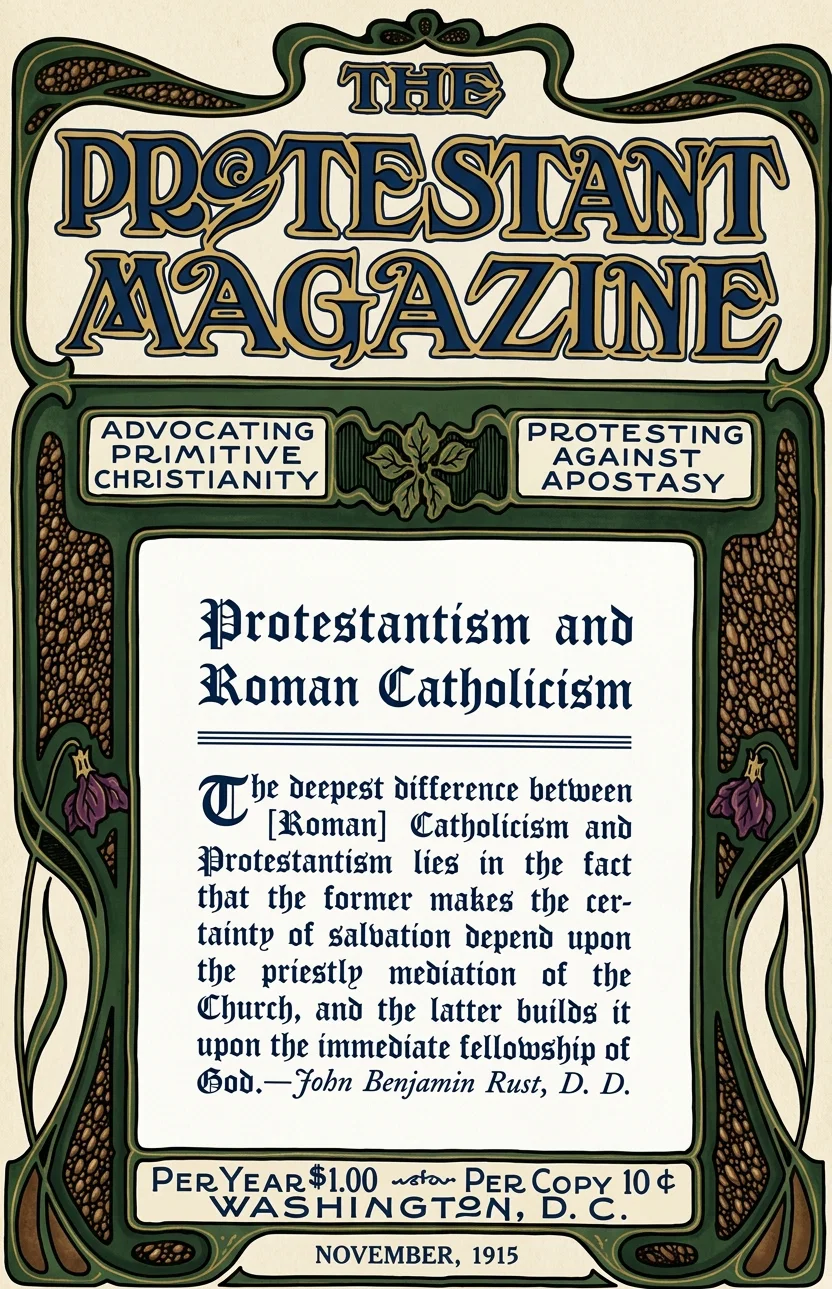
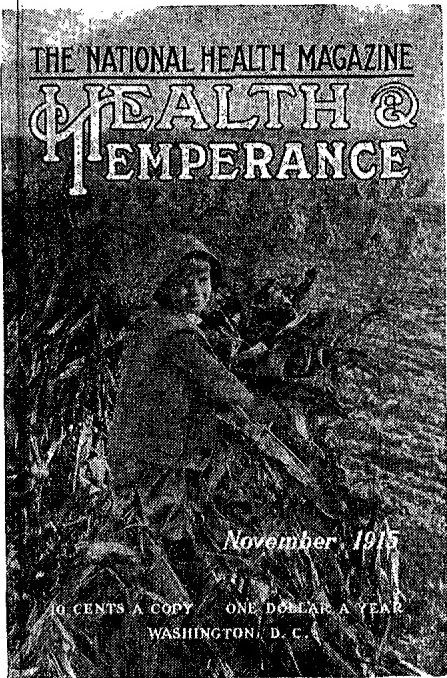
THE THREE LEADING MAGAZINES—CONSTANTLY ON GUARD
To old and new subscribers
3
HEALTH AND TEMPERANCE THE PROTESTANT MAGAZINE LIBERTY MAGAZINE
3
Sample each of current numbers, 25 cents

Subscribe for Three Years

$7.05
Regular price all three magazines for three years
Special combination price
$4.90
A Saving to You of
$2.15
No more worrying about renewals. Enjoy three years of good reading.
Order Through Your Tract Society
Magazine Department, Review and Herald Publishing Assn.
Takoma Park Station, Washington, D. C.

HOLIDAY SHOPPING

Already large advertisements are being printed in magazines and daily papers, advising people to “shop early” and thus avoid the holiday rush. This is good advice, and many persons are already making their selections of Christmas gifts. No doubt many who read this are thinking of what they are going to present to their friends the coming holiday season.
A good book is one of the best gifts. Why not help your neighbors do their Christmas shopping by getting them to buy one of our good books? Send one dollar to your tract society for a

HOME WORKERS’ PROSPECTUS

which shows sample pages and covers of twenty-four splendid books—something to please all. Many with no previous experience have had good success. Old and young are alike successful in this work. Begin now, and thus do a real missionary service and turn the holiday season into a blessing, the results of which will be seen in the kingdom.
ORDER FROM YOUR TRACT SOCIETY

HOLIDAY SUGGESTIONS

In planning your holiday gifts, why not decide to give your friends a set of the Berean Library? This set of twelve volumes contains some of the most important books for this time—books on prophecy, showing its rapid fulfillment, and the importance of being ready for the coming King; books on Christian experience, the coming of the Lord, the home of the saved, etc. No one can read this set of books without being greatly blessed, and convinced of the truth for this time.
Read this list of books contained in this library:—
No. 1. Steps to Christ No. 7. Capital and Labor No. 2. Thoughts on Daniel No. 8. Here and Hereafter No. 3. Thoughts on the Revelation No. 9. Bible Footlights No. 4. His Glorious Appearing No. 10. Our Paradise Home No. 5. Sabbath in the Scriptures No. 11. Religious Liberty in America No. 6. Sabbath in History No. 12. The Coming King
Total cost of the 12 volumes, postpaid, $3.60. Six or more sets, $2.16 per set, express extra.
ORDER FROM YOUR TRACT SOCIETY

New Bible Studies by Correspondence

THE Fireside Correspondence School wishes to announce four new Bible studies—for the fourth, fifth, sixth, and seventh grades respectively. These lessons are based on Mrs. McKibbin’s “Bible Lessons,” used in these grades in all the primary schools of the denomination. Probably half our children and young people of these grades are still in the public schools, where they have no opportunity to study the Bible. A little later, when they enter our intermediate schools or academies, they will find themselves behind in Bible study and will have this work to make up. By means of these correspondence lessons this work may be done in addition to their other lessons in the public schools or during the summer vacation. Or they may begin the work this winter and finish during the summer vacation. I hope our parents will note the importance of this matter, and will see to it that their children obtain the benefit afforded by this opportunity. All who are interested should at once address the Fireside Correspondence School, Takoma Park, D. C., for further information.
C. C. LEWIS, Principal.

“In Memoriam”

THIS little book gives a brief history of the life and work of Mrs. E. G. White, her last sickness, and the funeral service, including a verbatim report of the funeral sermon. It is beautifully illustrated with pictures taken at the funeral and the grave, and portraits of Mrs. E. G. White, and Elders James White, Joseph Bates, J. N. Andrews, J. H. Waggoner, J. G. Matteson, Uriah Smith, G. A. Irwin, and O. A. Olsen, all of whom have been laid to rest waiting the call of the Life-giver. This little booklet will be greatly prized by all who were acquainted with Sister White or her work.
Price, only 10 cents. Order of your tract society.

Harvest Ingathering

THE Pacific Press has begun the third edition of the Harvest Ingathering Signs, which, when printed, will make a total of 800,000 copies.
October 21, 708,000 papers had been mailed, with orders still coming in rapidly. Thirty-seven local conferences and seven union conferences have ordered more papers than last year.
The autumn weeks now passing are the most favorable time we shall have for soliciting for missions. A little later the minds of people will be filled with holiday shopping, and unfavorable weather will come on. The weeks now passing, therefore, must determine largely what our success this year will be.
One conference president writes: “We are taking an active interest in the Harvest Ingathering campaign this year, and hope to bring our returns up much above last year. We are planning for a strong campaign, and I trust we shall see the result of our efforts in the actual gathering of funds.”
A telegram from St. John, New Brunswick, October 21, reads: “Maritime has more than reached its quota for Harvest Ingathering.” T. E. BOWEN.

The Statistical Report

The statistical report for 1914 presents some very encouraging features. During the year, 113 churches were added, with a membership of 11,287, making a total of 3,700 churches, with a membership of 125,844. This gain for 1914 was 9.85 per cent., the highest former gain being 7.16. This message is now being carried forward in 87 different countries, with a total force of laborers, including institutional workers, of 9,360. This is an average of one laborer for every thirteen church members.
These figures give evidence of a living movement going throughout the earth, one in which God is manifesting his power for the salvation of men.

A Quarterly Awakens Interest in Truth

The following interesting incident, from the Australasian Record, shows how the Lord can use even a Sabbath School Lesson Quarterly to awaken an interest in the truth: “In the sowing of gospel seed beside all waters, some seeds find fertile soil. Brother E. D. Thomas, in South India, relates that one hot day, beneath the equatorial sun, an elderly gentleman came into the mission compound at Nazareth. The traveler had a booklet [the Sabbath School Quarterly on Topical Studies on the Message] which he handed to Brother Thomas, inquiring whether the Seventh-day Adventists published it. On receiving an affirmative reply, his joy was manifestly great. He said: ‘I have come walking such a long distance [fifty miles] to see the faces of the people who believe in such a grand truth as is revealed by this booklet, and to get acquainted with them. This book has been my spiritual meat in my old days. I have spent hours upon hours under the banyan tree near my house, reading and studying it.’ He remained a few days at the mission, and returned a firm believer in the truths of the Sabbath and the near coming of Jesus. He took a quantity of literature with him.”

Sabbath School Mission Giving

It is a cheering report that comes from the Sabbath School Department. In the first quarter of 1915, $93,581.45 was given by the Sabbath schools for missions. The Sabbath School Worker, summing up the record of gifts for the years, says: “Thus $2,039,048.56 has been deposited by our Sabbath schools in the bank of heaven in a little over twenty-eight years. How we should rejoice that this two millions of dollars has helped so substantially in fulfilling God’s plan of sending the message to ‘every nation, and kindred, and tongue, and people.’ We know not how many precious souls will be saved in the kingdom of God as the direct fruit of these freely given dollars. Who could wish that the dollars were fewer in number? Who does not wish they were many times multiplied? But the account is not yet closed. Week by week we may still add to the deposit; and let us give as we would give if it were our boys and girls, our fathers and mothers, our friends and neighbors, who were in heathen lands with no knowledge of the truth that is so dear to us.”

Nurses Sail for Porto Rico

On October 16 the Misses Edith and Ethel Frye sailed from New York for Porto Rico, in response to an urgent call from that field for two experienced lady nurses. They received their training in the New England Sanitarium, at Melrose.

Professor Salisbury Travels via China

News has come that Prof. H. R. Salisbury is on his way to the fall council, coming by way of China and the Pacific Ocean. It is probable that he will also return by that same route, on account of the danger and uncertainty attending travel by the usual route across the Atlantic Ocean and through the Mediterranean Sea and the Suez Canal.

Adventist Workers Enter Central America

ANOTHER country is added to our list. On September 23 Brother John L. Brown, Sister Brown, and their little boy sailed from Santiago, Cuba, for Central America, to pioneer the work in the republic of Salvador. They are the first Seventh-day Adventist workers to enter that field. Brother Brown will begin the work with our literature. He has for several years been laboring in Spain, but recently returned to work in Spanish-American fields. On the same boat Brother and Sister C. F. Innis and their little daughter sailed from Cuba for Guatemala. Brother Innis will engage in the colporteur work in Guatemala, and Sister Innis will help in the office.

First Sabbath Keeper Baptized on Mangaia

THE first Sabbath keeper to take his stand for present truth on Mangaia, Cook Islands, was baptized on Sabbath, August 14, by Pastor Sterling, after which the ordinances of the Lord's house were celebrated. Brother Sterling writes that he is encouraged by the outlook on Mangaia.
Continue reading: Missionaries Sail for Shanghai