THE proposition to rear a monument in honor of Lord Baltimore as founder of the colony of Maryland would seem to be eminently proper; for whether we consider the personal character of the man, his zeal and enterprise as the projector of a colony in the New World, or the magnificent results that have attended his settlements on the shores of the Chesapeake, his fame is as truly meritorious as that of the founder of any other commercial enterprise in America. In this day of multiform centennial glorification let not the name of Cecilius Calvert be overlooked.
But it is to be hoped that his co-religionists—the Romanists—of the present day will not compromise themselves, nor mar the fair fame of an honorable man of affairs by persisting in claiming for him, an honor to which he did not aspire, and an administration of the colony which he had no authority to grant—that of being the pioneer, founder, and patron of religious liberty in the American colonies. If the leaders of Romanist thought in the United States, and especially in Maryland, really desire to conciliate their Protestant fellow-citizens, and to verify the truth of history, they have on this occasion a fine opportunity to retire from an offensive and untenable position—to recede from their wonted claim for Lord Baltimore—a claim inconsistent with an essential, abiding principle of their own church; false, in fact, and impossible according to the terms of the charter of Maryland.
The writer has in his possession an old folio volume containing a copy of the original charter of Maryland in Latin and English, and colonial records and acts of the assembly from 1637 to 1765. These furnish incontestible evidence that religious liberty in the colony of Maryland was not contemplated by Charles I., who granted the charter; that such liberty was never accorded to the colonists by the proprietor or his lieutenants, and never secured to the freemen by acts of the assembly. On the contrary, acts were at times passed on the subject of religion as intolerant, fierce, and bloody as any to be found in force elsewhere in the Old World or in the New. Compared with some of Maryland’s “religious liberty” enactments, under the Calverts, the “Blue Laws” of Connecticut were “gentle doves,” and the laws which hung Quakers in Boston, and witches in Salem, were righteous regulations.
The charter patent granted by Charles I. to Lord Baltimore incorporating the Province of Maryland opens with the usual preamble and the terms of the general purpose of the grant. Then follows a particular designation of the geographical metes and bounds of the region to be occupied. That is followed by an extended enumeration of the rights, franchises, and authority confirmed unto the proprietor, his heirs and assignees, “in and to the region designated, its soils, woods, marshes, lakes, rivers, bays, islands, etc., with fishings of every kind of fish, as well of whales and sturgeon and other royal fish as of other fish; and, moreover, the opening and working of veins, mines, and quarries.” And then occurs the following: “And furthermore, the patronage and advowsons of all churches which—with the increasing worship and religion of Christ—within the said region, islands, islets, and limits aforesaid, hereafter shall happen to be built, together with license and faculty of erecting and founding churches, chapels, and places of worship in convenient and suitable places within the premises, and of causing the same to be dedicated and consecrated according to the ecclesiastical laws of our kingdom of England; with all and singular such, and as ample rights, jurisdictions, privileges, prerogatives, royalties, liberties, immunities, and royal rights, and temporal franchises whatsoever, as well by sea as by land, within the region, islands, islets, and limits aforesaid, to be had, exercised, used, and enjoyed as any Bishop of Durham within the bishopric or country—Palatine of Durham, in our kingdom of England, ever heretofore hath had, held, used, or enjoyed, or of right could, or ought to have, hold, use, or enjoy.”
The above is all that Lord Baltimore’s charter contains on the special subject of religion or ecclesiastical affairs. It is proper to explain the reference to “the Palatine county of Durham.” At that period there were in England three Palatine counties—those of Chester, Lancaster, and Durham. They were called Palatine because the proprietors exercised, each in his county, royal prerogatives as a king in his palace. In the case of Durham the bishop was the proprietor, and hence he exercised the chief authority in the county, both civil and ecclesiastical; he was, in fact, a royal bishop of the county, which was, at the same time, his diocese. Taking, therefore, the Palatine county of Durham and the jurisdiction of its bishop proprietor as the model and measure of corresponding authority in Maryland, that colony was thus constituted a Palatine province, and its proprietor invested with an episcopal oversight of its churches.
But while the proprietor of Maryland was thus invested with Palatine, episcopal authority, the terms of the charter were not mandatory. He might found churches and chapels, but he was not required to found them; and then all such places of worship that might happen to be established must be “dedicated, consecrated,” and ordered after the model and according to the ritual of the established Church of England, observed in the Palatine county of Durham.
Manifestly, then, according to the terms of his charter, the proprietor of Maryland could not officially tolerate any form of dissent from the established Church of England, nor could he lawfully found or dedicate in the province a dissenting meeting-house, church, or chapel; neither was it in his power, as Lord Palatine of the province, to authorize or permit other persons to establish within his jurisdiction such places of worship for the use of dissenters from the form and faith of the Church of England.
Much less could Cecilius Calvert, or any of his successors, holding under his original charter, lawfully establish and proclaim the general principle of personal religious liberty. The very idea of such liberty was alien to all existing ecclesiastical institutions, and as an actuality, then, nowhere to be found.349It appears, however, that the Romanist Lords of Baltimore, or their representatives in the province, did not molest dissenters from the English established church, for the reason that, being themselves dissenters, they could not consistently or prudently enforce upon others those charter principles which they themselves were openly violating. And thus the ideal church of the province of Maryland, designed after the model of the Palatine Church of Durham, became from the first a nullity; while there prevailed for a time a degree of religious freedom in which all dissenters participated—Romanists and Protestants alike.
Now if for this happy state of the church in Maryland, Lord Baltimore was entitled to thanks, it must have been on the principle of a certain man who generously gave away his neighbor’s apples. As this man was helping himself to apples one day in his neighbor’s orchard, a stranger came along who, supposing him to be the proprietor, politely asked permission to gather a few apples. “Certainly,” said the supposed proprietor, “help yourself; take as many as you want.” When the stranger had filled his pockets with the choice fruit, he was quite profuse in his thanks for the kindness. “Oh, no,” replied the other, “don’t thank me; these apples are not mine. I am myself stealing them just as you are.”
It is evident Lord Baltimore had no authority to grant religious liberty to his colonists, and it is equally manifest he had no intention of granting such privilege to his followers. It could not have been his original purpose to found a State on the principle of general religious liberty; for then, as an honest, candid man, he would have refused a charter which forbade the granting of that liberty. Nor did his lordship or his Romanist adherents subsequently intend to establish universal religious freedom in the colony. This is evident from their public acts.
At a general assembly held at St. John’s, and terminating March 19, 1638—about four years from the founding of the colony—an act was passed on the closing day of the session ordaining certain laws for the government of the province, of which the first was, “That holy church within this province shall have all her rights and liberties.” At an assembly held at the same place two years later, 1640, “An Act for Church Liberties” was passed October 23, ordaining “that holy church within this province shall have and enjoy all her rights, liberties, and franchises, wholly and without blemish.” This was subsequently confirmed as a perpetual law.
Now, why this special legislation in behalf of “holy church”? Why were not all the churches, any and all sects, included if universal religious toleration was the design of the benevolent and enlightened proprietor and his general assembly? Why the necessity of this special legislation? If liberty of worship had been from the first legally accorded to all dissenting sects, the Romanists enjoyed it in common with all the rest; and hence they did not need this special protection; but if they, or any other dissenters, required legislative protection, all did, and to limit such legal assurance to one sect was not universal toleration. The authors of this partial and special toleration, therefore, could not have been those pioneers of universal liberty of conscience of whom we hear so much at this time.
—Paul Le Clair, in Converted Catholic.
The W. C. T. U. and Politics.
REGARDING the recent convention of the Woman’s Christian Temperance Union at Chicago, the following is from the press dispatches:—
The event of the session was the report of the Committee on Resolutions touching the non-partisan question. The majority report says:—
“We believe it is vital to temperance reform that the principle of prohibition be made the dominant issue in American politics. We therefore give our approval to that party only which declares in its platform for prohibition in the State and nation, and stands in action for its application to law.”
The minority report was brought in by Mrs. Mattie M. Bailey, of the Iowa delegation, and read as follows:—
“That the recent amendment contests demonstrate the need of more persistent and persuasive educational temperance work among all classes of people; the results of these several contests have given us practical proof that the success in the effort for the overthrow of the legalized liquor traffic can only be assured where the intelligent convictions of the people are in favor of prohibition, and that defeat is certain where such convictions are lacking; therefore, resolved, further, that as forty odd departments of the W. C. T. U. work are for no party, but are for the education of the people in the truths of total abstinence and prohibition, and as we have in our membership women whose differing political preferences lead them to sympathize with and support different political parties, therefore it is unjust and unwise for this organization to pledge its influence, support, or allegiance to any political party.
“Unjust because if this organization is non-partisan, as our president has lately declared, such a pledge of influence, support, or allegiance, representatively given, interferes with the individual freedom of any and every member to prefer and work for the political party of her choice. Unwise because in the practical carrying out of that pledge our religious and educational work is thereby subjected to party limitations and antagonized by disastrous partisan opposition,”
Mrs. Foster and Mrs. Bailey spoke in favor of the adoption of the minority report. Mrs. Clara Hoffman spoke against its adoption. The majority report was adopted. The Iowa delegates alone voted in favor of the minority report.
At this point Mrs. J. Ellen Foster arose and read a long protest on behalf of the Iowa delegation, setting forth that they had met with rebuffs and insults until forbearance had ceased to be a virtue. At the conclusion of the reading the entire Iowa delegation left the hall.
The Right to Rest.
By Ellet Joseph Waggoner
The Rev. Dr. W. W. Evarts, of Chicago, is an active worker for a national Sunday law, and, like all his companions in the work, he uses arguments which, on account of their weakness, he would be ashamed to use in any other cause. The Golden Censer published a portion of one of his speeches some time ago, from which we extract the following:—
“It is not proposed to make people pious, to compel them to pray, but to protect those who wish to worship and pursue higher education. It is not declared, You shall be a Catholic, or a Protestant, or a Mohammedan, or a Jew, or anything of the sort. The church wants to give the people a day that is necessary for all men alike. Every man knows the necessity for it if he knows himself at all. One day in seven, it is that right the Sabbath law protects, and that is all. The church simply gives the right, guards the right, for all men.”
Notice first the expression, “The church wants to give the people a day.” The same idea is even more strongly expressed in the paragraph preceding the one just quoted, in which we find the statement, “The church, by enforcing the Sabbath, is taking better care of humanity than liberty leagues or infidel reformers.” So, notwithstanding their pleading for a civil Sunday, we have an admission by one of the leaders in350the movement, that it is purely a church affair, and that although when the law is passed the State will be the nominal enforcer of it, the church will be the real power behind it. In other words, the State will be the cat’s paw for the church; yet we doubt not that if Dr. Evarts were asked directly if the Sunday movement is religious in its nature, he would say no. It is strange how this Sunday-law craze leads people virtually to deny any connection between the church and religion.
But the point which we wish particularly to notice is the idea that the Sunday law is designed simply to protect the people’s right to rest and to worship. We can scarcely imagine how such an argument as this should deceive anybody, for anyone can see that the object is entirely different. Granting that it is everybody’s right to rest on Sunday, suppose there are some who do not wish to avail themselves of that right, what will the State do in that case under a rigid Sunday law?—It will say, You must do so. In other words, it will declare that nobody has a right to choose his own day for rest and worship, and so instead of preserving rights, it will deprive people of their rights. As a matter of fact, everybody has a right to be protected in resting on Sunday, provided he wishes to do so. If a movement were set on foot to deprive people of their right to rest on Sunday it would find no more vigorous opposer than the AMERICAN SENTINEL; but who ever heard of any such a movement being started? Who ever heard of such a thing as an attempt to secure a law forbidding people to rest on Sunday?—No one. The fact is that under our present Constitution everybody has that right, and everybody who wishes to avail himself of it is protected in it.
There is no necessity for a Sunday law in order to protect people in their right to worship on Sunday. This plea for a Sunday law, on the ground that it is necessary to protect people in their right to Sunday rest, is equivalent to saying that those who wish to rest cannot do so unless everybody else does.
Suppose I get tired and want to take a holiday, making a trip into the country. Everybody will say that I have a right to do so if I can afford it; but I demur. I raise a great ado and say that the State has to protect me in that right. Our Sunday-law friends would tell me that the State does protect me in that right; that if anyone should attempt forcibly to restrain me from pursuing my journey, the State would punish him; but I say, No, I am not protected in my right to take a holiday trip to the country, unless the State shall compel everybody else to go with me. While I am going to the country there are scores of people who would go about their business as usual, and I ask that they be compelled to take a holiday too, in order that I may be protected in my right to recreation! Anyone can see the nonsense of this, and yet this very argument is used in behalf of Sunday laws. The idea that one person cannot rest because someone else happens to be working, was never heard of until necessity compelled the movers for a national Sunday law to invent it. It is not the language of reason, but of bigotry; it is the language of those who wish to compel everybody to do as they do.
That a law compelling all to rest is not necessary in order to protect all in their right to rest is shown by the fact that people keep the seventh day, concerning which no civil law has ever been made, and they feel that they have a right to do this. We know of several instances where a very few observers of the seventh day live alone in the midst of a very large city, surrounded by thousands who pay no regard whatever to that day; and yet this few feel that they have a right to observe the seventh day if they wish to, and they do so, and find no difficulty whatever. They do not ask for a law compelling other people to rest on that day in order that they may be protected in their right. Yet they surely have the same right to be protected in their observance of the seventh day as others have in their observance of the first. If not, we would like to know why not. Those who admit that they have a right to be protected in their seventh-day rest thereby relinquish all claims for a national Sunday law; and those who will not admit that they have the right, thereby admit that they desire class legislation which will favor some but which will work injustice to others who are equally deserving. We would like to have our friends think seriously of this matter and state whether they believe that the only persons in this country who have any rights are those who observe Sunday. E. J. W.
Religious Education by the State.
By A. Delos Westcott
In a plea for religious instruction by the State, Rev. Geo. B. Cheever asks the following question:—
“Shall God himself be intrusted with the dominion over the consciences of rational beings instructed by his own laws and providences, or shall the States, by majority of voters, uninstructed from infancy in the holy requisitions of God’s law, be the supreme governors of the human soul?”
Here are really two questions; and of course Mr. Cheever intends that the first one shall be answered in the affirmative, and the second one in the negative. In this view, the questions contain the very essence of the doctrine always advocated by the AMERICAN SENTINEL, and are exactly opposed to the principles of so-called National Reform. For whenever religion is put into the hands of the State, an attempt is made to transfer “the dominion over the consciences of rational beings” from God to the State. There is no dodging this conclusion, because Mr. Cheever admits all through his article that this is emphatically a case of conscience.
Our proposition is still further confirmed by Mr. Cheever’s second question. This question shows that in his mind the reason why the States should not “be the supreme governors of the human soul,” lies in the fact that the “majority of voters” are “uninstructed from infancy in the holy requisitions of God’s law.” Mr. Cheever must intend to convey the idea either that the majority of voters will always remain uninstructed “in the holy requisitions of God’s law,” and therefore the States can never become “the supreme governors of the human soul,” or else that the time may come when the majority of voters will be instructed in the requisitions of God’s law, and that when they are so instructed it will then be perfectly proper for the States to “be the supreme governors of the human soul.” Evidently the latter view is the one which he indorses; for the sole object of his lengthy argument is to show the necessity and utility of religious instruction provided by the State. Only let the States instruct “the majority of voters” “in the holy requisitions of God’s law,” and they will be eminently fitted to “be the supreme governors of the human soul,” says the Rev. Geo. B. Cheever, D.D.
It is of course well understood that the SENTINEL has never indorsed this sentiment implied in Mr. Cheever’s second question. The friends of religious liberty are perfectly satisfied to intrust the Almighty “with the dominion over the consciences of rational beings;” and they forever deny the right of the States, no matter how well instructed their voters may be, to usurp that dominion, or constitute themselves “the supreme governors of the human soul.” And this is why they are opposed to having the State dictate to the people what they shall study, or what they shall practice, in matters of religion.
A. DELOS WESTCOTT.
Enforced Sunday Observance — Who Are Its Allies?
By Editor
In the Bulletin of August 27 we attempted to show the inconsistency of the Chicago Daily News in its attempt to bring into Chicago enforced Sunday observance over the deceptive issue of closing the Sunday saloons. Since the writing of that article, the utterances of the Daily News have been more pronounced than before, and the charge then made abundantly proven to be just. In the Morning News of September 9, under the leading editorial, “Sunday Observance,” we find these significant words: “And this suggests the point, which has doubtless occurred to many of our readers, that a wide-open saloon is only one of many forms of violation of the divine command, ‘Remember the Sabbath-day, to keep it holy.’ Open barber shops, open grocery stores, and other open places of traffic, are infractions of this command, only less mischievous than the open saloon.” In the News of September 23, in the leading editorial, “Some Progress,” we find these words: “For nearly two months the Morning News has devoted an unusual amount of its space to an endeavor to bring about Sunday observance in Chicago. . . . The fight has been carried on because the Morning News believes in Sunday observance. It believes in it, not only from a religious and moral standpoint, but also from an economic and hygienic point of view.” And how does it work to bring about Sunday observance?—By appeals to the civil authorities. We deny the right of any civil ruler to enforce the fourth commandment, or to enforce Sunday observance, from a religious, or any other standpoint. God says to this self-appointed guardian of the Almighty, “Vengeance belongeth unto me, I will recompense, saith the Lord.” Heb. 10:30. The News quotes Cardinal Gibbons, and many Catholics, to show that the Church of Rome favors Sunday closing. In a letter commending the course of the News, from “Fides,” of St. Charles, Illinois, which appeared in the News of September 21, we read: “No man with a knowledge of the teaching and doctrine of the Catholic Church could be so inconsistent as to accuse her of failure in the slightest degree to enforce the most exact and religious observance of Sunday.” This is too true ever to be contradicted. The question is whether the country is ready for such enforced religious observance of the fourth commandment as shall please the Daily News and the Catholic Church. The fight is not for temperance; it is not against the saloon; it is not for prohibition.
News of September 17, editorial, “One War at a Time.” “It may be even admitted that in a certain sense the fight is not specifically against the saloon, but against unlawful Sunday toil and traffic of every sort. Nevertheless, the fight on hand now is against the Sunday saloon, open in violation of an express law of the State. When we have won this fight, we will reform the lines, plant the standard on the ground thus gained, and press the attack on other specific instances of Sunday violation. But just now, ‘one war at a time, gentlemen, if you please.’”—Workers’ Bulletin, Des Moines, Iowa.
The Civil Law Did It.
By A. W. Sanborn
WHEN the Roman Catholics are charged as being responsible for the terrible persecutions during the twelve hundred and sixty years of papal rule, they very meekly seek to excuse themselves from all blame by saying, “The civil law did it.” And now when the Sunday-law advocates get their ideas embodied in the civil laws of our country, and should sore persecution be the result, as it certainly will, will not these same professed Christian people seek to clear their blood-stained skirts by saying, as the mother church said, “The civil law did it”?
A. W. SANBORN.
Religion Outside Government’s Province
THREE men—say a Christian, an infidel, and a Jew—ought to be able to carry on a government for their common benefit, and yet leave the religious doctrines and worship of each unaffected thereby, otherwise than by fairly and impartially protecting each, and aiding each in his searches after truth. If they are sensible and fair men they will so carry on their government, and carry it on successfully and for the benefit of all. If they are not sensible and fair men, they will be apt to quarrel about religion, and, in the end, have a bad government and bad religion, if they do not destroy both. Surely they could well and safely carry on any other business, as that of banking, without involving their religious opinions, or any acts of religious worship. Government is an organization for a particular purpose. It is not almighty, and we are not to look to it for everything. The great bulk of human affairs and human interests is left by any free government to individual enterprise and individual action. Religion is eminently one of these interests, lying outside the true and legitimate province of government.—Supreme Court of Ohio.
The Sunday-Law Issue in Ohio
THE defeat of Governor Foraker, in Ohio, is charged, not so much to the saloon influence as to the Sunday-law issue, and the belief that he favored a crusade against all sorts of activity on Sunday, even to the stopping of the delivery of milk on that day. Assuming this to be a correct statement, it is proof that the extremist often defeats himself. Radical suasion in the interest of good morals is not objected to by the people, but the attempt to legislate radicalism on the Sunday question into the people, oftener than not suffers defeat.—Sacramento Record-Union.
Advertisements.
ADVERTISING RATES made known on application. No advertisements of patent medicines, novelties, cigars, tobacco, liquors, novels or anything of a trivial, intemperate, immoral or impure nature accepted. We reserve the right to reject ANY advertisement.
Fresno and Merced County Lands
TO RENT AND FOR SALE.
75,000 Acres of Wheat and Sugar Beet Land in the above Counties, to rent for a term of years. Also
100,000 Acres of fine Raisin, Fruit, Alfalfa, and Sugar Beet Land, with water for irrigation, for sale in tracts of from 20 acres to large tracts suitable for Colony purposes.
For particulars, apply to
E. B. PERRIN,
402 Kearny Street,
San Francisco, - Cal.
"The Ideal" Account and Memorandum Book, and Business Guide. (Copyrighted).
By A. L. ANTHONY
SPECIAL FEATURES: Fully and plainly specified accounts; silicate slates—for both slate and lead-pencil, contains slate-pencil and lead-pencil (with eraser); a printed washing list—on silicate (very convenient); business and legal forms, etc., etc. 150 pages, 3½ x 5½ inches. Substantially bound, in full Russia only.
Price, only $1.00, post-paid. To book dealers, $6.00 per set (8), express paid. Strictly first-class, very popular. A handsome and useful holiday present. Order at once of the publisher,
A. L. ANTHONY, Yountville, Cal.
Pacific Business College
PACIFIC Business College,
320 Post St., S. F.
Life Scholarship, $75.
Send for Catalogue.
G. H. KRIECHBAUM,
DENTIST,
Office 854½ Broadway; Corner Seventh, Oakland
Office Hours—9 to 12 A. M. and 1 to 5 P. M.
Rooms 17 and 18.
9 Cords IN 10 HOURS
Runs Easy. NO BACKACHE.
BY ONE MAN. Write for descriptive catalogue containing testimonials from hundreds of people who have sawed from 4 to 20 cords daily, 25,000 now successfully used. Agency can be had where there is a sawmill. A NEW INVENTION for filing saws sent free with each machine, by the use of this tool everybody can file their own saws now and do it better than the greatest expert can without it. Adapted to all cross-cut saws. Every one who owns a saw should have one. Ask your dealers or write FOLDING SAWING MACHINE CO., 808 to 811 Fulton Street, Chicago, Ill.
A $65.00 Sewing Machine!
For $18.00.
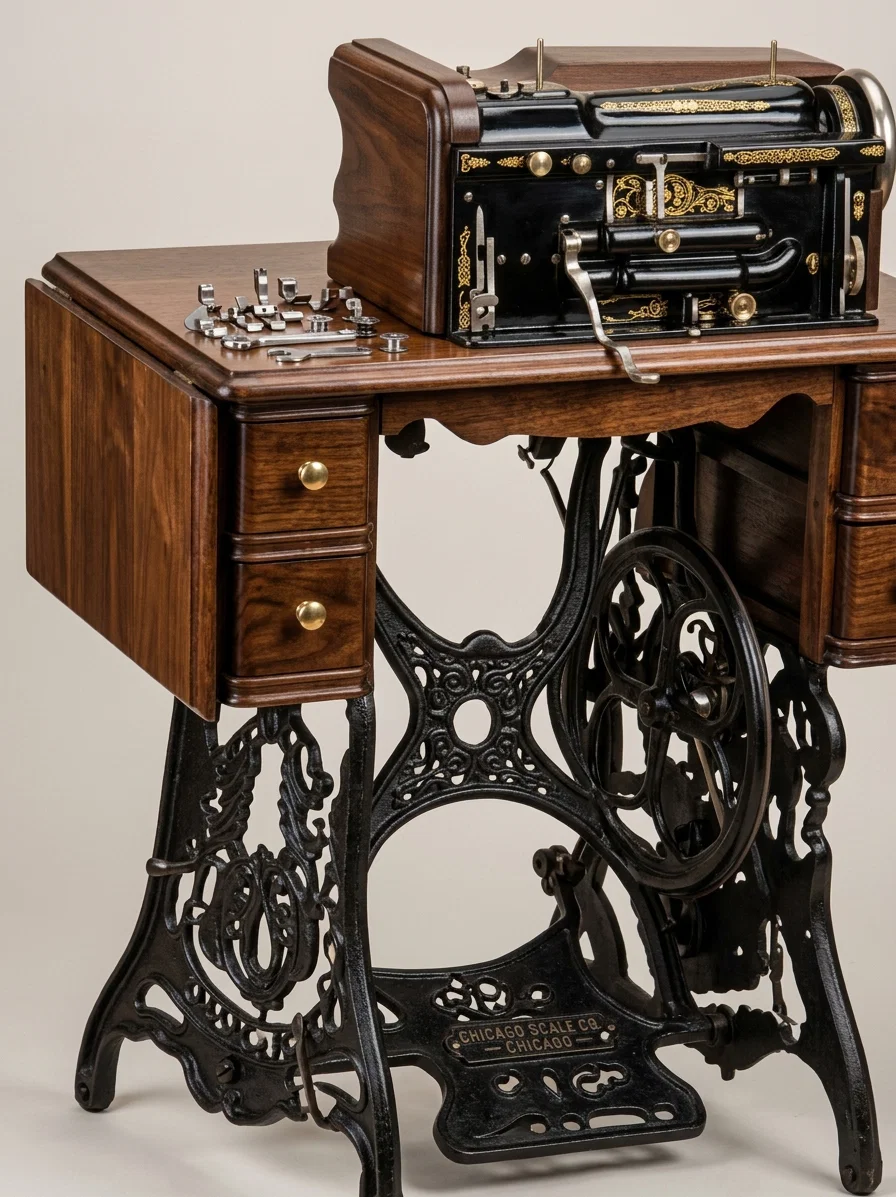
Black Walnut Furniture Cover, Drop Leaf, 5 Drawers and full Set of Attachments. Warranted. A 14 lb Tea or family Scale, $1.00. And 100 other Articles to ¼ of usual prices. Send for Catalogue. CHICAGO SCALE CO., Chicago.
EMPLOYMENT and FREE HOMES.
For information of all States and Territories, with Beautiful Engravings of the most interesting Scenery and the various Industries of all Sections, send 10 Cents for copy of THE WESTERN WORLD, Illustrated. For complete copy of all Government Land Laws, a Colored Map of every State and Territory (including Alaska) with a History of each from earliest times, see
THE WESTERN WORLD GUIDE AND HAND-BOOK.
The most comprehensive, instructive and useful Book ever published relating to the Public Lands. It tells who are entitled and how to get them, giving all the Laws in relation to the same. It also gives all laws of each State of importance to Settlers or Prospectors; also all Pension, Patent and Postal Laws and Laws of each of the States; as a guide for Homes, Employment or Pleasure there is nothing more extensive and comprehensive. It also gives a History of every Nation in the World, how and by whom owned, etc.; in addition to the most complete and useful Information, the edition contains an Encyclopædia of useful Tables and Facts, which in any other one hundred books would hardly be found, and which make it worth ten times its weight in Gold. It contains nearly 400 pages, neatly bound and mailed to all parts of the World for 50 Cents. It is the best selling Book for Agents ever published. Many are making $100 per month, others as high as $2,000 yearly selling the Guide and Hand-Book, Premiums and obtaining Subscriptions. We will send a free copy and terms to any one ordering two books and sending $1.00. “The Western World, Illustrated,” one year and Guide and Hand-Book, both for 75 cents. Address THE WESTERN WORLD, Chicago, Ill.
SOME
Desirable and Valuable
NEW BOOKS.
In the Following List of Miscellaneous Books
will be Found Something to Interest all.
We Furnish them Post-paid at the
PUBLISHERS' PRICES.
Lives of the Fathers, Farrar, 2 vols., cloth....$5.00
Life of Christ, Farrar, cloth....1.00
The Messages of the Books, Farrar, cloth....3.50
History of the Interpretation, Farrar, cloth, 3.50
Life of St. Paul, Farrar....1.50
Syriac New Testament....2.50
Heads and Faces and How to Study Them, cloth....1.00
Hours with the Bible, Geikie, 6 vols. in 3, cloth....4.50
Holy Land and the Bible, Geikie, 2 vols....5.00
How We Got Our Bible, cloth.... .60
100,000 Synonyms and Antonyms, cloth....1.00
Life of Christ for the Young, Geikie, cloth....1.50
The Christian's Secret of a Happy Life, paper.... .50
The Christian's Secret of a Happy Life, cloth.... .75
The Christian's Secret of a Happy Life, cloth, gilt edges....1.00
ADDRESS,
Pacific Press Publishing Co.,
OAKLAND, CAL.,
Or, 43 BOND ST., NEW YORK.
MORAL AND SCIENTIFIC COMPANION, Florence, Arizona; illustrated, wide-awake; 25c per year. Ads 10c per word.
PRINTERS’ INK.
A JOURNAL FOR ADVERTISERS.
PRINTERS’ INK is just what it purports to be, “a journal for advertisers.” It is issued on the first and fifteenth days of each month, and is the representative journal—THE TRADE JOURNAL, so to speak—OF AMERICAN ADVERTISERS. It tells the intending and inexperienced advertiser, in plain, comprehensive articles, how, when, and where to advertise; how to write an advertisement; how to display one; what newspapers or other media to use; how much to expend—in fact, discourses on every point that admits of profitable discussion. If you advertise at all, PRINTERS’ INK can help you. Perhaps you expend but Ten Dollars a year in advertising; if so, PRINTERS’ INK may show you how to obtain double the service you are now getting for one-half the money. A year’s subscription
COSTS BUT ONE DOLLAR.
A sample copy costs but Five Cents. Advertising is an art practiced by many but understood by few. The conductors of PRINTERS’ INK understand it thoroughly. Surely their advice, based on an experience of more than twenty-five years, will help you. Address,
GEO. P. ROWELL & CO.’S
Newspaper Advertising Bureau, 10 Spruce Street,
New York.
West Shore Railroad
N. Y. C. & H. R. R. R. Co. Lessee.
The Picturesque Route for Business and Pleasure Travel.
“SUMMER EXCURSIONS,” a handsomely illustrated book, giving description of the Hudson River, Catskill Mountains, Saratoga and other New York State resorts, will be mailed on receipt of five cents in postage stamps.
For tourist books, time-tables and information regarding West Shore Railroad, call on or address H. B. JAGOE, General Eastern Passenger Agent, 363 Broadway, or C. E. LAMBERT, General Passenger Agent, 5 Vanderbilt Ave., New York.
This equals one-fourteenth the combined circulation of all the 1,423 Daily Newspapers of the United States at last report, which was
1,431,844,000
THE WORLD alone . . . . . . . . . . . . 104,473,650
The Weekly World
IS THE
BEST and BIGGEST NEWSPAPER
on the North American Continent.
12 Large Pages and 84 Long Columns.
A POPULAR BOOK
Published and Given with Each Issue of the Weekly Edition.
(Latest Issues)
May 1—A Voyage to Mars................Greg
May 8—Houp-la........................Winter
May 15—His Fatal Success.............Malcolm Bell
May 22—The Dream Woman..............Wilkie Collins
May 29—'Twas in Trafalgar's Bay......W. Besant
June 5—A Yankee Lucille..............Wm. E. Penny
June 12—A Queen Amongst Women.......Braeme
June 19—A Strange Secret.............Sylvanus Cobb, Jr.
June 26—John Jago's Ghost...........Wilkie Collins
July 3—A Man of Honor...............J. S. Winter
July 10—The Case of Mr. Lucraft.....W. Besant
July 17—A Troublesome Girl..........The Duchess
July 24—He Loved and Rode Away......Riddell
July 31—Harvest.....................J. S. Winter
Aug. 7—Blind Love...................Wilkie Collins
Aug. 14—Mystery of Central Park.....Nellie Bly
Aug. 28—Sir Percival
Sept. 4—Fair but False..............Dora Thorne
Sept. 11—A Passive Crime............The Duchess
Sept. 18—Anton Malissoff............Greville
One Year (52 numbers), $1;6 Months (26 numbers), 50c.;3 Months (13 numbers), 25c.
Try a subscription for three months. Agents wanted at every post-office. Address,
THE WORLD, New York.
TEN LECTURES
By John Harvey Kellogg
ON
NASAL CATARRH
Its Nature, Causes, Prevention and Cure, and Diseases of the Throat, Eye and Ear, due to Nasal Catarrh; with a chapter of
CHOICE PRESCRIPTIONS
BY J. H. KELLOGG, M. D.,
Medical Superintendent of the Largest Medical and Surgical Sanitarium in the World.
The work consists of 120 pages, and is embellished with a colored frontispiece and
Six Beautifully Colored Plates,
Besides many illustrative cuts of the throat and nasal cavity in health and disease. This little work costs only 30 cents, and is in great demand.
PACIFIC PRESS PUBLISHING CO.,
Or 43 Bond Street, New York.OAKLAND, CAL.
NOW READY!
THE NATIONAL SUNDAY LAW.
WE do not mean that a National Sunday Law is now ready, but that a treatise under this name, prepared by Alonzo T. Jones, is now ready for circulation.
This pamphlet contains the arguments in behalf of the rights of American citizens, and in opposition to the Blair Sunday-rest bill, which Mr. Jones presented before the Senate Committee on Education and Labor, Dec. 13, 1888.
Dr. Wilbur F. Crafts has pronounced the report as published
“MIGHTY INTERESTING READING,”
And Mr. Jones's comments will make it more so. His argument is enlarged to what it would have been without Senator Blair's interruptions, objections, and counter-arguments, and is accompanied with answers to all of his objections and counter-arguments.
As the Sunday question is now a living issue, this treatise will be interesting to all classes, especially legislators, lawyers, judges, and other public men. The argument is
Based on Scripture and History, Constitution and Law,
Showing the limits of the civil power, the unconstitutionality of the Sunday bill, an analysis of the Sunday laws and other religious legislation of the different States, the Sunday-law movement of the fourth century, and the Sunday-law movement of the nineteenth century, the methods used in securing endorsements to the petition for the Blair bill, and the workings of such Sunday laws as are proposed for the United States.
The work contains one hundred and ninety-two pages. Price, 25 cents. Address,
AMERICAN SENTINEL,
1059 Castro St., Oakland, Cal.; 43 Bond St., New York.