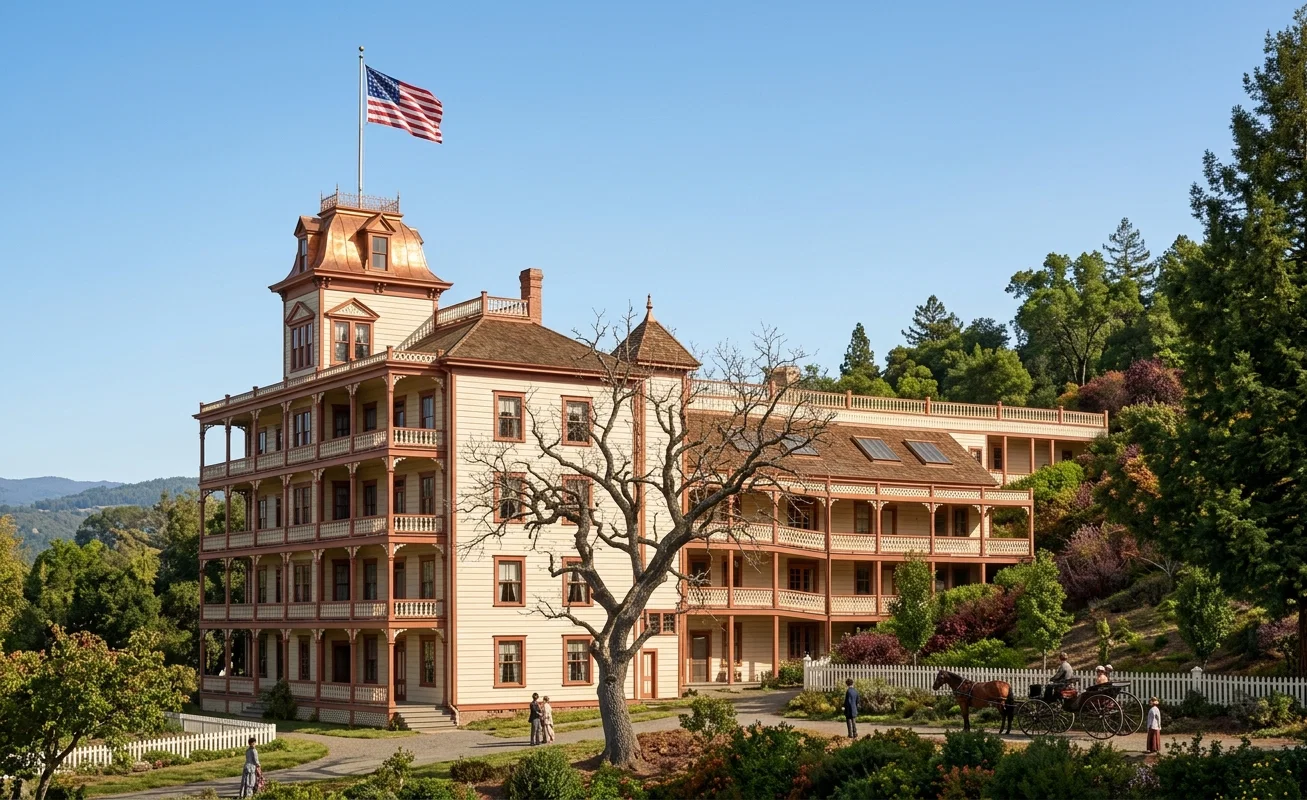
THIS delightful Resort offers unrivaled advantages to Tourists and all classes of Invalids, both for Winter and Summer. It is situated on the southwestern slope of Howell Mountain, 500 feet above and overlooking the noted and beautiful Napa Valley, and 2½ miles from St. Helena. This place is noted for its Pure Water, Dry Atmosphere, Clear and Balmy Sunshine, Even Temperature, Mild Breezes, and the absence of high winds.
THE RATIONAL TREATMENT
By all known remedial agents is employed in this Institution. With these natural and acquired advantages, pleasant and desirable surroundings, thorough and judicious treatment, and wholesome diet, most invalids who avail themselves of these agreeable facilities, rapidly recover. Patients have the care of a regularly graduated Physician of experience, who is assisted by well-trained and courteous gentlemen and lady assistants.
All Invalids and Tourists may feel assured that they will be courteously received, and kindly cared for.
For Circulars and further particulars, address
RURAL HEALTH RETREAT,
St. Helena, Cal
The Real Object of Sunday Laws
In concluding a report of an address by Mr. Crafts on his favorite theme, “The American Sabbath or the Continental Sunday,” the Christian Nation says:—
> “The address was listened to with deep interest. We hope that the agitation of this most important subject may mean the better enforcement of the Sabbath laws now existing in our own city, that we may not see men reeling to and fro in our streets on God’s holy day. In the desecration of the Sabbath, as in all other evil, the liquor traffic is foremost. Prohibit the liquor traffic and you stop a very large proportion of the public desecration of the Sabbath. May the time soon come when the Sabbath shall be protected by law, not merely because it is needful for man to have a rest-day, but because it has been instituted and set apart by God, and because he has said, ‘Remember the Sabbath-day, to keep it holy.’”
There is something very peculiar about this Sunday-law question. The law, we are told, is wanted to secure a day of rest for workingmen, and as a temperance measure, but somehow or other, try as they will, they cannot conceal the fact that the real object is to honor the day. They don’t want men to be drunken on the day, and Sunday prohibition would prevent the desecration of the day, and they want the law because God has said, “Remember the Sabbath-day, to keep it holy.” But they don’t want religious legislation; oh no! they only want to enforce their version of the fourth commandment by civil law. That is all.
The Roman Catholic National Reform Alliance
By Editor
In an article in the Christian Statesman of August 31, 1881, Rev. Sylvester Scovel, writing of the desirability of uniting with Roman Catholics for the purpose of securing so-called national reform, said:—
“We may be subjected to some rebuffs in our first proffers, and the time has not yet come when the Roman Church will consent to strike hands with other churches, as such; but the time has come to make repeated advances, and gladly to accept co-operation in any form in which they may be willing to exhibit. It is one of the necessities of the situation.”
And again in the same line the ChristianStatesman of December 11, 1884, said editorially:—
“Whenever they [the Roman Catholics] are willing to co-operate in resisting the progress of political atheism, we will gladly join hands with them.”
And now comes the Baltimore Catholic Congress, which closed its session in that city on the 11th inst., and says in its platform:—
“There are many Christian issues in which the Catholics could come together with non-Catholics and shape civil legislation for the public good. In spite of rebuff and injustice, and overreaching zealotry, we should seek an alliance with the non-Catholics for proper Sunday observance.”
At present we leave our readers to draw their own conclusions, and forecast the probable results of this Roman Catholic National Reform alliance now as good as formed.
Church and State Harmony
THE Catholic Review of November 9 has the following on the proper relation of Church and State, which should commend itself to National Reformers:—
“It would be hardly worth while noticing the eternal changes which Americans ring on ‘the union of Church and State’ phrase, except to ask those that use it what do they mean when they declare so firmly that union of Church and State shall never exist in America. What the phrase formerly meant is done away with in all civilized countries almost completely, although these countries may have Catholicity or a Protestant sect down in the Constitution as the State religion. The old state of union will probably never return. Harmony is now the proper word for expressing the desirable relations of Church and State, and this harmony must exist or the world will continue to endure the discomforts of eternal quarreling. The State must admit that the Church ranks above it, and has a deeper interest in men than it can ever have. It must act accordingly. The present attempt of the atheists and foolish secularists to push Christianity out-of-doors, and leave the people to the mercies of State officials in their necessities, must be resisted and overthrown. The State is bound to assist the Church in her work quite as much as the Church is bound to keep the people mindful of their salvation and faithful in working for it. The two powers are a mutual aid to each other, and must be always in relationship. Harmony is the word for the present moment, but users of the phrase, ‘No union of Church and State,’ know too little of the matter to produce anything but discord.”
“Harmony” is an excellent word, and in this connection is about the equivalent of Mr. J. M. Foster’s proposition, that “the State and its sphere [should] exist for the sake of, and to serve the interests of, the Church,” and that “the Church and the State [should] exist in friendly recognition and co-operation.” It is well known what Catholics regard as “harmony” between Church and State; it is about equivalent to the relation which may properly exist between one man and one woman, namely, marriage. And that which Secretary Foster means by “friendly recognition and co-operation” is explained by his own words, as follows: “The expenses of the Church, in carrying on her aggressive work, it [the State] meets in whole or in part out of the public treasury. Thus the Church is protected and exalted by the State.”
It certainly ought not to be very difficult for National Reformers to join hands with Romanists in “resisting the demands of political atheism,” since on this question these so-called Protestants and the Papists occupy the same ground. If they are kept apart it will be only because each party will insist that it is the church to the exclusion of the other. But inasmuch as they have each expressed a willingness to join hands with the other in a propaganda by civil law, there is little ground for hope that they will not agree to unite their forces for their mutual advantage, and for the discomfiture of political atheists, by which they mean all who do not agree with their theory of civil government.
United States American Relocation
THE United States American has removed to 419 Folsom Street, San Francisco, to which number all communications should be addressed. The American is “devoted to choice literature and to the dissemination of American principles.”
National Christianity in Catholic Countries
“WE cordially, gladly recognize,” say the National Reformers, “the fact that in South American republics, and in France, and other European countries, the Roman Catholics are the recognized advocates of national Christianity, and stand opposed to all the proposals of secularism.” This is especially true of Equador and Spain, particularly the former, some account of the moral condition of which we published last week.
The Sunday Saloon Argument
By Editor
THE field secretary of the American Sabbath Union has discovered a new argument for closing saloons on Sunday. He says, as reported in the Christian Nation, “The saloon should be closed on the Sabbath, because in being open it jeopardizes the safety of the people in passing along the public streets going to and from church.” We are perfectly agreed that saloons should be closed on Sunday, but the same arguments that would close them on that day would close them on every other day. They are no more a menace to passers-by on Sunday than on any other day, and people are entitled to no more protection on Sunday than on other days. The idea is absurd, and shows the true animus of the Sunday movement; it is to honor and favor the church and the day; and that is just what civil government has no right to do.
The Sunday Crusade and Ohio’s Election
IN commenting upon the result of the late election in Ohio, the Cincinnati Commercial Gazette of November 6 says:— “The German Republican guard will be accused of enlisting again under the banner of the saloonists, but they did not do anything of the sort. They rebelled against the peculiar combination on the Sunday question. No, it was not the saloonists who won the Democratic victory in Hamilton County, though they will claim it and use their power to the uttermost, but it was the Sunday crusade which struck not only the saloons but extended to base-ball, ice-cream, soda-water and cigar stands, and seemed to be threatening the milk wagons.”
Sunday Laws and Prohibition
The fact is that the advocates of Sunday laws are for Sunday first and prohibition second; that which they wish most of all is not to close the saloons on that one day, but to exalt Sunday as a religious institution. For the present, at least, politicians who do not care to get scorched would do well to let the Sunday question alone. The time foretold by National Reformers when the politicians will all demand front seats on the Sunday-reform (?) car has not yet come, though no one knows how soon it may dawn.
Quebec’s Roman Catholic Control
“TO-DAY the Province of Quebec is,” says the American Citizen, “under the exclusive control of the Roman Catholic Church. The public officers are Roman Catholic, the religion is Roman Catholic, and it has just been shown that the courts are equally Roman Catholic.”
The Province of Quebec is, then, Mr. M. J. Foster’s ideal State: it has, in the common acceptance of the term, no established church, but “the State and its sphere exist for the sake of, and to serve the interests of, the church.” This is just what Mr. Foster says should be, and it is just the condition of affairs which he would like to see in this country.