The Secret Source of Power — Every One May Have It — Illustrious Example of One Who Lived in That Mighty Presence — The Secret of a Young Lady's Beautiful Character
IN recounting the faith of some of those whose lives are an inspiration to the children of God, the writer of the book of Hebrews cites Moses as one who "endured, as seeing Him who is invisible."
THEY REALLY KNOW GOD
There is no myth, no fancy, in the revelation of God to the inner soul of man, that is portrayed in this experience. Not a few Christians to-day have this living knowledge. They really know God, and live as if in His presence.
This was in a peculiar sense the case with Moses. On the barren heights of Horeb, he saw the Invisible in the burning bush. Henceforth he lived as in God's presence. Time could not dim the divine image, nor the veil of years efface from his memory the solemn charge laid upon him in that hour. In the trials and persecutions and rebellions of after-years, Moses "endured, as seeing Him who is invisible." No experience, however bitter, could erase from his mind that glorious vision.
NOT THE HAUGHTY MONARCH, BUT THE INVISIBLE GOD
A little later we see Moses in the court of Pharaoh, giving to the king a message from Jehovah. His message was ridiculed; he was taunted, reviled, commanded not to appear before the king again; his life was threatened; but he endured it all. He saw not the haughty monarch, nor his powerful armies, but the Invisible.
The Egyptians worshiped calves, goats, and reptiles. Their gods they could carry into battle, that these might see the valor of their worshipers. But Moses had no visible God. When he talked to Jehovah, he spoke into empty space, as far as the Egyptians could discern. There was nothing material in sight that could encourage one to endure and suffer or to serve in battle. They could not understand the source of his power.
SUCCEEDED THROUGH HIS INVISIBLE LEADER
The day soon came when they would endure Moses no longer. From the king on his throne to the lowest serf in the land, the Egyptians rose up and thrust the prophet and his people out of the land. We see him at the head of this motley army — a great company of three and one half millions of human beings, undisciplined, homeless, in an enemy's land, fleeing from an irate and powerful monarch.
Across uninhabited deserts Moses led this unwieldy company, where there was neither food nor water, where conditions were such that God rained bread from heaven to feed the multitude, and brought water from the rock to quench their thirst. And in it all, Moses trusted his Leader to supply the needs of the people, and bring them safely through.
Whence came his invincible courage? What was the source of his confidence? Was it human? No; it was born into the heart of Moses from above. He "endured, as seeing Him who is invisible." In patience, in fortitude, in courage, in meekness, in trials, there are few who have ever equaled this servant of God.
SECRET OF HER BEAUTIFUL CHARACTER
A young lady whose beauty of character was the inspiration of all who knew her, being pressed by a near friend to reveal the secret of her charming life, said: "When I am gone, you will find a locket on my heart. Open it. That will reveal my secret." When the time came, on her knees beside the dead, the friend opened the locket, and read therein these words: "I live as seeing Him who is invisible."
Every Christian is entitled to this "inner vision." It is his privilege to have this experience, this revelation of God to his soul. When this vision is once received, its possessor is God's man. A relationship is established between the Invisible and man that earthly things can not affect. This experience is the heritage of God's children; and those who seek for it, will not be disappointed.
THE GREATEST OF ALL CURSES
By John O. Corliss
Scientifically Demonstrated — A Narcotic and Deadly Poison — A Transmittable Blight
FACTS differ from opinions in that they are undebatable. The truth about alcohol has been as thoroughly substantiated as has the law of gravitation, or as have the facts of astronomy. Alcohol has no food value; and he who would assert that it has, but displays ignorance of late scientific discoveries. In his Paris laboratories, the celebrated French chemist, Louis Pasteur, settled the fact that the formation of alcohol is not a simple chemical process, but that this drug is the waste product of the life processes of living organisms, the toxic excretion of ferment germs.
ITS POISONOUS NATURE ESTABLISHED
The moment this fact was determined, the poisonous nature of alcohol was also established. What, then, is the errand of toxin? There is a well-established law in nature's processes, that the waste product of one form of life will not only, when retained, poison the form of life that produces it, but will also, when transplanted, poison any form of life that is higher and more delicate. Every living creature forms toxin in its life processes; and this must be eliminated, or the creature soon dies. To cover an animal completely with varnish or with any substance that prevents this elimination of toxin, causes death in a short time.
The reason for this is that life processes are carried on through regular changes of minute living cells, which are known to science as protoplasm. When permitted, toxins greatly interfere with the functions of these life guardians. For the purpose of this brief article, however, it is only necessary to refer to the mission of what are termed the white blood corpuscles. These, as veteran sentinels, keep watch over every part of the body, to fight and expel disease. But when saturated with alcohol taken into the system, they become entirely incapacitated, and so nature's processes are halted, to the detriment of life's functions.
A TRANSMITTABLE BLIGHT
If results were confined to the one violating nature's law, the terrible curse of alcohol might be erased with the death of the first transgressor. But besides the degeneracy wrought upon the original offender, the blight is transmitted to the offspring, which consequently pass but a short and handicapped existence. In this the deadly effect of alcohol is strikingly manifest; for in the embryonic stage, the tissues are tenderest and most susceptible to harm, while the alcohol maintains its poisonous power. Every process, therefore, which touches the matter of reproduction, whether in male or in female, is affected by alcoholic influence. For example, it has been well established, by animal tests, that one part of alcohol in a thousand parts of water will seriously attack an embryo, while one part of alcohol in two hundred parts of water will kill an embryo. This becomes a11subject for grave consideration, when one thinks that a prospective mother may, at a dinner, partake of a one two-hundredth solution of alcohol, and produce a miscarriage without even becoming intoxicated.
PROHIBITION DEMANDED
The good of future society demands that children shall be well born. As it is, however, innocent children come forth with inferior minds, in feeble bodies, without the power to enjoy life's advantages in any particular. And they have, on the debit side, an inherited appetite for the accursed stuff that has made them what they are. Why should such conditions control the citizenship of an enlightened commonwealth? Why should human vultures be permitted to fatten at the expense of community welfare? Why, in the name of loyalty to Heaven, and patriotism to one's country, may not men and women unitedly rise up to sweep from the state the greatest curse that ever befell society?
J. O. C.
SYSTEMATIC BIBLE STUDY
Our reading this week includes the thirty-eighth chapter of Job. It presents some of the sublimest utterances ever put into human language.
Job has been engaged in a prolonged discussion with his friends, and at times he has seemed almost peevish at some of the things they have said. Now God speaks to Job, and in the form of a long series of questions, He calls his attention to the majesty and power of the Infinite, as contrasted with the weakness of the human. These questions suggest thought and research that were far beyond anything we know of the general education and learning of that time. We should ponder these sublime passages with more than usual care.
Read three chapters each week-day, and five chapters on the Sabbath.
GODLINESS CAN NEVER BE OF COMPULSION
By W. A. Spicer
MUCH has been said of a millennial dawn, of an age of "second probation," when the wicked of the present and past ages are to have another chance, apparently. We are told that the wicked are to come forth in the resurrection with "the same wicked desires," yet they are not permitted to do wrong. "The only liberty that will be granted is the liberty to do right."
This theory is certainly based upon a strangely perverted view of what godliness and salvation really are. It proceeds upon the supposition that goodness, or godliness, can be forced upon men; that evil can be made to bring forth that which is good.
IT DENIES CHRIST'S TEACHING
This is a denial of Christ's teaching regarding the nature of goodness: "Every good tree bringeth forth good fruit; but a corrupt tree bringeth forth evil fruit. A good tree can not bring forth evil fruit, neither can a corrupt tree bring forth good fruit." Matt. 7: 17, 18.
It is not merely because He has chosen some other way of salvation, that the Lord does not compel men to godliness. It is because He can not do it; for even God "can not deny Himself." 2 Tim. 2: 13. Godliness is God-likeness. The Lord is not good and righteous because He is compelled to be. It is His nature. And no righteousness, or godliness, can ever come of compulsion. It can never be forced from an evil nature. Salvation is a change of heart, the free gift of the new heart created in Christ Jesus. The theory of mechanical and compulsory righteousness subverts the fundamental principle of the gospel.
W. A. S.
G. B. T
By G. B. T.
"BINNEY'S Theological Compendium," page 170, says, "This seventh-day Sabbath was strictly observed by Christ and His apostles previous to His crucifixion." This is indeed true; and inasmuch as He "suffered for us, leaving us an example, that we should follow His steps," we too should observe the seventh day. He left no precept or example for Sunday keeping.
G. B. T
19—DARKNESS AND LIGHT
By Editor
I understand that the gospel as brought to view by Christ and His apostles in the first centuries and recorded in the Bible was covered up during the Dark Ages, and began again to be revealed at the commencement of the Reformation. What was the first light brought out, and when, and by whom? And was it justification by faith? And did later reformers take up the same and carry it on through with them, or did they reject it? READER.
No, it is not true that the gospel was wholly hidden during the Dark Ages. There were faithful followers of God who kept it alive in their own hearts through all that darkened time. There were those, like the Waldenses and others, out in the wilderness and among the mountains, who were loyal to God, and who had His word. There were those even in monks' cells, in the convents, among the priests of Rome, who had access to the Bible, and were faithful to it as far as they saw it. Of course a mighty impulse was given to this in the time of the Reformation. Previous to this, men had been stirred to study the Bible. Wyclif's translation had been made, and portions of the Bible were translated by others. When printing was invented, that gave a great impetus to the spread of the gospel. Then followed other translations.
It is quite impossible to say just when or by whom or what was the first thing developed, when there was more or less of it developed all the way. There were numberless men in the Roman Catholic Church who stood for the truth of God. Some of them went down to martyrdom. Others remained. The great thing of the Reformation in Germany especially was justification by faith. Later reformers accepted this, and went on developing other phases of the Word.
The great mistake made by many of the Protestant sects was that of trying to crystallize what they believed into a creed. It is impossible for human words to express the infinite truth of God; and just as soon as men tried to define what God's word taught, they limited the Word, and limited the faith of those who would accept the creed. Of course there were always those within the creed-bound church who believed out beyond the creed, and whose faith ignored man's framing of God's truth, who saw greater light in the word of God, and consequently they rebelled against the creed, separated themselves from the creed-bound body, gathered around them other followers, and sometimes made the same mistake over again—formed another creed.
That has been one of the great hindrances to Protestantism. If the word of God had been allowed to have free course, and rule, and be glorified, and men had rallied around that—the Word and the Word alone—union would have come instead of the discord we see at the present time. Man's hope of saving discord and divisions has resulted in only greater confusion. It is impossible for us to tell, as our questioner asks, the particular creed that each of the churches holds to. Sometimes churches divide on church government purely. Take the Congregationalists and the Presbyterians for instance. The Presbyterians leave the management of their church largely to the presbytery or the elders. Each Congregational Church is independent. It has no general body of authority.
There is very little difference between the creeds of Protestants, and it is growing less and less all the time. Of course the Baptists have one phase of truth to which they hold, some of them tenaciously and loyally; namely, baptism. Some of them are yielding that. There are books on religions which will give the various creeds of churches. It is impossible, however, even to indicate them in the Question Corner.
20—TEACHING ERROR
Has God ever commissioned anybody to teach error, or has it at any time been His will that man should believe error?
It would seem as though the question answered itself. "He is . . . a God of truth." Deut. 32: 4. The fact is that He is incarnate truth; for Jesus Himself, who came to represent the Father, declares, "I am the way, the truth, and the life." John 14: 6. He saves us, not by error, but by truth—sanctifies us by His truth. John 17: 17. His word is truth, and it is by that Word that we are kept from the paths of the destroyer. Ps. 17: 4. And there are a multitude of other passages that teach the same thing. No lie is of the truth. No lie is of God. None of God's children are ever justified in either believing or teaching a lie. Matt. 5: 19; Rev. 22: 15. Those who hold to error and are still saved, are saved not because of the error, but in spite of it. It is because there is dominant truth in their lives notwithstanding the error.
Interesting Experiences with the Chinese
By Ross C. Porter
What a Missionary May Meet in the Orient — Courage and Success in the Work Regardless of Difficulties
By ROSS C. PORTER
President Asiatic Division
MISSION life in the Orient is not all romance. It has much of the regular mission experience connected with its daily routine; but the customs and associations are quite different from those of the home land, and these add variety to the regular program.
NATIVE ACCOMPANIMENT TO BURDENS
When the glamour of going as a foreign missionary has worn off, and one finds himself located in an inland Chinese city, living in daily contact with Chinese life, he begins to catch a glimpse of mission life at the front. The "hah ah" sound heard all day long, and often all night, is the native accompaniment to carrying loads on the shoulder. A load is usually suspended from a bamboo carrying stick, one basket on either end of this springy shoulder pole. To the newcomer, this sound is novel; but in time it becomes wearisome and nerve wearing, especially when it peals out upon the stillness of night.
THE SEWERAGE SYSTEM A DEATH-TRAP
But there are other things of a more serious nature. The sewerage system in many Chinese cities is a source of menace to health and to life. It is a veritable death-trap. It usually consists of a square, box-like ditch, covered with paving stones, with much ventilating space between them. It is laid just beneath the pavement, almost on a level, and is never flushed. It runs along all principal streets in both the residence and the business section. The foul air rising constantly, reminds one that he is living over a horrible cess-pool, from the fumes of which there is no escape day or night.
HOGS IN THE HOUSES OF THE WELL-TO-DO
Passing along a street in the city of Chang-Sha, one of the foremost cities of China for education and culture, I thought I detected an odor that indicated a barn-yard near. Proceeding in the direction from which this odor came, what was my surprise to find in a well-to-do Chinese family residence, on a high-class street, nine hogs, weighing about two hundred and fifty pounds each. They were penned on a shelf-like board floor, elevated about three and one half feet above the floor of the living-rooms, and separated from the kitchen and the dining-room by a fourteen-inch board set up edgewise. On the other side of the room, between the dining-room and the sleeping apartments, separated from the bedroom by an openwork bamboo partition, were a larger number of shoats, ranging from fifty to one hundred fifty pounds.
My curiosity having been aroused, I was emboldened to ask permission to enter the house of a business man from whom we had frequently hired sedan-chairs for the women of our party. Again I was surprised to find, in that respectable home, thirteen large hogs, situated in the same relation to the living-room as were the others.
CHINESE CHARACTER FOR "HOME"
While in Canton, south China, I was speaking of this experience, and was informed that this was a common custom throughout China. The Chinese character for "home" was said to be a pig under a roof.
In confirmation of this statement, I was taken to a Chinese home in Fatshan in which I counted over one hundred hogs, ranging from fifty to two hundred fifty pounds each.
We also visited a home where six water-buffalo cows and one calf were kept in the home with the family. Beds were suspended on poles above the cows, where some of the family slept. These people seemed to enjoy about the usual health of the Chinese. I wondered what our germ specialists' diagnoses of some of these cases would be. For me it was difficult to see how a person could live under such conditions.
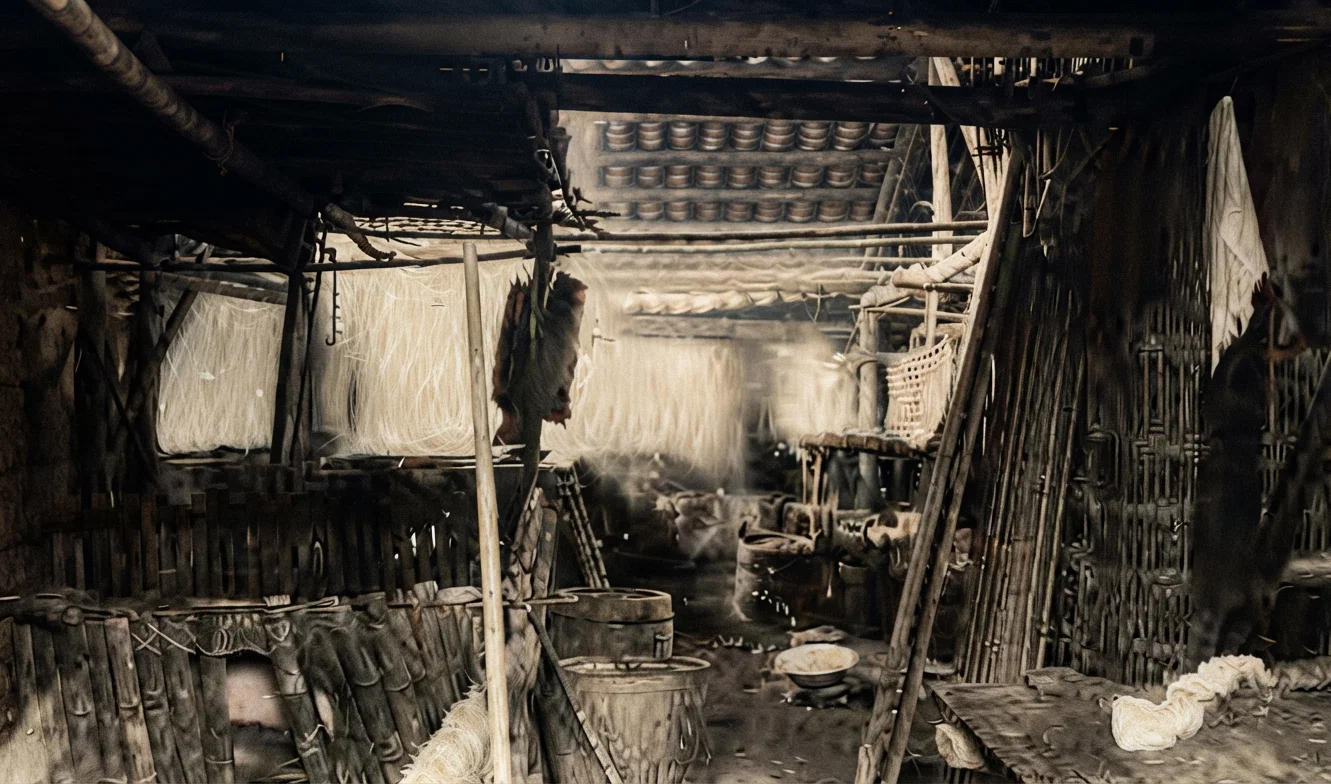
INTERIOR OF VERMICELLI FACTORY, CANTON, CHINA, SHOWING PIG-PENS ON THE LEFT
PIGS IN FACTORIES
I visited two vermicelli factories in Canton. In the first, I found seventeen hogs penned in the factory, in an ordinary pig-pen, just across the aisle from the vats. In the second, there were twenty-eight penned in the same way. Although the day was dark and rainy, we managed, by a four-minute exposure, to secure a picture of one of these factory scenes. The pens are fairly well kept, and seem to add no special flavor to the factory product. The hogs are housed thus for convenience of feeding, and also for safety. They live on the waste from the homes and the factories, and being inside, they are less liable to be stolen.
THEIR VEGETABLES UNSAFE
The Chinese method of fertilizing their gardens makes it positively unsafe for foreigners to eat any vegetables without scalding or cooking them. Even when taking this precaution, many missionaries are obliged to quit the field on account of contracting sprew. This disease is not incurable under favorable conditions; but very few foreigners recover unless they leave the field, when a few have been known to rally from its grip.
THE COURAGE OF THE MISSIONARY
Notwithstanding these perils, and added to these, the political revolution perils, it is marvelous how, as in apostolic times, the Lord miraculously delivers and sustains the missionaries, giving them an interest and a love for their work that is remarkable, and turns calamities into avenues through which to reach sin-burdened hearts. Two hundred thirty-two converts, mostly from heathenism, were baptized by our workers in central China alone last year.
Transforming Hearts in Haiti
By Albert F. Prieger
A Lawyer and Libertine Turns to God — A Mighty Power Revolutionizes His Life
By ALBERT F. PRIEGER
SOME time ago I was called to a small city here, and found a number of believers ready for baptism. Among them was a lawyer who seemed very anxious for baptism, but I had just heard from our native worker a little concerning his former life.
The man was brought up a Catholic. As is customary in these countries, he had lived with a woman a number of years without marriage. They had one child, and by some former woman he had two other children in another city.
Now he was in great perplexity, not knowing what to do to please God; but because the woman he was living with was opposed to his new-found faith, he thought it best that he should leave her.
Realizing the sinful course he had pursued, he came to me for advice. We began to search the good old Bible in reference to his case; and when he found that in the sight of God he was married to this last woman, and that he had no right to leave her if she consented to live with him, and that he ought to support all his children, he resolved to be married by the state the next morning, which was Friday.
The woman was very much surprised to see how everything was changing, since she had been under the impression that to be holy one must be unmarried, like the priests, and that he would leave her.
When she found that she was now a lawfully married woman, and all because of this new-found gospel, she went, contrary to the13wishes of her priest, to witness the baptism of her husband. When I baptized him, she sank on her knees, and resolved in her heart to follow.
There were nine persons baptized. We organized them into a church, and this woman became a member, subject to baptism. It was good to see how readily she gave up all objectionable practises to serve her Master more fully.
For a time this brother's faith was tried severely. But just now I received word stating that this government has appointed him as one of the judges of Haiti, and I believe we of the home land, of faith, may say with Paul in Rom. 1:16: "I am not ashamed of the gospel of Christ: for it is the power of God unto salvation to every one that believeth; to the Jew first, and also to the Greek."
The Flying Squadron
By Editor
A group of Pacific Press employees working for temperance in near-by cities and towns in conjunction with the Santa Clara County Dry Federation. These workers are distributing 2,000 temperance SIGNS, and 12,000 of the tracts and leaflets described below. They make it a point to do this work on the same days that temperance rallies are held by the "dry" forces in the places visited. One of the Federation officers has appropriately named this company the "Flying Squadron."
The "Flying Squadron"
Friends of temperance everywhere could not do better than secure a good supply of these unexcelled tracts and leaflets for work in their home city or town. If you are without organization, don't let that hinder, but plan to do something on your own initiative.
The liquor traffic is the greatest evil in existence. Are you willing and ready to do your part, even though that may be small, to put it out of business? If so, make a selection from the list below, and place them in your neighbors' hands. Results are sure to follow.
"The Demons' Council." A unique document written in allegorical style. 100 ……50c
"Prohibition or the Liquor Traffic — Which?" contains admissions from the opponents of prohibition as to the evils growing out of the liquor traffic. This is one of the strongest arguments favoring prohibition. 100 ……50c
"Story of a Dry Town." An interesting story of a town as it was with its seven saloons, and the results two years after it went dry. 100 …………………………25c
"Why Does the Saloon Exist?" The saloon man says he has a legal right to do business. Has he? This publication presents the "legal right" phase of the question. 100 …………$1.00
"Dark Valley Railroad." In two colors, in the form of a railroad time-table. Gives names of stations, time of arrival of trains, and shows map of the route. Cigaretville, Mild Drink, Tipplersville, are some of the stations. 100, $1.50
"It Doesn't Pay." The question as to whether the liquor traffic pays is much debated. This tract considers the saloon from this standpoint. 100 ……………………$1.00
"The Wine Industry and Prohibition." The claim is made that prohibition will throw thousands out of employment, and make valueless vast tracts of land. Will it? This tract answers this contention negatively, and satisfactorily to all. 100 …………………………$1.00
Pocket Package No. 4. 400 pages of the above tracts assorted, in a strong Manila envelope, for 25c. Postage prepaid.
Our depository in your state (see list on page 15) will give your order prompt attention.
PACIFIC PRESS PUBLISHING ASSOCIATION, Mountain View, California
WANTED FOR MISSIONARY WORK
By Editor
Papers and tracts, Review excepted. C. S. Howard, Brownsville, Texas.
Clean copies of SIGNS, weekly and monthly, Youth's Instructor, and Life Boat, a regular postpaid supply, for distribution on boats, in hospitals, and among 10,000 soldiers. Mrs. Birdie Conway, 767 Kinau Street, Honolulu, T. H.
Tracts and pamphlets. Can also supply addresses of some individuals likely to welcome correspondence. Mrs. Lawrence Perry, Kalama, Washington.
Clean back numbers of the SIGNS OF THE TIMES weekly, by Capt. J. L. Johnson, 440 Fifty-seventh Street, Brooklyn, New York, for use in connection with ship mission work in New York harbor. Readers will please note the change of address.
BOOK NOTICES
"THE ORIGIN OF CHRISTIAN SCIENCE," by T. P. Stafford, A. M., Th. D., Kansas City, Missouri, the Western Baptist Publishing Company, 1912. 240 pages, demy octavo.
One of the most valuable contributions to the exposition of the character of Christian Science, is this volume by Professor Stafford. The book shows that he has made extensive research on this subject, and he writes with the assurance of one who knows what he is talking about.
He makes it conclusively clear that Christian Science is merely a working over of the utterances of the heathen philosopher Plato, as revamped and presented by Plotinus and others in the first centuries of the Christian era, in what is known as Neoplatonism. Every individual who cares to know the truth concerning Christian Science, and the fact of its relation to paganism rather than to the Bible, will feel, after reading this volume, like thanking Professor Stafford for the splendid work he has done.
Mrs. Eddy presents her work as a great revelation, as a completely new thing; but when it is shown that Plato before her had very similar notions and gave out a very similar teaching, and further, that the Neoplatonists on down to the times of Spinoza were continually working over his philosophy into forms of thought identical with those of Christian Science, it takes away the fascination that comes from any idea of inspiration and special illumination in connection with Mrs. Eddy's work.
Professor Stafford thinks that Christian Science has points of general similarity to Indian philosophy,—Brahmanism and Buddhism,—yet that in reality it is an "offshoot, that is, a sucker, of Platonism."
The evidences for the conclusions he reaches in his volume are well authenticated by numerous references to recognized authorities.
Sanitarium Cooking Oil
"THE OIL OF QUALITY"
Pure Cotton Seed Oil direct from refinery. Sweet, wholesome, and delicious. 4 1-gallon cans, $3.60; 5-gallon can, $3.90; 2 5-gallon cans, $7.70; 30-gallon barrel, $20.80; 50-gallon barrel, $32.75. Cash with order. Sanitarium Cooking Oil Co., Louisville, Kentucky.
A Request for Armageddon Pamphlets
Pacific Press Pub. Assn.,
"Mountain View, Cal.
"I am greatly interested in your publication Signs of the Times. Your October number came to my office to-day, giving a number of articles on the present European war.
"Enclosed herewith find one dollar, for which please send to me at once one hundred copies of your pamphlet 'Have We Come to Armageddon?' Any other tracts or publications touching this great and important Eastern question, you may care to send to me, will be greatly appreciated, and I will promptly distribute the same among my friends and neighbors.
"I have believed for years that the end of this present world would come as predicted in your publications. Sincerely yours." (Signed)
Publishers' Note.—Many such letters have come to us of late. The October number of the Signs Magazine, here referred to, can be supplied at ten cents a copy, or five to forty copies at five cents each. That pamphlet "Have We Come to Armageddon?" sells for $1.00 a hundred post-paid. Our depositories can fill orders promptly.
A Story of Typewriter Supremacy is the History
OF THE
UNDERWOOD
Winner in all Contests for
Speed—Accuracy—Stability
Proved by all International Typewriter Records
UNDERWOOD
"The Machine You Will Eventually Buy"
531 MARKET STREET SAN FRANCISCO, CAL.
Uncle Sam's Tapeworm
By Milton H. St. John
An Allegory
By MILTON H. ST. JOHN
THERE is no question but that Uncle Sam has a decidedly acute case of tapeworm, very long and many-jointed.
The tapeworm, we are told, is a parasite that fastens itself somewhere in the digestive tract, and eats or absorbs the food and nourishment that should go to the replenishing of brain and brawn. Thus it creates an abnormal appetite.
So with the liquor traffic. It has literally, as well as figuratively, fastened itself in the digestive tract of Uncle Sam's body politic, and like the literal tapeworm, it has absorbed and is absorbing the energies that should go to the building up of body, mind, and soul. This crooked, creeping, slimy, smooth denizen of the pit is indeed a parasite, which, very soon after being introduced into the human digestive tract, creates a very abnormal appetite, but does not furnish one atom of muscle or nerve food to supply the abnormal appetite that it has created.
Again, the tapeworm is made up of joints. We have heard of tapeworms that were over thirty feet long, and were made up of over four thousand joints; and as incredible as these figures may seem, reputable physicians vouched for them. These worms, which are very small when they first take up their abode in the human digestive canal, have been known to live and grow until the unfortunate victim has well-nigh starved to death.
So it is with Uncle Sam's tapeworm. The liquor traffic had a small beginning in America; but now it has become the largest and most malicious menace to our political, social, and religious life. It is indeed made up of many "joints." For instance, there are the first and most important of all, the brewery, distillery, and winery joints, where demons in liquid form are manufactured. These joints, being the largest and most important, are placed next to the head of this ugly vampire, and are vitally important to its continued life. Then there are the saloon joints, the most numerous of all the joints in Uncle Sam's parasite. And among others might be mentioned the dance hall joints, the grill joints, the hotel joints, and many others that will readily suggest themselves to the reader's imagination. Note the striking coincidence that these places are familiarly spoken of as "joints."
The head of the tapeworm is the only vulnerable part, and this parasite can not be destroyed by removing a few joints here and there; for as long as the head lives, it will quickly develop new joints, and the worm will soon be just as large and ravenous and many-jointed as before. To destroy the tapeworm, it is absolutely essential that the head be removed or killed. Then the whole worm, in all its joints, will die a natural death, and be cast out of the body.
So with the whole liquor business, from the brewery and distillery and winery joints to its most insignificant joint. To be destroyed at all, a death-blow must be dealt at its head, which we may say, in our analogy, is the legalizing, by our national government, of this iniquitous traffic. Thus the head of this allegorical tapeworm has tenaciously fastened itself in our national Congress.
Now while local option is good, and state prohibitory laws are better, more is needed to destroy utterly this blasting, blighting, burning, blistering, ravenous, body and soul destroying creature of hell. What is urgently needed is that all who believe that no man has a right to give or sell a poison to his fellows which robs the user of his judgment, and makes him a menace to himself and society at large, shall arise in their God-given manhood and womanhood and strike this worst of all human parasites a death-blow upon its head, by voting for a prohibition amendment to our national Constitution, and then electing men to office in city, state, and nation who will enforce such an amendment. And it can be done if the friends of humanity are united.
"The honor of God, the stability of the nation, the well-being of the community, of the home, and of the individual, demand that every possible effort be made to arouse the people to the evil of intemperance. . . . Let the voice of the nation demand of its lawmakers that a stop be put to this infamous traffic."
"If thou forbear to deliver them that are drawn unto death,
And those that are ready to be slain;
If thou sayest, Behold, we know it not;
Doth not He that pondereth the heart consider it? And He that keepeth thy soul, doth not He know it?"
And "what wilt thou say when He shall punish thee?"