A TAME stork has been known to join children playing hide-and-seek, to run when touched, and to distinguish the child whose turn it was to pursue the rest so well as to be on its guard along with the others. The Germans and Dutch esteem it a good omen when a stork builds its coarse nest of sticks on their housetop. Innumerable stories are current among different nations, ascribing to the stork gratitude, chastity, parental affection, conjugal fidelity, and filial piety. In the Tyrol, for example, a male stork refused to migrate, and passed several winters with his mate, who being wounded, could not fly. The regularity of its migrations has made it the subject of comment in all history, both sacred and profane.—Steele’s Zoology.
New Zealand Birds
It is curious how extraordinarily tame are the parrots, pigeons, and flightless birds as soon as you penetrate into one of the dense “bushes,” or forests. They have no fear whatever of man, and they regard him simply as a curiosity. The small birds—the New Zealand robins and fantails, for instance—will actually perch on you if you keep perfectly still; and it is amusing to see the robin—which, by the way, is almost exactly like the British robin, except that he wears a white waistcoat instead of a red one—put out a wax match.
Light a match and put it down near you and stand still, and the robin, which is almost certain to be near you, will invariably fly down to it, and put it out with his beak, or fly away with it. He is a delightful little bird, and his little bold black eyes twinkle every bit as brightly as those of his British compatriot. If you chirp with your mouth in the same way that you persuade a weasel to look out of a stone wall into which you have seen him run, the little fantail gets desperately excited, and after flying close round you a minute or so, will just light on your head or shoulder for a moment, and then dart off, to return directly and repeat the process.—Selected.
Fought to a Finish
“The amazing strength of spiders is shown in a number of well-authenticated instances,” says a biologist of the University of Pennsylvania. “We have an instance of a half-inch spider’s catching a two-inch fish. The spider weighed fourteen grains. It was of the ground, or wolf, family. A British scientist came upon it struggling with the fish on the edge of a little pool. Its claws were buried in the fish’s tail, it had the tail out of the water, but the head still remained underneath. Like a fiend the spider struggled to pull the fish up on the bank, and the fish struggled desperately to draw the spider into the pool.”
“For ten minutes the scientist watched this silent and deadly fight. Then he hurried away, scientist-like, for a bottle to catch the fighters in. He was gone about half an hour, and, on his return, the end had come. The fish was dead, and the spider was slowly dragging it away.”
Noble Aims
By Henry Davenport
WHERE noble aims employ the hours,
Dull workshops turn to floral bowers.
— Henry Davenport.
Do It Now
Of proverbs and maxims we each have a store
Wise counsel and preaching we've all heard before;
But if you will try them I think you'll allow
The value of three little words: “Do it now!”
— Selected.
Seize Opportunity Before It Passes You By
“Don’t nurse opportunity too long — take it into active partnership with you at once, lest it leave you for other company.”
Step Up Higher
By Albert F. Caldwell
If to-day you've made some progress,
Do not tire.
Sit not down!—upon the morrow
Step up higher!
If to-day you've felt a soul-growth
Then aspire!
Loftier ideals still await thee,
Step up higher!
If you've seen the mountain summits
Tipped with fire;
Beyond are scenes aflame with glory,
Step up higher!
If you've heard the Master's whisper,
Then draw nigher.
There is offered life to him who
Steps up higher!
— Albert F. Caldwell.
Be Firm: Old Teutonic Pluck
By Oliver Wendell Holmes
BE firm; one certain element in luck
Is genuine, solid old Teutonic pluck.
— Oliver Wendell Holmes.
A Case of Need
By Pansy
[The incidents in this story happened in San Francisco a few weeks ago.]
EDWARD had his fork half-way to his mouth with a morsel of food on it. As Nana spoke, he laid it down, and looked across the table at her. “It seems as though I ought to save it,” he said.
Nana laughed. “O, no,” she answered; “eat it; there isn’t enough of it to save.”
“It’s enough to choke a fellow,” said Edward, gloomily.
Nana laughed again. “I shouldn’t think it was big enough for that,” she said. “You needn’t look at me as though I had no feelings. I might as well laugh as cry, but I’m just as troubled as you are. Mama seems real weak to-day, and it’s no wonder. There is nothing to tempt her to eat. She’s been crying, too. She turned her head away quick when I went to ask her how to make that miserable sloppy gruel that she couldn’t eat, after all. I almost told Dr. Colton this morning when he talked about all those delicacies, that he might as well order gold-dust.”
“Did he say she must have them?”
“Not exactly; he only spoke of it as a matter of course. ‘Give her nourishing food,’ he said; ‘broths, and fruits, oranges and pineapples, anything that she fancies.’ It all sounds so easy when he gets it off! I almost giggled; it seemed so funny to think of our being able to buy them! Mama shook her head at me. I guess she was afraid I was going to disgrace her by saying some such thing.”
“Mama ought to have what the doctor orders. We can’t expect her to get strong if she doesn’t.”
“I know it,” said Nana. “But what can we do? I should be willing to beg if mama would let me. I thought of it last night when I stopped at Benham’s, and saw them unpacking a great box filled with fruit. I know I could have said: ‘O do please give me one orange and a little piece of pineapple for mama!’ If it hadn’t been for mama’s asking me questions, I believe I should have done it.”
“Something has got to be done,” said Edward, as he pushed his empty plate away and rose up. His sister did not look encouraged. They had both said that before, and meant it; yet nothing had been done.
Edward was nearly fifteen, and his sister Nana, a year and a half younger, thought him almost a man; but he felt bitterly that he could not earn a man’s wages.
Both of these young people, however, seemed older than they were, for the reason that almost from babyhood they had shared their mother’s cares and troubles, and tried to help her plan.
Little Sara, their eight-year-old sister, was just beginning to talk plainly when the father died, and trouble began. The pale little mother, who had never been strong, did her best. She gave up the front room of their small house for a store, and had moved into it whatever things were given to her after the auction sale at her husband’s store. A queer, tumbled-up mass of things there were. Many of them nobody wanted, and the little mother did not know how to arrange those that might have been sold. She had never learned how to keep store. But she managed to get enough to feed and clothe them and keep the children in school, until she fell ill.
Then the two older ones tried to shoulder her burdens. Edward found, after long hunting, a place as errand boy in a down-town grocery; and Nana was housekeeper, nurse, and saleswoman at home. Customers did not hinder her much. Sometimes for days together the little bell over the front door did not ring.
It rang that day just as Edward pushed back his chair. Nana answered it, and came back smiling. “Ten whole cents!” she said, holding up the dime. “The first sale I have had to-day.”
It was very still in the little kitchen after Edward had gone back to the store and Nana to her mother. Little Sara was alone with Betsey Amelia, her one dear dolly. If you had been watching her, you would have noticed that the little girl hugged Betsey Amelia very often; and sometimes, after she had put her face down to the doll’s, there would be tears on Betsey Amelia’s painted cheeks.
A great thought that meant a great sacrifice had come to little Sara. In order to understand it, you will have to know about Philip.
Philip was a boy who went to the public school where little Sara went, and who had been for some weeks trying to raise twenty-five dollars with which to buy a pony. All the children in school had heard about it. When Philip had twenty dollars, he was in despair for the other five. The owner of the pony would agree to wait for him but one more day. Then Philip had a bright thought—his bicycle. What should a boy with a pony want of a bicycle? He tried to find a purchaser among the boys, and failed. Then he advertised in the morning papers:— “FOR SALE: A first-class bicycle in good order, for five dollars. A case of necessity.” Within twenty-four hours Philip’s bicycle had changed hands, and he was the owner of a pony. It is true that Philip’s father said the wheel was worth more than the pony; but Philip did not think so, and little Sara did not know it. Advertising was the way to sell things. That was what little Sara had learned.
She had but one thing of her “very truly own” that she thought anybody would care to buy, and that was her dear and dearly loved Betsy Amelia. Could she part with her?—Yes, for mama’s sake, she could. A doll not so pretty as she, and not quite so large, stood in a show-window that little Sara passed on her way to school, and was marked “Only one dollar.” Little Sara was no dunce; she knew that one dollar would buy several oranges, and a pineapple, and berries, and even cream. What if she had a whole dollar to spend for mama? Wouldn’t anybody who cared at all for dolls be glad to give a dollar for Betsy Amelia? Little Sara felt sure of it. Left to herself that afternoon, she worked hard, and printed her advertisement.
“FOR SALE: A dear dollie named Betsey Amelia for one dollar. A case of need.”
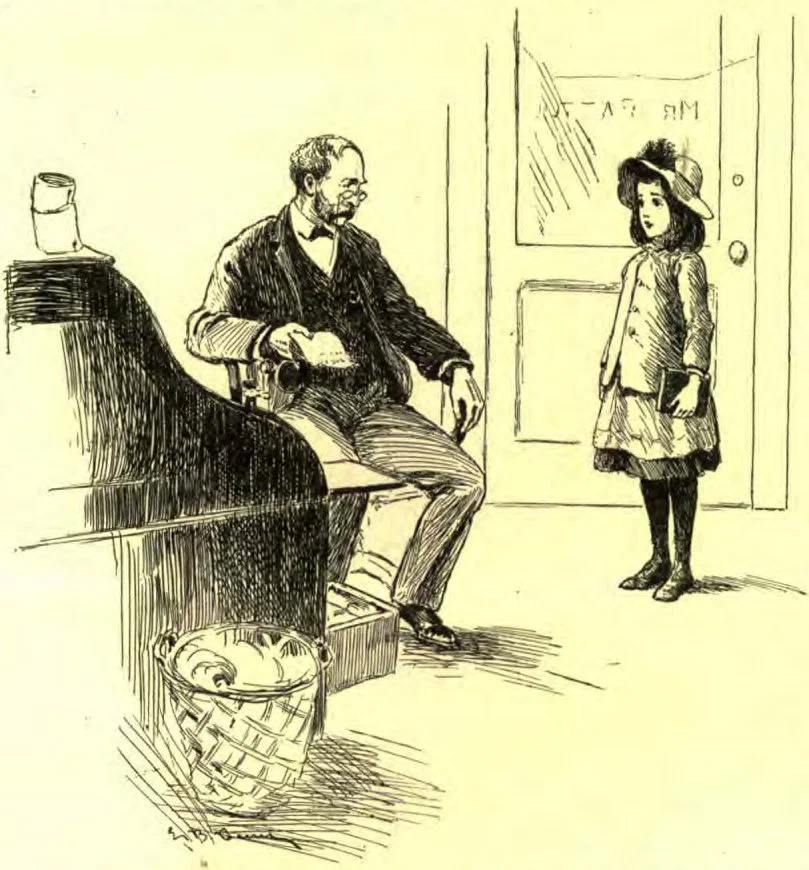
When she went to school the next morning, she took her advertisement along, and stopped at the office of The Daily Bulletin, the editor of which was a good friend of hers. He always said, “Good morning, Mouse,” when she met him, and often exchanged for a kiss an orange or a red-cheeked apple. He had often told her that his girls were all boys, and she could play that a piece of her was his little daughter.
He took her advertisement with a grave face,6and was very businesslike indeed; only he asked her one queer question. “Isn’t ‘Betsey-Amelia-For-One-Dollar’ a rather unusual name for a doll?”
“Why, why! Mr. Patten, what can you mean?” said little Sara; “that isn’t her name: it is just Betsey Amelia.”
“O,” said the editor, meekly, “I didn’t understand.” As little Sara closed the door, she thought she heard him laugh; but she might have been mistaken.
The next day was Saturday, and little Sara arose early, and dressed Betsey Amelia in her best, and set her in the store window. She never had a chance to see The Daily Bulletin; but of course the editor put in her advertisement, and told where the doll was to be found: he had promised; and little Sara believed that people would begin to come early to look at the doll. She had not yet told either Nana or Philip. Indeed, she would have liked to make the dollar a surprise for both of them if she could. At the breakfast table came up a plan that she saw might help her do this.
“Do you suppose, Edward, I could leave little Sara to look after the store for two hours this morning? There is hardly ever a customer, especially in the morning; and mother wants me to go myself with that work she finished last week, and explain why it was so late, and show her about the bad place in the lace.”
“I should think she might be clerk as well as not,” said Edward, smiling at little Sara’s eager face. “She knows the prices of things, and can count all the money she will get, I am sure.”
Was everything ever better planned? What if she should have a whole dollar to give to Nana as soon as she got home! Then mother could have all she needed for over Sunday, and there was no money coming in from anywhere else. When Philip asked whether money was to be paid for the work that was to be taken home, Nana shook her head, and said, soberly, that it was to be charged on their coal bill. The thought of what she might do made little Sara feel almost happy in spite of the fact that she was to part with Betsey Amelia.
Never was there a neater-looking little saleswoman than the one who took her place in due time behind the counter, charged with watching two bells, the one on the door, and the one that her mother was to ring if she needed anything.
The door-bell rang first; but before it rang, a carriage stopped at the gate, and a lady stepped out of it.
“Is this the dolly that I saw advertised?” she began, looking smilingly at the small saleswoman and then at Betsey Amelia. “It is a dear little doll, I am sure. Is it yours, my dear? and may I be told what the ‘case of need’ is?”
Little Sara had not meant to tell, but the lady was so sweet that before she knew it, she was explaining the whole plan and the reason for it. The lady was pleased with it, too, and told little Sara that it was a very kind, unselfish thought, and that she would be glad to take the dolly, and considered two dollars not a cent too much to pay for one so neatly dressed. More than that, she looked at pins and thread and buttons and needles, and liked them so much that when she went away, she left five whole dollars in the cash-drawer, which had been empty for weeks. Little Sara was so excited that she forgot to feel bad about Betsey Amelia.
What a morning that was! No sooner had the first carriage rolled out of sight, than another stopped, and three ladies made their way to the door. The small clerk met them eagerly. “O!” she said, “I’m sorry. I mean I’m glad;” then she stopped in confusion, and began again. “If you came to see dolly, she has been sold.”
Of course they were sorry. Each lady had meant to have her. But they came in, and looked about them, and wanted tape and soap and pins and hair curlers. While they were still there, others came, and little Sara began to think that something must have happened the night before to all the pins and needles in the city. How else could it be accounted for that so many ladies wanted them at once? Before Nana came back, every pin was sold; then they began on the buttons and thread. Never in its history had the little store had such a wonderful morning. The ladies kept coming, and every one of them asked about the “case of need,” and every one of them bought what cost much more than the price of the doll.
“Isn’t this the little girl who used to bring such nice cookies to school with her luncheon?” one lady asked. “My children used to have bites of them, and tell how good they were. I wish you had some of those for sale. But if your mama is ill, she can not make any, I suppose.”
“My sister Nana knows how to make them,” said little Sara, eagerly. “Mama said hers tasted every bit as good, and I know she would like to make you some.”
Then every lady there wanted two dozen cookies as soon as she could get them.
When Nana reached home, she found a little saleswoman with cheeks so red that they almost seemed to blaze, and $23.30 in the cash-drawer, and nine dozen cookies ordered.
But the strangest thing in that strange day happened at night, just as little Sara had laid her tired head on her pillow, and was trying to keep back the tears because for the first time in Betsey Amelia’s life she was sleeping somewhere else than by her side. The little bell over the store door rang once more, and Edward answered it, to receive a box and a note for “Miss Sara Newton.” The note read:— “DEAR LITTLE SARA: My Lilian has been very happy to-day with Betsey Amelia; but to-night she thinks the dolly is homesick for her own dear mama, and wants her sent back to you with Lilian’s love. I am sure you will keep her for my little lame Lilian’s sake, for she truly wants to make you a present of her ‘to keep,’ she says.”
And there, in the box, smiling her own sweet smile, was dear Betsey Amelia!
“I’m glad she’s got back,” said Edward, looking down on her, and speaking with a queer tremble in his voice. “I didn’t know I loved dolls, but this one has cured mother, and made our fortune.”—Pansy, in Junior Christian Endeavor World.
The Striking Clocks
By Joseph Blethen
THE clocks struck one; and then they struck
Demanding shorter hours.
To suit the fashion of the hour
They walked out of their towers.
One went about the sleeping town
On this odd temporal mission,
And urged all clocks to go on a strike
To better their condition.
They gathered in the public square
To listen to haranguing,
And when the leaders made a point,
The clocks all made a clanging.
“In striking we have always led
(One old clock there made mention),
But lately other strikes than ours
Are claiming some attention.
“As near as I can understand,
These strikes for shorter hours
Would leave us broad, progressive clocks
Some leisure in our towers.”
Then off they went to meet the Sun,
And left the sleeping peoples
With only watches there on watch
Amid the clockless steeples.
The Sun slacked never whit his pace,
Though loudly they made trial,
But all that day he marked the hours
Upon the court-house dial.
The clocks declared they should stand firm
Till all demands were ceded,
But when their mainsprings had run down
Some winding-up was needed.
Then one old clock declared his mind:
“I want no time to play.
I need each moment of my time
To tell the time of day.
“I find that Time goes calmly on
For every man and nation,
And striking clocks that go on strike
Must lose their occupation.”
Then back they went to shelf and tower
With shame in all their places,
And to this day those clocks have held
Their hands before their faces.
— Joseph Blethen.
Saying “Thank You”
“Ten years ago,” said a well-known clergyman recently, “one would have prophesied great things for that young man; but he never educated himself to say ‘Thank you.’ His life has become self-centered, and his influence is decreasing. I sometimes think he actually does not recognize a favor when he sees it.”
The neglect to say “Thank you” does lead to a sort of dulness of perception, and fosters selfishness. To say “Thank you!” quickly and heartily, commends one to others, and stimulates his spiritual life.
Some people say that words cost nothing, and that they prefer to let their actions speak for them. But to omit saying “Thank you” is of itself an action, and an action which is distinctly an affront to the doer of the favor. By the glum silence and apparent indifference of the one whom he has assisted, the donor feels himself rebuffed. The favor he did may have been little enough, but surely worth a word or two of acknowledgment. Can he be expected to understand how the one whom he has aided or encouraged is planning to “pay him back” some day? The thought of “pay” would only seem another affront.
The doer of any kindness, slight or large, asks for no return. He is moved to his act by his interest and sympathy. He asks only that the obligation be recognized. “Thank you” is simply the grateful acceptance of his kindly deed, which makes him feel glad that he has had the privilege of doing it.—Wellspring.
A Missionary Maiden
By Claude Holmes
THE LORD is anxious to have all little children work for him. He says that he has a “book of remembrance” which is always before him, and in it are written the good words that are spoken by those who love him; and after Jesus comes, we can see it, if we are faithful.
But the Lord has another “book of remembrance” in which are found the deeds of some of his good children who have lived in the past. He has given us this book so we may know what he thinks about our little acts; and this book—the Word of God—we all can and should study.
Once when Jesus was upon this earth, a woman made a great sacrifice to show her love for him because he had forgiven her sins. He so appreciated this sincere mark of faith and love that he said, “Wheresoever this gospel shall be preached in the whole world, there shall also this, that this woman hath done, be told for a memorial of her.”
But many years before this, even before Christ came down to this world, a little girl did some missionary work, and did it in such a self-sacrificing7way that it pleased the Lord to record it in his book of remembrance. He did not give us her name, so we know that it was the work, and the spirit in which she entered upon it, that pleased the Lord. He desires all the children to learn about this, and know how they may, in one way at least, be laborers together with God.
She was a little Hebrew girl, and her mother had taught her about God and the prophets, and how to attend to the little things about the home and perform her tasks in a neat, orderly way.
One day this little maiden was taken captive by a band of Syrians, who were skirmishing around, and was carried many miles away from her home and friends. When her captors returned to their home, she became a servant, and waited upon the wife of a man named Naaman. But she did not complain, nor make her condition more unhappy by sullenness and discontent. She took a friendly interest in the family, and showed her faithfulness in all her work.
Naaman was a mighty man of wealth and power, and a captain, or commander, of the Syrian army. But great as he was, when he transgressed God’s laws, he became sick, and was afflicted with leprosy. When the little girl saw how Naaman was suffering with this dread disease, she told Naaman’s wife about the great prophet in Israel, and entreated that her master should go to him and be healed.
Naaman had so much confidence in the maiden that he immediately began preparations to go. The prophet was glad to relieve him of his affliction, and when he was healed, he was so happy that he exclaimed, “Behold, now I know that there is no God in all the earth, but in Israel.”
Little did the maiden realize the influence of those words. They would probably have been useless, however, had not her life been consistent with them. God wants all the children to remember that even a child is known by his doings.
CLAUDE HOLMES.
President Roosevelt and the Newsboy
A WAITER started to drive a newsboy from a restaurant in which Mr. Roosevelt was dining. He stopped the waiter, and bought a paper of the boy. Then, noticing that the boy was shivering, and looking hungrily at the tables, he called the head waiter, slipped a bill into his hand, and asked him to take the lad to the kitchen and give him a square meal.
After the boy had dined, Mr. Roosevelt made him take him to his home, which was in a poor garret. The family were Hungarians. The mother was too ill to work, and the boy was supporting her and three children. They were given money for their present needs, and charitable societies became interested in them. He finally got the boy a good place with a wealthy Hungarian. This is only one of many cases in which Mr. Roosevelt was kind to the poor in that part of the city, and it is no wonder that the Hungarians recently invited him to a dinner, and were so enthusiastic over his coming.—Junior Christian Endeavor World.
God's Care
Just as Dr. Judson had finished translating the New Testament into Burmese, he was cast into prison. His wife took the precious manuscript, and buried it in the ground. But if left there, it would soon decay, while to reveal its existence to its foes would surely lead to its destruction. So it was arranged that she should put it within a roll of cotton, and bring it to him in the form of a pillow, so hard and poor that even the keeper of the prison did not covet it. After seven months this pillow — so uninviting externally, so precious to him — was taken away, and then his wife redeemed it by giving a better one in exchange. Some time after, he was hurried off to another prison, leaving everything behind him, and his old pillow was thrown into the prison yard to be trodden under foot as worthless cotton; but after a few hours one of the native Christians discovered the roll, and took it home as a relic of the prisoner, and there, long afterward, the manuscript was found within the cotton, complete and uninjured. Surely the hand of the Lord was interposed to save from destruction the fruit of years of toil, so important for those who were to read the Burmese Bible.—Selected.
MEMORY VERSE: “Whosoever drinketh of the water that I shall give him shall never thirst; but the water that I shall give him shall be in him a well of water springing up into everlasting life.” John 4:14.
“When therefore the Lord knew how the Pharisees had heard that Jesus made and baptized more disciples than John (though Jesus himself baptized not, but his disciples), he left Judea, and departed again into Galilee. And he must needs go through Samaria. Then cometh he to a city of Samaria, which is called Sychar, near to the parcel of ground that Jacob gave to his son Joseph. Now Jacob’s well was there. Jesus therefore, being wearied with his journey, sat thus on the well: and it was about the sixth hour.
“There cometh a woman of Samaria to draw water: Jesus saith unto her, Give me to drink. (For his disciples were gone away unto the city to buy meat.) Then saith the woman of Samaria unto him, How is it that thou, being a Jew, askest drink of me, which am a woman of Samaria? for the Jews have no dealings with the Samaritans. Jesus answered and said unto her, If thou knewest the gift of God, and who it is that saith to thee, Give me to drink; thou wouldest have asked of him, and he would have given thee living water. The woman saith unto him, Sir, thou hast nothing to draw with, and the well is deep: from whence then hast thou that living water? Art thou greater than our father Jacob, which gave us the well, and drank thereof himself, and his children, and his cattle? Jesus answered and said unto her, Whosoever drinketh of this water shall thirst again: but whosoever drinketh of the water that I shall give him shall never thirst; but the water that I shall give him shall be in him a well of water springing up into everlasting life. The woman saith unto him, Sir, give me this water, that I thirst not, neither come hither to draw. Jesus saith unto her, Go, call thy husband and come hither. The woman answered and said, I have no husband. Jesus said unto her, Thou hast well said, I have no husband: for thou hast had five husbands; and he whom thou now hast is not thy husband: in that saidst thou truly.
“The woman saith unto him, Sir, I perceive that thou art a prophet. Our fathers worshiped in this mountain: and ye say, that in Jerusalem is the place where men ought to worship. Jesus saith unto her, Woman, believe me, the hour cometh, when ye shall neither in this mountain, nor yet at Jerusalem, worship the Father. Ye worship ye know not what: we know what we worship: for salvation is of the Jews. But the hour cometh, and now is, when the true worshipers shall worship the Father in spirit and in truth: for the Father seeketh such to worship him. God is a Spirit: and they that worship him must worship him in spirit and in truth. The woman saith unto him, I know that Messias cometh, which is called Christ: when he is come, he will tell us all things. Jesus saith unto her, I that speak unto thee am he. . . .”
“The woman then left her water-pot, and went her way into the city, and saith to the men, Come, see a man, which told me all things that ever I did: is not this the Christ? . . . And many of the Samaritans of that city believed on him for the saying of the woman, which testified, He told me all that ever I did. So when the Samaritans were come unto him, they besought him that he would tarry with them: and he abode there two days. And many more believed because of his own word; and said unto the woman, Now we believe, not because of thy saying: for we have heard him ourselves, and know that this is indeed the Christ, the Saviour of the world. . . .”
“So Jesus came again into Cana of Galilee, where he made the water wine. And there was a certain nobleman, whose son was sick at Capernaum. When he heard that Jesus was come out of Judea into Galilee, he went unto him, and besought him that he would come down, and heal his son: for he was at the point of death. Then said Jesus unto him, Except ye see signs and wonders, ye will not believe. The nobleman saith unto him, Sir, come down ere my child die. Jesus saith unto him, Go thy way; thy son liveth. And the man believed the word that Jesus had spoken unto him, and he went his way. And as he was now going down, his servants met him, and told him, saying, Thy son liveth. Then inquired he of them the hour when he began to amend. And they said unto him, Yesterday at the seventh hour the fever left him. So the father knew that it was at the same hour, in the which Jesus said unto him, Thy son liveth: and himself believed, and his whole house.”
Questions
1. As Jesus journeyed again to Galilee, to what city of Samaria did he come? Where did he sit down to rest? Who came to the well for water? What did Jesus ask her to give him?
2. Why was his request a surprise to this woman? What did Jesus tell her she would have done if she had known who it was that asked her for a drink? Did she understand what he meant? What did she ask?
3. What did Jesus say about the water of the well by which he sat? What of the “living water” that he gives to men? What did the woman now ask him to give to her? Did she yet understand his meaning?
4. What did Jesus now tell this woman to do? How did he show her that he knew of her past life? What did she say she now perceived?
5. What question did she now try to lead Jesus to settle? Did he answer her question? How did he say the true worshiper would worship the Father? How alone can he be worshiped?
6. Where did the woman now go? What did she say to the men of Sychar? What was the result of her invitation? What did the Samaritans ask Jesus to do? What was the result of his visit to Sychar?
7. To what place did he afterward go? Who came to him there? What did he beseech Jesus to do? How did Jesus test the faith of this man? What did the nobleman still entreat?
8. What glad words did Jesus speak to the anxious father? How did the nobleman show that he believed? Who met him on his way home? What good news did they bring?
9. What did the nobleman inquire of his servants? What did he thus know? What was the result of this miracle?
Love Dwelleth Not in Lip-Deaths
Love dwelleth not in lip-deaths.
Be Not Deaf to the Warning Sound
BE not deaf to the sound that warns.
Benediction of Peace and Truth
“THE great God of truth fill all thy hours with peace.”
IX—The Holy Spirit
(May 27)
Memory Verse: “Howbeit when he, the Spirit of truth, is come, he will guide you into all truth.” John 16:13.
Questions
What promise did Jesus make just before his crucifixion? John 16:7.
What is meant by the Comforter? John 14:26; note 1.
What was the Holy Spirit to do for God’s children? John 14:26.
How is this same work of the Spirit described later? 1 John 2:20, 27.
Some conscientious souls are in distress at times, fearing that because of sin, the Spirit of God has been grieved from them forever. But notice that the first work of the Holy Spirit when it comes to the heart is to bring conviction of sin. Those who feel a real sorrow and conviction for sin may rest assured that the tender Spirit of God is still striving with them to forsake sin.
Unique Features of an Afternoon Walk
I have found too many interesting and instructive things in wood and meadow not to accept readily an invitation from a friend to take a walk in the country, and especially since we were to go with the purpose of finding something new. Brook and river, grove and meadow, hill and valley, were all visited, and we thoroughly enjoyed renewing our acquaintance with early spring blossoms and returning birds. The trees, too, were just shaking out their flower clusters, and unfolding the green leaves that had been so nicely tucked away for the winter. Already we had seen enough to make our walk worth while; but down by the Nashua near the old mill whose wheels were turned by the dark water, we came suddenly upon a unique procession. It consisted of twenty-four baby turtles all in a row. The little pedestrians were as much alike as peas in a pod, and not larger than a silver dollar. They had apparently just emerged from a sand hill, where they had passed the winter, oblivious alike to the discomforts and pleasures of the season. They were as dusty as the old miller himself, and were lining up, presumably for a bath in some meadow pool, or for a visit to last year's food haunts.
Later on in our walk as we came out of a pine grove, a large wire bird-house attracted our attention. In it sat a great owl alone. Near by were other cages in which flitted from perch to perch pretty juncoes, Java sparrows, and dainty goldfinches; but the owl took no notice of his little feathered kin. His air suggested a sense of superiority; and he was not altogether amiable to us, seeming to regard our visit as an intrusion. We were kindly disposed, but every attempt to convince him of our interest only called forth from the grouty old fellow new signs of displeasure. Unwittingly, however, he afforded us much amusement. His wonderful adeptness in turning his head from front to back, and the numberless repetitions of this feat, delightfully entertained us. One moment his great eyes would be full to the front, and if he heard an unfamiliar sound at the rear, instantly, without the slightest movement of any part of the body except the head, he would face the opposite direction.
Perhaps this performance had an especial fascination for us because we remembered how often in the physical culture class we had strained and creaked our own neck in the effort to direct the face even over the shoulder. So the marvelous ease with which the bird performed the impossible to us, won for him our admiration, despite his unfriendliness.
The lengthening shadows hastened our unwilling return, but just as we were passing through a narrow lane almost hidden by shrubs, trees, and overhanging branches from the grove at one side, we heard the clear, ringing note of the veery, or Wilson's thrush. To the lover of bird songs, this note is entrancingly sweet. We were constrained to linger. After the little fellow closed the entertainment, we went home with fresh interest in the world of life.