The Youth’s Instructor, Vol. LIII, No. 20

A Brief History of Hongkong

The Youth’s Instructor

May 16, 1905

Review and Herald Publishing Assn. · Washington, D. C. · May 16, 1905

A Brief History of Hongkong
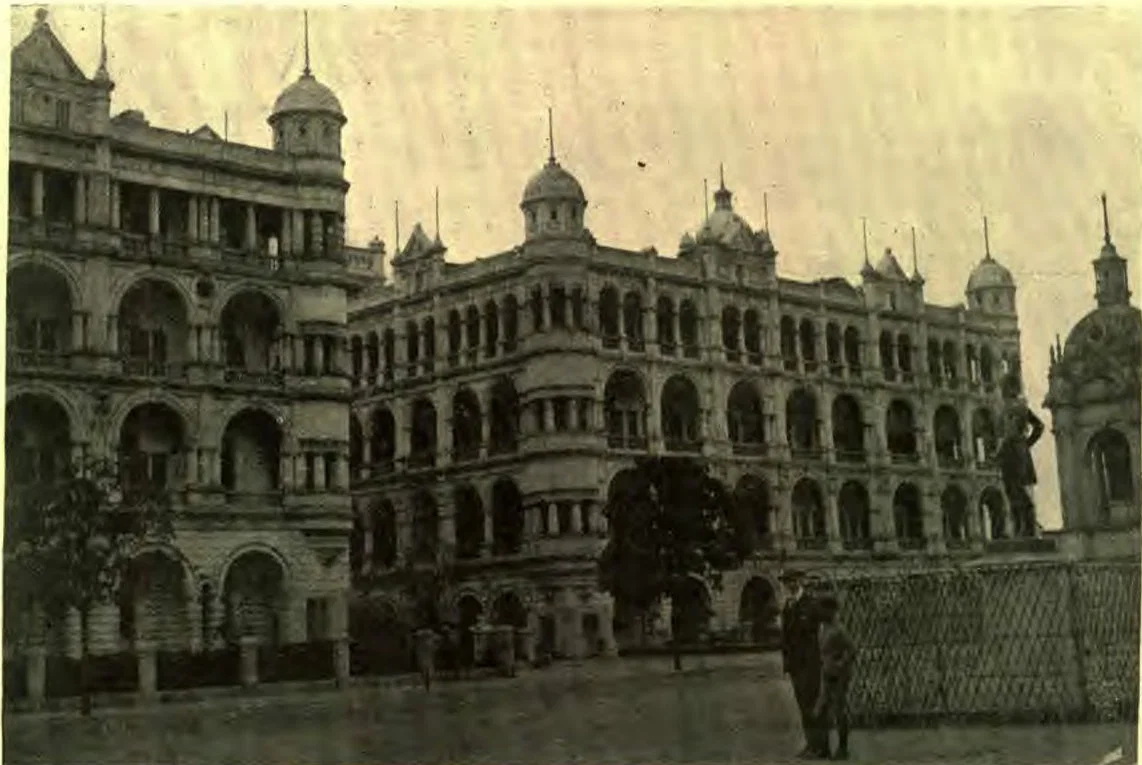
THE island of Hongkong, the most eastern of the British possessions, situated at the mouth of the Pearl River, about ninety miles from Canton, is eleven miles long, seven wide, and about twenty-seven in circumference. The name “Hongkong” signifies fragrant mountain, so named on account of the abundance of fragrant shrubbery which covers the mountain slope.
Before the British took possession of the island, it had scarcely any history. It was scantily peopled by fishermen; but in 1841 it was ceded to Great Britain by the Chinese government. This was not done, however, without some difficulty. England felt the need of a place on the coast where British trade might be controlled and protected, and where merchants and officials might be freed from the insulting requirements of the Chinese authorities. As early as 1834 England’s representative in Canton, having sufficient foresight to see the great commercial and naval advantages that would come to Britain from a possession so admirably situated, urged the home government to send a force from India to take possession of Hongkong. Later the chief superintendent of trade required that all the ships of Her Majesty’s subjects, at the outer anchorages of Canton, should proceed to Hongkong, hoist their colors, and be prepared to resist all attacks of the Chinese government. When the British community left Canton, Macao, being a Portuguese colony, offered them protection from the enemy; but when the Chinese threatened bombardment of Macao on account of the refugees, the English felt they could no longer accept this hospitality, so took to ship, where they could make a home for themselves until the accomplishment of their object—the taking of Hongkong.
At first, progress was rapid. Queen’s Road, now the principal street, was laid out for a length of three or four miles, and buildings were rapidly constructed. But things were soon checked, owing to the unhealthful condition arising from the upturning of the malarious soil. The abandonment of the island as a colony was seriously discussed. One man who recommended the idea of abandonment, cited, as a reason, the loss of two hundred fifty-seven men by death, from a single regiment within twenty-one months, and of the Royal Artillery fifty-one out of one hundred thirty-five men died within the space of two years. He said it was a delusion to hope that Hongkong could ever become a commercial emporium like Singapore. But the governor argued against this pessimistic idea, and said time alone was required for the development of the colony, and for the correction of some of the evils which hindered its early progress. The governor lived to see his predictions largely fulfilled. The people continued to suffer from malaria for some time, and even now it has not entirely disappeared; but the colony is prosperous.
PRINCESS AND QUEEN'S BUILDING IN HONGKONG
In 1862 the Hongkong mint was established. In 1874 one of the most destructive typhoons visited Hongkong, causing enormous damages and the loss of thousands of lives. The year 1894 is memorable, in the colony, as the disastrous year of the bubonic plague, from which twenty-five hundred persons died. A hundred died in a single day. The government used every measure to impede its progress and crush it out wherever possible. That portion of the city where it raged worst was cleared of inhabitants and destroyed, the government promising to reconstruct it in accordance with sanitary requirements. Special hospitals were erected, and the medical staff was increased by additions from army and navy and the coast ports. Then, as now, the plague disappeared gradually as the cooler weather came on. The past summer as many as thirty cases were reported in a day, but this means only a part of the actual number stricken, as the natives are not fond of reporting. When it is known that a member of a native family has the plague, it is quite common for the family to remove to other quarters, and leave the dead or dying in the vacated home, or else, if the sick can be moved without detection, they board a steamer, and take him to his native home in the country to die. God’s promise in the ninety-first Psalm is especially comforting during this season to his believing children.
The government of Hongkong is administered by a governor, aided by an executive council consisting of five officials and two non-officials.
Hongkong is a free port. It is now the fourth city in the world in commercial importance. Trade consists chiefly in opium, cotton, sugar, salt, flour, oil, cotton and woolen goods, yarns, matches, metals, earthenware, amber, ivory, sandalwood, betel, granite, and vegetables. It possesses unrivaled steam communications. The European and American mail is conveyed twice a week. Several less important steamers also carry mail.
The harbor of Hongkong is one of the finest and most beautiful, having an area of ten square miles. With its diversified and varied shipping scenery, it presents an animated and imposing spectacle. It is enclosed on all sides by lofty hills, formerly destitute of foliage, but now the slopes are gradually covered with young forests, the result of the afforestation scheme of the government.
The city of Victoria is beautifully situated, the houses, many of them large and handsome, rising tier upon tier, from the water’s edge to a height of over six hundred feet on the face of the peak, while many bungalows are visible on the very summit of the hills. Seen from the water at night, when lamps twinkle among the trees and houses, the city, spreading along the shore for more than four miles, furnishes a sight not soon forgotten. The roads and streets are well built, and are clean, and many of them nicely shaded by spreading banyan trees. The European business quarters occupy the central portion of the city. The botanical gardens are situated just above the government house, and consist of finely laid out terraces, slopes, walks, and parterres. There are twelve or more churches, and many schools—government, parochial, and private.
There are printed here three daily English newspapers and two weekly. The native press is represented by four daily papers, also a Portuguese paper published weekly, besides a number of smaller papers.
The approaches to the port are well lighted. A lighthouse is situated at the western entrance, the light being a fixed dioptric of the fourth order, visible at a distance of fourteen miles; and the eastern approach is indicated by a group of flashing dioptric lights of the first order, visible at a distance of twenty-two miles. A lighthouse thirty miles distant from Hongkong is connected with the port by a cable, and the approach of vessels is signaled from it to the post-office.
The city is supplied with water from three immense reservoirs upon the mountain. The water is caught and conducted by means of little drains all about the surface of the mountain, into these large reservoirs, and from them through iron pipes to our homes. There is an electric-tram road in process of construction, but thus far our means of travel is by jinrikishas drawn by the natives.
IDA-M. THOMPSON.

In the Neighborhood

(Concluded)
The homes of a neighborhood are known, not by their beautiful architecture, not by their splendid furnishings, nor yet by their lack of that which opulence affords, but by the manners which their children exhibit in every-day life. The city neighborhood suggests selfishness, while that of the country bespeaks generosity. How fortunate the children whose playhouse has a canopy of apple blossoms and a carpet of living green, whose companions are the birds, whose recreations consist in chasing the winged butterfly, playing hide-and-seek with the nimble squirrel, and watching the industrious swallows build their cozy mud houses under the eaves of the old barn! How fortunate the children who never know the evils of the city streets!
In these days of social clubs, dancing, theater-going, prize fighting, and other similar attractions, the subject of proper recreation has come to be one of serious moment to the followers of Christ. Children who are allowed to attend evil entertainments are truly objects of pity, while those who are reared amid surroundings that frown down everything in the way of recreation are deserving of sympathy. Some homes adopt the plan of work, work, work, from early dawn till late at night, with no rest or recreation in view this side of heaven. There is danger that too much greed and selfishness may close the eyes to eternal interests; that such individuals will miss the rest and peace which God designs his children to enjoy in this world, and thus miss the rest that remains for the people of God in the world to come. There are recreations that are perfectly proper for the Christian to engage in, and which are necessary to the highest development of the soul. One can accomplish more for the salvation of humanity by taking a day of rest and recreation when needed, than he can to plod along three hundred sixty-five days in the year, like a horse in a treadmill. The groves were made to be of benefit to humanity; and what can be more enjoyable than a day spent in the refreshing shade of “God’s first temples,” beside some rippling stream, or on the shore of some placid lake? Our Sabbath-schools would receive new inspiration by rightly spending a day amid such surroundings as these.
“There are kinds of recreation which are highly beneficial to both mind and body. An enlightened, discriminating mind will find abundant means for entertainment and diversion from sources not only innocent, but instructive. Recreation in the open air, the contemplation of the works of God in nature, will be of the highest benefit.” We are further instructed that “among the most dangerous resorts for pleasure is the theater. Instead of being a school of morality and virtue, as is so often claimed, it is the very hotbed of immorality. Vicious habits and sinful propensities are strengthened and confirmed by these entertainments. Low songs, lewd gestures, expressions, and attitudes deprave the imagination, and debase the morals. Every youth who habitually attends such exhibitions will be corrupted in principle. There is no influence in our land more powerful to poison the imagination, to destroy religious impressions, and to blunt the relish for the tranquil pleasures and sober realities of life than theatrical amusements. The love for these scenes increases with every indulgence as the desire for intoxicating drink strengthens with its use. The only safe course is to shun the theater, the circus, and every other questionable place of amusement.”
One of the bright spots in the shadows of the past, is that of an evening spent in a private home with the young people of College View, Nebraska. The program included some innocent outdoor and indoor games, music, and helpful words of instruction from a minister, also from an educational professor and a sanitarium physician. I am sure it was an uplifting occasion, and one well calculated to assist all present to reach a higher plane of being.
“But,” says one, “if we have an occasion for neighborhood or Sabbath-school recreation, the boys and girls will talk with one another.” That may be; but the Bible in no place prohibits it. The Creator made us social beings, and we who have bidden adieu to the spring-time of life can by no means crush out this tendency in those who are enjoying the sunny days of youth; nor should we wish to do so. It must be proper that boys and girls should treat one another with courtesy, or they never would have been placed in the same family. The trouble is not that they will talk with one another, but that they have been receiving such ill training that they will not always know when to speak or what to say.
Children and young people should be so educated that they will be at ease when in company, and not always appear to be on a strain. They should be so self-possessed that they will not be lost in a fog of perplexity when circumstances demand that they manifest calm dignity, refinement, and heaven-born sociability. If girls who do not preserve the dignity of womanhood, when in the presence of boys and young men, could hear what the young men say about them, they surely would not wish to give further cause for such criticism, unless they lightly esteem the honor of a “spotless reputation.” Young ladies who cultivate the habit of calling up boys and young men over the telephone, just for the purpose of having something to say, are not raising themselves in the estimation of the young men, and might employ their time to better advantage. “Let no man despise thy youth; but be thou an example of the believers, in word, in conversation, in charity, in spirit, in faith, in purity.” “Only let your conversation be as it becometh the gospel of Christ.”
Many of the recreations and entertainments of the present time are of such a character that a Christian can not participate in them and preserve his integrity. Kissing plays are a snare of Satan to entrap souls; and no boy or girl who desires to be kept from falling, should countenance anything so foreign to all that is good, pure, and true. Should you be so circumstanced as to be called upon unexpectedly to join in such an undignified pastime, have sufficient moral stamina and Christian courage to decline. Your good example may save a soul; and you will be esteemed all the more highly if others are made to understand that your ideas of propriety are not so commonplace as to permit you to indulge in promiscuous kissing. O that our boys and girls, before whom are such infinite possibilities for good, would place a higher estimate upon true manhood and womanhood; that they would abandon forever the low moral plane on which so many now dwell, and take their permanent stand on higher ground.
Satan has so set his wily snares that the association of boys and girls together has come to be a serious question. It seems impossible for many to receive even the simplest courtesies of mere friendship without imagining that the giver must have matrimony as the objective point, when the giver never has thought of it. In the good old days when boys and girls could “choose up and spell down,” with no risk of encumbering themselves with lifelong partners, there was more of the invigorating atmosphere of unalloyed friendship than exists to-day. But it is sweet to believe that there are yet a few young people numbered among “the salt of the earth,” who recognize simple friendship when they see it; who appreciate the acquaintance of great souls whose conversation is elevating and profitable, and includes nothing that would suggest sentimentalism. Sensible boys and girls have no desire to converse with those who are so depraved in their ideas as to think that they should pay the penalty of matrimony for the privilege. Sensible boys and girls are not easily caught by cheap bait. Sensible boys and girls prefer to get something else into their heads before settling down to the realities of married life; they prefer to fit themselves for usefulness before the golden opportunity is gone, and gone forever.
This is an age of sentimentalism. Boys are so prone to imagine themselves to be in love, and girls are so anxious to get married, that they unfit themselves for either happiness or usefulness. If girls were less easily won, boys would respect and esteem them more highly than they do at present. Matrimony is not the chief end of life, and boys and girls should not permit this theme to take possession of their thoughts while they should be receiving an educational training that will fit them to do a grand work for humanity. Many of our youth are turning their backs to the opportunities of the hour by joining their life interests with those who have little or no interest in true heart religion. One can not afford to run the risk of imperiling his soul and blighting the hopes of a lifetime in such a summary manner.
Dear young friends, where are your thoughts? and whither do your footsteps tend?
MRS. M. A. LOPER.

A Hard Word

PERSEVERANCE! Can you spell it? And it's meaning, can you tell it? If you stick to what you're doing, Study, work, or play pursuing, Every failure bravely meeting, Bravely each attempt repeating, Trying twice and thrice and four times, Yes, a hundred, even more times, You can spell it! You can spell it! And its meaning, you can tell it!
—Selected.

How “Abide with Me” Was Written

At the age of fifty-four Lyte found himself doomed to die of consumption, and in sorrow at having to leave his task unfinished, he prayed that at the least it might be granted to him to write something which would live to the glory of God when he was dead. Then on the last evening he ever spent at Brixham, after preaching his farewell sermon, he took his pen, and as the sun was setting over the ships that lay in the harbor, he wrote “Abide with Me.” Next morning he started for the Riviera, and there died a month later.—Selected.

The Power of a Sunny Temper

“A SUNNY temper is a heart-opener. It brings shy people out of their reserves, and makes them expand in its presence as the flower opens to the sun. It takes the suspicious off their guard, and makes them respond with trust and warmth.”

The Sign of the Stork

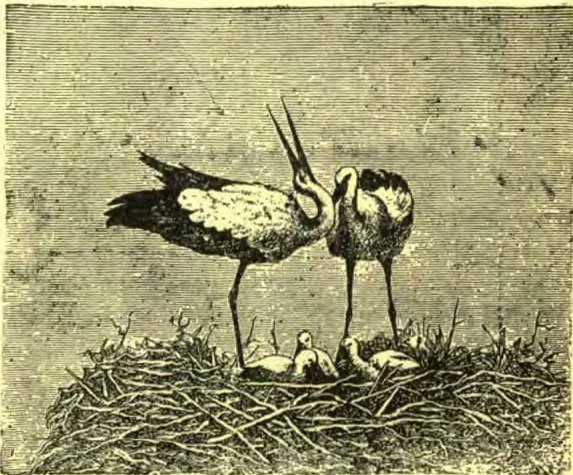
In a certain town in Norway the figure of a stork appears on the church and over many of the houses. Tourists who go there often find on sale on every hand, images of the stork in silver and gilt, or carved in wood. The story of the origin of this sign of the stork is unusual and interesting. The hero of the tale is Conrad Jonassen, whose name will be forever associated with the stork.
Many years ago, when Conrad was a boy, a stork built its nest on the roof of the house. Conrad and his mother fed the bird, and so encouraged its return. In time the boy went to sea. One day the ship fell into the hands of pirates, and he, with his shipmates, was sold into slavery in Africa. Hardships and indignities of all sorts were heaped upon them for three years. One day Conrad saw a stork flying about overhead, and was filled with homesick longings. He whistled to the bird as he used to do at home, and to his delight the stork came near and finally alighted, as if expecting to be fed. He had nothing to give the bird then, but the next day he saved a part of his breakfast, hoping that the stork would come again. It did, and for several days continued to come.
At length it occurred to the homesick slave that the stork would soon be flying north again, and like an inspiration came the thought that by means of the bird he could send a message which might possibly fall into the hands of friends. He wrote a few lines on a bit of tough paper, and bound it fast to the stork's leg. A few days later the bird disappeared.
One day Mrs. Jonassen noticed the stork, which had returned again to its nest on the roof, picking at something on its leg. She fed the bird, caught it, and removed the bit of paper. Fancy the mother's feelings when she found it to be a message from her own son, long since given up for lost. News too good to believe!
It would be too long a story to tell of the interest of the parish, of the money raised, the expedition sent to rescue Conrad and his mates. All this took place, however, and Conrad Jonassen came home. In after-years he became a rich man, and did much for the welfare of his native town. The stork was never forgotten, and it is small wonder that it became the emblem of the Norwegian town.—Outlook.

The Beginning of Plants

THERE are many seeds so small that we can not see them with the naked eye. The seeds of all toadstools can be seen only by the help of a powerful microscope. It takes from two to four thousand toadstool seeds laid end to end to reach one inch. The size of a seed does not appear to make any difference in its life. It contains the germ that, properly planted and cared for, will swell, sprout, grow into the same kind and sized plant that bore it. The seed of the giant sequoia of California, through the largest of which a street-car can run or a load of hay be drawn, is not so large as the seed of the little parsley. The poet has written, “Mighty oaks from little acorns grow.”
Every plant grows from a seed. There are many plants which grow from roots and cuttings, but the plants these roots and cuttings are taken from began in seeds. Let us see how.
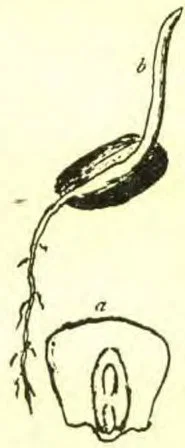
a. Corn germ. b. Corn sprouting
When seeds are ripe, perfected, they usually fall to the ground. They may be blown to a distance by the wind, carried off by birds, or scattered by their explosive seed-pods. Some, like the burdock and Spanish needle, have hooks, which catch on one’s clothes, the wool of sheep, or hair of animals, and are carried away from home to start new patches for themselves. Perfect seeds are alive. Many kinds sprout, or germinate, as soon as they strike the ground. Others do not germinate until the next spring. Some seeds, if not planted, die in a year or two. Some—the seeds of the sensitive plant—keep alive for as many as sixty years. The way to tell whether or not seeds are alive is to place them on wet cotton, in a warm place, under a tumbler. If alive, they will sprout.
A seed contains the germ of a new plant. This germ is surrounded with more or less food for the young plant. Over the whole is a skin or hull. Soak a grain of corn or a chestnut or a bean until it is soft; then carefully split it across its width. At the point you will find the germ nicely folded up. All the matter about it is food stored for it to consume when it is ready for it.
When a seed strikes the ground, and is on a spot which suits it (it may be in a crack of the soil or rain may splash dirt over it, or a bird may scratch earth to it), dampness, moisture, warmth, passing in through the hull, swell it, the hull bursts, the germ unfolds. The part of the germ stem which first comes from the hull turns downward, and strikes for the ground beneath it. This is the root. It then branches, grows in size and length, branching all the while as it has more work to do in passing up to the branches and leaves above the food it collects. The roots are not dumb waiters, as we shall see.
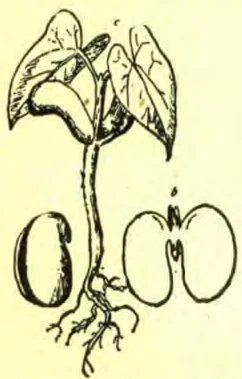
a. Bean splitting. b. Bean sprouting. c. Seed-leaves and second leaves.
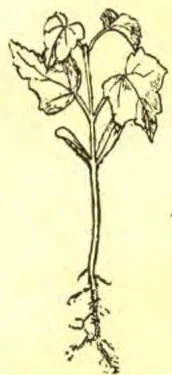
The other end of the germ stem always turns upward. The seed leaves (those which were along with it in the seed) seek the light, air, and sun warmth. The stem grows longer, the leaves get above the ground, spread themselves out, and begin their work of changing, with the help of the light and air, the food passed up by the roots into new wood, new leaves, and all that goes to make a little plant or a giant tree. Between the two seed-leaves a tiny bud shows itself. It swells, and opens into two leaves. The stem under these grows, and hoists them higher. This budding, stem growing, branching, goes on until the plant, or whatever it is, is finished far enough to bear blossoms and ripen its seeds.
The best way to learn and remember how a plant begins is to lightly plant a lot of seeds—clover, corn, wheat, or morning-glory—in a flower pot. After the seeds swell, each day take one up and examine it closely. By doing this you will make nature tell you very pleasant stories, and show you a great deal that you ought to know.
The food that is collected by the rootlets in the ground, and is passed up by them, is not ready for the use of the branches and leaves. It all has to go to the leaves to be cooked, as it were, by the light and air. It then returns through the cells of the plant to make wood, roots, even leaves. The extra matter which surrounded the germ in the seed, fed the very young plant until it spread its seed-leaves, and could begin business for itself. If you cover a thrifty plant with anything that will keep out all the light and air, the leaves will whiten, and the plant will die. The roots are busy all the time, but the food they pass up does not get properly changed. It is not digestible by the plant. The plant dies of starvation.
In the bean, which is a very interesting seed to study while germinating, the food for the young plants is stored in the two thick seed-leaves, which are the two halves of the bean. It is these seed-leaves which we eat, and which are so luscious in the lima bean. Large beans should always be planted with the stem side down. The great seed-leaves (halves of each bean) will be set right to push up through the earth. I know a gentleman who left the city to try farming (of course, he believed he knew all about it), who, when his lima beans came up, thought they were wrong side up. So he turned them all!
The acorn swells, bursts the hull, and divides like the bean. So does the chestnut. But the two halves remain in the hull, and are not made use of as first leaves. They furnish food for the young plants.
This branching goes on
Acorns grow prettily when set in a hole in a card over a glass of water. The lower part of the acorn should always touch the water. The growth of peas can be watched by the same plan. Many of the plans of plant growth, with good plain descriptions and illustrations, can be found in “How Plants Grow: A Botany for Young People,” by Prof. Asa Gray.
A great number of plants and trees have the power of starting new growths from their roots, or cuttings of their branches. The locust and ailantus trees are well-known tree producers from their roots. Yet they both grow plenty of seeds. Potatoes are not the seed of the potato plant. The seed grows on the top of the potato vines. Yet pieces of potato, each having one or two “eyes,” or sprouts, upon it, are always planted to grow the new crops from.
Strawberry plants, dewberry vines, wild raspberries, run out arms or shoots along the ground. At a joint, roots are thrown out, which grow into new plants. Grape-vines can be increased in this way.
A common plan for getting the kind of fruit wanted is to take a cutting from, say an apple-tree, cut the lower end wedge shape, and insert it in a split made in the stump, or in a branch of another apple-tree. As many kinds of apples can be grown on one tree as there are branches to place cuttings in. This is called grafting. The begonias, cacti, and several other plants can be grown by planting in the earth the edges of pieces of their leaves.
The grand purpose and work of every living thing is to produce after its kind. The efforts of plants to do this in several ways is truly wonderful.
But, after all, the little seed is the true beginning. A good many habits, besides those of plants, grow from very small beginnings. In starting a crop of habits, choose them as carefully as you do seeds,—plant the best only, cultivate well, keep clean of weeds.—Charles McIlvaine, in Sunday School Times.

Spring Thirst for Wood-Paths: Verse by N. P. Willis

The spring is here—the delicate-footed May, With her slight fingers full of leaves and flowers; And with her comes a thirst to be away, Wasting in wood-paths her delightful hours,— A feeling that is like a sense of wings, Restless to soar above these fleeting things. —N. P. Willis.

A Toad's Appetite

THE toad is an exceedingly greedy animal. It feeds continuously throughout the night, and in twenty-four hours consumes a quantity of insects equal to about four times its stomach capacity. This has been definitely ascertained by studying the animals confined in cages. Their capacity for food is proportionate to the size of their stomachs and their powers of digestion. In one toad's stomach have been found seventy-seven thousand-legged worms, in another's thirty-seven tent caterpillars, in another's sixty-five gipsy-moth caterpillars, and in yet another's fifty-five army-worms. Thirty large celery caterpillars have been fed to a toad in less than three hours; another has been observed to “snap up eighty-six house-flies in less than ten minutes,” while still another swallowed ninety rose-bugs.
Dr. Kirkland reckons that in ninety days (May, June, and July) a toad will destroy 9,720 injurious insects. Of this number about two thousand, perhaps, will be cutworms. Many gardeners give their children one cent for each cutworm found and destroyed, considering this a low estimate of the damage caused by the pest. Even at so nominal a figure, the toad's services on this one item would come to twenty dollars. If other insects which it destroys be added, a year's work for one toad would come to at least forty dollars.
Thus it appears that the toad is conspicuously the friend of man, and nothing could be more foolish than the practise of killing these useful animals.—Saturday Evening Post.

THE WEEKLY STUDY

Paul’s Experiences at Jerusalem

OPENING EXERCISES.
SCRIPTURE FOR STUDY: Acts 21:15-40.
REFERENCE STUDY: “Sketches from the Life of Paul,” pages 207-218.
TOPICS FOR STUDY:—
Leaves Cæsarea for Jerusalem.
Companions.
Received by elders.
Relates experiences.
Many opponents.
Nazarite vow.
Mobbed.
Great uproar.
Carried to the castle.
Paul makes known his citizenship.

Notes

This is Paul’s fifth and last visit to Jerusalem. It marked a very important crisis in the work of the great apostle. Some four years had been covered by this fruitful missionary tour.
James and all the elders of the church were present, and received the apostle gladly. Note the statement “he rehearsed one by one the things which God had wrought among the Gentiles.” This was a real missionary meeting, and furnishes us an example of how to have an interesting missionary meeting in our churches. Let all go to work and secure some items of personal missionary experience to “rehearse,” and the church missionary meetings will be seasons of interest and refreshing.
Read Num. 6:13-21 concerning the Nazarite vow. “Agrippa I, not long before, had given the same public expression of his sympathy with the Jews, on his arrival from Rome to take possession of his throne. And what the king had done for popularity, it was felt that the apostle might do for the sake of truth and peace.”—Conybeare and Howson.
“The completion of this vow involved (Num. 6:13-18) a considerable expense for the offerings to be presented in the temple; and it was a meritorious act to provide these offerings for the poorer Nazarites. St. Paul was requested to put himself under the vow with those other four, and to supply the cost of their offerings. He at once accepted the proposal.”—Bible Dictionary.
“Paul’s great object in visiting Jerusalem was to conciliate the church of Palestine. . . . He felt that if he could by any lawful concession on his part win them to the truth, he would remove a very great obstacle to the success of the gospel in other places. But he was not authorized of God to concede so much as they had asked. This concession was not in harmony with his teachings, nor with the firm integrity of his character. His advisers were not infallible. Though some of these men wrote under the inspiration of the Spirit of God, yet when not under its direct influence, they sometimes erred. . . . Instead of accomplishing the desired object, these efforts for conciliation only precipitated the crisis, hastened the predicted sufferings of Paul, separated him from his brethren in his labors, deprived the church of one of its strongest pillars, and brought sorrow to Christian hearts in every land.”—“Sketches from the Life of Paul.”
“Paul’s first act (on reaching Jerusalem) was to present the contributions with which he had been entrusted. He had been careful to guard against the least occasion for suspicion in the administration of his trust, by causing delegates to be elected by the several churches to accompany him as joint trustees of the funds collected. These brethren were now called forward, and one by one they laid at the feet of James the offerings which the Gentile churches had freely given, although often from their deepest poverty.”—Id. G. B. T.
Continue reading: Storks Play Games