Your ShelfYour Projects

Review and Herald, Vol. 91, No. 21.

Rome in Politics and Religious Legislation
Earlier text: How We May Increase the Income

A Visit to Africa's West Coast

L. R. CONRADI
HAMBURG has become such an excellent shipping center that one can find steamers going from it to any part of the world. Twice a month there is an excellent mail service by the Wormann line to the West Coast of Africa. On the evening of Nov. 9, 1913, I boarded the "Lucie Wormann," saying farewell to my friends; but the low water and fog delayed us until the next afternoon. We were so near home, and yet so far! Our second cabin was well filled with people going to all parts of the West Coast, many of them being aged Africans. Two missionaries who were going to the Gold Coast, and a Hamburg merchant, who was also religiously inclined, were my companions during the voyage. Thus there was ample opportunity to receive and to give information, and it was well improved. We were happy indeed, when nearing Africa, to begin to feel the benefits of its warmer climate.
November 18 we reached Las Palmas, where Brother Aldrich met me, and we spent about an hour in conversation. I regretted very much that I could not visit him in Teneriffe. During the first part of the trip I improved every occasion to talk with the missionaries about our own mission experiences and to learn of theirs. But during the course of the journey they became so deeply impressed with these experiences that they themselves began to inquire about our doctrines. The night before we parted, I invited them to a special season of prayer. Before we knelt down, they said they desired to make a statement to me. In their mission seminary but little attention had been given to the prophetic portion of the Bible. What they heard of us there only prejudiced their minds, and they had used their influence against us. But while they were in the seminary in Berlin, the mission professor spoke favorably of our mission efforts, and now, after having become better acquainted with us, they felt that they ought to make a confession. We then sought the Lord together. Nothing removes prejudice from the hearts of missionaries more quickly than to learn that others are doing the same pioneer work as they are doing, and that God is blessing them.
Our boat reached Freetown one day late, Sunday evening, November 23. Brethren Myers and Lewis and several of our native workers met me at the ship, and within two hours after landing I was in their well-built and well-filled chapel, presenting the gospel. Our missionaries have secured a beautiful property at Freetown, and put up two large buildings, with dwellings for several missionaries. Since the school was removed to Waterloo, one building has been used for treatment rooms. Our water supply is excellent. Our chapel is about half a mile distant in another part of town.
Freetown, as the name infers, is an old settlement of freed slaves, which has gradually grown to an important town, containing about forty thousand people. A strip of land along the coast forms a British crown colony, while the hinterland is a protectorate. As these slaves came originally from several different parts of Africa, the English government knew no better way than to make the English the language for them. The Sierra Leonians are known as great traders all along the coast. Some of them have been educated in Oxford and Cambridge as doctors, lawyers, ministers, etc. They have also a fine college in Freetown, where both the English and the Timni are taught.
During my stay, I attended the distribution of prizes for all the schools, which was presided over by the governor. It spoke well for the progress made in education. But the religious influence of the people of Sierra Leone has not made itself felt very much among the heathen in the hinterland.
As the brethren expected me a day earlier, they had planned that we should leave Monday morning by train for a place one hundred and twenty miles inland. So we had to get ready the best we could, and early in the morning Dr. Myers and I, with eight porters, started out. Sierra Leone is being well supplied with railways; the main line runs from Freetown to the borders of Liberia, about one hundred and sixty miles. About eighty miles inland from Freetown, a branch starts out toward the French colony in the north, and we followed it to its present terminus, Macumb. Along the Atlantic coast French colonies intersperse with others, but the hinterland forms a vast, unbroken French colony.
West Africa differs in many ways from East Africa. Fine palm woods cover the country. Near the coast, the country is well built up, and farther inland, in the Timni country, we found that the natives had well-built villages. Late in the evening we arrived at Macumb, where a missionary of the Christian Alliance Mission met us and took us across the river to his station. The workers of this mission were gathering in for a conference, and right here was an excellent opportunity to become acquainted with them and their methods. To my surprise, in this hinterland I found among seven missionaries not less than four single women, who had charge of mission stations, and only one married couple. We were kindly received. Quite a number of graves testify to the hardships of their pioneer days.
Early next morning we walked in about three hours to Mapagi, where one of our native teachers lives in the same house with the chief, trying to do school work. After careful investigation of the situation, we were persuaded that we would better abandon the idea of continuing work in this village. As the canoe farther up the river had been carried down by the stream, we had to return on foot, and that night we stopped at Rolalla, having made about twenty-two miles with our porters. The native chief had one of the houses cleared for us, our camp beds were quickly put up, supper was cooked, and we slept quite comfortably in the native house.
At 4 A. M. we began to press our way through the forests and fields, and by 8 A. M. reached Matotoka, where Brother Thompson is teaching. The paramount chief here was very favorable to us. He had put up the building in which our teacher lives, and encouraged his people to attend our school. We regretted very much that he was away. The village as a whole consisted of well-built houses, having good doors. We also found sewing machines in every village, mostly run by men. There were carpenters at work, and there was even a silversmith.
We left Matotoka in the afternoon and marched till 9 P. M. Not having a map (something that every missionary ought to carry), we were surprised to find quite a large river between us and the village to which we wished to go. As the people were having a dance in the village on the opposite side, we had to shout a long time before a canoe came over and ferried us across. Here again a good house was cleared for us, and the next morning we marched in two hours to Boas, whence we took the train for Moyama, arriving there at 2 P. M.
The United Brethren have quite an old station here, with an American woman in charge. Associated with her is a woman doctor, who is located at Rotifunk, and is doing splendid medical mission work.
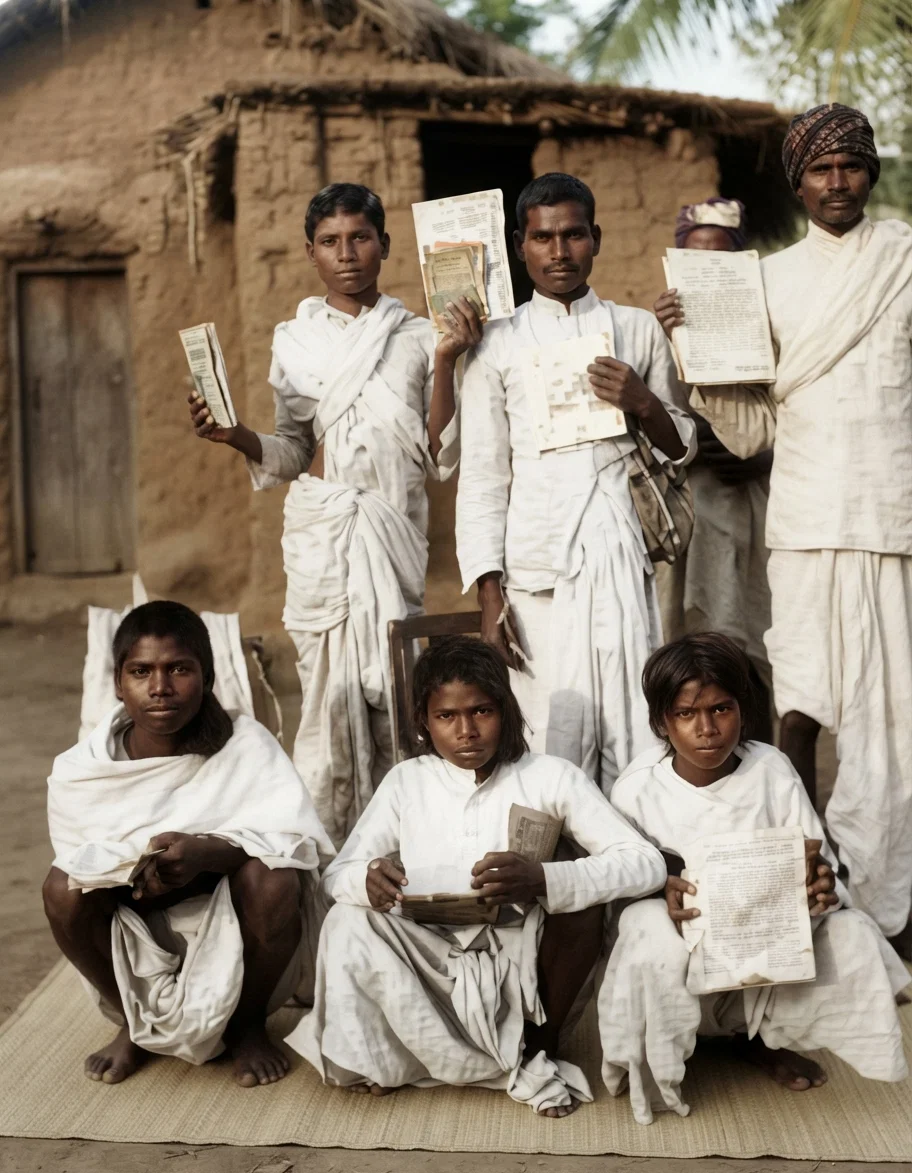
Photo by W. A. Barlow

SANTALI TEACHERS AND STUDENTS OUT WITH PAPERS
Photo by W. A. Barlow SANTALI TEACHERS AND STUDENTS OUT WITH PAPERS
In four hours we marched to Gbanghama, where Brethren Harding and Davie are located. In this village we stayed three full days. The chief had built us two good houses at a cost of about fifteen dollars each, while our missionaries had put in windows and doors. We have three native boys as pupils here, and Brother Harding is trying to do some teaching and preaching. Wherever I went, I found that the schools are rather poorly attended, some of the missionaries being able to hold only evening schools. But I am sure that if proper efforts are put forth, much more can be done to reach the natives. Sabbath morning we had a Sabbath school. I spoke to the natives in the council house, and then in the afternoon in another village.
Monday we went by rail to Waterloo, where I spoke in the chapel in the evening. This chapel is in town, while just outside of the town, close to the railway track, are the mission buildings, consisting of a good school building, dwelling house for the teacher, and industrial wheelwright's shop. About half a mile away is the school farm. The buildings are well put up, roomy, and airy. We have about thirty natives in the school from the Gold Coast, Liberia, and from the coast and hinterland of Sierra Leone. Besides this advanced school, we have a primary school, which is conducted in the chapel. Professor French was in charge of the school, assisted by some native workers. Brother Lewis had thus far looked after the industrial department of the school, which is turning out very creditable trucks.
A week sufficed to visit every place where we had begun mission operations outside of Freetown. We learned what other missionaries were doing, and became somewhat acquainted with the great needs of the hinterland. One impression, however, had already fixed itself upon my mind, and that was that in order to do real, successful, permanent mission work, we must occupy territory in the hinterland, and place one white missionary among the Timnis and one among the Mendis, and associate with each some of the native men as assistants. As our mission conference in Freetown was to begin December 2, we returned there the same day.

Interested Ones in Bengal, India

BROTHER W. A. BARLOW, our missionary at Bobomohal, a station of the Bengal Mission in India, sends us some letters written him by native students, who have become interested in the message. We give two:—
"My Dear Sir: I am exceeding sorry to inform you about me when I was at Serampore [Carey's College]. I wrote some letters to Miss Burroway and to you, but unfortunately those letters were found by my missionary. So he at once sent me to my father with those letters. When I reached home, my father rebuked me severely. Now he says that he will never allow me to go to Calcutta or some other places, so now I am bound to stay at home. Though I am under these circumstances, yet I am always finding a means to write to your mission. There is none to give me good advice during this gloomy day. Before, my father and relatives did not allow me to write a single letter, but now they are not so strict. I suppose they think that I have forgotten your mission. I thank God for his grace and mercy as he offers me a good opportunity to inform you all of my wants and distress this night. I pray you kindly show me a right path. You see I am here as a keeperless sheep."
"Though I have got father and mother here, they do not allow me to walk in the right path."
"Last year my father married me to a girl, so now I am bound by a girl. If I go somewhere, I am bound to take my wife with me; but under this condition I do not know what I shall have to do, as I am emptied pocket now. My father does not give me a pice in my hand, thinking that if I get money, I shall run away from home. Nearly last six months I was shut up at home, but now they allow me to go outside for a few hours under guard. I always pray to God to take me there [the Seventh-day Adventist mission] with my wife, safely. I believe our merciful Father will take us there very soon. Kindly write to me as soon as you could, also inform Mr. French about us. I hope you will try your best to save one soul, and to make us walk in the true path. Kindly do not forget these poor friends. Where is Miss Burroway now? Also kindly inform Mr. Wood about us. Last year Mr. French told me to go to Burma, but before going to Burma my father took me home, so I could not go there. Now father is not at home. Most probably he will come home after a month."
This youth was stirred up to investigate the truth through reading for some time our Bengali quarterly at Serampore College.
Here is another letter from a Burmese youth interested in present truth through reading our Bengali quarterly lent him by a fellow student:—
"DEAR SIR: I thank our most gracious and holy Heavenly Father for the light which can remove the darkness of a sinner's heart. My heart was also full of darkness and error, but I thank God that he has given me his ever-shining light in order to shine in my gloomy heart. Kindly pray for me that I may walk in his light, and may be a good and faithful servant of his kingdom, and may worship him with my mind, body, and soul till my last sleep. I am quite well by the grace of our Saviour. With my best regards to all."

A Missionary Experience in the West Indies
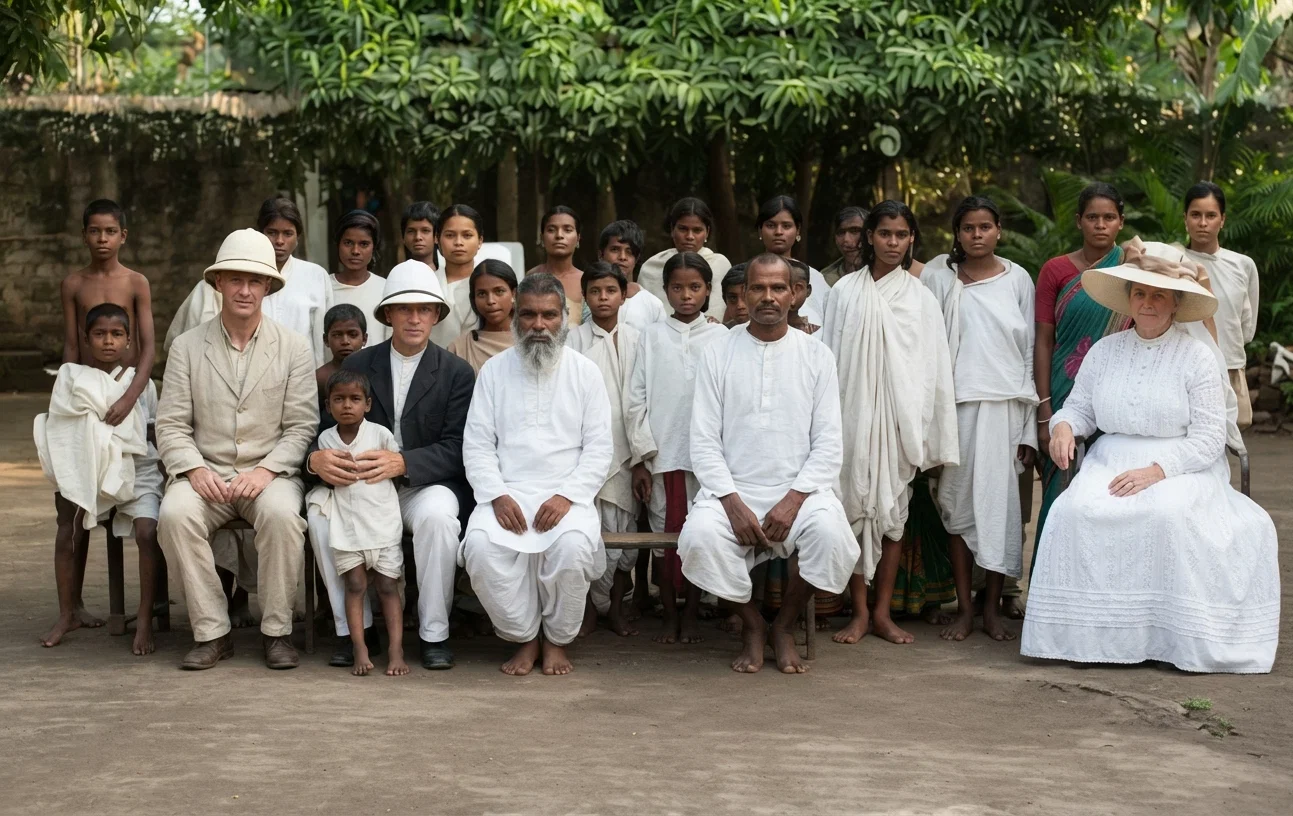
Photo by R. Norton
SANTALI BOARDING SCHOOL, BOBOMOHAL, INDIA
Photo by R. Norton SANTALI BOARDING SCHOOL, BOBOMOHAL, INDIA
"ACROSS the street from our mission house," writes one of our missionaries in the West Indies, "lived a doctor, a Roman Catholic, who was very bitter against the truth. His servants, especially his hostler, imbibed the same spirit. This man led many of the baser sort in annoying demonstrations against our work. Jeers and mockery were common. Stones were often thrown onto and into the house during services. The owner of the house was becoming fearful for the safety of his property. We prayed much to know what was best to do; we wanted to win them if possible.
One bright moonlight night they were especially bad. Only a dry ditch, crossed by a bridge walk, separated our house from the narrow street, in the middle of which the people walked. As we stepped out there after the meeting, where several of this rough crowd stood jeering, a thought struck me. I had a four-foot reflector telescope mounted on a standard of convenient height. I said to them, 'Do you want to see the mountains on the moon?'
'Ha! ha! No mountains on de moon, no.'
'O, yes, certainly there are mountains on the moon. I can show them to you. Do you want to see them?'
'Hu! Like to see de mountains on de moon? — Yes.'
"I stepped inside for my telescope. As I came out with it over my shoulder, quite a formidable-looking weapon, they scattered in every direction,— some around the corner of the house, some behind the fence, some down the road as hard as they could run, some into the ditch or behind clumps of bushes.
"I set my instrument, and got it focused upon the moon. Several of our own people looked through it with exclamations of delight. It was some time before I could get the mob back to look, some of them not at all. But the leader ventured, then others. It was a beautiful view. In astonishment they exclaimed, 'Sure, there are mountains on de moon, yes.'
"After another good look and other exclamations, they went quietly away. We never had any more trouble with them. Several of that very company soon accepted the truth and were baptized, and one of them lived in our home for years, a faithful helper and a servant of the Lord."

Good Advice for All the Family

A Word to Mothers

LET the mothers of this land be the chosen confidents and companions of their daughters. There is something wrong in every mother, how good soever she may be, whose young daughter cannot lay her head on her mother's lap, and, without fear of reproach or repulse, give expression to her full thoughts. That mother may, or may not, approve her daughter's wish or opinion; she may think it premature, or in every way inadvisable; but, O, the relief and safety to that daughter, that she may "tell mother"! Let the two talk it over together, as young companions do, honestly and frankly.

Praise Your Wife

A sunshiny husband makes a merry, beautiful home, worth having, worth working for. If a man is breezy, cheery, considerate, and sympathetic, his wife sings in her heart over her puddings and her mending basket, counts the hours until he returns at night, and renews her youth in the security she feels of his approbation and admiration. You may think it weak and childish if you please, but it is the admired wife, the wife who hears words of praise and receives smiles of commendation, who is capable, discreet, and executive.
I have seen a timid, meek, self-distrustful little body fairly bloom into strong, self-reliant womanhood under the tonic and the cordial of companionship with a husband who really went out of his way to find occasion for showing her how fully he trusted her judgment, and how tenderly he deferred to her opinion.
In home life there should be no jar, no striving for place, no insisting on prerogatives or division of interest. The husband and the wife are each the complement of the other. And it is just as much his duty to be cheerful as it is hers to be patient; his right to bring joy into the door as it is hers to garnish the pleasant interior. A family where the daily walk of the father makes life a festival, is filled with something like heavenly benediction.

Saving Mother Steps

There are so many steps for mother to take every day! She is kept busy, trotting about from morning till night. Her work is unending. Does it ever occur to John or Mary to save mother steps, by offering to run up or down stairs for her, to fetch some needed article?
A helping hand in the kitchen is always acceptable. Willing feet to run errands will not be refused. Mother's hands and feet get tired, and she is ready and glad to make use of service proffered by her boy or girl. Such service is sweet to her, and how happy it will make you who offer it!
Mother would be less weary, too, at night if she did not have to repeat things so often. Prompt obedience would save her voice, as willing errands her feet.
One way of serving Jesus is to serve mother. Our Saviour was obedient to his parents and did their bidding. He had nothing to regret when recalling his boyhood days. What a comfort it will be to look back upon your childhood days and to feel that you did your duty by mother! It is a satisfaction that brings with it a sense of peace and joy.
All honor is due to your mother, boys and girls. Save her all you can, and thus lengthen her days. The world holds no other like her. Remember that "Honor thy father and thy mother" is the first commandment with a promise. — Catholic Citizen.

Making the Old People Happy

THERE should not be any unhappy old people. Age should bring its compensations of serenity and philosophy. As a matter of fact, however, the average old man or woman is far from content.
The problem which confronts sons and daughters in caring for their parents is a grave one. Old age is sensitive, and the feeling of uselessness fills many an active soul with restlessness and discontent.
Perhaps the greatest mistake that is made by young people is that in their eagerness to relieve father and mother or grandfather or grandmother of burdens, they take away everything that makes life interesting. Those who have for a lifetime been eager workers do not want to sit with their hands folded; and so it often happens that father "butts into" his son's business affairs, and mother "meddles" with her daughter's housekeeping. Then comes friction, and the son and the daughter, having shown plainly that they desire no interference, cannot understand that their rebuffs have seared the souls of the anxious, active old people.
It is always well, if possible, to provide something for the aged to do. If they can be made to feel that they are helping, their satisfaction will be supreme. If father has been a wise financier, it surely cannot hurt his son to talk over the affairs of the store or office. If mother has been a practical housekeeper, her daughter need not be too snippy to take advice.
I know one dear lady whose daughter insisted that she should sit with folded hands. Then when the old face took on unhappy, haggard lines, and the frail little body drooped, the anxious daughter asked the doctor, "What's the matter with her?"
He was a bluff old person, and he thundered: "Give her something to do; she is pining for action."
"But the maids don't like to have any one around the kitchen," the daughter said.
"Then let her go there when the maids are out," the doctor suggested.
So on Thursday afternoons the dear old lady cooked the dinners. The whole family learned to look forward to them. And the satisfaction that mother got out of that one day in the week lasted her through the other six.
She made chicken pies; she baked beans; she concocted sauces and soups and gravies after old-fashioned recipes; and when they were served, she beamed across the table as if to say, "Should I be put on the shelf when I can cook like this?"
The duty of children toward their grandparents often forms a great problem; but I believe that if there is any question of preference, it is the grandparents who should have first consideration. No child can be hurt by being made to have an attitude of deference toward the aged. Often, if any old people are eccentric, the children's sympathies will at once be aroused if we tell them that "grandfather has borne so many weary burdens," or that "grandmother has had sorrows." On the other hand, to say, "Never mind; grandfather is peculiar," or, "Grandmother is fussy," will foster a contempt which will be evidenced by the child's manner.
To those of us who grow up impatient with the faults of old age there will come a day of reckoning. Some day all of us will be old. Do we wish our children to treat us as we are treating our parents? Would you be happy under the circumstances with which we have surrounded father and mother?—Dolly Madison, in Reformed Church Messenger.

The Call to Be a Missionary

For my part, I have never ceased to rejoice that God has appointed me to such an office. People talk of the sacrifice I have made in spending so much of my life in Africa. Can that be called a sacrifice which is simply paid back as a small part of a great debt owing to our God, which we can never repay? Is that a sacrifice which brings its own best reward in healthful activity, the consciousness of doing good, peace of mind, and a bright hope of glorious destiny hereafter? Away with the thought in such a view, and with such a thought! It is emphatically no sacrifice. Say, rather, it is a privilege. Anxiety, sickness, suffering, or danger now and then, with a foregoing of the common conveniences and charities of this life, make us pause, and cause the spirit to waver and the soul to sink; but let this be for only a moment. All these are nothing when compared with the glory which shall hereafter be revealed in and for us. I never made a sacrifice.— David Livingstone.

Manhood Overtops All Titles

"MANHOOD overtops all titles."

Soul Winner Won by Newspaper Report

Attending the biennial session of the Southwestern Union Conference, which was held in Keene, Tex., April 1-12, was a young sister who embraced the truth just two years ago, having been attracted to it through the reading of a report in a newspaper in her home city. The remarkable part in connection with this sister's experience is not only that she embraced the truth, but that she has been an instrument in the hands of the Lord in winning others to the gospel.
This sister, who resides in Oklahoma City, did not know until two years ago that there was an Adventist in her part of the world. At that time she heard her father read an article about one of our meetings which was held in Keene, Tex. The Lord opened the columns of that newspaper for the publication of this item just at the time when our sister was at the deciding point of being a Christian. Several years before, she had heard some phases of the truth in another city, and was convinced that the seventh day is the Sabbath, and upon hearing her father read the article, she decided to obey. Three weeks later she learned of the location of the Adventist church in Oklahoma City, and attended services. Soon after joining the church, she became a Bible worker, and from November, 1912, to January, 1914, reports that nine of her readers have joined the church, and nine others are keeping the Sabbath.
In the tent effort during the summer of 1912, our sister, who was one of the workers, visited and instructed some of those who as the result of that effort accepted the doctrines we teach. A talk with our sister, who is of a sterling Christian character, demonstrates that it is worth the while to use the newspapers for the advancement of the message. How many others attracted to the precious gospel truth through newspaper reports, will become efficient Bible workers and win souls to the cause of Christ, the Lord only knows. Who knows how many there are hungering and thirsting after righteousness, and longing to engage in missionary endeavor, who might be won to the Lord by the efforts that we could put forth through the agency of the secular press? It pays to use the newspapers. We ought to take courage, and write for these papers at every opportunity. They are to take a prominent part in closing up the work of God on earth, and we cannot be lax in writing for them.
The mother and sister of the lady already mentioned have since joined the church, and her father is favorably impressed with the truth.
Another interesting incident was related at the recent meeting in Keene concerning the effectiveness of the newspapers in reaching people with the message. Elder V. B. Watts, president of the New Mexico Conference, and another brother held a series of meetings in the city of Albuquerque some months ago, and the papers there were quite liberal in publishing extracts of their sermons. The Albuquerque papers have an extensive circulation in New Mexico, as is evident by the fact that when Elder Watts visited a place in the mountains over four hundred miles from Albuquerque by the railroad line, and forty-five miles from the nearest railroad station, the ranchers there, upon hearing who he was, told him that they had been reading his articles in the papers. Elder Watts said that some of those who accepted the truth during his effort were first attracted to his meetings by the reports in the papers.
Other brethren in different cities in the Southwestern Union said that they have been using the papers in their neighborhoods with good results. They told how friends would meet them on the street and tell them how interested they were in reading their reports. The secular press is an excellent medium for the planting of seed that some day will spring up and bear precious fruit for the Lord's kingdom.
The convention recently held in Keene was quite widely advertised in newspapers in different places. The Cleburne papers published reports, as did the larger dailies in Dallas, Ft. Worth, Houston, and Austin.
W. L. BURGAN.

Send Rain, O Lord, Send Rain!

HELEN ADAIR
THE harvest time is almost here, But flowers and fruits and grain Are drying up, and turning sear, And languishing for rain.
The soil is baked, and hard as stone; The very beasts complain; The earth, with open mouth, doth moan; "Send rain, O Lord, send rain!"
As pants the hart, we pant for thee; All earthly help is vain; O, hearken to our humble plea: "Send rain, O Lord, send rain!"
"I will pour water," thou hast said, "Upon the soul athirst, And floods, where Want and Famine tread, Upon the ground accursed."
The latter rain is due, O Lord, To ripen off the grain, The time foretold within thy Word, When we must ask for rain.
We claim thy promise, thy "bright cloud;" O, send thy showers again "To every herb," as thou hast vowed! Send rain, O Lord, send rain!
By faith we hear the freshening breeze, And see the lightning's glare; We know that thou hast heard our plea: "Prepare us, Lord, prepare!"

A Monarch and the Slit Skirt

King Albert of Belgium is strongly and rightly opposed to the freak fashions in woman's dress, and he evidently spares no pains to make his antipathy widely known. Recently at a court ball King Albert noticed a woman wearing a slit skirt of a most pronounced type. He immediately whispered instructions in the ears of the court marshal. The latter performed a delicate and disagreeable task in the following manner: Offering the woman his arm, he led her from the ballroom, remarking, "His Majesty has noticed that you have torn your dress, and has requested me to escort you to your carriage to enable you to return home for repairs."—Selected.

Our Acts Make or Mar Us

OUR acts make or mar us: we are children of our deeds.—Victor Hugo.

Emmanuel Missionary College Institute

The institute that closed a few days ago at the college was the climax of a continued line of instruction given in the canvassers' band during all the school year. The first term was devoted to the relating of experiences by those who had canvassed during the previous vacation. These were both instructive and encouraging. The band met each Tuesday for one period.
During the winter term instruction on general methods of work was given by competent instructors. Then the band was divided into classes according to the book each expected to handle. Each class had an experienced leader, who conducted studies in the general characteristics of the book, and especial attention was given to the selling features. The institution was held near the close of the spring term, and lasted one week. All the field agents of this union were present, and joined in drilling the students in their descriptive canvasses and in giving instruction in the art and science of salesmanship.
At the chapel period on the first day of the institute the needs of the work were presented. Then slips of paper were passed out for the names and home addresses of those who volunteered to go, and for the name of the conference in which they preferred to work. All were advised to return to their home conference, whether that was in this union or elsewhere. The names of those who responded were classified, and lists were placed with each field agent. Perfect harmony prevailed, and it was seen that order and cooperation should be a part of the education of workers who are in training for the great work of God in these last days of confusion.
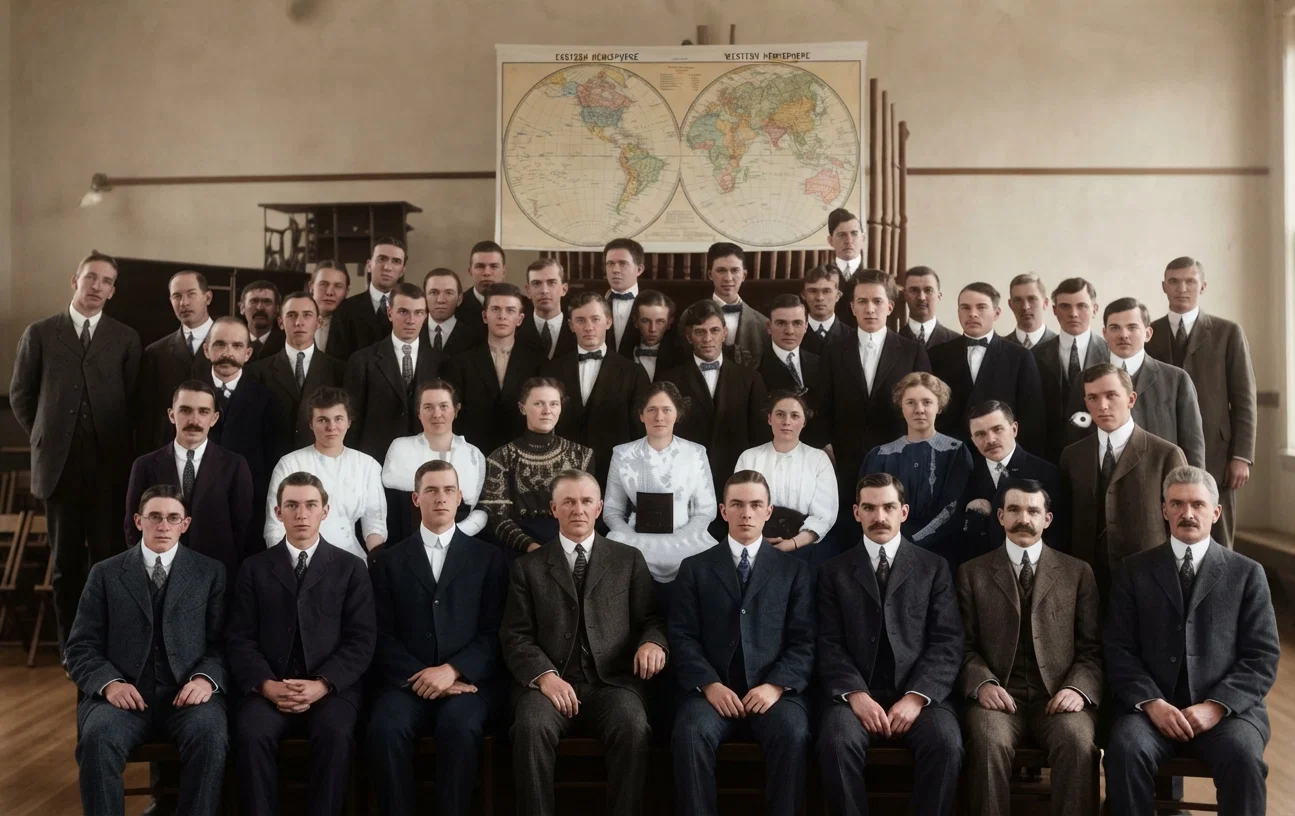
COLPORTEURS' INSTITUTE AT EMMANUEL MISSIONARY COLLEGE
There were about forty who responded. The accompanying illustration will introduce them to you. In the background will be seen a map of the world, and no doubt distant fields will be blessed by the labors of some of these sturdy young people.
The institute at the college is but one of eleven that have been held this winter and spring in this union. Each of our academies is sending out an enthusiastic band of students who will work for scholarships. The number trained in each of the institutes held at these institutions is as follows: Fox River Academy, 21; Beechwood Academy, 15; Adelphian Academy, 15; Cedar Lake Academy, 10; Broadview Swedish Seminary, 20. The institute at Bethel, Wis., has not been held. There are a number who will come to this union from the German school at Clinton, Mo., and from the Norwegian school at Hutchinson, Minn. There are 141 who have planned to go out to earn scholarships this summer. When these are added to the regular workers, we shall have over 200 at work.
While the signs thickening around us indicate that the end is approaching, shall we not recognize in the response of our young people to the call of the work an unmistakable sign that the work is being finished? "Thy people shall be willing in the day of thy power."
J. B. BLOSSER, General Agent.

Waiting in the Market Place

—a Call From the South

THE Bible describes two classes. The first is actively engaged in gathering souls for the Master. They have been set to work, and they keep diligently at the work. The members of the second class are standing idle. When asked why they are not fruit gathering, they reply that no one has set them to work. The spirit of prophecy says that some in this second class are waiting to be carried to the vineyard, or else they want the vineyard brought to them.
The picture before us is this: Before us is a vineyard of well-ripened grapes. Grapes when ripe need to be picked quickly, or they drop to the ground one by one and are lost. The Master expresses astonishment that any one should know these conditions and still stand idly by and not help. Why should not a person help for the sake of saving the crop? or just for pure love of the work, and what he individually might get out of it? or for economy's sake? or because of his regard for the owner of the vineyard? But no, there are some who do not begin to work because they have not been told just which row to pick on, just what shaped basket to carry, just where to put the grapes when they are picked, etc.
The Master finds these conditions, and he says to these friends of his: Hurry into the vineyard; do not stop to bargain over wages; pick fruit while it is day, and when the work is done I will settle with you in the right way.
This is a clear message which has been applied by the spirit of prophecy to the South. We read: "It needs men and women who will not be sent to the Southern field by our people, but who will feel the burden to go into this neglected portion of the vineyard of the Lord."
Some are inclined to feel that they lack the talent and ability needed by the laborer, but to them comes the message that farmers are needed,—farmers who have made a success at home, who love the country, and are willing to study their profession. Such men are an addition to any community, and the South welcomes all such. Mechanics are also needed. Teachers can find a world of work awaiting them. There is this to consider, also: the South is a place in which the inexperienced may learn to work. Abraham did not know much about how to work for the Lord in Palestine, but he answered the call, he went to the new land, and there learned what to do.
The present war conditions ought to teach us some things in regard to the South. The opening of the Panama Canal ought to be a parable which every Adventist finds himself ready to interpret. God is pointing the nations of the world to our own Southland. International interest is centering south of us. A new continent looms big in the distance. From our own Southern States should go forth an army of workers into this more distant south.
When a United States government official, addressing our own people, can ask for teachers capable of carrying on such work as is done in the self-supporting schools of the South, in the school at Madison, Tenn., and in the hill schools; can ask for such teachers to enter government schools, it shows that God has committed to his people great principles of education, the carrying out of which will put them in the lead. Can we heed his call? When shall we take up this work? When shall we begin the training for that great world-wide mission movement that is now due to the world?
The Madison school is working quietly, steadily, for the preparation of practical missionaries who can follow the instruction given for conducting our schools, for medical missionary work, for Christian farming, and for evangelical work. The work of the institution is carried on throughout the year. The next summer term opens June 24, and closes with the annual rally of self-supporting workers the last of August.
Are you still standing in the market place? There is work to do; let us show you into the vineyard.
M. BESSIE DEGRAW.
Continue reading: The Lake Union Conference