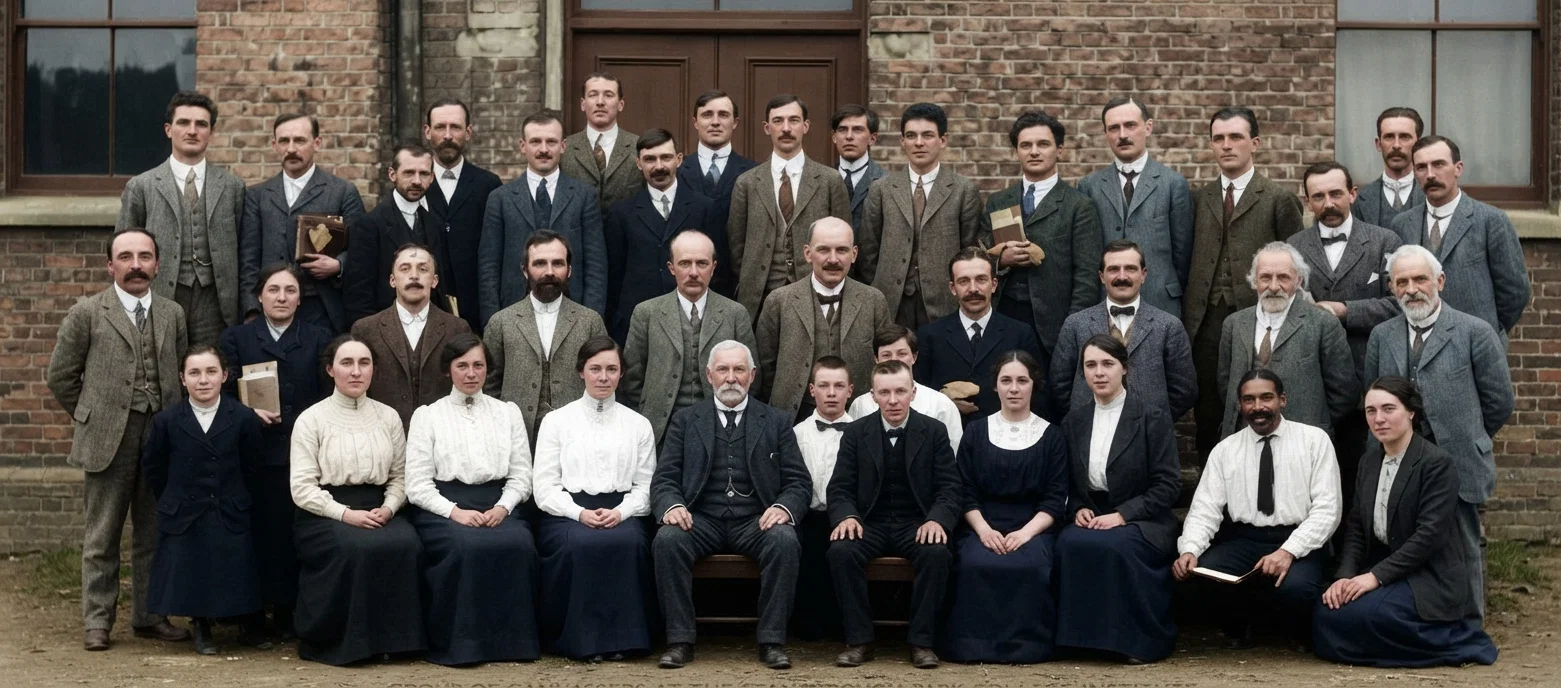
THIS meeting was held at Battle Creek, Mich., April 14-24. The first five days of the time were devoted to a ministerial institute, except that one hour each day was occupied by the bookmen in the study of principles relating to the sale of truth-filled literature as a means of the rapid spread of the gospel message.
Almost the entire list of delegates responded at the first meeting. It was noticeable that all were in their seats at every meeting.
The daily program began at 8:30 A. M. with a devotional meeting continuing until 9:15. Scripture study was conducted from 9:30 to 10:45, and again from 11 to 12:15. Another period in the afternoon, from 2:30 to 3:45, was given to Bible study; and the bookmen occupied the time from 4 to 5:15 for their special study.
The ministerial institute was designed to give all laborers an opportunity to cease from active field work and turn aside for a little time of rest and study, to seek a better preparation for the service of the Master by becoming better acquainted with the Word of truth and receiving a more complete endowment of the Spirit of truth. The demand for such a season is indicated by the meager results from labor bestowed in recent years. It was believed that God, who is almighty and has given to the world a mighty truth, can make his ministers mighty in word and doctrine, and is able by the aid of the Holy Spirit to move men's hearts.
Those who conducted the studies were specially guided by the Holy Spirit in their efforts to bring from the great storehouse of truth that which would be most helpful to all. If any failed to obtain a more exalted conception of the work of the ministry, or a clearer view of the divine call and the sacred responsibility resting upon the one who enters that high calling, they must have failed to allow the Word of God to have due weight on the mind. Doubtless all were impressed with the fact that the Lord has amply provided in his Word for the enlightenment of his servants as to all that pertains to the minister and his work,—in fact, his life, his deportment, his responsibility, and the source of his power to accomplish anything.
The business of the conference was laid over until the close of the institute work, in order that all minds might be free from care and perplexity as far as possible. On Monday, the twentieth of April, the delegates entered heartily into the transaction of the business of the session. It was desired that the work be completed before the next Sabbath, which, with other matters to occupy the time of the delegates, left scarcely four days in which to accomplish it. However, everything was disposed of in the desired time. Committees labored earnestly and reported promptly, and the work was done. Whether or not the haste and dispatch necessary to the consideration of voluminous and important questions in so short a time was in consonance with thoroughness and perfection, the future will no doubt reveal. It can be said truthfully that the plan of transacting the business of a great union at its biennial session, within the time of the working days of one week, is in the experimental state. No criticisms were heard from those on whom the responsibility of the work rested.
The spiritual atmosphere throughout the entire meeting was most excellent in every department, which no doubt contributed to the celerity with which the work moved forward. Perhaps as the end draws near much less time will be spent in business transactions; but, instead, all will be concerned about the most vital business of all, the preparation for a change of worlds.
ALLEN MOON.
Newspapers in the Lake Union Conference Attract Persons to the Truth
By W. L. Burgan
Notwithstanding the fact that the newspapers were devoting many columns of space each day to the Mexican situation, which necessarily caused them to shorten most of their other articles and to refuse to publish those of minor importance, the four dailies in Battle Creek, Mich., devoted considerable space to reports of the biennial meeting of the Lake Union Conference, which was held in the Tabernacle, April 14-26. These four papers circulate over a considerable portion of eastern Michigan, and are read by many thousands of people.
Not only did the papers gladly accept the articles prepared for them, but three of the papers sent their own reporters every day to gather further features in connection with the convention. These reporters exhibited a persistency for news that was quite noticeable, and they did not stop with the regular proceedings, but interviewed brethren on various doctrinal subjects, and their write-ups aroused more than usual interest. The interest shown by the newspapers and the importance they attached to the meetings were in direct contrast to the way some of the papers in that city had looked
upon our work in the past. Prominent headlines on the front page of the papers were placed on a number of the reports, indicating that the editors considered the news from our convention of general interest, as national and international events usually find their way on the first page of the papers.
The Detroit papers, which circulate over the length and breadth of Michigan, also published accounts of the meetings. These papers wield a powerful influence, and reports from different sections indicated that the articles about the Battle Creek meetings were being read.
It was very encouraging to attend this meeting. Brethren from all four States in the union conference territory were enthusiastic over the success they had had in securing the publication of articles along different lines in their home papers. Some told how the reports in the secular press had attracted strangers to the meetings who subsequently accepted present truth; others told how the newspaper reports had helped them in securing the attention of the people, and also in meeting them in their homes.
One of the ministers in the West Michigan Conference, a strong advocate of the newspaper work, said that he was successful in getting published an extract of every sermon he preached during his last tent effort in one of the large cities in his conference. He said that two of the most substantial of those who accepted the truth were attracted to his meetings through the newspaper reports. One is a physician, and not only is solidly on the Lord's side, but contributes very liberally for the advancement of the cause. This same minister said he met a reputable gentleman who told him that he had been reading the sermons with interest, and that they convinced him of the Sabbath truth. W. L. BURGAN.
Japan
By Benjamin P. Hoffman
At present I am not attending language school, but am working with private teachers. In this way I am having more opportunity to talk the language, and also study along special lines, as it is Biblical vocabulary that I need.
And now I am happy to be able to report to you that I have begun speaking in this language, that is, giving talks and leading meetings. Not long ago a call came for meetings to be held over on the other side of Tokio. A man who had heard of the truth offered his house, and promised to get a congregation of his neighbors if a foreign worker would come and speak to them. I saw in this a special opportunity, and so went. It has now developed into a regular appointment for Sundays. Thus the Lord opens the way when we are ready.
It takes hard work and study to prepare, but the Lord verifies his promise of help, and I rejoice to be able gradually to take up the work which I have longed to do. I realize the force of the words of Paul in 1 Cor. 13:1, and am seeking God for the fullness of his power, that this gift of God may be "the pen of a ready writer," and all the glory go to God, who gives the power. In apostolic times we read that every man heard the wonderful works of God in his own tongue. We in Japan still need your earnest prayers.
Benjamin P. Hoffman.
Blantyre, Nyasaland
By Joel C. Rogers
It is now a month since the first rains began here. The country is changing from its brown and blackened hills—blackened by sun and fire and drought—to the delightful green and red of the tropics,—red because most of the early leaves of the trees are of that color, but turn to green after a month or two. Natives are planting their food crops, and Europeans their profit crops of cotton and tobacco. Soon the grass on the plains and near the streams will be tall and wet, making travel difficult and dangerous from malaria. The mosquito will not take possession of the land for six months. The tsetse fly, spreading death abroad to man and beast, is always present. Four new districts within the last month have been "declared" infected by sleeping sickness. Nearly half of Nyasaland is now infected. Both natives and Europeans are affected by it. No European who contracts it ever has escaped a rather sudden demise, so far as I have heard. So it behooves us to work while the day lasts. It will be a dark day when this disease covers the land. JOEL C. ROGERS.
Sabbath School Organized at Springville
A Sabbath school was recently organized among the colored believers at Springville, Tenn. Five new members have been added to the church at Memphis.
Canvassing for Subscriptions
By E. M. Graham
WHILE good results will be obtained from the regular sale of periodicals from house to house, attention should also be given to obtaining subscriptions for them. Once paid for, the periodical will go to the house for a period of time, during which there will be given considerable light on this message.
"A mistake has been made in soliciting subscriptions for our periodicals for only a few weeks, when by a proper effort much longer subscriptions might have been obtained. One yearly subscription is of more value than many for a short time. When the paper is taken for only a few months, the interest often ends with the short subscription. Few renew their subscriptions for a longer period, and thus there is a large outlay of time that brings small returns, when with a little more tact and perseverance, yearly subscriptions might have been obtained. You strike too low, brethren; you are too narrow in your plans. You do not put into your work all the tact and perseverance that it deserves. There are more difficulties in this work than in some other branches of business; but the lessons that will be learned, the tact and discipline that will be acquired, will fit you for other fields of usefulness, where you may minister to souls. Those who poorly learn their lesson, and are careless and abrupt in approaching persons, would show the same defects of manner, the same want of tact and skill, in dealing with minds should they enter the ministry.
"While short subscriptions are accepted, some will not make the effort necessary to obtain them for a longer term. Canvassers should not go over the ground in a careless, unconcerned manner. They should feel that they are God's workmen, and the love of souls should lead them to make every effort to enlighten men and women in regard to the truth. Providence and grace, means and ends, are closely connected. When his laborers do the very best they can, God does for them that which they cannot do for themselves; but no one need expect to succeed independently and by his own exertions. There must be activity united with firm trust in God."—"Testimonies for the Church," Vol. V, page 399.
This work of soliciting subscriptions for periodicals may be taken up in connection with the house-to-house sale of the papers, or may be made a regular business. There are workers who take a few sample copies with them and devote their efforts to securing subscriptions. They say it is almost as easy to obtain a subscription as to sell a single copy, and much more profitable, for then the visits of the paper are insured for a length of time. It accomplishes more in a given time than the house-to-house sale does. Both methods have advantages, and each will reach some people that could be reached in no other way.
E. M. GRAHAM.
Great Britain
By N. Z. Town
FROM March 20 to April 12 the annual meetings in the Irish Mission and in the Scottish, North England, and Midland Conferences were held. Each of these meetings, except the last, was followed by a canvassers' institute lasting about four days. The keynote in all these gatherings was the home missionary work. The questions of how each member could have a part in the work, and how each one might win one or more to the truth during the year, were carefully considered. The delegates and brethren and sisters present at these meetings took a deep interest in this matter, and entered heartily into the plans that have been suggested by the General Conference Home Missionary Department.
GROUP OF CANVASSERS AT THE STANBOROUGH PARK COLLEGE INSTITUTE
Not only did the brethren and sisters manifest a deep interest in the home missionary work, but also in the work in the regions beyond. The needs of the missions in charge of the European Division were presented by Elders W. J. Fitzgerald and Guy Dail, and the following resolution was enthusiastically discussed and unanimously voted in each conference:—
"Whereas, The needs of our missionary work are ever enlarging, requiring greater sacrifices on the part of each member in the homelands, therefore,—
"Resolved, That we definitely plan to adopt the recommendation made by the European Division General Conference to raise all our various offerings (Sabbath school, First day, annual, and miscellaneous offerings) to an average of ten cents a week per member to meet the urgent calls, and the heavy expenses in carrying forward this important branch of our work."
While recognizing the great need which still exists in the homeland, the brethren here in the British field feel that one of the best ways to help the home work is to be liberal toward the foreign mission work.
Recommendations were also passed favoring the support of the endowed bed, which is kept up at the Stanborough Park Sanitarium for the accommodation of our own brethren and sisters; and of getting all our people who are able to do so to subscribe for our church paper, the REVIEW AND HERALD.
In the discussion of these recommendations, the thought was emphasized that one of the best ways to raise ten cents a week is to keep the brethren informed regarding the progress that is being made in the mission fields throughout the world.
The Midland Conference meeting was one of special interest; first, because it was the first meeting of that conference since its organization, Jan. 1, 1914; and, second, because of the meetings being held at Kettering, in the Temperance Hall, where the truth was first presented to the people of Kettering thirty years ago by Elder J. H. Durland. Since then Sister E. G. White, Brother S. H. Lane, and several others have spoken to the people of Kettering in this same hall. Mr. T. Adams, the chairman of the Urban Council at Kettering, attended the first meeting of the conference, and made a fine speech welcoming us to Kettering.
In his reply to Mr. Adams, Elder Fitzgerald outlined the missionary work that is being carried on by Seventh-day Adventists throughout the world.
We were glad to meet at this meeting Elder T. M. French, who had just arrived from the Canary Islands to take up work in the Midland Conference.
Elder Guy Dail met us at the Scottish meeting, and was with us until the close of the Midland conference. The people very much enjoyed his talks regarding the experiences of our workers in the mission fields.
Following these annual conferences, Brother S. Joyce and the writer conducted a canvassers' institute with the students in Stanborough Park Missionary College. Nearly fifty young people in the college are planning to enter the canvassing work during the vacation. They manifested a lively interest in the studies given during the institute, and are very enthusiastic over the prospects for the summer. About twenty canvassers came in from the Midland and South England Conferences to get the benefit of the instruction.
The Lord has greatly blessed in these conferences and institutes in Great Britain. The workers are of good courage, and the outlook before them is good for a successful year.
N. Z. TOWN.
The Greatest Test of Character
ThE greatest test of character is to be found in what is, rather than in what is extraordinary. It is easier for the soldier to be faithful in the rush of the battle, when sustained by enthusiasm, than to maintain a high tone of consistent principle under the many trials of daily drill.—Dr. Macleod.
Songs in the Night
"There is never a day so dreary
But God can make it bright,
And unto the soul that trusts him
He giveth songs in the night.
There is never a path so hidden
But God will show the way,
If we seek the Spirit's guidance
And patiently watch and pray."
Young People's Work
I AM very much interested in the young people's work. There was a time not many years ago when our young people were drifting from the ranks faster than they are today. This young people's work has put the brakes on that tendency, and our young people are being held much better than in the past. I am sure we are all glad of this.
Some years ago a prominent minister of a certain denomination said to me: "Mr. Watson, I would not belong to a church that could not hold its young people." He surprised me a little, but I answered: "My dear sir, if our young people could go to the card party, the dance hall, and the skating rink, I think we should have no trouble in holding them in the church." That man knew that I knew what I was talking about, and he never mentioned the subject to me again.
It is a fact that the world and the devil are bidding for Seventh-day Adventist young people. I tell you it means something to hold the children of Seventh-day Adventists to this great truth during the perilous times in which we live. But while that is true, I thank God from the fullness of my heart that we have a truth that can hold many of the youth in our church schools, in our academies, and around the firesides. And many might have been held who are in the world today if we had bestirred ourselves in the past, organized the young people for service, and given them assurance that we would have places for them after they had become equipped for service.
Now it seems to me that there is nothing that presents itself to this union, or any other union in the United States, that can be compared to the salvation of the young people. I can remember when the foreign fields were supplied with the best-trained ordained ministers in the denomination. The best ministers were picked to go to foreign fields; and when the Mission Board could get no more ordained ministers to go, it began to pick the brightest licentiates. And now whom is it sending to the foreign fields? The great burden of this work rests upon the young people, and some of them are taken from school before they have finished their courses, so great is the need. Now it does seem to me that the most important part of this great work of the third angel's message is the work for our young people. What do you say? [Amen.]
We have a multitude of young people in this union, and I would urge that we search out the best man that can be found to take this work in hand in connection with the union conference committee, and establish the right kind of leadership.
In regard to the Reading Course work and the Standard of Attainment, I believe that no better recommendation can be placed in the hands of our young men and young women if they want to enter the Washington Missionary College than a Standard of Attainment certificate. It tells one thing at least,—that they have stuck to something until they have finished it. Think of the good that has been accomplished by those fifty-three gift books that came into the North Texas Conference during 1913.
I seldom find time to read except when on the trains; but I have set myself this year to read twelve volumes, and I have already finished four of them, besides reading my Bible; and many of them are large books.
G. F. WATSON.
I am very much interested in the young people's work. I like the sound of it. You know so many times we see the young people going into the common activities of life. What is the cause of it? It is because of their training. What do they hear at home? It is farming, raising corn, cotton, etc. It is not strange, therefore, that they have no higher ambition than these things. What do they read? It is generally the newspaper and the popular magazine; and it is not strange that they do not have any high ideals.
But now when we turn about and give them information in another direction, it is not strange that they should turn about. And that is the value of the Reading Course. When I began to talk to my students about the value of the Reading Course, one of them said to me, "Those books are not for students; one of the leading workers told me they were only for people who could not go to school. People in school are too busy to read." I told him this was a great mistake. What are we in school for? We are in school to learn to read. When a man leaves school, if he stops with the information he has gathered there, of what use is he in the world? At school he simply has laid the foundation on which to build. He has prepared himself with certain facts, to which he can add, and thus become useful. A man that stops his studying when he gets his diploma, is never worth much in this world.
So I have been very much interested in encouraging our students to take these Reading Courses, and to finish them. I believe they are of special value to students, because they inform us of the work to be done in this world of ours.
C. B. HUGHES.
If we want to bring up our children in the truth, I feel that we ought to do our duty right at the start, by having family worship morning, noon, and night. It is not necessary for our young people to drift away from the truth. I knew a family of several children, the oldest boy of which was converted at the noon-hour worship, the second boy in the fields, the second daughter at the close of the Sabbath, the fourth child in a cotton patch, and the fifth on a Sabbath spent at home.
If the parents would be faithful in teaching the little ones the Word of God before they are able to talk, making it a part of their young lives, I am sure there would be no difficulty in bringing them up in the truth. We ought to keep our children in our ranks; I do not like to hear of our children's going into other denominations or out into the world. I believe that if they are trained in the way they should go, there will be no trouble in keeping them in the truth. Therefore I am heartily in favor of this great movement that has been started for our young people. [Brother Taylor has been using the Morning Watch Calendar for three years.]
J. I. TAYLOR.
The young people's work is certainly very precious to me; and while we were talking about the Reading Courses, I thought of some of the papers that have been handed in to me. One of the questions on the book "The Black-Bearded Barbarian," is, "What have you learned from this book?" And I thought of the answer of one young man, which was something like this: "That I wanted to be like —, 'burned out for God.'" And then I recalled another young man who thought he was too busy to read. He felt that he could not take the Reading Course. He is a rice farmer. But I talked with him and showed him the books, and he said he would try to read them. He bought the books; and several weeks after the time for the review to come, I received a letter from him, and in this letter was his review. It was written with lead pencil, and blurred and smeared with oil and grease; but it was a review of the book he had read. When he had read the three books, he wrote me: "I never again can do without the Reading Course. I thought it was impossible for me to take it; and I have written these reviews while watching the machines at night." He attended to the rice machines, and would manage to snatch time at night to read the books. I have kept some of the papers of young people who seemingly had no desire to enter the work, and cared little for the truth of God; but by the way they answered the questions it was clear that they had a tender place for God in their hearts and for his work.
On visiting many places where I have previously sold the Morning Watch Calendar, I find that the children have learned a great many verses. And in some places the Morning Watch Calendar has been the means of starting family worship. I believe that no one who will use that calendar and other Missionary Volunteer plans as we are asked to use them will backslide. The facts are that many of our young people are drifting because they do not know the truth. They have never been taught the reason for the points of our message, which they will learn if they study the Standard of Attainment.
MRS. G. F. WATSON.
All My Treasures I Pour
"Is there aught so dear to me
That I cannot spare for Thee?
In the casket of my heart
Do I hide from thee a part?
"All my treasures now I pour
At thy feet forevermore;
Love and will and life are thine;
I am rich if thou art mine."
Christianity Is Life
By Ian Maclaren
CHRISTIANITY is not a drill; it is life, full, free, radiant, and rejoicing. What a young man should do is not to vex himself about his imperfections, but to fix his mind on the bright image of Perfection.—Ian Maclaren.
Every Man Is the Architect of His World
"Every man is the architect of his world. I own fortune."
South Africa
From the Field
South Africa
IN a letter from Dr. W. C. Dunscombe, of the Cape Sanitarium, at Plumstead, South Africa, we read that that institution is having a healthy growth. Its ten years of existence has developed it into an institution of excellent equipment. During the past year or two a number of additions have been made to its facilities without increasing the sanitarium's indebtedness. The physicians connected with the institution have contributed liberally to this end.
The sanitarium accommodates only about twenty-five or thirty patients, and the workers are enabled to become quite well acquainted with the patients before they leave. It is found that many of them come to the institution with a longing to receive spiritual help and to learn something of the truths we hold. Many have become interested in the truth while there, and some have accepted it. Several are making an earnest study of it. Dr. Dunscombe says: "We feel grateful to God that he has given us these opportunities to labor for him, and it is our earnest desire that we may not let the medical and scientific side so fill our minds and hearts that we shall lose sight of the fact that we are medical missionaries, and that our first aim is to win souls to Christ."
This sanitarium is the only one in this part of South Africa. Patients are drawn from all parts of Africa. Quite a few come from even as far north as Rhodesia and British East Africa. Thus the influence of the institution becomes a wide one. The prime minister and quite a few of the representatives and senators are now numbered among its guests. Dr. Dunscombe closes with the statement: "It is our earnest desire that our work may be so conducted that it shall be the right arm of the message here in South Africa."
Portland, Oregon
The sanitarium here is at present full of patients, and is crowded for room. It is now enjoying the heaviest work of the season. A number of class recitations have been dismissed in order that nurses may have time to care for the patients. Several nurses from the city have been called in. The work of the chaplain is showing good results, in that individuals are expressing a desire for spiritual help. Recently three persons in one week found peace for their souls. Some interesting experiences are gained in connection with the spiritual work. The workers rejoice that they have the privilege of thus doing real soul-saving work.
Temperance Literature
Our department has been enabled to supply helpful temperance literature to some of our workers in the field who are engaged in temperance campaigns. We shall be glad to furnish others with material of this kind. A recent hearing in connection with the United States Senate on the proposed amendment to the Constitution prohibiting intoxicating liquors has been put in print. In it are the statements of a number of temperance workers representing various organizations. This makes a pamphlet of sixty-one pages. It may be had free of charge by addressing our Medical Department.
We would request, too, that any items of interest regarding prohibition movements, temperance speeches, reports, etc., be called to our attention where it is thought that these might be used to advantage in passing on to others. Address Medical Department, General Conference, Takoma Park Station, Washington, D. C.
Glendale, Cal.
A most cheering word comes from the Glendale (Cal.) Sanitarium saying that the past year has seen twenty-four patients accept the truth, some of them uniting with the Glendale church. As many others have gone away fully determined to study into present truth, and have kept up correspondence with members of the sanitarium family.
Practically all these persons have first become interested in the study of our health principles, the presentation of which receives considerable attention at the sanitarium. Enthusiasm in this leads to a further study of our work and truth, and to a fuller knowledge and acceptance of the message we give. Attachment to principles rather than to an institution is encouraged by the sanitarium workers, and patients go away praising the truth they have learned.
We hope to secure a fuller report of the religious work of the Glendale Sanitarium, which may offer valuable suggestions on how to combine religious work with medical.
L. A. H.
Dr. G. A. Droll, of the Kansas Sanitarium, reports most encouraging progress in his work. Dr. and Mrs. Droll are doing considerable lecturing on health topics before clubs and in the public schools. The interest shown on the part of the public is surprising. Many favorable developments are seen. A minister of the city, who was a patient of the sanitarium, brought nine of his ministerial brethren of the city to sample a health and temperance dinner, giving occasion for many questions and answers, and leading to several requests for health talks and lectures to be given in their churches.
The veteran canvasser Walter Harper writes that he is still using relief books in his work. Recently he sold forty-one copies of "Ministry of Healing" in a little over two weeks, in addition to over three hundred and fifty dollars' worth of other books. He firmly believes that it is in harmony with God's plan to combine medical and religious books. He also believes that it is right to devote time and effort in behalf of relief books and their objects. He finds great blessing in working accordingly.
At a late constituency meeting of the Washington (D. C.) Sanitarium Association the reports of the superintendent and the business manager were received with special interest, encouraging progress being noted in both reports. Dr. H. W. Miller was reelected medical superintendent, and L. M. Bowen treasurer and business manager.
Workers and Openings Wanted
An excellent opening is offered in Arizona for a Seventh-day Adventist dentist. Missionary opportunity is good; financial outlook is also good.
A few openings are offered to persons desiring to engage in treatment room work, either to start an enterprise or to purchase. Some capital is needed.
A gentleman nurse, single, capable of taking charge of sanitarium bath rooms, is wanted.
We have on our list of available workers persons desiring employment, as follows: baker, business manager, bookkeeper, cook, engineer, electrician, housekeeper, nurse, optometrist, painter and decorator, physician, steward.
Information will be given regarding any of the foregoing on application to the Medical Department, General Conference of Seventh-day Adventists, Takoma Park, D. C.
L. A. H.
News and Miscellany
Notes and clippings from the daily and weekly press
— The pecan crop in central Texas is estimated at $200,000, growers receiving all the way from six to twenty-five cents a pound for nuts. Two and a half million pounds were gathered—ninety carloads. The prize tree for the season netted its owner $300.
— American intervention in the Dominican republic for the purpose of establishing a provisional government is admitted as a possibility by officials in Washington. Sharp fighting is going on between the Dominican government forces and insurgents. American interests are in danger.
— Miss Eleanor Wilson, daughter of President and Mrs. Wilson, was quietly married to the Secretary of the Treasury, Hon. William G. McAdoo, on May 7. The wedding was strictly a home affair, the ceremony taking place in the Blue Room of the White House. The bridal couple received many choice and valuable presents.
— A striking illustration of the terrible human waste in war is furnished by the census just taken of the new Bulgarian territories acquired by conquest. The male population of that portion of Macedonia allotted to Bulgaria was reduced during hostilities from 175,000 to 42,500. In Bulgarian Thrace only 225,000 males remain out of a total before the war of 494,000, while in the district of Mustapha Pasha, where fighting raged long and fiercely, only 4,000 males are left out of 33,000.
— To test the honor of the convicts confined in the State penitentiary at Rusk, Tex., the practice of leaving all the cell doors unlocked and the prison gates wide open was adopted recently. All the inmates are free to go and come day and night, as they please. All but two guards have been discharged, and they will be dispensed with if the new system works well. The convicts are employed during the day on the State farm, a mile from the prison. They work without being guarded, and no one has attempted to escape so far.
— The American Red Cross Society has notified its 4,000 members to be ready for a call in case hostilities should reopen between this country and Mexico.20
— It is announced that the Incorporado Company of Sao Paulo, Brazil, failed recently, and with it not less than forty-six banks in the principal towns of the state of that name. The company had been organized to finance smaller country banks.
— The moving picture show has a rapacious appetite for nickels. It took 6,380,000,000 nickels to satisfy the motion picture fad for 1913; that is, $319,000,000 was spent on this form of amusement during 1913. Such amount is twenty-one times as great as $14,942,523, our total contribution for foreign missions.
— The Hub retains the bean-eating championship. During the last winter it is estimated that the 1,283,458 people in Greater Boston spent more than $10,000,000 on baked beans alone. Thirty-three million quarts were disposed of in the city and suburbs in the last year, an average of nearly thirty quarts a year for each person.
— It is estimated that more than 30,000 barrels of flour were required in New York City to supply the demand for unleavened bread during the Passover festival. Arrangements were made for the Jewish soldiers and sailors stationed in and around New York to attend services at the Fifth Avenue Temple and in Tuxedo Hall. There are about 500 Jews connected with the army and navy in that city.
— An appeal is being made to the United States District Attorney and to the Department of Agriculture to put a stop to the practice of "sanding" and "overcropping" poultry by Western shippers. After starving the chickens for twenty-four hours or more, they are given a paste, just before reaching New York, composed of grain, pebbles, and finely crushed stone. This, it is said, often adds four ounces to a four-pound chicken, and brings a large profit to commission merchants.
— Mindful of the numerous embarrassments occurring during the Spanish war, the War Department has prepared regulations concerning newspaper correspondents with the army in the field. The newspaper man who desires to be a correspondent with the army must deposit a certified check for $1,000, against which he may draw for subsistence supplies at the commissary or for any part of his equipment. He must also provide a bond in the sum of $2,000 for his good conduct, which in the case of forfeiture may be transferred to any charity the Secretary of War may designate. The correspondent will also take a military oath of loyalty in the usual form. He must agree to abide by all the regulations laid down for his guidance. Only one correspondent will be permitted to accompany the same field army. Men who have adventure rather than actual service as journalists in mind will not be received. No photographers for the press will be allowed with the army. There will be an official army photographer whose films will be sent to Washington promptly and prints will be furnished to the press at a slight cost.
— It is a pleasure to turn from recent accounts of unsatisfactory political conditions in the Philippines to the report of the surgeon-general of the United States Public Health Service, telling of further success last year in the campaign against disease. During the whole year not a single case of cholera occurred in the islands; there were only a few cases of plague and of smallpox, the latter among persons inaccessible to vaccination. All three of these diseases have in times past ravaged the islands, as many as 40,000 annually having died from smallpox alone. It is also to be noted that yellow fever no longer has a foothold, either in the Philippines or in any other portion of American territory.