The Youth’s Instructor, Vol. 66, No. 14.

Current News Briefs from Around the World

The Youth’s Instructor

Apr 2, 1918

Review and Herald Publishing Assn. · Takoma Park Station, Washington, D. C. · Apr 2, 1918

Current News Briefs from Around the World

Betsy Ross made one flag, and got fame; Mrs. Fowler restored 173 flags at the Naval Academy, and got $30,000.
In order to hasten the Government’s aircraft program, authority has been given to commandeer spruce in the Northwest wherever it may be found.
A bone-dry bill was passed by the Kentucky house of representatives on February 27. The bill will become a law as soon as it reaches the governor.
In the North American Division, more persons have embraced the gospel message for this time during the past year than during the twenty-three years previous.
The queen of dairy cows, Duchess Skylark Ormsby of Minnesota, is dead. The Duchess produced in a year 27,761 pounds of milk and 1,205 pounds of butter.
Rehabilitation of the Spanish railroad system is planned by the United States, to make possible the shipment of large quantities of supplies from Spain to General Pershing’s forces in France.
The fire department of Verdun, France, is said to be the busiest fire department in the world, Verdun having been swept with fire and iron for three years is continually catching fire and continually being put out by this indefatigable corps of men.
Spiritualism is said to be taking a fast hold upon death-stricken England. “People are flocking to Spiritualistic séances as they did to the churches at the beginning of the war; and Sir Oliver Lodge’s book, ‘Raymond,’ is more popular in England than the Bible.”
A loan of approximately 2,000,000 yen gold has been closed with the Japanese Mitsui Company by the Chinese government, the proceeds from which will be used in the construction of wireless stations in Shanghai, Chifu, and elsewhere, according to the best information.
Three million new pennies every day—that’s Uncle Sam’s response to the war-made demand for the humble cent. To meet the emergency, Director of the Mint Raymond Baker ordered the Denver branch of our coin factory to turn out nothing but pennies. The San Francisco and Philadelphia mints are busy on pennies and other small coins. Altogether, the daily output of one-cent pieces is close to 3,000,000.
A new nation has been born. Ukrainia, or the People’s Republic of the Ukraine, which came into existence by a treaty with the Central Powers at Brest Litovsk, comprises some 30,000,000 inhabitants and an area larger than France or Germany. The western boundary, as defined by the treaty, gives the new nation a considerable slice of Polish territory, but the other boundaries are as yet not definitely determined.
The most famous rat catcher in Paris was Dick the Rat, who had the contract for rat-cleaning the Paris sewers. Harry Jennings, an American, learned the trade from him; and a gentleman named Heitler learned it from Mr. Jennings. When Mr. Heitler died, his daughter Gertrude decided to go on with the business. The boats that dock at New York are now rat-cleaned by a corps of men under Miss Heitler’s direction, and Miss Heitler sells the rats to hospital clinics. She’s the only woman rat catcher.
The long-distance record for knitting trench caps is claimed by Mrs. Atwood Topliff of Pasadena. Beginning the day after the great war started in 1914, Mrs. Topliff has knitted an average of one woolen cap a day; and long since passed the 1,000 mark. The woolen yarn alone used by her has cost more than $500.
Brig.-Gen. Peyton C. Marsh has been appointed Chief of Staff of the United States Army, to succeed Gen. Tasker H. Bliss, who will probably remain abroad as representative of the United States on the Inter-Allied War Council. General Marsh has been chief of artillery under General Pershing in France.
It is proposed to erect a monument on the island of Islay to the memory of the men who lost their lives, through the sinking, by a submarine, of the “Tuscania,” a transport carrying American troops to Europe. The monument will consist of a huge granite column inscribed with the names of the victims.

— Jessamine G. Childs, in Christian Herald

Fellowship

I ASK not to be understood; I only ask to understand;— In any clime, in any land, To grasp each friend or fellow by the hand, And look into his eyes and say, “I understand.”
I understand because I know The heartaches, and the joys of living too; I may have stood myself just where you stand. Can I transform you with diviner wand than sympathy, And tell you of some peace I may have found, Not asking to be understood, Only to understand?

— Jessamine G. Childs, in Christian Herald

To the Colporteur

I ALWAYS feel like lifting my hat to the solicitor of good books, as they are doing more good than I ever hope to do.— Dr. T. De Witt Talmage.
THERE is no calling nor occupation more honorable.— Spurgeon.
THE greatest public benefactor is the man who sells good books. The bookseller’s vocation is as high as any in the business world.— Gladstone.
SHOW me the man who reads good books, and I will show you the man who moves the world.— Napoleon.
WHEN I was a boy my mother was very poor, but she was never too poor to buy her boy a good book, and to this more than anything else I owe my success in life.— Henry Clay.
A DOLLAR in the head is worth five in the pocket, and you might say fifty on the back, because that in the pocket will get out, that on the back will wear out, but that in the head will grow sharper by constant use.— Benjamin Franklin.

A Typical Roman Catholic Feast in Quito, Ecuador
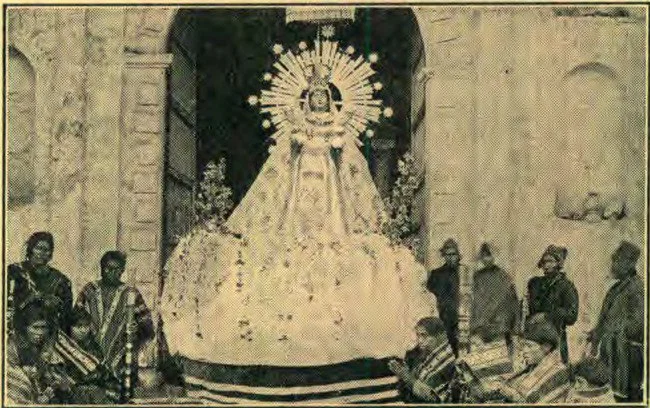
THE church of San Blas, one of the leading urban parishes, is decked out with candles, bouquets, and palms, arranged in fantastic forms on ceiling, walls, and altars.
At about five o’clock in the afternoon two young men wearing red rockets appear at the church door, calling the people to the ceremony. When the bell sounds for six, two deacons and three priests come out from the sacristy, richly dressed and wearing miters such as used to be worn by the Jewish high priest. They perform the usual genuflections and offer incense according to the Roman ritual, and then sit down in some large chairs and begin to drone the Gregorian chants which are sung at Christmas time in Catholic churches the world over.
IMAGE OF THE VIRGIN MARY AS CARRIED IN PUBLIC PROCESSIONS ON FEAST DAYS
Hundreds of wax tapers glitter in the church, while from the great steeple sputter and flash fifty giant light fuses. The great crowd of praying, singing, and shouting Indians and the blanketed musicians rend the air with their noises. During the lulls one can barely hear the voice of the priests who are chanting sentences in Latin, or the response of the choir, these last being accompanied by the orchestra after the manner of the ancient Chaldeans, Greeks, and Romans in their tragedies. By oft-repeated kneelings and bowings the worshipers seek to show their affection for an oil-painted image which occupies a rectangular frame at the side of the room. This is the Virgin of the Nativity.
The worshipers recite prayers to Mary with sobs and devout sighs. While the chanting continues in the church a wild, drunken multitude forms at the doors with flutes, drums, and other native instruments. To the accompaniment of this music they sing all sorts of native picnic and Indian songs. The “brotherhood stewards” set off rockets, bombs, fire wheels, Roman candles, whizzers, and fire mountains, which throw fire about in confusion, burning the clothing of the spectators. At the door of the church lies the body of an Indian saturated with alcohol. He was killed by falling from a high altar that he was dressing up for the feast. There he lies abandoned, and no one seems to pay any attention to him.
The arrival of bonfire wood is indicated by the arrival of twelve young llamas, richly caparisoned with red “bandana” handkerchiefs and flying pennants. They are led by as many Indian girls, who also carry large jars of chicha (a native beer) and demijohns of rum. Ahead of these llamas go three groups of dancing yumbos (masked Indians), rustic backwoodsmen dressed in their Sunday best. They dance to the music of the fife and the discordant tom-tom, in imitation of the Incas, Caribs, and Aztecs. They make a specialty of dancing and pirouetting at the church door before the praying priest, who thus receives their homage.
The drunkenness now reaches its height, and the five bonfires are lighted. These are distributed about the square, which is filled with people. Four policemen guard each fire. The yumbos keep up a ceaseless dancing and yelling to the monotony of the tom-tom. The general racket and public drinking continue till far into the night, when some retire to the near-by drink shops, others go home, and the more drunken ones lie stretched out in the open streets.
Early the following morning begins an endless flow of brotherhoods and Indian worshipers. Everybody admires the arrangement of the church and the ornamentation of the Virgin of the Nativity.
A number of wooden statues clad in dressing gowns and having tin wings arrive about nine o’clock. They are “angels” who have come to the procession. They are carried on litters by specially selected Indians. They are placed in two rows under arches of evergreens and lanterns, among these latter being one with the inscription, “Lunch, Coffee, and Beefsteak at all hours.” The “angels” are followed by a crowding multitude of brotherhoods with long, thick wax candles for the procession. Some enter to hear the mass, while others remain in the court, firing rockets and firecrackers and sending up paper balloons. The wind music and the drinking go merrily on. It is the hour of the mass. The three priests, the deacons, the acolytes, and the sacristans appear near the altar, dressed according to regulations. When the mass begins, the uproar increases. The mass continues with all the pomp and ceremony of the Roman ritual. Here and there through the press are to be seen white persons who, with prayer book and rosary in hand, join in the general confusion. The whole thing reminds one of so many talking machines turned loose at once.
The hour for the “preaching” of the “gospel” arrives. The priest mounts the pulpit called “the chair of the Holy Spirit,” and with great oratorical freedom pronounces the panegyric. He extols the imaginary virtues of the Nativity of Mary. He presents her as the coredeemer, savior, mediator, and advocate of her devotees, especially of the brotherhoods and their families, who are spending the savings of a year in this feast.
Is it possible that these priests of the Roman Catholic apostolic religion are ignorant of the teachings of St. Peter, of whom they affirm that the popes are the legitimate and infallible successors? When Peter in the name of Jesus healed the man who was born lame, Annas, the chief priest, and all those of the lineage of the high priest, laid hands on him and cast him into prison. The following day, when they insinuated to him that he should neither teach nor speak in the name of Jesus, he replied: “This is the stone which was set at naught of you builders, which is become the head of the corner. Neither is there salvation in any other: for there is none other name under heaven given among men, whereby we must be saved.” Acts 4:11, 12. O Romanists, why do you teach the people doctrines that are contrary to the Sacred Scriptures? Why do you seek to hide the sublime truth that we can be justified and saved only by faith in Jesus Christ? that Christ alone is our Redeemer and Saviour, his being the only name whereby we must be saved? Why do you set up other saviors, mediators, and advocates, assuring the people that they are able to save us?
All during the mass the stewards are distributing little cards and bouquets of artificial flowers, crowding in among the young women especially, and interrupting all in the most ridiculous manner. Once the mass is ended, the “Indian king” starts out. He wears a mask, and as he goes out he shouts: “Everybody to the procession!” The parade begins at the church door and passes through several of the principal streets. The vanguard is composed of yumbos dancing, leaping, and pirouetting. Indians of both sexes, carrying lighted candles, form long lines, with a space between through which pass the “angels” in litters borne by the singers, who quarrel and nearly fight for the privilege. In the center, mounted on a luxurious litter and borne by the stewards, comes the Virgin of the Nativity. This is an image in the form of a handsome young woman, about four feet high, adorned with charms, bracelets, earrings, necklaces, etc., and clothed in a beautiful silk dress covered with gold braid and brilliants. The musicians go ahead of the image, also the Indian king and the singers. These are mounted on prancing steeds led by lackeys. Behind the image, prayer book in hand and with solemn tread, marches the gowned and mitered priest under a giant parasol and surrounded by fanatical women who chant the rosary. Flowers are showered down on the image from the windows as the procession passes. The noise of the rockets, firecrackers, and bombs reminds one of a battle. During all the course of the procession the wives of the stewards pass along serving wine and rum to the faithful.
On reaching the church the procession halts and silence is ordered, that the praises of the Indian king and the singers may be heard. The first farsical stanza is recited in a thin, weak voice by a young singer about fourteen years old; the second by another about twelve years of age, but with a stronger voice; and the last, a clownish mixture of prose and verse, is recited by the Indian king. All are silly adulations of the image of the Virgin,—who is called “Mother of God,” “Queen of the Universe,”—and of the priest, the stewards, and the people who are co-operating in the feast. At the end of each part, the yumbos throw sweets and oranges, at times with such force as to smash them against the image or the worshipers. As the priest seems to be the special object of one of these “attacks,” he hastily retreats to the church, where he peeps from a window approvingly, to the general delight of all.
Slowly the crowd disperses, and this part of the feast is over. The yumbos and candle bearers dance through the streets to the house of one of the stewards, where a “wedding feast” is prepared and where drink flows freely. The carousal keeps up four days. Many drunken men and women may be seen at any hour of the day or night, dancing or reeling along the streets, or lying in the gutters unconscious. For convenience there are six saloons within a hundred yards of the church.
If scores of these feasts are celebrated every year in the capital city in plain sight of Archbishop Dr. Gonzalez Suarez, who is called the glory and mentor of the Ecuadorian clergy, what must be the custom in the rural villages and parishes?
We are almost at the close of our planet’s history. The prophecies and the unmistakable signs of the times clearly show that we of this generation are treading on the very threshold of the divine judgment. Instead of wasting time in feasting, we ought, with a loud voice, to give the warning of the threefold message of Revelation 14:6-12: “Fear God, and give glory to him; for the hour of his judgment is come: and worship him that made heaven, and earth, and the sea, and the fountains of waters.”
My beloved reader, with all respect for your belief, permit me to ask you a question: Whom should we believe, God or man? Conscience and duty point to one road, and selfish worldliness points to another. Search the Scriptures, and if you find that you are in sin, seek real heart repentance, and accept the gospel of salvation by faith in Jesus alone, who tells you, “I am the way, the truth, and the life: no man cometh to the Father, but by me.” “Come unto me, all ye that labor and are heavy-laden, and I will give you rest.” BENJAMIN DE LA TORRE.
Translated by E. L. Maxwell.

My Dream

I WAS a care-free, happy country girl, though I had my regular household duties to perform. Reared by Christian parents, I early learned to pray. When I was twelve we attended a camp-meeting, where I was baptized and received into the church. The experience made a never-to-be-forgotten impression upon me. I came up out of the water with a heart full of joy because Jesus loved me; he had given his life on the cross to buy me from the natural tendencies of this life; I had accepted the sacrifice and been buried with him by baptism to prove that I was dead to this world. I was raised to a life to be used in the service of the dear Master who had bought me at so great a price. My baptism was a symbol to me of death and the resurrection.
I learned my Sabbath school lessons and read my Bible while I rocked my baby sister to sleep. I committed to memory Bible verses while I ironed. The verses I learned then have been a great comfort to me throughout my life. I sang the hymns in church, not to show what I could do, but because I loved my Saviour and wanted to praise him. I attended the weekly prayer meetings, unless I stayed at home to relieve mother. I believe I really led a Christian life.
When I was about sixteen I had a dream that made an unusual impression upon me. I dreamed I was in the church, which was full of people singing and praising God. Soon it seemed to me that the throng moved out on a great plain, still singing. Gradually many people dropped out, but I did not think it amiss, for they were at their work in their own separate places.
Finally only a small company remained with me, and we were ascending an incline that became more and more steep as we went upward. After a time I looked about me, and only one friend was coming my way. For a little while we walked onward and upward together. The way became more steep and rocky. We ceased to sing. I looked, and my friend was not there. Our paths had separated. My friend was true and traveling the right path, but not my path. I climbed alone, yet I was not lonely, for this was my path, the way that I could see to go. I climbed on and on, up, ever up. The rocks were slippery and jagged; sometimes I could not see the top, but I kept on climbing.
Before I realized it, I was standing on the top, gazing out over the space below me. The way was partly hidden by the mist of distance. I could see what I had passed as through a veil, but I had no desire to go back. My way was forward. I had faltered from the general direction, and my path was crooked; it wound around the rocks, bowlders, and shrubbery, but ever up, up. The mist thickened around me; I could see but a few feet before me. Still I kept reaching for the shrub or rock that would help me up the rugged path. The way became so rough and steep that the rocks would roll from under my feet and the dust and gravel would rattle down in the space below me, but I was not afraid. The way grew more rough and steep, the rocks more hard to climb, but if I slipped and slid in a treacherous place, I reached for another handhold, found it, and went upward again.
Then, without surprise to me, several persons were with me. We sang and climbed together; the way became less steep, and others were added to the little company as we went up, till we came out on a beautiful plateau high on the mountain top. We rejoiced, and walked forward to the edge of the cliff, about two hundred feet high. Below us lay a beautiful valley skirting the cliff; a clear river ran at the base of it; cottages nestled here and there among the trees and shrubbery. Then the little company were in the valley, walking and singing and rejoicing, all quietly happy and glad. Dear old friends were around me. Suddenly a bright light shone above us; we looked up. O rapture of raptures! in the center of the light Jesus sat on a snow-white cloud. Words cannot express our joy. Then we all exclaimed as with one voice: “This is our God; we have waited for him, and he will save us.”
I awoke with the rapturous cry ringing in my ears. Lying there in my bed, thinking over my dream, the conviction came to me that this dream was an outline of my life as a Christian. As I have come to hard places in my Christian path I have thought of the dream, and as I have reached upward for a new handhold and foothold, strength has come to me. Help was always there when I reached for it.
I am old now. My life travels are almost ended. I have kept the faith. I rejoice that Jesus died that the sinner might live. He will not only save us from sin, but from sinning, if we draw close to him in time of trial, and do not allow ourselves to wander from him.
The church that received me when I was baptized so long ago, has been dispersed many times. We would begin to feel that the members were strong in the Lord, then in a few months the company would be scattered, the old members would move into new districts, many into places where there were no church privileges, and other new members would take their places, only to stay a few years, then go to some other place, while others joined our company. I, too, went out away from my own people, away from the church, into a place where I could not even see a person of my faith. I was compelled to stand alone, alone in the faith. The way grew hard, and though I was very lonely at times, I was not afraid. When in trial I would reach out for new strength, and help to climb the rugged path was always given me. Sometimes circumstances made it seem as if I could not live through the trials; but as I looked to Jesus for guidance and strength, he never failed me. My way was out alone. Scoffers were many, but they only made me more cautious. During these hours of testing I learned many hard lessons, but through God I learned them.
I had married the son of one of our faithful sisters. I thought I should never be alone in my faith, but my husband left the truth. Sabbath became a day alone for me. For twenty years I rarely saw a Seventh-day Adventist. The friends about me were kind, but they were Catholics, infidels, and atheists. The way was steep and rugged. My path was crooked, in and out among the bowlders of unbelief, but not once was I tempted to give up my faith in God and his truth. The promises of God sustained me. I was “tried as by fire,” but his hand was always where I could reach it. I did not have to go alone, for Jesus was always there to help me over the bowlders and up the rugged way.
At last a small church of my own faith was raised up near me. I joined. Oh, how precious are the hours that I spent with those of my own faith! The way was less steep. Soon we shall be on the plateau on the mountain top. My dream has cheered me all the way.
Shall the rest of the dream come true? Shall I be among the faithful ones who will see Jesus come? Shall I see him on the snow-white cloud and join the rapturous shout, “This is our God; we have waited for him, and he will save us”? May God grant it.
I realize that if I am not saved it will be my own fault. If I am faithful to my Saviour, I shall surely see him and join the blessed throng of the redeemed. Forgetting the things that are behind, I must press forward toward the mark of the prize of our high calling in Christ Jesus. I must be steadfast to the end. God has given his word that we shall reap if we faint not, so if I hold to the hand of Jesus and continue in prayer and thanksgiving, I can and will go through. He will be my strength and my shield. He will bear me up and I shall not fall. The crown is sure to the faithful.
MRS. M. E. FRAME.

The Invitation

“FOLLOW thou Me,” a voice is heard Amid the bustling throng; “To ease the care of life's lone years For thee, I've suffered long.”
And then again, beside the grave When hearts are sadly torn, The fragrance of that incense sweet Upon our souls is borne.
And could we see that gentle One Who speaks unto our soul, Our faith and hope and life would reach Within his shepherd fold;
To live for Him would be our aim Throughout the years of life's short race; And when the sun of life is set We'd meet our Saviour face to face.
DOROTHY BROCKMAN.

The Rich Man Who Refused Missions Giving

“A CERTAIN rich man did not approve of foreign missions. One Sunday at church, when the offering was being taken up, the collector approached the millionaire and held out the plate. The rich man shook his head. ‘I never give to missions,’ he whispered. ‘Then take something out, sir,’ whispered the collector. ‘The money is for the heathen.’”

Give What You Have to Others

Give what you have to some one. It may be better than you dare to think.—Henry Wadsworth Longfellow.

The Trespassers

MODESTY is a young girl's most attractive virtue. Let this characteristic be wanting and brilliance, vivacity, and physical beauty lose their luster. Imagine, if you can, the embarrassment that came to the young girls who, walking down the street, encircled with outstretched arms two supposed-to-be strangers in khaki coming toward them, but one of whom was their pastor. Boldness brings little but chagrin to its perpetrator. The reserved, modest girl, the girl who does not subject herself to such needless embarrassment, is a princess among women, and is admired and loved by mankind.
Custom still refuses to accord women in general the courtship privileges of royalty, so until this is done girls should not offend the well-bred of both sexes by making advances to young men. A man does not respect a girl or woman too ready to cast herself at his feet and beg for a place in his affections. Notwithstanding this, in every age there are always some who take these unconventional liberties. Even in Puritan days, notwithstanding the usual statement to the contrary, they were found. Boston's most noted divine of those days, Cotton Mather, graphically detailed in his diary of 1703 his experience with a young woman of this character. He says:
“There is a young Gentlewoman of incomparable Accomplishments. No Gentlewoman in the English America has had a more polite Education. She is one of rare Witt and Sense; and of a comely Aspect; and extremely winning in her Conversation, and she has a Mother of extraordinary Character for her Piety.
“This young Gentlewoman first Addresses me with diverse Letters, and then makes me a Visit at my House, wherein she gives me to understand that since my present Condition [Mrs. Mather had died two months before] had given her Liberty to think of me, she must confess herself charmed with my Person, to such a Degree that she could not but break in upon me, with her most importunate Requests that I would make her mine; and that the highest consideration she had in it, was her eternal salvation, for if she were mine she could not but hope the Effect of it would be, that she should be Christ's.”

A Way of Escape Found

Mr. Mather later wrote that “much Prayer and Fasting and Patience” must be his way to encounter the snares that were laid for him. At one time he almost yielded to her pleadings, and confessed to “a mighty Tenderness for a Person so very amiable;” but later he so far rescued himself from the snare to entrap him that he wrote: “As for my special, soul-harrowing Point; I did some Days ago, under my Hand, vehemently beg, as for my Life, that it might be desisted from, and that I might not be killed by hearing any more of it.” But the lady's importunity even exceeded that of the Biblical widow, and the great preacher wrote pathetically of the distress it gave him. He said: “My Spirit is excessively broken. There is danger of my dying suddenly, with smothered Grief and Fears.”
Fortunately the reverend gentleman fell in love with a charming lady, and was finally able under love's inspiration to extricate himself from the annoying attentions of his self-confessed admirer, though dire threats of evil were made upon him if he took unto himself another for a wife. Despite these protestations, Mr. Mather pursued his enchantress until she became his own.
While there may be few in this time who would plead their cause so distressingly persistently, yet there are many who trespass upon ground forbidden to the well-bred, modest woman. They make bold to ask young men to escort them here or there, to buy confectionery for them, to write to them, to give to them their pictures, and make other equally unconventional requests.

Sympathy Extended to Young Men

We have always had sympathy for the young men who were thus besieged by unsolicited feminine admirers, for many thereby have been seriously inconvenienced and harassed; but we never dreamed that these attentions could come so near making a martyr of one as the Puritan preacher has disclosed.
As a patriotic duty, greater effort should be made to inculcate in young women a modest, reserved course of action in their association with young men, especially so now that our young men in uniform are being urged by the leaders of the nation to prove true, for the sake of humanity, to the highest principles of a noble manhood. Every young woman who has any true love for her country, will in this hour seek to be only an inspiration for good to every young man in her company.

A Good Foundation

A KIND, good person is sure to have good manners, for he has the foundation for consideration and courtesy, though he may know nothing of the rules of etiquette, never have been outside of his own home town, and never have seen the inside of a college. Good breeding is innate, and no amount of culture, polish, mingling in society, or acquired poise will give one good manners if the heart is not right, for out of it are the issues of life. One can secure a fine veneer and still be self-centered and thoughtless of others, yet, under strain, the veneer will crack, and one day or another the individual will stand forth as he truly is, robbed of his graciousness, courtesy, and supposed good breeding. A man may be untutored, ungainly, and poorly clad, but if his heart is good and kind he will have good manners that no amount of strain will imperil, no hardship nor reverses wear away, for he is a gentleman through and through, and his good breeding is only an outward sign of inward consciousness “at leisure from itself,” whereas the cultured egotist tries to carry the insignia of an order to which he does not belong.
With one possessing thoroughly good manners — the manners that proceed from a kind and loving heart— we are always at ease, for we know that what we say will be listened to with interest and sympathy; that our good qualities will be thoroughly appreciated and our faults not dwelt upon; that what is best within us will be sought and encouraged, and it is only human nature to strive to please noble souls such as these.
The person with truly good manners rejoices with us in our joy, and sympathizes with us in our sorrow, for his kind and loving heart gives him a wide outlook, a broad humanity, a helpful spirit that puts him in touch with all sorts and conditions of men and makes him sensitive to their joys and sorrows. He is alive to our good qualities, regrets our faults and foibles, and makes us feel that he has a real interest in us.
Such individuals are met with pleasure and parted from with regret. They make us realize the charm of true, good manners, and create within us a strong desire to be like them. The world cannot have too many of these loving, happy, considerate souls.— Selected.
Continue reading: Gems in Their Natural Shapes