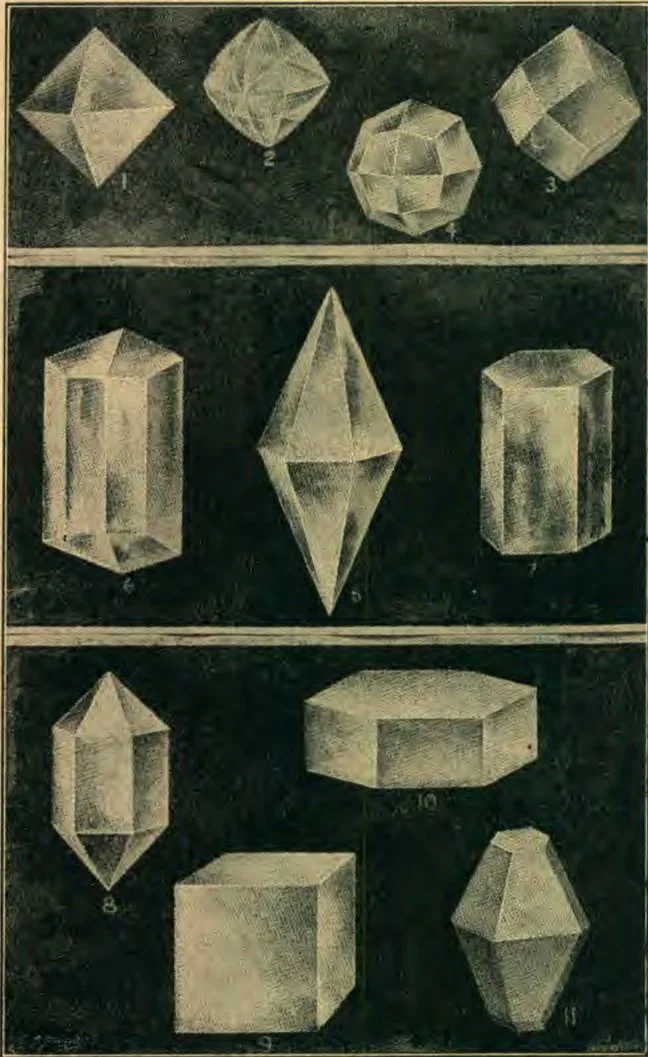
The eye has become so accustomed to the gem as it is seen mounted in jewelry, with its many little facets given it by the lapidary, that the fact is quite forgotten that practically every gem once possessed its own beautifully symmetrical shape when it left the hands of nature.
1, 2, Diamond Crystals; 3, 4, Garnet Crystals; 5, Ruby or Sapphire; 6, Topaz; 7, Emerald; 8, Rock Crystal; 9, Rock Salt; 10, Mica; 11, Sulphur
These shapes are known as crystals, and are of the greatest importance, because by them the gem may be recognized; for the same gem will always appear in the same shapes, which are peculiar to itself alone, and quite different from the shapes of all other gems. For example, the diamond occurs in a crystal like that shown in Figure 1, which is like two four-sided pyramids with their bases set together; or, again, in a shape like that of Figure 2, where the faces of the crystal are slightly curved. The most characteristic shapes of the garnet crystals are seen in Figures 3 and 4, in twelve- and twenty-four-sided figures. This gem, particularly, occurs in well-defined and beautiful little crystals. Again, we have crystals of ruby or sapphire occurring in a form like that shown in Figure 5, a six-sided double pyramid; but these crystals are apt to be rougher in outline, and without natural polish. The natural polish that many of the gem stones possess on their faces is finer than any that the skilled jeweler can produce.
Figure 6 shows a simple crystal of topaz. This stone is often very rich in crystal faces; frequently no fewer8than thirty or forty may be counted on the top alone. A typical crystal of emerald is shown in Figure 7, a simple six-sided prism; and Figure 8 shows that of a rock crystal. Rock crystal was the first among all crystals to be written about, and as long ago as 2,200 years an ancient historian described its shape. Both this stone and the emerald in their natural crystal shapes were made into necklaces by the Egyptians. Because rock crystal is so clear and colorless, the ancients, for many hundreds of years, believed that it was only a form of ice so hardened that it could never melt.
From what has been already said about gems and their natural shapes, it might be inferred that every gem, as it comes from the mine or river bed or from wherever it may have been discovered, is found in its exact crystal form. However, this is not always the case: sometimes it may lose its beautiful shape from being rolled and tumbled in river beds and streams, or again it may be found in a very imperfect condition, perhaps only one half, or less, of the faces being present. But even when many of these are absent, or perhaps only traces of them left, the crystallographer will be able to recognize the gem.
Color Not Reliable Test
Now the shapes of the crystals of semiprecious or precious stones are particularly important, because some of their other properties are of little use to us in the recognition of the gem. Take, for example, color; it might be supposed that this would be of great help, but this has not always been found to be true, and, in fact, it is very often most misleading. Topaz (Fig. 6) will illustrate this point. This stone is commonly yellow or brown, or a yellowish-brown color; but it is often found perfectly colorless, also pale blue and deep wine color.
Again, the garnet may be of every shade of red, of several very beautiful shades of green, also orange color, brown, and even black.
These differently colored varieties sometimes have different names, such as “evening emerald,” for one of the green kinds, and “cinnamon stone,” for the orange-colored stone; but they are all garnets, having their characteristic chemical composition and crystalline form. The giving of these different names to stones of the same family is most confusing, especially so in the case of the ruby and sapphire, for these two stones are only two varieties of the same mineral, corundum, the only difference being that of color. They are alike in all their important properties. The coloring matter in most gem stones is present in so small a quantity that it is often difficult to discover to what it may be due.
Known by Its Hardness
There is, however, another simple property that is of great service in determining a gem, that is its hardness. Thus, diamond can always be recognized, as it is the hardest of all minerals, and will, therefore, scratch any of them. Next in order come the ruby and the sapphire, which may be scratched by the diamond, and in turn will scratch any of the other gems, such as the topaz, emerald, or garnet.
Each gem has its own particular degree of hardness, which is always the same.
A good deal has already been said about crystals of gem stones, and perhaps it should be added here that these are not the only kinds of crystals. Nearly all minerals (which include precious and semiprecious stones) occur in crystals, each one having a form peculiar to itself. Thus we have crystals of rock salt in the form of simple cubes (see Fig. 9); crystals of mica (Fig. 10) — that shiny black or brownish mineral, occurring in little hexagonal-shaped plates, which split into the finest, thinnest leaves imaginable, and which is used for making lamp chimneys, as well as for other commercial purposes; and crystals of sulphur (Fig. 11). There are also sugar crystals, like those of rock candy; and, perhaps most beautiful of all, snow crystals, which occur in an infinite number of lovely forms.
The growth of a crystal resembles, in a way, that of a living being, for it grows out of a solution as if it were alive; and if injured, it repairs itself, replacing any missing parts; or, if it is delayed in the course of its growth by some impediment, when this is removed, it will continue to grow as if there had been no interruption.
Finally, does it not seem a pity that these exquisite little objects, often brilliant with faces of nature’s making, are never made use of in their natural forms? — Mary Winearls Porter, in St. Nicholas.
The Sunflower
By B. F. M. Sours
A THOUSAND lamps of flaming gold,
A thousand torches burning bright,
In one strong phalanx true and bold,
A dauntless legion for the light:
Like soldiers round a camp fire, there,
Like camp fires guarding challenged ground,
They circle, in the sunflower fair,
Its honeyed center round and round.
The honest sunflower has no art
To hide its character by stealth;
It shows you plainly all its heart,
And carries on its face its wealth.
How simple its integrity!
'Twere well if we were as sincere,
As free from all hypocrisy,
With breath as sweet, with heart as clear
See how it turns its faithful head
To get the kisses of the sun.
And should not we when upward led,
With joy the happy journey run?
Then let us, too, be ever true,
And walk the paths where all is bright,
Beneath the skies of cloudless blue,
Our faces always toward the light.
B. F. M. Sours.
Contentment Amid Plenty and Moderate Means
The happy man is he who is cheerful with moderate means; the unhappy he who is discontented in the midst of plenty.— Democritus.
Things Not to Do
Talk While Music is Rendered
UNNECESSARY talking during the rendition of music, either vocal or instrumental, is an insult to the performer, especially if the artist has been asked to sing or play. In public places music is often rendered as an accompaniment to some entertainment; but at a recital, concert, or parlor entertainment, a person who talks, whispers, or does anything to attract attention from the music, or distract the attention of others who may want to listen, shows disrespect to the performer and does an injustice to those who appreciate the music, besides publicly labeling himself as ill-bred.”
Make Little Noises
When in a public place, avoid anything that might disturb others, as by hitting the seat in front of you, no matter how light the taps; or by drumming on the seat with fingers, as the impulse is carried by the wood and is disagreeable to some persons.
Trans-Australian Railroad
The United States, Canada, Russia, and Argentina are crossed by rail from east to west, and Australia is to be added to the number, now that the Augusta-Kalgoorlie road is being finished. The distance covered by this new road will be equal to that from Boston to San Francisco. In the United States the extent of transportation from Boston to San Francisco is 3,467 miles. In Canada, from Halifax to Vancouver by the Canadian Pacific is 3,656 miles. In Russia, from Vladivostok to Petrograd by the Trans-Siberian road, and between Moscow and the capital is 5,785 miles. In South America, from Buenos Aires to Valparaiso is 908 miles. This new road in Australia from Brisbane to Perth will be 3,467 miles in length. Only a comparatively little time ago railroads were never dreamed of. The vehicle hitched to a horse had no improvement made in transportation for six thousand years till comparatively recently. Now the earth is literally girdled with steel rails, and the people are racing in cars back and forth over the continents. The railroads are built in the interest of commerce, but the kingdom of Christ is using them to carry light and evangelism to the ends of the earth.— Christian Herald.
The Service Flag
THE service flag consists of a white field with a red border, and one or more blue stars in the field to indicate the number of boys that have gone to the front from a home, church, or organization.
The service-flag idea originated with Capt. R. L. Queisser, of Cleveland, who had two sons in the service and who wanted to get up a flag that would give some visible indication of this fact. He made the design in question, and secured a design patent on it from the patent office last November. The patent covers strictly only the flag with two stars in it, as Mr. Queisser made it for his own use. Some of the flags hung in front of big offices, factories, etc., contain scores or even hundreds of stars.
In some cities and States the flag has been adopted by the authorities, and provision has been made for supplying them free to all families that send boys to the war. Mr. Queisser allows the flag makers to make flags according to his design, and they pay him a small royalty on each flag. He gives half of his profits to the Red Cross.— The Pathfinder.
How We April Fooled Aunt Patty
By Mrs. O. M. Hatch
MRS. O. M. HATCH
“O MOTHER! Tomorrow is April Fools’ Day, and Ned Turner has planned for us boys to give Uncle Rasmus the biggest April fool!” exclaimed Ted Cummings as he burst into his mother’s room, and tossed his schoolbooks onto the table.
“Tell me all about it, Ted,” and Mrs. Cummings settled back in her chair to listen, for she and Ted had been chums ever since he could remember.
“I don’t believe, mother, you will approve of his plans. And I don’t exactly myself. But you know how Ned is.”
Yes, Mrs. Cummings well knew Ned’s set and domineering disposition, and sighed.
“Perhaps, Ted, he is not so much to blame as others. You know his mother died when he was very young, and his father and aunt reared him in the most strict and exacting manner. Very little love and sympathy have come into his life. But I believe if the right chord could be touched Ned would respond. We will do all we can for the motherless boy. But tell me all about Ned’s plans for April fooling old Uncle Rasmus.”
After Ted had finished, Mrs. Cummings made no comment, but quietly remarked: “I have a story, Ted, to tell you—a true story, taken from my own life. I wish Ned were here; I think it would do him good.”
“Why, here he is now, mother,” as Ned came sauntering up the walk.
“I was just speaking about you,” said Mrs. Cummings as she gave Ned a cordial greeting. “I was intending to relate to Ted an incident in my own life, and I wished you were here.”
“I am glad to be here,” said Ned honestly, “and hear anything you have to say, Mrs. Cummings,” for secretly Ned thought there was no one quite equal to Ted’s mother.
“When I was sixteen,” began Mrs. Cummings, “why, that is just your age, isn’t it, Ned?”
“Yes, I was sixteen last month.”
“We thought it would be great fun to April fool Aunt Patty. Now to know Aunt Patty was to love her. If there was any one sick, it was Aunt Patty who was sent for. If a death occurred, it was Aunt Patty who comforted the mourners. If one was discouraged or downhearted, it was she who gave good counsel and cheer, and substantial aid whenever she had money to do with. Never a poor hungry soul ever came to her door and departed unfed. In fact, no one ever came in contact with Aunt Patty without being the better for it.”
“Well do I remember when my life hung in the balance with diphtheria. Mother was exhausted, and it was Aunt Patty who came and nursed me back to health and strength. And to think, Ted and Ned, that I should so far forget even common courtesy as to consent to be the leader in fooling Aunt Patty!”
“Never shall I forget that night! The moon rode high in the heavens, and the clouds were dark and swift. At the appointed time we started. There were about twenty boys and girls in the party, and they were armed with old tin cans, horns, bells, fifes, and several drums. You can imagine the frightful din when all of those nerve-racking instruments were put in operation. And to think we thought that would be such fun! Little did we dream how near a tragedy that night’s work might have caused.”
“I was to creep up stealthily to the house and knock. and Aunt Patty’s opening the door would be the signal for pandemonium to be let loose. How little people who play such pranks realize that they are the biggest fools of all!”
“Slowly and silently I approached the door. Hearing voices, as I thought, I peeped through the window, and there on the floor, before a fireless stove, knelt Aunt Patty. The tears were streaming down her wan cheeks—strange I had never before noticed how thin they were—as she pleaded with God not to forsake her, and reminded him that her coal bin was empty and her cupboard bare. As she prayed, a shiver ran through her frame, and she drew her thin shawl closer around her. She prayed for a blessing to rest on all her friends and neighbors, and especially ‘dear Muriel.’ I could stand no more, but fled conscience-smitten to my companions. Great was their consternation and remorse, for they all dearly loved Aunt Patty.”
“‘Now, boys and girls,’ I exclaimed tearfully, ‘something must be done, and done right away.’”
“‘Suppose we run as fast as we can to your home, Muriel, and tell Mr. and Mrs. Hilton,’ spoke up Alice Williams.”
“‘Agreed!’ we all exclaimed, and away we ran to my home. It was a very sober but excited company that burst into the sitting-room where father and mother were quietly reading.”
“‘What, back so soon!’ exclaimed mother, as she looked up with a smile. Then as she caught sight of our sober faces, she asked, ‘Is there anything the matter with Aunt Patty?’”
“‘No, and yes, mother,’ and I hastily explained the situation.”
“‘Do I understand, Muriel, that you intended to April fool Aunt Patty by hooting, screaming, ringing of bells, and beating of drums?’ asked father. ‘If so, you may well be thankful a kind providence prevented you from carrying out your intentions, as the joke might have proved fatal.’”
“‘What do you mean, father?’ I gasped, horrified.”
“‘Just what I have said, Muriel. Aunt Patty has a very weak heart, and any sudden shock or fear might cause her death. I trust my daughter, or any of these dear girls and boys, will never again be guilty of such an undertaking.’”
“‘Never, father!’ I exclaimed, tearfully.”
“‘Now,’ continued my father, cheerfully, ‘we will indeed April fool Aunt Patty, but in a far different manner from that you had planned; a joyous surprise will not harm her. We will send word to her friends and neighbors to meet here inside of an hour and a half, and all march together to her home, carrying with us, not only the necessities of life, but some luxuries as well.’ Then turning to mother, he requested her to kindly write out such articles as she thought each family could bring on such short notice.”
“Within fifteen minutes the boys and girls had been commissioned, and were hurrying home with their slips of paper closely treasured. Quickly the gifts were prepared, and all assembled at our home.”
“‘Friends,’ said my father, ‘in token of the love and esteem in which the citizens of Ridgefield have ever held Aunt Patty, and to show our appreciation of her loving ministrations among us, I vote we make up a purse, and will start the donation with fifty dollars.’10”
“At the pleased murmur that responded, father looked toward me, and said brokenly: ‘I firmly believe that Muriel would not be here tonight had Aunt Patty not nursed her so devotedly during her battle with diphtheria; and I think there is not one present who has not at some time been the recipient of Aunt Patty’s generosity.’”
“Then Deacon Wilson arose and said: ‘I remember when we were burned out, it was Aunt Patty who gave us a home and helped us to start anew. I will give fifty dollars now, and more later.’”
“A thunder of applause greeted this remark, for Deacon Wilson was not noted for overgenerosity.”
“Then little Miss Paterson arose and with trembling voice said: ‘I should have lost my home thirteen years ago, had it not been for Aunt Patty; and although I have little money, I will gladly give her a home with me the remainder of her life.’”
“Then everybody began to talk, and what do you think, boys? In just a few minutes, they not only raised more than four hundred dollars in money, but voted to make Aunt Patty matron of Leabright Orphanage. The orphanage had formerly belonged to her father, Dr. Leabright. It was her old home. The family had been very wealthy, but after her father’s death reverses came, and, I am sorry to say, through the rascality of her only brother she was obliged to sell her beautiful home to pay the debts. It left her penniless. For a long time she struggled bravely on, teaching music, tutoring, and sewing, until her health broke down, and the doctors ordered a long rest. It was during this time that her funds were exhausted, and she was reduced to the condition in which I found her that April night.”
“It was just half past eight o’clock when we started for Aunt Patty’s, Deacon Wilson leading the way with his double team, the wagon loaded with apples, potatoes, all kinds of vegetables, besides coal and wood. What a merry party we were, as we went up the moonlit road to the little brown house on the hill!”
“In answer to my knock Aunt Patty opened the door, and to say she was astonished when she saw nearly all of Ridgefield assembled in front of her house, is putting it far too mildly. She seemed incapable of moving, until my father called out in his hearty voice, ‘We thought we would give you a little surprise, Aunt Patty, if you will let us in!’”
“Amid laughter and tears, greetings were exchanged and gifts presented. It looked more like a county fair than anything else. The tables were piled high with bread, biscuit, butter, pies, cake, jelly, preserves, and a lot of other good things too numerous to mention. Right royally had Ridgefield responded to father’s call.”
“‘How shall I ever be able to eat all of these good things?’ said Aunt Patty, as she lovingly touched the huge collection.”
“‘Well,’ said kind Uncle Rasmus in his slow way, ‘we calculated on how you love to give, so we thought we would bring enough for you to share with others less fortunate.’”
“‘Do you mean our Uncle Rasmus?’ asked Ned.”},{
An Interesting Boy
THE editor of one of our weeklies asked Dr. Alexander Graham Bell, inventor of the telephone, to name the most interesting man he knew. Dr. Bell replied that his most interesting acquaintance is not a man, but a blind, deaf-and-dumb boy, Charlie Crane, who is at present attending a school for the deaf at Halifax, Nova Scotia. The principal of the school gives the following interesting sketch of the life of the unfortunate lad:
“Charles Allen Crane was born in Vancouver, British Columbia, on April 10, 1906. When he was nine months old he lost both sight and hearing through spinal meningitis. He was admitted to the School for the Deaf at Halifax on May 10, 1916, when he was a little over ten years of age. He is one of a family of eight, four boys and four girls, and his parents are healthy, intelligent, and well-educated people.
“Charlie has a keen sense of humor, is most inquisitive, and as happy as the day is long. If he suspects you are fooling him, up like a flash goes his hand to your throat to find out whether or not you are laughing. He has been about eighteen months in Halifax, and under regular instruction less than twelve months. In that short time he has been taught to speak; and his speech, unlike that of so many deaf children, is pleasant and even the most difficult sounds distinct and easily intelligible. Some months ago he addressed the Rotary Club here, and each word was easily understood by every one in the large room. He has a most11retentive memory. He had been about five weeks here when the school closed for the summer, and one day in the holidays his teacher was surprised to see him spelling the names of pupils. She watched him carefully, and found that he omitted only seven out of the ninety-seven pupils in attendance.
“Geography, if I may so call it, has a fascination for him, and he seems to be endeavoring to make a world for himself by finding out from all who come in touch with him the names of countries and what the people are doing who inhabit them. He has wormed out the names of numbers of streets in London, Paris, New York, Washington, Vancouver, and other cities.”
On the Water Wagon
NEWPORT and Annapolis have gone on the water wagon. The Hon. Josephus Daniels, Secretary of the Navy, drew a circle with a 5-mile radius about certain naval training stations, training camps, and marine barracks, and by this simple act banished John Barleycorn from these two ancient capitals. He did this under the provisions of the selective draft law, which empowers the authorities to prevent the sale of liquor within five miles of any military camp or reservation.
Newport, the summer capital of wealth and fashion, the most exclusive watering place on the Atlantic coast, will no doubt feel most the effects of this stringent order. Civilians living in the dry zones are permitted to have liquor in their homes and to serve it to their guests, but traffic in the stuff is prohibited for the period of the war. Annapolis saloons are put out of business by a stroke of the official pen, even while the legislature of Maryland is considering the subject of State prohibition.
Previous to this recent order the sale of liquor had been prohibited within but half a mile of the training stations and barracks. But commanding officers complained to the department that this regulation did not meet conditions, and they recommended that the full 5-mile limit be put into effect. In following this recommendation Secretary Daniels says that “by various means liquor found its way into the possession of enlisted men of the navy and marine corps stationed at these places, and the moral and physical welfare of these men was seriously endangered.”
He directs attention to the fact that at the Newport training station there are 6,900 enlisted men and that at the training station and the torpedo station are large quantities of high explosives, all of which makes it advisable that the men shall not have access to alcoholic stimulants. Consequently, for the safety and welfare of the men and the Government’s property, the Secretary decided it was necessary to impose prohibition upon the whole town for the war’s period. Newport will be a dry spot this coming summer.—Washington Post.
Who Are These Three?
By Lora E. Clement
SIXTY-TWO years ago soft Virginia skies first smiled down upon a child who is known today as “the greatest living American.” His father was a Presbyterian clergyman, and the son inherited rare literary and executive ability. He was graduated from Princeton University, and later chosen the first non-clerical president of his Alma Mater.
Of his own personal appearance he once said:
“For beauty I’m no star;
There are others more handsome by far;
But my face, I don’t mind it,
You see I’m behind it;
It’s the people in front that I jar.”
His more public career began in 1910, with his election to the governorship of New Jersey, and in12serving the people of that commonwealth he brought about extensive political and social reforms. He is an author of note.
Wider activities have become his portion with the passing years. His name has become a household word, a synonym for steadfastness of purpose, for courageous determination in the face of greatest difficulty, for democracy itself. Shoulder to shoulder with Washington and Lincoln, he stands as the molder of national destiny.
At the recent war council, which met in Paris to lay plans for closer co-operation between the Allies, the chief representative of the United States was a slightly gray, keen-eyed, soft-spoken man, who has been called “the Assistant President of the United States.” This was his third mission abroad. During the months of our neutrality he was “the common denominator of the warring nations,” for he went to Germany, France, and England, working in the interests of peace and the common good. He is a quiet man. During his five years of close association with diplomatic affairs, he has spoken perhaps as many as twelve sentences for publication, and in despair newspaper men speak of him as “the sphinx in the soft felt hat.” Intimately associated with President Wilson, he is doing in his unobtrusive way perhaps more than any other one man, aside from the President himself, to “make the world safe for democracy.”
He was a member of the tribe of Israel bearing the name of the beloved child of Jacob’s old age. Although the son of a wealthy and influential chief, yet in accord with the simple customs of the time he grew to manhood in his father’s house, engaged in the humble duties of a husbandman.
Absent from home at one time on an errand for his father, he decided to visit Ramah on the return journey, and there had an experience which changed the whole course of his life. He was called from quiet, humble surroundings to a position of great honor and responsibility.
This man was physically strong and “good to look upon;” he was skilled in the arts of ancient diplomacy and warfare. But he was jealous in the extreme, and possessed of a violent temper which he made no effort to control. His career is one of the most brilliant and pathetic in the early history of Israel, for while he attempted to rule others, he himself had never learned the lesson of obedience. Repeatedly he disregarded the commands of God, until the Spirit was weary of striving and left him to the mercy of the tempter and his own evil passions.
His later years were spent in seeking the lives of those whom he imagined were anxious for his throne and kingdom. He died a coward on the battle field of Mt. Gilboa, when his army was overcome by the Philistine hosts, and the man who had slain his thousands gave place to him who had put ten thousand to flight.
LORA E. CLEMENT.
“Let’s Go Back”
By Mrs. D. A. Fitch
WE had not learned much about the beaches of Porto Rico, and desiring to spend a pleasant holiday at one of them, we made inquiry of an old resident. In giving directions as to how to reach the beautiful beach of Louisa Aldea, he did not say there was a smooth road all the way, neither did he intimate we would find any roughness as we traveled. The gentleman who had invited us to take the trip was master of his machine, and so we had no fear of an accident or of any trouble.
We had not gone far when we came to an uneven road, but our owner-chauffeur seemed to have no disposition to abandon the trip, although one of the party repeatedly said, “Let’s go back.” All the way was not like that. There were many smooth stretches of road over which the automobile spun swiftly enough.
Much might be said in regard to the incidents of the day, but they have little to do with the lesson to be pointed by the journey. We had a pleasant day, and returned home much benefited by the trip.
We have not learned all about the country to which Jesus, a resident of it, has invited us. To reach that place means more than a pleasant ride over flowery beds of ease. There will be rough and uneven ways of which warning has not been specifically given. Trials of various kinds will come all unexpectedly, causing us to say, “Let’s go back.” Such a feeling being only transitory we soon realize that he who invited us is Master, not only of the road and vehicle, but of us if we will permit him to be such in deed and in truth. The joltings and jarrings by the way will only serve to strengthen faith and hope and greatly increase the pleasure of possession when the inheritance is finally reached. Too much cannot be said of the country to which we are going, of its occupancy and everlasting duration. The reliable guide book tells us that “eye hath not seen, nor ear heard, neither have entered into the heart of man, the things which God hath prepared for them that love him.” 1 Cor. 2:9. So let none of us be influenced to turn back by the hardness of the way. A life of eternal bliss awaits all who endure unto the end.
Mrs. D. A. Fitch.
For the Finding-Out Club
This Is for You
THE Finding-Out Club was very popular last year. Persons from all parts of the country sent in answers to the questions. Some made scrapbooks of the material found in this department.
Miss Clement is now writing interesting sketches for the Finding-Out Club. The editor was disappointed that no one sent in answers to the list of inventors given in the INSTRUCTOR of Feb. 26, 1918. To the person who submits the greatest number of correct lists during 1918, including a correct set of answers to the questions of February 26, the editor will present a book. The rules governing the club are the same as those of last year. See 1917 file.
The “Butch” Boy
By George S. Belleau
RALPH PALMER was “butch” boy, or news agent, on an excursion train that ran from a large Southern city to the Atlantic beach. The end of the summer was drawing near, and he was not anxious for the season to close, for he had enjoyed it and made many friends. In his association with the train crew he had become known as a good, moral boy. He was never seen using tobacco or drinking anything stronger than water.
All of Ralph’s life his mother had been a devoted Christian. She had taught him about the boys of the Bible and the lives they led. When he was very small he decided that he would live a clean life. Even though Ralph received a Christian education he never seemed to take a deep interest in the religious side of life, although very respectful toward things that pertained to religion.
The last week for the excursion train to run came. The conductor had taken an unusual liking to the entire crew, so he told the “boys” that he would give them a big “feed” on the last night. All were very anxious to get back to the city, and as soon as they could get away after arriving, the seven made their way to the restaurant where the conductor had ordered the supper to be served.
On entering they were shown to the special table prepared for them. The center of the table was decorated with a massive dish of egg salad. Instead of a plate, there was a large cabbage leaf at each place.
The meal was progressing well, and every one eating as if he had been “saving up” all week for the feast. The conductor made them feel that he considered this privilege an honor, and wanted them to have every good thing obtainable.
Presently, the waiter came in with a large bucket containing ice and several bottles. Ralph at once realized that he was about to have an unpleasant experience—one that nearly every boy has to pass through in one form or another. The waiter opened and placed a bottle before each one.
“No, thank you,” said Ralph, as a bottle was placed in front of him.
“Come, come, my boy,” said the conductor, taking the bottle and pouring the beer into Ralph’s glass, “it won’t hurt you.”
“No, I have never tasted it and I’d rather not begin,” replied Ralph.
“Drink it, Ralph, one time doesn’t matter,” cried one.
“Don’t be a piker and spoil the party; do anything one time to be a sport,” sarcastically said another.
He was the fun for the whole company, and the devil seemed to possess them. Hitherto they had been friendly and courteous to him, always taking his part.
After several minutes of urging, Ralph actually feared he would not be strong enough to be true to his convictions. He could feel that Satan was gaining ground gradually. He clasped his hands together under the table to keep from having the glass pushed into them. As he felt himself slowly yielding, he tried to think of something else to do. Suddenly, it seemed as if his mother put her hand on his shoulder and whispered to him, “Pray, my boy.” He silently asked God for strength, and scarcely before he finished the engineer said, “Ah, fellows, leave the boy alone; I wish I had never begun.”
“So do I,” confessed the conductor, “I’d be a few hundred dollars ahead now.”
Peace and joy came over Ralph, and he thoroughly13enjoyed the rest of the meal. It seemed that the men could not be pleasant enough to him.
Today, Ralph realizes that it was his mother’s prayers and the Christian education that she worked so hard to give him that conquered the enemy that evening, and has since won many other victories for him.
Ralph took a firm stand for Christ, and a few years later sold the same conductor a copy of “Daniel and the Revelation,” taking pride in telling him that he was selling books to get money so he could attend school and prepare to be a minister. The conductor was only too glad to help him by purchasing a book.
GEORGE S. BELLEAU.
The Value of Kind Words
By Blaise Pascal
KIND words do not cost much. They never blister the tongue or lips. We never heard of any mental trouble arising from this quarter. Though they do not cost much, yet they accomplish much. They make other people good-natured. They also produce their own image on men's souls, and a beautiful image it is.
— Blaise Pascal.
Our Counsel Corner: Pledges and Prayer Bands
[All our Missionary Volunteers are invited to contribute questions to Our Counsel Corner. The Young People’s Missionary Volunteer Department will be glad to answer, through these columns, questions on subjects of interest to young people.]
WHO is supposed to countersign the Missionary Volunteer membership pledge,—the society secretary or the church missionary secretary? E. N. P.
The pledge card should be countersigned by the Missionary Volunteer Society secretary, after which it should be returned to its owner. E. I.
How should a prayer band be conducted? R. D.14
Prayer bands should be thoroughly spontaneous and free from formality. No unwilling leader should be appointed to take charge. Invite all the young people to join a prayer band, but do not overurge any one. Meet regularly, and as often as once a week. The program may consist of, (1) a short study, (2) some expression from each member, (3) discussion of objects of prayer, (4) prayer. The study should not be more than five minutes in length, when the meeting lasts from but fifteen to twenty minutes. A few thoughts on some Bible text, an illustration bearing directly on the subject, helpful paragraphs from some suitable book, or a personal experience may be given; but this part of the meeting should never consume much time. Long readings, talks, or Bible studies are absolutely excluded in a prayer band. The band is for prayer for certain definite objects, therefore prayer and the objects of prayer must be kept uppermost. Nothing is more disheartening than wandering, aimless, pointless praying; therefore, let the objects be mentioned before the prayer season begins. As far as possible, the leader of the band should plan to have each member take his turn in leading out in the meetings. The prayer band, rightly conducted, is the secret of true success in the Missionary Volunteer Society. M. M.
We are told that we must train successors if we are really successful. This is sometimes hard to do; one of the boys who I feel sure would develop into a good leader is so shy that it is hard to get him to take any part in the meeting. How can I help him? LEADER.
Keep on trying to get him to take part, and be prepared to fill in any break that may occur. Francis E. Clark tells about a young and inexperienced boy who was once appointed to lead a meeting on “Christian Heroism.”
“He began bravely, ‘If you are a Christian—’ His words and prepared thoughts failed him.
“‘If you are a Christian—’ (long pause)
“‘If you are a Christian—’ He could get no farther, but blurted out, ‘What you scared of anyway?’ and sat down covered with shame and confusion of face.”
This boy had really succeeded. He had tried, and he had done his best. Dr. Clark says: “Others, provoked to good works by his manly effort, rallied to their apparently vanquished leader, and we had one of the best meetings of the year.” A. B. E.