Another Vision of the Four Great Empires—Saw the Fourth Broken into Ten—The Prophet Interprets His Own Prediction
By JEAN VUILLEUMIER
In our last three issues, Mr. Vuilleumier has given us some studies on the prophecy of the second chapter of Daniel. In this and the next two papers, he presents studies on the seventh chapter of that intensely interesting book.
In the articles on the seventh chapter, it will be shown that this chapter parallels the second. That is, it tells of the four great monarchies, and on the subject of the breaking to pieces of the fourth, the seventh chapter is specific in telling the exact number. It also tells of an eleventh, an ecclesiastical kingdom, that arises among the ten; and it tells in detail what this church power would do. Thus while the seventh chapter is parallel to the second, it tells many details that are not in the former.
This article takes us to the breaking of the Roman Empire into its ten kingdoms. The article next week will be devoted to a consideration of the church kingdom that arose among the ten.
EDITOR.
In a vision given to the prophet Daniel, in 603 B.C., for the immediate benefit of King Nebuchadnezzar, of Babylon, as we have seen in former articles, this young Hebrew exile saw four successive world empires under the image of a great metallic statue. The fourth—the Roman Empire—was to be reduced into several fragments, or kingdoms, which, for an undetermined length of time, were to exist together, uniting or warring with each other, until they should all be swallowed up in destruction. Then the earth itself, the theater of their rivalries and bloody contests, was to be rejuvenated, and occupied by a new empire, the universal and eternal empire of Jesus Christ and His saints.
A NEW AND MORE REMARKABLE VISION
Such is in brief the vision found in the second chapter of Daniel. But chapter seven of the same book contains a new vision, more remarkable still, which, while covering the same ground, brings to view some wonderful developments in the nearer period of medieval and modern times, and that with special reference to the central, commanding figure of the prophecy. It will repay us to devote time to the study of this vision and its astonishing fulfillment. And to that effect, let us read it step by step, both in the description given by Daniel and in its interpretation given him by a heavenly being.
VERSES FROM THE VISION
“Daniel spake and said, I saw in my vision by night, and, behold, the four winds of heaven brake forth upon the great sea. And four great beasts came up from the sea, diverse one from another.” Verses 2, 3.
THE PROPHET’S OWN INTERPRETATION
“These great beasts, which are four, are four kings, that shall arise out of the earth. But the saints of the Most High shall receive the kingdom, and possess the kingdom forever, even forever and ever.” Verses 17, 18.
Here, then, is the great plan of God for this earth and its nations. Four mighty empires will compass the destinies and glories of earthly history in its fallen, sinful state. Then this same earth will become the eternal and peaceful abode of a race called “the saints of the Most High.” How simple, yet how thrilling! Can we believe it? Let the fulfillment of the vision itself answer this question.
THE ROARING WATERS OF THE GREAT SEA
According to Isa. 17: 12, 13, and Rev. 17: 15, the great sea symbolizes the restless multitudes of earth’s nations. The four winds of heaven that cause these waters to seethe and surge are the winds of war, political feuds, and rivalries (see Jer. 4: 11-13), which cause the rise and downfall of kingdoms and potentates.
“And four great beasts came up from the sea, diverse one from another”
THE BABYLONIAN MONARCHY
“The first was like a lion, and had eagle’s wings: I beheld till the wings thereof were plucked, and it was lifted up from the earth, and made to stand upon two feet as a man; and a man’s heart was given to it.” Dan. 7: 4.
As we learn from the vision of the second chapter (Dan. 2: 37, 38), the Babylonians are the first of the four great nations. They are here represented by the king of animals and the king of birds; while in the former vision, by the choicest metal. Under the successors of Nebuchadnezzar, the Babylonian lion loses much of its military valor; and finally, in 538 B.C., this empire falls into the hands of Cyrus, who establishes the Medo-Persian monarchy.
THE MEDO-PERSIAN MONARCHY
“And, behold, another beast, a second, like to a bear; and it was raised up on one side, and three ribs were in its mouth between its teeth: and they said thus unto it, Arise, devour much flesh.” Dan. 7: 5.
The two unequal nations making up this new empire; the three great territories added to it by conquest—Chaldea, Lydia, and Egypt; the cruelty of the Medo-Persian wars; the clumsy mass of their armies,—all this is fittingly represented by that bear leaning upon one of its sides, having three ribs between its teeth, and devouring much flesh. But the scene changes.
THE GREEK-MACEDONIAN MONARCHY
“After this I beheld, and, lo, another, like a leopard, which had upon its back four wings of a bird; the beast had also four heads; and dominion was given to it.” Verse 6. This symbol not only denotes the customary ferocity of war, but also a marvelous velocity in military movements, and the division of the empire into four parts. This was fulfilled by the unequaled record of Alexander the Great, who conquered the world in less than ten years, and after whose untimely death his great empire was divided into exactly four kingdoms.
VISION OF THE ROMAN MONARCHY
“After this I saw in the night visions, and, behold, a fourth beast, terrible and powerful, and strong exceedingly; and it had great iron teeth; it devoured and brake in pieces, and stamped the residue with its feet: and it was diverse from all the beasts that were before it.” Verse 7.
“Then I desired to know the truth concerning the fourth beast, which was diverse from all of them, exceeding terrible, whose teeth were of iron, and its nails of brass; which devoured, brake in pieces, and stamped the residue with its feet.” Verse 19.
THE PROPHETIC INTERPRETATION
“Thus he said, The fourth beast shall be a fourth kingdom upon earth, which shall be diverse from all the kingdoms, and shall devour the whole earth, and shall tread it down, and break it in pieces.” Verse 23.
Such indeed was the Roman power, which succeeded the Greek. For six long centuries, it ruled the earth. The greatest captains the world had known, like Hannibal and Mithridates, were dashed in pieces406against this iron power. By degrees, all known nations were brought to submit to the dread authority of the Roman senate, either as allies or as conquered peoples. Marius, Sulla, Pompey, Cæsar, and a hundred more, marched in succession to all parts of the political compass, spreading terror and ruin to the nations, who had to yield their wealth and offspring to the victors. The terror of the Roman name became a proverb.
But this tremendous power was to pass through a second phase. It was to be divided into ten kingdoms.
VISION OF THE TEN BARBARIAN KINGS
“And it [the beast] had ten horns.” Verse 7.
“Then I desired to know the truth . . . concerning the ten horns that were on its head.” Verses 19, 20.
THE INTERPRETATION
“Thus he said, . . . As for the ten horns, out of this kingdom shall ten kings arise.” Verses 23, 24.
The division of the Roman Empire into ten distinct kingdoms is the one leading feature in the political history of the Middle Ages and of modern times. During the fourth and the fifth century, the Roman world of the West was conquered and divided by the Alemanni (351), the Franks (351), the Burgundians (406), the Suevi (406), the Vandals (406), the Visigoths (408), the Saxons (449), the Ostrogoths (453), the Lombards (453), the Heruli (475, 476).
The nations of Europe to this day have occupied nearly the same territories and borne nearly the same names. The central figure in this prophecy will be the theme for next week.
Gripped by the Madness of War
By J. S. Washburn
Will We Have Peace or War?—The Tension of the Situation—Pope Benedict Thinks All Civilization Gone Mad
By J. S. WASHBURN
NEVER since that dark day when sin entered Eden, has mankind faced so great, so ominous a crisis as to-day. The very air seems trembling with an intense and fearful expectancy. There is surely “distress of nations, with perplexity; . . . men's hearts failing them for fear, and for looking after those things which are coming on the earth.” Luke 21: 25, 26.
A few days after the sinking of the Lusitania, President Wilson gave an address in Philadelphia, to 4,000 newly naturalized citizens of the United States. Following so quickly that most terrible event in the history of so-called civilized warfare, the air was tense with an expectancy that the president would deliver an authoritative statement on the war situation, defining exactly the stand of the United States on the destruction of American ships and American lives.
The president is to speak in the immense Convention Hall, seating 30,000 people. Some time before his arrival, a great throng surrounds the hall, only ticket holders being admitted. A very strong force of police guard every entrance, and stand ready for any emergency. Rumors of threatened attempts on the president's life have been circulating, and Philadelphia takes no chances. No president was ever so closely guarded before in Philadelphia, as was President Wilson on this occasion. An army of 800 men were constantly on the watch. The entire City Troop, government secret service men, and every detective in the department, are on duty.
WILL HE SPEAK PEACE OR WAR?
At the station, the president passes between living walls of armed men. Seated in an automobile with his private secretary and the mayor of Philadelphia, secret service men standing on the steps, the president heads the procession to the Convention Hall. Standing in the great throng near the hall, I can but think of royal processions I have seen in England. A rush of plumed cavalry vividly recalls the forerunners of royalty, the shouting, cheering thousands—and the man who holds, in large measure, the destiny of this great nation, and of the whole world, in his hand, sweeps swiftly by.
A slender, scholarly, refined man is the president in appearance, growing gray, but alert, energetic, and wholly self-possessed. We know he will do his utmost for peace. We know he will not be swept into the awful maelstrom of world war, if it is possible to preserve an honorable peace.
God guide and keep the president in the path of safety and right! Surely if ever men ought to pray for rulers and those in positions of authority, it is to-day, and for the president of the United States, apparently the only hope of this warring world.
Over the mighty throng who hang breathless on the president's words, waiting for the fateful words of war, falls like oil upon the troubled waters, a message of peace. “The example of America must be not merely the example of peace because it will not fight,” he said, “but of peace because peace is the healing and elevating influence of the world, and strife is not. There is such a thing as a man being too proud to fight. There is such a thing as a nation being so right that it does not need to convince others by force that it is right.”
THE MAN OF PEACE
Recent events had not shaken the president's calm. There was no passion in his voice. He was grave, but not somber. As he rose to speak, there was tremendous and long continued applause. The heartiest cheers of all were given when a man in the gallery shouted, “Three cheers for the man of peace!” The people came to be startled, and went away apparently thankful that they were not.
TAFT APPEALS TO STAND BY HIM
The president said: “I am sorry for the man who seeks to make personal capital out of the passions of his fellow men. America was created to unite mankind. Think first of humanity.”
The wonderful enthusiasm that greeted these appeals for peace, seemed to indicate that those who heard the president, approved his utterances. But the next morning, a mingled chorus of approval and disapproval was heard all over the world. Former President Taft made a ringing appeal to the country to sink all party feeling and stand by the president. Other leading men urge war; and one of them, an ex-president, compares President Wilson to “the great arch neutral, Pontius Pilate.”
BENEDICT SAYS WORLD GONE MAD
The world is stirred with the awful passion for war, and it will be a great struggle for us as a nation to keep our balance. The pope is reported to have said to Cardinal Gasparri: “All civilization seems to have gone mad. Our endeavors have failed. It all rests in the hands of God. May He pity His misguided children.”
Truly, “all civilization seems to have gone mad.” The Turkish problem hastens to its final fearful settlement. Gog and Magog, “Rosh, Meshech, and Tubal,” are rushing swiftly toward Armageddon. Spirits of demons are gathering the nations to the great battle of the Lord God Almighty.
O, let us pray for a little time of comparative peace in which to finish the work of God in the earth, which is so soon to be cut short in righteousness! But let us not deceive ourselves. Let us not be so foolish as to expect lasting peace, but let us calmly yet earnestly and quickly prepare for the impending crisis.
“Then, O my Lord, prepare.
My soul for that great day!
O, wash me in Thy precious blood,
And take my sins away!”
God Creates a Necessity
By Ellen G. White
GOD is not dependent upon man for the support of His cause. He could have sent means direct from heaven to supply His treasury, if His providence had seen that this was the best for man. He might have devised means whereby angels would be sent to publish the truth to the world without the agency of men. He might have written the truth upon the heavens, and let that declare to the world His requirements in living characters.
God is not dependent upon any man's gold or silver. He says: “Every beast of the forest is Mine, and the cattle upon a thousand hills. . . . If I were hungry, I would not tell thee: for the world is Mine, and the fulness thereof.”
Whatever necessity there is for our agency in the advancement of the cause of God, He has purposely arranged for our good. He has honored us by making us coworkers with Him. He has ordained that there should be a necessity for the coöperation of men, that they may keep in exercise their benevolent affections. Mrs. E. G. WHITE.
The War from the Seer's Viewpoint
By Albert M. Dart
The Final Stand of the Turk—Where Will It Be? What Will Be Its Significance?
By ALBERT M. DART
“My anguish, my anguish! I am pained at my very heart; my heart is disquieted in me; I cannot hold my peace; because thou hast heard, O my soul, the sound of the trumpet, the alarm of war. Destruction upon destruction is cried; for the whole land is laid waste.” Jer. 4:19, 20.
For nearly a year, the world has been stirred by the horrors of the European war, since modern engines of destruction have been used by sagacious minds of so-called civilized lands to destroy as many lives as possible. Surely the prophet’s words, “Destruction upon destruction is cried; for the whole land is laid waste,” are fulfilled in current events. Complications continue to arise, and human foresight cannot discern the end.
WHERE DOES THE WAR LEAD?
The possibility of the United States’ being drawn into the fray is recognized. But to suggest what may or may not transpire along these lines is not so much the object of this writing, as to set forth the meaning of these things in the light of the “sure word of prophecy.”
What the outcome of this war will be, what changes will take place in the map of Europe or of the world, is not of so great moment as what change is taking place in the lives of men in view of what these things portend.
None who carefully study the prophetic portions of the Bible—and these constitute about three fourths of the Book—can fail to see that the end of this world is attended by disastrous wars without parallel, involving the whole world.
AWAKENED TO WAR
The prophet Joel, in looking down the ages to the last days, when the harvest of the earth would be ripe, spoke of the war spirit prevailing in the world, when “the mighty men” and “the heathen” would be awakened by it, and the nations of the earth would beat their “plowshares into swords” and their “pruning hooks into spears,” and the weak would be accounted strong. “For their wickedness is great,” said the prophet. Joel 3:9–13.
As wickedness increases, war increases. War is wicked, cruel, murderous. War is not Christlike, for Christ is “the Prince of peace.” True, He said, “I came not to send peace, but a sword”; but remember that the rejectors of the peace He offers are the ones who take the sword. “Put up . . . thy sword,” is His command: “for all they that take the sword shall perish with the sword.”
SATAN’S CAREER ENDS IN WAR
War is the work of Satan, and a result of sin. “There was war in heaven;” and Satan, the originator of sin, “was cast out into the earth, and his angels were cast out with him.” Rev. 12:7, 9.
He and his angels end their career in war, involving the whole world in “the war of the great day of God, the Almighty.” “And he gathered them together into a place called in the Hebrew tongue Armageddon.” Rev. 16:14, 16.
“Armageddon” is a word frequently used these days, but too often without an adequate conception of what it means to the human family, and of the nearness of the great battle.
Not only is general war in the last days prophesied, but definite points gained in battle are mentioned, so that the inhabitants of the world may see clearly the hand of God in the affairs of men, and be duly warned of just retributions for sins wantonly committed against God.
THE TURK AND THE WAR
“To illustrate this matter, we will take one phase, the most prominent of Holy Writ—that of the Turkish government. Prophecy mentions four definite points in the career of the Turk, which should be continually kept before the minds of the people, so striking is their fulfillment, and so significant to the world’s inhabitants.
These points are: His establishment as an independent power; the loss of his independence; his expulsion from Europe; his establishment at Jerusalem, where “he shall come to his end, and none shall help him.”
The significance of the last point is seen in the fact that the prophecy states that “at that time shall Michael [Christ] stand up: . . . and there shall be a time of trouble, such as never was since there was a nation even to that same time: and at that time thy people shall be delivered, every one that shall be found written in the book.” Dan. 12:1.
Thus, as before indicated, developments in the formation of character to stand the test of the Judgment are of more importance than developments threatening further complications in the war. But the latter are intended of God to arouse individuals to a sense of their true condition in the light of what these things mean, and lead them to seek God for forgiveness of sin, that their names may be “written in the book,” and that they may be delivered.
MOHAMMEDANISM AND PROPHECY
The rise of Mohammedanism to a place of supremacy is prophesied in the ninth chapter of Revelation, under the symbol of locusts coming out of the “bottomless pit” (Arabia) and spreading over the earth.
The prophet says, “There arose a smoke out of the pit, as the smoke of a great furnace; and the sun and the air were darkened by reason of the smoke of the pit”—a striking figure of the darkness of Mohammedan doctrine.
Constantinople was in possession of the Greeks, and its overthrow by the Turks marks the beginning of the independent career of the Turkish government. In this connection there are definite historical dates confirming the prophecy with great clearness.
SINGULAR ACCURACY
Says the historian Gibbon: “It was on the twenty-seventh of July, in the year twelve hundred and ninety-nine of the Christian era, that Othman first invaded the territory of Nicomedia; and the singular accuracy of the date seems to disclose some foresight of the rapid and destructive growth of the monster.”
This is indeed a singularly accurate date; for the prophet said that they were to “hurt men”—torment with their invasions—“five months,” which in prophetic time is 150 years. 150 years from July 27, 1299, reaches to July 27, 1449—another accurate and definite date, as seen from the fact that this date marks the time when the Greek empire would be overthrown and Constantinople fall into the hands of the Turks.
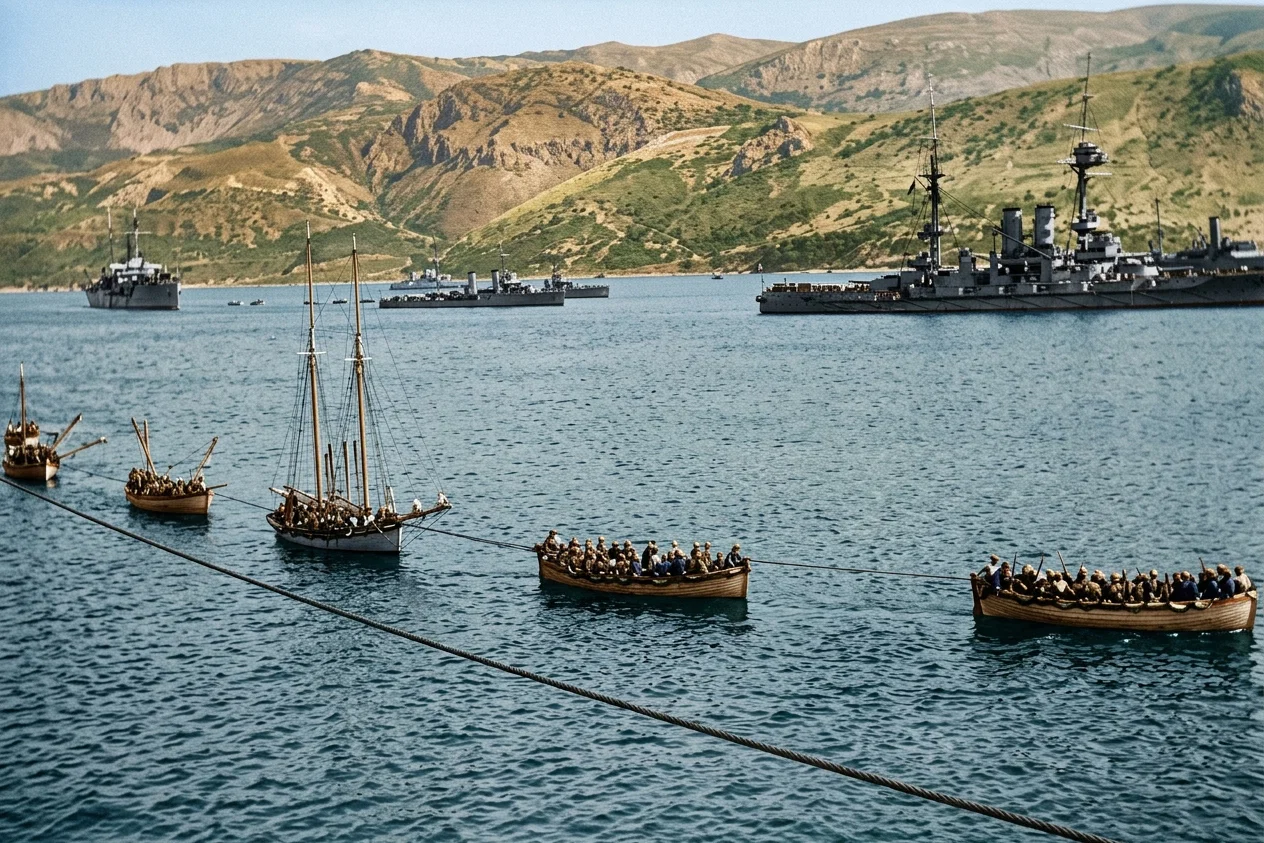
ALLIES LANDING REENFORCEMENTS IN THE DARDANELLES UNDER COVER OF BATTLESHIPS
From this date, the prophet definitely points out the time of Ottoman supremacy. It was to be for “an hour, and a day, and a month, and a year.” This time, computed by the year-for-a-day system, established in prophecy, amounts to 391 years and 15 days. At the termination of this time, prophecy calls for the loss of Turkish independence.
What are the facts in the case? This will be considered in our next article.
The Ointment of Devotion
By George W. Rine
A Monumental Deed—It Stands While Time Endures
By GEORGE W. RINE
WHENEVER we come in touch with the beautiful, we are judged by it. Any day may become, in a very real sense, a judgment day of the soul. We are liable at any time to be called to give an account of our stewardship of life's hidden things. God has many ways of testing us in order to determine what manner of persons we are. And one of those ways is by bringing us into the presence of the spiritually beautiful.
Often very simply and unexpectedly, amid the dust and prosaism of the workaday world, the veil is drawn aside from the monotony and routine of existence, and the pure, the holy, the beautiful things, which are really never absent, are made to appear. Then it is that the dividing line goes forth between them that see and them that see not, between them that gather and appropriate the high and true meaning of life and them that miss it.
It was in the house of Simon the leper at Bethany, when the alabaster box was broken, and its rich, rare perfume filled the room, that such an hour of judgment occurred. All who witnessed that sacrament of simple devotion, then and there, perhaps without realizing it, had to give an account of themselves. By that rare, gracious deed they were judged. It proved some of them to be destitute of spiritual insight — to be of the earth earthy. For the blindness and hardness of their hearts, and for their inability to understand, they were condemned.
WHERE THE HEART SEES AND JUDGES
There are failures to understand on which Heaven looks very leniently. Many of us cannot follow close reasoning. In the intricate subtleties of thought, we soon lose our way. To an untrained mind, logical thinking is rarely possible. But there are powers of appreciation that are not conditioned upon distinctly intellectual acumen. “There is a world where the heart sees and judges.” There is a capacity for comprehension and408appreciation which is born of the affections. In the beautiful realm of faith, of sacrifice, and of brotherly service — there blindness is a crime, and not to understand is a sin. For the best, the deepest, and the most precious meanings of life make their appeal not primarily to the intellect, but to the heart, to the affections.
There are things that only the good and the sincere and the generous can understand — things that can be perceived not by the clever headed, but by the pure hearted. The pure in heart shall see God — see Him in the simple, faithful, unselfish things that life reveals to us. It is when we meet these things that our place and worth in the kingdom of the spiritual are determined for us.
GRACIOUS AND BEAUTIFUL
A gracious and beautiful deed had been wrought that day before the eyes of all in Simon’s house at Bethany. By that deed, they were placed before the judgment bar of spiritual insight, sympathy, and appreciation; and for some of them, the verdict was anything but flattering. For in the words of the story, “there were some that had indignation within themselves, and said, Why was this waste of the ointment made?” “This waste”! How blind to the higher and more enduring utility was the man who asked this sordid question! Ah, “utility” is a larger word than the “man of the world” can ever guess. The things which in the world’s judgment count for nothing, in the kingdom of God count for most. In the higher and truer sense, there is nothing more practical and serviceable than that which men so often flout as empty sentiment.
“This waste of the ointment”! That is the thrift of selfishness, the economy of which a man ought to be ashamed. It is the question of a man who cannot understand the blessedness of giving, who counts all the outpouring of life, all the consecrations of life, as so much waste.
“WHY THIS WASTE?”
“Why this waste?” In the catechism of unbelief and materialism, there is no question more depressing or more ugly than that. Such a question carries with it the implication that the most gracious and lasting thing in all the world — a soul’s unselfish service of love — is vain and futile. No, the ointment was not wasted. It served a high and beautiful end. That incident has found a place in the deathless record of the unselfish service of a soul’s love. It was one of those simple, instinctive gifts of a supreme devotion which help to keep the life of the world tender, warm, spiritual.
“Why this waste of the ointment?” This question is found in the catechism not only of the worldly man, of the materialist, but one of the devil’s queries, it is one of his own lies. That is where Christ put it when He declared, “Verily I say unto you, Wheresoever this gospel shall be preached throughout the whole world, this also that she hath done shall be spoken of.” Shall not that broken vial be remembered forever? Shall not the perfume of that spikenard linger so long as time endures?
No, sympathy is never wasted, love is never lost.
The One Who Cares for You
By I. A. Crane
By I. A. CRANE
ARE you tempted to think yourself too guilty to be the object of the Saviour’s care? Do you feel that you cannot hope for God’s mercy and forgiveness? Know to-day, dear reader, that whoever you are, whatever your sin, however hopeless your case may appear, you need not despair. Jesus came to save the lost. The Shepherd is not seeking the sheep that are in safety. He seeks for the sheep that is lost. Luke 15:4.
Do you feel that you are hopelessly lost? Take courage. You can be saved. You are still the object of the Saviour’s love. Your Shepherd has left the care of all the flock, and seeks for you. He is not a hireling shepherd, who has no care of the flock. He gives His life for the flock. John 10:15.
It is true you are guilty and self-condemned. You have disregarded His word, and sought pleasure in sin. Now the evil days have come, and you find yourself hopelessly entangled. Your mightiest struggles only increase your hopelessness. You are lost—lost! You can never hope to free yourself or find the way. Yet, thank God, you have a Shepherd! He seeks you now.
Think of His love and sacrifice for you. Think of His almighty power. You can know that He will never give up His search for His lost one “till He find it.” He will surely hear your faintest cry.
Will you not to-day surrender all to Him, and let Him save you? Make all heaven rejoice by believing His goodness, and trusting His power to save. Let your heart respond to His call to you. Acknowledge to Him your sins, and tell Him you are willing to give up all and be obedient in all things.
He who cleansed the vile leper can save you from the power of your sins. Can you not believe that He who made the worlds can save you from your sinful habits? Is not He able to keep you from falling? Jude 24. Truly He is able and willing. Trust your helpless, lost soul in His care, and learn the meaning and joy of the words, “The Lord is my Shepherd.”
“There is joy in the presence of the angels of God over one sinner that repenteth.” Luke 15:10.
Hail in Prophecy and in Reality
By J. S. Rouse
By J. S. ROUSE
THE accompanying photograph shows the effect of a great hailstorm that recently passed through a portion of the Missouri Valley. Hailstones fell, during this storm, larger than baseballs. Note the broken siding on the house, caused by the beating of the great hailstones, which lie on the ground in this picture.
When Christ was on earth, He gave some signs of His return. Among the signs given were wars, famines, pestilences, earthquakes, fearful sights and great signs from heaven.
Surely it was a fearful sight to see those large hailstones killing stock, beating buildings to pieces, and destroying the crops. While this storm was raging, history was making which marks the fulfillment of the prophetic Word. We stop, halted in amazement at the rapid fulfillment of prophecy, knowing that we are nearing the time mentioned by the great prophet, when, just prior to the second coming of Christ, hailstones shall fall, every one to be the weight of a talent, or about fifty-eight pounds each. Rev. 16:21. According to this prophecy, this war in the elements will continue to increase.
War among the nations must increase also; for the prophetic Word says every nation under heaven will be gathered to the last great battle, the battle between good and evil. And the battle must also grow hotter and hotter, according to John the revelator; for he saw Satan come down with great wrath, knowing that he had but a short time. And because Satan has come down in great wrath, “woe unto the inhabitants of the earth!”
While this terrible condition exists, the children of God can have peace in their hearts, the peace of Christ Jesus; for He said He left it here for us. John 14:27. This peace will be a protection to all who turn to the Lord, and they shall be delivered, every one whose name is found written in the book.
Do You Know This?
By David Paulson
An inspired writer said, “We know that we have passed from death unto life [are genuinely converted], because we love the brethren.” 1 John 3:14.
Of course that does not mean loving folks that we naturally like. Any heathen can do that. It is loving some folks that we must ask the Lord to help us to love.
Have you had any experience in that direction? If not, how do you know whether you are really converted or not?
Furthermore, “By this shall all men know that ye are My disciples, if ye have love one to another.” John 13:35. That is the most convincing evidence that the Lord can give your unconverted friends. And remember, that does not mean merely loving folks for whom we have a “natural affinity,” but it is loving people that it takes a divine miracle to enable us to love.
Again, have you had any experience of that kind? If not, you have not yet had all that is coming to you in your Christian life.
DAVID PAULSON.
Christ Became What We Are
“CHRIST, on account of His immense love, became what we are, that He might make us what He is.”