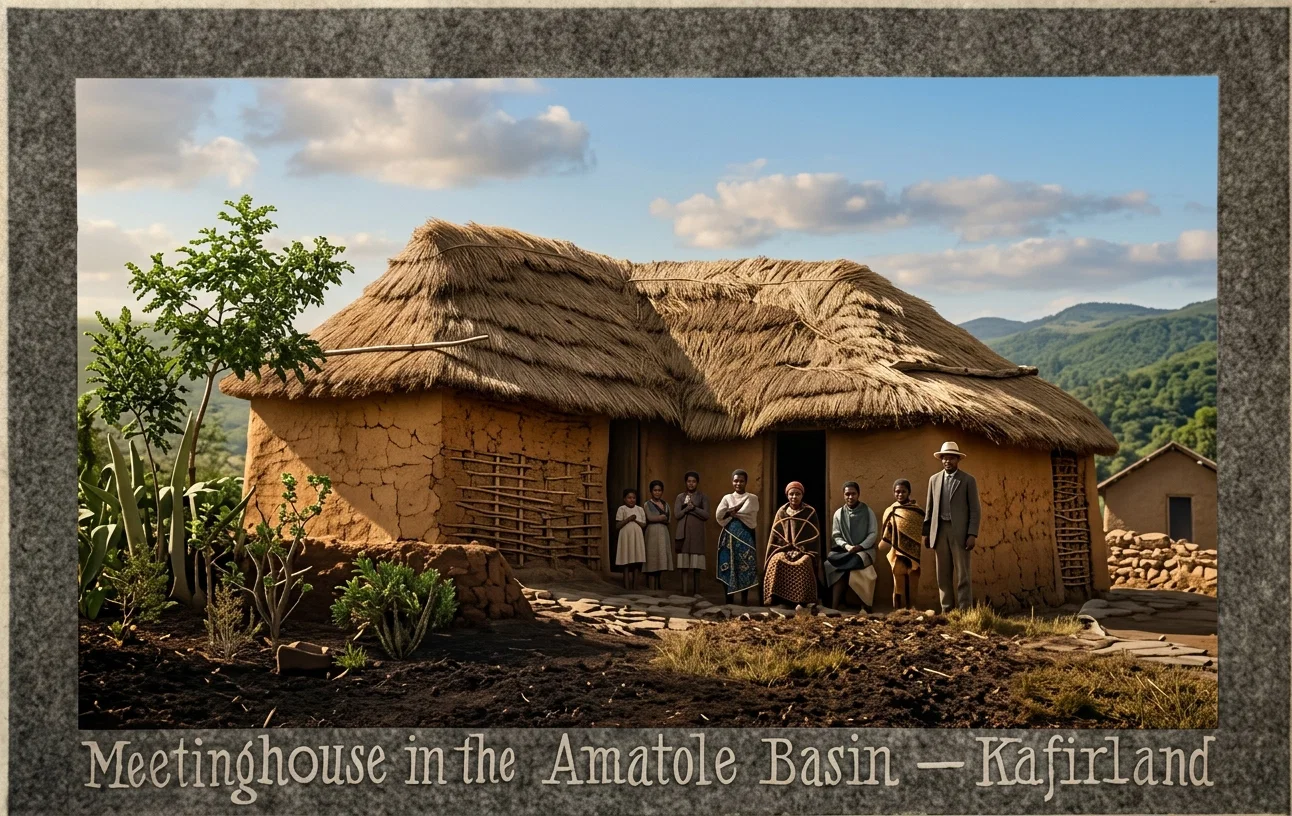
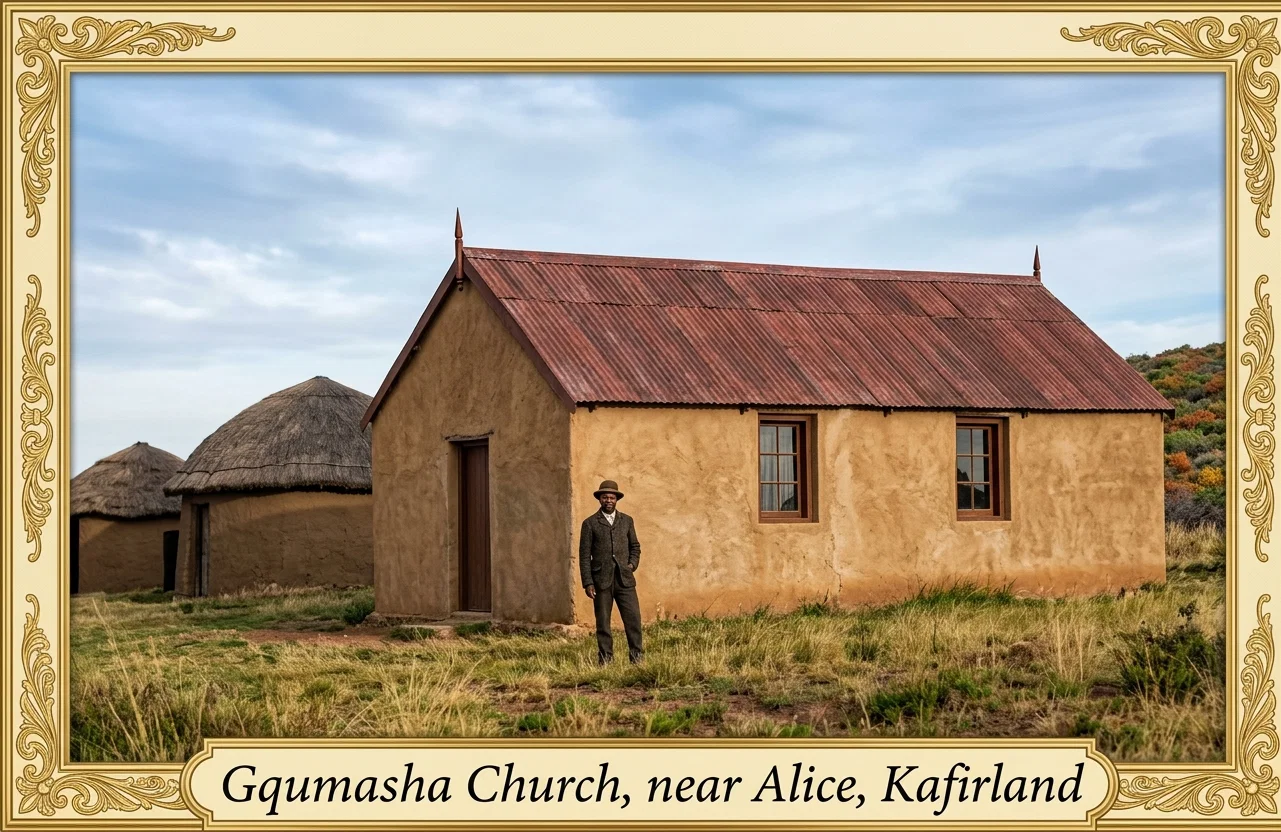
There is an interesting work carried on by our society in the heart of Kafirland, in the region of the Amatole Mountains. Here the villages are numerous and populous. “We have seen the Spirit of God working in the hearts of these Kafirs,” spoke Missionary Smailes in our conference the other day. “We have seen old men get up as we were singing a hymn of invitation, and give their hearts to God.” “And when they give their hearts to God,” he added, “the beer and the tobacco, and all the other evil things, go out of the life.”
COULD SEE THE POINT
Meeting-house in the Amatole Basin — Kaffirland
Gqumahasha Church, near Alice, Kafirland
Many of these Kafirs think very clearly into propositions. “What is this about the pipes, Fundis?” asked a newly awakened soul of the missionary. The new convert was a heavy smoker, and had only just learned that tobacco was ruled out in our society.
“It means that the tobacco and the pipes go out, along with the drink, when this truth comes in,” said Brother Smailes. “But there is nothing in the Bible about tobacco smoking,” said the man. “There is the church over there,” said the missionary, pointing to the newly erected place of worship, just dedicated to God. “Would you smoke in the church?” “No,” said the man. “Why not?” “It is God’s house.” “Who built it?” “Why, men built it; but it was built as a house of God.” “Who built this house?” asked the missionary, pointing to the body. “God built it,” said the man, a new light dawning upon him. “Yes,” said the missionary; “these bodies of ours are not our own. They are built to be temples for the indwelling of the Spirit of God. If you would not smoke in the house of God built by men, how can you call it right to smoke this harmful thing in this body where the Lord wishes to dwell by His Spirit?” “Fundis,” he said, “you make it plain. The pipes will have to go. Nothing in the world shall stand in the way of God’s truth.”
HEALED THROUGH PRAYER
There was a general meeting called at the Qumahashe church, near the town of Alice. A new convert, Picoli, a man well on toward sixty, walked forty miles to get to that quarterly meeting. He had but recently found Christ amidst the darkness of heathenism. But after the long walk, he came down with fever, his temperature mounting high. Deathly sick, his disappointment too was keen over his inability to attend the meetings.
The brethren met in the little hut where the sick man lay, and prayed over him. “He got right up from the sick bed,” said Missionary Smailes, “and half an hour later, was in the meetings for which his heart had longed. Next morning, when I was riding twenty-five miles from Alice, I overtook the old man striding along on his return to the Fish River, happy in the Lord.”
FROM RAW HEATHENISM
It is not so uncommon an incident, one may say. True; but it is good to see these souls coming out of raw heathenism into the joys and realities of the life of simple faith and trust.
The good Shepherd is certainly searching out His lost sheep in Kafirland. From yet farther into the country, calls are coming for mission stations to be opened. W. A. S.
THE MOTHER OF ALL APOSTASIES
By R. C. P.
The Mystic Power That Has Worked Through All Ages
A Mighty Struggle with Her in the Last Days
IN Rev. 14: 8, an apostate movement is revealed in the following statement: “Babylon is fallen, is fallen, that great city, because she made all nations drink of the wine of the wrath of her fornication.”
The chronology of this special apostasy locates it following the announcement of the Judgment message. Verses 6, 7. This announcement is a prelude to that of verses 9-14, announcing the last message before the second coming of Christ. It is therefore a last-day movement.
The primary significance of the word “Babylon” is, “Gateway to heaven.” Young, in his unabridged concordance, defines410the word “Babel,” “confusion, gate of Bel. . . . Perhaps when Nimrod founded the city, he gave it the name of Babil, ‘gate of Il,’ or ‘gate of God.’ After the confusion of tongues, the name was connected by the Hebrews with the root balal, to confound.”
Thus through their apostasy, even the city they founded as the “gateway to heaven,” the “gate of God,” became confusion through the mingling of error with truth. This was illustrated by the pure speech of the people being confused at the time their languages were confounded, on account of their apostasy, when they in unbelief attempted to build the Tower of Babel.
The ancient city of Babylon, which for many centuries was the center from which radiated the false doctrines of the pagan system of worship, is here made the symbol of this last-day apostasy.
SYMBOL OF SATANIC POWER
The dragon of the twelfth chapter of Revelation represents satanic power as manifested through empires dominated by paganism. Satan is the king of the Babylonian system. Isa. 14: 4-14. In Rev. 14: 8, it is plainly stated that the Babylonian religious system has ever dominated all nations. “She made all nations drink of the wine of the wrath of her fornication.”
This scripture clearly shows that the Babylonian religious system controls by force instead of conviction. From the city of Babylon the first earthly kingdom developed. See Gen. 10: 10, margin. As the apostasy here symbolized by the city of Babylon does its work through nations by influencing them to enforce its false creed, this message of Rev. 14: 8 is designed as a special message of warning against enforced religion, or a union of church and state.
ORIGIN OF THE BABYLONIAN SYSTEM
After the fall of man, God improved the earliest opportunity to present the pure gospel of faith in Christ through the symbol of sacrificial offerings as the sinner’s only hope. Satan, the king of the Babylonian system, at once perverted this great truth, and led Cain to offer the fruit of the ground as a gift of penance to appease the wrath of an offended God.
This was the beginning of the Babylonian system of salvation by works. The system of penances first introduced in Cain’s offering was an apostasy from the gospel of salvation by faith, which was prefigured by the offering of animals upon whose heads man confessed his sins, and they were then slain by his own hand as his substitute, bearing his death penalty. These sacrificial offerings prefigured Christ, as the Lamb of God, in love bearing and removing the sins of the world.
In the offerings of Cain and Abel are represented the two religious systems. In Cain’s worship there were manifested three distinct lines of apostasy,—first, apostasy from the truth of salvation by faith; second, a religion of works adopted as a creed; third, the creed supported by force, resulting in persecution with the death penalty as the ultimatum to offenders.
From the very beginning of the career of the Babylonian system as it emanated from Satan, its king, and operated through individuals and confederacies, before the origin of nations, God ever manifested His opposition to its creed. “The Lord had respect unto Abel and to his offering: but unto Cain and to his offering He had not respect.” Gen. 4: 4, 5. The conflict between these two religious systems is clearly traceable from the days of Cain and Abel to the development of the Babylonian empire.
THREE DIVISIONS OF BABYLON
In Rev. 16: 19, Babylon, as represented by the symbolic city of old, is said to be divided into three parts: “And the great city was divided into three parts, and the cities of the nations fell: and great Babylon came in remembrance before God, to give unto her the cup of the wine of the fierceness of His wrath.” This same Babylonian system that has dominated all past nations, and still dominates them, and will do so to the close of time, is responsible for all the religious persecution that has ever cursed the world. “And in her was found the blood of prophets, and of saints, and of all that were slain upon the earth.” Rev. 18: 24.
As previously shown, the Babylonian system is a religion of works. It is an apostasy from the Christian system of faith. It is a religion of force, which is an apostasy from the religion of love. What three divisions of the great system of religion by force have presented themselves before the world as dominating all nations?—They are paganism, the papacy, and apostate Protestantism. These three divisions of the Babylonian system cover the history of nations. They are all developed by apostasy from the true faith. The Lord holds this Babylonian system of enforced religion responsible for the blood of all martyrs slain upon the earth since the fall of man.
THE PAGAN DIVISION
As already shown, when the city of Babylon was founded, she was claimed to be “the gateway to heaven,” or “gate of God.” Her later creed, founded upon an apostasy that emanated from the city of Babylon and other cities throughout the world, formed the great Babylonian apostasy of pagan times.
There were several distinct lines of apostasy in the pagan division of the Babylonian system:
First, an apostasy from the true God to the worship of many false deities.
Second, an apostasy from the true Sabbath, which was a weekly reminder of the true God, to the pagan sun holiday.
Third, an apostasy from faith to a formal creed.
Fourth, an apostasy from a religion of love to religion by force.
Fifth, an apostasy from the true view of the kingdom of Christ; resulting in the enforcement of a creed, and Christ’s crucifixion.
APOSTASY FROM THE TRUE GOD
The history of the Babylonian kingdom abounds with records of apostasies from the true God to the worship of false deities. As Cain’s religious creed was an apostasy from the true faith in his day, so the pagan division of the Babylonian system was an apostasy from the true faith in the days of the Babylonian kingdom.
God ever sought to restore the people of the Babylonian empire to the true faith. He was so insistent in His efforts to recover that empire from apostasy that He sent King Nebuchadnezzar out into the fields for seven years to eat grass as an ox, until his hair had grown as eagles’ feathers, and his nails as birds’ claws. His object in doing this is stated thus: “And they shall drive thee from men, and thy dwelling shall be with the beasts of the field: they shall make thee to eat grass as oxen, and seven times shall pass over thee, until thou know that the Most High ruleth in the kingdom of men, and giveth it to whomsoever He will.” Dan. 4: 32. Nebuchadnezzar accepted the correction, and returned to the true worship of God. Dan. 4: 34-37. But there came a reaction under the reign of later kings, and the Babylonian empire died apostate. Dan. 5: 17-30.
The same apostasy is prominently seen in Egypt. God at length arose in His majesty, and sent Moses and Aaron under a divine commission from His throne to say to Pharaoh and his kingdom, “Let My people go, that they may serve Me.” Ex. 8: 1. As shown in Exodus, chapters 8-15, through most powerful manifestations of His displeasure against Egypt for her oppression of His people and His opposition to the false gods of the Babylonian system under the pagan division, He made Himself known as the true God, and branded all false divinities as weak and worthless usurpers.
The same apostasy is traceable through Medo-Persia, Grecia, and Rome pagan. Polytheism was the prevailing custom of all the nations influenced by the pagan religious system.
R. C. P.
Eyes of Faith
“It is necessary to have the eyes of faith to see through the windows of heaven.”
Christ, the Light of the World
“CHRIST is the Light of the world. His people are reflectors.”
WORD SECRETS
By J. O. C.
HENRY DRUMMOND offered a suggestion concerning words that is worthy of study. He said that a man's whole life can be unlocked if the words he uses are closely watched. If this be true, the cultivation of choice words is of great importance.
Viewing the subject from Mr. Drummond's statement, one is reminded that the associations of men have much to do with the form of words they use in regular conversation.
THE USE OF THE WORD “FATHER”
As an illustration of this line of thought, the word “father” was scarcely ever used by the ancient house of Israel except with reference to an earthly ancestor. The term did not carry, with them, the weight of loving attachment which should have bound them closely together, but simply indicated pedigree, and their pride of ancestry. With scarcely more than a single exception, no one thought of using the word to express relationship with the heavenly Author of their being. In consequence, every reference to the Creator was made the occasion of fear and trembling, and the voice of His words from Sinai brought forth the united demand that God cease speaking to them, lest they die. They could bear any statement from their earthly leader, Moses, because their knowledge of humanity far exceeded their understanding of Him who had their best interest most deeply at heart. Ex. 20: 19.
Even though, at the same interview, the people were asked to make a sanctuary for God, that He might dwell among them (Ex. 25: 8), yet their experience in Egyptian bondage had caused them to regard Jehovah more as a taskmaster than as a Father who had loved and was yet loving them with an everlasting affection. Jer. 31: 3. Thus their words were the true reflection of their life history, and also clearly indicated the faithless attitude they maintained toward the future.
Later in the history of that people, one came upon the stage of activity who had a wider view of God's relation to humanity. Elijah was trained under the direct supervision of Heaven's power, and thus learned something of divine gentleness and paternal promptness. When he vindicated the authority of Jehovah before the host of Baal worshipers, although he manifested much human weakness in doing so, God quickly responded to his petition for a heavenly manifestation. 1 Kings 18: 24-38. But when this same prophet became derelict in duty, heavenly reproof was gently administered at Mount Horeb. 1 Kings 19: 9-18. In all this, he learned that God was more than a severe judge of human action — he found Him to be a loving Father. So when his earth work was done, and horses and chariot of fire appeared to convey him above, he was enabled to cry, “My Father, my Father, the chariot of Israel, and the horsemen thereof.” 2 Kings 2: 12.
“I GO TO MY FATHER”
Like the Son of God, the prophet foreknew that he was going to the Father. Doubtless this knowledge was the cord that bound the prophet to his work under the varying circumstances in which it came to him. But there is another thought in this connection which naturally comes forward, and that is that the prophet, in being thus taken “to the Father,” was a forceful type of the Saviour's declaration, “I go unto My Father.” John 14: 12.
The term “my Father” expresses one of the grandest sentiments language affords, because it embodies love and childlike trust that no other two words can convey with a single exception. Christ made it the center of His life work, and the password of His approach to the throne of the universe. He made it also the rallying cry of unity for those who would be members of God's household. He had come from the Father, and constantly anticipated the time when He would return to the Father, and in the end connect His followers with the perpetual life right which He had purchased for them.
“OUR FATHER”
With this end in view, His early instruction to believers when approaching God was to say, “Our Father”—that is, Christ's Father and mine. Thou didst love Him “before the foundation of the world,” and Thou didst also love me enough to give that beloved Son to redeem me. Now that He has gone to Thee to prepare a place for me, that I may be with Him where He is (John 17: 24), I am His, and He is mine. Thou art our Father.
Then, as the expression on the lips of the Saviour became more touchingly tender as the close of His earthly ministry drew near, reminding one of a wistful eagerness to reach the home of His ardent love, so as life draws near its close with those who have daily gone “to the Father” in daily preparation for the final face-to-face meeting, He will become the one more loving, tender Parent, drawing the soul upward toward Him in deep yearning for the concluding event, where one will be satisfied with long life in the presence of eternal glory.
Those precious words will thus become a deep-scented fragrance of heavenly knowledge in every place as the expression of the Spirit's mysterious indwelling and control of human effort. 2 Cor. 2: 14, 15. J. O. C.
GOD’S WORD LIVING AND POWERFUL
By M. C. W.
THAT Word has power to change the heart. The wonderful gospel of nature is revealed to us in the first six verses of the nineteenth psalm. The very manifestation of God’s power in His wonderful works should teach man to reverence the Creator. But the higher school of life is revealed from the seventh verse onward, which opens with: “The law of the Lord is perfect, converting the soul: the testimony of the Lord is sure, making wise the simple. The statutes of the Lord are right, rejoicing the heart: the commandment of the Lord is pure, enlightening the eyes. The fear of the Lord is clean, enduring forever: the judgments of the Lord are true and righteous altogether.”
All these expressions refer to one and the same thing, the great law of God; for the soul that will open itself in faith and receive it, we may know that it will work the change which God designed should be wrought by His word.
THE INVITATION TO ALL
That word of God is a word of invitation to all,—not simply to the Jewish people, but to the people without. Therefore we read: “Look unto Me, and be ye saved, all the ends of the earth: for I am God, and there is none else.” Isa. 45: 22. And a little later, the same prophet voices the Spirit of God: “Ho, every one that thirsteth, come ye to the waters, and he that hath no money; come ye, buy, and eat; yea, come, buy wine and milk without money and without price.” “Seek ye the Lord while He may be found, call ye upon Him while He is near: let the wicked forsake his way, and the unrighteous man his thoughts: and let him return unto the Lord, and He will have mercy upon him; and to our God, for He will abundantly pardon.” Isa. 55: 1, 6, 7.
The called-out ones who receive this word will themselves become a revealing church; that is, that which has molded and changed their own life they will reveal to others. But one scripture upon this — many might be given: “Give thanks unto the Lord, call upon His name, make known His deeds among the people.” “Declare His glory among the heathen; His marvelous works among all nations. For great is the Lord, and greatly to be praised: He also is to be feared above all gods. For all the gods of the people are idols: but the Lord made the heavens. Glory and honor are in His presence; strength and gladness are in His place. Give unto the Lord, ye kindreds of the people, give unto the Lord glory and strength. . . . Worship the Lord in the beauty of holiness. Fear before Him, all the earth.” 1 Chron. 16: 8, 24-30.
POWER TO CHANGE AND TO KEEP
That Word which has power to change, to convert, to translate from a kingdom of sin to a kingdom of righteousness, has also power to keep. This is the experience of one who had passed through the transmutation: “Concerning the works412of men, by the word of Thy lips I have kept me from the paths of the destroyer.” Ps. 17: 4. It not only keeps, but it warns as well. Thus another scripture reads: “Thy word have I hid in mine heart, that I might not sin against Thee.” Ps. 119: 11.
And this Word rises above all human expression to the contrary. Great men may arise who will oppose it. False prophets may multiply who will have contrary teaching. Thus are they contrasted by the prophet of God: “The prophet that hath a dream, let him tell a dream; and he that hath My word, let him speak My word faithfully. What is the chaff to the wheat? saith the Lord. Is not My word like as a fire? saith the Lord; and like a hammer that breaketh the rock in pieces?” Jer. 23: 28, 29.
THE COMING CHRIST AND HIS CHURCH
That Word revealed the coming Christ. Of this we have had evidence. It reveals that coming not simply in His glory, but in His humiliation. See Isa. 52: 13 to the close of chapter 53: “His visage was so marred more than any man, and His form more than the sons of men.” He was wounded for our transgressions, bruised for our iniquities; bears our griefs, and carries our sorrows.
The same prophet also speaks of the result of the humiliations of Christ, and the message which His followers would bear: “How beautiful upon the mountains are the feet of him that bringeth good tidings, that publisheth peace; that bringeth good tidings of good, that publisheth salvation; that saith unto Zion, Thy God reigneth!” Isa. 52: 7. And again: “Comfort ye, comfort ye My people, saith your God.” “O thou that tellest good tidings to Zion, get thee up on a high mountain; O thou that tellest good tidings to Jerusalem, lift up thy voice with strength; lift it up, be not afraid; say unto the cities of Judah, Behold your God!” Isa. 40: 1, 9.
That word of God received begets within love and devotion to the Word. Said Jeremiah: “Thy words were found, and I did eat them; and Thy words were unto me a joy and the rejoicing of my heart.” The old Idumean patriarch Job esteemed the words of God’s mouth more than his daily food. And Daniel, the beloved of God, who was doubtless the author of the one hundred and nineteenth psalm, says, “O how love I Thy law! It is my meditation all the day.” M. C. W.
Question Corner
By Milton C. Wilcox
Conducted by Milton C. Wilcox, Mountain View, California
NOTE.—This department is for the purpose of helping Bible students. Answers must of necessity be brief, often only suggestive, never exhaustive, never infallible, only as they agree with the infallible Word. Such questions only will be answered as seem to the editors to minister to the mission of the paper. Questions of the same import cannot be answered repeatedly in the same volume. Name and address must be given, not for publication, but as evidence of good faith and to insure reply by letter if thought best. It is well always to inclose stamp, not stamped envelope, unless answer is desired by letter alone.
The first of these verses declares that Cain went out from the presence of Jehovah, and dwelt in the land of Nod, on the east of Eden. Doubtless the center of God’s worship was in Eden, and doubtless there was manifest the Shekinah, or glory of God. From that presence Cain went away into the land of Nod, or wandering—for that is the meaning of the word “Nod.” And he became a wanderer there. Finally he built a city. This must have been many years after. By this time, Adam’s wife had borne him other children, and these doubtless had borne still other children; and from among these, Cain obtained a wife, and to this wife were born children. It is true, as our correspondent says, that when a man leaves the face of the Lord, or the presence of the Lord, he will do that which is wrong. He cuts himself off from the power that would save and hold him.
146 — How Many Beasts Went into the Ark?
Gen. 7: 2 and 7: 8, 9 seem contradictory. A friend says that God commanded Noah to take the clean beasts by sevens, and then in the other verse it reads as though he took them by twos, saying, “As God commanded.” E. C.
There is no contradiction. “Sevens”—not one seven, but two sevens; and two sevens are fourteen. Therefore the Lord took them by twos. There were just seven pairs, and they went in two and two, male and female, as God commanded Noah. But of the unclean beasts there were only two of each kind. The Hebrew language has three numbers—the singular, the dual, and the plural. Whenever the dual is expressed, the simple plural is used. Whenever the plural is expressed, there is some modifying word attached. So the term “sevens” means two times that amount, or fourteen.
147 — Satan Cast Out of Heaven
Was Satan cast out of heaven before the earth was created and inhabited by man, or after? F. R. B.
The book “Patriarchs and Prophets,” in its first chapter, will give more light upon this question than we are able to give in the brief answer to the question in the SIGNS. We would like to suggest that our querist read that book.
It seems clear to us that what Job calls the laying of the foundation of the earth was before Satan was cast out. God asks Job: “Where wast thou when I laid the foundations of the earth? declare, if thou hast understanding. . . . When the morning stars sang together, and all the sons of God shouted for joy?” Just what stage “the foundations of the earth” implies, we do not know. It may have been the first presentation of God’s plan in the making of the earth.
The morning stars were two in number at that time,—Lucifer, the day-star, or son of the morning (Isa. 14: 12); and Michael, the Son of God, the bright and morning Star (Rev. 22: 16). There was harmony in God’s universe then, and the morning stars sang together at that time, and all the sons of God shouted for joy. None of the angels had then fallen. Just how soon after that the fall took place, we do not know. There are two events of that kind mentioned. The first is in 2 Peter 2: 4, Jude 6, and Rev. 12: 4. This was the first casting down from the heaven where God dwelt. Yet in a certain sense Satan had access to the heaven where the assemblies of God met from that time on until Jesus died upon the cross.
Immediately after the casting out of Satan and his angels we would naturally believe Satan came to this earth, tempted man, and man fell. Then began the warfare mentioned in Revelation 12—war in heaven, war in the spiritual realms, between the wicked spirits in high places, to which Paul refers, and the angels of God. Eph. 6: 12. On the one side were the Son of God and His angels; on the other side, the fallen Lucifer and his angels. And that struggle went on between those great spiritual forces over man until the devil had placed our Lord upon the cross and in the tomb; but His character had not been affected. He was still the Lord of life because He went down the road of righteousness. He was raised from the dead, and then that song was heard in heaven: “Now is come salvation, and strength, and the kingdom of our God, and the power of His Christ: for the accuser of our brethren is cast down, which accused them before our God day and night.”
From the time that man fell until our Lord Himself conquered the devil, Satan had accused God. This is clearly set forth in Job, chapters 1 and 2, and in Zechariah 3, and also in Jude 9.
In some way, Satan had access to the great assemblies held in heaven when the representatives of the different worlds, called “sons of God,” came together. And he continued to accuse God of injustice and lack of wisdom, and accuse God’s servants, until the time when our Lord Himself conquered. And then it was said, “The great dragon was cast out, that old serpent, called the devil, and Satan, which deceiveth the whole world; he was cast out into the earth, and his angels were cast out with him.” Rev. 12: 9. Verse 8 declares that at this time, the evil angels prevailed not, neither was their place found any more in heaven. No more could they enter this spiritual conflict with the other angels. Their character was demonstrated beyond question when Christ was put to death upon the cross. From that time on, their warfare was not conducted on the same plane. They were bent on the one purpose of the destruction of humanity.
There is nothing to intimate in any way that Satan was cast down at the Flood. He was upon the earth at the time of the Flood, and the very cataclysm may have threatened his destruction; but his warfare lay in spiritual realms, indicated by the term “heaven,” yet not in the very heaven where God Himself dwells.
148 — Resurrection of Moses
Please tell me where I can find the resurrection of Moses in the Bible. J. P. C.
First of all, we have the statement in Jude, verse 9, of a dispute between Michael the Archangel and the devil. That dispute was about the body of Moses. Michael the Archangel was our Lord and Saviour as an angel from the time sin entered until He became flesh. Michael is the Prince of life. Satan is the one who has power over death. Heb. 2: 14. The only question that they could have about the body of Moses, it would seem evident, is the resurrection of Moses. Jude does not tell us how this dispute ended, but we may know that Michael was triumphant.
In addition to this, we have the transfiguration scene in Matthew 17, Mark 9, and Luke 9. That transfiguration scene, Peter tells us in his second epistle, the first chapter, verses 16-18, was a shewing forth of Christ’s second coming—our Lord Himself in glory, Moses representing the saints who will be raised from the dead at Jesus’ coming, and Elijah representing those who will be translated without seeing death. It was not Moses’ spirit and Elijah’s body that were with Jesus upon the mount, but Moses and Elijah. This, taken in connection with the passage in Jude 9, very clearly shows that Moses was raised from the dead, but not when.
149 — A Day, a Month, and a Year
Please explain Rev. 9: 15, where it mentions an hour, a day, a month, and a year. R. J. A.
We have not time or space to enter into a lengthy examination of this scripture. We refer the student to the book “Daniel and the Revelation” or to “Great Controversy.”