Hearing on the Religious Amendment to the Constitution
By W. A. Colcord
From Our Own Correspondent
Under National Reformers the great Bartholdi Statue of Liberty would be a gigantic falsehood.
Tuesday afternoon, April 12, a hearing was granted the National Reformers before a subcommittee of the House Judiciary Committee of Congress on the proposed religious amendment to the Constitution of the United States. Three speakers were present: Rev. J. S. Martin, general superintendent of the National Reform Association, of Pittsburg; and William Alexander Brown, an attorney, and Dr. T. P. Stephenson, editor of the “Christian Statesman,” of Philadelphia; who occupied something like an hour and a half in setting forth the views, objects, and desires of the National Reform Association. No others besides National Reformers, it seems, were notified of the hearing.
The arguments adduced at the hearing were the usual ones which the National Reformers have been urging for the past forty-five years or more,—that “this is a Christian nation;” and being Christian, that it ought, in its fundamental law, to acknowledge God “as the source of all authority,” and Jesus Christ “as the ruler of nations,” and to enact such laws as are necessary to “perpetuate our national Christianity,” and “protect us against the repeated and increasing assaults being made upon our Christian usages, customs, laws, and institutions.”
They desire such an amendment to the Constitution, they said, because of “the effect, IN THE INTERPRETATION OF LAW, such an amendment as that proposed would have.” Such an amendment, they said, would be “a KEY to the interpretation of law.”
The Sheppard amendment, upon which the hearing was granted, proposes simply the prefixing of the five words, “In the name of God,” to the preamble of the Constitution. “Excellent as Mr. Sheppard’s amendment is,” they said, “it does not go far enough.” They wish such an amendment as will “fully and unmistakably” indicate that “this is a CHRISTIAN nation.”
When asked by Mr. Sheppard what attitude they thought the Jews would take toward such an amendment as they desire, and which they proposed as a substitute to the one proposed in the Sheppard Joint Resolution (H. J. Res. 17), they replied by saying: “We must all keep in mind that this is not a Jewish nation, and that a nation two thirds of whose citizens are Christians or in sympathy with the Christian religion, could not be expected to be governed by the wishes of the Jews, who were in a great minority, if these wishes are adverse to that which is essential to the nation’s life and welfare.”
Other questions were likewise asked as to the probable attitude of the “Universalists, Unitarians, and Seventh-day Adventists.” The report in the “Christian Statesman” for May says that “answers similar to the above” were given, and that these “seemed to satisfy” the inquirers.
In his address, Mr. Brown, the Philadelphia attorney, said: “In offering this proposed amendment, we have in mind no peculiar or sectarian significance of the words of the amendment, and we do not seek the furtherance of any sectarianism or anything that would violate either the letter or the spirit of that portion of the first amendment to the Constitution which states that ‘Congress shall make no law respecting an establishment of religion, or prohibiting the free exercise thereof.’”
Whether there is any “sectarian significance” to this “Christian amendment” proposed by the National Reformers should be sufficiently apparent from the answers given to the questions regarding Jews, Universalists, Unitarians, and Seventh-day Adventists. The views even of Christian sects are not to be considered nor respected if they do not harmonize with those of the majority. And whether the program of the National Reformers is in harmony with either the letter or the spirit of the first amendment to the Constitution may be gathered also from the opening words of the address made by Rev. J. S. Martin. He said: “The National Reform Association which is sponsor for this proposed amendment is an organization of Christian patriots, thousands in number, to maintain and promote in our national life the Bible or Christian principles of civil government, to develop, perfect, and thoroly establish our national Christianity.”
The first amendment forbids anything like an established national religion; but the National Reformers here assert openly, and before a committee in Congress, that they wish Christianity “established” as our NATIONAL religion.
How “patriotic” these National Reformers are may be judged from the fact that they are not only seeking legislation that is in direct violation of both the letter and spirit of the Constitution, but are endeavoring to overturn one of the fundamental principles upon which the national Government is founded, that of religious freedom, and, so far as the Reformed Presbyterians, who constitute a large and controlling influence in the association, are concerned, have pledged themselves NOT TO VOTE until their designs and purposes have been accomplished.
After defining what they mean by “national Christianity,” including everything from the “religious inscription on our coins and public buildings,” to religious instruction in the public schools, laws against blasphemy, perjury, and “Sabbath desecration,” and “especially the decision of the Supreme Court in 1892, ‘This is a Christian nation,’”—the same speaker said: “It is not the purpose of those favoring this amendment to have the nation impose a creed upon its citizens or to proscribe their conduct in such a way as to interfere with their liberties or infringe upon their rights.”
They wish the nation to declare itself “Christian;” to express belief in God and in Jesus Christ; adopt the Scriptures as the standard of law and morality; and to enact laws against infidelity, blasphemy, and Sunday desecration; but they do not mean that it shall “impose a CREED upon its citizens” or “prescribe their conduct” so as to interfere with their rights and liberties!
Mr. Martin further said: “It is not the purpose of those favoring this amendment to unite church and state. . . . It11is their purpose forever and most effectually to prevent such a union.”
They would simply have the state, he declared, “clearly and explicitly recognize, acknowledge, and practise for itself that religion which is confessedly essential to its welfare.” That is what the bishops of the fourth and fifth centuries wished the Roman state to do. And that made the Papacy. This will make the image to the Papacy.
In his concluding remarks Mr. Brown said: “We appear here as the servants of the National Reform Association under binding instructions to present this proposed ‘Christian amendment,’ and no other.”
The “Statesman” reports the chairman of the committee, Representative Moon, of Philadelphia, as saying that no argument was needed in behalf of the proposed amendment, “as he was sure he voiced the sentiment of the entire committee when he said that he had ofttimes wondered why a Christian nation did not have some acknowledgment in its national Constitution.”
The report further says that “few or no objections were made to the Christian amendment, and that little or no exception was taken to the argument made in defense of it.”
The chairman asked one of the speakers if he did not believe that if such an amendment was submitted to the people “it would provoke wide-spread discussion and possibly opposition.” The speaker thought it unquestionably would.
Further hearings upon this matter will probably be held. We have little doubt that this question, so far-reaching in its consequences, will yet be widely agitated.
W. A. COLCORD.
Echoes from the Laymen’s Missionary Congress
Lord Cecil of England spoke of his various observations in the Far East:
“The Chinese accepted the Gospel in sincerity. Persecution came, and culminated in the Boxer uprising, in which thousands of native Christians lost their lives. The blood of the martyrs proved again the seed of the church. That persecution has resulted not in the retarding, but the rapid spread, of the Gospel. In Pekin the street chapels are crowded, people eager for the Gospel. How potent are the effects. Note the opium reform. When I first went to China, you could find the Chinese smoking opium on every boat, and the fields were red with the poppy. Later I traveled from Mukden to Pekin, from Pekin to Hankow, and then to Shanghai, back to Hankow, and on to Chan-Sha, the scene of the recent riots, and then into West China; and I did not see a single trace of the poppy. With such a reform we see that powers that are good are also moving China.”
Dr. Pott, president of St. John’s College, Shanghai, China, made the following pertinent remarks:
“The yellow peril is not that China will awake and go forth to conquer the world. It is not that the empire will become the great competitor with the Western commerce. It is that this new empire shall be a godless China. The danger is that this new civilization shall be wholly materialistic. The formation of a new civilization in the Far East through the fusion of the Oriental and Occidental elements, constitutes a great crisis. It concerns not only China, but the future of the whole world. The missionaries have not only to fight the false religion and devil-worship of heathen lands, but also have to fight the agnosticism and materialism of the West. The inroad of scientific education undermines the old religious systems and the old ethical ideals, and tends to leave China without God.
“China is receptive to new truth. She is forsaking old ideals. China for centuries was like a closed room, using the figure of Sir Robert Hart. The dead air was unstirred by breezes from without. Some seventy years ago the work of prying open the doors and the windows began, but she only yielded from force from without. Now of her own accord, she is swinging wide open the doors and the windows, and welcoming the breezes of Western influence and civilization. The changed attitude is due to no small extent to the work of Christian missionaries. China is awake and making rapid progress.”
A Sweeping Decision
THE state supreme court of North Dakota has just handed down a decision which will be far-reaching in its effect upon those engaged in selling substitutes for beer in the state of North Dakota. The finding of the supreme court in the famous test case which has been taken before it, is that the prohibition law of that state applies not only to whisky and beer, but to any and every substitute for these liquors, whether or not they contain alcohol.
This decision is one of the most sweeping ever handed down by a state supreme court. In many cases the courts have held that liquors containing more than one per cent of alcohol come under the ban of the law; but this decision puts all substitutes in the same class, even tho some of them may not contain any amount of alcohol.—The Issue.
Religion and Money
By Editor
Quite a number of colleges in the United States have been started in the past by various denominations and for the one purpose of educating the young men and women of these several denominations. Recently the Carnegie Foundation was founded for helping small colleges. Since then these denominational colleges have been dropping their denominationalism in order to get a share in the Carnegie fund. The Evening Post of New York declares that this has caused no little concern, and it seems to us that there is reason for concern. For instance, the Wesleyan, Middletown, College makes application as a pensioner to the Carnegie fund; two Presbyterian colleges have “made over their organization and are now on the pension list of the Foundation,” namely, Center College, of Danville, Kentucky, and Coe College in Iowa. Drake University, of Des Moines, “has also broken away and joined the steadily increasing group of pensioners.” We really do not see any reason for keeping alive some of these smaller educational institutions that have drifted so far away from their primal purpose.
An Awful Weapon
Among the last weapons which men are seeking for the destruction of human life, is electrical energy. It is stated in a despatch from Berlin, April 23, that the Krupps, the great gun makers of Germany, have circulated a private and confidential offer to well-known scientific experts for an invention which shall project electrical energy to such a distance as to explode balloons and magazines in warships. Some think that this will be the next development of warfare. Should such a thing succeed, it would mean the destruction, at one stroke, of the world's aerial and marine Dreadnoughts.
Embraced Catholicism.
The Western Watchman is authority for saying that the German Kaiser’s cousin, Prince Frederick Henry of Prussia, eldest son of the late Prince Albrecht, regent of Brunswick, has embraced Catholicism and ceded his entire fortune to the Catholic Church, and entered an Italian monastery as a monk. He is known in that institution simply as “Brother Henry.”
Wellington Coal Mine Explosion Kills 137
An explosion in a Wellington coal mine, at White Haven, near Manchester, England, May 12, resulted in the loss of 137 lives.
BOOK NOTICES
“The Bible and the British Museum.” By Ada R. Habershon, with a preface by Sir Robert Anderson, K.C.B., LL.D. Gospel Publishing House, 54 West Twenty-second Street, New York.
One of the grandest places to find confirmation of the Old Book is in the British Museum. We have wished many times, as we passed through the great institution, with its ancient witnesses called from Babylon, Assyria, Egypt, and other ancient lands, that the public might have some book noting the correspondences between the ancient history and the Bible, and noting the contact of the great historic characters whose deeds were written in stone with the history of the Bible people. This the author has furnished us in this excellent work, in fifteen chapters and eight plate illustrations. Some of these chapters are: “The Roman Gallery,” “The Ephesus Room,” “The Nimroud Central Saloon,” “The Nineveh Gallery,” “The Egyptian Room,” “Babylonian and Assyrian Room,” “How We Got Our Bible,” etc. Nearly 250 Scripture references are cited. We are glad of its publication. It will make a valuable addition to every Bible student’s library.
“The Decay of the Church of Rome.” By Joseph McCabe. Price $1.94. E. P. Dutton and Company, 31 West Twenty-third Street, New York.
The aim of the author is to answer the question, “Is the Church of Rome gaining or losing ground in the wide field of religious controversy?” After acknowledging that many of the most diverse schools of social and religious thought share to a greater or less extent Macaulay’s prophecy of the future and wide-spread success of that religious body, yet the author believes that these beliefs and expectations rest upon frail considerations. He believes that statistics show that “the Church of Rome is rapidly decaying, and only a dramatic change of its whole character can save it from ruin.” He believes that the present population of Rome is less than it ought to be if she had merely retained her followers of eighty years ago and their children; that the church is losing immensely in Protestant countries, especially in England and the United States, while in France the losses have run into the millions. He believes, also, there is a great loss in moral strength and influence. He gives many figures and statistics, often drawn from Catholic authorities, in support of his contention.
Yet we do not share his conclusion. Granting all that he says concerning Rome’s loss of numbers, there has been a far greater loss in orthodox Protestantism, and especially in its Biblical and moral tone. There are great masses who are superstitiously religious yet spiritually lazy. Let there come great times of trial, trouble, calamity, the Protestant churches hesitating, halting, doubtful, divided, the Catholic Church strong, clear (in her way), positive, and the great superstitiously religious people would flock to Rome, the politician would swear eternal fealty, and in the words of the prophet “all the world” would wonder after and worship the great apostate power. The book is valuable in the immense work the author has done in gathering statistics, and the review he has given of Catholic work in various countries.
“Summing It Up.” By Henry Lewis Hubbard. Price 50 cents. J. S. Ogilvie Publishing Company, 57 Rose Street, New York.
This little work, the title-page tells us, is “a treatise on economical, moral, and religious conditions of the present time, showing how they have been evolved through the centuries, with suggestions as to how the mistakes can be rectified, and universal happiness and equality assured.” The author gives a rapid and fairly accurate review of political and social conditions in the world, notes the work of greed and selfishness through all the ages since the Deluge, refers to the noble struggle for liberty and equality in America, and the era of greed and general corruption now controlling political and social life. His remedy is righteousness, equality, justice through evolution. His diagnosis is correct, but his remedy is bound to fall short. It will come only by and through faith in Jesus Christ, and faith in Christ is personal and individual. This little book is one of the many voices calling for that for which multitudes hunger—the peace which Christ only can give, but in whose place they have put humanity and evolution.
“Animal Stories for Little People.” Illustrated. Price 50 cents. Henry Altemus Company, Philadelphia.
This little book, which has about 70 illustrations, gives many characteristics of animals which will be of interest to the little ones. The animals are represented as telling their own stories, and, of course, when the human tells them, they must be told in a human way.
Sketches of the Metropolis of Japan
By F. W. Field
IV. Popular Resorts in Tokyo
An intense love of the beautiful in nature is a marked characteristic of the Japanese people. The full moon on a calm evening draws crowds of admiring beholders. A Japanese will walk miles to see a fine display of flowers in bloom, or of scarlet autumn leaves. Special excursion rates on the railways are arranged when the plum blossoms open in February, the cherry blossoms in April, and when the maple leaves turn scarlet in autumn; and great crowds throng the resorts made famous each by its particular flower or tree.
Asakusa Park, Tokyo
Band Stand, Hibiya Park, Tokyo
So it almost goes without saying that public parks are common in Japan. Every town of any considerable size has its park. But the parks of Tokyo excel all others in size, if not in beauty.
Ueno Park (pronounced Wayno), in the northern part of the city, is said to be the largest park not only in Tokyo, but in all Japan. For the most part the grounds of this park are quite elevated, affording good views of the city. The extensive grounds enclose the Imperial Museum, an art school, a zoological garden, besides various temples and shrines. Tall evergreen trees afford a dense shade. But of all things that it contains, Ueno Park is most famous for its flowering cherry-trees. The blossoms open early in April; and at this time the park is thronged with gaily dressed sightseers.
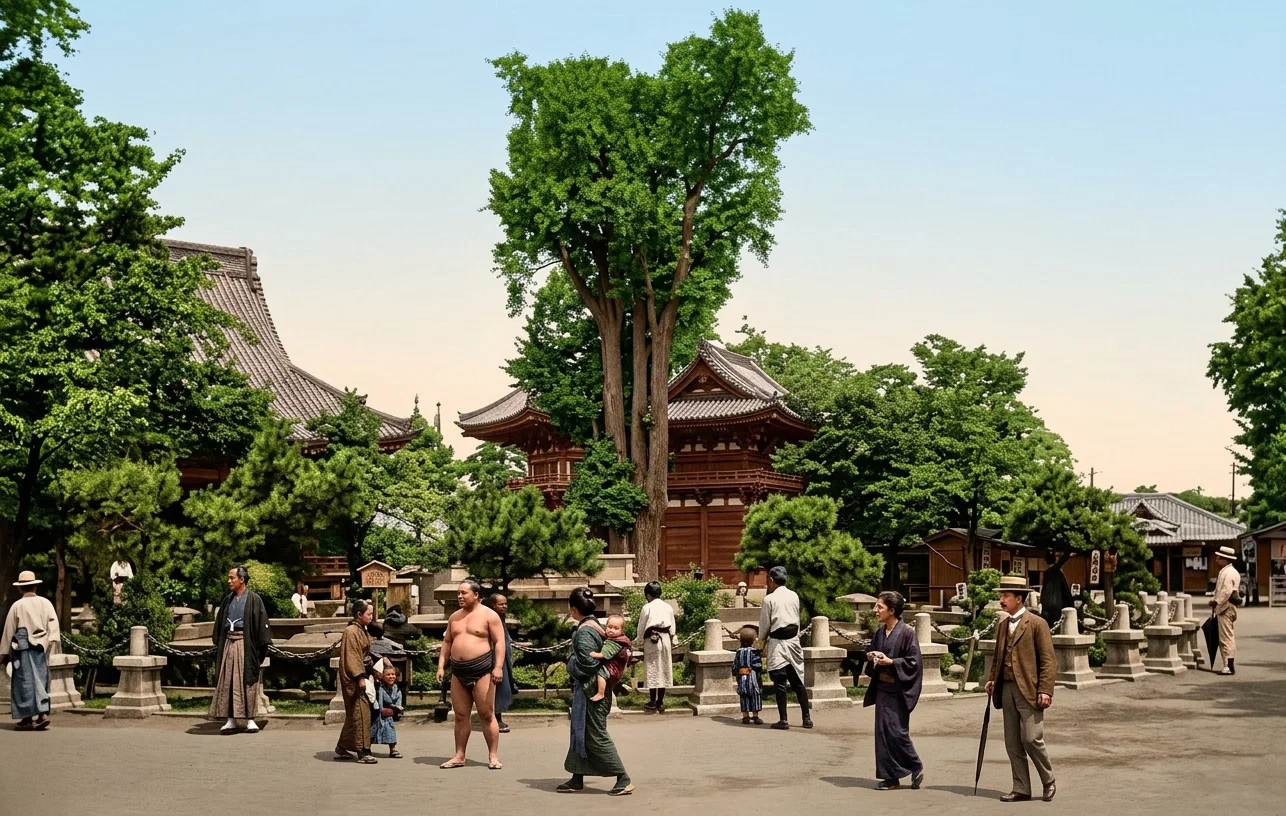
Asakusa Park, farther east, is not so large as Ueno; but the attractions are of such a nature that crowds of people visit it on almost any pleasant day, but especially on Sundays. There is a “Garden of a Thousand Wonders” containing flowers, animals, birds, life-size figures arranged in historic tableaux, with an entertainment of trained birds, moving pictures, or automatic dolls, every half hour. One street in the park is taken up with various cheap shows and play houses. On the whole it is an interesting place to go to see the people, as they worship at the big Buddhist temple, and enjoy the various amusements.
Far to the south is Shiba Park, in the gloomy shade of whose towering evergreens stand the great temples dedicated to certain of the Tokugawa shoguns who are entombed here. The booming of the great temple bell in this park can be heard for miles as it is rung morning and night.
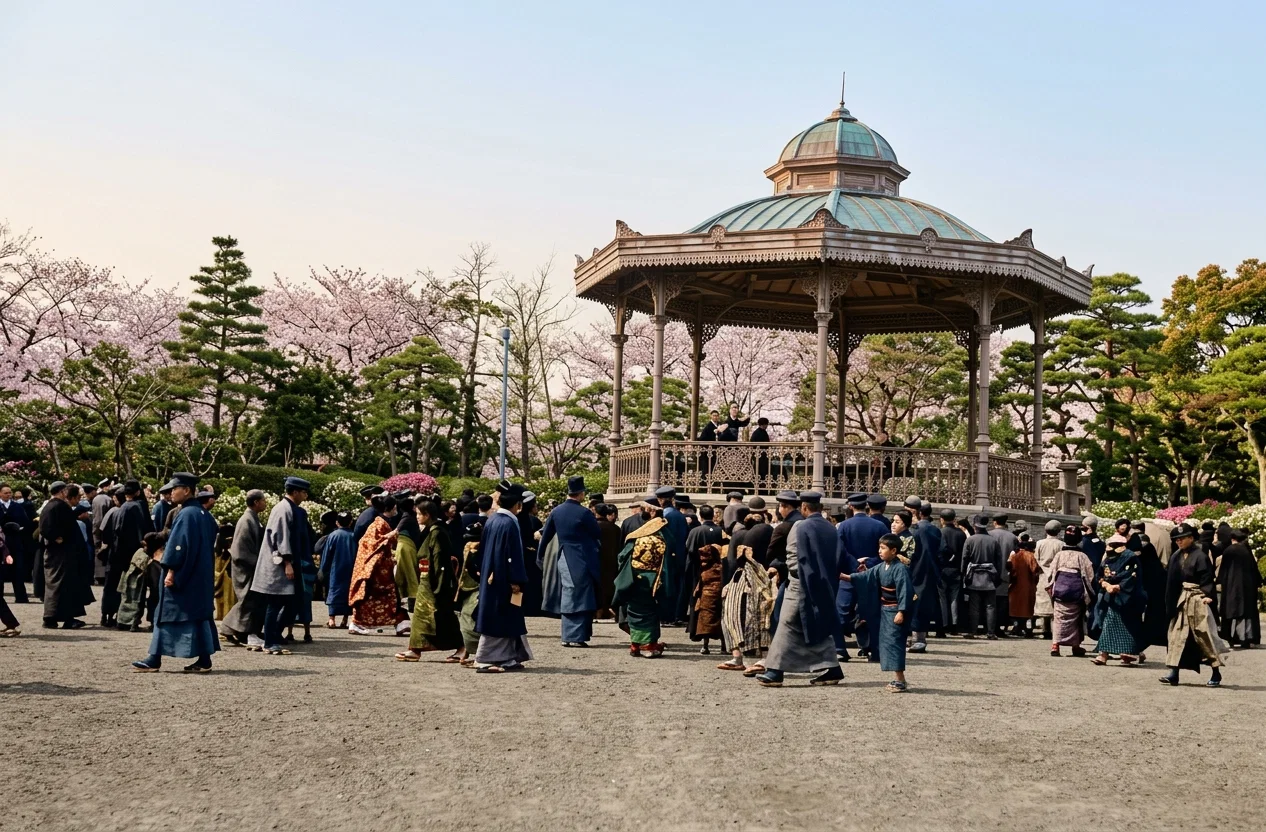
Hibiya Park, fairly near the center of the city, is the newest of all the parks in Tokyo, having been laid out only six or seven years ago. It is also peculiar in that it is laid out according to Western ideas of landscape gardening. It has become one of the most popular resorts in the city, and is a common place for holding all sorts of out-of-door meetings. This park was the scene of the great mass-meeting preceding the riots of September, 1905, when the people expressed their dissatisfaction with the terms of the Portsmouth Treaty. In summer the Yokosuka marine band gives a weekly concert in this park, and renders very creditable music on a good complement of instruments.
The childlike love of beautiful things is one of the most apparent traits of the Japanese character, and must certainly tend to smooth the asperity of life in this world of hardship and trouble. But love of the beautiful in nature is no substitute for the love of moral beauty. In fact, the first is often found in a heart that is sadly distorted by sin. These four great parks and other smaller ones afford the people opportunity for physical relaxation and recreation, where they can take delight in the beauties of flower and shrub and tree. But these do not minister directly to their spiritual needs. So we are planning and laboring to provide a resort, in the form of an attractive church building, to which we can invite the people, that they may have held up before them the moral beauty of the Man of Calvary, and that by beholding they may be changed.
F. W. FIELD.
Tokyo.
In the Land of the Crescent
The latest news from our Turkish superintendent at Constantinople tells us that while other professed Christians are stirred up against our work and doing all in their power to turn the authorities against us, and while the authorities of course are always suspicious, yet the Lord has overruled all things for good. One of our native brethren has been selling with success a little tract on “Who Is Jesus?” written in Arabic and dedicated to Moslems; but the authorities were set on his track and the Ministerial Department notified. The Ministerial Department referred the question to the Minister of the Interior, he to the Minister of Justice, and he to the Director of the Punishing Department; consequently our brother was brought before this last. The Minister of the Police claimed that the International Tract Society represented by our brother was not Christian, and he was told to read the tract. Just then a Moslem teacher who was standing beside him testified that he had read it and found it wholly in harmony with the Bible. This affected favorably the mind of the official, and he assured us that we should not be hindered if he found it was in harmony with the Bible. He read it and decided it to be Christian. Then he wrote a favorable reply to the Minister of the Interior, who in turn wrote the same to the Minister of Police, and at last the command was delivered to the Director of the Police in order to have it generalized and to reach all the police stations of Constantinople. And this is the sum of the commandment: “Tho the nature of the Seventh-day Adventist religion has not yet been verified by the government, the tract entitled ‘Who is Jesus?’ has been investigated and found to be in harmony with the four Gospels; therefore let Dirkran be unmolested in selling it.” Thank God for this. So the lands are opening all over the great world, and the appeal is always to the workers in the home land for men and means.
The Call
By Phillips Brooks
THE while I listened came a Word —
I knew not whence, I could not see;
But when my waiting spirit heard,
I cried: “Lord, here am I; send me!”
For in that Word was all contained —
The Master’s wish, the servant’s joy,
Worth of the prize to be attained,
And sweetness of the time’s employ.
I turned and went — along the way
That Word was food and air and light;
I feasted on it all the day,
And rested on it all the night.
I wondered; but when soon I came
To where the Word complete must be,
I called my wonder by its name —
For lo! the Word I sought was He.
—Phillips Brooks.
A True Story Number Two
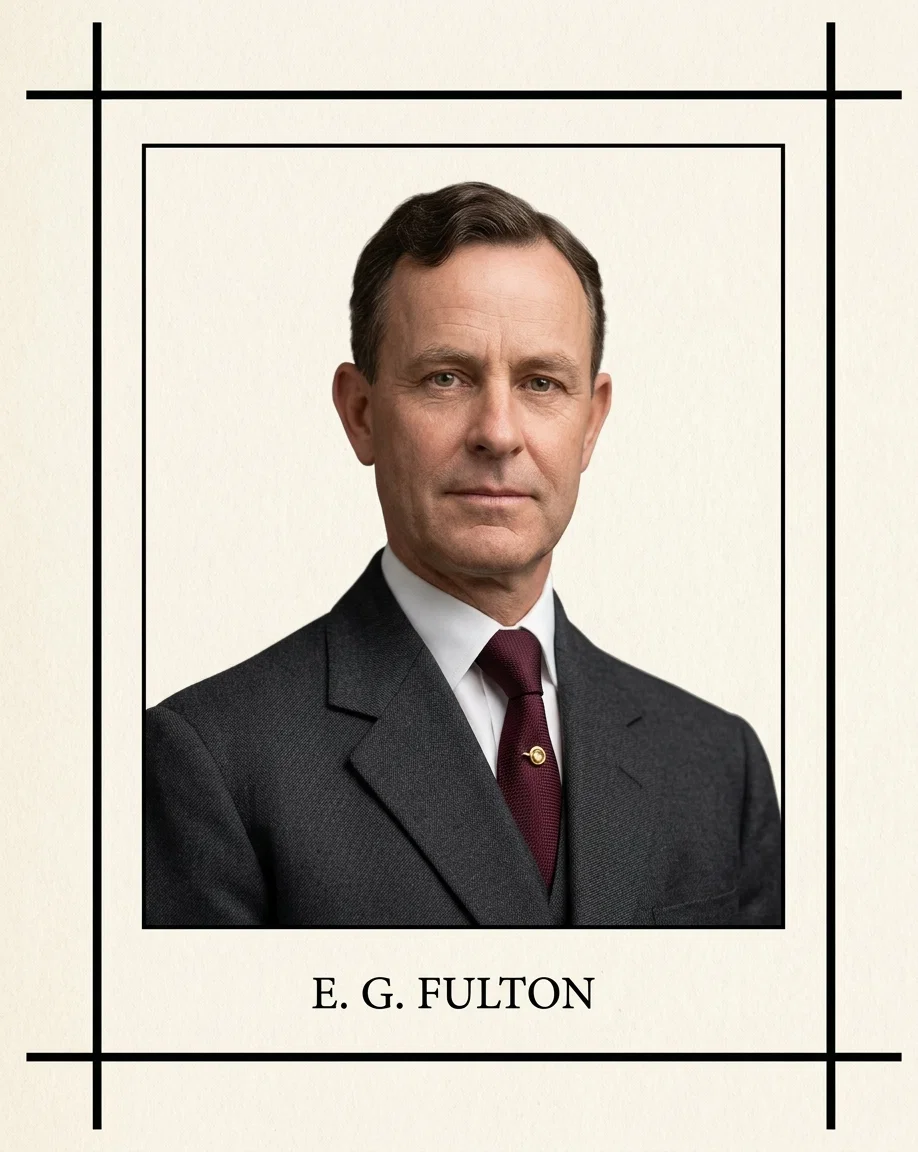
E. G. FULTON
If, as suggested last month, you had started a vegetarian restaurant, and had so pleased your patrons that between 1,500 and 2,000 ate with you daily, and to serve them you employed 57 assistants, and were occupying three buildings;
And you should yield to the pleas of friends and write out descriptions of the dishes that enabled you to build up such a trade;
And after two years’ experience should revise and issue a second edition;
And two years later should rewrite the entire series, adding scores of new recipes, until the whole should make a volume of over 400 pages;
After doing all this, do you think any one would object to a raise in price to $1.00 instead of 75 cents? Of course not; they would say, “25 cents for four years’ constant experimenting and improving is very cheap indeed.”
And they would be right, too; for this is a true story of Mr. E. G. Fulton, manager of the Los Angeles Vegetarian Cafeterias. Every copy of his old edition of “Vegetarian Cook Book” has been sent out, and orders for scores of the new edition at $1.00 are being received. If you had a copy of the old edition, you will want one of the new; for you have learned how practical Mr. Fulton’s recipes and suggestions are. If you did not have a copy, the story of his success should be a sufficient argument to lead you to secure one without delay. Remember the new edition with 420 pages is $1.00 post-paid. Sold by all tract societies and by the publishers, the Pacific Press Publishing Assn., Mountain View, Cal.
Christ Our Advocate
His Ministry in the True Tabernacle
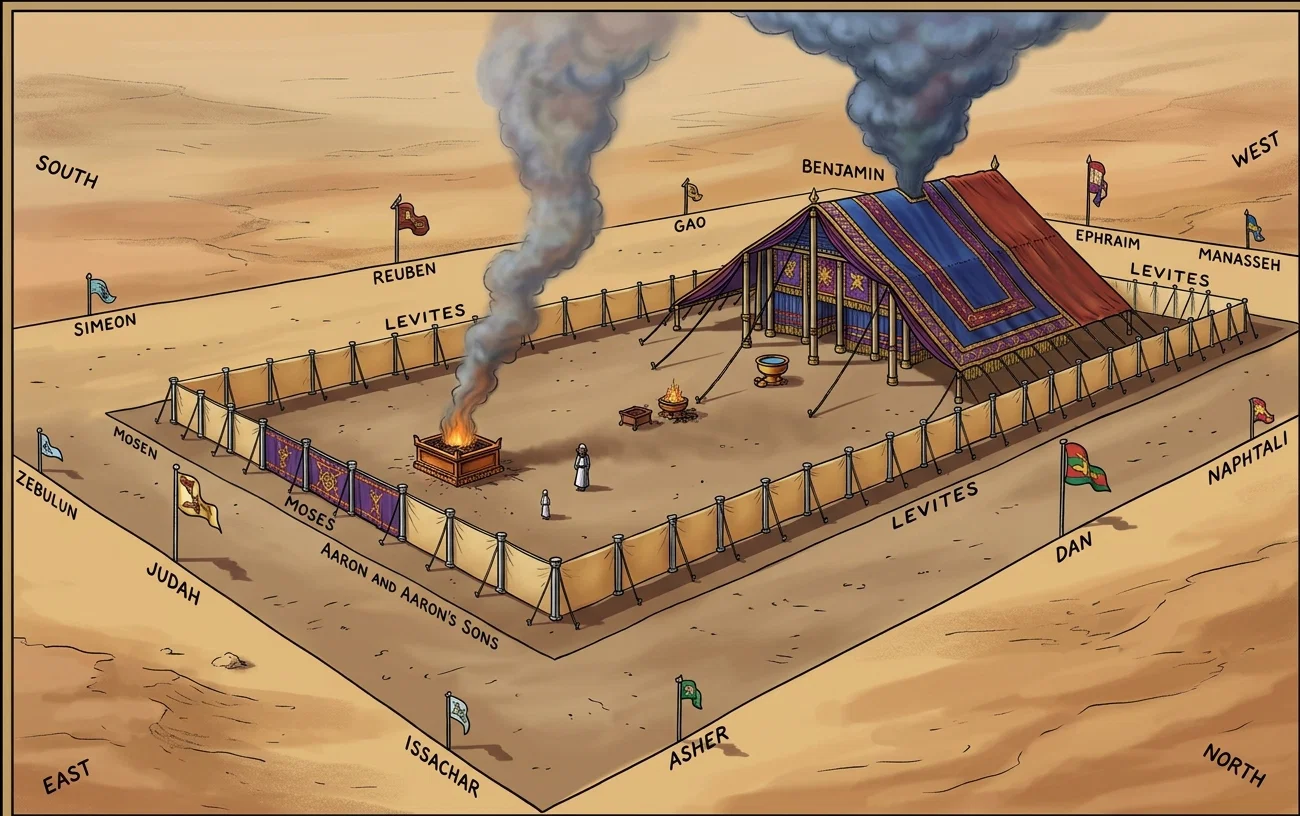
The above is a representation of the shadow, or type, “of the true tabernacle, which the Lord pitched, and not man.” In this “true,” or heavenly tabernacle, Christ, our Advocate, presides. What His work is, and how it concerns us, are the themes of this booklet, by Elder M. H. Brown. Several original illustrations. 112 pages, price 10 cents.
Other Choice Books
In sending for the above-mentioned pamphlet, you may wish to include in your request copies of some of the following:
The Lord’s Day
A study of the Sabbath question in the light of the dispensations. 125 pages, price 10c.
The Sure Word of Prophecy
A verse-by-verse study of the book of Daniel. 96 pages, price 10 cents.
The Saints’ Inheritance
A beautiful study on the home of the saved. 88 pages, price 10 cents.
Matthew Twenty-four
Christ’s answer to the disciples’ question, “What shall be the sign of Thy coming, and of the end of the world?” and the history connected with the fulfilment of this prophecy. 94 pages, price 10 cents.
Christian Science
A consideration of this “science” in the light of reason and revelation. 50 pages, price 10 cents.
The Spirit World and a Future Life
Is there a supernatural power being manifested by certain mediums, or is it all fraud? If it is genuine, what is its source? 96 pages, price 10 cents.
Order through your Tract Society, or
Pacific Press Publishing Association
Mountain View, Cal.
61 N. Park St., Portland, Ore. 1109 E. 12th St., Kansas City, Mo.
Calgary, Alberta
Here and Hereafter, or Man’s Nature and Destiny
By Uriah Smith
By Uriah Smith. This work is a thorough canvass of the great questions of a future existence, and the nature of man in the present life. Every text in the Bible which has any possible bearing upon these points is taken up and carefully explained. Cloth, 357 pp., $1.00. Address this office.
Left with a Trust.
By Nellie Hillis
By Nellie Hillis. Is a story of the struggles of a family to help mother and each other during the absence of father, and pleasantly reveals the brighter side of youth where there is a worthy purpose and a will to be kind and affectionate. 160 pages, illustrated. Cloth, net, 50 cents. Address this office.
Helps to Bible Study
Helps to Bible Study. A series of Bible readings, simple and easy, designed as an aid to the personal study of the Scriptures, and adapted to the use of individuals or families; also a valuable assistant for Bible workers. 125 pages. Paper covers, 25 cents; cloth, net, 50 cents. Address this office.