Your ShelfYour Projects

Signs of the Times, Vol. 37, No. 22.

Question Corner
Earlier text: Hearing on the Religious Amendment to the Constitution

Shiloh: the Man of Sorrows

By Mrs. L. D. Avery-Stuttle

Chapter XIV.—The Voice in the Wilderness

MUST now ask my reader to pass with me over an interval of some eighteen years, to the winter of the year of Rome 779-780. It was the first year of the governorship of Pontius Pilate over Judea, and the thirtieth year of the reign of Herod Antipas over Galilee.
In these eighteen years, the hand of time had wrought many changes. The daughter of Aretas, the emir of Arabia, who was the lawful wife of Herod Antipas, had returned to her father, in humiliation and dishonor; while the infamous Herodias, having abandoned her husband Philip, had taken up her abode, together with her sensual daughter Salome, in the palace of Herod at Tiberias, as his wife.
Tiberias Cæsar, emperor of Rome, and ruler supreme of the civilized world, sat in haughty grandeur in his palace on the banks of the Tiber, and was the despotic arbitrator, through his agents, of all that concerned the temporal being of the seed of Abraham.
The yoke of Rome was growing heavier upon the neck of groaning Israel. The mighty Deliverer whom they had so confidently expected to free them from their hateful bondage, had not come. Zion still languished, her harp upon the willows, while her sons and daughters, unwept and unloved, were ground beneath the heel of the hated Roman.
This to apply to the majority—to the common people. Some there were among those high in authority who catered to their conquerors, who flattered and fawned upon their oppressors, and cringed in servile and feigned humility before them. Such was the bigoted and cruel Annas, who, with the pompous and craven Joseph Caiaphas, occupied the position of high priest, at Jerusalem. But some there were devoted and godly among the people, who prayed night and day for the appearance of the Shiloh of Jacob, and who studied, with Spirit-anointed eyes, the rolls of the prophets which pointed with unerring fingers at the mighty dial of the ages, and indicated the exact time when He who was the Desire of the Nations MUST appear. And now the time was fully ripe; while in heaven and upon earth inspired voices were crying aloud in unmistakable tones: “Up! O Israel, favored of Jehovah, arise and hail thy Redeemer, the Holy One of Jacob,—for the days are fulfilled.”
Over in the wilderness of Judea, on the farther banks of the Jordan, a man had appeared. His dress was that of the ancient prophets; his manner simple and unassuming; his preaching wonderful. No reed shaken by the wind was this man; no coxcomb arrayed in the soft raiment of those who dwell in kings’ houses, was this mighty preacher of righteousness. Priests and rulers might respect the persons of the proud and haughty—not he. Others might cater to the preferences of the lofty Sadducee or the proud Pharisee; this man was alike insensible to the glittering pomp of kings or to the learned logic of the rabbis. Neither praise nor censure affected this master champion of righteousness—than whom a greater was never born of woman. No successful appeal could be made to his love of money or to his fear of the condemnation of society,—he had renounced both.
Kings and princes listened spellbound to the words of the wonderful prophet of the wilderness, whose thrilling message, “Behold, One cometh after me the latchet of whose shoes I am not worthy to unloose,” aroused the wondering nation. Even the haughty Herod Antipas came from his luxurious palace to listen to the mighty voice crying fearlessly from the wilderness, and went home, trembling and rebuked, to his godless paramour.
“Prepare ye, prepare ye the way of the Lord. Make straight in the wilderness a highway for our God!” Scribe and Pharisee and pompous Sadducee were humbled alike with the self-distrustful publican.
Among the multitudes who flocked to listen to the wonderful preacher, let us follow some of the characters with whom we shall become well acquainted before the close of this narrative.
The throng that gathered daily upon the banks of the sinuous Jordan, tho conspicuously cosmopolitan, was made up largely, yet by no means entirely, of the Jewish race. Some who visited the strange prophet, came with a sincere desire to learn the truth, and to gain spiritual wisdom; but many more, out of idle curiosity, to see the remarkable man whose preaching was attracting the attention of kings, to note his manner of dress, and to learn somewhat of his strange life in the wilderness. Some of these—but not all, for human nature is much the same in every age—returned to their homes pricked in heart and humbled in soul by the same almighty Spirit which dominated the mysterious prophet.
Among others from the village of Bethany who journeyed to the camp of the great preacher, might have been seen one morning a man broad of brow and noble in appearance, riding toward Bethabara. His jetty hair fell to his shoulders in waving masses; his large, finely shaped head bespoke the scholar and the gentleman; but there were lines about the mouth, which unmistakably betrayed a weak and sensual character. The man was Simon of Bethany.
Beside him, also seated upon an animal, rode a woman, lovely as a peri. Even Rachel, the far-famed of Padan-aram, could scarcely have been more beautiful. The long, shining braids of hair had been unbound, and fell far below the waist, while the entire head was covered with a wimple. The great dark eyes, shaded by long, curling lashes, were turned timidly toward the ground; but ever, as she cast brief glances at the man by her side, they were filled by the light of a love pure and holy.
The large flowing sleeves were caught up at the shoulders, which were covered by a crimson mantle, while about the waist was a girdle of fine needlework. It was Mary Magdalene.
Just in advance, and riding also more slowly than the many travelers bent upon the same errand, were two others whose acquaintance we wish to make,—a man broad of shoulder, strong of limb, not more than thirty years of age, and a woman somewhat older, with a distinctively Jewish countenance. Their dress was that worn by the better class, tho it was far from rich or ostentatious. Kindness, generosity, goodness, were written in unmistakable characters upon the face of the man, while the soft, musical tones of the young woman bespoke a gentle nature, tho strongly marked lines of care had shown themselves prematurely upon the broad brow.
It was Lazarus of Bethany and his sister Martha. Evidently they cared not for the companionship of others, but like them, they faced the rising sun, for the destination of all was Bethabara beyond Jordan. The country through which they were passing was wild, rocky, and picturesque. The sun was low in the heavens when at last the gray walls of Jericho became discernible in the distance.
“See, my Magdalene,” observed the man farthest in the rear, “yonder lieth Jericho; behold, we will give the beasts drink at the fountain of Elijah; and I think it best that we tarry all night in the city; verily we shall see the wilderness prophet soon enough on the morrow. We will tarry at the home of Machbor, a ruler of the Jews. Verily he hath great possessions, houses and lands without number. It is well that we bide with him for the night. What sayest thou, O queen of women?”
“I care not if my brother and sister bide with us,” is the timid reply; “but why may we not continue our journey even to Bethabara, where dwell some of my kindred, even Adah, the widow, and her son Reuben, but lately of Beersheba, where they were keepers of an inn and where they abode many years until the death of her husband? Why should we wait until the morrow to listen to the words of the prophet? Behold, my brother and my sister intend not to spend this night at Jericho, and surely, O Simon, thou knowest that wherever they abide, there must I also.”
“Lazarus and Martha! the foolish ones! wherefore should they know upon whose couch thou sleepest, my Magdalene?”
“But O Simon,” replied the woman, her cheek flushing, “this morning as we made ready for the journey, I heard my sister speak unto Lazarus our brother. ‘Knowest thou, my brother,’ she said, ‘how well our sister loveth to keep the company of Simon, her betrothed? I know not why, but I fear some evil will befall her.’ And Lazarus replied in my hearing, ‘Simon careth not for our sister, my Martha.’ And methinks his voice trembled with tears as he added, ‘Careth the vulture of the mountains for the dove that cooeth upon the housetop?’”
The speaker hastily brushed a tear from her eyes as she awaited the reply of her companion.
“Wherefore speaketh thy brother words of falsehood and folly?” exclaimed Simon hotly. “Hath he forgotten that our betrothal was arranged by thy dead father? Well he knoweth that before the snows of another winter shall whiten the mountains of Judea, thou shalt be the bride of Simon of Bethany.”
“But behold,” continued the speaker, eagerly scanning the road toward Jericho, “yonder cometh mine acquaintance, the ruler, Machbor, of Jericho, with whom I have business, and with whom verily we shall tarry until the morrow.”
As Machbor approached nearer, he cast a look of surprise at the woman, while he addressed her companion, who was giving the beasts drink at the fount of Elijah:
“Ho, Simon, is it thou? whither goest thou?”
“Behold, we go down to Bethabara beyond Jordan, that we may hear the voice of the prophet.”
“Come, then, if so be; ye shall bide at mine house, and I will tell thee of the prophet, and of Him whose coming he foretelleth; for verily mine eyes have seen strange things; for I returned from the Jordan even yesterday.”
“But, verily, the woman’s elder brother and sister are in our company, and wherever we abide, there must they also. Behold, they be by the palm-trees yonder,” said Simon.
“See,” interrupted Magdalene, “we shall overtake them quickly.”
Simon and Machbor had no difficulty in persuading the party to pass the night in Jericho, and at once the young ruler, Machbor, led the way, conversing constantly with Simon, while the others followed. Their way led through the better part of the city, until at last Machbor paused before a massive mansion, built of hewn stone.
A servant, Matthias, a young Jew of pleasant appearance and kindly brown eyes, met them at the entrance. It is not a hard task to recall this young man of thirty, tho he has changed somewhat in the eighteen years since we last met him.
“Look you, Matthias, these my guests will abide with us until the morrow, then they go over Jordan to hear the prophet.”
At mention of the great preacher, the expressive eyes of the man servant Matthias were fixed eagerly upon them, and he would have spoken, but as they entered the house, a strain of softest music greeted them.
“My wife Zilpha is reckoned as being very skilful upon the harp,” smiled Machbor.
In another moment they had reached the inner apartment, where a pleasant-faced young woman was seated beside her harp.
“Ah, Machbor, my husband, why hast thou returned so soon?” she cried, laying her instrument upon a couch, and bowing courteously to her guests.
“But see, Zilpha, I have met my friend Simon of Bethany, and his friend Lazarus, and these be his sisters. Behold, they go that they also may hear the words of the Baptizer.”
“Verily, my husband and I returned from Bethabara but yesterday, and surely we have also seen the Messiah—the Shiloh of Jacob.” The woman’s eyes were bright, and her voice rang with conviction.
“What! I knew not that the preacher exalted himself as the Messiah!” exclaimed Simon, with a frown of scorn upon his expressive countenance. “Of a truth,” he continued, “when the Messiah cometh, He will do great signs and miracles, and the power of the Cæsars shall be broken. Doth the prophet of the wilderness perform miracles in the name of Jehovah?”
“No,” replied Zilpha eagerly, “he is not the Messiah, but he saith—”
“I care not what he saith,” interrupted Simon almost rudely; “if he do no miracles, surely he is not the Shiloh of Jacob, and even if so be that he doth, we must not forget, Machbor, that the prophets in the days of our fathers did many miracles, yet even the greatest of them said not, ‘I am the Messiah.’”
“Verily, O Simon, one would think that thou wouldst not that the Messiah appear!” exclaimed Magdalene. “For myself, my spirit hungereth to behold Him; my heart and my flesh cry out for Him!”
“Of a truth thou wilt call me an apostate and an unbeliever,” returned Simon, “tho verily I go gladly to the Jordan to hear this prophet on the morrow. But what thinkest thou, Machbor? Thou art one of the rulers of Israel; what thinkest thou?—are the days spoken of by the prophet Daniel fulfilled?”
“Truly, the days are fulfilled, when, by the mouth of the prophet, Shiloh must appear.”
“Art thou a disciple of the Baptizer?” queried Lazarus.
“Nay, I follow him not, but my soul goeth out toward him. But there be those who asked him plainly, saying, ‘Who art thou?’ ‘Ho! Matthias!’ called Machbor, stepping to the outer doorway, to summon his servant; ‘Ho, Matthias, what said the Baptizer when thou didst ask him, “Who art thou?” Come, tell thou these my guests,’ he continued, as his trusted servant entered the room.”
“Verily, I asked him!” exclaimed Matthias, bowing low; “many days ago, when first I visited the man, I asked him; and he made answer both to me and to all the multitude about him, saying, ‘I am the voice of one crying in the wilderness, Prepare ye the way of the Lord, make His paths straight. Repent, repent ye, for the kingdom of heaven is at hand; for verily One cometh after me, the latchet of whose shoes I am not worthy to stoop down and unloose.’”
There was something in the earnest tones and clear brown eyes of the speaker, which caused Simon of Bethany to regard him closely for a moment, as he spoke:
“Verily, thou art the son of Sylvanus, of Bethsaida, and thy brother-in-law is one Bar-jona, the fisherman. I know him well; he often cometh to Jerusalem and Bethany. And of a truth I believe thou art he whom thy mother saved, when a babe, from the sword of Herod the Great. And I have heard that thou hast also an elder brother, one Heber, who hath been a wild man these years, and whom no man tameth.”
“Thou hast said,” assented Matthias sadly, regarding the inquisitive speaker with his kindly brown eyes, as he thought of the poor brother who had now become an imbecile wanderer, whose reason had never returned to him since the awful night in Bethlehem, thirty years before.
“But,” continued Simon, “I would hear more concerning the wilderness prophet. Thou sayest, then, that he maketh no claim to the Messiahship?”
“But,” interrupted Magdalene, turning toward Zilpha, “thou didst say that thou hast already seen the Messiah. When sawest thou Him, and where is He, that we may go to Him? for of a truth He saveth our nation. Is it not written, ‘Surely He hath borne our griefs and carried our sorrows’?”
As Magdalene ceased, and saw the eyes of all in the room fastened upon her, the sweet face flushed painfully, and the dark eyes drooped.
“Verily, O Magdalene, thou knowest the prophets like a master in Israel,” replied Simon; “but the question, it hath not yet been answered,” he continued, turning to the hostess. “Thou sawest the Messiah? Where sawest thou Him?”
“I will tell the story,” she replied, “and thou shalt help me, Machbor, when my memory proveth treacherous.”
“Three days ago, we visited the Baptizer for the first time,—that is, my husband and I,—for Matthias hath been many times, until he hath become a disciple of the prophet.”
“Of what appearance is the prophet?” queried Lazarus.
“Verily,” interrupted Simon, with his fine eyes turned quizzically upon the speaker, “I have heard that he dresseth himself barbarously, and is of a savage and ferocious aspect. What sayest thou if—”
“It is false—false!” interrupted Zilpha, almost angrily.
“Of a truth, I speak that only which I have heard,” replied Simon in a conciliatory voice; “I know not,—thou knowest.”
“But believe me, of a surety it is false. Some of the priests and Pharisees, who have been rebuked by him, I doubt not have been exasperated and angry, and have told this thing. But this man dresseth himself as did Elijah the prophet of God, in a garment of camel’s hair, fastened at the waist with a wide girdle of leather. But it is indeed a dress which becometh his large muscular form.”
“The free life from childhood in the wilderness, untrammeled by the restrictions of society, has perhaps given him the remarkable development of body, which is surely as perfect as that of King Saul,” interrupted the host.
“They tell me that his luxuriant hair hath never been shorn,” continued Zilpha, “and it falls below his shoulders in jetty waves. His flashing eyes are fearless and bold as the eagle’s, when reproving the monstrous sins of the hypocritical professors; otherwise, they are mild and kindly. His voice is, at times, terrible; and he holdeth multitudes with his burning eloquence. He is altogether a wonderful man, of a truth,” declared Zilpha; “but he is not the Shiloh of Jacob.”
(To be continued)

The Bible or Tradition?

A review of Dr. Torrey on the Sabbath question. Revised and enlarged. Some of the sub-heads are as follows:
What Seventh-day Adventists Believe
“The Unanswerable Propositions”
A Strange Conclusion
The “Ministration” Is Changed; Not the Law “Done Away”
The Principle Illustrated
Does the Doctor Teach Men to Break Them or Keep Them?
Law of Sin, Not Law of Moses
Law Established by Faith
Antinomianism
Law Abolished, Yet Not Abolished
Typical Sabbaths
Sabbath Not a Shadow of Anything
A Divine Distinction
The Sabbath a Memorial, Not a Shadow
Sunday Observance. Merely a Privilege
“The Bible Only,” the Protestant Platform
The Lord Himself Speaks
Protestantism or Romanism — Which?
An Unfailing Help.
This pamphlet is issued as No. 193 of the “Bible Students’ Library.” Price two cents each.
Address your tract society or publishers of this paper.

New Nurses’ Class at Glendale Sanitarium

Los Angeles, Cal.

A new class for the training of medical missionary nurses will be started at Glendale Sanitarium during the month of June. This school is affiliated with San Fernando Academy, where a year of preparatory work is given. Term at Glendale, two years. If desired, advanced medical work can be arranged for at Loma Linda after graduation.
Arrangements are such that students can work their whole way, as allowances are liberal. Full particulars upon application. Intending students please apply at once to Dr. Belle Wood-Comstock, Glendale Sanitarium, Glendale, Cal.

Painter and Grounds Laborer Wanted

Painter and single man wanted for common labor on grounds about buildings. Painter to take pay in medical and surgical work, for self or transferable. Garden City Sanitarium, San Jose, Cal.

For Sale

Nice home of 11 acres. Tokay vineyard; new buildings; five-room house with bath, hot and cold water, acetylene gas; water piped all over the place; family orchard; church and school privileges at the Western Normal Institute; two and one half miles from Lodi on main road; easy terms. Address C. T. Jansen, R.F.D. Box 119, Acampo, California.

Our Little Friend

An Illustrated Paper for the Smaller Men and Women, for the Children and Little Ones
Instructive and entertaining, clean, wholesome, sensible. It is a character builder, a helper to father and mother. Our Little Friend would plant seed in the joyous life of the children in the Present, that it may bear blessed fruitage in the Harvest of the Future. Respect your child's individuality. Take the paper for him or her. Only 60 cents a year.
Address, OUR LITTLE FRIEND Mountain View, Cal.

The Preserver of Peace.

King Edward VII was a conserver of peaceful sentiments, a strong force for peace among the nations of the world. His son, George V, will probably be. Few rulers desire to see their realms plunged into war. Yet feverishly, madly, the world is preparing for the great conflict. Universal strife is held in check by the King of Kings. His angels hold in check the winds of strife. And he uses men like the Czar of Russia, Edward VII, and Mr. Roosevelt. But all the efforts of these men apart from God, consciously or unconsciously to themselves, would come to naught. God has His work to do. When that is finished, and He permits man to work his own puny will, then His restraining hand will be withdrawn, Armageddon will come, and the earth will be desolated. But beyond lies the purified, eternal kingdom of joy.

In India

In India.—The London Times of April 22 tells us that the India problems are still grave problems. Many have hoped that the present seditious movement was merely a transient, superficial agitation. But others fear that it is a wide, deep-seated conspiracy for the overthrow or paralysis of British rule; and the Calcutta correspondent to The Times says that there is little or no substantial evidence in support of the optimism which prevails in certain official circles both here and at home, and that however favorable things appear on the surface, one must look deeper to see the wide-spread strength of the troubles which exist in India. After mentioning some of the more important representatives in the new Indian large council of fifty-nine members, the correspondent tells of one class which is not represented in the council, and that is the millions of humble toilers known as the “depressed classes,” the vast majority of them that go to swell the numbers of the Hindu population of India in the census, and yet are regarded as untouchable by all the higher Hindu castes. He speaks of the anomaly of the high caste Hindu politician, who claims to represent the interests of this class, and yet he is debarred from all contact with them; for by their very touch he holds himself to be polluted. The correspondent truly says that the raising of these depressed classes will have to overcome tremendous difficulties before it can make any appreciable headway against the accumulated pressure of social and religious traditions handed down from remote ages; and it is literally true now, as it has been ever since England really began to govern India, that the best and truest friends of those depressed classes are among the European rulers of the country. The greatest curse in India is the system of caste which prevails there; and about the only amelioration that it has known is that which has come through the English rule. He tells us that the council has brought people together, but it is a real question as to how much it is going to strengthen the imperial British Government in that vast territory.

Study the Revelation With Us

Before long, now, we shall begin the study of The Revelation. You, your friends, and your neighbors, ought to study it with us. In this you can help us.

In South America

In South America.— In our Outlook department next week will be printed an article from our correspondent setting forth the differences between Ecuador and Peru, and the probability of war.

Dry Dock Dewey Sinks in Subig Bay

The great dry dock Dewey, built at the expense of a million dollars, transported to the Philippines at great expense, now lies at the bottom of Subig Bay. Water displacing valves were left open, and the great structure, 106 x 500 feet, large enough to accommodate the biggest Dreadnought, went down. The machinery, capable of lifting 24,000 tons dead weight, is said to be ruined. This is one of the items of war cost in time of peace.

Halley's Comet

HALLEY'S COMET has been decidedly disappointing save to the fearsome ones. Yet we have not felt at all that it would be as spectacular as many indicated. In our issue of March 29, it was said as to the passage of its tail that “probably will not be noticed by ordinary mortals unless on account of certain electric or magnetic, and perhaps atmospheric, phenomena.” In our issue of April 19 we said, “It will be a question whether people are not much disappointed in its brightness as compared with the comet of 1861 or 1882.” In the SIGNS of April 26 Professor Burckhalter said, and of scientists so far as we know he was alone in saying it:
“It is not absolutely certain, nor anywhere near certain, that the earth will pass through the tail of the comet. If the tail is curved, as the tails of comets usually are, it is easily possible that the earth will pass under it, several hours, or even a day or two, after the 18th.”
Well, the professor's forecast was correct. The tail did not envelop the earth, nor was there any display worth the name. At Yerkes' Observatory a slight shower of meteors was laid to the comet. We endeavored to assure our readers, and prevent needless alarm, and we hope we succeeded. There were in different parts of the country many frightened ones; some died of fright, several committed suicide, others became insane. One man confessed to a murder. It is a good thing on such occasions to trust God. The sad thing is that many will become frightened over some careless remark of a scientist or noted man who will pay no regard to God's solemn warnings of great evils. A calamity, ever present, worse than any comet, is sin. But for that God has the remedy.

Ultraviolet Rays Sterilize Water and Milk

It has been found by French experimenters that the ultra violet rays of light, which make no impression on the sense of vision, they are so short, will sterilize foul drinking water and make it safe to drink, and will also sterilize milk and other liquids. In this work the rays are more effective than ozone. The application of the principles is said to be very simple,—a mercury vapor lamp immersed in the water to be sterilized. In one test germs of the polluted water of the River Seine were in five minutes destroyed to a distance of two feet by an immersed Cooper-Hewitt lamp of 110 volts. Of course, when the water is confined, sterilization will proceed much more rapidly.

Policy or Principle?

WE are led to this question by a recent edict of the highest authority of Islam. The high priest, together with the Ulema Council, has the following to say to Mohammedans throughout the world: “The constitutional government in Turkey is in harmony with the tenets of Islam.” That of course we all would naturally believe; but it says further: “True Christians and Mohammedans worship the same true God, and therefore they are brethren. Sincere Christians have a right to a seat in Paradise also. Equality and fraternity between Christians, Mohammedans, and Jews must be emphasized by Mohammedanism, and practised by true followers of the prophet.” On the face of it that is certainly good, and the promulgation of the edict will help in the promulgation of the Gospel.

Indestructibility of the Bible

A LADY asked a laborer if he would accept a Bible. He answered, “No, and if you leave one I will throw it into the fire.” She laid it on his table. He seized and threw it upon the burning coals, where all was consumed save a single leaf, which was blown out. His wife picked it up and read on it, “Heaven and earth shall pass away, but My words shall not pass away.” This passage was a two-edged sword in the furious man’s heart. He could not sleep, and was filled with terror. He sought the donor of the burned Bible, confessed his sins, and asked for pardon from her and from God, and found the Saviour. We may burn the sacred pages, but its truths will survive to condemn or crown us.

The Disillusionment of Political Life

Disillusionment sums up Lord Rosebery's experience of political life. Speaking at a banquet given in honor of his son, he said: “My son is, I think, twenty-six. He has probably the opinions I entertained at twenty-six. He has all the generous enthusiasm, high faith, noble ardor, and belief in the accomplishment of much good by legislation which prevail at the age of twenty-six. I hope he may long retain those characteristics, but reverse those figures. At sixty-two you have seen many illusions disappear; your hope and belief in the power of legislation to effect much are apt to shrink, and your politics partake rather of autumn than spring.” It is a saddening experience to realize that life and its opportunities are almost passed away, and that one has spent his energies to little real profit. But every plan that does not look beyond the present life, will end thus in disappointment. “The world passeth away, and the desire thereof.” Unless we lay hold of eternal life in the years granted us, our days will be spent to little purpose.—The Present Truth.
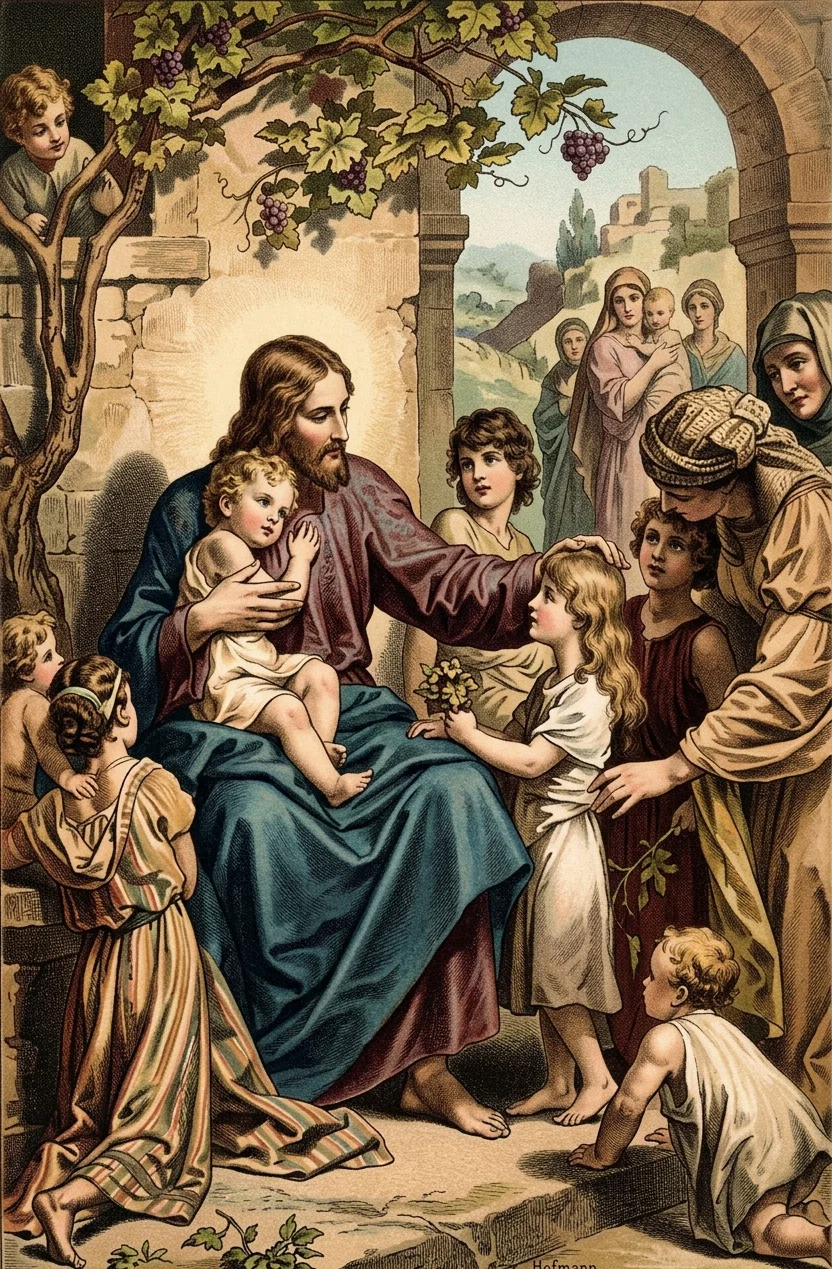
JESUS AND THE CHILDREN

You have reached the end of this edition.

Signs of the Times · Jun 7, 1910