The Youth’s Instructor, Vol. 64, No. 3.

Belgian Relief Funds and Continued Need

The Youth’s Instructor

Jan 18, 1916

Review and Herald Publishing Assn. · Takoma Park Station, Washington, D. C. · Jan 18, 1916

Belgian Relief Funds and Continued Need

Fifty million dollars has been spent for Belgian relief, but far more is needed.
Blessed is the man, who, having nothing to say, abstains from giving us wordy evidence of the fact.—George Eliot.
The Senate of Haiti has approved a treaty with the United States providing for a virtual American protectorate over the country.
“The quiet, intense, passionate power of laying a finger on the wounds of a soul and healing them is worth far more than sermons.”
The postmaster of Chicago declares that forty-five per cent. of the mail handled in that office is improperly addressed. Looking up and correcting mistakes in the mail costs the office $85,000 a month.
A State-wide prohibition bill, it is announced, will be introduced early in the next session of the Delaware General Assembly. A majority of all the new members in both houses are pledged to support the measure.
Congressman Claude Kitchin, floor leader of the House of Representatives, declares that new measures must be considered at once by Congress for raising internal revenue, as the revenues on liquor and tobacco are on the decrease.
“He that justifieth the wicked, and he that condemneth the just, even they both are abomination to the Lord.” Prov. 17:15. How carefully we should walk lest we transgress in one or both of these ways, and so merit the displeasure of our Father above.
The Nebraska Farmers’ Congress went on record in favor of prohibition at a meeting in Omaha, Dec. 8, 1915. After a heated debate, a resolution for prohibition was drawn to replace the one submitted by the resolutions committee opposing prohibition. The amended resolution was adopted by a vote of 52 to 7.
The Dry Chicago Federation is now waging a petition-signing campaign. It is expected that at least 250,000 signers will be obtained to the petition for a cleaner and greater Chicago, and for a vote on the saloon question. Early in January there is to be held a large convention of all the civic and uplift organizations of the city, for the purpose of inaugurating the campaign.
The Nobel prize of $40,000 for physics for 1915 has been awarded to Prof. Max von Laue, of Frankfort-on-the-Main, for his discovery of the diffraction of rays in crystals; while the prize in chemistry has been awarded to Prof. Theodore William Richards, of Harvard University, for fixing the weight of atoms. This is the first time that the Nobel prize in chemistry has been awarded to an American.
A public-spirited citizen of Illinois has started a campaign to eradicate poison ivy, which he says is far more dangerous than is generally supposed, and the ill effects more lasting. He has issued a call to all who are interested in aiding humanity to burn the vines in the late fall, after the frosts have caused the leaves to wither. However, great caution must be observed in approaching the vines. The leaves should not be touched at any time, even when withered, for poison ivy has no innocuous season.

Good Health at a Cheap Price

AN apple a day, it has been wisely said, will keep the doctor away. But so will plenty of water, and water is cheaper and handier than apples. Because water is to be had for the asking and taking, we do not value it. We are careful to wash our outer bodies, but we fail to realize the value of flushing our inner bodies. Doctors say that if we all gave the body eight glasses of water each day, doctors would have less practice. “Most of us would starve,” said one doctor lately, “if all followed this schedule:” —
1 glass of water upon rising, 2 glasses of water between breakfast and luncheon, 2 glasses of water between luncheon and dinner, 1 glass of water upon retiring.
That is certainly not an impossible achievement. “But,” added this doctor, “although there are two opinions about drinking water with meals, the weight of medical opinion is against asking food to swim in water. Before and after meals is the safest rule for drinking water, and then plenty of it.” It is worth thinking about: if we can get good health at so cheap a price.—Ladies’ Home Journal.

A Messenger

In China, an ignominious form of punishment is to fasten upon the criminal a heavy plank in which a hole has been cut to admit the head. Upon this plank a description of the crime is printed in large letters. The offender is turned into the street to wander in the presence of a jeering, hooting mob. Recently in one of the villages a man was seen walking slowly up and down the street bearing upon his neck this badge of shame. The curious crowds that pushed forward to learn his crime were silent through astonishment. Instead of reading upon the board the record of broken law, they saw sentences like this: “God is love.” “Believe on the Lord Jesus Christ, and thou shalt be saved.” This man was not ashamed of the gospel of Christ. Longing to share with his countrymen the good news of salvation, he chose to wear the criminal’s collar that the thronging crowds that should gaze upon it might thus read a message from the true God.—The Christian Endeavor World.

While There Is Time

A LADY who once needed legal counsel was advised to consult a prominent lawyer. She kept putting it off, and when she finally went to him and began to state her case, he said, “Madam, you are too late. I cannot be your advocate, for I have been appointed your judge.” God forbid that the Judge of all the earth should apply such words to any of us.— Record of Christian Work.

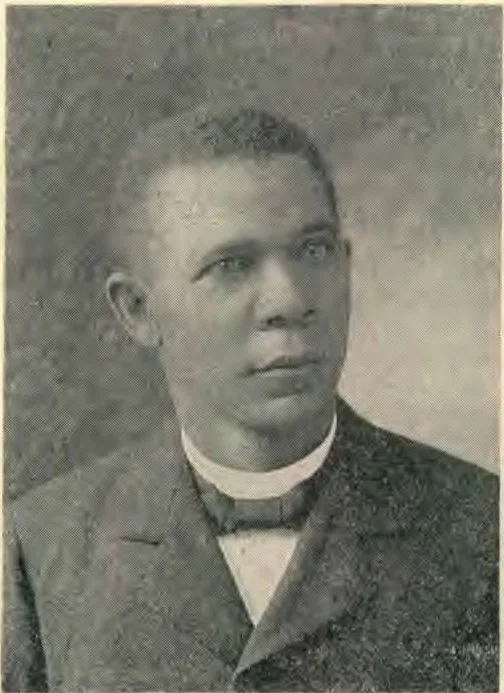
Booker T. Washington

LEONA BURMAN
“The individual who can do something that the world wants done, will, in the end, make his way, regardless of his race.”
ABOUT fifty-seven years ago, in a typical log cabin in Virginia, there was born a black baby boy. As he grew up, he was valued for what he would bring in the market, for he was born a slave. His mother, being the plantation cook, had very little time to devote to her children; but she must have spent that little well, for with no attention or thought from his father, who was a white man on a near-by plantation, he developed into a remarkable boy. Though only seven years old when set free by the Emancipation Proclamation, he had already borne his share of burdens on the plantation, and he said he could remember no period of his life that had been devoted to play.
Soon after the close of the war he went with his mother and stepfather to the new State of West Virginia. They settled in Malden, a small town about five miles from Charleston. The boy was put to work in a salt mine, and there he learned his first figures from the salt barrels filled by his father.
He had a most earnest longing for an education. In some way his mother got a copy of Webster’s “blue-back” speller, and as he had been told that the way to learn to read was to learn the alphabet, he began to try to understand it. There was no one to help him, for none of the colored people could read, and he was afraid of the white people. Though his mother was totally ignorant of books, she sympathized with her son in all his efforts, and to her influence he attributed the success of his life.
Finally a school for colored children was started in the valley, and the lad’s hopes rose high, only to be dashed to the ground when his father said he could not spare him from work in the mine. By dint of persevering and planning, however, he at last secured permission to attend for a few months.
MRS. WASHINGTON
MRS. WASHINGTON
His first day at school brought him face to face with a new difficulty. He had only one name, whereas all the rest responded to the roll call by at least two. His mind was quick, and when the teacher reached him he announced his name as “Booker Washington,” a name that has stayed by him all these years. He afterwards learned that the name Booker Taliaferro had been given him in infancy by his mother, and so he signed himself Booker Taliaferro Washington. Such is the early history of one of the noblest men our country has produced. We may now follow him in his efforts to secure the education for which his whole being hungered. When about thirteen years old he overheard two miners talking of a great school for colored people that had been started somewhere in Virginia. Silently the boy crept up where he could hear more, and as they talked, he learned that poor students were to be allowed to work a part or all of their way. The more he heard, the more it seemed to him that Hampton would be heaven on earth, and he decided that he would attend that school, though he had no idea where it was, or how he was to get there.
About this time he went to work for Mrs. Viola Ruffner, who had the reputation of being very strict with her servants, so much so that one rarely stayed with her longer than two or three weeks. Booker made up his mind to please her, and hired out for five dollars a month. He found her a woman who demanded absolute honesty and frankness in her servants, and when she found these, she was a friend. She was thoroughly systematic in everything, and the lessons he learned in her home made a valuable part of his education, and, no doubt, contributed largely to the success of his later life.
BOOKER T. WASHINGTON
In the fall of 1872, he decided to start on his five-hundred-mile journey to Hampton. After traveling a part of the way by train and stage, he found that all his money was gone. Nothing daunted, he set out to walk. When he reached Richmond, he found himself alone in a strange city with no money. He went without supper and slept under the sidewalk. The next morning he secured work on a ship in the harbor, but in order to save every cent for school he continued to sleep under the sidewalk. Many years later, he was given a reception near that spot, but his mind was more upon the sidewalk and what it suggested than upon the reception.
When he at last reached Hampton he was tired, hungry, and unkempt; but as soon as he could, he applied to the head teacher for admission. Evidently she was not favorably impressed, for she made no decision in his case, though she admitted several others. He did not become discouraged, but continued to linger near her. Finally she told him to sweep a classroom. Feeling that it was his entrance examination, he did his best, sweeping three times and dusting four times. When he had finished, Miss Mackie examined the room, testing for dust with her handkerchief. She was satisfied, and admitted him to the school, giving him the position of janitor. Though the work necessitated long hours and little sleep, he was happy, for he was able to earn a large part of his expenses. The thoroughness of that first sweeping characterized his subsequent life.
After finishing his course at Hampton in 1875, he taught for two years in his home town. He then spent eight months in study in Washington, D. C. While there, he had an excellent opportunity of witnessing the superficiality of a large class of colored young people whose only ambition seemed to be to learn a little Latin or Greek and hold a government position. He decided that true success consisted in laying a foundation for the betterment of the masses of his own race, and that a practical education that would teach them how to perform life’s duties in a better way was of more value to the colored people than Latin and Greek or music.
During the summer of 1879, Mr. Washington was asked to connect with the Hampton Institute as preceptor and teacher. This gave him the opportunity of carrying his own education farther.
His life work began in 1881, when, by the recommendation of General Armstrong, he was selected to start a school for colored people, at Tuskegee, Alabama.
He found no buildings, no equipment—in fact, nothing with which to begin work. After spending a month in visiting the colored people in their homes, he was almost discouraged as he thought of their great needs. But more than ever he was convinced that the education to be given them must take hold of their everyday lives, and make them valuable in the community where they lived. This, however, was not the ideal of the Negro. He wanted an education that would enable him to live by his wits rather than by work; that would make it possible for him to wear a high hat, kid gloves, and fancy boots. Many expected to get a diploma in two or three months. Booker Washington, therefore, had to overcome the prejudices of the white people and the wrong ideals of the Negroes.
The school was started in temporary quarters, with thirty students and one teacher. A little later, an old abandoned plantation, one mile from Tuskegee, was offered for sale for five hundred dollars. Only two hundred and fifty dollars was required as a first payment, but this amount was much more than Mr. Washington had ever had at one time. Greatly perplexed, he wrote to his former teacher, General Marshall, who at once offered to lend him the money from his personal funds. The mansion having burned, the only buildings on the plantation were an old cabin, a kitchen, a stable, and a henhouse, all in a dilapidated condition. The stable and henhouse were repaired, and used as recitation rooms. Convinced that farming should be an important part of a young man’s education, Booker Washington next cleared, with the aid of the students, twenty acres, and put in a crop.
As soon as it was evident that the school was being conducted on right principles, and that the education given at Tuskegee was not spoiling the Negro, but was making him a useful citizen, gifts began to be made for the erection of permanent buildings. But this success did not come without hard work, sleepless nights, and some dismal failures on the part of the leader. He determined not to run into debt for luxuries and to have the students build their own institution. In speaking of the beginning of the dining room service, he says, “Had we started in with a fine, attractive, convenient room, I fear we should have ‘lost our heads’ and become ‘stuck-up.’ It means a great deal to start off on a foundation which one has made for oneself.” In harmony with this idea, Booker Washington rose from the plantation slave to a man honored by many of earth’s great men and women. From a poor colored boy struggling by himself to master the alphabet, he progressed till Harvard University, in 1896, conferred on him the degree of master of arts.
The institution at Tuskegee, begun in poverty and without equipment of any sort, has grown till it owns twenty-three hundred acres of land, one thousand being cultivated by the students each year. The old stable and the henhouse, with one teacher and thirty students, have been replaced by eighty-three buildings, with one hundred and ten instructors and fifteen hundred students. The school provides thorough academic and religious training, besides conducting thirty-seven industrial departments. Every student is required to master at least one trade. Although started without resources, the institution now owns over eight hundred thousand dollars’ worth of property, besides having an endowment fund of more than a million dollars. All this is free from mortgage. The yearly expenses are about one hundred and fifty thousand dollars. Most of the money invested in Tuskegee, Mr. Washington raised by going from door to door, explaining the work.
On November 15, death took from the Negro race, Mr. Washington, its foremost teacher and leader. In summing up the life of this great man,—for a great man he surely was,—I can do no better than to give a few quotations, which make clear the principles on which his life was conducted.
In speaking of a large gift received from the late C. P. Huntington, Mr. Washington said: “Some people may say it was Tuskegee’s good luck that brought to us this gift of fifty thousand dollars. No, it was not luck. It was hard work. Nothing ever comes to one that is worth having, except as a result of hard work. When Mr. Huntington gave me the first two dollars, I did not blame him for not giving me more, but made up my mind that I was going to convince him by tangible results that we were worthy of larger gifts.”
“From General Armstrong,” he says, “I learned that great men cultivate love, and that only little men cherish a spirit of hatred. I learned that assistance given to the weak makes the one who gives it strong; and that oppression of the unfortunate makes one weak. It is now long ago that I learned this lesson from General Armstrong, and resolved that I would permit no man, no matter what his color might be, to narrow and degrade my soul by making me hate him.”
If we desire success in our work as missionaries for Jesus, we can do no better than to follow the advice he gives. “In order to be successful in any kind of undertaking, I think the main thing is to grow to the point where one completely forgets himself; that is, to lose himself in a great cause. In proportion as one loses himself in this way, in the same degree does he get the highest happiness out of his work.”

Knowledge Given to Impart, Not Conceal

SELDOM ever was any knowledge given to keep, but to impart; the grace of this rich jewel is lost in concealment.— Bishop Hall.

“With Good Will Doing Service”

IVA F. CADY
WHEN we are young and inexperienced, Satan makes us a special target for his deceptions and temptations. He seeks to make us dissatisfied with the conditions by which we are surrounded, and succeeds very well with many of us, so that we dislike the little tasks that we are required to do in the home as our part of the necessary work, and are filled with discontent. We feel that we have a very unhappy lot, and murmur and complain about the hard work we have to do. We do not always think how mother spends hours, and perhaps all her waking time, in laboring for others. Whether she feels like doing it or not, she does not complain; though she might be very glad for more assistance so that she could have some leisure time to read, write, or rest, or for a little pleasant recreation.
Some young people do not have their minds upon the work they are doing. They do it in a careless, slovenly way, while their minds are occupied with daydreaming. Those who have the habit of reading novels have so constantly before their minds the fascinating but unreal experiences found in such literature, that they are usually discontented with real life, and take little or no interest in doing the necessary work in the home, counting it as drudgery. They prefer instead to exercise their minds in building air castles. Now, this is a very foolish habit. Solomon tells us that “the eyes of a fool are in the ends of the earth.” Prov. 17:24. How much better it is to have our hearts and eyes upon our work, seeking to do it promptly and as well as we possibly can, instead of dreaming how we should like to be somewhere else as a great hero or heroine, or of what great things we shall do and of the good things we shall have sometime in the future. Many good things may be gained if we will work for them, but in real life happiness and prosperity do not come through idle dreaming.
We are told that “better is the sight of the eyes than the wandering of the desire: this is also vanity and vexation of spirit.” Eccl. 6:9. So it is far better to take an interest in the things right around us, and to see what is our present duty, rather than to dream of how much good we might accomplish if we were only in some other place, under different circumstances. If we learn to put our hearts into our work, then we can really enjoy it. And when we think how we all must have washing, ironing, cooking, and all these other necessary things done for us, why should we not willingly and gladly bear our share of the burdens? Many make a rose-colored future for themselves in their daydreams which will never materialize. We should discover happiness in our present lot.
Some girls never take any interest in housework until they get into homes of their own; but how much better if they had found pleasure in lightening the burdens of their mothers while with them, instead of making more work and care. Many a mother, though overworked herself, will cheerfully perform the task of the daughter rather than compel her to do it against her will. The unwilling child not only murmurs because she is called upon to do the work, but often spends so much time in doing it, or does it so poorly, that it would be pleasanter and less work for the mother to do it herself. But the wise mother knows that her child should learn to be useful, and that she can learn only by doing.
Girls, you should be independent. I do not mean that you should be obstinate and wilful, which some consider independence. But, instead of depending upon mother to do all your work and to wait on you, learn to help her. You are young and strong; and though you may not now be able to realize it, most of you have very few cares and very little to do in comparison with what your mother has. Cultivate the habit of putting things back in place after you have used them, and not leaving them for her to put away. Make a practice of keeping your room tidy, and your own clothes in order. It might be a great relief to your mother and no more than your duty if you would do your own washing and ironing, and also help wash and iron for the other members of the family. And now is your best time to begin to learn to sew, while your mother is near and can help you. Perhaps your school work is so pressing that you feel you have no time for anything else. True, one’s studies do take much time; but you need physical exercise in order to keep well. Since you need to exercise your muscles as well as your brain in order to secure the proper, all-round development, and we are told that there is nothing better than housework for this purpose, you will feel much better satisfied if you obtain the needed exercise in relieving your overburdened mother, rather than in the gymnasium or in playing basket ball or tennis. And how is it during vacation? Are you off for a holiday then, simply thinking of enjoying yourself? or are you remembering to help mother, so that she may have a little time to enjoy herself with you?
I know that there are many daughters who are thoughtful and caretaking, and who are faithfully performing their part in the home with willing and loving hearts. Then, too, there are those who are deceived into thinking that they have a very hard time, while they are only a burden and an anxiety to their parents. When such get where they have to bear the burdens of life for themselves, they will find them doubly hard.
“It is good for a man that he bear the yoke in his youth.” Lam. 3:27. It is also good for a woman that she bear the yoke in her youth. We gain strength by exercise,—strength of both body and mind. If one begins in her youth and yokes up with her mother, helping her with the household cares, and thus learning and becoming strong by doing, she will find that when she gets into a home of her own, things will go much more smoothly than they would if she had never had any practical experience with housework. Some may think that cooking and sewing are the only things one needs to learn; but the housewife needs to understand well the whole system of housekeeping, that she may successfully carry on her own work.
Some girls never think of doing a thing to help unless they are requested particularly to do it; and then they sometimes keep putting it off and forgetting it, and must needs be reminded of it again and again before they finally get it done. Every one should cultivate the gift of initiative, taking an active interest in the home affairs, and watching to see what is to be done; then doing it voluntarily, and not waiting to be asked even once. And we should do our work, “not with eyeservice, as men pleasers; but as servants of Christ, doing the will of God from the heart; with good will doing service, as to the Lord, and not to men.” Eph. 6:6, 7.

The Story of the Rebellion Against the Government of King Jehovah

The Great War — No. 18

The Story of the Rebellion Against the Government of King Jehovah

The New Earth

CARLYLE B. HAYNES
As the earth emerges from its fearful ordeal of fire, it comes forth cleansed from every stain of sin. The Holy City becomes its capital, and the whole earth becomes again like the garden of Eden for beauty. As “the wilderness and the solitary place” shall “blossom as the rose,” and “the glory of Lebanon shall be given unto it, the excellency of Carmel and Sharon,” the earth becomes what it was at first meant to be—the eternal home of the people of God.
After the destruction of the wicked and the cleansing of the earth, the righteous will go forth from the Holy City, and “they shall build houses, and inhabit them; and they shall plant vineyards, and eat the fruit of them.” Isa. 65:21. The whole earth will be populated with the redeemed of the Lord. They will build homes which will never be destroyed. There will be no fear of fire or earthquake. Sin will have passed forever. There will be none to make afraid. There will be no ravenous beasts there. All will be peace and contentment, and unspeakable happiness will prevail in the hearts of all.

Sabbath Meetings

Every month and every Sabbath day the people of the new earth will gather at Jerusalem to engage in worship of the King of kings. “For as the new heavens and the new earth, which I will make, shall remain before me, saith the Lord, so shall your seed and your name remain. And it shall come to pass, that from one new moon to another, and from one Sabbath to another, shall all flesh come to worship before me, saith the Lord.” Isa. 66:22, 23. Here in the city of God the redeemed will partake of the tree of life, which yields its fruit every month. Here also they will wander through the groves which border the “river of the water of life,” which proceeds “out of the throne of God and of the Lamb.” Rev. 22:1, 2.

Sin Will Never Return

“And there shall be no more curse.” Rev. 22:3. Sin has been destroyed and will never return. Every one of the created intelligences of the other worlds, every angel, and every soul which has been redeemed at such an infinite cost, has fully decided that God is righteous. They have had enough of sin. The experiment carried out by Satan will never need to be repeated. Thank God for the promise of the Word that when the Lord destroys sin “he will make an utter end: affliction shall not rise up the second time.” Nahum 1:9.
In that glorious land “my people shall dwell in a peaceable habitation, and in sure dwellings, and in quiet resting places.” Isa. 32:18. “Violence shall no more be heard in thy land, wasting nor destruction within thy borders; but thou shalt call thy walls Salvation, and thy gates Praise.” Isa. 60:18. “Instead of the thorn shall come up the fir tree, and instead of the brier shall come up the myrtle tree.” Isa. 55:13. “The wolf also shall dwell with the lamb, and the leopard shall lie down with the kid; . . . and a little child shall lead them.” Isa. 11:6. “They shall not hurt nor destroy in all my holy mountain.” Isa. 11:9. “And God shall wipe away all tears from their eyes; and there shall be no more death, neither sorrow, nor crying, neither shall there be any more pain: for the former things are passed away.” Rev. 21:4. “And the inhabitant shall not say, I am sick: the people that dwell therein shall be forgiven their iniquity.” Isa. 33:24.

A Royal Diadem

And the New Jerusalem shall be “a crown of glory in the hand of the Lord, and a royal diadem in the hand of thy God.” Isa. 62:3. “Her light was like unto a stone most precious, even like a jasper stone, clear as crystal.” Rev. 21:11. “The nations of them which are saved shall walk in the light of it: and the kings of earth do bring their glory and honor into it.” Rev. 21:24. “And there shall be no night there; and there they need no candle, neither light of the sun; for the Lord God giveth them light: and they shall reign forever and ever.” Rev. 22:5.

Broken Ties Reunited

And in the new earth I shall “know even as also I am known.” 1 Cor. 13:12. Friends and loved ones, long separated by death, will there be reunited, and they will know each other just as they have known each other here. Their love and sympathy for each other will be increased, and will continue throughout the ages of eternity, never again to be broken by death. All the faculties of the human mind will be developed there, and our capacity for knowledge will be constantly increased. There will be no enterprise into which one can enter that will be too great to be carried forward to completion. There will be no aspiration which cannot be reached. There will be no ambition which cannot be realized. There will be no end to the acquirement of knowledge. It will be possible then to travel from planet to planet, and from system to system, in the study of the treasures of wisdom and knowledge of the universe of God. Our companions will be the angels of God and the unfallen intelligences of the other worlds.

Of This There Will Be No End

And to all this there will be no end. As the ages of eternity unfold, there will never be any fear that the years still to come will bring with them an end to the happiness of the redeemed. When an eternity has passed away, and myriads of ages have rolled by, still all beyond stretches eternity.
The controversy has closed. Sin is destroyed. The great universe of God is clean. The bond of love and gladness binds together again the whole creation. And thus shall it ever remain.

Come, Then, to Christ

Oh, my brother man, I want a place in that glorious new earth! Do you not want to be there also? It will soon be here. It will not be long before sin and sinners will be no more. The day of the Lord hasteth greatly. Do not be deceived by the wiles of Satan. He will take you captive if he can. The message of the coming of Christ is even now in the earth, and is being proclaimed far and wide. There is salvation in that message for you, and a preparation to meet the Lord in peace. Come, then, to Christ, who rescues the perishing, who saves the lost. Seek for his mercy. Cast away the sins which offend him, forsake the thoughts which insult him, and take him for your Redeemer and Friend. For you he has given his life, that you might have a part in the new earth. O, delay no longer! The time is short. The Lord is at hand. May he say to the reader of this series of articles, “Come, ye blessed of my Father, inherit the kingdom prepared for you from the foundation of the world.”

A Letter From Honduras

DEAR YOUTH: As you do not hear very often from Spanish Honduras, I want to say a word to you about this part of the world, for I am sure you will be pleased to know something about the country and the people who live here.
Honduras is a republican state of Central America, with an area of 46,400 square miles. It is divided into seventeen departments. Its surface is hilly, with numerous fertile valleys. Its mineral wealth is very considerable, and includes gold, silver, lead, and copper. The chief rivers are the Chamelecon, Ulua, and Aguan, flowing to the Caribbean Sea, and the Choluteca, an affluent of the Pacific. There are extensive forests, abounding in fine timber, such as pine, mahogany, and cedar. The principal cultivated products are maize, beans, wheat, rice, plantains, bananas, coconuts, and tobacco.
Among the fruits that abound here are guavas, mangoes, papayas, pears, and oranges. Sweet potatoes, yams, cabbages, cassava, and cocoa are grown quite extensively.
Since 1880 the capital has been Tegucigalpa. The executive authority is in the hands of a president. The constitution of the state gives the legislative power to a congress of deputies composed of thirty-seven members.
There are four seaports on the northern coast of Honduras of nearly equal importance,—Trujillo, La Ceiba, Omoa, and Puerto Cortes. Steamers come from the States to all these points.
We have about 500,000 people to take the third angel's message to in this field, and only a very few to do it. The Bay Islands of Honduras have had the message for several years, so that most of their inhabitants have already heard the special gospel message for this time; therefore we shall have to do the most of our work from now on over on the mainland, among the Spanish people.
I am sending you the picture of one of our little Sabbath keepers who lives at the west end of the island of Ruatan. He rode his horse about eight miles a few weeks ago to the little town of Coxen Hole, where we have our mission house. As we saw him riding in the street, we stopped him and took his picture. His name is Clemens Wood, and his father is the elder of the West End church.
I am also sending you the picture of a little missionary that came all the way from the States about three months ago, to help his papa and mamma (Brother and Sister Paden) in the office work of the conference.
We have one church on the mainland, and three or four Sabbath schools. The Spanish Sabbath school in Ceiba now numbers about twenty-seven. Nearly every Sabbath new ones come. The Spanish people seem to be very glad to learn of this precious truth, and the ones who have learned about it are doing what they can to tell it to others. One of the Spanish brethren came to the mission house a few days ago and bought sixty-five sols’ worth of books to take to the interior of the country to sell to his people. This is about twenty-six dollars’ worth in United States currency.
The people are buying every kind of book, tract, or paper they can hear of that is printed by our people in the Spanish language.
These words of our Saviour apply in a special sense to Honduras: “The harvest truly is great, but the laborers are few.” Shall we not do all we can to tell the people about Jesus and the message for this time? Will not the ones standing idle in the market place come and help us? ISAAC BAKER.
Continue reading: The Christian Sabbath Guardians