The Youth’s Instructor, Vol. 34, No. 34.

INTERESTING PHENOMENA
Earlier text: INTERESTING PHENOMENA

AN ELEVATED RESIDENCE.

A HOUSE now in process of erection high up on the Alps, for the purpose of making atmospheric observations, is thus described by the Metropolitan of August:—
“The highest observatory in Europe is being built on the summit of the Sonnblick, one of the Tyrolese Alps, near the well-known Gross Glockner. The Sonnblick, 10,000 feet high, is more accessible than the neighboring peaks, and at a height of 8,000 feet has a house for about twenty miners who are employed at some mines half-way up the mountain. One of these miners is studying meteorology in order to take up his quarters in the observatory, whence he will telephone daily observations to the miners’ house, 2,000 feet below. This will be his only mode of communicating with the outside world in winter, and his observations will be sent on again from the miners’ house by telephone to Rauris down below, and thence to Vienna for publication. As the Sonnblick is exposed to violent storms, the observatory will consist of a strong block-house and massive stone turret, 40 feet high, the walls being unusually thick, and the structure anchored to the rock by steel-wire cables. The house will be of wood, which keeps out the cold better than stone, will have two living-rooms, while the tower will be fitted with the latest improvements in meteorological science. At present, the miners’ house is reached by a wire rope-way, and thence it is an easy three hours’ ascent to the summit.”

THE CLOVER FEAST.

Among the many feasts and other rites and ceremonies of the Dakota Indians is one for the children, called the “Clover Feast.” It lasts for several days, and the children engage in it as if it were a great treat. The celebration of the feast is thus described: “When the clover is new and the blossoms sweet, the camp moves to where it is thickest. Then the children fast for a time and have some dances under the direction of the ‘medicine man,’ who is a sort of priest of the tribe. On the proper day they break their fast by eating the heads of the sweet clover. They go crawling about on their hands and knees, nibbling the heads like so many sheep and goats, after which they have a feast of more substantial things.”
A good many of these children are being instructed in the Government schools, and after they have learned civilized ways, we trust they will make useful men and women.—Selected.

Early Inventions and Introductions in England

Knives were first made in England in the year 1563. Pocket-watches were brought from Germany in the year 1577.
The currant-shrub was brought from Zante in the year 1533; in 1540, cherry-trees from Flanders were first planted in Kent.

FAITH'S SELF-DENIAL.

Faith could hardly believe her senses, it seemed so like a terrible dream; all day she went quietly about the house, washing the dishes, sweeping and dusting, and doing the dozen other little things that fell to her lot as the only girl in the household. It seemed more like some story she had read, as she thought of the long line of soldiers marching down the dusty road, with their bright weapons glittering in the sunlight, and remembered how proudly her own brother Ben had marched away with them, swinging his cap to her as he passed the door. She didn't miss him so much in the daylight; but how long the hours grew between sunset and bedtime, and how strangely silent the house had become now Ben's merry whistle and cheery voice were gone! But as the days went by, Faith began to get used to it, and cheerfully did her work, trying to be to her mother all that Ben had been.
Then the autumn came, ripening the fruit on vines and trees and turning the leaves all ablaze with scarlet and yellow. With the bright, warm days came a letter from way down in Virginia, whither Ben's regiment had gone. An old farmer had given it to Faith as she was slowly swinging back and forth on the great gate, looking down the road. She grasped it eagerly and ran to the house, waiting while her mother tremblingly broke the seal and read. It was a cheerful letter; yet it brought tears to the mother's eyes as he made all the hardships of the army seem so light. But the words that Faith remembered were these:—
“I feel almost ashamed of my good clothes when I see how poorly clad the rest of the boys are. Just think, mother, hardly a fellow in our mess has a whole pair of shoes, let alone stockings; and they suffer terribly on the long marches. I don't know what they'll do when winter comes.”
And then followed loving words to all the home folk, telling them how glad he would be when the war was over, and he could come back again.
That evening father and mother talked about the soldiers, while Faith sat on the stool in the corner by the fireplace, drinking in every word. She was a thoughtful little girl, and already was busily thinking what she could do to help matters. “Just suppose it was Ben,” she kept repeating to herself. But she was obliged to go to bed without finding any way out of her difficulty. Taking a candle, she went up the broad oaken stairs to her room. What a pleasant, cheery little room it was, with its white curtained window and snowy bed! Faith opened the closet door to hang up her dress, when her eyes fell on a huge bundle lying on the shelf. May be this was the way out, who knew? She looked at the bundle again, and sat down in a chair to think about it.
Do you wonder what startled her so? Nothing but a mass of gay colored wool. What of that, do you query? A good deal for Faith, when I tell you about it. All that soft wool had been clipped from the backs of her own pet sheep, and had been carefully dyed with herbs and leaves she had gathered with her own hands in the broad fields adjoining the house. Faith meant to have a new dress out of this very wool, and she was going to begin spinning it next week. It was a great event, this having a new dress, for all Faith's wardrobe had to be made from stuff that grew on the place. Nor was it often that her busy mother would stop to color the wools so carefully, probably thinking that the gray linsey-woolsey would answer just as well. But this was to be her very best dress, and worn only when company came, or she rode horseback behind her father on Sundays to meeting.
“No,” thought Faith, as she rose and slammed to the closet door, shutting out the sight of the wool, “I want that dress myself, and I shan't make it up into yarn;” then she blew out the light and went to bed. But she didn't sleep very well; she kept seeing the poor soldiers, in the cold weather, with bare feet or tattered shoes, and when she did fall asleep, it was only to dream of Ben, hungry and cold, in that far-off battle-field. She couldn't stand that. With the first peep of day, Faith arose, and seizing the wool from the shelf, ran down where her mother was preparing the early breakfast.
“Please, mother,” began the little girl, all intent on her plan now she had made her mind up to it, “let me make this into socks for the soldiers.”
Mrs. Havesham paused in her cooking, and kissing Faith's expectant face, said, “Are you sure, dear, you want to give up your new dress?”
And Faith only smiled back and said, “Suppose it was Ben.”
“Yes;” said her mother with a heavy sigh, “suppose it were our Ben;” and that settled it.
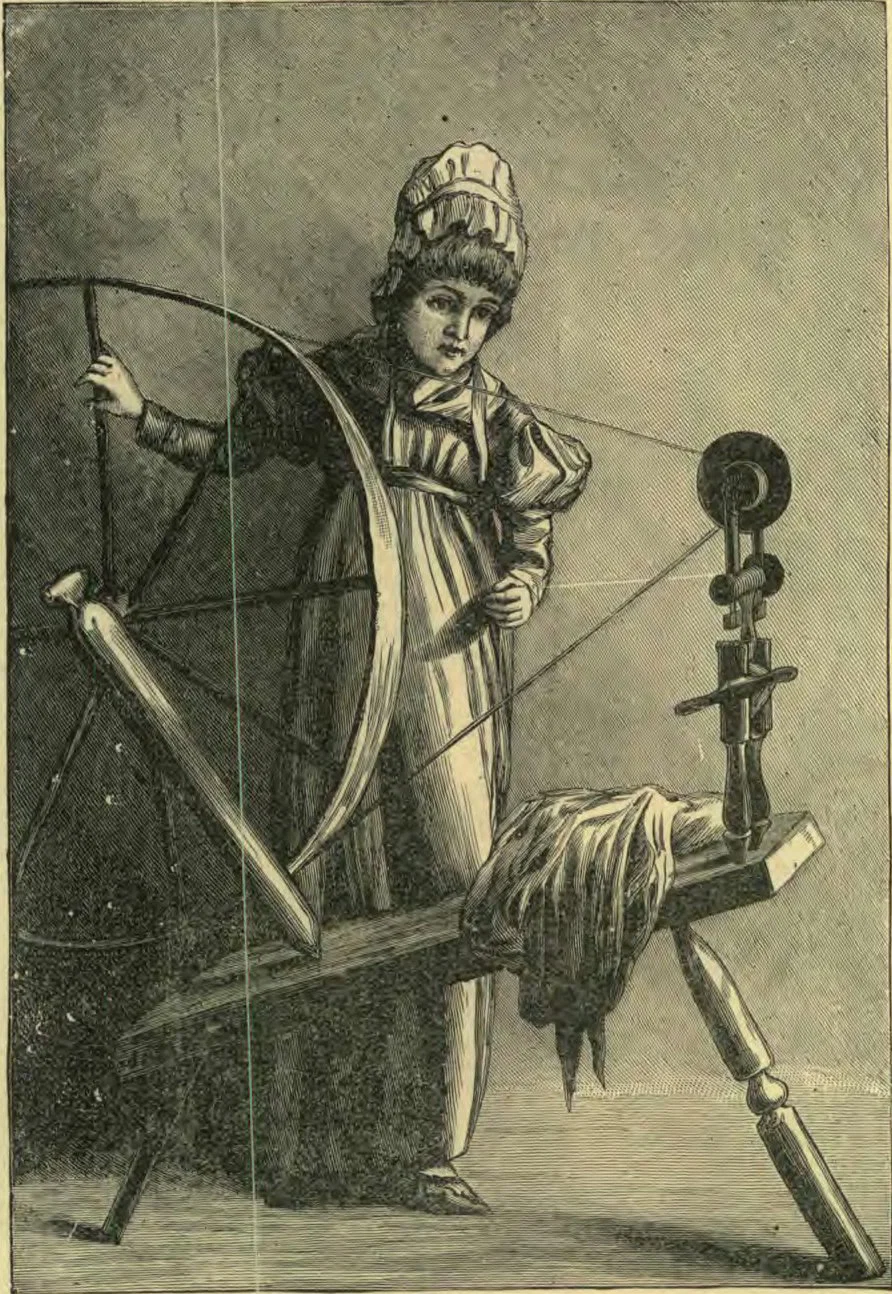
But you must not think that Faith did not sometimes regret for a moment the loss of her dress; yet as she spun the yarn and helped her mother fashion it into comfortable socks, she kept saying to herself, “Suppose it were Ben,” and a little Bible verse about “doing it unto the least of these” would help out her good resolution. If you should visit the attic of the old home, you might see the very wheel on which the yarn was spun, and hear this and many other stories told about the old times, when mothers and daughters gave not only their comforts but those they held dearest on earth for the sake of their country. W. E. L.

Letter Budget.

Omer Trent McCoon writes a letter from Multnomah Co., Oregon. He says: “Dear Budget, I thought I would write and tell you how well I like you and all the rest of the INSTRUCTOR. I am a little boy seven years old. I am trying to obey Eld. Canright’s instructions in his ‘Little Things, No. 3.’ My sister Olive and I wash and wipe the dishes. Olive is five years old. We carry in all the wood for mamma, the vegetables from the cellar, and cut the kindling. We go to Sabbath-school and learn lessons in Book No. 1. We have a little brother Otis, two years old. My papa is away most all the time. I help him, too, when he is here. We do not go to day school, but mamma teaches us at home. We are trying not to speak any cross words. Mamma read in my Testament, ‘Blessed are the peacemakers.’ She gave me a Testament on my seventh birthday. She is reading it aloud to us. She has read to the fifteenth chapter of Luke. I want to be good, and meet you all in heaven.”
We want to say to Omer that it pleases us very much that he and Olive are not only hearers, but are doers, of what is written for them in the Testament and the INSTRUCTOR. Mamma will read from your Testament some day, “Blessed are they that do his commandments,” and such “may have right to the tree of life, and may enter in through the gates of the city.” Faithful mammas make good teachers; do you prize yours?
Harlie Newman writes from Manatee Co., Florida. He says: “I read the INSTRUCTOR and like it very much. I learn a great deal from it, and I like to have every thing in it true. I was surprised to see the picture and read the description of the shaddock tree in Vol. 33, No. 44. Of course, I never saw the shaddock of Cochin China, or of the East Indies; but the shaddock tree of Florida is a beautiful tree, and bears a delicious fruit, which is of a green color at first, but turns to a pale yellow long before it is ripe. It does not get ripe until January; and if left on the tree, it continues to improve until July, and when fully ripe, is equal to the orange. I am eleven years old. I go to Sabbath-school, and besides my lesson I learn a verse in the Bible every Sabbath. I have learned the ten commandments. My mother is my teacher. I have lived in Florida nearly three years, and I like it real well. There are a great many curious things here.”
Harlie, did you ever hear the story of the shield that two persons quarreled over, one declaring it was red, and the other that it was blue, afterward finding that it had both a red and a blue side? Probably the difference between your description of the shaddock fruit and that given in the INSTRUCTOR results from different persons having decided the quality of the fruit from that gathered at different seasons of the year, as you say the fruit improves from January to July if left to hang upon the tree. The picture of the tree used in the INSTRUCTOR is the same as the one given in the “American Cyclopedia” and “Webster’s Unabridged Dictionary.”
Blanche Redoute, of Douglas Co., Minn., writes: “It is a pleasure to read all the letters in the Budget. How many there must be of us in the INSTRUCTOR family; and as Eld. Canright says, we ‘can do a lot of good if we just try.’ He asks us to try. Will we not do the best we can to help all we can wherever there is work to be done?”
We suspect Blanche is trying to do as Eld. Canright says; and we hope many will respond to her question.
Royal B. Hix, a little boy eight year old, who lives in Furnas Co., Neb., says: “I would like to keep the Sabbath, but papa and mamma do not, and will not let me. I go to Sabbath-school and learn lessons in Book No. 1. I like the Sabbath-school. I have a little sister about two years old, named Minnie. I like her very much. I want you to pray that my papa and mamma will some day keep the commandments of God, that we may all have a home in the golden city.”
Indeed, we will remember your parents, dear boy; and we must believe that God hears the prayer of faith, and will show them his truth.

NOTHING

I asked a lad what he was doing; “Nothing, good sir,” said he to me. “By nothing well and long pursuing Nothing” said I, “you’ll surely be.” I asked a lad what he was thinking: “Nothing,” quoth he, “I do declare.” “Many,” said I, “in taverns drinking, By idle minds were carried there.”
There’s nothing great, there’s nothing wise, Which idle hands and minds supply; Those who all thought and toil despise More nothings live, and nothings die.
A thousand naughts are not a feather When in a sum they all are brought: A thousand idle lads together Are still but nothings joined to naught.
And yet of merit they will boast, And sometimes pompous seem, and haughty; But still ’tis ever plain to most That nothing boys are mostly naughty.
—Selected.

“NATURALLY GOOD.”

WE have heard of boys who were “naturally good” and “naturally smart,” but we have never happened to meet one of either kind. Neither have we met a blacksmith whose right arm was “naturally stronger” than the other. In all the cases, we know that striking has made the arm strong, study has made the boy wise, and downright hard fighting with temper and tongue, the grace of God assisting, has made the boy good.—Morning Guide.

You have reached the end of this edition.

The Youth’s Instructor · Aug 25, 1886