The Youth’s Instructor, Vol. 59, No. 11.

News Briefs from Around the World

The Youth’s Instructor

Mar 14, 1911

Review and Herald Publishing Assn. · Takoma Park Station, Washington, D. C. · Mar 14, 1911

News Briefs from Around the World

IN New York City there is one saloon for every thirty families.
HALF a million children in the Philippine Islands are now studying English in the public schools.
BARON ALBERT ROTHSCHILD, head of the Austrian branch of the famous family of bankers, died of heart-disease on Feb. 11, 1911.
THE second annual announcement of the College of Medical Evangelists, of Loma Linda, California, can be obtained by writing to the president, W. A. Ruble, M. D., Loma Linda, California.
Two of the king’s printers were fined three hundred pounds, or fifteen hundred dollars, for omitting the word “not” from one of the short commandments of the decalogue, in an edition of the Bible printed in 1631.
A BILL introduced in the Missouri House of Representatives forbids aeroplane ascensions to a greater height than one thousand feet, holding that higher ascensions than this are equivalent to attempted suicide.
PROF. E. A. ROSS, of the University of Wisconsin, thinks that hobble skirts, tube gowns, and peach-basket hats show a decided decline in the intelligence and good sense of the women who adopt such customs.
WHAT is believed to be a world’s record in wireless communication was made on February 11, when the local operator picked up a message from the steamer “Korea,” nearly four thousand five hundred miles out on the Pacific. The big liner reported all on board well.
FIFTY thousand peach trees were recently cut down in an orchard near Americus, Georgia. This is the largest peach grove in the world, and contains about two hundred fifty thousand trees. Three hundred acres have been cleared of trees, and the land will be used for raising cotton.
ALREADY nearly six thousand bodies of victims of the plague have been burned or buried in the outskirts of Harbin, Manchuria. The plague is spreading rapidly in Peking, though the foreigners thus far have escaped it. The foreigners are fleeing from the city, but the missionaries are staying at their posts.
THE National Association for the Study and Prevention of Tuberculosis, presents statistics which show that ten years ago there was only one organization in the United States for the education of the public about tuberculosis. By September, 1911, the association says there will be five hundred such bodies. In 1900 there were less than one hundred hospitals, wards, and pavilions where tuberculous patients could be treated. The association hopes to report, by September, at least four hundred fifty hospitals and sanatoria.
ACCORDING to a conservative estimate, two million children under sixteen years of age are employed in the cotton-mills, glass-factories, sweat-shops, mines, and agricultural industries of the United States. Dr. A. S. Daniel, of the New York Infirmary for Women and Children, makes the following statement: “Children workers in the sweat-shops in this city are expected to be able to sew on buttons at the age of three years, and to hem trousers at the age of six. A child of eighteen months was found toiling with its mother in a sweat-shop.”
J. T. ANDREW, of Montgomery, Alabama, has invented a safety appliance to prevent the derailing of trains, however great the speed at which the train is moving, when it strikes a broken or bent rail. Mr. Andrew’s recent experiments at Washington, D. C., indicated that his device would do all that is claimed for it.
“BOSTON authorities are making a determined effort to stop the spitting nuisance, the police commissioner having announced that he will have arrested a certain number of offenders on a certain day, twice that number on the following day, and so on, increasing the number of possible arrests until the public is awake to the offense.”
POSTMASTER-GENERAL HITCHCOCK reports that the total postal receipts for the fiscal year 1910, aggregated $224,128,657.62, a gain of $20,566,274.55 over 1909. If this record can be maintained, the postal affairs of the country should be on a paying basis within another twelve months, for the first time, so far as available figures show, within the history of the Post-Office Department.
LAST year the United States sold exports and bought imports in commercial exchange with Latin America valued at the splendid total of six hundred thirty million dollars, which represents an increase of approximately three hundred million dollars during the last ten years. When the Panama Canal is opened, there is no reason why the exporters and importers of the United States should not build up their trade until it passes the annual mark of one billion dollars.

Good Working Mottoes

ONWARD and upward.
Deeds not words.
Keep forging ahead.
Never a day without an advance.
Do your work quietly and without ostentation.— Boston Transcript.

Subscribe Now

THE Medical Evangelist is the name of a new magazine published by the College of Medical Evangelists at Loma Linda, California. It is a sixteen-page monthly, and costs fifty cents a year. One of the objects of the magazine is to help build up the field work in connection with our institutions, especially our city work. Thousands of workers are needed where now there is only one. Every subscription to the magazine will contribute to the extension of the evangelical medical work.

A Visit to Historic Plymouth

W. E. GERALD
PROBABLY no spot in the United States is of more historic interest than the place of the landing of the Pilgrims. The sole interest in this place in 1620 was in the one hundred two persons who stepped from the “Mayflower;” to-day there is a flourishing town of over eleven thousand inhabitants. It is noted for being the home of the Plymouth Cordage Factory, the largest plant of the kind in the world, employing over two thousand hands, and furnishing nearly all the rope which Uncle Sam uses in his navy. Careful provision for the comfort of the employees is seen in the library, restaurant, and baseball grounds connected with the factory.
One of Plymouth’s chief industries used to be fishing. Now the energies of the people are devoted largely to the manufacture of tacks and woolen goods. In 1904 forty thousand barrels of cranberries were raised.
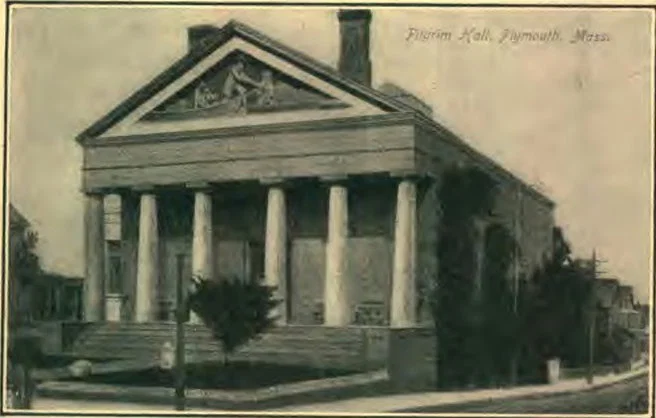
Pilgrim Hall, Plymouth, Mass.
An electric-car ride of about five minutes will bring one in sight of the Monument to our Forefathers, which conspicuously adorns one of the highest hilltops, and is said to be the largest piece of solid granite statuary in the world. Thirty years were required to build it. The granite of which it was made came from the quarries of Hallowell, Maine. On the central pedestal stands a figure of Faith, one foot resting on “Forefathers’ Rock.” In her left hand she holds a Bible, while with the uplifted right she points to heaven. Around the base of the monument, on wing pedestals, are four large figures of solid granite. One represents Morality, holding the decalogue in her left hand and the scroll of Revelation in her right. The other three represent Law, Education, and Freedom. On the faces of the pedestals are carved scenes from the history of the Pilgrims,—the departure from Delft Haven, the compact in the “Mayflower,” and the first treaty with the Indians. (See cover page.)
The total height of the monument is eighty-one feet. The length of the arm in the uppermost figure is nineteen and three-fourths feet, the circumference of the head thirteen and one-half feet, the neck nine feet,—and all of solid granite two hundred sixteen times life size. The cost was forty thousand dollars.
As I stood in the shadow of this monument one beautiful Sabbath day, and thought of the glorious principles of civil and religious liberty which it was intended to commemorate, and then of the decline from these principles which we have witnessed in the growing tendency to Sunday legislation and the tyranny of labor unions, I could not help recalling, with tearful eyes, the words of our Saviour to the Jews: “Ye build the tombs of the prophets, and garnish the sepulchers of the righteous. . . . Wherefore ye be witnesses unto yourselves, that ye are the children of them which killed the prophets.” It is truly a glorious thing to have the law of liberty written in stone; but how vain it is if those who thus inscribe it do not have it in their heart.
At Pilgrim Hall, on the wall of the curator’s office, hangs the commission from Oliver Cromwell, Lord Protector of England, to Governor Edward Winslow, as one of the arbitrators between Great Britain and the United Provinces of Holland. At the east end of the large hall is a picture of the “Landing,” thirteen by nineteen feet, painted by Henry Sargent, of Boston, and valued at three thousand dollars. Charles Lucey’s painting of the “Embarkation” is another work of value. Under the Sargent picture are the chairs of Elder Brewster and Governor Carver, and the Peregrine White cradle. In one of the glass cases is the sword of Miles Standish, the inscription on which was never understood until, in 1881, Prof. James Rosedale, of Jerusalem, an excellent linguist, pronounced it Cufic language, and translated it thus: “With peace God ruled his creatures, and with the judgment of his arm he troubled the mighty of the wicked.” It is supposed that this sword came to Captain Standish from the crusaders.
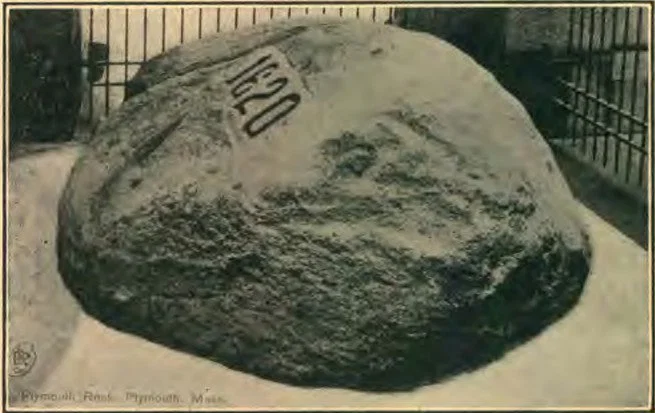
Plymouth Rock, Plymouth, Mass.
Another case holds the gun-barrel with which King Philip was killed. Here also are the original manuscripts of Mrs. Hemans’s celebrated ode, beginning, “The breaking waves dashed high,” and William Cullen Bryant’s poem, “Wild was the day, the wintry sea.” The north anteroom contains the old sofa upon which Governor Hancock sat with Samuel Adams as they plotted treason against the English crown. On the north wall of the library is the portrait of Josiah Winslow, whose grandson was the British officer who removed from their homes the French Acadians, whose sorrows Longfellow has made classic. The portrait of Governor Winslow is the only one in existence of any person who came over in the “Mayflower.”
A case at the west end of the library contains the oldest state paper in existence in the United States,—the first patent granted to the Plymouth colonists by the New England Company.
There is a book which was given to Governor Bradford by Pastor John Robinson, brought over in the “Mayflower” by Bradford, and afterward given to the church. Elliot’s Indian Bible is there also.
The object of supreme historic interest in Plymouth is the world-famous Plymouth Rock. At the foot of North Street, at the water’s edge, we find it, resting under a large granite canopy. It is an ordinary looking boulder about seven feet long, of greenish syenite in composition. It is claimed that not a shadow of doubt rests upon the identity of this rock. Thomas Faunce, whose father came over in 1620, upon hearing that the rock was to be disturbed in pre-Revolutionary times, visited the locality, and at the age of ninety-five, in the presence of witnesses, testified that it was the one upon which the forefathers landed. The attempt to move it farther away from the water’s edge resulted in splitting it into two parts. Some of the people were in favor of taking it to a more sightly place, and some of leaving it where it was. As a compromise between the contending parties, one part was removed upon higher ground, and the other left in its original place. After one hundred five years the incongruity of its being up in the center of the town was commented on by a visitor of note, so it was carried back and reunited with the other piece.
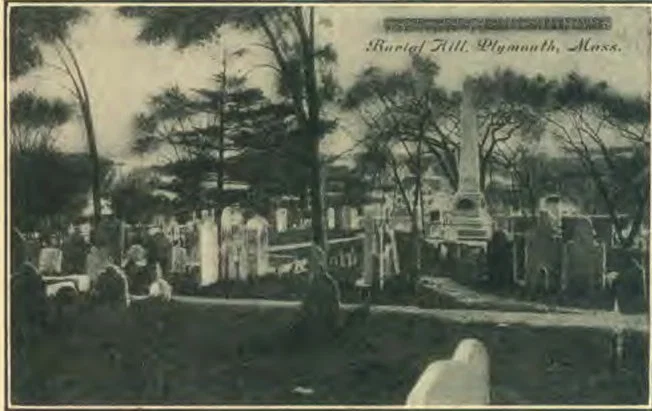
Passing up Leyden Street, one is thrilled with the thought that here, on each side of the present thoroughfare, were built the first homes of the Pilgrims. At the farther end of the street is Burial Hill, with its ancient gravestones and strange epitaphs.
“The Pilgrim fathers are at rest: When summer’s throned on high, And the world’s warm breast Is in verdure dressed, Go stand on the hill where they lie.”
This hill was the location of the old fort and the watch-tower. On one side of Governor Bradford’s obelisk are the Latin words, “Qua nos patres, difficillime, adepta sunt, non turpiter relinquere,” which, translated, mean, “What our fathers with difficulty attained, let us not basely relinquish.” On the easterly slope is a stone with the epitaph of a one-month-old child, as follows: “He glanced into our world to see a sample of its miserie.” That of Tabitha Plasket is curious for its spirit of defiance:—
“Adieu, vain world! I’ve seen enough of thee, And I am careless what thou sayest of me; Thy smiles I wish not, nor thy frowns I fear; I am now at rest; my head lies quiet here.”
On a stone to Elizabeth Savery is written:—
“Remember me as you pass by. As you are now, so once was I; As I am now, so you will be; Therefore prepare to follow me.”
At the base of Burial Hill runs the town brook, of which Governor Bradford wrote: “And there is a very sweet brook runnes under the hillside, and many delicate springs of as good water as can be drunke.”
Just above the famous rock is Cole’s Hill, the ground which has been hallowed by the fiercest struggles of the Pilgrims during the first dark, sad winter in which they landed. One who was there has portrayed the awful scene as follows: “This month (March) thirteen of our number die, and in three months past die half our company, the greatest part in the depths of winter, wanting houses and other comforts, being afflicted with scurvy and other diseases which the long voyage and unaccommodate condition brought upon them, as there die sometimes two or three a day. Of a hundred persons scarce fifty remaining, the living scarce able to bury the dead, the well not sufficient to tend the sick, there being in their time of greatest distress but six or seven, who spare no pains to help them.” On the hill they buried their dead, then leveled the graves and planted corn, so the Indians would not know how great was their loss. Severe rains have at intervals since revealed many of the skeletons.
The Pilgrims’ endurance of hardships in seeking freedom of worship should inspire us, who are taking part in the last gospel work, which is preparatory to ushering in not only freedom of worship, but everlasting deliverance from sin, disease, hardships, and death. While their faults are well known, let us remember their virtues, and seek to emulate them.

Examples for Our Admonition

Burial Hill, Plymouth, Mass.
THE subject of temperance is one whose importance God wishes his people to realize; and in order that we may better understand the blessings that follow it, and may shun intemperance and the losses it entails, he has had recorded for us some character sketches that we shall do well to study.
One of the things that especially attracts our attention, in studying these picture lessons that the Father has had placed on record for us, is that when God wished to raise up a person for some great, important work, one of the direct instructions was that such a one was to be temperate. We are led to the inevitable conclusion that, however it may seem to man, in the mind of the Master temperance is not a matter of small consequence.
Perhaps your minds have already preceded my pen to that grand illustration of this principle, John the Baptist, of whom the angel said: “He shall be great in the sight of the Lord, and shall drink neither wine nor strong drink, and he shall be filled with the Holy Ghost.” It is not necessary to review his life; you are acquainted with his history, and know how carefully the instructions were carried out. Let it suffice to give the Saviour’s words concerning him: “Verily I say unto you, Among them that are born of women there hath not risen a greater than John the Baptist.”
In marked contrast to this picture is one which disappoints us as we look at it—that of Samson. Here was another child, whose birth the Heavenly Father foretold, and for the sake of whose purity and strength such careful instructions were given to the mother. Twice it was stated that she should drink no “wine nor strong drink;” for her child was to be holy to God from his birth to his death, and to be used of God to begin the deliverance of his people.
While Samson’s life failed, through the sin of the man, the truth remains that the Lord would have his chosen instruments free from any degree of intemperance; for intemperance clouds the mind, and unfits it for God’s service.
From this sad picture we turn to one which has shone as a bright star through the long ages—that of Daniel, the man greatly beloved of God. Strangely significant is the time in Daniel’s life when the Lord chose to introduce him to us,—the time when he is taking his stand against using the king’s meat and wine; in other words, just when he is taking his stand for temperance. Are we not justified in believing that had that heart-purpose been less strong, Daniel’s life-history would have been a different one, or perhaps not recorded for the help of others at all?
Another picture is held before us, and its fearful warning should sink deep into each heart. In Proverbs we read: “It is not for kings to drink wine; nor for princes strong drink: lest they drink, and forget the law, and pervert the judgment of any of the afflicted.” Had Belshazzar heeded this instruction, one dark page of history need never have been written. Belshazzar was not ignorant of the true God nor of the judgment visited upon his grandfather, Nebuchadnezzar, nor of the lesson learned therefrom; for Daniel said to him, on that last sad night of his life, “Thou knewest all this.” But it was while “he tasted the wine,” that Belshazzar commanded his servants to bring the gold and silver vessels taken from the temple of God at Jerusalem; and it was while they drank wine, that they praised the gods of gold, silver, brass, iron, and wood; and in that same hour came that dreadful sentence from the throne of God, “Thou art weighed in the balances, and art found wanting.”
We learn from Rev. 1:6 that Christ has “made us kings unto God.” Then it is not for us to be intemperate; and if we follow Belshazzar in disobedience, can we hope to escape a like sentence from God? “Be not deceived; God is not mocked: for whatsoever a man soweth, that shall he also reap.”
In olden times the priests were commanded not to use wine or strong drink; the warning was, “lest ye die,” and the reason for not using it was, “that ye may put difference between holy and unholy.”
Who are the priests in God’s estimation to-day? —We read that he “hath made us priests,” yea, a “royal priesthood,” “an holy priesthood.” If ever a people needed clear, strong minds surely it is that people who, in the midst of deceptions that would, if possible, deceive the very elect, must give the trumpet a certain sound.
May it not have to be said of us: “But they also have erred through wine, and through strong drink are out of the way; . . . they err in vision, they stumble in judgment.” If the picture looks like such an extreme one that we feel it can not be a mirror reflecting our image, we must remember that this position was not reached by a “single bound,” but by the repeating of some cherished sin,—perhaps a very small one in human eyes. We must remember, too, that no sin is small in God’s sight; and that it takes only one, if clung to, to shut us out of the kingdom. CLARE ASHTON.

Argifying: Why Arguing About Religion Accomplishes Nothing

“Argifying”

I HEARD a phonograph the other day rendering a song, the chorus of which was, “Never stop to argify—just let trouble amble by.” Arguing about religion rarely does good. The Bible advises against it. I Tim. 6: 3-5. “Argifying” Bible classes soon lose interest because they arrive nowhere. When I was a boy, there was a store near by where a group of men gathered every night and talked. They would generally drift around to religion, and argue and argue. We boys would stand around in open-mouthed wonder as we listened to these great and wonderful men. Years rolled on as they talked. I went away to college, and became a man and a Christian. I tried twice to lead the chief arguer into the kingdom, but in vain. Not one of that little corner-store circle, with all their arguing, died a Christian. They all failed to get anywhere. It is the same in business, politics, and on the ball-field,—the disputer is a nuisance, and rarely arrives. The quiet, silent man who does things which talk for him is the man who convinces.—William H. Ridgeway, in Sunday School Times.

In Newness of Life

DEEP buried with my Lord in death,— Death to the man of sin,— I draw from Christ my life and breath, His Spirit dwells within.
My sins—not now my sins, for he Has taken them away, And cast them all within the sea, Beyond the light of day—
All blotted out, to him the praise Who giveth life anew; He guides and guards through all my days, And bringeth heaven to view.
MAX HILL.

A Book for Young People to Read

“The Passion for Men,” by Edwin F. Hallenbeck
THIS little book of 134 pages is full of helpful suggestions on personal work. The importance of the “one-soul audience” is plainly set forth, and many illustrations, drawn from the author’s rich experience, give valuable hints as to methods of approaching individuals on this all-important subject. No Christian should, of course, lose sight of the needs of the world-wide field; yet the path of true service is marked by the footprints of the Good Shepherd, who was willing to brave the night, and face the storm, and travel the rugged, thorn-lined way, that he might save one sheep which had strayed from the shelter of the fold. Price, in cloth binding, fifty cents. Order from the Review and Herald Publishing Association, Takoma Park, D. C.
Continue reading: Crystal Carbon-Diamond