YOU may not have been accustomed to thinking of the glittering, costly diamond as a near relative of the coal you shovel into your furnace by the ton. It may be, too, that you have not thought of that black, greasy powder you use for oiling your bicycle as even more nearly related to the diamond than the coal. But the diamond and the graphite powder are almost pure forms of carbon. Charcoal, coke, coal, and lampblack are slightly more impure forms of the same element. “Things are not always what they seem,” you know.
In a previous article it was stated that one of the most interesting of problems to the student of nature is the fact that some substances of very different natures are composed of precisely the same kind and of the same number of atoms in a molecule, but that the atoms are supposed to be arranged differently in their respective molecules. The varying forms of elements are said to be allotropic forms; so diamond and graphite are allotropic forms of carbon. Essentially, they contain carbon and only carbon. Charcoal is regarded as another allotropic form by some chemists. The first two are crystalline in their structure, and the latter amorphous; that is, without any definite form.
Carbon is an extremely important and very abundant element. The compounds containing this substance are far more numerous than those of all the other elements put together. All organic substances—that is, all things that have or have had life—contain it. Therefore, most all food products and vegetable drugs contain it. It forms a part of chalk, marble, limestone, coral, and many other minerals. It appears in the air in the form of carbon dioxide gas (CO₂). It is to the compounds of carbon we are indebted for our raiment, and for many of our dwellings. Its abundance is indicated from the world’s yield of coal, more than six hundred million tons being mined yearly, and it is estimated that there is still enough left in the crust of the earth to make a layer three feet thick over the entire land surface.
Five thousand billion tons of the carbon dioxide gas, it is estimated, exist in the atmosphere; “enough to keep a forest, which would cover the whole earth, land and water, growing for eight years, or ordinary crops for twenty-two years.” If we place beside these two items all the organic and mineral substances containing carbon, we must conclude that this element should claim some attention from its abundance, if for no other reason. But its utility is as marked as its quantity.
While diamond, graphite, and charcoal differ among themselves in color, hardness, luster, weight, power of conducting heat and electricity, and chemical affinity, yet they all agree in one particular,—if heated strongly in the presence of oxygen, they unite with it, and form carbon dioxide gas (CO₂). If a diamond is “heated white-hot between the charcoal poles of a powerful galvanic battery in a vacuum, it softens, and swells up, forming a black, brittle mass like coke.”
Crystal Carbon-Diamond
Crystals are the elite, the aristocracy, of the mineral world. Their beauty of form, delicacy of coloring, and durability make specimens not larger than a thimble cost thousands of dollars.
The word crystal comes from a Greek word meaning ice, as it was anciently thought that crystals could be produced only in the extreme cold of lofty mountain passes. One learned man of the early centuries described their formation by saying that “cold in mountain heights made the ice so dry that it congealed, or hardened, into crystals.” It is now known that intense cold is not at all necessary to their production, and that they have no connection whatever with ice. Nearly all varieties of minerals have their permanent crystalline forms, as well as the amorphous.
Some crystals are perfect cubes, prisms, pyramids, or hexagons, with surfaces as exquisitely polished, when taken from the ground, as our handsome plate-glass mirrors. Ten thousand different forms of crystals have been found and classified, but all have been reduced to two orders, consisting of six systems.
Crystals are of almost every size, varying from the microscopic to gigantic ones nearly ten feet in circumference. Beryls have been found more than four feet in length, two and one-half feet thick, and weighing nearly six thousand pounds. Equally large crystals of apatite have been discovered in Canada. The highest perfection of form and beauty, however, is found in crystals of moderate or small size.
The same mineral may occur in different places, and sometimes in the same place, exhibiting a variety of forms; its crystals may be plates as thin as paper, prisms, pyramids, dodecahedrons, and a hundred other forms; but however great the numbers, they may all be reduced to a single type. A thousand varieties of snow crystals have been observed; but when not injured by wind or other casualties, they all show their relation to the hexagonal system.
To get from a solution a perfectly formed and handsomely polished cube or prism implies a definite arrangement of each particle with reference to every other particle and to the whole, else the exact geometrical figure could not result. Of course each molecule does not intelligently choose its place, but the particles of a given substance never fail to arrange themselves7in the way peculiar to that substance. The perfect cubes of iron pyrites, or fool’s gold, if dissolved and allowed to crystallize again, would never take the form of the quartz crystal, but would assume their own natural form. The confused arrangement or general mix-up observed in a group of schoolchildren at recess, and their orderly arrangement in the schoolroom at the ringing of the bell, illustrates fairly well the process of crystallization, or the change in the particles from the solution to the perfect crystal. Mr. Ruskin says that if from a pile of bricks to be used in building a tower, the various bricks should suddenly of themselves get up from the pile, and walk over to the place where the tower was to be located, and each place itself in just the position necessary for the formation of the perfect tower, this action would illustrate what takes place in the process of crystallization.
This mysterious mathematical arrangement of molecules is still an unsolved problem, though various theories have been proposed. Scientists can no more tell why all that army of particles in solution move steadily to the nucleus of crystallization, and why each arranges itself about it in just the place that is necessary in order that a perfect, polished cube or prism may result, than they can explain how a pretty pansy face is made by absorption and arrangement of mineral particles from the earth; or how apple, pear, and plum trees, growing side by side, always produce their own kind of fruit.
No matter how much of a hurry the salt molecules, or particles, may be in, they never forget that they must have six square faces, twelve edges, and eight angles. So a peach never forgets the peculiar characteristics that make it a peach; and it is all because the Lord “putteth forth his hand upon the rock,” and because he said, “Let the earth bring forth . . . the fruit-tree yielding fruit after his kind.”
The diamond is the crystal form of carbon. Its crystals are pure, transparent, glittering, and octahedral; that is, having eight plane faces, or sides. The diamond is unaffected by any liquid reagent, as acids or alkalies. It is the hardest substance known, this property making its dust useful in polishing hard and refractory substances. Drills armed with diamond points are used by miners. The glass-cutter has a diamond wheel.
“Diamonds are among the purchases made periodically by the automobile manufacturers, though it is not generally known that the precious stones are required in the making of motor cars. The diamonds are used in the truing of emery-wheels, and in most of the large factories several of them are destroyed each month in this service. The stones used are large, but of an inferior quality, known as ‘bort’ diamonds. They are usually imported from Asia. Nothing else has been found of a cheaper material to do the work.”
The diamond has been obtained artificially by a French chemist. He made the real substance. Imitation diamonds consist merely of heavy flint glass. One “interesting way of distinguishing real from imitation diamonds is to bring them close to a little radium salt in a dark room; under this stimulus the real diamond phosphoresces, but the imitation article makes no response.”
Graphite, or Plumbago
Graphite is favored with several names. It is sometimes called black lead, as well as plumbago, because of its use in common lead-pencils. There is no lead about a “lead”-pencil. The lead of a pencil consists of powdered graphite mixed with clay and water. This dough is pressed into molds and dried, or, while soft, is forced through plates with apertures the size of the lead in the pencil.
Graphite is often found in hexagonal prisms, is steel-gray in color, has a greasy feeling, and, as a mass, is quite soft, though the particles are so hard that saws used for cutting graphite are soon worn out. It also, when burned in the presence of oxygen, unites with that gas to form carbon dioxide (CO₂), the gas we exhale.
Graphite is used as a lubricant for machinery; and since it resists heat up to more than a thousand degrees, it is used for making crucibles in which to melt steel and other metals. It is also used for coating shot and gunpowder. Its friability makes it of use in writing.
When any other form of carbon, as the diamond, is heated to an extreme temperature, it is transformed into graphite.
“By virtue of its greasy, adhesive, or sticking quality, it is easy to cover iron, which is so easily affected by the weather, with a thin, lustrous layer, or varnish, of graphite; the common stove-polishes, for example, are composed of powdered graphite. This mineral is a good conductor of electricity, and is used for coating wood, plaster, and wax, and other non-conducting materials, so as to make them capable of conducting the electric current, and so receiving a metallic film in the process of electrotyping.” F. D. C.
(To be concluded)
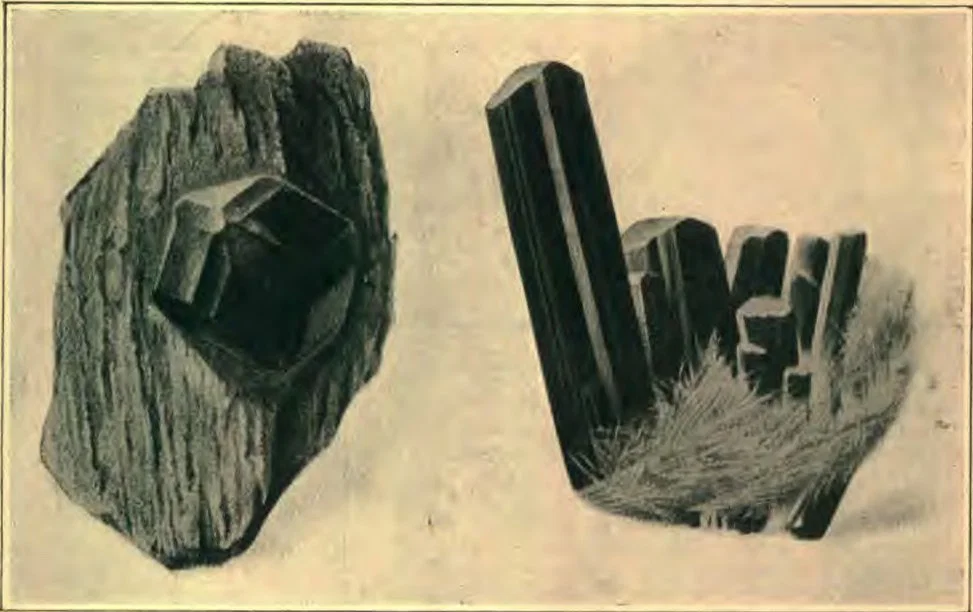
GARNET AND EPIDOTE CRYSTALS
Putting More Into Life Than Taking Out
“SEE how much you can put into it, instead of how much you can take out of it.”
A Mother's Song
By F. S. Armstrong
SHE was a dear old lady, one of intellect, education, excellent judgment, and true refinement; so one afternoon, when a gathering of mothers were discussing whether or not we should rock and sing our little ones to sleep, we were glad she was present, and that our hostess urged her to express her opinion.
A smile flitted across the dear old face as she laid aside the small sock she was knitting, and said:—
“My dear young mothers, let me tell you a little story—a true story. It settled this troublesome question for me, long ago, and it may be of assistance to you. When I was in my teens, my most intimate friend was a very beautiful and talented girl, the daughter of wealthy parents. She possessed a remarkable voice, which was cultivated and trained both at home and abroad, and when at the age of twenty-three she married and left her father's home, she was known as one of the finest singers in her State.
“I saw her but seldom after her marriage, but we were continually hearing of her wonderful voice and social prominence, and when we learned that a son was born to her, I wondered to myself what kind of mother the fashionable, flattered woman would make.
“When the child was eighteen months old, I visited her, and I shall never forget my first call to the nursery of her first-born. The sturdy, handsome little fellow gave a glad, boyish shout, and sprang into his mother's arms as we entered the room; but soon, being tired and sleepy, he nestled against his mother's breast, and said, ‘Sing a pretty song now, mama.’
“Directly the mother was rocking him to and fro, and the clear, rich voice that had so often held critical audiences spellbound, now filled the room with low, sweet melody, as the mother sang an old, beautiful lullaby. My eyes were so blinded with tears that I could scarcely see the sweet picture, but I drank in the music, and was satisfied that my friend was worthy of the sacred name—mother.
“After the little sleeper had been carefully tucked in bed, she turned to me, and said, ‘You may think me foolish, but I always rock and sing him to sleep once a day at least; he enjoys it so.’”
At this point of the tale the old lady paused for a moment, then continued:—
“Years after, I was traveling in Europe, and while tarrying for a few days in one of the principal cities, I learned that a prominent American was stopping in the same house with me. I was told, ‘He is the great tenor, Mr. ——, from America. Do you know him?’ Yes, I knew him—the son of my old friend and schoolmate; and I also knew that the ocean rolled between him and the grave of his gifted mother.
“I saw him often during my sojourn in that city, and a fine specimen of noble manhood he was. Riches, success, and flattery had not rendered him arrogant or egotistic. His mother had been a womanly woman, he was a manly man.
“During my last interview with him, I exercised one of the many liberties accorded to the aged, and requested him to sing for me. ‘What shall I sing?’ he asked. I answered, ‘Sing your favorite song, please.’
“He hesitated a moment, and a sad, tender expression came over his face. ‘My favorite is a very simple little song,’ said he, ‘and I rarely sing it unless I am alone, for it is very sacred to me, and strangers might not appreciate it; but you have asked for my favorite, and I will sing it for you—you knew and loved my mother, so will understand.’
“He went to the piano and played a soft, plaintive prelude; then in a low, marvelous voice he sang the selfsame lullaby that I had heard his mother sing to him so long before, in his babyhood.
“This, ladies, must be my answer to your problem.”
The knitting work was taken up as quietly as it had been laid down, but the question was settled forever—in my mind, at least.—F. S. Armstrong, in Farm Journal.
Fresh Flowers, or Faded?
A CHRISTIAN woman was employed in a home where a loved mother lay ill. Her daughter, a girl of fifteen, had never given her heart to Christ, fearing that by so doing she might lose some of her youthful pleasures, and saying that when she grew older, she would give herself to him. One day she came into the house bringing a bouquet of beautiful, fresh carnations for her mother. The nurse commented upon their loveliness, and then said: “We will not take them up to mother now; they are too fresh and beautiful; we will wait a few days.” The young girl was surprised, almost indignant, and sought an explanation. Said the nurse: “Is not this what you are doing to your loving Heavenly Father?” The girl felt the force of the illustration, and yielded her young life to the Master’s service.—The Epworth Herald.
The Keys of God
By Charles A. Campbell
O LORD, put thou a lock upon my heart,
My lips, my will, that there may never start
One thought or word or deed untrue to thee;
Set thou the lock, and keep secure, I pray, the key.
O Lord, my King, do thou unlock my will,
My lips, my heart; and by thy Spirit fill
My will with power, my lips with gentle speech,
And make my heart with love the wide world reach.
—Charles A. Campbell, D. D., in Sunday School Times.
The Officers of the Missionary Volunteer Society
By M. E.
No society of Christian Endeavorers in all the world need be despaired of,” says Francis E. Clark, “if there are enough devoted Christians left to serve as officers and chairmen of important committees.” This is only another way of saying that very heavy responsibilities rest upon the leader and his associates. It is their business to make the society a success. For this they should pray, plan, and work. It will mean working up programs which will attract, hold, and train the young people. But this is not all: the society that lives merely to produce good programs is dead. To make a society a success means also enlisting all in missionary endeavor; for in the ideal society every member is a worker. The officers succeed not so much by what they say and do as by what they get others to say and do.
General Duties
Aside from the duties indicated by the names of the officers themselves, it is expected that every officer will:—
Attend the society meetings regularly.
Be personally acquainted with all the society members.
Strive to increase the society membership.
Help to make strangers feel welcome.
Do faithful personal work.
Report missionary work regularly.
Study to learn the best methods for doing aggressive work: (a) By studying local conditions; (b) by studying adaptability of society members.
Co-operate with others.
Train a successor.
Co-operation
Few things are more needed than hearty co-operation among the officers. The success of a society often must be purchased at the sacrifice of some one’s pet scheme. At such times, be Davids. When he was forbidden to build the temple, he worked with all his might that Solomon might be enabled to build it. If another’s plan is adopted, enter into it as heartily as you would wish others to indorse your own. So far as possible, the plan for the society work should not represent the mind of just one officer, but should be the resultant of the individual planning and the joint counseling of all.
Training a Successor
Some one has said that no one ever succeeds in his work until he has trained a successor. Failure to do this has been a death-blow to many thriving young people’s societies. If every leader and his assistant are in reality sharing the duties of leadership, there will be one person in each society ready to step in when the leader steps out. If every secretary would faithfully train her assistant, there would no longer come to our ear the frequent complaint, “The society has a new secretary who does not understand her duties.”
Louis XIV of France said, “After me the deluge.” He cared not if France was hurled to destruction. It seems as if all he cared was to save himself from the discomfort of such an episode during his administration. But that is not the spirit in which the true Missionary Volunteer officer shoulders responsibilities. He is ever looking for new timber, and doing his utmost to season it, that the society building may constantly be improved and better equipped for its intended service.
Qualifications
There are no rules for duties that can supply the essential qualifications of society officers. The officers need a keen insight into particular needs, and that resourcefulness which meets emergencies, remedies defects, and strengthens weak places.
Surely every society officer should be a loyal Missionary Volunteer, whose aim in theory and practise is to give “the advent message to all the world in this generation,” and who is truly constrained by the love of Christ. He should have the Saviour for his daily companion, and know something of the power of prayer.
Let us bring in here the words of Dan Brummit, who has so successfully boiled the qualifications of leaders down to four words,—spirituality, sense, tact, and grit. These qualifications should be possessed not alone by the leader but also by every officer in the society. The first, if not all, is absolutely indispensable. Spirituality is to the society what steam is to the locomotive. That sense which brings in sufficient variety to keep up the interest, and yet ever forges on to the goal of preparation of all for more efficient service—how much the officers need it! How necessary an art is tact, to oil the wheels, to reduce the friction which is so liable to exist where many dispositions are brought in contact. And then—grit! Truly the officers need this “energetic courage,” which never despairs, but ever presses on, and refuses to give up to obstacles.
Finally, every officer should be a personal worker, ever seeking for souls as one who must give account.
Special Duties of Officers
Many societies accomplish little because the officers fail to know their individual duties. Many railroad wrecks come because some one misunderstood his duty. More than one army has been forced to retreat because some one blundered. Surely the failure to clearly understand one’s duties as a society officer, will be an obstacle to success in Missionary Volunteer work. All the society officers and chairmen of committees should co-operate to make their society ideal by counseling together, each one becoming responsible for the accomplishment of certain definite plans. Possibly the following suggestions will be helpful to some societies:—
The Leader
One union conference president said, “In every place where we have good leaders, we see excellent results.” Of all the offices in the society, this is the most important; and above all other officers, the leader needs adaptability to work with young people.
A good leader must not only be able, with the aid of his associates, to lay practical plans, but also to have them carried out. Just here was the failure of one leader, of whom a disgusted junior said, “O, she does all the work, and all we have to do is to say amen to it.” The mistake was not in her working, but in her failure to put the juniors to work. Interest and ability thrive best in the soil of service.
According to a discussion which took place in a meeting at the last General Conference, the leader of a Missionary Volunteer society should possess “promptness, discernment, stability of character, faithfulness in little things; he should be approachable, cheerful, magnetic, talk little but encourage much, always leading yet never appearing to lead.”
The leader should,—10
Lead the society meetings.
Be chairman of the executive committee.
Be a member ex-officio of all committees.
See that no officer neglects his duty.
The Assistant Leader
Since the duties of the leader may at any time devolve upon the assistant, that officer should, so far as possible, possess the essential qualifications for leadership.
The assistant leader should,—
In absence of the leader, fill his place.
Be a member ex-officio of all committees.
See that all committees work and report.
Get new members on committees (unless some other provision is made).
The Secretaries
Few realize the importance of this phase of society work. The weekly report is only a very small part of it, and the secretary and her assistant can do much to stimulate regular attendance and faithful reporting. This officer is the nurse of the society. Her finger is ever on its pulse, and it is the symptoms she records that guide us in diagnosis of the society’s prosperity.
The secretary should,—
Report all meetings of the society and of the executive committee.
Record all reports of missionary work.
Correspond with the conference Missionary Volunteer secretary, other societies, and, if possible, with society members who have moved away.
Report quarterly to the conference Missionary Volunteer secretary and to the church librarian.
The assistant secretary should,—
Gather reports of missionary work at each meeting and regularly from absent members.
Work for regular attendance.
The educational secretary should,—
Enroll as many as possible in the Missionary Volunteer Reading Courses.
Keep a record of all who enroll.
By constant effort urge all to persevere.
Strive to persuade and help all society members to become members of Attainment.
The Treasurer
The secretary and treasurer are usually the same individual in most of our societies, yet there is a wide field before the society treasurer, even in small societies. He should seek to develop a society of cheerful, liberal, and systematic contributors to God’s cause. If the society is raising money for China, the treasurer will bring to the meeting from time to time interesting news items from that field. He is the counselor of the executive committee in financial matters.
The treasurer should,—
Keep society books and funds.
Use funds as authorized by the executive committee.
Study best methods of raising funds.
Courage and Faithfulness
Let no officer feel discouraged. None possess the desired qualifications in full measure, but all may use faithfully their present abilities, and God will give the increase.
Every society that has good officers should be grateful . Poor plans and good leaders are far better for a society than are good plans in the hands of poor officers. Yet we must also remember that no captain ever sailed his vessel into port without the loyal support of some of the crew. Neither can any officer make a Missionary Volunteer society a success without the co-operation of its members.
M. E.
Two New Members Join the Instructor Band of Mercy
Two more requests for membership in the “INSTRUCTOR Band of Mercy” have been received. These are from Cecil Gibbs, of Hastings, Michigan, and Myron Evans Boss, of Collins Center, New York.
A Dog, a Man, and a Girl
HE was a poor, starved puppy, perhaps three months old. His color was a dingy yellow. His big paws looked out of place at the ends of his bony little legs. His ribs could easily be counted. His stomach was caved in nearly to his hunger-humped spine.
His ears drooped piteously, and his brown baby eyes had a wistful look in them, sorrowful to see. He was nosing around the back yard of a big hotel for something to eat. Perhaps his thirst was greater than his hunger; for it was a dry, dusty day in late December, and in all the Western town there were few places where a thirsty puppy might find a drink.
A big, strong man, the six-foot proprietor, came out and dashed scalding water over the puppy, laughing at the “fun” of seeing a poor little dog, frantic with pain, yelp and roll over and over in a sand pile by the unfinished house next door.
Soon the puppy rose and sneaked away to another back yard; for even his terrible burns could not for long distract his thoughts from the pangs of thirst and hunger. He found a dry, hard biscuit on the coal pile, and tried feebly to chew it; but not being very successful, he left it, and, staggering as he walked, tried to find a drink. Just then a little girl came out and threw away some soapy water from a basin. The puppy began to drink it, dirty and soapy as it was, from the ground where it had formed a little puddle.
The little girl saw, and, running to the hydrant, filled the basin with clean water, which she set before the puppy. He shrank from her in fear, but she stepped back and waited, and presently he gathered courage and drank.
O, how good the water tasted! But after a few greedy swallows, he went back to his dry biscuit. The little girl ran into the house, and brought some potato on a dish with gravy poured around it. She clapped her hands with delight as the poor little dog ate until his sides stood out with repletion. Then she brought a sack, and, folding it, laid it by the corner of the porch and coaxed the puppy to lie on it.— Our Dumb Animals.
Take Care to Do Right
“TAKE care to do right, and your rights will take care of themselves.”