The Youth’s Instructor, Vol. 59, No. 11.

News Briefs from Around the World
Earlier text: William Miller

The Acts in Alphabet

Ascension of Christ.
Baptism of Holy Spirit awaited.
Choosing of Matthias.
Descent of the Holy Spirit.
Experiment in communism.
First Christian martyr.
Great persecution of the church.
Holy Spirit given to Samaritans.
In the desert. Philip baptizes Ethiopian eunuch.
Journeys of Saul to Damascus.
Kindness of Barnabas to Saul.
Life restored to Dorcas.
Mission of Peter to Cornelius.
News of Antioch revival reaches Jerusalem.
Organization of missions at Antioch.
Paul’s first missionary journey.
Queer experience at Lystra.
Return to Antioch. Report to church.
Second missionary journey.
Third missionary journey.
Under arrest at Cesarea, Paul preaches to rulers.
Voyage to Rome.
Wonderful experience at Malta.
Xceptional privileges granted Paul at Rome.
Yearning over the Roman Jews.
Zeal to win all men to Christ.
— Mrs. J. R. Dowell.

Service to Others Enriches the Giver

He who renders great service to others, in that very service renders an even greater service to himself. It is impossible to enrich and ennoble the minds of other people by our precept and example, without doing in that good service even more to enrich and ennoble our own minds. J. W. Lowe.

The King James Version of the Bible

THIS year the three-hundredth anniversary of the appearance of our common English Bible will be celebrated both in this country and in England. There will be “a great popular demonstration in St. Paul's Cathedral, London; and a Bible exhibition under the direction of the British and Foreign Bible Society.”
The year 1611 was a great historic year for English-speaking Christians; for “the version of King James has had an influence upon the religion, the morals, the life, the literature, as well as the individual and the social ideals of all the millions who speak the English language, to a degree that no other single agency has ever exerted.”
It may be interesting to review some of the facts relating to this particular translation. There had been previous translations, but none of them was altogether satisfactory; so, acting upon the suggestion of Dr. Reynolds, King James of England laid plans for a new translation. Mr. Dixon Somerville, in a recent number of Service, gives the following account of this effort:—
Proclamation was made that all bishops were to search diligently for all men who understood Hebrew or Greek, that their services might be taken advantage of. Then he named fifty-four men from Oxford and Cambridge, who should meet, part at Westminster, part at Oxford, and part at Cambridge. A section of the Bible should be given to each of these groups. When the group should, by comparison and study, agree on a translation for its section of the book, this was to be submitted to the other sections for criticism. When all the reviewers should agree as to the translation, the book was to be published.
So far as history shows, only forty-seven of the fifty-four men named by King James actually took part in the translation. Among these were Dr. Andrews, of whom it has been said that “the world wanted learning to know how learned he was;” Edward Lively, “the greatest of Hebraists;” Francis Dillingham, “a great Grecian;” Dr. John Reinold, whose “memory and reading were near to a miracle;” Dr. Thomas Holland, “another Apollos, a most learned divine;” Dr. Miles Smith, who “had Hebrew at his fingers' ends;” Dr. Richard Fenton, of whom it was said that “never a more learned man hath Pembroke Hall, with one exception;” Dr. Samuel Ward, “skilled in tongues, though slow of speech;” and Mr. Andrew Dennis, “composed of Greek and industry.” In addition to these and other translators, the name of Dr. Thomas Bilson has been preserved. He it was who prepared the summary of contents at the head of each chapter.
We have so few facts concerning the days and months of toil spent by the devout translators that this word is of especial value: “Neither did we run over the work with that posting haste that the Septuagint did, if that be true which is reported of them, that they finished it in seventy-two days.”
The work hath not been huddled up in seventy-two days, but hath cost the workmen, as light as it seemeth, the pains of twice seven times seventy-two days, and more.” The reason for spending such a long time on the work is quaintly given in a sentence that modern workmen would do well to take to heart: “Matters of such weight and consequence are to be speeded with maturity; for in a business of moment man feareth not the blame of convenient slackness.”
The work was begun in 1607, and completed in season for the publication of the first volume in May, 1611.
Lovers of pure English are fond of calling attention to the fact that the King James Version rendered a signal service to the purity of the English language by the large proportion of Anglo-Saxon words used in it. It is said that whereas Gibbon used about seventy, Johnson about seventy-five, Swift eighty-nine, Shakespeare about eighty-five, the Authorized Version uses more than ninety Saxon words in every hundred employed. The Lord's prayer in Matthew contains, besides amen, sixty-five words, of which fifty-nine are Saxon and six Latin, and the first thirty-five are altogether Saxon. But the greatest service rendered by King James and his translators was that they put the Bible in the hands of those who had been without it; that is, the common people.

Our Wills Are Ours

Our wills are ours, we know not how; Our wills are ours, to make them Thine. — Tennyson.

The Weighing Machine

THERE is a machine in the Bank of England which receives sovereigns for the purpose of determining whether they are of full weight. As they pass through, the machine with unerring certainty throws out all that are of light weight on one side, and all of full weight on the other. Surely this is a true picture of the certainty of God’s judgments.— The Sunday School Chronicle.

The Snake and the Liar

OUT of the early history of the Christian church, two names have come ringing down the nineteen centuries, Judas and Ananias. Judas, the betrayer, has his apologists, who think we ought not to be too hard upon him. But did you ever hear any one speak a good word for Ananias, the liar, or apologize for him? The first liar that came into the world was the devil. He came in the form of a serpent. And if you will carefully notice, the human race instinctively feel toward a liar just exactly as they feel toward a snake. We despise the liar, and we despise the snake. Who trusts a liar? and who trusts a snake? The very minute you become a liar, you enter the snake family. The bite of the copperhead has not killed its victim any more surely than has many a lie. Lies are breaking up homes and blasting lives with the rising of every sun. When you become a liar, you belong in the company and family of the devil, and John 8:44 is the highest authority upon the subject.— Sunday School Times.

Pitkin's Message

NOTHING so perfectly reveals Horace Tracy Pitkin, who was killed by the Boxers in 1900, as his last recorded words, spoken to his Chinese helper while the devilish crowd were swooping down upon the mission: “Laoman, tell the mother of little Horace to tell Horace that his father's last wish was that, when he is twenty-five years of age, he should come to China as a missionary.” No man ever spoke more heroic words.— The Missionary Review of the World.

Blessed Are the Happiness Makers

“BLESSED are the happiness makers! Blessed are they that remove friction, that make the course of life smooth, and the intercourse of men gentle!”
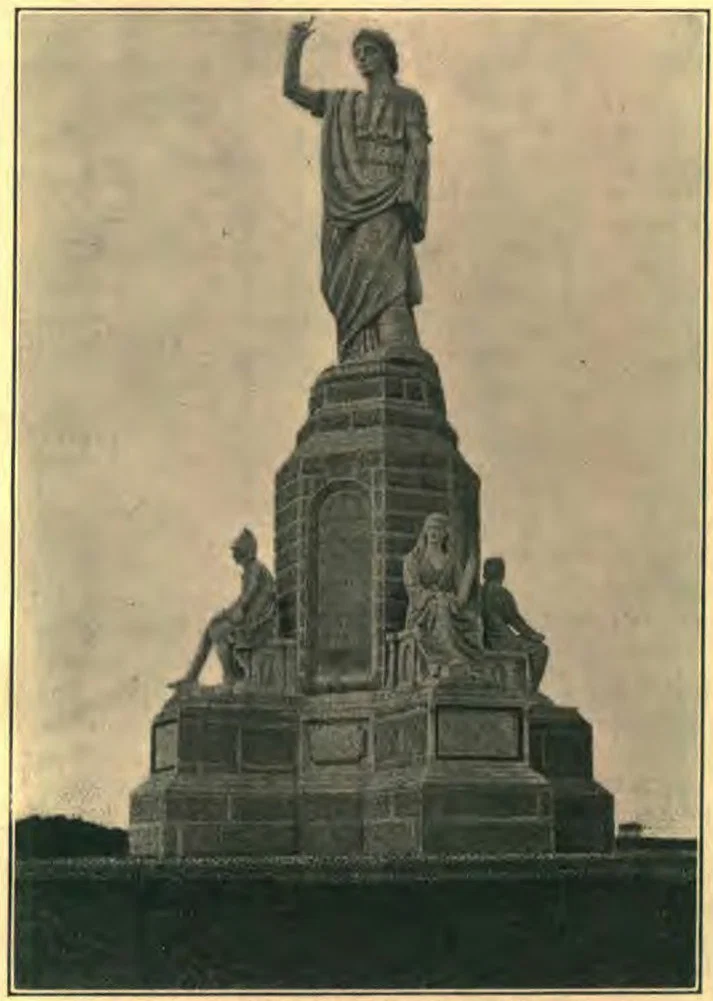
NATIONAL MONUMENT TO THE FOREFATHERS,
PLYMOUTH, MASSACHUSETTS
NATIONAL MONUMENT TO THE FOREFATHERS, PLYMOUTH, MASSACHUSETTS

You have reached the end of this edition.

The Youth’s Instructor · Mar 14, 1911