As I walked down to the wharf at North Sydney, Cape Breton, to take steamer for Newfoundland, my ardent desire to see the big island of which I had heard so much was mingled with whole-souled dread. I had sailed on the ocean before, and knew full well the pangs of seasickness awaiting me. However, my companion, Elder M. N. Campbell, walked with an air of confidence, assuring me there was nothing to fear, that he had made the trip several times, and had never been seasick.
Having bought our return tickets, we were asked to register. I afterward learned that the entire passenger list is immediately cabled to St. John’s, the capital of the island, so that people in the city may learn from the morning paper who are coming.
We took passage on the “Kyle,” a steamer that was launched from Newcastle-on-Tyne only a year before the great war began. Its speed is fourteen knots, and it was built to contend with the heaviest of ice. My friend and I were assigned the same stateroom. He chose a lower berth, and I took an upper in order to be next to the porthole. I wanted the fresh air, but was destined to enjoy it only a short time. Soon after leaving the harbor the steward came in and closed it tightly. It was well that he did, for that night we experienced that of which David told in the Psalms, “The stormy wind, which lifteth up the waves thereof.” I am sure David must, at some time in his life, have been on a sea voyage, for he described it all so well. “They mount up to the heaven, they go down again to the depths: their soul is melted because of trouble. They reel to and fro, and stagger like a drunken man, and are at their wit’s end.” All this I endured that night, and my only consolation was that my brother who had never before been seasick was suffering too, and almost as severely as I. The latter part of the psalmist’s description of a sea voyage, “He bringeth them unto their desired haven,” was fulfilled the next morning, ten hours after starting, when we steamed into Port-aux-Basques, a little seaport on the southwest corner of the island.
As we left the boat, customs officers awaited us and ordered all our baggage opened. Contrary to a prevailing idea, Newfoundland is not a part of Canada, although a part of the British Empire; hence, every one coming onto the island, whether from Canada or elsewhere, must submit to having his baggage overhauled. The officer found in my valises only one contraband article, a pair of opera glasses. In vain I protested that I had carried them for nearly twenty years. He demanded a deposit almost equal to their value if I took them with me. I told him to keep the glasses and I would get them on my return.
Our train was waiting, and we hastened to find a seat in the first-class coach, soon to begin our 548-mile trip across the island to St. John’s. This haste was important, for our tickets entitled us to seats there, and if crowded out we would have to ride in the second-class cars ahead, where there is no upholstering, and the traveler must be jolted about on seats consisting of hardwood slats only. Moreover, since the railroad is a narrow gauge, it was desirable that we secure seats opposite each other. On one occasion, on the trip, a fellow passenger with whom I was talking invited me to sit with him. I accepted, but—I weigh 180 pounds and he perhaps a little more. I wedged down halfway, could go no farther, and with difficulty got out.
We traveled at an average speed, including stops, of eighteen miles an hour. Of course in some places we doubled this rate and in others went much slower. Indeed, one told me he had seen men jump off from the rear end when the train was climbing a grade, run ahead almost to the locomotive, and jump on again. The roadbed is very rough, and the jolting of the train gives one the impression that he is traveling7at breakneck speed. Therefore, shaving while the train is in motion, is not an easy task, and if a passenger appears at breakfast with a piece of sticking plaster on his chin, one may know that he has been trying his hand at that treacherous feat. Along much of the way there are no fences by the railroad, and trees and bushes have been allowed to grow near the track. Once I saw a lady reach out of the car window while we were going at full speed, and pull a handful of foliage from the overhanging branches of a small tree.
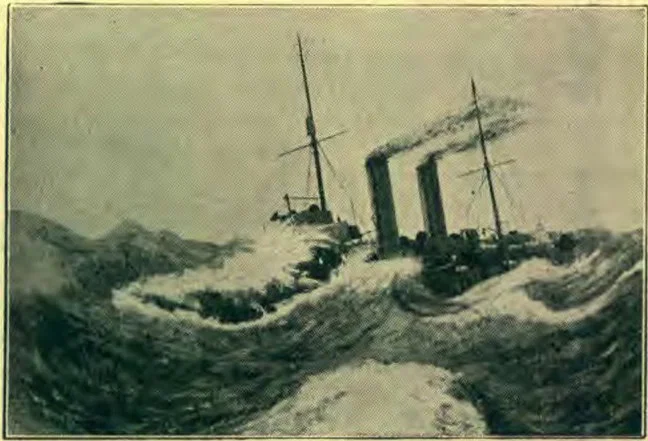
IN A HEAVY SEA OFF NEWFOUNDLAND COAST, WHEN TWO SEAMEN WERE WASHED OVERBOARD
On much of the route the scenery is magnificent. We started on the fourteenth of July and saw at that time mountains still capped with the snows of winter. One fourth of the area of the island is covered with water, ponds, lakes, and rivers in abundance. The ponds are fringed with water lilies, the lakes with trees which grow close to the water’s edge. The most common trees are spruce, birch, and larch. Along the railroad route there have been many forest fires. Wherever these have swept, beautiful, tall, pink flowers have sprung up. Because of this they are called “fire flowers.” The most beautiful scenery is along the Humber River, on the west coast. For about fifty miles from its mouth the river seems to be only a great arm of the sea stretching inland, rising and falling with the tide. In some places the giant cliffs tower above the river, casting their somber shadows over its depths, while farther up it runs through vast areas of forest and field, where roam the caribou, the fox, and the bear.
The name of the Humber River may have been borrowed from England, but in some names the people of Newfoundland are quite original; for example, Tickle Harbor, Badger Brook, Come-by-Chance, Hearts Delight, Hearts Desire, and Hearts Content. These are not obscure, remote places, but are all railroad stations. At each little station the people come to the doors or windows to see the passing train. It is the event of the day. At some places several persons will get on and pass through the cars to see if old friends are on board. Often their search is rewarded, and hearty greetings are exchanged.
We reached Grand Falls about midnight. It is here that Lord Northcliffe recently erected his large pulp and paper mills on the Exploits River, at an expense of more than £1,000,000 sterling. I was informed that the paper on which the London Times is printed is manufactured here. At this station a young woman boarded the train, and soon began knitting a pair of socks. As morning drew on, other women took out their knitting and began plying their needles swiftly. I watched with interest, for it had been a good many years since I had seen my patient mother doing the same for her sons. Then I thought of the Newfoundland boys away in the trenches, “somewhere in France,” who were to wear the socks that mothers and sisters were knitting here on the train.
At last our train pulled into St. John’s. The long journey was over, and we were glad to greet the smiling faces of Elders D. J. C. Barrett and R. A. Hubley. Newfoundland is a mission field under the direction of the Eastern Canadian Union Conference, and we were to attend a general meeting here of our people, which was to last five days. I was delighted to find that I was to be entertained at the home of Brother Johnston, whose daughter, Daisy, was one of my schoolmates years ago at South Lancaster Academy, and no less to find that my roommate here was to be Professor Kern, who had preceded us on the trip.
My special object in visiting Newfoundland was to meet with our young people there, and interest them in attending Williamsdale Academy in Nova Scotia. It was the first time a principal from the academy had visited them, and they responded well. Their response was due in large measure to the strong and helpful influence exerted by our workers there and the hearty coöperation of the brethren who accompanied me. A more intelligent and ambitious company of youth I never met. I was more than repaid for the time and expense incurred in my visit, when eleven of them definitely decided to join our school family in September. Four from the island are now earning scholarships.
Crossing the island the scenery often reminded me of the hills, valleys, and lakes of New Hampshire, but St. John’s seemed to be another San Francisco, only in miniature. It is a unique city, and one never to be forgotten. After my visit of less than a week, I understood better why all who have lived there think it is “the dearest spot on earth.” It has a population of 33,000, and is the nearest port in America to Europe. The city is built on a great hill that rises from the water’s edge. It thus overlooks a small but excellent harbor. The entrance to this harbor is about two hundred yards across and is called the Narrows.
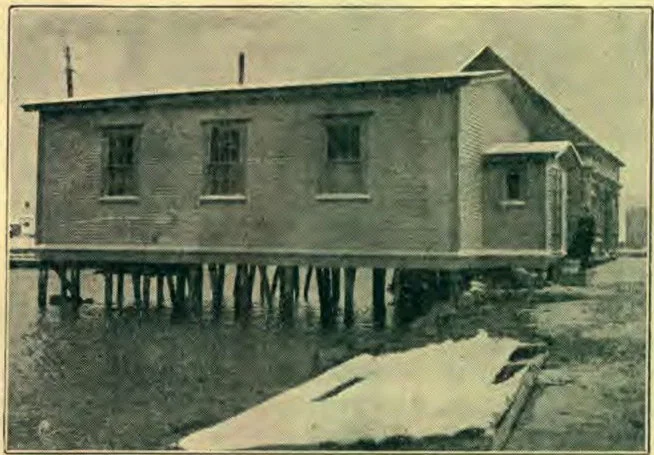
SEVENTH-DAY ADVENTIST CHURCH AT BAY ROBERTS
St. John’s is both an old and a new city. For centuries this ideal site was doubtless used by the Boothuks, Micmacs, or other tribes for an Indian village. It was one of the first places on the island to be settled by white men. But in July, 1892, a fire visited the city, destroying two thirds of the houses. Many of the old wooden buildings have been replaced by brick and stone structures, so that a more beautiful city has sprung from the ashes of the old.
This city has many fine buildings. Probably the8largest of these is the Roman Catholic cathedral, which looks benignly down on two smaller cathedrals, Anglican and Methodist, situated lower down the hillside. Away over at one side from these, like Mordecai in the gate, is the humble little church we call our own. Most of the business houses are on Water Street, a street running parallel to the bay. Here is the department store of Ayers and Sons, the largest in the city. There were four Ayers boys in the army. They were all killed in action, recently, and King George V sent a letter of condolence to the bereaved father.
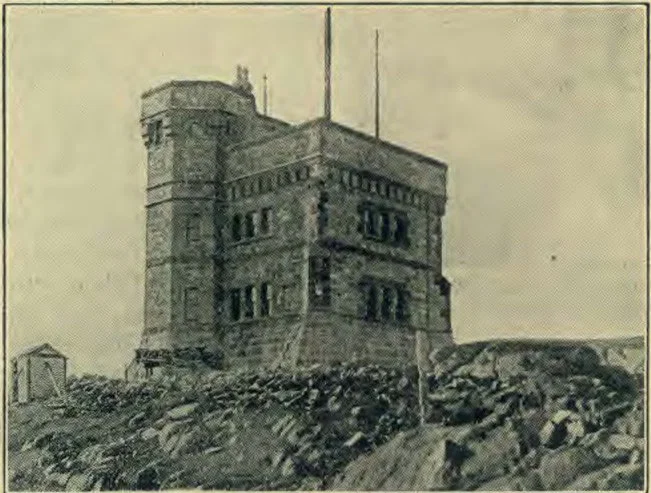
CABOT TOWER, ST. JOHN'S, NEWFOUNDLAND
High on a promontory overlooking the Narrows is Cabot Tower, a picture of which is shown here. Professor Kern and I visited this historic monument together. On the way up we were startled by the firing of a cannon near by. It was the “noon gun,” and by it the people of the city set their clocks and watches. Arriving at the top of the eminence, a fine view of the ocean was afforded. As I looked out upon its immensity, with here and there a sail to be seen, I could not but think of that June day in 1497 when the old grizzly sailor John Cabot first set eyes on the New found land. I thought, too, of John Guy, the first Englishman to successfully found a settlement on the island, and that eight years before the landing of the Pilgrim Fathers.
As we entered the tower, a large brass tablet arrested my attention. It bore this inscription:—
This Tower
is erected
to serve as a Perpetual Memorial
of the 60th Year of the
glorious Reign of
Victoria
Queen and Empress
and
in commemoration
of the
400th Anniversary of the Discovery
of
Newfoundland
by
John Cabot
Foundation Stone Laid June 22d, 1897
Building declared Open June 20th, 1900
We called on the keeper of the tower, an elderly man, who took pains to make us welcome and to explain many of the strange sights. He allowed us to look through the telescope with which he scans the waters, to get the first glimpse of every visiting ocean craft. It is his duty as the boats come nearer, and he recognizes their shape and flag, to signal all his information to the city.
Only a few steps below the tower we saw what was left of the fortifications of Queen’s Fort. There was the stone parapet behind which the old smooth-bore cannon had bristled defiance at unfriendly visitors. The cannons were gone and only the semicircular iron tracks of the carriages remained. Back of these was a little stone building, formerly the barracks of the garrison but now occupied by a private family. Behind this building was a curious stone structure of the shape of an inverted teacup. This, the lady of the house informed me, was formerly the magazine of the fort.
In the suburbs we met a ragged boy, and the following conversation ensued between Professor Kern and the lad:—
“What would you be if you were a man?”
“A soldier.”
“Why would you wish to be a soldier?”
“To fight the Germans.”
“Did the Germans ever do you any harm?”
“No, but see what they did to Belgium.”
“Would you not rather be a soldier of Jesus Christ?”
“Well, I don’t know.”
“Do you understand what I mean?”
“Yes, I learned in the Sunday school.”
“Do you not know that if you went to war you might get killed?”
“Yes, but I’d be willing to die for England.”
That boy had caught the spirit of thousands of other boys on the island, and indeed, wherever waves the Union Jack. We saw a regiment of soldiers drill on the parade grounds. Sturdy fellows they were, who had already learned bravery battling with the billows of the Atlantic, but had now exchanged the rod and net for the soldier’s gun and bayonet. It was fascinating to watch the quick movements of the ranks as9hundreds moved like a unit to the orders of the colonel in command. Yet I could not but feel sad as I thought of how they must all leave that week for England. Many a fond mother would never again see the support of her old age, and many a young wife would turn from the morning meal in tears because of the vacant chair. War is a cruel monster. A few hours after seeing the drill I read a cablegram in the post office. It told how Newfoundland soldiers had gallantly charged the enemy, but had advanced too far, and in a wood had been cut down, four hundred falling before the withering fire of the German batteries.
One other feature of life in Newfoundland must not be overlooked, and that is the famous Newfoundland dog. He is to be seen on every street, and is always the faithful friend of the children. Many stories are told of his heroic deeds in rescuing them from danger. When the Prince of Wales, the present king of England, visited the island a few years ago, he was presented with a full-blooded specimen of this noble breed. The prince was very fond of his new pet, and walked up Water Street, sporting with him amid the acclamations of the crowd.
Before returning home I visited a company of our people living in one of the out harbors, Bay Roberts. This village is built about one of the many inlets of Conception Bay, and is almost due west of St. John’s. The principal occupation here, as in so many other parts of the island, is fishing. At the time of my visit you might walk through every street and never see a young or middle-aged man. There were old men, women, and children. Where were the others? A few had gone to the war. Nearly all were on the Labrador coast, fishing. It is their harvest of the year.
A few small boats were bringing in catches while I was there. One boat was loaded with capelin. This10fish is about seven inches in length. It is caught in large quantities, and some are dried on the scaffolds called “fish flakes,” and used for food, but hundreds of tons are used for fertilizing the ground. A barrel of fresh capelin at the ship can be bought for only twenty cents. I saw four three-pound codfish sold for twenty cents. Three oranges are worth twenty cents there. In fact, Newfoundland is the home of the twenty-cent piece, and this sum of money seems to be a favorite price.
On a small wharf I found some men slitting, cleaning, and salting codfish. In a near-by shed were 150 quintals of these fish. They were piled in long tiers, like so much cordwood. As the men cleaned the fish, they threw all the livers together. They were extracting the oil from these, and had already filled four great puncheons with the dark-amber oil. They told me that in its crude state it is worth $140 a ton, but refined it sells for $2.50 a gallon.
Probably our little church at Bay Roberts is different in one respect from any other Adventist church in the world. As you will see from the picture, it is on piles and is built wholly over the briny waters of the bay. It was constructed by Elder Hubley, and is well finished inside. Look closely and you will see the bottom of the baptistery tank under the church. When a baptism is to be performed, water is pumped into the tank from the bay. When the ceremony is over, a plug is pulled, and the tank is soon empty again. One of our prospective Williamsdale students is standing on the steps.
My return trip across Cabot Strait was pleasant. The gulf was calm and the weather beautiful. And now as I think of Newfoundland, it is not as a mere island on the map, but a country animate with life, and with a people noble and kind-hearted. They are ready for the message that God has committed to us to bear to them. In scores of their coast towns, where live the simple, honest fisher folk, the word of present truth has never yet been spoken. Now is the time to work for Newfoundland.
A Peculiar Number
By Lawrence D. Rhoads
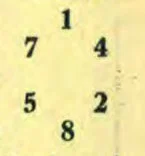
Curiosities in figures are fascinating to many. If the reader of this article will take paper and pencil and perform a few simple operations in multiplication and addition, he will be surprised at the results arising from a certain number. If you are able to remember that the number we shall use is 142,857, you can present the following peculiarities later on to others. Any one forgetting the number can readily derive it by changing the fraction one seventh to a decimal of six places. At the seventh place the figures begin to repeat themselves, so our number is a circulating, or repeating, decimal.
Let us begin by writing the figures of 142,857 in the form of a circle or, as we might say, in cyclic order. Multiply the number by 2. Now look at the cycle of figures and you will find that your answer can be read from the cycle by starting with 2 and reading in clockwise order 285,714. Multiply the original number by 3 and you will find the answer in the same cycle of figures as 428,571. The products by 4, 5, and 6 can likewise be read from the same cycle, as you will find if you multiply correctly. Only a very few numbers have this striking property, and all others are much larger than the one given. Multiplying by 8 you should get 1,142,856, which consists of more than the six figures in the cycle, but add the first digit 1 to the last digit 6, making 7, and you can read again from the cycle of figures 142,857. The same thing can be done with all possible multipliers in the hundreds and thousands, with a single exception. Going back and multiplying by 7 you will get another peculiar result, for it consists entirely of nines,—999,999. Multiply by any multiple of 7 and you will find that the product can always be changed to the same form—999,999. For instance, the product by 329 is 46,999,953. If you write the number of millions beneath the hundreds and add, you will get, as I before suggested, 999,999. Try a few other multipliers and see whether you can obtain similar results.
For a little variation, try another method. Start with 142,857, or any other number from your cycle of figures, and multiply by 77; then multiply the product by 13. Suppose that you begin with 571,428, your final result should be 571,999,428. You see that the result can be obtained by simply splitting the multiplicand and writing 999 between. If you wish to pose before your friends as a “lightning calculator,” you can easily achieve success with a little practice.
As a final example of curious products, start with 142,857 and as you continue to subtract 15,873, successively multiply the difference by 7. The results will then appear as follows:—
The bulky wall telephone apparatus, with its heavy coils and clumsy receiver, is doomed to give way to an interesting new invention if the reports from the University of Utrecht and the United States Consul at Amsterdam are to be believed—and the reliability of consular reports is rarely questioned.
A Dutch inventor named Peter de Lange has devised a new receiver and transmitter combined, which acts upon an entirely new principle. His invention is called the thermaphone, for it depends upon the heat generated in a tiny bit of platinum wire by an electric current passing through it for the vibrations which give him the audible message. These vibrations are said to reproduce voice tones far more clearly than is done by the old-style instruments.
The whole instrument is little larger in circumference than a pencil, is only about an inch in length, and can be carried in the pocket. It is screwed into a tiny electric contact in the wall. Instead of the high voltage current now used in these instruments, the new thermaphone will operate upon a tiny pressure and amperage — so small in fact, that instead of being knocked over by a shock, a person receiving the whole of the thermaphone’s working current could not feel it. This fact, which will mean an enormous saving to the telephone companies and their subscribers, combined with the fact that this new instrument costs but thirty cents, will insure the ready acceptance of the thermaphone in the United States if it can make good its claims.— Illustrated World.
October
By Geo. McAdam
On the hill the goldenrod;
Over the moor the spent grass, dead;
Along the way the sumacs nod,
Splashing the covert with glorious red.
So comes Autumn with stealthy step,
Stealing our Summer treasures away:
Throwing, to comfort our hearts bereft,
A wondrous glory o'er every day.
— Geo. McAdam.
Smile
It doesn't pay to be ill-natured. A grouch in the system is as deadly to progress as a ball and chain at the ankle. The ball-and-chain combination doesn't keep the wearer from toiling like all creation, but it holds him back quite effectively. It is the same way with the grouch.
Sometimes ill nature is a disease — sometimes just a habit. Even when it is a disease, there is usually a cure for it. Calomel has been known to work wonders with people who could not see anything in a doughnut but the hole, whose mere presence was enough to blot out a rainbow. Ill nature as a habit is no harder to break than any other of the evil habits that afflict the human kind.
The fellow who gets up in the morning with a smile, carries it with him all day, and takes it home at night — ah, the world will smile with him, at him, and for him. He may not amass great riches, but he will glory in a priceless wealth of friends. Men may not uncover at mention of his name, but wife and children will listen for his footsteps and crown him with affection. He may not be hailed as the conqueror of others, but he will be blessed in the realization that he has conquered himself. The feeling that expresses itself in a smile is worth cultivating.— Ambition.