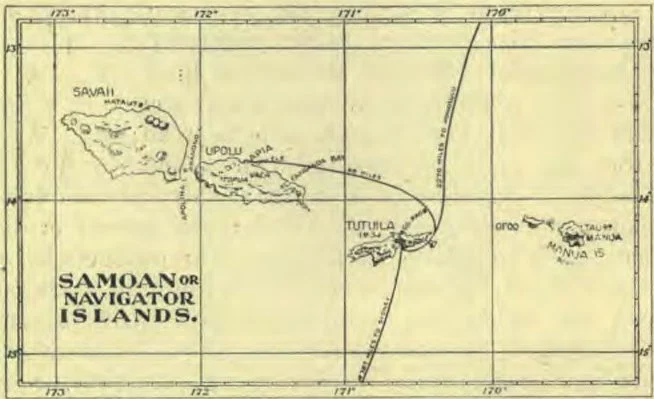
Since snapshots are not allowed at Pago Pago, we filmed as many mental pictures of this peaceful little world as memory could retain. Some one described it as a world of peace that passeth the understanding of any one not born a Samoan. At least their wants seem few and easily supplied, as their food needs little cultivation or preparation, and their costumes are largely born, not made. But though they go hatless, shoeless, coatless, and often with but one piece of raiment, yet they seem to possess a love for adornment and a certain refinement and grace, a naïve coquettishness and picturesque simplicity not tinctured with coarse bravado. Living as they do, on a narrow shelf of beach, between the sea and the sky, and under great tropical trees that toss the air breathed by a thousand glowing blossoms, they are still nature’s children, and not yet contaminated by the rapid stride of civilization.
The sister steamer of the “Sierra,” the “Sonoma,” was met at Pago Pago by four thousand Samoans, who came from a radius of five hundred miles, wearing full war paint and feathers, and for three hours entertained the passengers with native songs and dances. Following the dance, a big native feast was held, winding up with the passing of a huge bowl of kava, the native drink, of which all partook.
As we sailed out of the harbor, which is an ancient crater, very deep, and completely landlocked, the natives who assembled to greet the ship, quietly glided away, by shore and by sea, to their various little homes that polkadot the sugar cane and coconut groves. The rowers kept time with their oars to a native chant that floated to us on the breeze.
On the maps a little dot is placed and called Tutuila. To us it now represents much more,—the last landmark of our voyage, the last bit of American soil on which we may, perhaps, ever tread, the last place where we may greet the Stars and Stripes, and the last point where we may trust our letters to the care of a United States postage stamp. It also represents to us an interesting people, whose eyes have a pathos that haunts us, and in whose honest hearts we feel are deep places where the seeds of truth should be planted. Our hearts thrill with a new desire that the gospel torch shall be lighted and burn brightly, so that the people of this winsome little out-of-the-way islet may see the way to Jesus. To some it might seem a drowsy old place and slow, but I can well imagine that a native once lured away could not get back fast enough. And this was proved by the one who returned home with us on the “Sierra.”
When fluttering handkerchiefs and waving flags became indistinguishable by the fast-widening distance, we viewed again the contour of the island, with its bold coast line and the sharp-peaked, highly picturesque mountains by which it is traversed. Tutuila is about seventeen miles long and five miles wide, and is said to contain over five thousand inhabitants. There was no diving or swimming exhibition here. Doubtless the swimmers fear too close companionship with the sharks which infest these waters.
Later we passed in sight of Vatoa, or Turtle Island, where Captain Cook once essayed to land, but the natives were so forbidding that he decided not to do so. This was the last land we saw, although the water was at one time covered with dirt from Fiji, and occasionally that from some other island floated on the waves. We strained our eyes in vain in the direction where our own island, Pitcairn, lies.
On an outbound trip from Pago Pago, the “Sonoma” sighted a volcano in full eruption on a barren Tongan island, making a glorious spectacle at night. They also saw Norfolk Island and Lord Howe Island.
When the wooded heights of Tutuila were left behind, there was some change in the temperature and in the water. This was our most uncomfortable time after the first two or three days of the voyage. We had struck the trade winds, and the sea was choppy. The waves were running high, and flew over the deck. The stateroom portholes were closed, and we could get no ventilation down below. We could not sleep in the cabin, and spent the night in the social hall. We could get some air there, although the water dashed through if the window was open but a little. The room looked like a very active morgue, whose occupants often sought for a softer spot and a breath of air.
The sun was now directly overhead, and we crossed the date line just south of the Fiji group, in south latitude 19. Had we crossed the equator at the Gilbert Islands, we would have had zero latitude and maximum longitude. Now the longitude began to decrease, and the latitude was already increasing. We were indeed lost, for we were in a new latitude and a new longitude, and the sun was traveling north instead of south. People were speaking of our destination as “over here,” not “over there.”
NATIVE SAMOAN HOMES
Knowing our predicament, the erstwhile generous captain turned robber and took from us one entire day. Not satisfied with that, he took a night also, and even tried to beguile us into believing that when we went to sleep Tuesday night we woke on Thursday morning11. Of course he explained it all to his own satisfaction, that each degree of longitude we had passed represented a gain of four minutes’ time, and that we really were in debt for the greater part of the day and night he had taken from us. But I doubt not that on his return he will hunt up and take possession of that lost twenty-four hours, while we are forever deprived of it.
On nearing Tutuila, the ship’s force had resumed their dark woolen garments, and, notwithstanding the heat, continued to wear them. So inflexible are seagoing rules and etiquette.
A pleasing diversion occurred one morning when we sighted a four-masted American schooner loaded with lumber. She was the only vessel we had seen on the high seas in all this voyage, and we were glad to run across her. We had seen the smoke of the “Great Northern,” about three days from San Francisco, and met one of the Oceanic vessels one night too far away to see. The vessels were in wireless communication, or we should not have known that we met her, although we were on the lookout for her.
We sighted the schooner about half-past six, passed her about eight, and by nine-thirty she was out of sight, far back in our wake. We watched her with our opera glasses until there was not a speck of her to be seen. That incident gave us a better appreciation than anything else of how fast we were going and how far we had gone. The schooner signaled that they were from Puget Sound, had been out seventy-eight days, and were going to Melbourne. We reckoned that it would be one hundred days from the time they left port until they arrived. It had taken us about three hours to pick them up, pass them, and lose them in the distance.
For the Finding-Out Club
IN sending in the preferred pronunciation of the following words, state the authority you consulted:—
apostles
speedometer
pessimistic
Allies (n)
despicable
automobile
grievous
valet
previous
chic
commandant
chiropodist
noncombatant
chassis
acclimated
chauffeur
automaton
Answers to Questions in “Instructor” of August 22
I. THE Triple Entente comprises Great Britain, France, and Russia, while the Triple Alliance when formed was composed of Germany, Austria-Hungary, and Italy. Italy has withdrawn from the Alliance.
2. The Balkan States include Roumania, Serbia, Bulgaria, Turkey, Montenegro, Albania, and Greece.
3. The inhabitants of Bulgaria speak the Bulgarian language, based upon the ancient Greek and mixed with various modern languages.
4. The capital of Roumania is Bukharest; of Bulgaria, Sofia; of Serbia, Belgrade; of Montenegro, Cettinge; of Albania, Durazzo.
5. Gallipoli is a seaport of Turkey in Europe on east coast of peninsula of same name. The Vosges are mountains that separate German and French territory. Saloniki is a seaport in European Turkey. It belongs to Greece.
6. The ruler of Bulgaria is sometimes called czar, though his usual title is that of king.
7. An emperor is monarch of an empire. The title is regarded as superior to that of king, who rules only a single people; while an emperor rules over conquered or confederated peoples. Thus, the “king of Prussia” is “emperor of Germany;” the “king of England” is “emperor of India.”
8. The king of England, George V, is first cousin to Emperor William.
9. The kaiser of Germany is king of Prussia.
10. A dirigible balloon is a balloon that can be directed; a dirigible torpedo is one that is steerable.
A monoplane, an airship supported by a single aëroplane.
A periscope, an optical instrument on some submarines to permit of an outlook over the water when the boat is submerged.
A mitrailleuse (mē-trā-yūz’), a breech-loading machine gun, consisting of a number of barrels fitted together, and so arranged that the barrels can be fired simultaneously or successively and rapidly. It shoots mitraille, or grapeshot.
A Zeppelin, a dirigible airship invented by Count Zeppelin of Germany.
11. The United States, Norway, Sweden, Switzerland, Holland, and China are neutral countries.
What Can a Kitten Do?
By E. Grahme
I’m just a little pussy cat,
As happy as can be;
I’ve such a lot of playmates, who
Are very fond of me.
And what’s a kitten small to do
Who wants to sleep when, say,
She’s tickled with a flower, you know?
What can she do but play?
I sometimes wish they’d let me lie
And sleep upon the rug,
Or in the basket that’s my own,
Curled up so warm and snug;
But when I see a ball of string,
A ball that rolls away,
Or else a tempting cotton reel,
What can I do but play?
I have a little master dear,
A little mistress, too;
They love me so, I can’t complain,
Or “Please don’t tempt me” mew.
It isn’t really teasing me—
Too kind to tease are they;
So when they want a game with me,
What can I do but play?
— E. Grahme.
When England Taxed the Sun
By Gladys Blake
Isabel had some difficulty in walking the three blocks that lay between her own home and her cousin’s. Not that she was lame or sick or anything of that sort, but because it was such a bright and beautiful spring morning that she wanted to run, hop, skip, or do anything more lively than a prosaic walk. And if she had been a few years younger or the street just a little more private, it is likely that she would have done so. Yet, anxious as she was to dance over the distance, she was by no means desirous of reaching her destination with dispatch.
When she finally stood in front of her uncle’s handsome home, she continued to stand for quite a while. The bright morning sunlight was streaming against the upstairs windows, pleading for admittance; the fresh spring breeze brushed the glass beseechingly; and Isabel smiled with sudden humor. “You won’t get in,” she told the elements. “The odds are all against you. You do your best, I know, but you can’t overcome the obstacles in your path—glass panes, green shades, thick curtains, and cretonne draperies. It’s an unequal contest. Give it up and go where you are appreciated.”
It seemed to Isabel that the breeze sighed and the sun’s bright face clouded in response to her words. At any rate, she sighed and clouded as she went up the steps and entered the darkened hall. Her aunt met her at the foot of the stairs and told Isabel that her cousin would be delighted to see her. “Just go up to her room,” she said. “The poor dear has a dreadful cold.”
Isabel went up and was welcomed at the door by a heavy odor of camphor and a hoarse voice. A small fire was burning on the hearth, and the air in the room was stuffy and stale. A pretty girl sat sneezing and crocheting in a big armchair near a small table, on which lay half a dozen handkerchiefs surrounded by a motley collection of bottles and cups. She greeted her cousin warmly. “Do come cheer me up,” she said. “I’ve been living for two days on castor oil and horehound candy, and I don’t know which I hate the worse.”
Isabel took off her hat and jacket and tossed them on the bed. “Let’s have a little air,” she suggested. “You don’t think it would prove fatal, do you?”
“Why, leave the door open if you are too warm,” said her cousin heartily, and Isabel meekly opened the door into the darkened hall.
“I’ve brought you something,” said Isabel as she came back. “It’s a letter.”
“O!” cried the girl. “Has the mail come?”
Isabel was carefully untying a little package. “The mail that brought this,” she said, “came over a hundred and forty years ago. It was written by your great-great-grandmother when she was a girl.”
“Dear me!” murmured her cousin. “I didn’t know I ever had a great-great-grandmother! I suppose you have one of Aunt Mary’s heirlooms,” she added without interest.
Their Aunt Mary was the nurseryman who cared for the family tree! When one wanted to know—though one seldom did—who one’s great uncle Charles married the second time and on just what date one’s Cousin Laura was killed by a British bullet, one appealed to Aunt Mary for the edifying information. She it was who kept all the records, diaries, and old letters that had escaped the vicissitudes of the years.
“Aunt Mary lent it to me at my request,” explained Isabel. “I think it will do you good to read it.”
“If I must endure it, then you read it to me,” said her cousin. “Turn on the light by the piano.”
There was a little cabinet piano in one corner of the room where the owner did most of her practicing, and on the top stood a very pretty electric lamp with a silk shade. It may not have been a very expensive lamp, but it certainly did not deserve the glance of unutterable scorn that Isabel cast upon it. “I’d like to shake you, Lucile,” she cried. “Lamp, indeed! Do you realize that the sun is blazing outdoors?”
Lucile laughed. “Raise the shades if you prefer,” she said. “I was afraid the glare might hurt my weak eyes. I really have a severe cold.”
“No glare could ever get through all these curtains and things, even if you left the shades up to the top,” said Isabel. She went over to the window and not only raised the shade, but threw up the casement and knotted the curtains to one side. The sun poured in gloriously, and the air was sweet and fresh. “‘Hail, holy light, offspring of heaven, first-born!’” she caroled gayly.
“Are you beside yourself?” asked Lucile.
“No. I’m quoting Milton.”
Isabel came back to her seat and opened the old letter. It had been so carefully preserved that it did not look its age. Or perhaps some wise young lady of a more modern day had copied it onto newer paper. At any rate, the words were the words of a maiden13who had visited in England in the days when George III sat upon the throne, and just before a wonderful name was enrolled among the nations of the world. The things she wrote to her sister in America must be true, for they are vouched for in history. Lucile laid down her work and leaned back in her chair with a camphor bottle to her nose while Isabel read the following:—
“My DEAREST SISTER: I am writing this letter by candlelight on one of the loveliest autumn days that ever dawned. You say that Parliament has put a tax on your tea? Well, rejoice that you have still the sunlight and the air! Here in England they have taxed the sun. For every window in one’s house one must pay a tax, and people are bricking up their windows to reduce the expense. The houses are as dark and dank as cellars, and everybody has a cold. It’s very ennobling—if there is such a word! We are all becoming blue-blooded. My hands and nose were blue before I’d been in this house a week, and I have hopes of being a full aristocrat before I come home. Of all the outrageous taxes ever invented by a grasping government, I think this one is the worst. And yet Parliament thinks it has done something very clever. I wish all the M. P.’s could have such a lesson as Mr. Sheldon has had. But not all of them have as clever wives as Mrs. Sheldon. I must tell you what she did. About two weeks ago the distinguished M. P. went to France on business and left everything in his wife’s care. He has a beautiful home and much handsome furniture, but the thing for which he is most noted is his greenhouse, where he had some of the rarest and most beautiful plants and shrubs in this part of the world. I have twice walked through it—hands behind my back—and I have never seen anything like it before. I coveted everything I saw; but since I disturbed nothing, I was given a standing invitation to come whenever I pleased. Mr. Sheldon was loath to leave home, as both his children were ill, but was forced to do so. After he was gone, his wife had an inspiration. She had all the shrubs taken out of the greenhouse and carried up to the children’s playroom, and, by placing rugs and tables in the glass house, made it into a sun parlor for the children. When the M. P. came home yesterday, he found all his flowers dead for lack of sunlight and his children well. Mrs. Sheldon explained that she had merely exchanged nurseries. The distinguished gentleman had absolutely nothing to say. I hope it will influence his vote at the next session of Parliament. England is spending a great deal on botanical gardens just now and shutting her children in out of the sun. She has a strange idea as to which is the more valuable plant.”
Isabel put down the letter. “That’s the part I wanted you to hear,” she explained. “I believe it’s the only time in history that a nation ever taxed the sunlight. But if such a tax existed in America today, you would escape it entirely. No, I take that back. If such a tax existed today, you would begin to appreciate the sun and would pay almost anything to get a little of it. But because the easiest way to cure a cold is the cheapest, you won’t believe it. This old letter I’ve just read you has a message for you. May I tell you what it is?”
“No, you may not!” laughed Lucile.
“Then I’ll play it instead.” And going to the piano, Isabel began to play:—
“Clear the darkened windows, open wide the door;
Let a little sunshine in.”
— Gladys Blake, in The Visitor.
He Careth for Me
By M. E.
(Texts for October 8 to 14)
That matchless psalm, the twenty-third, should help us to understand God’s care for us individually. It is the most complete picture we have of the Great Shepherd. But we who live down here in the twentieth century, comprehend so faintly this peerless picture by David that many of us lose the touches that prove most conclusively his care for each one of us in all the experiences of life. We cannot appreciate fully the loving solicitude with which the shepherd on those Judean hills cared for his sheep.
Open your Bible to Psalm 23, while we get another glimpse of the Judean shepherd and his flock. It is morning and he is leading his sheep into green pastures where they may feed and find rest during the heat of the day. There are not many streams, but the shepherd knows where the “still waters,” or wells,14are, and to these he leads his sheep that they may quench their thirst and be refreshed. Should a sheep stray into a private field or vineyard and be caught, it would be forfeited to the owner of the land, so the shepherd watches carefully each sheep in the flock and brings back the wandering one—yes, he “restoreth” it. He leads his sheep in right paths; for he knows where the cliffs and the precipices are that he must avoid; but sometimes even right paths lead “through the valley of the shadow of death,” where dangers expected and unexpected assail the flock. Then between the foe and the flock stands the faithful shepherd protecting the trembling sheep that cuddle near him so his rod and staff may “comfort” them.
We must not forget that the shepherd would not have known where to find food for his sheep had he not first traversed the country and by dint of hard labor prepared a feeding place for them. A traveler from Judea helps us to appreciate the skill and heroism required to do this, when he says, “There are many poisonous plants in the grass, and the shepherd must find and avoid them. A cousin of mine once lost three hundred sheep by a mistake in this hard task. Then, there are vipers’ holes, and the reptiles bite the noses of the sheep if they are not driven away. The shepherd must burn the fat of hogs in the holes to do this. And round the feeding ground which the shepherd thus prepares, in holes and caves in the hillsides, there are jackals, wolves, hyenas, and tigers, too, and the bravery and skill of the shepherd are at the highest point in closing up these dens with stones or slaying the wild beasts,” and in this way preparing a table for his sheep in the presence of their enemies.
But let us return to the shepherd at the close of the day as he leads his flock to the fold. He does not drive them in carelessly. Through the day he has watched them together, and we almost forget that his eyes followed each sheep in the flock; but there is no mistaking it now, for stationing himself in the door, he inspects them closely one by one as they go into the fold. “He has the horn filled with olive oil, and he has cedar tar, and he anoints a knee bruised on a rock or a side scratched by thorns. And here comes one that is not bruised, but simply worn and exhausted; he bathes its face and head with the refreshing olive oil, and he takes the large two-handled cup and dips it brimming full from the vessel of water provided for that purpose and lets the weary sheep drink.” And so he keeps on until every sheep is inspected and sent in where it can rest safely through the night.
Now read the psalm again with this ray of Oriental light shining upon it. But remember the shepherd you see in it is the Lord, and you are the sheep of which he is taking such loving, faithful care. The picture is given that you may better understand how much your Saviour loves you, and with what tenderness he watches over you. And the picture is complete. It covers the whole day. Not for a moment does the Shepherd’s watchful care cease. Today he is caring for you, and every today he will care for you. Do not worry about tomorrow; it always lies beyond today. Its dangers cannot touch you; only today is yours; and God will take care of today. His care is always just for today, just when you need him most. And he wants you to rejoice in his care today, nor darken its hours with fears of a coming storm.
“He knows, and loves, and cares,
Nothing this truth can dim;
He does the very best for those
Who leave the choice with him.”
And you may be sure God will never forget you. Your friends may; your loved ones may; but God will not. You are graven on the palms of his hands; his thoughts are with you continually. The mountains may depart, and “the hills be removed,” but even in these calamities God will not forget you nor withdraw his loving kindness from you. In all the storms of distress and trouble, you may rest in perfect peace; for he cares for you. When you are called to pass through the waters of affliction, he will be with you. His strong hand will protect you from the fiery trials, and guide you safely past the hidden snares of the enemy. He has a very personal interest in you. When things go hard, he pities you; when you are weary, he wants you to let him give you rest. And always he wants you to come to him for just the help you need.
“When shadows hang o’er the whole day long,
And my spirit is bowed with shame and wrong;
When I am not good, and the bitter shade
Of conscious sin makes my soul afraid;
And the busy world has too much to do
To stay in its courses and help me through;
And I long for a Saviour—can it be
That the God of the universe cares for me?”
“Oh, wonderful story of deathless love,
Each child is dear to that heart above!
He fights for me when I cannot fight,
He comforts me in the gloom of night.
He lifts the burden, for he is strong;
He stills the sigh and awakes the song;
The sorrows that bear me down he shares,
And loves and pardons because he cares.”
MEDITATION.—I do thank thee, Tender Shepherd, for thy watchful care over me. So often I’ve wandered away, and thy bruised feet and loving arms have restored me to the fold. I have cost thee so much, am returning to thee so little. Thou art wondrously patient with me. I do thank thee that thy loving, watchful care does not fail. I am resolved with David “to dwell” with thee forevermore.
SPECIAL PRAYER.—This week all the members of our Morning Watch prayer circle are invited to pray unitedly for those who manufacture and distribute truth-filled literature. Time is short, and great responsibilities rest upon our publishing houses in the finishing of the work. Give them a lift with your prayers.
M. E.
A Brave Little Girl
A LITTLE girl with a cut in her hand was brought to a physician. It was necessary to make a few stitches with a surgeon’s needle. While the doctor was making preparations, the little girl swung her foot nervously against the chair, and was gently cautioned by her mother.
“That will do no harm,” said the doctor kindly, “as long as you hold your hand still,” adding, with a glance at the strained, anxious face of the child, “You may cry as much as you like.”
“I would rather sing,” replied the child.
“All right, that would be better. What can you sing?”
“I can sing, ‘Give, give, said the little stream.’ Do you know that?”
“I am not sure,” said the doctor. “How does it begin?”
The little patient sang a line.
“That’s beautiful!” said the doctor. “I want to hear the whole of it.”
All the while the skilful fingers were sewing up the wound, the sweet, childish voice sounded bravely through the room, and the only tears that were shed came from the eyes of the mother.
It is said to be a fact that some expression of one’s feelings tends to lessen pain. Since weeping and groaning are distressing to one’s friends, how would it do for all to try singing instead? Jesus helps his children to sing even in trials and pain.—Selected.
A Prayer for Youth Entering Life
“THE fishermen of Brittany utter this simple prayer when they launch their boats upon the deep: ‘Keep me, my God; my boat is small and the ocean is wide.’” A good prayer for youth just entering upon life.
Wasted Time and the Calendar
“WASTED time reminds us of the calendars on our tables: Time tears off a new day, but the other side is a blank.”
Missionary Volunteer Society Programs for Week Ending October 14
THE programs for the Missionary Volunteer Societies, Senior and Junior, for this date, with notes, illustrations, and other helpful material, will be found in the Church Officers’ Gazette for October.
MEMORY VERSE: “I believe that Jesus Christ is the Son of God.” Acts 8: 37.
Questions
1. While Philip was still in Samaria, what did an angel say to him? Acts 8: 26.
2. How did Philip show his willingness to obey? Verse 27, first part. Note 1.
3. Whom was he sent to help? What is said of this man? Why had he visited Jerusalem? Verse 27, last part. Note 2.
4. How did the eunuch travel? What was he doing while riding? Verse 28. Note 3.
5. What did the Holy Spirit say to Philip? Verse 29.
6. How did Philip show his eagerness to obey? What question did he ask the man in the chariot? Verse 30.
7. How did the Ethiopian reply? What did he ask Philip to do? Verse 31. Note 4.
8. What scripture was the Ethiopian reading? Verses 32, 33.
9. What question did he ask Philip? Verse 34. Note 5.
10. What did Philip proceed to do? Verse 35. Note 6.
11. To what place did they come while traveling? What question did the Ethiopian ask? Verse 36.
12. Repeat Philip’s reply. What declaration of faith did the treasurer then make? Verse 37.
13. Describe the baptism. Verse 38.
14. What took place when they came up out of the water? How did the Ethiopian feel as he continued his journey? Verse 39.
15. Where was Philip found? What did he continue to do? To what city did he come? Verse 40. Note 7.
Questions for Diligent Students
1. Give some facts about Ethiopia.
2. What is necessary before baptism?
3. According to Philip, how old must one be before being baptized?
4. How is belief in Jesus shown?
5. Prove that Philip baptized by immersion.
Notes
1. “While Philip was still in Samaria, he was directed by a heavenly messenger to ‘go toward the south unto the way that goeth down from Jerusalem unto Gaza. . . . And he arose and went.’ He did not question the call, nor did he hesitate to obey; for he had learned the lesson of conformity to God’s will.”—The Acts of the Apostles, p. 107. We are not told whether Philip knew why he was to take this journey. He may have gone under “sealed orders,” as government ships sometimes sail, not knowing where they are to go till out at sea.
2. “A man of Ethiopia: A general term for lands south of Egypt. “Of great authority: A man of power, of wide influence, a prince. “Under Candace [kan’da-sē]: Not the name of an individual, but of a dynasty; as Pharaoh in Egypt, and Caesar in Rome. “Charge of all her treasure: Secretary of the treasury. “Had come to Jerusalem to worship: This shows that he was a sincere seeker and inquirer, a soul hungry for the true religion. He had obtained glimpses of the truth from the Jewish residents in Ethiopia, and was seeking for more. . . . But he wanted more light, and he traveled a long distance, at great expense, that he might obtain it.”—Abbreviated from Peloubet.
3. “Young people often say that it is hard to become interested in reading the Scriptures. But if any one reads them in order to find out what to do, he will, of necessity, find a deep interest in the study, as one finds a map interesting when planning a journey, or a chart when crossing the ocean. It is good to use every spare opportunity in studying and meditating on the Word of God. What we do with our spare moments often determines our characters more than our daily labors do. The books we choose and are familiar with, like our chosen friends, mold our characters and guide our destinies.”
4. “There is enough of Scripture that is perfectly plain for every one to be guided safely through life to heaven; like the light, air, and water in their familiar uses. We can see plainly enough with our eyes for our ordinary daily life. But there are many things one can see with a microscope and telescope which he could never learn without those aids.”
“Thy Word is like a deep, deep mine,
And jewels rich and rare
Are hidden in its mighty depths
For every searcher there.”
5. “Of whom speaketh the prophet this?” The scriptures with reference to Christ must have been very puzzling to any Jew.
First, he is described as the Prince of peace, a great and glorious King, a deliverer, one who triumphed over the world, having an everlasting kingdom where nothing could hurt or destroy.
Second, he is described as one who was despised and rejected of men, a man of sorrows, unknown by men; and instead of living as a glorious King, he died and was buried.
The Ethiopian needed a guide to show that the first picture could not be true until the Saviour had suffered on the cross to make atonement for sin, then he would come in glory.
“The eunuch had heard at Jerusalem various conflicting reports in regard to Jesus of Nazareth. His mind was troubled upon the subject. He had a copy of the Scriptures with him, and was diligently studying the prophecies in reference to the Messiah, when Philip met him. They were strangers, but the mind of Philip was impressed that this was the man who needed his help.”—The Spirit of Prophecy, Vol. III, p. 304.
6. “The man’s heart thrilled with interest as the scriptures were explained to him; and when the disciple had finished, he was ready to accept the light given. He did not make his high worldly position an excuse for refusing the gospel.”—The Acts of the Apostles, p. 108.
7. Azotus is the Greek word for Ashdod mentioned in the Old Testament. It is about three miles from the sea, not far from Joppa.
Do Thou Thy Work: Verse on Faithful Labor
“Do thou thy work; it shall succeed
In thine or in another's day;
And if denied the victor's meed,
Thou shalt not miss the toller's pay.”