The Youth’s Instructor, Vol. 64, No. 40.

World News Notes from Wartime Europe and America
Earlier text: MRS. C. M. SNOW

“He Spake”—Who Spake?

WHAT and who was it that “certain of the synagogue” “were not able to resist” when they were “disputing with Stephen”?
1. “The wisdom and the spirit by which he spake.” Acts 6:10. See also verse 5; Matt. 10:20; Luke 21:15.
2. “The wisdom and the spirit that spake.”—Wycliffe’s Translation.
3. “The wisdom, and the sprete, whych spake.”—Cranmer’s Translation.
4. “The wisdom and the spirit that spoke by him.”—Syriac Translation.
5. “The wisdom of that spirit, which was speaking in him.”—Wakefield’s Translation.

Notes and Comments

“The spirit by which he spake was the Holy Spirit, and its power was irresistible. They were obliged either to yield to its teachings, or were confounded by its truth.”—Dr. Adam Clarke.
“It is not said they were not able to resist him, but ‘they were not able to resist the wisdom and the spirit by which he spake;’ that is, that Spirit of wisdom which spake by him. Now was fulfilled that promise, ‘I will give you a mouth and wisdom, which all your adversaries shall not be able to gainsay nor resist.’ Luke 21:15. They thought they had only disputed with Stephen, and could make their part good with him; but they were disputing with the Spirit of God in him, for whom they were an unequal match.”—Matthew Henry.
See also “The Desire of Ages,” chap. 37, pars. 17–19.
ARTHUR L. MANOUS.

October: Welcome to the Richest Month

October

WE welcome thee, October dear, Thou richest month of all the year, With thy ripened fruit, and thy leaves so red Falling in showers from overhead. A lingering birdie here and there Reminding us of summer fair; The chipmunk in his striped coat, The quail's loud, cheery whistling note, The brown nuts dropping one by one, The great red bars 'cross the evening sun, All thrill us with thy joy supreme, A never-ending golden dream. — Margaret T. Stevens.

The Open Door

“BEHOLD, I have set before thee an open door, and no man can shut it.” The next time you feel blue and discouraged, and think that you have no chance to make good as others have; when you feel that there isn’t much use in struggling because fate or destiny is against you, just recall this promise: “Behold, I have set before thee an open door, and no man can shut it.”
The promise means literally what the words signify, or it means nothing. But we know it to be true that the door which our Creator has opened to us no man can shut. That is, no one outside of ourselves can shut it. The promise is not for a few favored ones, but for all. You are the only one that can bar the door he holds open for you. And many a man is barring the door against himself while he is wondering why it is not open, wondering what is keeping it barred so tightly.
You know plenty of men and women whom no power on earth could permanently discourage or hold back. They would allow no man to bar the door ahead of them. Every day some brave soul whose faith and courage bear down all obstacles proves the promise true.
There is no one but yourself that can shut the door which leads to a larger life. There are no obstacles, no difficulties, no power on earth that can close your open door.
If you think you have no chance; if you are convinced that there is no opportunity for you anywhere on this beautiful earth; if you do not try to enter the open door, but sit down and blame fate or luck or destiny for your plight, of course you will close the door; but no other human being can close it.
Faith and courage keep the door open, and they light the path that leads to it.— Orison Swett Marden.

The Essential Thread

In the weaving of character there is a thread with a peculiarly pleasing luster that should be woven in and out among all the other strands. Its beauty enhances the attractiveness of every other thread. Without it the fabric is dead and cold; it repels; it does not win admiration or imitation. This splendid thread is honesty, strict integrity. Not honesty in financial matters alone, but honesty in word and act. Truth telling, strict veracity, is a strand of this essential character thread.
Character shines in light or darkness, under pleasant or adverse circumstances, if there is woven throughout the fabric this splendid thread of truth, perfect allegiance to fact at whatever cost; but if this be the lost cord of the character, beauty and strength are lacking. The possessor is a reed shaken with the wind, a man of straw, a coward. But the honest man is one “whom neither force nor fawning can unpin, or wrench from giving all their due.” The honest man is one whose heart conceives no sinister device. The honest man is he “who praises freely what he means to purchase and who enumerates the faults of what he means to sell.” The honest man, like Brutus, says of threats to turn him aside from the path of rectitude:—
“There is no terror, Cassius, in your threats; For I am armed so strong in honesty That they pass by me as the idle wind, Which I respect not.”
Honesty, the priceless thread of character, is fast losing its grip upon humanity. Shakespeare said of his time:—
“To be honest as this world goes, Is to be one picked out of ten thousand.”
It would seem that the present age yields even a less percentage of honesty. But it is nevertheless true, now as in ages past, that to be counted worthy of even true worldly honor and respect a man must be honest; and if he would fight the good fight of faith and win the crown of eternal life, he must be wholly honest, faithfully fulfilling promises and foregoing exaggerations. He must be honest in financial matters, never seeking to enrich himself by impoverishing another. Such is the honesty heaven honors; such is the golden thread that gives beauty and strength to the character fabric.

Charged with Power

“My power is made perfect in weakness.” Theodore Cuyler delighted to tell how, in his student days at Princeton, Professor Henry had so constructed a large bar of iron, bent into the form of a horseshoe, that it used to hang suspended from another iron bar above it. Not only did it hang there, but it upheld a 4,000-pound weight attached to it. The great horseshoe was not welded or screwed to the metal above it, but through the iron wire coiled round it there ran a subtle current of electricity from a galvanic battery, which converted it into a magnet. Stop the flow of the current for an instant and the huge horseshoe dropped. So does the lifting power of the Christian’s life come from the currents of spiritual influence which flow into his heart from the living Christ. The strength of the Almighty One enters into the believer. This was Paul’s secret.— Sunday School Times.

The Greatest Truths Are the Simplest
THE greatest truths are the simplest; and so are the greatest men.— A. W. Hare.
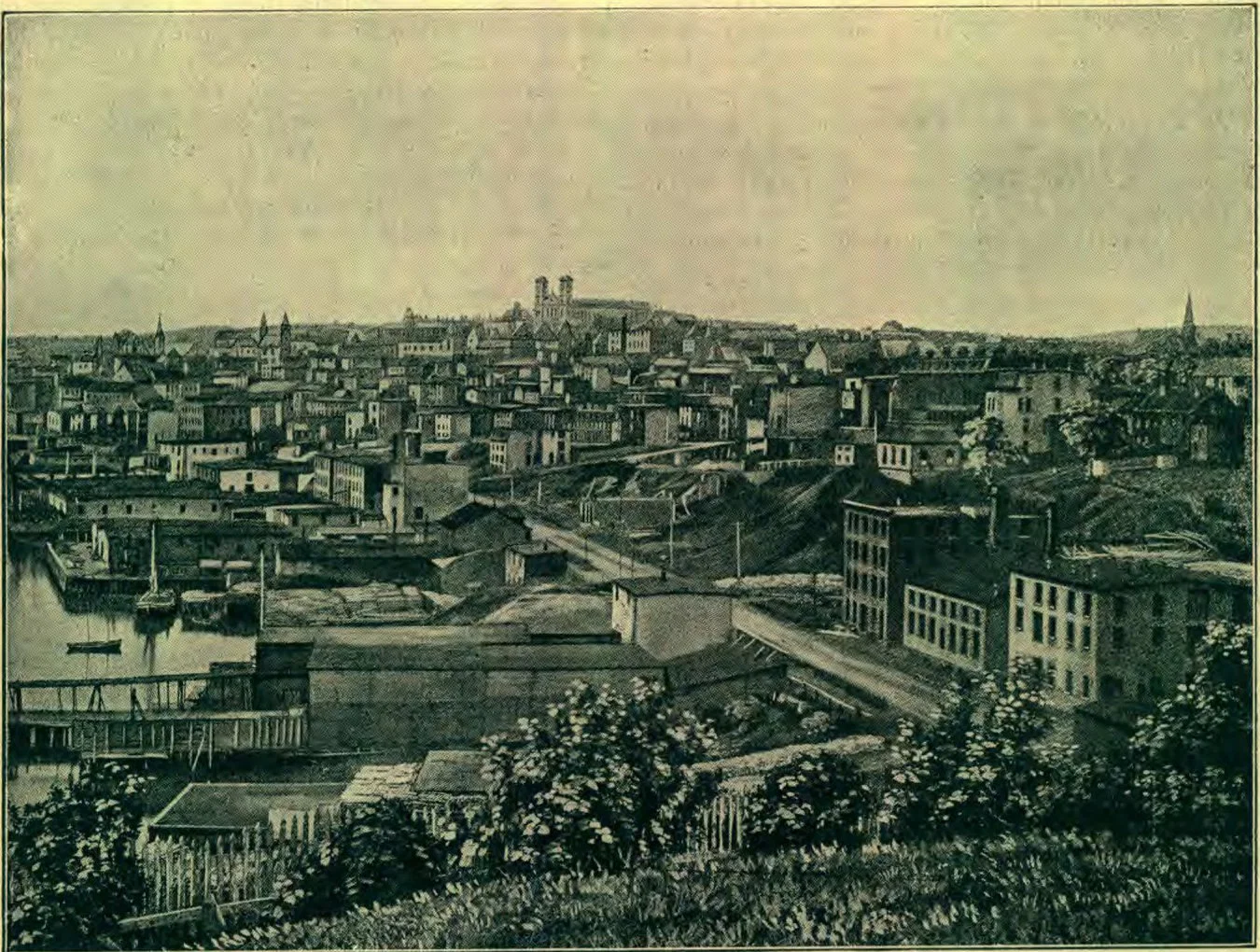
ST. JOHN'S, NEWFOUNDLAND, FROM THE EAST
THE EARLY MORNING OFTEN FOUND JESUS ON SOME SECLUDED PLACE, MEDITATING, SEARCHING THE SCRIPTURES, OR IN PRAYER.

You have reached the end of this edition.

The Youth’s Instructor · Oct 3, 1916