Evolutions of the Blind in Perfect Order — The Evolutionist Must Admit, "I Do Not Know" — Impressed upon Them
MUCH has been said, by evolutionists, against the doctrine of design in nature. The most persistent attacks have been made upon this plain and easily recognized law, but it stands as firm as ever. Everywhere one looks and studies in the field of nature, he finds clear indications of the purpose of design.
THE BUILDER'S MIND MUST DO IT
For evolutionists to say that it is a law of organized matter spontaneously to find the best combination for its preservation and growth, is to attribute to it an essential innate instinct, which implies foresight of the end, and an unconscious yet precise choice of the means. But such expressions as "foresight of the end," and "choice of the means," signify nothing unless they express mental qualities. This, however, is not saying that organisms necessarily have mind, though they do show the marks of mind.
For example: To build a boat practically necessitates that it be built on land, but planned for water. The water, however, does not build the boat, and has no opportunity to stimulate any adaptation of the boat to the water. The adaptation must be in the mind of the builder of the boat, and he plans and builds the boat so it will be adapted to the watery element. Now in nature we have many examples of a similar thing.
EYE AND EAR IN DARKNESS AND SILENCE
To illustrate: The eye is built in total darkness, and yet with perfect adaptation to all the laws of light. The laws of incidence and accidence, the law of refraction, the law of reflection, the law of projection,—the whole nature and quality of light,—are apprehended and met in the eye. Color absorption, inversion of images, vibration, diffusion, and the apprehension of size, solidity, and distance, are foreseen; and perfect provision is made for all, in the eye.
"THE EAR IS BUILT IN THE MIDST OF SILENCE"
The light does not do it. It has no opportunity whatever to stimulate in the growing eye an adaptation to its nature. But a power guides the eye as it is formed; and when completed, it is found to meet the requirements of light as perfectly as the die meets the counter-die.
Here is plainly the law of design. Here is clearly manifested foresight, purpose, adaptation of means to an end, with no possible and controlling means. A mind intervenes to bring about the adaptation of means to an end.
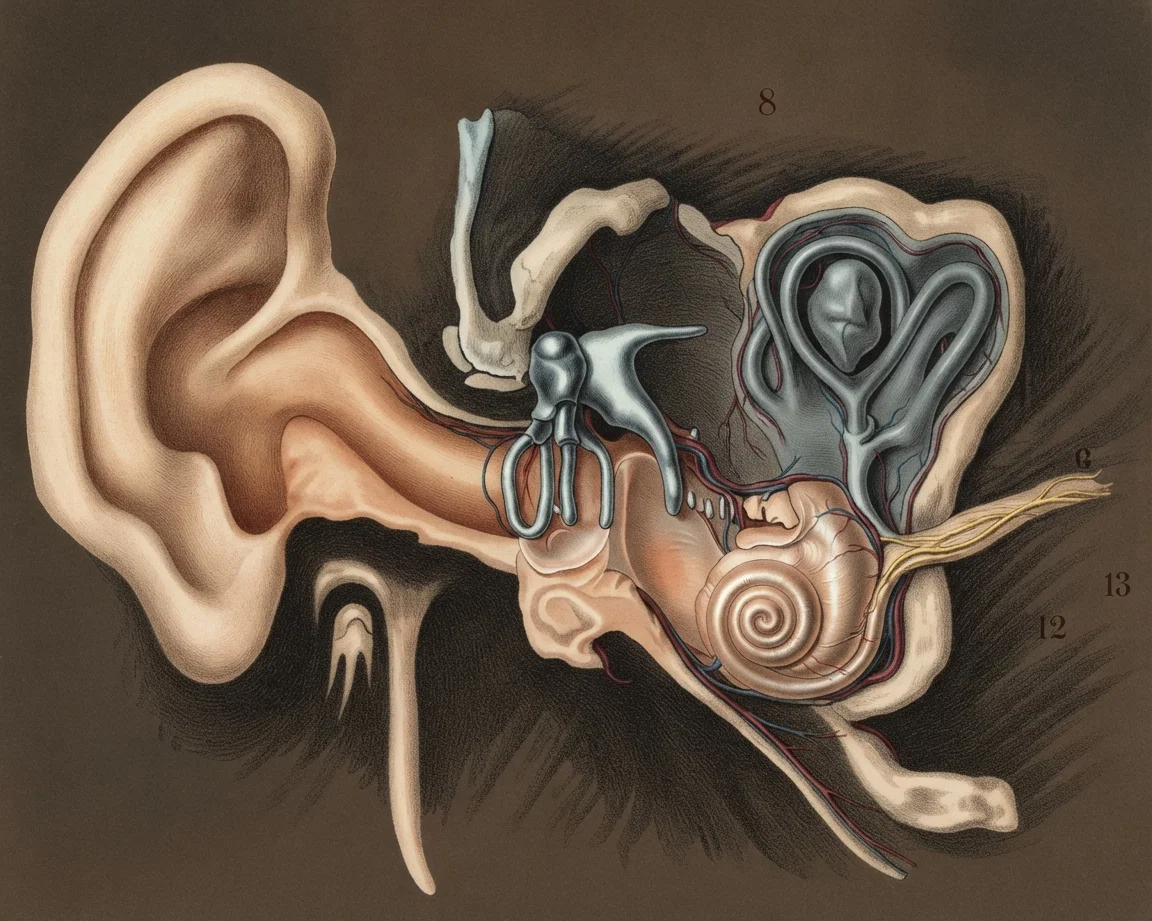
So the ear is built in the midst of silence. Yet it is adapted to sound; and when at last it is fully formed, all the qualities of sound vibration are met in the mechanical arrangements of the inner and the outer ear.
Likewise the lungs are built before a breath of air touches their tissues; yet when the new-born babe is at last placed in the environment of the atmosphere, with one gasp begin the inspirations and the expirations that are to continue while life lasts.
Shall we say of this that there is a blind automaton in the darkness and silence, whose only function is motion, and who, by continuing the motion, at length evolves everything that is perfectly adapted to the environment which he is afterward to reach — merely moving, yet always moving as the highest wisdom would direct? Blind indeed is one who can not see that the highest wisdom is directing.
THEY WOULD FALL INTO THE DITCH
Thus is manifested clearly the law of design. Think of a long procession of blind men, a blind man ahead, and a blind man behind, with his hands on the shoulder of the man in front — every one of them blind, from the leader to the last trailer in the procession. Yet they move on in perfect order, they turn here, they turn there, they deploy, they countermarch, they reverse, they go to the left hand and to the right hand. The most complicated maneuvers are executed, and all without disorder. Yet all are blind.
Ah, my friends, it is impossible! As Jesus said, if the blind lead the blind, they will all tumble into the ditch.
This is Christ's final word, and we accept it. If the blind atoms lead the blind atoms, the blind molecules and the blind atoms will all blindly fall into ruin. The very fact that every atom, every molecule, is marshaled in more orderly fashion than the soldiers in the best-drilled army, shows that there is a power of the highest wisdom in control.
EVOLUTION ADMITS IT
Evolution, in a way, admits this. It says that the organism is impressed; but it claims that that impression comes from the parent organism, that it is inherited. But whence came the first impression?
That could not be inherited. Evolution dodges this by saying, "We can not account for it," which is nothing more nor less than the doctrine of "I don't know."
Yet there must have been a first organism somewhere, else creation was eternal; and if there was a first organism somewhere, it, the first one, for the first time, must be impressed. And if the first one in some way could be impressed, then all the others in the same way could be impressed.
Evolutionists are right in saying that the laws of these organisms have their formation, growth, life, etc., impressed upon them; but that impress comes from the mind of the Creator, for in the beginning God created the heavens and the earth. This is the origin not only of the organism, but of its impressions.
And so, in our study of nature, we come back to the word of God, and to that first word given us in the first line of the book of Genesis, "In the beginning God." He is not only the beginning, but He is the end. He is the complete circle of creation. He upholds it by the word of His power. Heb. 1:3.
We have more to say of this next week.
L. A. R.
What Is There to Boast Of
By George B. Thompson
A HARDENED infidel on a certain occasion was boasting to an aged and godly minister that he was an infidel and believed none of the things revealed in the Bible. The tried saint of God simply said, "Well, is that anything to be proud of?" This question set the infidel to thinking, and finally led to his conversion. It is a good question. What is there to boast of in disbelieving the word of the Creator?
G. B. T.
THE NEW COVENANT KINGDOM
By Editor
It Is the Kingdom of Grace — The Principles of This Kingdom — It Was Made and Confirmed with Israel — Its Acceptance Voluntary
In his two preceding articles, Elder Porter has presented the old covenant kingdom and its relations to the new.
In this paper and the next, he presents the great principles that underlie the new covenant kingdom, and the manner in which this kingdom of grace is preparing subjects for the kingdom of glory bestowed upon the redeemed at the second coming of Christ. EDITOR.
CHRIST came to ratify the new covenant kingdom, which was established in Eden before the fall, and reestablished with Israel at Sinai. His first advent was in fulfilment of prophecy. The prophets had testified beforehand "of the grace that should come unto you," of "the sufferings of Christ, and the glory that should follow." 1 Peter 1:10, 11.
SOME PRINCIPLES OF THE NEW COVENANT
Before ratifying the new covenant, Christ must make plain the principles of the new covenant kingdom. He came to reveal to the world that it was possible, through the provision made for pardon and righteousness, to live as sinless on earth since the fall as before. "Where sin abounded, grace did much more abound: that as sin hath reigned unto death, even so might grace reign through righteousness unto eternal life by Jesus Christ our Lord." Rom. 5:20, 21. "But now the righteousness of God without the law is manifested, being witnessed by the law and the prophets." Rom. 3:21.
Christ's life of faith was an absolutely perfect reproduction of the law of the kingdom of God as proclaimed from Sinai. The law and His life were one. He lived the law of God perfectly, because by faith it was implanted in His heart. "Then said I, Lo, I come: in the volume of the book it is written of Me, I delight to do Thy will, O My God: yea, Thy law is within My heart." Ps. 40:7, 8.
A life of obedience to the law spoken from Sinai was lived by faith during the worldly sanctuary ministration. Christ's perfect life was the seal of God's testimony that such a life had been possible through faith since the days of Adam.
THE NEW COVENANT PROPOSAL
God's purpose in the new covenant kingdom was to restore man to his original relations. Christ had demonstrated, by His life, that by faith the law of the Edenic kingdom of God, as proclaimed from Sinai, may be implanted in the heart. And when it is so implanted, one will delight to obey it. It will not then be regarded as a yoke of bondage. Unbelief had cast that odium upon it.
Christ, having disproved that satanic slander against the law of the kingdom of God, by a life of liberty free from the slightest taint of bondage, announced that the same law should be reestablished in the heart by the new covenant kingdom. He further declared that instead of its being a yoke of bondage, it was a law of liberty when lived by faith. James 2:12.
Having tested it, He said, "For My yoke is easy, and My burden is light." Matt. 11:30. The new covenant proposal was: "Behold, the days come, saith the Lord, that I will make a new covenant with the house of Israel, and with the house of Judah: not according to the covenant that I made with their fathers in the day that I took them by the hand to bring them out of the land of Egypt; which My covenant they brake, although I was an husband unto them, saith the Lord: but this shall be the covenant that I will make with the house of Israel; After those days, saith the Lord, I will put My law in their inward parts, and write it in their hearts; and will be their God, and they shall be My people. And they shall teach no more every man his neighbor, and every man his brother, saying, Know the Lord: for they shall all know Me, from the least of them unto the greatest of them, saith the Lord: for I will forgive their iniquity, and I will remember their sin no more." Jer. 31:31-34.
TO RESTORE THE SINNER
The new covenant kingdom was established to restore the sinner to obedience to the law of the kingdom of God, taking the world in sin, and restoring it to obedience according to the requirements of the law of the old covenant kingdom — the kingdom of glory. It began with a world in sin and unbelief. Its conditions were faith, which produced obedience.
God purposed to do all that was promised in the making of the covenant, on conditions of faith. "He that believeth and is baptized shall be saved." Mark 16:16. The test of the genuineness of the faith was whether or not every precept of the Sinaitic law of the kingdom had been implanted in the heart of the believer. If he offended in one point, he was an unbeliever, and had failed in all. James 2:10. There was but one pathway for the acceptable child of faith. "For even hereunto were ye called: because Christ also suffered for us, leaving us an example, that ye should follow His steps: who did no sin, neither was guile found in His mouth." 1 Peter 2:21, 22.
The conditions of the new covenant kingdom are as plainly stated as are those of the old. The new covenant declared that the repentant sinner was entirely free from sin, which, through faith in the atonement of its sin-offering, should be remembered against him no more. These were the better promises, upon which He would establish a better covenant. Heb. 8:6. Only children of obedience could enter the old covenant relation. Only children of faith, which produced obedience, could enter the new covenant relation.
THE NEW COVENANT MADE AND CONFIRMED WITH ISRAEL
In promising the new covenant, the Lord said He would make it "with the house of Israel, and with the house of Judah." "And He shall confirm the covenant with many for one week: and in the midst of the week He shall cause the sacrifice and the oblation to cease, and for the overspreading of abominations He shall make it desolate." Dan. 9:27.
This was a prophetic week, each day representing a year. Therefore for seven years Christ confirmed the covenant with Israel and Judah. After three and a half years from His anointing as the Messiah at His baptism, by His death, as the antitype of all sacrificial offerings, He caused all sacrifices foreshadowing His offering to cease. "Blotting out the handwriting of ordinances that was against us, which was contrary to us, and took it out of the way, nailing it to His cross; and having spoiled principalities and powers, He made a show of them openly, triumphing over them in it. Let no man therefore judge you in meat, or in drink, or in respect of an holy day, or of the new moon, or of the sabbath days: which are a shadow of things to come; but the body is of Christ." Col. 2:14-17.
Thus He showed openly at the cross that the Jewish ritual, or sacrificial system of pardon, which prefigured His death, ended. The ritual Passover and wave-offering sabbaths, prefiguring Christ, ceased by limitation when "Christ our Passover was sacrificed for us"; and by rising from the dead, He became "the first-fruits of them that slept." But this was in the midst of the forementioned prophetic week.
THE FULL SEVEN YEARS WAS USED
That the full seven years was devoted to the confirmation of the new covenant kingdom with Israel, is plainly seen in Christ's instruction to His disciples. "These twelve Jesus sent forth, and commanded them, saying, Go not into the way of the Gentiles, and into any city of the Samaritans enter ye not: but go rather to the lost sheep of the house of Israel." Matt. 10:5, 6. As in the old covenant dispensation, their message was restoration through the gospel of the kingdom of God. "And as ye go, preach, saying, The kingdom of heaven is at hand." Verse 7.
At the end of the seven years allotted for the confirmation of the new covenant with Israel and Judah, the gospel was carried to the Gentiles. "Then Paul and Barnabas waxed bold, and said, It was necessary that the word of God should first have been spoken to you: but seeing ye put it from you, and judge yourselves unworthy of everlasting life, lo, we turn to the Gentiles." Acts 13:46.
NOT SAVED BY NATIONS
They were not to be saved by nations, but as individuals. "Then Peter opened his mouth, and said, Of a truth I perceive that God is no respecter of persons: but in every nation he that feareth Him, and worketh righteousness, is accepted with Him." Acts 10:34, 35. He was to take out from among the Gentiles all children of faith. "Simeon hath declared how God at the first did visit the Gentiles, to take out of them a people for His name." Acts 15:14.
The new covenant was not made with the Gentiles. They were grafted in by belief. Rom. 11:11-29. Both the old and the new covenant, therefore, were made with Israel. Rom. 9:4. Only the children of promise were counted as the seed. Verse 8. Thus all Christians are counted as Israelites, since they will enter the holy city under the names of the twelve tribes. Rev. 21:12.395
ACCEPTANCE OF THE NEW COVENANT VOLUNTARY
As loyalty to the old covenant kingdom was voluntary, so entrance into the new covenant kingdom is voluntary. Adam and all his posterity had the privilege of entering the new covenant kingdom. The call to them was without coercion. It was infinite love making an appeal to all who had fallen under sin, to enter the new covenant relations under the leadership of Christ, its divine Mediator. To accept or reject the call was left optional.
Why were some broken off? "Well; because of unbelief they were broken off, and thou standest by faith. Be not high-minded, but fear: for if God spared not the natural branches, take heed lest He also spare not thee." Rom. 11:20, 21.
The call to enter the new covenant kingdom was a call to faith. It was a call to a faith which would maintain that God would do for one all that He had promised. Faith is an inward experience, not an outward form. It is manifested in voluntary obedience, not in enforced, formal observance.
Being an inward experience, it can not be enforced. To undertake to enforce acceptance of the new covenant experience, is to advertise to the world that one is without experience in the doctrine he seeks to establish. Every child of faith knows that in its very nature faith is voluntary and can not be enforced.
A MINISTRATION OF THE SPIRIT
The new covenant was a ministration of the Spirit. "The letter killeth, but the Spirit giveth life." 2 Cor. 3:6. The purpose of the new covenant kingdom was to restore righteousness and life, leaving the final execution of impenitents to the kingdom of glory when it should be finally established through the reign of grace.
Christ came not to condemn, but to save. John 3:16, 17. The old covenant required either obedience from the heart, or death. The new covenant required righteousness as a gift from God through faith. The same obedience was required, but it was not the mission of the new covenant to inflict death penalties. Christ as Mediator, having accepted the death penalty for all, ministered the Spirit, and established righteousness. The infliction of the penalty of death, called the "second death," and which is eternal, was deferred until the end of the reign of grace. R. C. P.
Question Corner
By Editor
WE can not answer repeatedly in the same volume questions upon the same scripture. The name and address must accompany question. It is well always to enclose stamp for reply.
4322—THE GOSPEL TO ALL THE WORLD AS A SIGN OF THE END
Do not Rom. 10:18 and Col. 1:23 show that the gospel was preached to all the world in the apostle's time? Please show the relation of these scriptures to Matt. 24:14 and Rev. 14:6, 7.
Most assuredly the gospel was preached in all the world in the times of the apostles. Roman history corroborates the statements made in Rom. 10:18 and Col. 1:23. Truly the sound of the gospel message went into all the earth, and Christianity became strongly established in the city of Rome itself, the great capital of the empire, and from there, as well as from Jerusalem, it was carried into all the provinces, and was discussed and taught everywhere.
Matt. 24:14 reads: "This gospel of the kingdom shall be preached in all the world for a witness unto all nations; and then shall the end come." This text, taken by itself alone, might be difficult to understand; but when we study it in connection with Rev. 14:6, 7, and other similar scriptures, we see that a world-wide proclamation of the Judgment hour and the second coming of Christ is predicted by the prophets.
Ponder well these words in the sixth and seventh verses of Revelation 14, as you read them: "And I saw another angel fly in the midst of heaven, having the everlasting gospel to preach unto them that dwell on the earth, and to every nation, and kindred, and tongue, and people, saying with a loud voice, Fear God, and give glory to Him; for the hour of His Judgment is come; and worship Him that made heaven, and earth, and the sea, and the fountains of waters."
Observe that this message carries the everlasting gospel. Observe that it goes to every nation and kindred and tongue and people. Observe also that it not only calls upon us to fear God and give glory to Him, but it proclaims with solemn majesty that the hour of His Judgment is come; it is a time when the Judgment is in actual session.
So, then, we are to look for a gospel message that will be carried into every nook and corner of the world, and it is to proclaim the Judgment day and the end of the world. And while Matt. 24:14 may incidentally embrace the work that was done by the apostles in carrying the gospel to the Roman Empire, the text must include a reference to this great, all-embracing message that proclaims the Judgment hour, for it is definitely stated, "When this gospel of the kingdom shall be preached in all the world, then shall the end come." This message embraces not only the gospel of salvation, but it is the gospel of the glorious kingdom of God as well.
Paul thus addressed Timothy: "I charge thee before God, and the Lord Jesus Christ, who shall judge the quick and the dead at His appearing and His kingdom; Preach the Word." Thus does Paul clearly show that the kingdom of Christ is established at the appearing of Christ. And in like manner, in the parable of the tares in the field, in Matt. 13:24-30, the Master shows that the establishing of His kingdom is at His second coming; for in His own explanation of the parable, He says that the field is the world (verse 38), the harvest is the end of the world, and the reapers are the angels (verse 39); and then He tells of the purifying fires of the last days, so often spoken of in the Bible, that will burn up the wicked and consume all wickedness out of His kingdom, and "then shall the righteous shine forth as the sun in the kingdom of their Father." Verse 43.
Every true Christian in all the ages has been a subject of God's kingdom, and has been in His kingdom of grace, which extends to the end of probation. In this time the apostle exhorts us, "Let us therefore come boldly unto the throne of grace, that we may obtain mercy, and find grace to help in time of need." A throne of grace implies a kingdom of grace, and we are now in the time of such a kingdom; but we must distinguish between this and the kingdom of glory which we have at His second coming. "When the Son of man shall come in His glory, and all the holy angels with Him, then shall He sit upon the throne of His glory: and before Him shall be gathered all nations: and He shall separate them one from another, as a shepherd divideth his sheep from the goats: and He shall set the sheep on His right hand, but the goats on the left. Then shall the King say unto them on His right hand, Come, ye blessed of My Father, inherit the kingdom prepared for you from the foundation of the world." Matt. 25:31-34.
It is when the Son of man sits upon the throne of His glory that He invites His faithful followers to inherit the kingdom prepared from the foundation of the world. And this gospel of the kingdom, which presents the prophetic evidence that the great day is at hand, is the message that is to sound in all the world, in the ears of every kindred and tongue and people; and then shall the end come. We may not set a day for this great event, for the text says, "Of that day and hour knoweth no man." Matt. 24:36. But the same Word says just as emphatically, "When ye shall see these things [the fulfilment of His prophetic utterances] come to pass, know that it [margin, He] is nigh, even at the doors." Mark 13:29.
These texts studied together are very clear in presenting God's great plan.
4323—REBAPTISM
Is there any scripture in the Bible that proves it is necessary to be baptized the second time, if one fails to live a Christian life after the first baptism? or is probation closed with one who fails to live right after the first baptism?
We know of no scripture which directly says that one who has departed from the Christian life should be baptized a second time on returning to the faith. However, there are numerous passages which very clearly teach this. In the message to the church at Ephesus, in Rev. 2:5, those who have left their first love are exhorted to repent and do their first works. From Acts 2:38; 16:30-33; 8:36-38, we see that the first work after repentance is baptism. Heb. 6:1, 2 admonishes the believer to leave or advance beyond the elementary principles of the doctrine of Christ, and go on to perfection, not making it necessary to lay again the foundation of repentance, of faith, of baptism, etc.; showing that in case the Christian apostatizes, it is necessary to go back to these things, which, as the foundation principles, are necessary to the fully developed Christian character.
The object of baptism is to show death to sin, that the candidate has repudiated sin; he has forsaken the old ways and habits; and when, after baptism, he has gone back to these old practises, it is necessary to lay again the foundation from which he has departed.
God's dealings with the Israelites, during all the years of their apostasy and rebellion, show that there is repentance and salvation for those who have wandered away from Him. Although they had utterly turned away from Him, and were worshiping idols, with the heathen, still He pleaded with them to return to Him, and He would forgive and cleanse them. Read Jer. 3:6-15.
SYSTEMATIC BIBLE STUDY
By Editor
OUR reading for this week gives us the first part of the book of Hebrews, which is a divine commentary on the priesthood and the sacrificial service, showing us how the sacrifices and offerings and the work in general of the sanctuary in the old dispensation met their fulfilment in the ministry and sacrifice of Christ. This book should be very thoughtfully read.
We are also coming to some of the most interesting portions of the book of Isaiah. The entire book is very rich, not only in prophecies, but in promises. The latter part of the book is especially helpful in promises.
Read one chapter in Joshua and one in Isaiah each week-day; and one in Joshua, one in Judges, and one in Isaiah, on the Sabbath. In Hebrews read one chapter on week-days and two on the Sabbath.
PEOPLES AND CUSTOMS OF NEW HEBRIDES
By C. H. Parker
Cannibalism Still in Some Parts — Persistent and Earnest Work of the Presbyterians — Ancestral Worship — Very Peculiar Burial Customs — Premium on Hogs
By C. H. PARKER
SEVENTH-DAY ADVENTIST MISSION HOME AND CHURCH, ATCHEN, MALEKULA, NEW HEBRIDES
LAST week Elder Parker described the country and the climate of the New Hebrides Islands. This week he devotes himself to the people and their grotesque customs. He has promised to send us, in later weeks, more in regard to the specific work our people are doing in that field.
THE New Hebrides have been and are a very interesting field from a missionary standpoint, and have called forth a great deal of heroic effort and sacrifice on the part of the Presbyterian mission, which has operated here for the past sixty years. The work has been hard, and many lives have been given as foundation-stones for the gospel structure to be reared thereon.
STILL SOME CANNIBALS
All of the southern islands of this group have nominally accepted Christianity, with the exception of Tana, where a large proportion of the population is still held in the darkness of heathenism.
Few of the people of Ambrym, Malekula, and Santo, which are the largest islands of the northern division, have exchanged their heathenism for Christianity. Malekula is the backbone of heathenism and cannibalism. Not more than five weeks ago, a boat's crew were killed and eaten; and about a week later, seven native teachers were shot, roasted, and eaten, almost in sight of our mission.
The men of the heathen population go about perfectly nude, with only a bark belt, which serves as a place to put their pipes, matches, knives, cartridges, etc. The coast women wear a narrow strip of calico around the loins, while those inland wear a sort of grass skirt. The children, until they become quite large, wear the dress that they are born in.
If an injury is done to any man, he retaliates upon the first man he meets.
THEIR HUTS
The houses are thatched roofs set on the ground, with a hole left through which the occupants crawl in. There are no mats to cover the dirt floor. The people lie in the dirt like the beasts. As a result, their houses are plague spots of vermin and disease.
THEIR ESTIMATE OF PIGS
In building a house, they have to make a feast, at which they kill a number of pigs. The person who kills the pigs can not go down to the salt water for ten days. The owner of the house can not go down for forty days. All this time, they must keep their faces blackened, and of course water does not come in contact with their bodies.
Pigs are at a premium — that is, tusked pigs. We are told that as high as three hundred dollars has been paid for one. These pigs are used in making sacrifices to the dead.
Women are exchanged for pigs. Often wives are bought when they are mere children.
WORSHIP THEIR ANCESTORS
In their heathen dancing grounds, the people set up carved figures of their departed friends, before which they place stone altars. Upon these altars their pigs are killed, and there all food is offered before it is eaten.
Their worship is ancestral. The carved figures in memory of their dead are very grotesque. Over each of these figures is placed the form of a bird, like an albatross, with outstretched wings. In the bush, the natives have houses where they go to talk with their dead, asking them to help them, and to give them good seasons, plenty of yam and rain, and to make them strong in war with other tribes.
KILL A PIG AND CHANGE THEIR NAMES
Every time a man kills a pig, he receives a new name. It is very difficult to keep informed as to the names of the people, as they change so often. If a person is called by his old name, he stolidly replies that that is not his name. He can not tell you his own name, but some one standing by must speak it for him. I suppose this is New Hebrides etiquette.
Mr. Pig is king-pig here, and he is waited on hand and foot. His food is prepared and cooked from the best, and the women must feed him before they prepare their own food.
TOM-TOMS USED BY THE NATIVES IN ATCHEN, MALEKULA, NEW HEBRIDES
When his tusks complete the circle, pierce again the jaw-bone, and come through, then he is considered very valuable, and is kept tied to a pole, for fear that he might break his tusks while fighting with other pigs. Female pigs are never offered in sacrifice.
BUY WIVES WITH PIGS
Polygamy is practised, and a man can have as many women as he has pigs to buy with. Thus some men have several women, while others have none.
The men and the women do not eat together, and in most instances the men cook their own food, and the women theirs, on separate fires. The men will not take food from a woman, not even from a white woman. When they work on plantations, they are compelled to eat food prepared by white people; but when they return to their own people, they have to kill a pig so that they can be restored to caste.
The women are the burden bearers, while the men stalk on before, carrying guns, or bows and arrows, and clubs. If a woman runs away, the sinew of one of her legs often is burned, so that she will not be able to repeat the offense.
At the death of a man or a woman, a great wail is set up by the men. To one not acquainted with it, it would be mistaken for the howling of dogs. The ones that will profit by the land or other possessions of the deceased, howl loudest and longest.
The body is buried almost immediately, and generally in the house in which the person died. Sometimes, I am told, the face is left exposed to view. In the event of the death of an old man, three young men have to stay for one hundred days in the house where he is buried. During this time, they can not leave the premises nor see a woman.
WARMING THE DEAD
One rainy day, when passing by a house where an old woman was buried, we noticed a fire burning at the entrance, and a covering of palm leaves above, to convey the heat inside. We asked what it was for, and were told that the old woman was cold. Some may laugh at this as ridiculous; but there are customs practised by white people in the home land that are just as puerile.
NO WRITTEN SPEECH
The heathen people of whom I have been talking, have no written language; but it is wonderful how exact and concise they are in talking. Upon this we will have more to say at another time, as we are to reduce one of these heathen languages to writing. Later, no doubt, we will be required to do the same with other languages, as there is such a babel of tongues in these islands. We find it very interesting to hunt for the different persons, numbers, cases, genders, articles, etc. With perseverance, faith in God, and the controlling power of the Holy Spirit, the tongue of the dumb shall speak.