'Tis a sad but wondrous story,
How my Lord, the Lord of glory,
Left the presence of His Father
In the realms of light above;
Came to earth, so dark and dreary,
Found the sick, the sad, the weary,
Brought them back to God, their Father,
On the bosom of His love.
While He sought them, they denied Him,
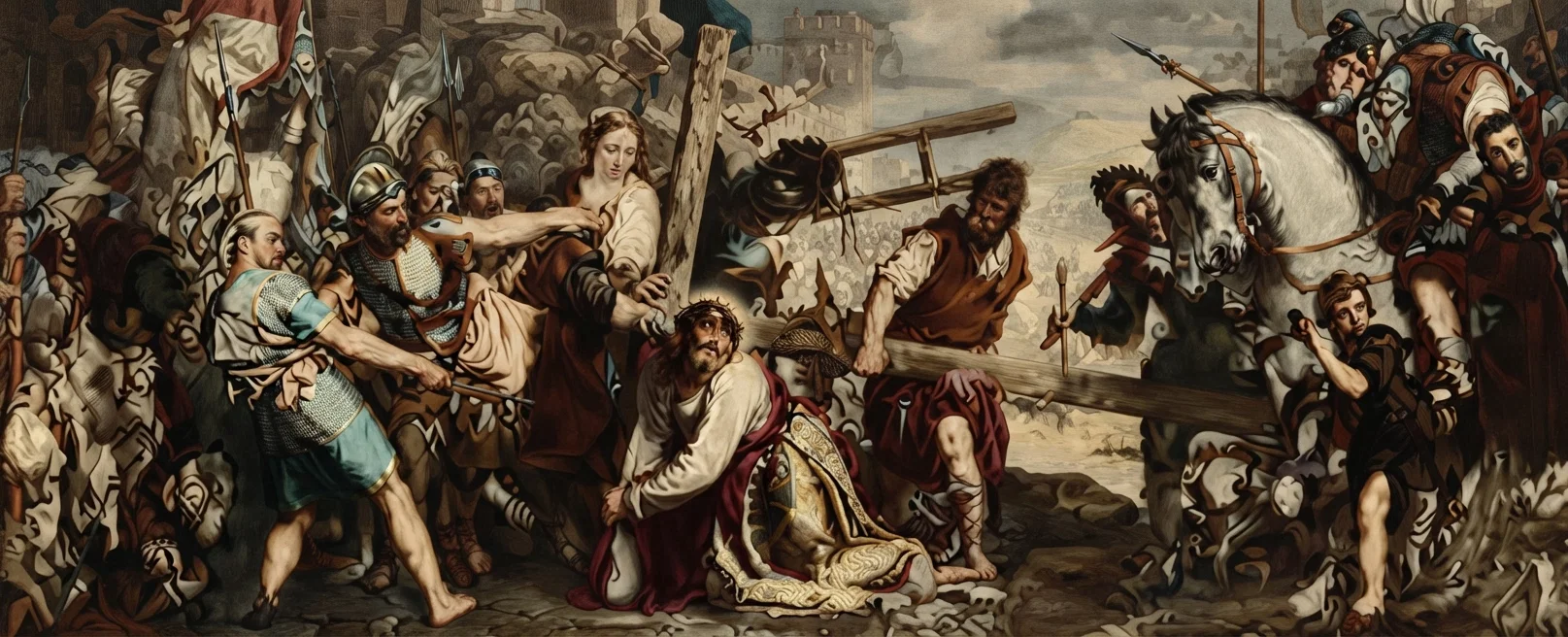
Scourged, insulted, crucified Him
On the brow of Calvary's mountain,
On that dark and dreadful day.
He had only prayers to render
From that heart by love made tender
For the cruel throng that mocked Him
While His life-blood ebbed away.
We are cleansed in that pure fountain
Which flowed down on Calvary's mountain
From the wounds our blest Redeemer
Suffered there for you and me.
From that Saviour naught can sever;
We are saved, and saved forever,
Who obey and follow daily
Where He leads so tenderly.
Day by day the signs are clearer
That the time is drawing nearer
When our blessed Lord and Master
Will return to earth again.
Then if faithful, we shall meet Him,
And with happy hearts shall greet Him
Who has borne so much of sorrow
For the love He bore to men.
In that blessed home supernal,
Joy shall be, and life eternal,
In the presence of our Saviour,
In this earth from sin made free.
Every heartache will be banished.
Every sorrow will have vanished.
Only joy and peace and blessing
There are waiting you and me.
The "Falling Away" and Antichrist
By LEE S. WHEELER
The Second Coming of Christ an Apostolic Doctrine—The "Falling Away" Obscured It
False Views of the Kingdom Sought to Supplant It—Yet It Is Still the Blessed Hope
By LEE S. WHEELER
THE second coming of Christ was not the first event the church in the days of the apostles was instructed to expect. "For that day shall not come, except there come a falling away first, and that man of sin be revealed, the son of perdition." 2 Thess. 2:3.
From the time of Christ's resurrection and ascension, the anticipation of His glorious return and the resurrection of all believers to a life of immortality was ardently believed and taught as "the blessed hope." Titus 2:11-13; Acts 1:9-14, 22; 4:2, 33; 1 Corinthians 15; 1 Thess. 1:9, 10.
GREEK MYSTICAL INTERPRETATION
The pernicious influence of Greek philosophy, however, in its tendency to attach a mystical interpretation to the fundamental doctrines of Christianity, particularly those connected with the resurrection and the future state, is frequently mentioned in the writings of Paul. Acts 17:18, 32; 2 Tim. 2:18; Col. 2:8; 1 Tim. 6:20; 2 Tim. 1:10-15.
From the opening of the second century onward Gnostic mysticism in the Eastern church, and Neo-Platonism in the West, ate like a canker at the teachings of the church; and in this "falling away" from the truth as it is in Jesus, the way was prepared for the establishment of that spiritual despotism in which the church supposed itself to be the kingdom of God, and man ruled in the place of Christ. Notwithstanding, "everywhere the Scriptures point to the kingdom of God as a thing of the future." ("Schaff-Herzog Encyclopædia of Religious Knowledge," article "Kingdom of God.") Dan. 7:27; Matt. 19:28; 1 Cor. 6:9; 15:50-53; Gal. 5:21; Revelation 20.
THE GLORIOUS KINGDOM
"In the West the expectation of a glorious kingdom of Christ found adherents for a long time."—"Catholic Encyclopædia," article "Millennium."
"The earliest Christians had been second adventists. This belief gradually died down, and was no longer fundamental at the time of the conversion of Constantine. That event and the subsequent triumph of Christianity [as a state religion] resulted in its complete eclipse."—"The Holy Christian Church," by R. M. Johnson, M. A., page 193.
A CHRISTIAN THEOCRACY
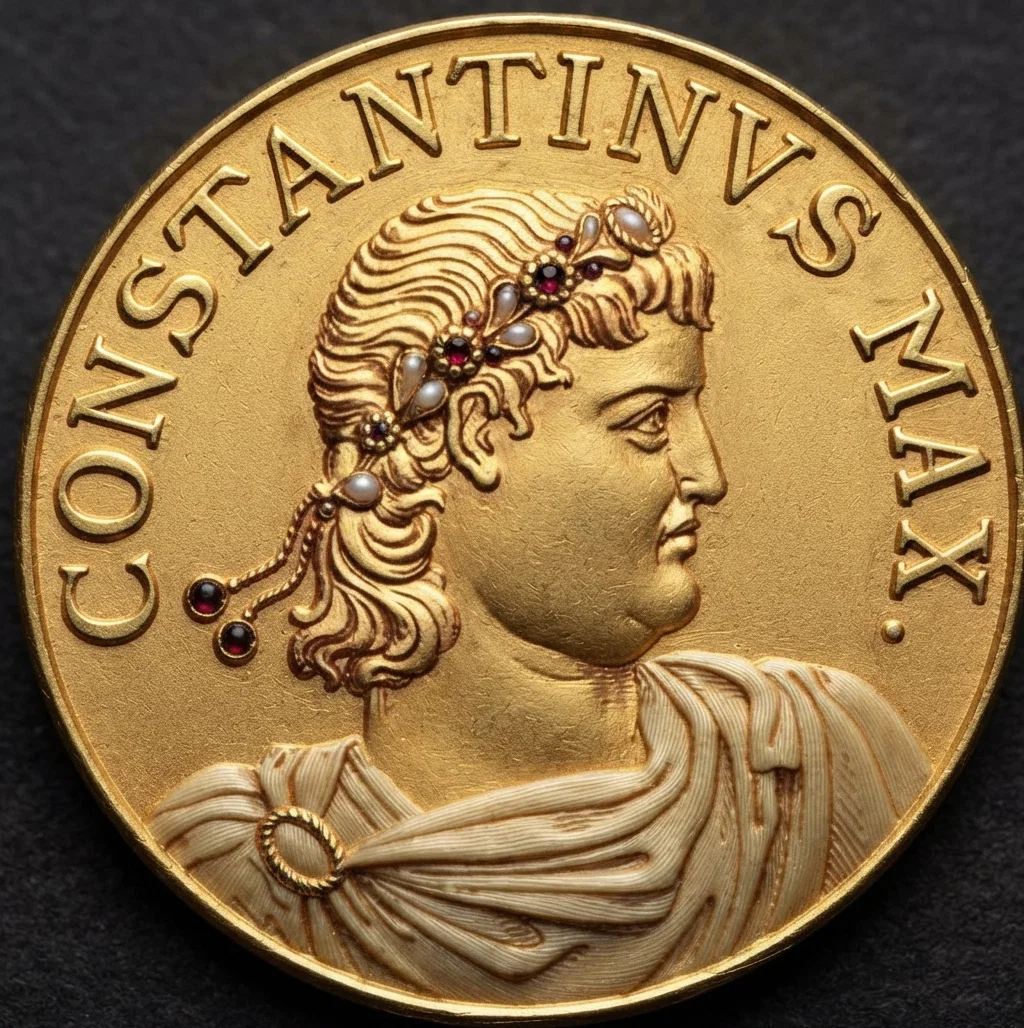
"Constantine, the first Christian Cæsar, . . . was the first representative of the imposing idea of a Christian theocracy, or of that system of policy which assumes all subjects to be Christians, connects civil and religious rights, and regards church and state as the two arms of one and the same divine government on earth."—Schaff's "Church History," third period, volume 1, page 12, paragraph 2.
"In the year 330, the emperor Constantine transferred the seat of government from Rome to Byzantium, which from that time was styled Constantinople. The temporal influence of the popes commenced to increase, nor did the emperors complain; nay, they were too willing to be relieved of the weight of government in Italy."—"Studies in Church History" (Catholic), by Parsons, volume 1, page 502.
THE CHERISHED TITLE "PONTIFEX MAXIMUS"
Still, however, the Roman emperors, to whom, since the days of Augustus, had descended the cherished title of "Pontifex Maximus," had not relinquished the prerogative6of supreme jurisdiction in religious affairs, by virtue of which Constantine, upon his conversion to Christianity, assumed all the authority of Moses, assembled the General Council of Nice, dictated the policy of the church, and attempted the suppression of heresy and the unification of the church under his own sovereignty.
From Constantinople, for more than two centuries, the Roman emperors continued to exercise such authority, until "with the decay of the empire the title [Pontifex Maximus] very naturally fell to the popes, whose functions as administrators of religious law closely resembled those of the ancient Roman priesthood, hence the modern use of 'pontiff' and 'pontifical.'"—"Encyclopædia Britannica," article "Pontifex Maximus."
THE CHURCH STEPPED IN
"The old Roman Empire was tottering to its fall; the church stood fast, ready to step into its inheritance. It was not simply that the world power, the enemy of Christ, had been vanquished; the fact was that it had gradually abdicated its political functions in favor of the church. Under these circumstances Augustine was led, in his controversy with the Donatists and as an apologist, to idealize the political side of the Catholic Church,—to grasp and elaborate the idea that the church is the kingdom of Christ, and the city of God. Others before him may have taken the same view, and he on the other hand never forgot that true blessedness belongs to the future; but still he was the first who ventured to teach that the Catholic Church, in its empirical form, was the kingdom of Christ; that the millennial kingdom had commenced with the appearing of Christ, and was therefore an accomplished fact."—"Encyclopædia Britannica," ninth edition, volume 16, page 317.
THE "DIRECT DIVINE RIGHT"
"According to the system of the 'direct divine right,' the pope has received immediately from God full power to govern the world, both in spirituals and temporals. The temporal ruler is only an official of the pontiff, and as he receives the temporal sword from the pontiff, to be used in conformity with the order of God, he may be deprived of it by the pope when he uses it against that order."—"Studies in Church History" (Catholic), by Parsons, volume 2, page 203.
This view is said to have first been taught by John of Salisbury, 1159, by Thomas a Becket, and by Henry de Suza, compiler of the laws of Swabia (1365), who asserted that "since the coming of Jesus Christ, all the dominions of the infidel princes were transferred to the church, and are vested in the popes as the vicars of Jesus Christ, the King of kings."—Ib., page 203.
IS THE CHURCH THE KINGDOM?
Cardinal Gibbons, in "The Faith of Our Fathers," page 23, furnishes us the following: "The church is called a kingdom: 'He shall reign over the house of Jacob forever, and of His kingdom there shall be no end.' Now in every regulated kingdom, there is but one king, one form of government, one uniform body of laws, which all are obliged to observe. In like manner, in Christ's spiritual kingdom, there must be one Chief to whom all owe spiritual allegiance; one form of ecclesiastical government; one uniform body of laws which all Christians are bound to observe; for every kingdom divided against itself shall be made desolate."
ARE PAPAL CLAIMS EXTRAVAGANT?
To the rest of the religious world, the claims of the papacy have seemed most extravagant and wicked. Yet it must be evident to any reflective mind, that if the assumption that the church is the kingdom be granted, the whole system appears logical and Scriptural; for of the kingdom of Christ it is said: "I shall give thee the heathen for thine inheritance, and the uttermost parts of the earth for thy possession. Thou shalt break them with a rod of iron; thou shalt dash them in pieces like a potter's vessel. Be wise now therefore, O ye kings: be instructed, ye judges of the earth." Ps. 2: 8-10.
Again it is said, "The nation and kingdom that will not serve thee shall perish; yea, those nations shall be utterly wasted." Isa. 60: 12. Consequently, if this interpretation is to be allowed, all the decrees of intolerance, and the crusades of extirpation waged against infidels and heretics, must be conceded to be but the exercise of the legitimate authority of the church, over the state. Protestantism has no defense, free governments have no ground for existence, by any system of religious teaching which assumes that the kingdom was set up at the first advent of our Lord, or that the prophecies of the kingdom should have a mystical interpretation.
APOSTOLIC DOCTRINE STILL MAINTAINED
On the other hand, those who, in the twentieth century, maintain the apostolic doctrine of the future coming and glorious kingdom of Christ upon earth, and who cherish still the "blessed hope" of the primitive Christians, see clearly, in the rise of the papal sovereignty and its long and persecuting career, a fulfilment of Paul's prediction of the "mystery of iniquity," the "falling away," and the development of the "man of sin," who, assuming to sit in the temple of God and to reign over the church as God, has, instead of the kingdom of Christ, developed the despotic monarchy of antichrist. Dan. 7: 17-26.
The Monarchies of the Prophets
By Jean Vuilleumier
Another Vision of the Four Great Empires — Saw the Fourth One Broken into Ten — The Prophet Plainly Interprets His Own Prediction
By JEAN VUILLEUMIER
In our last three issues, Elder Vuilleumier has given us some studies on the prophecy of the second chapter of Daniel. In this and the next two papers, he presents studies on the seventh chapter of that intensely interesting book.
In the articles on the seventh chapter, it will be shown that this chapter parallels the second. That is, it tells of the four great monarchies, and on the subject of the breaking to pieces of the fourth, the seventh chapter is specific in telling the exact number. It also tells of an eleventh, an ecclesiastical kingdom, that arises among the ten; and it tells in detail what this church power would do. Thus while the seventh chapter is parallel to the second, it tells many details that are not in the former.
This article takes us to the breaking of the Roman Empire into its ten kingdoms. The article next week will be devoted to a consideration of the church kingdom that arose among the ten. EDITOR.
In a vision given to the prophet Daniel, in 603 B. C., for the immediate benefit of King Nebuchadnezzar, of Babylon, as we have seen in former articles, this young Hebrew exile saw four successive world empires under the image of a great metallic statue. The fourth — the Roman Empire — was to be reduced into several fragments, or kingdoms, which, for an undetermined length of time, were to exist together, uniting or warring with each other, until they should all be swallowed up in destruction. Then the earth itself, the theater of their rivalries and bloody contests, was to be rejuvenated, and occupied by a new empire, the universal and eternal empire of Jesus Christ and His saints.
A NEW AND MORE REMARKABLE VISION
Such is in brief the vision found in the second chapter of Daniel. But chapter seven of the same book contains a new vision, more remarkable still, which, while covering the same ground, brings to view some wonderful developments in the nearer period of medieval and modern times, and that with special reference to the central, commanding figure of the papacy. It will repay us to devote time to the study of this vision and its astonishing fulfilment. And to that effect, let us read it step by step both in the description given by Daniel and in its interpretation given him by a heavenly being.
VERSES FROM THE VISION
“Daniel spake and said, I saw in my vision by night, and, behold, the four winds of heaven brake forth upon the great sea. And four great beasts came up from the sea, diverse one from another.” Verses 2, 3.
THE PROPHET’S OWN INTERPRETATION
“These great beasts, which are four, are four kings, that shall arise out of the earth. But the saints of the Most High shall receive the kingdom, and possess the kingdom forever, even forever and ever.” Verses 17, 18.
Here, then, is the great plan of God for this earth and its nations. Four mighty empires will compass the destinies and glories of earthly history in its fallen, sinful state. Then this same earth will become the eternal and peaceful abode of a race called “the saints of the Most High.” How simple, yet how thrilling! Can we believe it? Let the fulfilment of the vision itself answer this question.
THE ROARING WATERS OF THE GREAT SEA
According to Isa. 17: 12, 13, and Rev. 17: 15, the great sea symbolizes the restless multitudes of earth’s nations. The four winds of heaven that cause these waters to seethe and surge are the winds of war, political feuds and rivalries (see Jer. 4: 11-13), which cause the rise and downfall of kingdoms and potentates.
THE BABYLONIAN MONARCHY
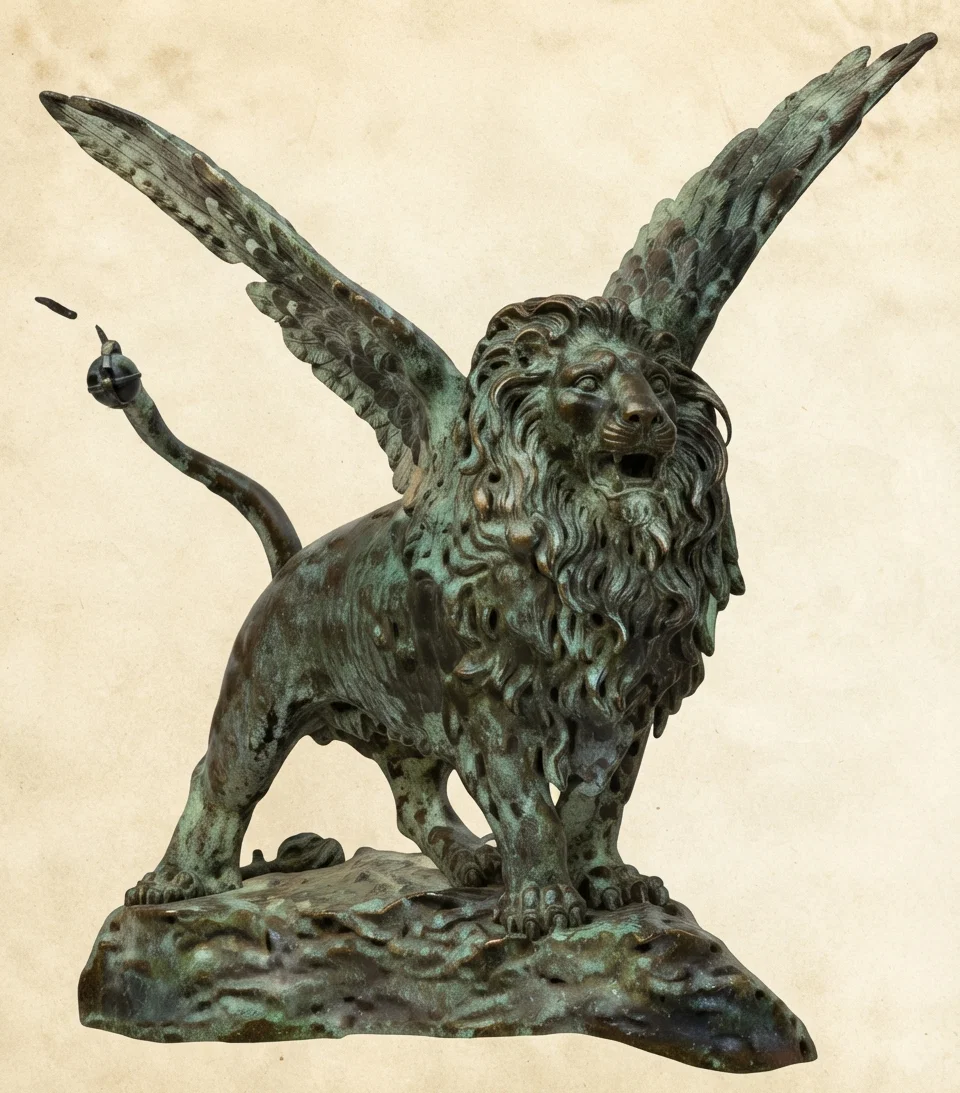
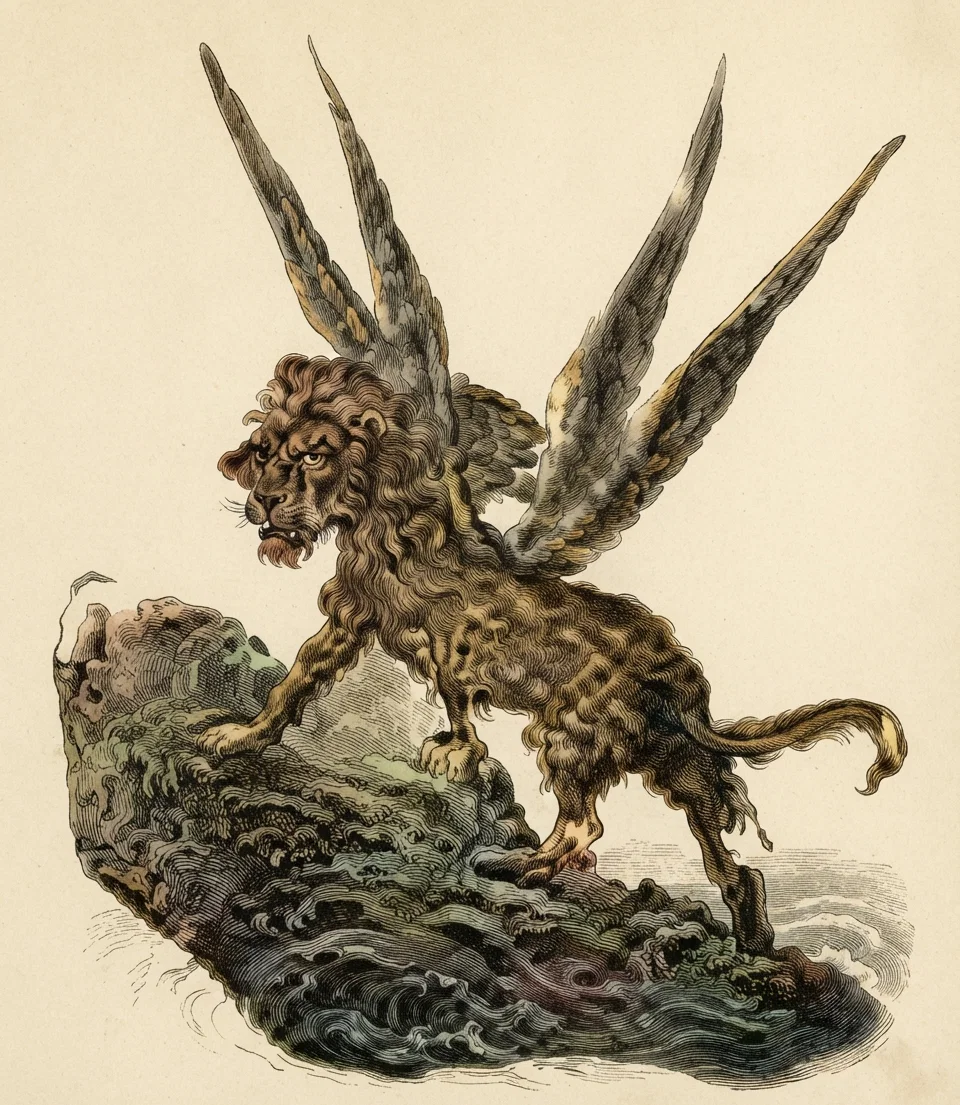
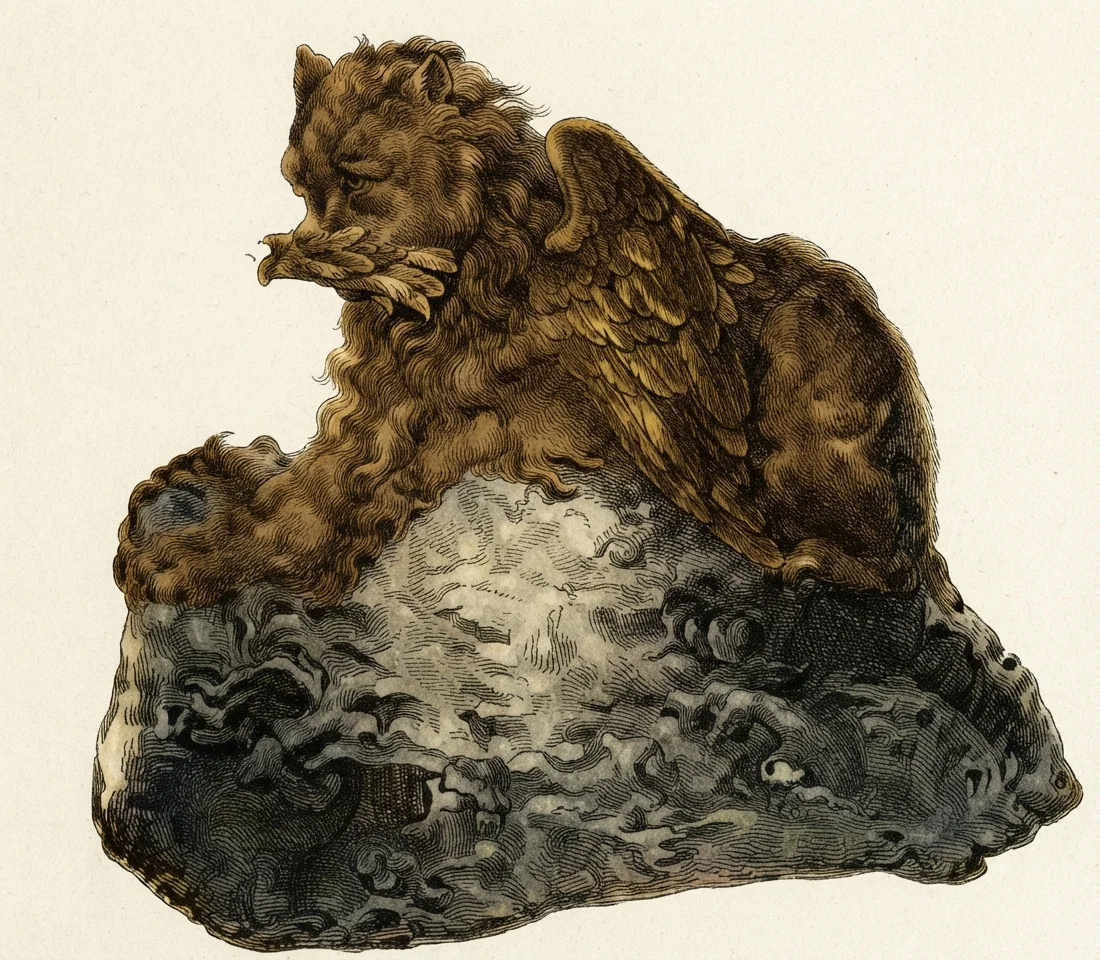
“The first was like a lion, and had eagle’s wings: I behold till the wings thereof were plucked, and it was lifted up from the earth, and made to stand upon two feet as a man; and a man’s heart was given to it.” Dan. 7: 4.
As we learn from the vision of the second chapter (Dan. 2: 37, 38), the Babylonians are the first of the four great nations. They are here represented by the king of animals and the king of birds; while in the former vision, by the choicest metal. Under the successors of Nebuchadnezzar, the Babylonian lion loses much of its military valor; and finally (in 538 B. C.) this empire falls into the hands of Cyrus, who establishes the Medo-Persian monarchy.
THE MEDO-PERSIAN MONARCHY
“And, behold, another beast, a second, like to a bear; and it was raised up on one side, and three ribs were in its mouth between its teeth: and they said thus unto it, Arise, devour much flesh.” Dan. 7: 5. The two unequal nations making up this new empire; the three great territories added to it by conquest — Chaldea, Lydia, and Egypt; the cruelty of the Medo-Persian wars; the clumsy mass of their armies, — all this is fittingly represented by that bear leaning upon one of its sides, having three ribs between its teeth, and devouring much flesh. But the scene changes.
THE GREEK-MACEDONIAN MONARCHY
“After this I beheld, and, lo, another, like a leopard, which had upon its back four wings of a bird; the beast had also four heads; and dominion was given to it.” Verse 6. This symbol not only denotes the customary ferocity of war, but also a marvelous velocity in military movements, and the division of the empire into four parts. This was fulfilled by the unequalled record of Alexander the Great, who conquered the world in less than ten years, and after whose untimely death his great empire was divided into exactly four kingdoms.
VISION OF THE ROMAN MONARCHY
“After this I saw in the night visions, and, behold, a fourth beast, terrible and powerful, and strong exceedingly; and it had great iron teeth; it devoured and brake in pieces, and stamped the residue with its feet: and it was diverse from all the beasts that were before it.” Verse 7.
“Then I desired to know the truth concerning the fourth beast, which was diverse from all of them, exceeding terrible, whose teeth were of iron, and its nails of brass; which devoured, brake in pieces, and stamped the residue with its feet.” Verse 19.
THE PROPHETIC INTERPRETATION
“Thus he said, The fourth beast shall be a fourth kingdom upon earth, which shall be diverse from all the kingdoms, and shall devour the whole earth, and shall tread it down, and break it in pieces.” Verse 23.
Such indeed was the Roman power, which succeeded the Greeks. For six long centuries, it ruled the earth. The greatest captains the world had known, like Hannibal and Mithridates, were dashed in pieces against this iron power. By degrees, all known nations were brought to submit to the dread authority of the Roman senate, either as allies or as conquered peoples. Marius, Sulla, Pompey, Caesar, and a hundred more, marched in succession to all parts of the political compass, spreading terror and ruin to the nations, who had to yield their wealth and offspring to the victors. The terror of the Roman name became a proverb.
But this tremendous power was to pass through a second phase. It was to be divided into ten kingdoms.
VISION OF THE TEN BARBARIAN KINGS
“And it [the beast] had ten horns.” Verse 7.
“Then I desired to know the truth . . . concerning the ten horns that were on its head.” Verses 19, 20.
THE INTERPRETATION
“Thus he said, . . . As for the ten horns, out of this kingdom shall ten kings arise.” Verses 23, 24.
The division of the Roman Empire into ten distinct kingdoms is the one leading feature in the political history of the middle ages and of modern times. During the fourth and the fifth century, the Roman world of the West was conquered and divided by the Alemanni (351), the Franks (351), the Burgundians (406), the Suevi (406), the Vandals (406), the Visigoths (408), the Saxons (449), the Ostrogoths (453), the Lombards (453), the Heruli (475, 476). The nations of Europe to this day have occupied nearly the same territories and borne nearly the same names. The central figure in this prophecy will be the theme for next week.
An Address to the Jews
By Harold Mayer
Scriptural Evidence that Jesus Is the Messiah — Jesus Fulfilled Every Specification of Prophecy
Stronger Evidence of His Divinity than Even His Teachings and Miracles
By HAROLD MAYER
A Convert from Judaism
IN the Old Testament Scriptures, it is clearly set forth that the cause of the separation between man and his Creator is sin. Isa. 59: 2. From the first disobedient act of Adam and Eve until the present generation, with its accumulated sins, the human race has lived in exile from God and His undefiled beings. But God, in His mercy and great love for mankind, devised a plan to save His banished ones. 2 Sam. 14: 14. And the knowledge of this plan of salvation was to be communicated to the world through the Hebrew race, whom God favored by making them the depositaries of His law, and of the records of the prophets. Rom. 3: 2.
HAD BEEN ACCURATELY DESCRIBED
Therefore the Jews, from their study of the Scriptures in their possession, would be led to expect the coming of One who would deliver them from the curse of sin. They had received an accurate description of the Anointed One of God who was to remove the curse from mankind; and further, the time of deliverance had been revealed to them.
The prophecy in the ninth chapter of Daniel had declared that after threescore and nine weeks, Messiah should be cut off for the sins of the people. And so the Jews were expecting their Deliverer sixty-nine weeks of prophetic time, or four hundred eighty-three years, after the going forth of the decree of the Persian monarchs to rebuild Jerusalem, 457 B. C. Ezra 7: 7-9. Four hundred and eighty-three years from this date would bring the expected time of the Messiah's appearing to about 26 or 27 A. D. The correctness of this date has never been disputed by the Jewish people.
ANSWERING THE PREDICTION HE STOOD BEFORE THEM
In the year A. D. 27, Jesus of Nazareth stood up in the synagogue and announced His mission as the Anointed of God to deliver the people from sin, quoting as His authority Isa. 61: 1, 2. The supernatural works of healing that afterward accompanied His teaching, testified that He was no ordinary man. Nevertheless the Jewish people did not recognize in Him any of the characteristics of the Deliverer whom their whole economy had taught them to look for.
Now either this man Jesus was a deceiver, or else the Jewish people had misunderstood the prophecies pointing to the Messiah. But a deceiver would hardly have persistently exclaimed: 'Search the Scriptures; for . . . they are they which testify of Me.' 'Moses wrote of Me.' 'It is written.' 'How readest thou?'
NO OTHER ANSWERS THE SPECIFICATIONS
It was evident that Jesus believed He was divinely commissioned to save the people from their sins; and from the failure of the Jewish rabbis of His time to convict Him of sin, He must have been the Messiah, for no other man since His time has so exactly fulfilled the specifications of the prophecies. If Jesus is not the Christ, mankind has no hope in any one; because the 'time' is long past, the scepter has departed from Israel, and the land has been 'forsaken of both her kings.' Gen. 49: 10; Isa. 7: 16.
In Gen. 3: 17-19 we learn that after Adam had sinned, he was sentenced to eternal death. God, however, did not carry this judgment into immediate execution, but revealed a plan of escape from the penalty. Gen. 3: 15.
PROMISES OF THE MESSIAH
The 'Seed of the woman' was to become the Saviour of all mankind. This is the first Messianic promise recorded in Scripture. This promise is made more definite in the eighty-ninth psalm, the third and fourth verses, and in other prophetic scriptures, pointing out a descendant of David as the Anointed of God to fulfil His purpose of salvation.
In Isa. 7: 14 the record is that the Saviour is to be born of a virgin, and His mission was to bring down God to mankind. The Jews are at a loss to explain this prophecy, although they are strong in branding Jesus as an illegitimate child. The great Jewish commentators are nonplused at this verse of Scripture.
Further on, in the ninth chapter of Isaiah, the sixth verse, it is made plain that God Himself is to be man's Saviour. Indeed, the whole Scripture is plain on this point of a divine Redeemer, for man can not 'by any means redeem his brother, nor give to God a ransom for him: (for the redemption of their soul is precious, and it ceaseth forever).' Ps. 49: 7, 8. And again, 'I have laid help upon One that is mighty.' Ps. 89: 19. 'The mighty God, the everlasting Father' alone was able to redeem man from sin.
THE JEWISH PEOPLE REJECT IT
In spite of the definiteness of this prophecy in the ninth chapter of Isaiah, pointing to the Son of God as the Messiah, the Jewish people will not accept such an idea. They claim it is not in harmony with the statement, 'Hear, O Israel, the Lord our God is one God.' But they fail to remember that the Scripture also says, 'I will declare the decree: the Lord hath said unto Me, Thou art My Son.' Ps. 2: 7. And again: 'Who hath established all the ends of the earth? what is His name, and what is His Son's name, if thou canst tell?' Prov. 30: 4. The latter part of the verse in the Hebrew seems to imply that the people of God would doubt the possibility of His having a Son.
But the existence of two divine Beings in the Godhead is clearly taught in the first chapter of Genesis, where the plural 'Elohim' is used for God, meaning Gods, when speaking of creation.
THE DIVINE SACRIFICE
Throughout the Jewish economy, the great truth of a divine Sacrifice was brought home to the heart of the believer. If a person committed a sin, he brought his substitute, a lamb, to the priest, confessed his sins over it, and placed them on its head. Then the animal was slain, and the sinner was pardoned because an innocent victim had taken his place and suffered death for each sin. Did the priest, as he went through this ceremony of placing his hands upon the sacrificial victim, think of the words of Scripture, 'The Lord hath laid on Him the iniquity of us all'? Isa. 53: 6.
The strongest proof that Jesus Christ is the Messiah of Israel is that He fulfilled every specification of Scripture. His miracles and teachings are secondary to this. The very fact that His own people rejected Him helps to establish the truth of His claim to being the Son of God and the Saviour of men; for do we not read in the fifty-third chapter of Isaiah that He was 'despised and rejected'? And the scripture goes on to say that it was God's will that this should be done to Him, in order that He might pay the full penalty for sin, and let the guilty ones go free: 'He was oppressed, and He was afflicted, . . . He is brought as a lamb to the slaughter. . . . For the transgression of my people was He stricken.' 'He was wounded for our transgressions, He was bruised for our iniquities; . . . and with His stripes we are healed.' 'We did esteem Him stricken, smitten of God, and afflicted.'
DID NOT NEED A TEMPORAL PRINCE
Israel did not need a mighty earthly prince with power to crush their political enemies. God had permitted ancient Israel to try this experiment on several occasions, and when success came to their arms, they turned to idolatry. What they needed was a Prince to deliver them from the enemy of souls, to save them from their sins (Isa. 49: 25), and to deliver them from eternal death. This was clearly the mission of the Messiah of Israel. Hosea 13: 14.
If the Jews could look at God's purpose toward them in this light, they would understand the plan of salvation — how necessary it was for the Messiah to sacrifice His life, even by the cruelest and most shameful of deaths, that of the cross; for only by tasting the cup of God's wrath to the bitter dregs could justice be satisfied over God's broken law. This would help one to realize, too, what an awful thing sin is, since it cost so much to redeem mankind.
THE AGONIES OF HIS DEATH FORETOLD
How plainly the prophecies speak of the sufferings of the Messiah, and how clearly they describe the exact manner of His death! The student of history that knows the Roman method of torturing criminals, could not be blind to the meaning of the words in the twenty-second psalm: 'My strength is dried up: . . . my tongue cleaveth to my jaws. . . . They pierced my hands and feet. I may tell all my bones. . . . They part my garments among them, and cast lots upon my vesture.' And in the sixty-ninth psalm: 'Reproach hath broken my heart. . . . They gave me also gall for my meat; and in my thirst they gave me vinegar to drink.'
What a picture that is of a Roman crucifixion! This is part of the prophetic description of the death of the great sin-bearer who paid the penalty, in our behalf, over God's violated law — who was cursed for our sake. Deut. 21: 22, 23.8
WERE THOSE FISHERMEN RIGHT?
Is not the mission of the Messiah made clear by these prophecies? And after all, may not those few fishermen who preached in Jerusalem and throughout Judea, be right in their views as opposed to the learning of the great Sanhedrin? 'The wisdom of this world is foolishness with God,' and simple faith is of more value in understanding the great purposes of God toward us than all the learning in the world. How significant are Isaiah's words, 'Who hath said Amen to our report, and to whom is the arm of the Lord revealed?'
The Law and God’s Character
"The law is the great standard of righteousness. It represents the character of God, and is the test of our loyalty to His government."
Joshua
By John H. Hartog
"For if Jesus had given them rest, then would he not afterward have spoken of another day." Heb. 4:8. The margin gives the third word as "Joshua," and the context plainly shows that Paul in this case meant Joshua. Both "Jesus" and "Joshua" mean, "Jehovah is salvation."
In Greek, the name "Jesus" was first pronounced as Yessoo, and later Yessoos; while the Romans, through whom we got the name, translated it into Jesu, later Jesus.
The Italians still pronounce it as Yay-zoo. The French drop the s before the word "Christ." The Germans have retained the oo sound, as Yay-zoos; while only the English and the Dutch languages adopted the short sound of the last syllable, Jee-zus, and Yay-zus respectively.
Now the son of Nun was originally called "Oshea." Moses changed that to "Jehoshua,"—two names which are very similar in Hebrew, as "Oshea" is Hoschea, and "Jehoshua" is Je-Hoschua. Num. 13:16.
This changing of names, as of "Abram" to "Abraham" and "Sarai" to "Sarah," was not without godly meaning, and is therefore worthy of our attention. Moses did not change Oshea's name as a word play, but to indicate that Oshea was to become, under God, the savior of his people. The people did not then understand that; but we, looking back, can readily comprehend it.
The angel who appeared to Joseph announced that the name of the Child would be "Jesus," and that it meant Saviour. Thus did Moses' action in changing "Oshea" to "Jehoshua" point to the Saviour of the new covenant.
The man who was to lead the people into the promised land was not Moses, but Joshua; and as this land was also symbolical of the heavenly Canaan, one gets the meaning of Moses' action all the clearer.
Several centuries after Joshua had led the people into Canaan, God spoke of "another day," through David, saying, "To-day, if ye will hear His voice." Therefore now, to-day, if ye will hear His voice, and truly keep His weekly rest or Sabbath here, ye will enter into that heavenly rest which was promised His children from the very beginning. The weekly Sabbath, the seventh day, which the Lord calls "My holy day," is therefore a shadow of the heavenly rest. With this thought in mind, it is plain what Paul means in Hebrews 4, for one can outwardly observe the Lord's Sabbath, and yet break the fourth commandment, by allowing trouble, adversity, sin, and what not, to overcome him, thus closing the heart to the heavenly rest and peace, instead of allowing faith in Jesus to triumph over them.