WE have been much encouraged, the last year, with the efforts put forth by one of our colporteurs, Song Yong Soo. He succeeded so well that in October, 1913, we put him in as field man under my direction, and he goes out with the workers, giving them practical instruction. At present he is with several men in the northern part of the country. A letter received from him yesterday is very interesting. He says:
"While visiting each house in the village of Taeke, about seven miles from Po Whang Chai, I met Mr. So Mong Pil. At first we had a heated discussion; but after about an hour, he stopped his abuse, and I opened my paper. Led by the Holy Ghost, he grasped the third angel's message. I had prayer with him and his mother, after which he paid for a six-month subscription to the paper.
"With three other colporteurs, I went to Moo Po Le, and the night of January 25 we held a meeting, with an attendance of from forty to fifty. The next morning, at a meeting, six agreed to believe. The work is forward there, and we left Kim Syang Kyum to teach them more.
"At Chil Caal one of our church-members assisted the colporteurs, and during the day invited folks to the meetings, which were continued for three days, resulting in over ten agreeing to believe.
"At So Rai four colporteurs, with much energy, sold the papers, and held meetings in the evening for four nights, with an attendance of from forty to fifty. Eight have agreed to keep the Sabbath. On Sabbath over twenty worshiped together, including our five church-members, with the eight new believers and others.
"The most interesting of the new believers is Kim Un Kun, who used to be a liquor merchant and a licentious fellow. He attended the meetings each night, and through the love of God, confessed his sins, and, doing away with his past life, has dedicated his house to God for a meeting place. His sister, Kim Ai Choo, a widow, is a good-hearted woman, who prepared a basin of warm water for each of the colporteurs every morning, after which she set up a good breakfast for them. This sister and three other women, with tears, prayed for their relatives, among whom eight have agreed to believe.
"From Chinampo, I have received a letter from two brethren who are working there. The nephew of one of the colporteurs, Pak Tai Hwan, and his family of five, put away their idolatrous worship, and, agreeing to believe, burned up the different articles offered to the spirits."
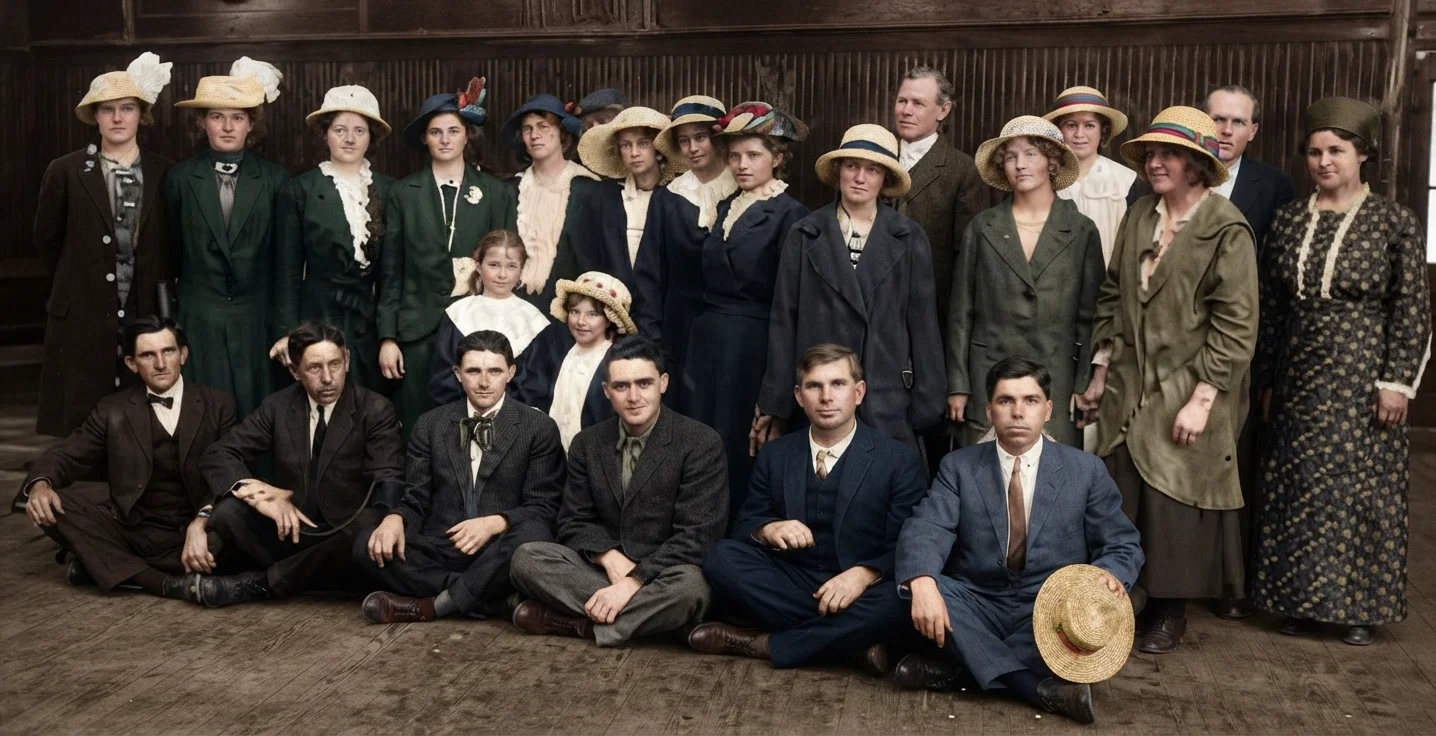
THIS is a group of men and women, with their children, who, under the leadership of Prof. and Mrs. W. S. Boynton, have recently gone from our academy at San Fernando, California, to establish an industrial school near Rome, Georgia. Five hundred acres of land has been donated to the enterprise by a woman in California, and buildings will be erected this summer. The school will be known as the Riverside Academy, and its work will be modeled much after that of our school at Madison, Tennessee.
Less than a month ago, we sent this brother 1,600 papers in one lot. Two weeks later we sent 300. Three days ago a telegram came for 300, and yesterday a letter came from him asking for 300 to be sent to another place. This brother is full of life and energy. He has from twelve to fourteen men working; but soon the farm work will begin, and most of these men will quit. Then, too, we do not consider as full-fledged new believers these people he reports. But it makes us feel that a start has been made; and if the openings are followed up, we know some returns will be garnered. We are glad to report that the work is onward in this department.
H. A. OBERG.
Living Where We Belong
ANY one who will, may become well acquainted with God. The way to do so is the way in which we become well acquainted with any one else: by taking time to be with Him. Only those who deliberately go into the presence of God, and spend time in conscious intercourse with Him, can come to know Him well.
True, God sometimes reveals Himself to one in a single hour in such a way as to bring to pass a deeper intimacy than could ever exist except by God's own action; but He does this, as a rule, for those who are seeking Him and taking time to be with Him, and none need ever persistently seek Him without coming to know Him in satisfying fulness.
A missionary said of another Christian worker, "He'll be the most 'at home' man in heaven of any man I know." "Why is that?" asked a friend. "Well, he is on such intimate terms with God here that when he gets to heaven it won't make very much difference." So it does seem with some consecrated souls. And when we are thus at home with God, we may share heaven's atmosphere with every one else.—Sunday School Times.
For Sale or Exchange
For sale, or exchange for Glendale property, six-room house, nearly new, with bath, gas and electricity if desired, lawn and hedge, good garden, chicken house and run, wood-shed, and about twenty fruit-trees in bearing. Share of Loma Linda water company. About one thousand yards from College of Medical Evangelists, one fourth mile from food factory and general store and Southern Pacific railway station. One block from new S. D. A. academy. Price $1,250. Easy terms. Apply to J. J. Laraway, Loma Linda, California.
TEMPERANCE
By Editor
Here is a group of leaflets on temperance that is selling by the hundreds of thousands, and will exert a tremendous influence in the prohibition campaign now opening throughout the United States and Canada:
The Demons' Council
A unique eight-page document, written in allegorical style. It shows how the liquor traffic has grown and fastened its hideous fangs on the souls of human beings, leaving wreck and ruin in its path.
This tract in the main consists of admissions from the opponents of prohibition as to the evils growing out of the liquor traffic. Here is one of their admissions: "It deliberately aids the most corrupt political powers, and backs with all of its resources the most unworthy men, the most corrupt and recreant officials. It does not aid the purification of municipal, state, or national administration. Why?—Because it has to ask immunity for its own lawlessness."
The terrible arraignment of the liquor interests by the liquor dealers themselves makes this one of the strongest documents produced in favor of prohibition.
Experience is the best teacher. This four-page leaflet tells an interesting story of a town as it was two years ago, with seven saloons, and the results two years after the saloons were closed.
The liquor dealer argues that from the standpoint of personal rights, he should be allowed to maintain and operate a saloon, and the only obligation is to meet the requirements of the state. Does he have this right? Read what Ex-Governor Patterson and others have to say on this question of personal rights, in this tract.
This document was prepared with special reference to temperance campaigns. Printed in two colors, in the form of a railroad timetable. It contains the names of stations, time of train arrival, and map of the route. It begins with Cigaretville. Some of the stations on the way are Mild Drink, Tipplerville, Bummer's Roost, Hungry Hollow, Drunkard's Curve, Deliriumville, Rattlesnake Swamp, and Prisonersburg, and it ends at Perdition. Price a hundred, post-paid. $1.50
It Doesn't Pay
Does the liquor traffic pay? This is one of the most vital questions under discussion at the present time. If the individual who argues that it does pay, will read this tract, the candid, truthful answer will come back, No, it does not pay.
The tract contains 16 pages and is well illustrated. Price a hundred, post-paid. . $1.00
The Wine Industry and Prohibition
An unanswerable reply to the claim that prohibition would throw 75,000 people out of employment in California and render valueless 170,000 acres of land.
Contains 16 pages, with illustrated heading. Price a hundred, post-paid . . . . . . . . . $1.00
Pocket Package No. 4
Four hundred pages of the above tracts in a strong manila envelope, post-paid. . . . $ .25
Address your tract agency or
PACIFIC PRESS PUB. ASSN., Mountain View, Cal.
Portland, Ore., Kansas City, Mo., Calgary, Alta., Can.
The Standing Army of the Interior
By David Paulson, M. D.
The White Blood Cells as a Wrecking Crew—How Alcohol Makes It Easy for Disease to Attack Us—The Real Meaning of a Fever—The Medicine of Cheerfulness
By DAVID PAULSON, M. D.
Medical Superintendent Hinsdale Sanitarium, Hinsdale, Illinois
METCHNIKOFF, the remarkable investigator at the head of the Pasteur Institute, has given us an entirely new vision of the healing possibilities of the blood. We now have the most amazing confirmation of the Scripture declaration that "the blood is the life."
THE WRECKING CREW
The red blood cells concern themselves in carrying oxygen from the lungs to the tissues; but the white blood cells, which exist in much smaller number,—only one to four or five hundred of the red,—have a vastly different and much more romantic mission to perform. They are the builders and repairers of the body. When some part is injured, they are the "wrecking crew" that immediately apply themselves to replace and rebuild the destroyed tissue.
But they are not only hewers of wood and carriers of water. They are also the standing army of the interior; for when disease germs invade some part of the body, these white blood cells at once undertake the work of defense, freely sacrificing themselves, if necessary, to accomplish this.
ROLLS UP GERMS AND DIGESTS THEM
If the web of a frog's foot is scratched with a needle, so that some germs are introduced, and if it is then placed under the microscope, in a few moments the white blood cells can be seen passing through the blood-vessel wall, very much as one might pass a handkerchief through a keyhole. They have neither eyes nor feet nor hands. They merely resemble a little lump of jelly. Yet, guided by some mysterious influence, they work their way over to the microbes, fold themselves around them as a housewife works raisins into dough, and then actually digest these germs.
TOO DRUNK TO SMELL
A well-known pathologist in Rush Medical College, Chicago, inoculated two rabbits with pneumonia germs. To one of the rabbits was then given alcohol, which formerly was the orthodox treatment for pneumonia. This rabbit died. The other one, which had not received alcohol, recovered.
A drop of its blood put under the microscope revealed the fact that the white blood cells had eaten up the pneumonia germs. An examination of the blood from the rabbit that died showed that the white blood cells had scarcely destroyed any pneumonia germs.
Evidently the alcohol that made the rabbit drunk, also made these white blood cells so drunk they could not smell the germs. No doubt many pneumonia patients have been hurried to their graves by the mistaken notion that alcohol in some way would save their lives, instead of actually cooperating with the germs to destroy them.
Do not overlook this practical point,—that the same alcohol that tends to kill a pneumonia patient, will, when used in health, pave the way for pneumonia by crippling the bodily defenses against disease. That is why surgeons dread to perform surgical operations on alcoholics. They know they can not depend upon the active cooperation of the white blood cells to repair the damage their knife does, and to dispose of any germs that may be accidentally introduced during the operation.
HOW NATURE COOPERATES IN DIPHTHERIA
Diphtheria germs do not venture into the blood stream, to be captured by the blood cells. They establish their headquarters in the throat, and begin to manufacture a poison, one part of which will ruin twenty million parts of human flesh—many times more dangerous than rat poison. It is this toxin, after it has been absorbed into the blood, that overwhelms the heart and ends the life of the patient. The body endeavors to make an antitoxin to neutralize this. If it succeeds in doing this promptly enough and in sufficient quantities the patient survives.
Some years ago Von Behring, a noted German investigator, discovered that the horse does not contract diphtheria, because it already has antitoxin on hand in its blood. So he perfected a method of securing this horse serum containing the antitoxin, and injecting it into the diphtheritic child to supplement its own efforts in this direction.
AS SENSIBLE AS TO DRINK MILK
Unquestionably this remarkable discovery has saved tens of thousands of children. And to go to the horse for antitoxin when the child is short on its own account, is just as rational as to go to the cow for milk when the natural supply is not sufficient.
Of course, if the cow has tuberculosis, then it becomes a serious matter for the child; and if the horse from which the serum is procured happened to have glanders, it would be even more serious. But the principle itself is unquestionably sound.
Nature does something more than to neutralize the poison that is absorbed. It does its best to prevent the absorption of the poison. For this reason it manufactures a patch in the throat. But unfortunately nature seems to overlook the fact that there is only a small space in the throat, and frequently keeps on making the patch thicker and thicker, and thus may gradually choke the child.
NEEDS HEAVEN'S RESOURCES
Then the doctor must interfere and remove a part of the patch. In other words, God has put more intelligence into the well-trained doctor's brain than into the mucous membrane of the child's throat, just as He has given the driver more brains than He has given the horse. Yet the driver needs the horse to pull his load. Likewise the doctor could do nothing in the sick-room, without the healing power of nature.
On the other hand, he must be prepared not simply to cooperate with nature, but sometimes to spur it up, at other times to restrain it. And right here is where he needs not only all the human wisdom that he can command, but frequently divine wisdom as well. And blessed is that physician who at such an emergency knows that he has not only the resources on earth at his command, but the resources of heaven as well.
THE REAL MEANING OF FEVER
When the system becomes overwhelmed with poisons, whether introduced from without or manufactured by the germs within, nature generally produces a rise of temperature.
In former times the doctor felt that it was his duty to crush the temperature at any cost. The scientific physician of to-day knows that for every degree of temperature, the body has multiplied to a tremendous extent its capacity to destroy poison. This is nature's method of house cleaning. And yet, like the patch in the throat, the process is not altogether devoid of danger. The hotter the blood, the greater the ability to destroy poison; but the liver, the kidneys, and other internal organs can not safely endure for any length of time this greatly overheated blood. Nature, in her anxiety to destroy the poisons, seems to overlook this fact. So again we have need of the skilled physician and the trained nurse, with their human intelligence.
But the important thing is not to give some death-dealing drug to smother the fever process, but rather to cool the patient sufficiently and yet permit the fever process to go on until it has accomplished its purpose.
ONLY TWO PER CENT OF DEATHS
Formerly ten to twenty per cent of typhoid fever cases were fatal. A generation ago Dr. Brand secured permission to introduce the use of cold baths for typhoid fever in the German army. After he had treated eight thousand cases with only two per cent of deaths, the whole medical world was convinced of the great advantage of baths in the treatment of fevers.
If we desired to burn up a lot of rubbish in an old stove that could stand only a certain amount of heat, we might stir up the fire, and yet at the same time apply cool applications to the stove. That is precisely what we now do to the fever patient; and as a consequence, hundreds of lives are saved that in former times would have been sacrificed to the prevailing ignorance of nature's program.399
SHALL WE COOPERATE OR HINDER?
Earth and sea were ransacked to find a sure cure for tuberculosis. But it still continued to claim its full toll of victims until some one conceived the idea of keeping the tubercular patient outdoors day and night, feeding him wholesome, nourishing food, and giving due attention to his bowels. And this came very near being a sure cure in all early stages.
But it was not the fresh air in the lungs that healed the patient. It was the fresh air in the blood, reviving its healing possibilities. Any one can comprehend that the kind of blood that can repair a diseased lung can just as readily repair a diseased stomach, liver, or nerves. So we have come to understand that fresh air is one of our most important adjuncts in the mighty struggle against disease.
A reasonable amount of pleasant outdoor exercise contains health and life-giving possibilities. The man who lives in a poorly ventilated house or office day after day is permitting his bodily defenses to crumble to pieces.
THE CHEERFUL SPIRIT
Thirty centuries ago the wise man said, "A cheerful heart is a good medicine." Prov. 17:22, A. R. V. We now know that depression, sorrow, jealousy, and hatred tend to hinder white blood cells from doing their work. They also block digestion. So if we want to cooperate intelligently with the healing influences God has put within the human body, we should pray that some of the joy of the Lord may be put into our lives; for it is those who wait on the Lord who shall renew their strength. Isa. 40:31.
The Tobacco-Using Habit
By William Covert
My Experience and Observation
By WILLIAM COVERT
FROM childhood, I have felt called upon to use my influence against the use of tobacco. Whatever may be the purpose of its existence, I am absolutely sure that tobacco was not intended for man to chew and smoke.
My opposition to the use men were making of it grew out of my observation concerning its effects upon those who were using it. The first lesson came by my accidentally tasting the nauseating weed. I borrowed a knife to pare an apple, and the instrument had been used by its owner in cutting tobacco just before I used it to cut into the apple. O, the nauseating taste that the tobacco oil upon the knife imparted to the apple! I then marveled that any one could ever acquire a love for anything so unpleasant to the palate as that tobacco was to mine.
After that little experience with tobacco, I inquired if all men were expected to use tobacco, and I was told that it was a matter of personal option with each one. When I received the answer, there came a resolution into my soul, young as I was, which said: "I will never use it. A thing so repugnant to my unperverted senses as tobacco is, shall never have dominion over me."
Next I saw a farmer boil some tobacco stocks and scraps from his tobacco shed and put the boiled water upon his young cattle. When I asked him why he was doing such a thing as that, he said he was killing the vermin on the cattle. I noticed that every member of the herd was trembling with weakness, and evidently suffering in agony as a result of the treatment. Then I thought I must see what the effect would be upon the little creeping things that had made their habitation upon the sorry looking cattle; and behold, before the setting of the sun, every creeper on the poor young cattle had died from the use of tobacco.
The cattle recovered, because the thickness of their hides prevented the tobacco poison from slaying them, but the unfortunate bugs were not so deeply encased in their shields, and they died of too much tobacco.
The farmer gave the bugs an overdose at the beginning, and it proved fatal. Yet if it could have been administered to them in moderation until the habit was acquired, perhaps they would have become advocates of its use. They did not have a chance to learn how to use it; but most of the boys of my acquaintance did get a chance on the sly to take a little at a time until the habit was fastened upon them, and then but a few of them had manhood enough left to shake it off.
It seemed that they acquired the habit before judgment was enthroned or reason developed. Thus maturity, as far as they did mature, found them short on the very essentials that go to make up the highest state of humanity. The tobacco-using habit was acquired before manhood was developed in a sufficient degree to resist it; and after it was fastened upon them, their resisting power was subjugated to such an extent that they could not easily discard the habit.
As I viewed the conflict, it seemed to me that my associates were giving place to an unhealthy, uncleanly, unnecessary, undesirable, inconvenient, expensive practise, without one redeeming feature to justify them in the course they were taking.
And now, since I have had the opportunities of a long lifetime to observe the evil effects of tobacco-using, the conviction is confirmed that this habit is an unmitigated curse.
The question is asked, Can any Christian man give a satisfactory answer to his own conscience for it?
Important Subjects
By Editor
The July "Signs of the Times Magazine" will consider some very timely subjects. They list as follows:
"A Quick Work in This Generation — Providential Agencies at the Present Time — What It All Means." — W. A. Spicer.
"The Spirit of Kindness Is the Spirit of God's Kingdom — Evidences of God's Fatherhood — How Nature Reveals the Character of Its Creator — Jesus Christ the Example of Perfect Manhood." — R. C. Porter.
"The World-Wide Gospel Message — The Real Purpose of Linking the World Together by Telegraph, Telephone, Railroads, Steamships, Newspapers, Books, Various Means of Communication — Increase of Knowledge as a Sign of the Times." — I. H. Evans.
"The Final Battle — The War That Closes the History of the World — Why It Is Restrained — When It Will Come." — J. O. Corliss.
"The Passing of Simplicity — Another Sign of the Times in the Changes That Are Taking Place in Human Life — The Past and the Present in a Light That Points a Lesson." — Frank S. Weston.
"God's Eternal Purpose in Christ — A Study of the Great Contest over Man's Soul — Who Is the Real Saviour of the World, Christ or the Virgin Mary? — Who Is the Mediator Between Man and God?" — T. E. Bowen.
"The Drug-Endangered Nation — Increase of the Drug Traffic — Cocain a Menace." — Milton Charles Wilcox.
"A Work of Reform — Why Is there So Much Agitation over the Sabbath Question? — A Clear, Logical Answer — Providential Means of Sabbath Reform." — Mrs. E. G. White.
"Literary Aspects of Evolution — Some Poetic and Prose Selections from Evolutionary Literature — Some Clumsy, Some Stupid, Some Blasphemous — Contrasted with the Treasures of Wisdom and Knowledge in the Sacred Word." — George McCready Price.
"Putting on Immortality — Who Shall Have Immortal Life — When Immortality Will Be Given — The Mighty Change That Will Take Place." — William Covert.
"The Eastern Question — It Is Still a Question — Some Index-Fingers, Every One of Which Points Toward Russia — Prospects of Another Uprising in the Near Future."
"Our Canadian Letter — Will there Be Catholic and Protestant Political Parties in Canada? — Some Eventful Agitations Relative to Church and State." — Jean Vuilleumier.
"Nuggets of Gold" — "Christianity and Social Problems."
Ten cents in coin or stamps will bring you a copy. Five cents up to forty copies.
SIGNS OF THE TIMES MAGAZINE
Mountain View, California
Sanitarium Cooking Oil
"THE OIL OF QUALITY"
Pure Cotton Seed Oil direct from refinery. Sweet, wholesome, and delicious. 4 1-gallon cans, $3.60; 5-gallon can, $3.90; 2 5-gallon cans, $7.70; 30-gallon barrel, $20.80; 50-gallon barrel, $32.75. Cash with order. Sanitarium Cooking Oil Co., Louisville, Kentucky.
THE THREE BEST WAYS
BETWEEN
California and the East
The CENTRAL ROUTE
Less than three days to Chicago
The SOUTHERN ROUTE
All rail or via the palatial Southern Pacific steamers between New Orleans and New York
The SHASTA ROUTE
Via Portland or the North
The best of equipment and service
Protected throughout by automatic block signals
INQUIRE OF ANY AGENT, OR
MR. C. S. FEE
General Passenger Agent
San Francisco, California
SOUTHERN PACIFIC
George Washington
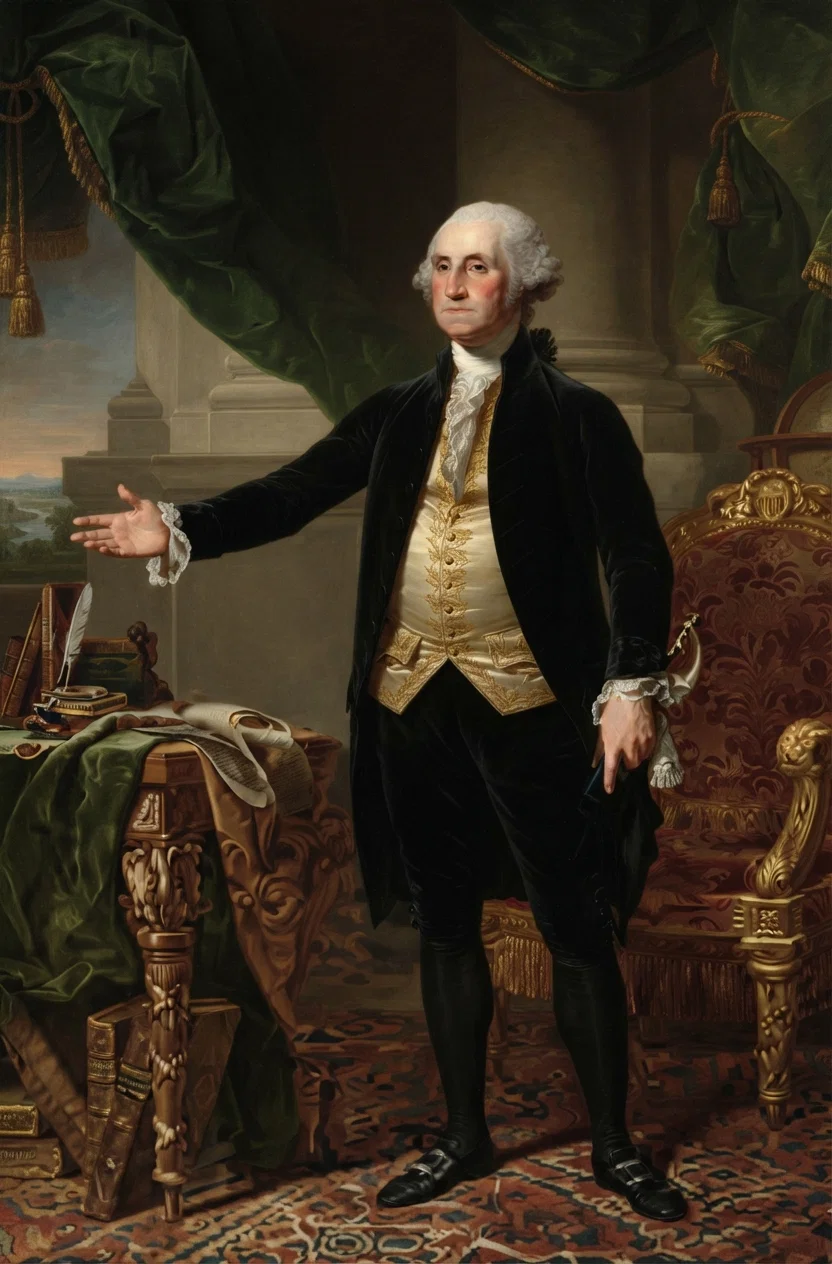
GEORGE WASHINGTON is often called the "father of his country." Without doubt he was one of the foremost among the mighty men who laid the foundation of this great nation. And yet the materials out of which that foundation was built had been hewn out amid the sufferings and conflicts of many preceding generations. For centuries England had been a battle-ground for freedom. Patriots had struggled to wrest their liberties from the despotic grasp of men who claimed the "divine right" to be tyrants.
A little handful of men, led by Washington and a few kindred spirits, established a nation here where principles could be allowed to operate that were too revolutionary for the more conservative peoples that inhabited the Old World. But if these principles had not already been well worked out in England, Holland, and elsewhere, they could not have sprung up so suddenly here. Hence, under the guiding hand of a benign Providence, our liberties have come to us as a blessed inheritance. And the men who inherited this great wealth of freedom have so used the sacred legacy as to build up, on this western continent, one of the mightiest nations the world has ever seen—a nation that has been a blessing and a help to all the world.
Four days after the date of this paper is the time for the celebration of our national independence. This year it falls on the day set apart by Jehovah as the Sabbath of sacred rest. It would be well if all men could know the truly great and important things for which these two institutions stand—the Sabbath for its great spiritual freedom, and the fourth of July for its great principles of physical freedom and true personal liberty.
An Active Volcano in the United States
By Editor
DURING recent days, an active volcano has broken out in Mount Lassen, in the north-eastern part of California. At first, the disposition was to treat the matter as a fake, as the mountain from which the volcano is belching is one of the snow-capped peaks, and consequently, there are not very many people living in that immediate region. But scientists have investigated it, photographers have photographed it, and it is an assured fact that the United States now has an active volcano of its own.
There are evidences of volcanic eruptions in bygone centuries, in different parts of the mountainous regions of California; but none of them have been in action for at least two hundred years, so say the reports.
Some people may think, because of the active volcano in this state, that it is not a very safe place to live; but there are very few of the inhabitants of California who would know anything about this eruption were it not for the newspaper reporters and photographers. California is a big state, and has an immense area of mountainous region where very few people live, as well as its thousands of acres of fertile valleys. Next week we may have some photographs of the volcano in action, and some further things to say concerning it.
The English Suffragettes
MRS. PANKHURST recently "vowed to lie on the steps of the House of Commons without food or water until Premier Asquith consents to receive a deputation." The same despatch that tells of this, tells of the suffragette plot against the safety of Prince Henry, King George's third son. It also tells of the attack made with a hatchet, by a young and stylishly gowned woman, upon an attendant at the Doré gallery, who tried to prevent her from destroying valuable pictures on exhibition there. A later despatch tells us of a state function at which many notables were present, when suddenly a suffragette, who had got into the assembly in some unaccountable manner, threw herself upon her knees before the king, shouting, "Your majesty, for God's sake, don't use force." This was considered a very dastardly thing for a person to do in an assembly of that character.
A day or two since, some of these same suffragettes invaded Catholic churches, and created scenes by attempting to harangue the congregations. Worship was disturbed in this way in a number of instances.
Mrs. Pankhurst recommends that Premier Asquith be threatened as well as implored, and the slogan has been adopted by the militant suffragettes, "No peace for King George or Queen Mary." Things of this character are so inflaming the populace that it is believed by some well-informed persons that mobs may rise up and resort to lynching of some of the leaders in this militant suffragette movement. The army is growing larger, all the time, of those who can not be satisfied unless they are creating some kind of social tempest.
"Union of Professional Theologians"
SAMUEL GOMPERS, president of the American Federation of Labor, was recently led to say, "The ministerial associations are nothing more nor less than a union of professional theologians."
Leaders in the church federation movement have made the statement that they should organize the forces of the church, following the example of the big business monopolies and the labor-unions; and Mr. Gompers is quite right in saying that they have done this. But where is the promise in the Bible that the church of Christ is to perform its work through force of numbers?
We can find where He says, "Not by might, nor by power, but by My Spirit, saith the Lord of hosts"; and we can find where He says, "Put not your trust in princes, nor in the son of man, in whom there is no help"; but we do not find in the sacred Word where He authorizes His followers to overawe politicians, and because of numbers, to compel the making of laws that are agreeable to the members of the church.
In attempting to follow Christ, it is well for us to understand that He directs us to turn to His word for guidance; and if we are not guided by definite statements in the divine Book, we may find ourselves part of the great apostasy instead of followers of the humble Nazarene.
Desires a Horse-Thief License
By Editor
A MAN who signs himself G. I. Lovegold, is reported to have applied to the board of supervisors of Imperial County, California, for a horse-thief license.
In his plea for the license, he says he is willing to pay liberally for the privilege, and that he is emboldened to make the application, by reason of other special privileges that are sought by citizens "of good moral character." He says that these good moral people, so-called, ask for licenses for a business that produces at least three fourths of all the crime committed in the county and that has recently made the criminal court the most expensive in its history.
Mr. Lovegold thinks his business would not be nearly so injurious to the community as that of selling intoxicating liquors. For instance, he would not take away the senses of any man, nor rob his purse. He would not cause any man to beat his wife, to commit murder, to raise a disturbance in the community. All he would desire would be simply the privilege of stealing horses.
He says that he would do nothing to destroy men's souls, and that he would be willing to put himself under solemn obligation not to steal horses on Sunday, election days, or legal holidays, nor after twelve o'clock at night. He would not steal colts, nor horses that have no sense, nor old broken-down plugs.
In fact, he thinks he would confine his stealing to the well-to-do only; but their bodies, their minds, their reputations, and their characters would not be hurt. He would simply take their horses.
He reminded the board of supervisors that they had to have license fees to run the county; and that if he did not steal horses, somebody else would; and if they do not let him have a license for stealing them, the result will be that a lot of sneak-thieves and liars will, under cover, get them by stealth.
Mr. Lovegold has certainly presented a very fine piece of irony. There is just as much sense in granting license to horse thieves as there is in granting license to saloon-keepers; for, as the gentleman points out, the horse thief would not do anything like the injury that is accomplished through the licensing of strong drink.
A Violent Thunderstorm in Paris
A THUNDER-STORM of phenomenal violence raged over Paris, France, for three hours on June 15. The streets became rushing torrents. Seven persons were killed, and many were rendered homeless.