Jimmie was not a boy, nor even a dollie; but he filled an important place in the life of a little girl I once knew.
It was in the time when the greater part of Kansas, Colorado, Oklahoma, and Indian Territory were taken up by vast cattle ranges, and few white people were seen, save the cattlemen and their families. On the border of one of these wide ranges lived little Dot with her mother and father and “the boys,” as the hired men were called. The life was a dreary one, and the child would have had a lonely time of it, had it not been for her fondness for pets, of which she had a great many. Dearest among them all was Jimmie.
One fine day in early summer one of the boys rode up to the cabin door, and called for Dot. When she appeared, he leaned down; dropped into her hands a tiny bundle of reddish-brown fur, with four little feet, and a pair of bright, frightened eyes; and then galloped away.
Dot stood looking at her unexpected gift, almost as much frightened as the little animal itself. Just then papa came up, and told her that the little creature was a young prairie-dog. This served as an introduction, and Dot had soon made for her new pet a cosy nest in a box outside the kitchen door. She called him Jimmie, and his education began at once. He proved an apt learner, and would soon drink his saucer of milk with as much relish as did the big gray cat, who soon became his friend and almost constant companion.
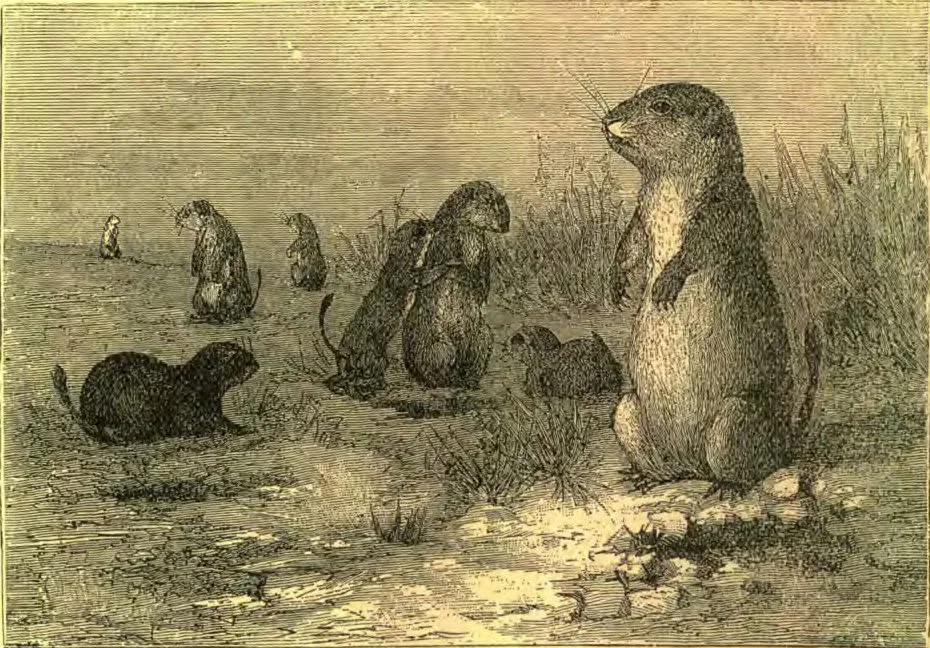
Jimmie was not long contented with his nest in the box, however. He chose rather to follow the customs of his race, and dig for himself a burrow. Choosing a spot not far from the house, he began the work of excavation with great vigor. He would dig away as fast as his little paws could work for a while, pushing the earth out behind him; then he would come out, and build it into a regular mound around the hole, patting it down with his nose. This performance afforded the family much amusement; for his face, covered with the particles of fresh earth, contrasted strangely with his sharp black eyes as he sat upright at the door of his house, viewing his work with evident satisfaction.
PRAIRIE-DOGS AT HOME.
The big cat did not seem altogether to approve of Jimmie’s enterprise; for there was much less time to play, now that house-making was in progress. Still, Brindlefur was interested. He would stretch his long body on the grass, and watch his little friend as he worked at his new home. Perhaps after a time he would thrust his paw into the hole, as a sort of challenge for a romp. If Jimmie was in a romping mood, he would come out, and the frolic would end in a precipitate rush for the burrow. Jimmie was always first to reach it and dart in. Brindlefur would follow close after, and thrust in his paw, and then roll over on his back, as if laughing. Sometimes this romping would last for hours at a time.
Jimmie’s industry was not confined to the making of his house; but he kept every spear of grass and every weed cut off close to the ground for many feet around the door of his dwelling. This was no doubt because these little animals are always on the lookout for danger, and the herbage obstructed his view. One morning when Dot went to look for Jimmie, he was nowhere to be found; and she called many times before she heard the sharp, short bark with which he always responded to his name. Usually he would rise to his haunches, and answer, at the first sound of the familiar call, no matter where he was; but on this particular morning he seemed loath to leave his work. When Dot’s mama went to investigate, she found that he had cut down a choice rose-bush that she had tended with much care. Only the rounded white stump, bearing the marks of Jimmie’s sharp teeth, was left to tell the story. It was found that this rose-bush hid a portion of the public road from Jimmie’s view when he stood on guard at the door of his dwelling; and this was no doubt his reason for wishing to cut it down.
At another time Dot’s papa came in, and said that there was something interesting going on at Jimmie’s hole. Dot and her mama followed him, and saw about half the body of an ugly spotted snake protruding from the hole. Of course Dot wanted it killed at once, but her papa said: “No; I have heard that prairie-dogs and rattlesnakes [for it was a “rattler”] often live together in the same hole, and now we will see whether this is so, and what Jimmie thinks of his visitor.”
The snake was scarcely more than in the hole when Jimmie rushed out in evident alarm and great excitement. He did not appear to notice the onlookers, but began, with all his might, to fill up the hole. Nor did he stop until his task was completed, and he had pressed the last bit of earth firmly down over the intruder. It had cost him several hours of hard work, but his victory was complete, and he viewed the result with evident satisfaction. But the fact that he was homeless soon dawned upon him, and he began to cast about for a suitable location for a new home. When he found a place to his liking, he began work at once, and in a few days was master of another house.
One autumn day in the third year of Jimmie’s residence at the ranch, a neighbor cattleman came to see Dot’s papa, and brought his dog with him. Jimmie evidently mistook this stranger for the big black-and-white ranch-dog with whom he was on familiar terms, and with whom he often enjoyed a frolic; for he scampered up to the stranger in high glee. But the dog did not understand. With a growl he caught Jimmie in his great teeth, and shook him; and when he let go, Dot’s little pet fell to the ground dead.
Dot grieved long and deeply over him; and though she afterward had other pet prairie-dogs, none of them quite filled Jimmie’s place.
ETHEL TERRY REEDER.
STRENGTH IN WEAKNESS
By L. A. Reed
When we study the structure of plants through the microscope, we meet at every turn most marvelous revelations. The first discoveries made with the microscope were during the years immediately preceding 1700, and they produced a profound impression.
Swammerdam, a Dutch philosopher, became nearly insane at the wonders revealed to him by the instrument. At last he destroyed his notes, concluding that it was sacrilege to unveil, and make plain to the eyes of man, what God had intended should never be seen by human eye.
Of course there is nothing in God's universe which he attempts to hide from the true inquirer after knowledge. But if he should hide the mysteries of his way, no man alive could ever uncover them.
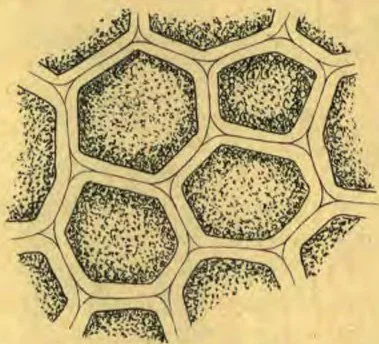
Under the microscope the tissues of plants appear like honeycomb,—built up of a large number of cells. And as in the honeycomb some of the cells are often empty, and some filled with honey, so in the cells of plants, some appear filled with a slimy substance, while others are empty.
Besides these honeycomb-like structures, we observe little tubes and fibers arranged in various ways, and bound together with strands and membranes and into pith and wood. By divisions and subdivisions, these cells increase in number.
Further investigations show that within these cells is a body of “gelatinous, slimy consistency, which lives in the cell-cavity, like a mussel or a snail in its shell.” Scientists call this body “protoplasm,” and by them it is considered the basis of life.
Whatever theories they may have about it, the known facts are these: All activities in the plant, all motion and work, are wholly dependent upon this watery material. That which we know by the name of “life” is seated only in these protoplasmic bodies. It is truly marvelous—the building of elms and oaks, the rearing of their huge trunks and limbs in air, the ramifying of their countless roots in earth, all the mighty work of the plant, by the action of the little slimy bodies in the cavities of the tree. They are almost as thin as water, as frail and delicate as anything we can imagine; and yet here is the Shekinah of God's power. Here God condescends to manifest that marvelous energy which men call the power of growth.
That we may comprehend something of the mighty power of plant-growth, I offer the following remarkable illustration: “In the Agricultural College at Amherst, Mass., a squash of the yellow Chili variety was put in harness in 1874, to see how much it would lift by its power of growth.
“It was not an oak nor a mahogany tree, but a soft, pulpy, squashy squash, that one could poke his finger into, nourished through a soft, succulent vine, that one could mash between finger and thumb. The squash was confined in an open harness of iron and wood, and the amount lifted was indicated by weights on a lever over the top. There were, including seventy nodal roots, more than eighty thousand feet of roots and rootlets. These roots increased one thousand feet in twenty-four hours. They were afforded every advantage by being grown in a hotbed. On August 21 the squash lifted sixty pounds. By September 30 it lifted a ton. On October 24 it carried over two tons. The squash grew gnarled, like an oak, and its substance was almost as compact as mahogany. Its inner cavity was very small, but it perfectly elaborated its seeds, as usual.
“The lever to indicate the weight had to be changed for stronger ones from time to time. More weights were sought. The students scurried through the town, and got an anvil and pieces of railroad iron, and hung them at varying distances. By the 31st of October the squash was carrying a weight of five thousand pounds. Then, owing to defects of the new contrivance, the rind was broken through, without showing what might have been done under better conditions. Every particle of the squash had to be added, and find itself elbow room, under this enormous pressure. But life will assert itself.”
All this marvelous growth was by the means of cells. It was wholly the work of the protoplasm. The protoplasm is a thin, watery nothing, compared with solids; but in it is exercised an energy that is the power of Almighty God. “It is God that worketh.” God uses the weak things of the world to confound the mighty.
L. A. REED.
Cell Chambers. Dark Portion Represents Protoplasm.
Look Up, Not Down: Keeping Our Eyes on Christ
“Look up! look ahead!” cried a friend who was teaching me to ride a bicycle; “don’t look down at the handle-bars, but keep your eyes up.” “Eyes front! don’t look down,” said a sergeant who drilled me. “If you feel seasick, look at the sky; keep your eyes from the water,” advised a cousin who took me in a sailing-boat on a rough sea. “Look at me, not down at your oars,” shouted my brother, who steered a boat that I was rowing on our river. Look up, not down! Look forward, not backward! Stephen looked up steadfastly into heaven, and saw his Lord. The disciples gazed up into heaven after their Master as he ascended, and gathered strength and courage to serve him faithfully on earth.—Selected.
Persons: Jesus, soldiers, Simon of Cyrene, two thieves, chief priests, scribes, elders, company of women, Pilate.
QUESTIONS
1. After being again scourged, to whom was Jesus delivered? Where was he taken? Mark 15:16; note . What did the soldiers first do to him? Matt. 27:28. To what terrible abuse was he then subjected? Vs. 29, 30. Having satisfied their brutality, what did the soldiers do? V. 31; note .
2. Who was at first compelled to bear the cross? John 19:17. As Jesus was unable, in his weakened condition, to carry the burden, upon whom was it laid? Luke 23:26.
3. Who formed a part of the procession that wended its way to Calvary? V. 27. What admonition did Jesus give them? V. 28. To what time and to what facts did he point them as a reason for his statement? Vs. 29, 30; note . What were his closing words to them? V. 31; note .
4. With Jesus what others were to be put to death? V. 32. By what name was the place of crucifixion known? Matt. 27:33; note . What drink was given Jesus upon arrival there? V. 34; note .
5. What then took place? What words were thus fulfilled? Luke 23:33; Mark 15:28. While they were nailing him to the cross, what prayer did Jesus offer for his enemies? Luke 23:34. When the cross had been raised, what shameful scene took place? Matt. 27:35; John 19:23, 24. What was the time of day? Mark 15:25.
6. What inscription was placed upon the cross? John 19:19. What request did the priests make of Pilate concerning it? V. 21. What did Pilate say? V. 22.
7. What mocking words were spoken by the passers-by? Mark 15:29, 30. What did the priests have to say? Matt. 27:41–43; note .
NOTES
LIFE FORFEITED
By S. N. Haskell
“He that planteth and he that watereth are one: . . . for we are laborers together with God: ye are God’s husbandry.” 1 Cor. 3:7-9. Some render this, “Ye are God’s tillage;” others, “Ye are God’s field.” Macknight translates it, “Ye are God’s farm;” the Revised Version says, “God’s tilled land.”
The tilling of the soil, therefore, becomes an object lesson of the cultivation of the grace of God in the heart; and as the weeds and thorns and thistles are destroyed, the lesson of the uprooting of sin from the heart should be taught.
The life of God in the weeds, which is the same as the life of God in the good fruit and the good trees that are planted and cultivated, is forfeited by being devoted to that which is useless. So the life of God in the soil is forfeited when it is devoted to nothing but weeds and thistles, the same as the life of the sinner is forfeited when devoted only to evil. As the weeds and thistles are destroyed in cultivating the soil, so sin is to be destroyed in the human heart. Hence in planting flower seeds in the garden, and keeping down the weeds, there lies a practical lesson of cultivating the heart by the grace of God.
The Lord, therefore, in making it necessary to destroy that which is obnoxious and would hinder the growth of that which is useful, is teaching man to co-operate with him in restoring his image in the soul. Whatever is wholly devoted to destruction and sin should be destroyed. In destroying it we are co-operating with God in the plan of redemption. The frogs in Egypt, the lice throughout all the land of Egypt, destroyed by Moses, taught the lesson of destroying those insects that are only a curse to man. The life in them is the life of God, but it is devoted to nothing but evil.
In the destruction of the mosquito and the poisonous reptile, and the insects that destroy the fruit-trees, there is simply an object lesson of the final destruction of sin; and in destroying them, we co-operate with God in the plan of redemption. This was forcibly impressed upon the minds of Israel when they were instructed, in besieging a city, not to “destroy the trees thereof by forcing an ax against them: for thou mayest eat of them, and thou shalt not cut them down (for the tree of the field is man’s life) to employ them in the siege: only the trees which thou knowest that they be not trees for meat, thou shalt destroy and cut them down.” Deut. 20:19, 20. It was still more forcibly taught in Deut. 29:18-21. If any person should plant a root that bore a poisonous herb, the Lord said he would not spare him, but would “blot out his name from under heaven.”
Men are responsible for the life of God, whether it be in man or in the animal creation or in briars and thorns. The apostle taught this when he shook the viper from his hand into the fire. S. N. HASKELL.
TAKE THE Canadian Pacific Railway
for . . . CHATHAM, LONDON, WOODSTOCK, PORTLAND, OTTAWA, GALT, TORONTO, and MONTREAL, QUEBEC, BOSTON,
All points in New England, the Maritime Provinces, Great Britain, and the Continent.
Illustrated literature, time-tables, and full particulars, upon application to—
J. FRANCIS LEE, GEN. AGENT,
Passenger Dep't. 228 SOUTH CLARK ST., CHICAGO
Branch Offices: 76 Ottawa St., Grand Rapids, Mich.; Room D, Chamber of Commerce, Cincinnati, Ohio; 315 Chestnut St., St. Louis, Mo.
Cincinnati Northern Railroad Co.
TIME TABLE NO. 3.
IN EFFECT SEPT. 24, 1899.
Trains Pass Battle Creek, as follows:
WEST-BOUND.
No. 21, Mail and Express ............ 6.58 P. M.
No. 23, Accommodation ................ 2.07 P. M.
No. 27, Local Freight ................ 8.25 A. M.
EAST-BOUND.
No. 22, Mail and Express ............ 8.25 A. M.
No. 24, Accommodation ................ 1.45 P. M.
No. 28, Local Freight ................ 5.30 P. M.
Direct connections are made at Toledo with all roads diverging. Close connections for Detroit and Cincinnati.
J. L. READE,
Ticket Ag't., Battle Creek.
E. R. SMITH, City Pass. Ag't., 6 West Main St.
GRAND TRUNK RAILWAY SYSTEM.
By A. S. Parker
Time-Card in Effect November 19, 1899.
C. & G. T. DIVISION.
WEST-BOUND FROM BATTLE CREEK.
No. 2, Mail and Express, to Chicago — 12.15 P. M.
No. 1, Chicago Express, to Chicago — 9.00 A. M.
No. 3, Lehigh Valley Express, to Chicago — 3.40 P. M.
No. 5, Pacific Express, to Chicago, with sleeper — 1.10 A. M.
No. 75, Mixed, to South Bend — 8.20 A. M.
Nos. 9 and 75, daily, except Sunday.
Nos. 1, 3, and 5, daily.
EAST-BOUND FROM BATTLE CREEK.
No. 8, Mail and Express, to Pt. Huron, East, and Detroit — 3.45 P. M.
No. 4, Lehigh Express, to Pt. Huron, and East — 8.27 P. M.
No. 6, Atlantic Express, to Port Huron, East, and Detroit — 2.25 A. M.
No. 2, Leh. Exp., to Saginaw, Bay City, Pt. Huron, and East — 6.50 A. M.
No. 74, Mixed, to Durand (starts at Nichols) — 7.15 A. M.
Nos. 8 and 74, daily, except Sunday.
Nos. 4, 6, and 2, daily.
A. S. PARKER, Ticket Agent,
Battle Creek.
CALLED TO SERVICE
The great London philanthropist, Dr. Barnardo, who has done so much for the street waifs of that large city, was led to take up that particular work as the result of the following incident:—
“He was closing the rooms of a city mission one night after the children had gone, when down by the stove he saw one poor little ragged urchin standing without hat or shoes or stockings. He said to the boy, ‘Boy, it is time for you to go home.’
“The boy did not move.
“Dr. Barnardo went on closing things up, and by and by he said, again, ‘My boy, why don’t you go home?’
“‘I ain’t got no home.’
“Dr. Barnardo did not believe it, but asked the boy to come to his house, and after giving him something to eat, heard his story. He was an outcast, without father or mother or place to sleep.
“‘Are there more like you?’ asked Dr. Barnardo.
“‘Lots of ’em,’ said the boy.
“‘Will you show me some of them?’
“‘Yes, I can show ’em.’
“So about midnight he went out with that boy, and they threaded their way down some of the streets of London, and then into a ‘close,’ and the boy pointed to a kind of coal-bin in this area, and said, ‘There’s lots of ’em in there.’
“The doctor stooped down, lighted a match—and there wasn’t a boy there. He thought the lad had been swindling him, but the boy wasn’t at all abashed. He said, ‘The cops have been after ’em; they’re up on the roof.’ And with that he went up a brick wall onto a tin-covered roof, pulling the doctor up after him.
“There, on that winter night,—it happened to be a starlight night,—the doctor saw thirteen boys cuddled up, and one little boy cuddled close to his brother to keep warm; nothing under them but a tin roof; nothing over them but the starlit sky.
“The boy said, ‘Shall I wake ’em?’
“It occurred to the doctor that he had one boy there, and this boy was going to waken thirteen more, and he didn’t know what to do with one, so he said, ‘No.’ But that night, on that tin roof, he stood and promised God that he would devote his life to the outcast boys and children of London.
“That was Dr. Barnardo’s night. That night he received his peculiar call for that peculiar service; and last night, in or near London, there slept under friendly Christian roofs nearly five thousand boys and girls, gathered by him, in course of training for lives of purity and usefulness.”
The Largest Custom-House in the World
THE largest custom-house in the world is that at New Orleans. It was begun in 1848, and finished in 1878. It is built of Quincy granite, the interior being finished in finest marble. It has one hundred and eleven rooms. It cost nearly five million dollars.
Smoking Forbidden on St. Petersburg Streets
It is said that smoking is not allowed on the streets of St. Petersburg. Occasionally a man may be seen puffing a cigar, but he is a foreigner, who has not yet learned the law, though if he continues to smoke, he will not be allowed to remain long in ignorance of it. The late Czar Nicholas, entering a hotel one evening in his general’s uniform, saw a man smoking, and asked him if he was a foreigner. “Yes, General; I am just from Paris.”
“Then you are not aware that smoking in the streets of St. Petersburg is forbidden by law? I warn you, lest you get into trouble.”
“Thanks, General,” said the Parisian, throwing away his cigar. He was much surprised to learn, a little later, that it was the czar who had given him this kindly warning. Czar Nicholas hated tobacco in any form.
THE LITTLE THINGS
In a lecture before a class in the Purdue University Railway Course, not long ago, an official of the Pennsylvania Railroad showed how the cost of the distinctively little things mounts up in the offices of a large railway system. He showed, for example, that the Pennsylvania pays, each year, about one thousand dollars for pins, five thousand dollars for rubber bands, five thousand dollars for ink, seven thousand dollars for lead-pencils, etc. These sums are trifling when compared with the cost of the stationery used in the offices, which, according to Mr. Dudley, costs the company nearly as much as its iron. Some roads, seeing the waste in the use of these supplies, have ordered their officials to use pads of manila paper for their communications with one another.
PAPERS WANTED
The Florida Tract Society will be glad to use late, clean copies of the Youth's Instructor in supplying reading-racks, etc. All wishing to aid in this work should send papers, postage paid, to Josephine Grannis, Orlando, Fla.
NOTICE!
PERSONS desiring to send papers to prisoners in the Southern States and Mexico may obtain addresses of same by writing to J. B. Clark, Box 1, Welsh, La. Please do not send papers to Brother Clark to be remailed. It would be well for those sending papers to write at one side of the wrapper their name and address.
To Reach BATTLE CREEK
FROM
CHICAGO, BUFFALO, DETROIT, OR TOLEDO.
Purchase Tickets Reading over the MICHIGAN CENTRAL
“The Niagara Falls Route.”
A First-class Line for First-class Travel between Chicago and New York and Boston. Elegantly equipped through trains pass Battle Creek in each direction daily.
R. N. R. WHEELER, Ticket Agent, Battle Creek.
O. W. RUGGLES, Gen’l P. and T. Agt., Chicago, Ill.
Self-Pronouncing S. S. Teachers’ Reference Bible.
CONTAINS the celebrated _Teachers’ Helps_, comprising nearly 400 pages. Also a complete series of fifteen new maps.
_Description._— Imperial Seal Binding, Tuck Edges, known as “Divinity Circuit,” Rounded Corners, Full Red under Gilt Edges.
We offer this Bible, post-paid, for only _SIX NEW YEARLY SUBSCRIPTIONS_ at 75 cents; or _TWELVE NEW SIX MONTHS’ SUBSCRIPTIONS_ at 40 cents.
We will also send it, post-paid, with the INSTRUCTOR one year for $2.25. For 20 cents extra we will stamp your name in gold upon the cover.
Spring's Quiet Miracle and the Power of Love
Look about you these March days, and see how the change from winter to spring is brought about—not by an earthquake, a tornado, nor any great convulsion of nature, but by the simplest means possible. The days lengthen slowly, the sunshine grows a little warmer, and the thick covering of ice built over lake and river breaks up, the great snowdrifts sink away, and the miracle is wrought.
Love is like sunshine in its effect on human hearts—it melts their reserve, softens their hardness, and makes them tender and receptive. A north-wind manner never has a south-wind effect: and this it is well to remember in our every-day dealings with those around us.