The Youth’s Instructor, Vol. 48, No. 10.

IMPRESSIONS OF THE HAWAIIAN ISLANDS

The Youth’s Instructor

Mar 8, 1900

Review and Herald Publishing Company · Battle Creek, Mich. · Mar 8, 1900

IMPRESSIONS OF THE HAWAIIAN ISLANDS
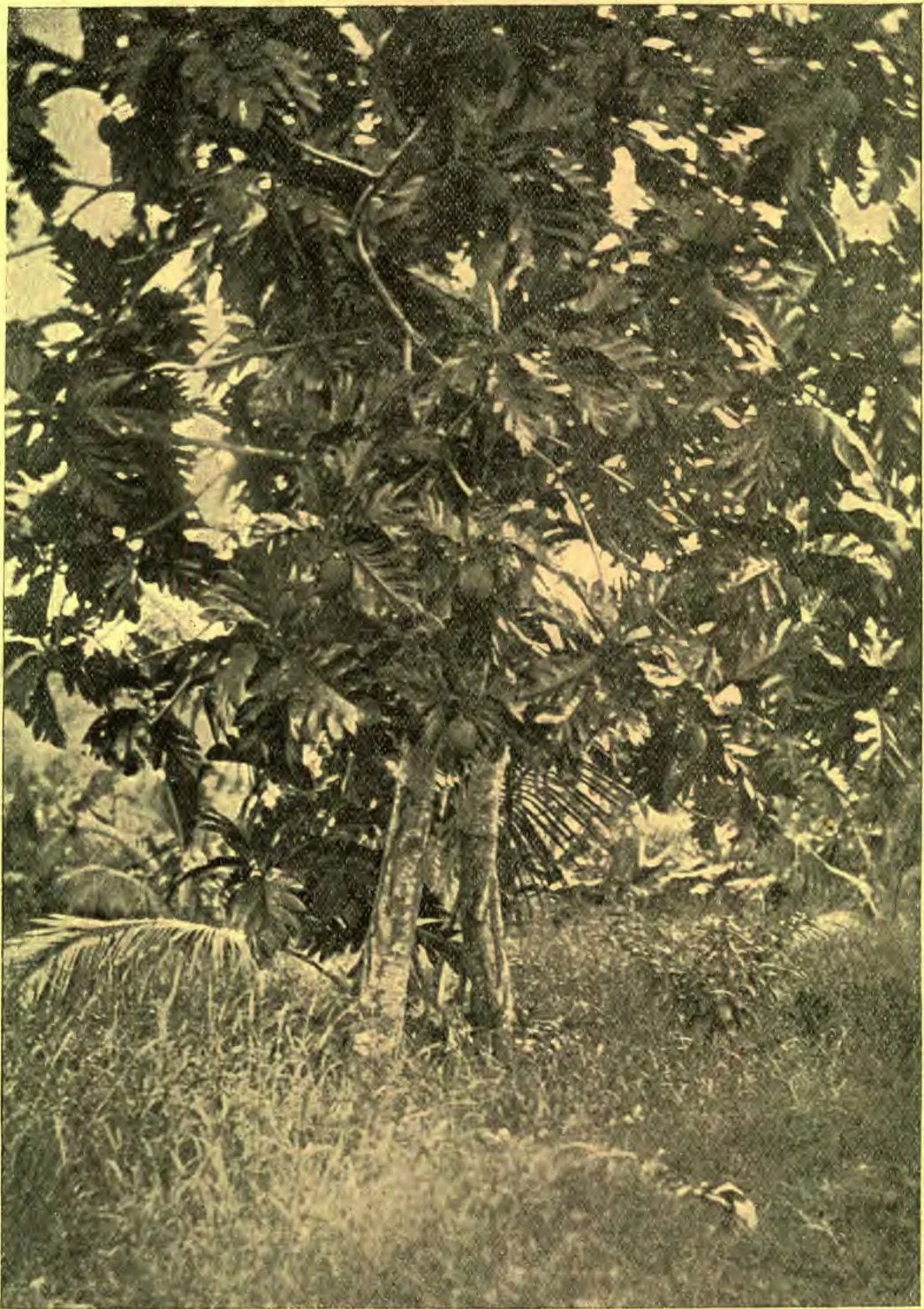
BREADFRUIT TREE.
BREADFRUIT TREE.
The Hawaiian, or Sandwich, Islands are situated near the middle of the North Pacific Ocean, about two thousand miles southwest of San Francisco, and three thousand five hundred miles from the coast of Asia. They have a delightful climate, the cool sea-breezes modifying the heat of the tropical sun, which otherwise might be too great for comfort. Casper Whitney, in Harper’s Weekly of June 17, says: “In point of fact, the climate of Hawaii is perhaps not excelled anywhere else on earth. Large enough, as the islands are, to have a character of their own, and still in no way to neutralize the peculiarly desirable quality of oceanic environment, the Hawaiian climate is midway between temperate and tropical; tender, yet not enervating; breezy, though not boisterous; with sunshine from which you need no protection, and a rainfall that does not become monotonous. A veritable land of sunshine and breezes, whose temperature you may vary as you choose, from sea-level up to Mauna Kea (13,805 feet) or Mauna Loa (13,600 feet). You may leave one side of an island in a rainstorm, and find sunshine on the other; but though there is considerable variety in this respect, the temperature is about uniform, and at sea-level is seventy-four degrees Fahrenheit. Taken by the year, this average does not vary over a degree one way or the other; taken by the month, the average of the coldest month is sixty-nine degrees, and of the warmest, seventy-eight degrees. The extreme lowest temperature is fifty degrees; the highest, ninety degrees: and either of these figures has been reached only once in the last dozen years. The average daily range at Honolulu is eleven degrees, and its usual temperature is several degrees cooler than the average of a number of other cities in the same latitude,—notably Havana. The northeast trade winds are the saving feature of the Hawaiian Islands, imparting uniform temperature, healthfulness, and tonicity. What particularly impressed me in the Hawaiian climate,—and I cite my experience because I do not, as a rule, care for these too balmy climes,—was the absence of an enervating quality. Some say that such an influence does attend upon long residence on the islands; but my investigations suggest that only white women who never take any exercise are so affected.”
Several days before reaching the islands, one notices the change in the climate, and realizes that he is approaching the tropics. White dresses and white linen or duck suits are much in evidence.
The first view of these “dots in the Pacific” is anything but reassuring. They stand like sentinels, brown, barren, and rocky, giving one no idea of the beauty hidden within. But soon the vessel rounds Diamond Head, and lo! what a transformation! Mountains of living green from base to summit, with valleys of surpassing beauty, pass in succession before the gaze of the admiring tourist, while the waves of the “Peaceful” Ocean rise and fall softly and slowly, washing the white sands, and seeming loath to leave the beautiful shores that they so lovingly caress.
Now our vessel glides through the narrow opening in the reef into the placid waters of the harbor. Suddenly all around us we see, bobbing up and down in the water, little black, curly balls, and in a moment we see that they are heads,—heads of little brown Kanakas (natives). These little men appear just as much at home in the water as upon terra firma. We look upon them with wonder as they emerge from the watery depths, holding up, with grins of triumph, the nickels thrown overboard by the passengers.
Along the wharf stands a motley assembly of persons of all shades and colors,—whites, Chinese, Japanese, and last but not least, Kanakas,—all mingled in promiscuous confusion, and all looking happy and contented.
An American notices, with a faint feeling of satisfaction, the absence of that hurry and rush so common in all large cities of his own country; and if he sometimes tires of the slow means of public transit,—the mule-cars,—he must still acknowledge that they are quite in harmony with the narrow streets, the climate, and the customs of the people.
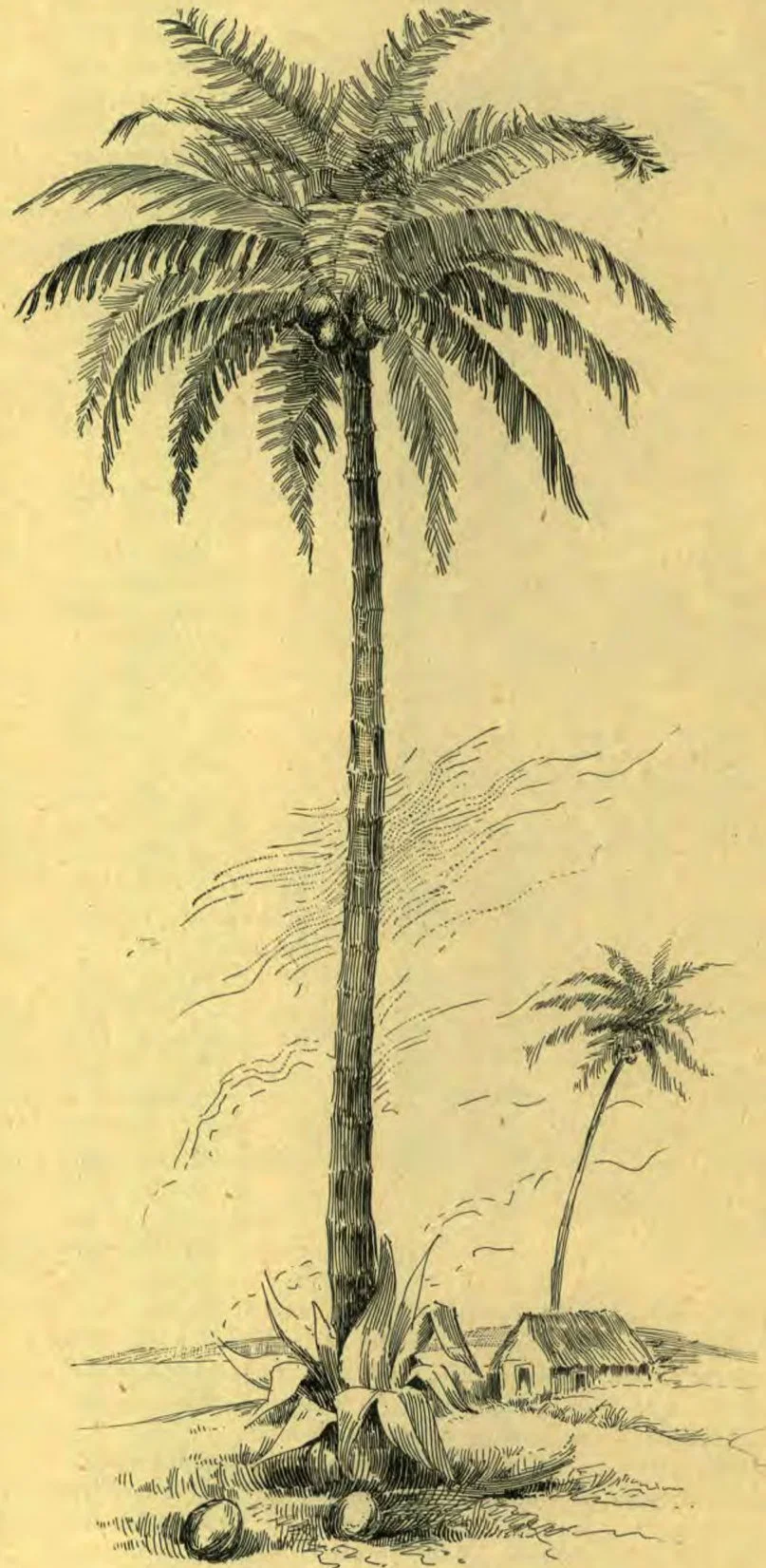
Algeroba, mango, alligator pear, and orange trees, with their wide-spreading branches and luxuriant foliage, are all strangers to the inhabitant of the regions where King Frost reigns nearly half the year. Banana and papaja trees, though smaller, are not less important. Among other trees are the breadfruit, cocoanut and date palm, fig, guava, pepper, kou, koa, eucalyptus, and Ponciana Regia. For several months in the year, the latter is aglow with a mass of bright scarlet or yellow flowers.
Among the shrubs should be named the single and double hibiscus. This is used mostly for hedges, and is in bloom the year round. It has large, scarlet, bell-shaped flowers.
The bugainvilloea is a large vine, growing something like the wild grapevine of the Central States, and often covering the side and half the roof of a house with a cataract of magenta blossoms.
There are also shrubs called “color-leaves.” These, as the name implies, have beautiful leaves of various colors, some being mottled red and green, yellow and green, or red, yellow, and green, while others are striped.
COCOANUT PALM.
COCOANUT PALM.
Then there is the lanialii, bearing large, yellow, trumpet-shaped flowers; the gardenia, beautiful with wax-like white blossoms; the promelia, melia, and various other useful as well as ornamental shrubs and vines.
There is also the ti (pronounced “tea”) plant, seen in almost every native yard. Ti leaves are used in great numbers in preparing the native feasts, or luaus, a description of which will be given in the future.
LENA E. HOWE.

SELECTING A CAMERA

THE selection of a camera must be largely governed by the amount of money at the disposal of the purchaser. Cameras are made to suit all pocketbooks and all tastes. Those that look well and are moderately efficient may be bought for from five to ten dollars. Fifteen dollars will get a fairly good one.
The cheap cameras are usually what are called “fixed-focus” instruments; that is, an object is always in focus with such a camera, no matter what distance it is from the lens. If you studied the article in last week’s paper, you will know that there is really no such thing as a fixed-focus lens. Lenses that are called fixed focus are simply those of such short focal length that anything beyond eight or ten feet will always be in focus.
For distant objects, or for objects that are an equal distance from the camera, these fixed-focus lenses do fairly well; but in photographing objects at an unequal distance, the one nearest will be out of all proportion larger than those farther away. The photograph of a horse facing the camera will show the animal’s head almost as large as his body. Another point against cameras of this style is that they have no ground glass on which to see the image.
The most convenient instrument for an amateur’s use is one of the many patterns of folding hand-cameras. Some of these are very simple and reasonably cheap. Others are supplied with all the modern improvements, and are more expensive. To describe all the different makes and grades would be unprofitable, as the manufacturers’ catalogues do that fully; so I will simply explain some of the terms used.
One of three types of lenses is usually fitted to hand-cameras. The achromatic is the cheapest and most simple; and it does effective work in photographing landscapes, and, indeed, in most photographs that a beginner would be likely to undertake. Another and better grade of lens is the “rapid rectilinear.” This is composed of two lenses, and works more rapidly, and for some purposes more satisfactorily, than the achromatic lens. For a moderately priced outfit, the rapid rectilinear lens is the one to choose. Anastigmat lenses are ground after a complicated formula, and the best of them come near perfection; but they are so expensive that they are out of the reach of most amateurs.
By the angle of view of a lens is meant that part of a circle included in the picture it takes. For example, a lens comprising an angle of forty-five degrees will take a picture of an object extending from one of the cardinal points of the compass half-way to the next. If a lens having an angle of ninety degrees is pointed southeast, at one side of the image will be whatever object lies directly south, and at the other side will be whatever lies directly east.
Lenses having an angle of more than eighty-five degrees are called “wide-angle” lenses. The perspective in a photograph taken with a wide-angle lens is always violently distorted.
In photographing tall buildings or high mountains, it is often necessary to point the camera upward; but an object photographed with the camera in that position will appear in the picture as if leaning backward. To overcome this difficulty, some cameras are supplied with what is called a “swing-back.” This enables the operator to set the back of the camera perpendicularly, regardless of the incline of the camera itself. The swing-back is sometimes used under other circumstances, but they are of minor importance. Some cameras are equipped with double swing-backs, but the single swing is usually sufficient.
The rising, falling, and sliding front enables the operator slightly to change the position of the image on the ground glass without moving the camera. This is often convenient, but by no means essential.
It may not be out of place to say a word here about the size of cameras. A five-by-seven-inch instrument is a convenient size for all-round work. Plates of any smaller size may be used, by the addition of a few inexpensive kits. If the price of a camera of this size puts it out of reach, one four by five inches in size should be the second choice.
I strongly advise my readers to get a camera that uses glass plates. Celluloid films and “snap-shot” cameras are all right for the expert, or for the tourist, who has some one else “do the rest:” but the beginner will have trouble enough with glass plates; and films are much more difficult to handle. To be sure, it is possible to take more pictures in a given time with films and a roll-holder than with glass plates. But it is the care and study put into each picture that gives one skill in photography, not the number of reckless “snap shots” made.
Just a word about the price of a camera. Most dealers give a discount of from ten to twenty per cent from the manufacturers’ price. If your dealer does not do this, you had better look elsewhere.
Besides the camera, a light but strong tripod and one or two printing-frames should be bought. It will be best to get printing-frames a size larger than your camera. If the camera is four by five inches in size, get five-by-seven-inch printing-frames. If a five-by-seven-inch camera has been decided upon, the printing-frames should be six and one-half by eight and one-half inches in size. The reason for this will be seen when you get to printing.
A number of other things will be needed; but in succeeding articles, instructions will be given for making them. J. EDGAR ROSS,

MARCH STUDY OF THE FIELD

Part II: Historical and Political China
(March 11-17)
1. Basis of Study.—For Part II of the March study on the field read “Historical and Political China,” in the Missionary Magazine of that month. The lesson for next week will also be based on this article. But China is so mighty an empire, and so important a missionary field, that we believe the members of the Reading Circle will not regret having spent the time required to master a few of the points brought out in Mr. Howell’s article.
2. The Hia Dynasty.—Yu, B. C. 2205, is said to have been nine cubits (about 13½ feet) high. The Chinese believe that a rain of gold occurred during his reign. This may have been a shower of meteors. Kieh Kwei, B. C. 1818, is supposed to have been a cruel monarch, who cared much for physical enjoyment and the gratification of the senses. He caused to be made a large pond of wine, at which three thousand persons could drink at once. Drunkenness and quarrels were common, even in the palace. Those who remonstrated with the emperor were killed or exiled. This ruler was dethroned by the people. Yu and Kieh Kwei were the first and last of the Hia dynasty.
3. The Literati.—The literati are the scholars of China. They are opposed to foreigners and their ways, and believe that the study of strange doctrines is injurious. The Chinese have a mania for literary degrees, and every family is ambitious to have at least one of its members obtain a degree by passing the examinations. The family will cheerfully support the one chosen for this purpose.
4. Nestorians.—But little is known of the origin of the Nestorians. They are named after Nestorius, a native of Syria. They claim to be of Hebrew origin, and are supposed to be converted Jews. Their language is a modern dialect of the Syriac. These people are supposed to have sent missionaries to China in the fifth century. Their churches were scattered over a large part of Asia. They were conquered by the Mohammedans, and the church was crushed.
5. Nestorian Monument.—This was discovered at Singan Fu, the ancient capital of the Chinese Empire, by a Chinese workman. It is a marble slab about ten by five feet in size. When found, it was covered with rubbish, but it was at once removed to a temple. It was erected more than eleven hundred years ago. It contains a Chinese inscription that gives an account of the creation and of the birth of Christ; tells of the attitude of a number of Chinese emperors who favored the religion of Jesus Christ, and sent gifts to the church; speaks of the Magi who visited the Babe in Bethlehem, calling them Persians; it also mentions opposition and persecution by the Buddhists.
6. Manchuria and the Manchus.—Manchuria is one of the divisions of the Chinese Empire. The country is mountainous and densely wooded in the south. The northern part consists chiefly of prairies. In the valleys it is well watered and fruitful. It is rich in minerals. The Manchus are lighter in complexion, and of a heavier build, than the Chinese. The principal pursuits are agriculture and hunting. The poppy is a profitable product. Cotton, tobacco, millet, pulse, wheat, and other crops are grown by the farmers.
7. Kublai Khan.—The brother of Kublai, while khan, or ruler, of the Mongols, ordered him to subdue Corea and China. The Chinese having asked him to aid in expelling the Manchus, he joined them, drove out the Manchus, and took possession of northern China. He afterward invaded and subdued southern China. He patronized Chinese culture and literature, gained the confidence of the Chinese, and was popular among them.
8. Marco Polo.—Marco Polo was a celebrated traveler. His father and uncle were noted merchants. They were well received by Kublai at his residence in 1261. He questioned them concerning the people of Europe, and their modes of government, and commissioned them to bear to the pope a written request that one hundred learned Europeans be sent to act as instructors to the Mongols in arts and sciences. They found it impossible to discharge this mission, and on their return took with them Marco to the court of Kublai Khan. This ruler was attracted to Marco, noting the rapidity with which he learned the customs and language of the Mongols. During his residence at the courts of the various neighboring rulers, he noted closely their customs and language, and on his return to the khan, always gave the minutest reports of what he had observed. He was in the service of this ruler for seventeen years, and traveled in the countries of eastern Asia, visiting China, which no European had ever seen before, and Japan, the existence of which was never even suspected. He published an account of his travels. This book created a sensation, and many said it was pure fiction; but its statements were verified by subsequent travelers.

BEREAN LIBRARY STUDY

Dan. 11:1–13; “Thoughts on Daniel,” pages 222–230

NOTES ON LESSON 15

  • (March 11–17) *
1. Notes on Daniel 11.—In the notes on this chapter no attempt will be made to give any study in addition to the regular Reading Circle lessons, as they are quite comprehensive. The space will admit of only a few historical incidents concerning the character of individuals, or the nature of events, connected with the fulfillment of the prophecy.
2. Xerxes.—This king, referred to in Daniel 11:2 as being “richer than they all,” is the King Ahasuerus mentioned in the book of Esther. The Encyclopedia Britannica says: “The Hebrew Ahashverosh is the natural equivalent of the old Persian Khshayarsha, the true name of the monarch called by the Greeks Xerxes, as now read in his inscriptions.” The great wealth of this king is well illustrated in the description given of the seven days’ feast, in Esther 1:5–9.
3. A Jewish Maiden.—An interesting bit of Bible history comes to mind in connection with the mention of Xerxes, or, as the Bible calls him, Ahasuerus. Esther, described by Inspiration as a maiden “fair and beautiful,” was the daughter of parents who were of the tribe of Benjamin. They did not return to Judea after the captivity; and upon the death of her parents, Esther was adopted by her cousin Mordecai, after the national custom of the Jews in such cases. After Xerxes had divorced Vashti, he became enamored of the Jewish maiden, Esther, and finally “set the royal crown upon her head, and made her queen.” About five years later Esther was enabled to do a signal favor to the Jewish people, then quite numerous in Persia, by influencing the king to revoke a command by which all the Jews in his provinces were to be slain. The whole account, as recorded in the book of Esther, is intensely interesting. The result of Esther’s faithfulness in using her influence to the utmost for the right was such as to prove true the statement of Mordecai, “Who knoweth whether thou art come to the kingdom for such a time as this?”
4. Smitten of God.—In the comments on Dan. 11:12 in our text-book, mention is made of the efforts of Ptolemy to enter the temple at Jerusalem. The account as given by Prideaux reminds one of the fate of Uzzah, when he took hold of the ark. 2 Sam. 6:6, 7. After describing the attempt of Ptolemy to force his way into the temple, the historian says: “He was smitten from God with such a terror and confusion of mind that he was carried out of the place in a manner half-dead. On this he departed from Jerusalem, filled with great wrath against the whole nation of the Jews for that which had happened to him in that place, and venting many threatenings against them for it.”
5. Another Incident.—Returning to Alexandria, Philopater resolved to punish the Jews in Egypt for his repulse and disgrace at Jerusalem. He commanded that all the Jews that could be found in Egypt should be brought in chains to Alexandria. He then appointed a day when they should be destroyed by elephants, in the place where the games and races were celebrated. The day came, and a great crowd assembled; but the king did not come. Inquiry revealed that he was in a drunken stupor. The spectacle was postponed until the next day. But when the hour came, the king was again too drunk to attend. The next day the king came. The signal was given, and the maddened elephants were let loose; but instead of rushing upon the Jews, they “turned their rage upon all those who came to see the show, and destroyed great numbers of them.” The king was so impressed that a divine power interposed to protect the Jews that he permitted them all to be set free. Three years later, however, he carried on his persecutions against the Jews after the manner recorded in the lesson.
6. Coma Berenices.—The constellation of stars known by that name to students of astronomy came by its name in this way: Before Ptolemy Euergetes started to invade the territory of the king of the north, as recorded in our lesson, his wife, whose name was Berenice, which was also his sister’s name, made a vow that if her husband returned safely, she would consecrate her hair to the gods. Upon his return, she did so; but soon the discovery was made that her hair was missing from the temple. The priests of the gods were in danger of receiving punishment, when an artful courtier of the king affirmed that the hair had been conveyed to heaven; and he pointed out seven stars, which had never before been part of any constellation, and declared that they were the hair of Berenice. And to this day that group of stars is called by that name.

HOW MISSIONARIES TRAVEL IN CHINA

China, the largest and most populous of all mission fields, has most ways of travel. Wherever the canals and rivers run, the missionaries go to and fro by water in house-boats, with several rooms, in which one can stand up; in little slipper boats, shaped like a slipper, which go very fast; in long, low boats, very hot and very slow; or as passengers on steam tugs, which are beginning to ply on the Chinese inland waters. Where there are no waters for boats, and yet no roads for horses, the traveler uses a chair, either a mere seat swung between two bamboo poles or a comfortable rattan chair. Two Chinamen will carry a heavy passenger for twenty or thirty miles, or even more, in such a chair without stopping for food, though they will stop and eat and drink if they are allowed.
In northern China the missionaries sometimes use horses; many take shenzas, which are in principle like the takht-ravans of Persia, but very much more crude,—just two long poles, placed parallel, about three feet apart, the front rods borne by one mule, and the rear by another, with a rough little house built on the poles between, with matting roof and canvas floor. Here the missionary huddles himself with his kit about him, and is jogged up and down, especially when the mules go up or down steep banks, until he reaches the end of his journey. Still farther north, carts are used,—and such carts! They have no springs, and they are built to endure Chinese roads, which are the worst roads in Asia, Africa, Europe, or America.—Well-Spring.

HOW TO CLASSIFY WHAT IS STUDIED

(Concluded)
We should not restrict ourselves to a classification of scientific subjects. When we come across some beautiful pearl of truth in reading gospel literature, we should preserve it; for some day it may help some poor, struggling sinner, and inspire him to lead a higher and better life. Whenever I read some specially attractive or strong statement in the Testimonies, I classify it then and there; and it is almost impossible to conceive what a wealth of beautiful, sparkling truths I thus have at hand at a moment’s notice. To illustrate, I will look in the Index, and under “P” note the title “Possibilities,” page 247. That means that the gems of truth that I have classified under this head will be found there. I will select a few from several hundreds:—
God’s ideal for us is higher than the human thought can reach.—Collection of Special Testimonies, page 484.
Who would dream of the possibilities of beauty in the rough, brown bulb of the lily? Even so God will unfold the human soul.—“Mount of Blessing,” page 138.
Seek to become men of influence, that you may reveal the power of truth upon the intellect.—“Christian Education,” page 53.
Under the title, “Life on the New Earth,” I glean the following:—
A wicked man would not be at home in heaven.—Signs of the Times, 1893, page 38.
The redeemed will range from planet to planet.—Review and Herald, 1886, No. 10.
It will be a place of glorious rest to the weary laborer.—“Christian Temperance,” page 99.
I have often been asked how I find time to classify and preserve these things; yet the very ones who ask this question will perhaps spend more time in hunting for one or two references to assist them in their particular work than I use in an entire year in classifying in this way the beautiful truths to which Providence gives me access.
Reader, ask God to fire you with an ambition to study, not to show others how much you know, but to be “approved unto God, a workman that needeth not to be ashamed, rightly dividing the word of truth.” We not only need to have great principles in our minds, but we also need facts that will be like spikes to fasten them down. Many Christian persons imagine that if they are only good, it is not necessary for them to gather a great fund of useful information,—that God will in some way give it to them without any effort on their part. Bear in mind that God will hold us responsible for every opportunity he has given us, and that there is no grief more bitter than sorrow over lost opportunities.
DAVID PAULSON, M. D.

JUSTIFICATION BY FAITH II

ABRAHAM’S great act of faith is recorded for our benefit. It teaches us the great lesson of confidence in the requirements of God, however close and cutting they may be; and it teaches children perfect obedience to their parents and to God. By Abraham’s obedience we are taught that nothing is too precious for us to give to God.
But many do not know what self-denial and sacrifice for Christ’s sake mean. Should God speak to them as he did to Abraham, saying, “Sacrifice your possessions, your temporal benefits, that I have lent you, to advance my cause,” they would be astonished, and think that God did not mean what he said. God knew to whom he spoke when he gave the command to Abraham. Abraham knew that One faithful and true had commanded,—One whose promises are unfailing. Had God commanded him to offer his gold, silver, or even his own life, he would have done so, knowing that he was only yielding to God his own. God requires no more of man than he in his infinite love has given.
The grief that Abraham endured during those three days of trial was imposed on him that he might learn the lesson of perfect faith and obedience, and that we might comprehend the self-denial of the Father in giving his Son to die for a guilty race. God surrendered his Son to the agonies of the crucifixion, that guilty man might live. Legions of angels witnessed Christ’s sufferings; but they were not permitted to interpose as in the case of Isaac. No voice was heard to stay the sacrifice. God’s dear Son was mocked, and derided, and tortured, till he bowed his head in death. What greater proof of his pity and love could the infinite God have given? “He that spared not his own Son, but delivered him up for us all, how shall he not with him also freely give us all things?”
The apostle Paul says: “If thou shalt confess with thy mouth the Lord Jesus, and shalt believe in thine heart that God hath raised him from the dead, thou shalt be saved. For with the heart man believeth unto righteousness; and with the mouth confession is made unto salvation. For the Scripture saith, Whosoever believeth on him shalt not be ashamed. For there is no difference between the Jew and the Greek: for the same Lord over all is rich unto all that call upon him.”
God calls for faith in Christ as our atoning sacrifice. His blood is the only remedy for sin. For us he arose from the grave, and ascended to heaven to stand in the presence of God. He was delivered for our offenses, and raised again for our justification. When we take hold of his wonderful truth by faith, we shall say, with Paul, “We all, with open face beholding as in a glass the glory of the Lord, are changed into the same image from glory to glory, even as by the Spirit of the Lord.” We behold the light of the glory of God in the face of Jesus Christ. Such a view of Christ irradiates with glory the word of God. It lays for our faith a foundation. It sets forth a hope to every believing soul. Well may we bow our souls before the majesty of this precious truth. MRS. E. G. WHITE.

A NEAR OPPORTUNITY

The girl told me the story herself. Her mother had for weeks been seriously ill, and she had borne the care and anxiety with her daily work. It was not easy to care for one’s mother, manage the household, and go to the office besides. When the mother finally began to grow better, the daughter was so worn out that she herself was in danger of illness. She longed to get away, if only for two days, but there seemed no way. At the end of one week when she came back from her work, she found a note waiting for her, from a friend on the next square.
“I know you must be tired out,” the writer said, “and somehow the impulse to send for you came to me very strongly. I want you to come over this afternoon, and stay with me till office time next week. If you wish to go to church, all right; but if not, you shall have the whole quiet house to yourself Sabbath morning, and you can rest in any way you please. Anything shall be yours except one—you are not to cross your own threshold for two days. You are to pretend you are away on a vacation. You needn’t answer. I shall expect you.”
So the girl went, and from the day and a half in a bright, restful atmosphere, gained the new strength and courage she had so sorely needed.
Often it happens that our missionary work, that for which we are “sent,” lies no farther away than our nearest neighbor. Happy for us and for him if our eyes and hearts are quick.—Well-Spring.

THE VOICE OF THE LORD IS UPON THE WATERS

A LONELY spot, with nothing more Than rocks and winds and waves, half veiled in fog: The place a mighty poem, grandly wrought, In handwriting of God.
Against the rocks upon the shore, The surging waters of the ocean beat, While, in unnumbered voices, solemnly, “Deep calleth unto deep.”
One gull, above the lonely waves, Whose tossing spray his weary efforts mocks, Dips his white wing beneath the brine, then sinks To rest upon the rocks.
“God’s voice is on the waters’ dark; It sounds above the wintry waves, and breathes Among the pines upon the cliff’s proud crest, And whispers in the breeze.
The roar of billows on the rocks Voices the power of God; but in reply, His tender love and mercy echo forth In the lone sea-gull’s cry.
MINNIE ROSILLA STEVENS.

A BIRD'S CAROL

DOUBTLESS you have sometimes seen in winter, flocks of fluffy gray birds, a little smaller than robins, flying about the trees with soft, whistling calls, or feeding on the ground, so tame and fearless that they barely fly out of the way at man's approach. Few seem to know what they are, or whence they come.
The beak is very short and thick; the back of the head and a large patch above the base of the tail are bright golden-brown and orange; and across the gray wings are narrow double bars of pure white.
If you watch them for a few minutes on the ground, you will see that they have curious ways of moving about, sometimes putting one foot before the other, in a funny attempt at a dignified walk like the blackbirds, and again hopping about like the robins, but much more awkwardly—as if they were not accustomed to walking, and did not know just how to use their feet.
The birds are pine grosbeaks; and they are, in some sections of our Northern States, regular winter visitors from the far North. But only when the frosts are severe, and the nights grow very long, and the snow lies deep about Hudson Bay, do they leave their nesting-places to spend a few weeks in bleak New England as a winter resort.
Long ere the first bluebird has whistled to us from the old fence rail that, if we please, spring is coming, the grosbeaks are whistling their soft calls and singing their love-songs in the thickets of northern Labrador.
A curious thing about these flocks we see in winter is that they are generally composed entirely of females. The males are very rare with us, and may be distinguished instantly by their beautiful crimson breasts. Sometimes a flock contains one or two young males; but until the first mating season tips their breast feathers with deep crimson, they have the same sober dress as their female companions. This crimson shield is the family mark of all the grosbeaks, just as the scarlet crest marks all the woodpeckers.
But if the old male, with his proud crimson, is rare with us, his beautiful song is still more so. Only in the deep forests by the lonely lakes and rivers of the far North, where no human ear ever hears, does he greet the morning sunrise from the top of some lofty spruce, or pour into the ears of his sober little gray wife the sweetest love-song of the birds,—a long succession of soft, warbling notes, tumbling over one another in a quiet ecstasy of harmony, mellow as the note of the hermit thrush, but softer and more continuous.
It is as if his gentle spirit feared lest any should hear but her to whom he sings, and reiterated his song lest she should not hear. But sometimes he forgets, and sings as other birds do—because his world is bright and warm. Then other ears hear, and regret that his northern country life has made him so shy a visitor.
One Christmas morning a few years ago the new-fallen snow lay white and pure over all the woods and fields. It was soft and clinging as it fell the night before. Now every old wall and fence was a mound of gleaming white; every old post and stub had a soft white robe and a tall white hat. Every little bush and thicket was a fairyland of white arches and glistening columns and dark grottoes, walled about with delicate frost-work.
Before the sun was up, I had started for a morning walk. Soon the flight of a downy woodpecker directed my steps to a corner of an old, deserted graveyard, thickly shadowed by evergreens, and a favorite summer haunt of birds.
There is no better time for a quiet peep at the pine grosbeak than the morning after a snow-storm, and no better place than an evergreen grove. If you can find the birds at such a time,—which is not at all certain, for they have mysterious ways of suddenly disappearing,—you will find them quiet and subdued, and willing to bear your scrutiny without flying away into deeper coverts.
I had scarcely crossed the wall when I stopped at hearing a new bird-song. It was soft and mellow and beautiful, suggestive more of June woods and a summer sunrise than of the snow-packed evergreens and Christmas-time, but so subdued or muffled that I could not tell whence it came.
For half an hour I looked and listened diligently, the new song coming at intervals apparently out of the air. When I finally located it in the top of a tall fir-tree, I understood the cause of its muffled sound.
The bird, whatever it was, had gone to sleep the night before in the bushy top of the old fir. During the night the soft snow had fallen thicker and thicker upon the flexible branches, and their tips had bent beneath the weight till they touched the trunk below, forming a green bower about which the snow packed till it was completely closed. The bird was a prisoner within, and singing as the morning sun shone in through the walls of his prison-house!
As I listened, delighted with my new minstrel and his very novel music-room, a mass of snow, loosened by the rising sun, slid from the lofty snow bower, and a pine grosbeak appeared in the doorway. A moment he seemed to look curiously about over the new, white, beautiful world, then flew to the topmost twig of the old fir, and turning his full crimson breast to the sunrise, poured out his morning song.
Once, long afterward, I heard his soft love-song in the heart of a Canada forest; but even that lacked the charm of this rare, sweet carol at a time when our native birds were singing to the sunrise in Florida. Only once did the grosbeak sing from the top of the old fir. Then a plaintive little whistle came from a pine grove across the fields, and he flew away with his companions.—Wm. J. Long, in the Youth's Companion.

A TRAGEDY IN THREE PARTS

PART I — THE BONNET

A BIT of foundation as large as your hand, Bows of ribbon and lace, Wire sufficient to make them stand, A handful of roses, a velvet band— It lacks but one crowning grace.

PART II — THE BIRD

A chirp, a twitter, a flash of wings, Four wide-open mouths in a nest; From morning till night she brings and brings, For growing birds, they are hungry things— Aye, hungry things at the best.
The crack of a rifle, a shot well sped, A crimson stain on the grass, Four hungry birds in a nest unfed— Ah, well! we will leave the rest unsaid; Some things it were better to pass.

PART III — THE WEARER

The lady has surely a beautiful face, She has surely a queenly air; The bonnet had flowers and ribbon and lace; But the bird has added the crowning grace: It is really a charming affair.
Is the love of a bonnet supreme over all, In a lady so faultlessly fair? The Father takes heed when the sparrows fall, He hears when the starving nestlings call— Can a tender woman not care? — Selected.
Continue reading: JIMMIE