1. WHAT led Gad and Reuben to ask for possessions on the east of the Jordan River?
2. What objection did Joshua make to granting their request?
3. On what condition were they finally allowed to settle on the east of the Jordan?
4. What chapter in Numbers records the camping places of Israel on their journey from Egypt to Canaan?
5. How many places are listed?
6. What is the meaning of Bochim?
7. What circumstances gave this name to the place?
Part II
Pronounce the following words:
scenario
vicar
cater-cornered
viscount
cement
vignette
chalet
valet
challis
vagary
chiropodist
truths
vaudeville
turquoise
Part III
Who is She?
THE name of this person is “writ large” in the annals of her time. She was born in New York State, of New England parentage. While she was yet a child, the family moved West on account of her father's health, and settled near Janesville, Wisconsin. Her parents were devoutly religious, with unusual powers of thought and speech, which she inherited.
She, with her brother and sister, was educated at home until she was eighteen years of age. Early in life she manifested a fondness for books, and when very young made her first attempt at book writing. This four-hundred-page book on adventure was written as she sat in the top of her favorite oak, where she had fastened to the tree a board on which were printed in large letters these words: “The Eagle's Nest—Beware!”
When she was of age, the family moved to Illinois, and she and her sister attended school at Evanston. This amusing incident still lives in the tradition of this Western town: All through her life it was one of her characteristics to dress plainly, and during her college days she and her sister were smiled at because9of their simple dress. Her father always had the whim of giving his personal care to the purchase of his daughter's wardrobe, and one winter gave her a red worsted hood, which was far from becoming. She wore it in spite of this fact. The girls ridiculed her unmercifully about the plain, homespun thing, and one girl teased her once too often. The subject of our sketch bore the ridicule as long as she could, then “turned on her, threw her down, crumpled her up under a desk, and walked off defiantly, tying the strings of that despised hood.” Ever after, she was the heroine of the school.
She studied abroad for two or three years, and visited Palestine, Egypt, and Greece. She was an educator, reformer, public speaker, teacher in academies and colleges, and philanthropist. She had a variety of gifts and a combination of excellencies which drew to her all lovers of humanity. She was an early advocate of higher education for women. She believed in coeducation, and in the principle of self-government. At one university where she was president, a dozen girls were on the honor roll as needing no disciplining at all. One writer says that her constantly recurring question was not, “What are you going to be in the world?” but, “What are you going to do?”
Children have been named in her memory, fountains are inscribed with her name, memorials are placed in churches, institutions bear her name, her picture is seen in thousands of halls and schoolrooms, libraries, hospitals, and homes, and her statue or bust is set East and West in places of honor and dignity.
Her greatest interest in life was the cause of temperance and womanhood, and it is said that the secret of her remarkable power and wonderful success in her work was that she was “eminently a woman of prayer.” At her death, as she lay in her silver-gray casket, the only ornament was a broad, encircling white ribbon. MARGARET WEIR.
Answers to Questions Printed March 4
The first part of the requirement admits of such a variety of texts that we shall not give a list.
The second part is answered by the name of John G. Paton, missionary to the New Hebrides.
March 18
San Marino is the country referred to, and Dr. John Scudder the missionary described.
The Call Answered
By E. F. Collier
E. F. COLLIER
The expectant face of Winifred Ridman pressed tightly against the window of the passenger coach as the train at last rolled in at the station. For her a single stretch of five months was a long time to be absent from home, enjoyable as the school might be, and she longed to see again the welcome faces of friends in her native town. Looking out, and surveying the group upon the platform, she searched for one face in particular. But her smile faded as she sensed her keen disappointment.
Then a man pushed his way to her side and addressed her.
“Evenin’, Miss Winifred. Be you lookin’ for Mrs. Terrell? Well, she told me to meet you and bring you right up to the house, herself not feelin’ as spry as usual the past month or two.”
With a vague misgiving in her heart, Winifred stepped into the waiting car, and was whirled away to the Terrell home. As the car sped along she briefly reviewed in her mind the events connected with her life during the preceding two years. Roy, Mrs. Terrell’s only son, had lost his life in a daring heroism during the war in France. Then Fred McClure, Roy’s comrade in service and loyal friend in life, had returned, himself wounded, to relate the story of the lad’s brave sacrifice. A long-standing friendly attachment had existed between Winifred and Roy, and his death caused her very deep grief. Then her mother had died, leaving her orphaned and practically penniless. But the kind heart of Mrs. Terrell went out to her in motherly affection, and thus she came to dwell under the same roof, while the ties of love grew stronger still. Mrs. Terrell, who was comfortably supplied with this world’s goods, generously arranged for her to attend the training school at Big Rock Seminary, whence she had now come at the end of the term.
The car had hardly stopped when she sprang from the footboard and hastily ran up the steps to the door. This she opened without ceremony, and entered. She found Mrs. Terrell seated in an easy-chair, her face alight with pleasure at Winifred’s return.
“Dear Mother Beth,” she cried happily as she embraced her, “it is so good to see you again! But what is the matter, mother dear? You did not mention in your letters that you were ill.”
A veiled sadness enhanced the famed sweetness of Mrs. Terrell’s smile as she answered, “My dear child, it was altogether unnecessary to mention it to you. Your heart is young, and young hearts should be always happy. You ought not to be worried with another’s affliction, even mine.”
“But I am worried about you,” answered Winifred, anxiety stressing her voice. “Please tell me what is wrong.”
“The doctor tells me I am to be an invalid the rest of my days. But do not be so frightened and distressed. See, I can sit in a chair with comfort. By day I can gaze out through the window and see the blue sky and the passers-by. I can write many letters and read many. And best of all, I can be happy in the thought that you are living your bright young years for Jesus and his precious truth.”
Winifred wept. “I am so sorry, and I feel so badly on account of it, Mother Beth, for I love you in just the same way that I loved my own real mother. You are the only one I have in the world, and it just breaks my heart. And I was intending to—to—”
The poor girl broke off in pitiful sobbing.
“But now I shall stay right here with you and take care of you always,” she continued after a while.
Mrs. Terrell meditated quietly a few moments. Then she drew Winifred into her motherly arms and looked down into her brimming eyes.
“What were you intending to do before you knew that I was a cripple?” she asked.
“Oh, I must not think of it now! This changes everything, and my duty henceforth is with you.”
“My child, a few moments ago you pressed a question upon me, and I answered it. Will you do less10for me? You know that whatever interests you both interests and pleases me. Whatever you may have contemplated doing, it will do no harm to tell me of it.”
“Yes, of course I will, Mother Beth—I will tell you. Only let me dry my eyes first. It is quite a story, and you may think me a foolish girl; but my heart was filled with the hope, and it was very sweet as a possibility. But now I will give it up. Do you remember—of course you do—the letter from Roy that Fred brought back? In it he told of the desire he had to go to a foreign field as a missionary, and what a distinct call it was that came to him. And then—and then he never got to go. I cannot forget it. That unanswered call clung to me until I finally made up my mind to answer it myself. Up to this very hour I was planning to offer to go as a missionary at the earliest opportunity. I have thought about it and dreamed about it, seeing throngs stand with hands outstretched from over there. One time I dreamed I saw Roy standing among them. He beckoned to me, and I called back to him and promised that I would come. But it was only a dream, I suppose, which I will now forget, for I am going to be a missionary to you instead.”
And she punctuated her decision with a hearty kiss. “Winifred!”—Mrs. Terrell tried to look very stern—“be prepared to change your mind! I am quite certain you will in regard to one thing you have said; and if you do, perhaps you ought also in regard to giving up your cherished plan.”
“But you know I—”
“Sh! Just a moment, dear one. Did I not hear you say a few moments ago that I was the only one you had in the world to love and think about? Have you forgotten some of the things you have written to me from time to time? Have you forgotten—”
Winifred blushed and placed her forefinger tightly upon Mrs. Terrell’s lips.
“You are the only, only one, Mother Beth, except—”
Her cherry-red lips took the place of her forefinger as she pressed her rosy cheek against Mrs. Terrell’s smiling face.
“I fear I must be very stern with you,” said Mrs. Terrell, the look in her eyes contradicting the tone of her voice. “Will you please bring me that letter off the mantel shelf? Thank you. Now be seated and listen to me as I read from this letter which, by the way, is from Fred McClure.”
“I knew it before you told me, because I saw the handwriting,” laughed Winifred, seating herself upon the floor and snuggling up against the other’s knee.
Then followed the reading of a portion of the letter which Fred had sent a few days before.
“You can never know how much good it does me to have a kind friend like you to write to and from whom to receive advice. I can truly understand how greatly Winifred appreciates you. You see we both are motherless, Winifred and I, and foolish, perhaps,—I mean I am!—and we need just such as you for sympathetic babying and kindly advice.
“Winifred has written to me again of her desire to go to foreign fields. It appears to be a hard-and-fast conviction with her that she must go. I know about how she feels, too, and have known ever since that hour when we sat beside you and heard you read Roy’s last letter. Poor boy, he never realized what an influence that letter would have on Winifred’s life and mine. But I have never dared to say anything to a soul other than you, for I know how utterly unqualified I am with my meager schooling to fill the position of a gospel missionary. And yet I want to go.—God knows I want to! Ah, had I but the knowledge and intellect that poor Roy carried with him to his grave!
“But now, dear Mrs. Terrell, I have good news! I have a letter from denominational headquarters stating that a practical farmer with good Christian experience, who loves the souls of men and desires to see the saving work advanced in distant fields, is wanted at once to locate with a certain mission station in West Africa. That means me, and I am invited to go. As far as I can make out from an old map which I have in my possession, the location of this station is exactly at the place marked on the map that Roy had pasted in his Bible which I brought back to you.
“I feel very unworthy, but here at last is something which I can do for the cause. I feel like shouting, Hurrah! However, I do not want to go alone. Do you think for one minute that I could hope—? I dare not think of it unless you offer me some encouragement. I understand that she is to be home Wednesday. I shall plan to come also on the nine o’clock train.”
“Why, that is this evening!” exclaimed Winifred, starting up,—“now—in half an hour!”
“Yes,” answered Mrs. Terrell, “it is. But be patient and hear me finish this letter.” These are his closing words:
“If you are with me in this, be sure to help me out when I get there, or I shall never be able to see it through.
“Lovingly yours,
“FRED McCLURE.”
Looking up shyly into the smiling face, Winifred inquired, “Mother Beth, did you offer him any encouragement, and are you with him in this?”
“My dear, next week my younger sister is coming to make her home with me permanently. I have sufficient means to employ such servants as I need. I have a comfortable home, and my heart, like yours, is always with the great advent message. You are young and ambitious to engage in the good work, and you have a good education, but you could hardly think of going alone. Fred is a good boy, thoroughly conscientious and loyal, and his desire is the same as yours. He says he loves you. In view of all this, would you have me discourage him?”
Dear reader, you should be told that Winifred’s answer that night to Mrs. Terrell’s question was to plant another kiss—this time a very fervid one—upon the cheek of her patron mother. And that is the reason, partly, that eight weeks later, when a steamer slipped out of Boston harbor, it carried a very happy couple toward the great continent of Africa. And each of them was bound by a double vow,—to love and honor each other, and, with the cherished memory of Mrs. Terrell and her dead son in their hearts, fulfil God’s mission for them across the sea.
A Man's Mother
MAN, if you have an old mother, be good to her. Tell her that you love her. Kiss the faded lips. Hold in yours the work-knotted old hands. Scatter a few of the flowers of tenderness and appreciation in her pathway while she is still alive and can be made happy by them.
Don't wait to put all of your affection and gratitude and reverence for her into a costly ton of marble inscribed “Mother.”
Don't wait to throw all your bouquets on her grave. It's very doubtful whether an angel in heaven takes any interest in cemeteries or gets any satisfaction from visiting earth and contemplating a flattering tombstone; but it is utterly, certainly certain that you can make your old mother's heart sing for joy by showing her, while she is alive, just one tithe of the love and appreciation that you will heap upon her when she is dead.
These words are written for some one particular man who reads this page. I do not know his name, but I know his story.
He is a middle-aged man, married, prosperous. He is a good man, highly respected, and he hasn't an idea that he is not doing his full duty by his poor old11mother who lives in his home and whom he supports. He supplies her wants. She eats at his table, is sheltered by his roof, is warmed by his fire, is decently clothed by his hands; but that is all.
He neglects her. He never says a word of affection to her. He never pays her any little attentions. When she ventures an opinion, he cuts it short with curt contempt. When she tells her garrulous old stories, as old people will, he does not even try to conceal how much he is bored. In a thousand unintentional ways the old mother is made to feel that she is a cumberer of the ground, an impediment in the household, an old-fashioned and useless piece of furniture of which every one will be glad to be rid.
Under this coldness and neglect the poor old mother's heart is breaking, and in a letter, written in a trembling and feeble handwriting, she asks if I cannot say something that her son will read, and that may make him think.
Ah, if I only could!
If I could only say to him, “Man, man, give love as well as duty to your mother. Give her the wine of life as well as the bread. Don't forget the woman who never forgets you.” Of course the man will say, and truly, that he is busy, overworked, care-burdened; that he has the claims of wife and children upon him; that he is often irritable through sheer physical weariness and overstrain.
Granted. But your mother's life has not been easy. Your father was a poor man, and from the day she married him she stood by his side fighting the wolf from the door with her naked hands, as a woman must.
She worked not the eight- or ten-hour day of the union, but the twenty-four-hour day of the poor wife and mother. She cooked and cleaned and scrubbed and patched and nursed from dawn until bedtime, and in the night was up and down getting drinks for thirsty lips, covering restless little sleepers, listening for croupy coughs. She had time to listen to your stories of boyish fun and frolic and triumph. She had time to say the things that spurred on your ambition. She never forgot to cook the little dishes you liked. She did without the dress she needed that you might not be shamed by your clothes before your fellows.
Stop, man, and think what life would have been to you if she had treated you in your childhood as you are treating her in old age! Suppose there had been no warm, caressing mother's love? Suppose there had been no soft breast on which you could weep out your childish sorrows, no clinging arms to enfold you and comfort you when the things of your little world went wrong? Would it not take away from the memory all that is best and sweetest in life? Is there anything else so pitiful on earth as the little child that is motherless, that is an alien in a strange home, that has no one to love it?
Yes, there is just one other figure more forlorn than the little unloved child, and that is the old mother who is unloved by the children she reared, and who is doomed to spend the last years of her life in a glacial atmosphere of neglect, her devotion, her labors, her sacrifice forgotten. Remember them now while there is yet time, while she is living, to pay back to her in love and tenderness some of the debt you owe her. You can never pay it all, but pay down something on account this very night.—Philadelphia Evening Bulletin.
A Runaway That Made Good
SIR ERIC GEDDES, one of England's great men, left home at the age of seventeen. When he reached New York, he had only ten dollars, and a check for seventy-five dollars, which his father had given him for the return trip. This he mailed to the donor immediately on landing, and set out to find a job in the New World metropolis. He soon secured work as a typewriter salesman. Later he went to Pittsburgh, where he found work in the Homestead Steel Works. He tested out several other lines of work before he found rapid promotion.
He worked as a section hand on the Baltimore and Ohio Railroad, as station agent, and lumber jack. Later he was a sheep herder in Australia, then foreman of a railway gang of coolies in India, finally becoming traffic manager of one of the Indian railways.
It was in India that the door of opportunity swung wide for him. When the war broke out, he was the highest-paid railway official in England. He is now first lord of the admiralty. Some predict that he will in time become prime minister of Great Britain.
But success came not without effort on his part. Even during his roving and unsettled days he was always studying, preparing himself for higher work.
The Talkative Tortoise.
By Robert Seaver
By Robert Seaver
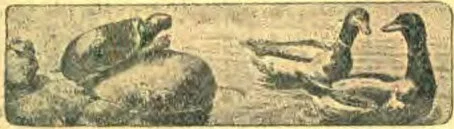
A TALKATIVE tortoise—I shouldn't suppose
A tortoise could talk, now should you?—
Once lived in a pond with two neighborly ducks,
And chattered away to the two.
She loved to converse, and the ducks were polite,
And patiently listened all day.
(This tortoise, I think I have told you before,
Had rather a talkative way.)
IT happened one summer the pond became dry.
The ducks thought it wiser to find
A pond that was deeper, and wetter, as well,
And leave the poor tortoise behind.
The tortoise begged hard to be taken along;
She never had learned how to fly,
Because, in the effort of learning to talk,
She'd been far too busy to try.
THE ducks said, “Just hold this big stick in your mouth,
And we will take hold of each end,
And carry you with us away through the air,
But be careful of one thing, my friend.
Be sure not to talk, for as sure as you do
You'll fall!” So the tortoise agreed,
And the ducks took the stick and away they all flew,
At really remarkable speed.
OH, how the poor tortoise was yearning to talk!
She barely remembered in time,
And held to the stick with her jaws tightly shut.
The ducks still continued to climb.
She wanted to talk of the marvelous view,
And villages far down below.
She almost forgot, for I think I have said
She was too fond of talking, you know.
“LOOK,” shouted the people, “at what's in the sky!
Oh, look at the tortoise up there!”
“Oh, hush!” said the tortoise: the next thing she knew
She lay on her back in the square.
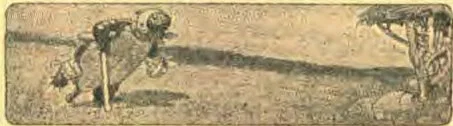
“I know what's the matter with me,” she remarked,
As she sadly limped home on a crutch.
“I'm rather inclined, when I've nothing to say,
To talk altogether too much.”
— Youth's Companion.
Good Words from the Mail Bag
I CANNOT tell you how much I appreciate the INSTRUCTOR. It is a boon to one shut away from all Christian influence and association, alone, yet not alone. LILLIE FREEBOROUGH.”
“I find the INSTRUCTOR of great help in my work, and I send it to friends after reading it myself. I have taken it for years, and do not know what I should do without it. “MRS. HERBERT CHRISTENSEN.”
“Although our children are grown, yet they like the INSTRUCTOR, and as a mother I can speak of its inestimable worth as an educator in any family. I am sure if I had another family to rear I should not be without it or the Little Friend. I am confident that the Lord is blessing your work. “MRS. ELGIN FARNSWORTH.”
“I thank you, dear YOUTH’S INSTRUCTOR! Today I was so blue, so tired of the struggle, I did not care to attend the Sabbath services. And when I was left alone I began to look about for something to read. Light reading was with a sigh pushed aside, for I must keep my promise made to God so often, as to light reading on the Sabbath day, and then I picked up an old copy of the INSTRUCTOR. At first, as I looked it over I was not interested in it, but not for long. Oh, it did seem to have everything I wanted just then! As I read, I was reproved in an article on the Sabbath, and then there was comfort in another; and although I have always read the INSTRUCTOR more or less, it never seemed so dear to me as it does today, for has it not shown me the right way, and brought hope into my heart once more? So I thank you, dear INSTRUCTOR. “A READER.”
“Of all the papers for the youth that I have ever read there is none that quite equals the INSTRUCTOR. I enjoy the articles and the illustrations as well. It is certainly a paper well worth reading by the youth who wishes to build a character according to the Christian standard. The Counsel Corner is full of excellent instruction. The poetry is beautiful, and I keep many of the poems for future reference. The readings on Bible characters are all such as to ‘administer grace’ to every reader. The Finding-Out Club is a helpful study, and I have been one of its members at different times. The notes on current events keep me posted on happenings in the world, and this is essential information. Then last, but not least, I wish to mention the ‘Meditation on the Morning Watch and Prayer’ which has been discontinued the past year. I always looked for it first, as it seemed to unseal God’s Word to me. I should like to see it resumed. MRS. ANNA OSBORN.”
“The INSTRUCTOR has a place here in Bermuda which no other paper could fill. You can be sure that the Lord is greatly blessing your labors here. “EUGENE ROWELL.”
“The YOUTH’S INSTRUCTOR gets better and better all the time, and I feel that in my work for the young people it is a very valuable aid in helping them to cultivate a taste for good reading. “C. E. ADAMS.”
“I have been a reader of the YOUTH’S INSTRUCTOR since childhood, and although I have reached the age of maturity, I try never to miss one number of this excellent paper for the youth. I consider that the subject matter set forth week after week is of the highest value for spiritual and intellectual development. I have never found any other youth’s paper equal to it in this respect. What I have gained through reading the INSTRUCTOR can never be told, and only eternity will reveal the influence which this paper must have exerted over other youth in leading them into lives of usefulness and purity and service for others. May God continue to bless the INSTRUCTOR as it continues its noble mission, and may God bless the editors as they continue their work from week to week, and through this agency may many more of the youth be led to follow in the footsteps of the Master. “FORREST WASHBURN.”
Elder R. F. Cottrell, of Peking, China, says: “The INSTRUCTOR was never better.”
Mrs. J. L. Shaw says that in reading the INSTRUCTOR she almost always finds “something that appeals to the heart—as do the writings of Mrs. E. G. White.”
“Inclosed please find post-office order for $1.75, which is to renew my subscription for the YOUTH’S INSTRUCTOR, which expires April 1, 1919. I have been taking the paper three months, and think it is a perfectly lovely paper. I could hardly do without it now, for it contains so many good things that boys ought to know. I am twelve years old, and the INSTRUCTOR is just what I need. ‘Let the good work go on.’ I will give my papers to other boys. “MARION A. PALMER.”
Cheerful and Hopeful Men Succeed Best
By Charles Kingsley
THE men whom I have seen succeed best in life have always been cheerful and hopeful men, who went about their business with a smile on their faces, and took the changes and chances of this mortal life like men, facing rough and smooth alike as it came.—Charles Kingsley.
O Give Thanks Unto the Lord
“O GIVE thanks unto the Lord; for he is good.”
Is This Your Conference?
By M. E. K.
EVERY living thing grows. Of all organizations the Missionary Volunteer Society should be a progressive one, for all normal young people are growing. Every Missionary Volunteer should grow spiritually, mentally, and socially. Every society should grow in numbers and efficiency. Every conference Missionary Volunteer department should grow. Here is a word from a conference Missionary Volunteer secretary which indicates growth:
“I am glad to tell you that we have two new societies now, and they are starting off wonderfully well. I think, too, our societies are blessed this time with real leadership, at least in three of them. One of the new societies will have twenty or more taking the Reading Courses, and at least eight or ten the Standard of Attainment. This society is in a church where but very little has ever been done for the young people, so I think this is a wonderfully good indication that they are organized for business and missionary endeavor. They have a splendid leader, a real enthusiast.”
Is that your conference? If not, can you not help to make it yours? M. E. K.
The Junior Standard of Attainment
By E. I.
A JUNIOR Standard of Attainment certificate? “Yes, I have one, of course!” Shouldn’t you like to be able to say that at camp-meeting this year? Well, you can, if you really want to.
I suppose that most of our Juniors know what a certificate like this stands for; but just to be sure about it, perhaps we ought to explain it again.
One day a minister was on the train bound for a near-by city where he had an appointment. After he had traveled a few miles, he began conversation with the gentleman with whom he was seated. “What is your business, may I ask?” inquired the minister. “I am a salesman. I sell typewriters,” was the answer. “Here is my catalogue. By the way, what is your business?”
“I am a salesman, too,” replied the minister. “Here is my catalogue.” And he handed the man a Bible.
Our boys and girls also should be engaged in the business of the King, even though they are not ministers. They should be just as ready to tell what their business is, and to interest others in it, as these two men were. The Bible is the “catalogue” to be used in telling others of Jesus. Of course, no one can tell to another something which he himself does not know—we all recognize that; and for this reason we need to study our Bibles, so that we may be able to explain God’s great plan of salvation.
To read the Bible is good, but to study it is better. And that is what one does when he takes the Standard14of Attainment. Some of the subjects to be studied are: “The Plan of Redemption,” “Conversion,” “Prayer,” “Baptism.” There are twenty-seven subjects altogether. Then besides these there are one hundred questions on the history of our church to be studied. These and the twenty-seven Bible subjects are printed in a little pamphlet called the Junior Standard of Attainment Manual, the price of which is six cents. Your conference tract society will have them for sale.
In our church schools many children take the Standard of Attainment, studying under the direction of the teacher. But boys and girls who do not have the privilege of attending church school may pass the Standard of Attainment just as creditably by a study of the little manual. Perhaps your parents will study it with you in the home. It would do them good. A Standard of Attainment class conducted as a part of the church Junior society is also an excellent way to study.
Examination time comes twice a year. The next Standard of Attainment test will be during the month of May. You may try the test any time between May 1 and June 1. So you have some time yet in which to finish your preparation. The test papers are sent out by your conference Missionary Volunteer secretary. If there is no school in your church, ask the church elder to write for the test papers. He will be glad to do it. When you have finished the examination, your examination papers should be sent to the conference Missionary Volunteer secretary.
And then comes—I started to say, “Then comes your beautiful certificate;” but of course there’s an “if.” If you pass the tests, you will receive one. But do not worry. Every one who really gets ready beforehand will be sure to succeed. And it is so well worth the effort! Won’t you try to become an Attainment member? E. I.