The Youth’s Instructor, Vol. 67, No. 16.

The Menace

The Youth’s Instructor

Apr 22, 1919

Review and Herald Publishing Assn. · Takoma Park Station, Washington, D. C. · Apr 22, 1919

The Menace

The “Association Opposed to National Prohibition,” has been organized with the avowed purpose of making the Eighteenth Amendment to the Constitution “forever inoperative.” The Associated Press says that “among the incorporators will be Percival S. Hill, president of the American Tobacco Company; Joseph W. Harriman, president of the Harriman National Bank; and Michael Friedsam, president of B. Altman & Co.
“Plans for organization of branches in twenty-nine States have been laid, and nearly 800,000 persons already have applied for membership. The organization claims to stand on the principle of ‘personal rights and liberties,’ and is opposed to introduction of any bills in Congress or in the State legislatures differentiating between light wines and beer and whisky.
“It is as strongly opposed to prohibition by Constitutional amendment of the manufacture and sale of cigarettes, cough drops, and chewing gum as it is to the prohibition by Constitutional amendment of the manufacture and sale of intoxicants.

Additional Objects Stated

“In addition to the organization’s campaign to influence public opinion for ‘maintenance of the standards of personal liberty’ by ‘all lawful and proper means,’ the organization also proposes to disseminate information regarding the political, social, and economic effect of the prohibition of the sale of alcoholic beverages, to promote temperance in the use of alcoholic beverages, ‘and to oppose any movement to limit or discontinue the use of tobacco.’
“The organization will hold mass meetings and parades in forty-three cities on April 19, the anniversary of the firing of the first gun of the American Revolution. A national convention is to be held between June 1 and June 15.”
This organization is a personal challenge to every lover of sobriety and prosperity to arouse himself to labor with untiring zeal until every intelligent citizen of this country is well informed concerning the individual and national benefits of prohibition.
Let none sleep in this hour when the liquor adversaries go about as roaring lions seeking to find a way to make ineffective the law that rightly enforced will prove the very greatest possible benefit to the nation.
F. D. C.

God Waits to Be Asked

“GOD waits to be asked.”

Miscellaneous News Items from 1918 Periodical

Increase of twenty per cent in domestic telegraph rates became effective April 1.
Germany at the beginning of the Great War stood second among maritime nations; now she is sixth or seventh.
Men owe Dr. Mary Walker a debt of gratitude as the inventor of the inside neckband on shirts, which protects the flesh from being rubbed by the collar button.
In a single day — the last day of August, 1918 — 46,214 soldiers were shipped out of the port of New York. This is claimed as a world’s record for a single day’s shipment of troops.
Lieut. Col. Theodore Roosevelt intends to make the life work of the late Colonel Roosevelt his own life work, and to follow the trail blazed by his distinguished father, politically, socially, and in a literary sense.
The start of the United States Navy’s attempt to cross the Atlantic Ocean on a heavier-than-air machine will take place on the first clear day in May, or as soon thereafter as the fog belt which now envelops the Newfoundland coast shows signs of clearing.
Jules Vedrines, a famous French airman, has demonstrated that a present-day airplane can make a successful landing on a roof if properly handled. He recently received $5,000 for his voluntary landing on the roof of a large Parisian department store during a flight.
In 1914 our 3,500 canneries were preserving in this country 3,000,000,000 cans of food each year. This record has since been more than doubled. Now that the world’s need has brought to our table 200,000,000 additional mouths and appetites, there is no prospect of a decrease in this kind of food supply.
The old idea that the tongues of crows, rooks, and magpies, must be split for them to possess the ability to talk is pronounced by Dr. C. W. Richmond, associate curator of birds in the Smithsonian Institution of Washington, D. C., to be unnecessary. It is pronounced by others to be both unnecessary and cruel.
The former kaiserin of Germany seldom wore the same dress twice unless it had previously undergone a radical change in her own workshop, where she kept from four to six dressmakers busy all the time. She therefore bought from 200 to 225 costumes a year, some costing as little as one hundred dollars, and others thousands of dollars.
Dr. Robert H. Goddard, professor of physics at Clark College, acting under the patronage of the United States War Department, the Smithsonian Institution, Clark University, and Worcester Polytechnic Institute, has invented what is claimed to be the most efficient rocket ever developed. It is a terrible engine of war, with an altitude range of 70 miles straight up into the air, and a distance range of at least 200 miles. The best-known rocket in use today is accredited with an efficiency of less than 3 per cent, while the Goddard rocket has an efficiency of 63 per cent.

“God First”

IN my bedroom hangs this motto, And its place is near the door, So that it may e’er remind me, God all else must be before!
Never do I cross the threshold, Than the motto seems to say: “Just a word with God thy Father, Ere thou goest on thy way.”
When I’m dressing in the morning, As I see it hanging there, It reminds me of my duties, Help for which I seek in prayer.
Duties, burdens, worries, troubles, All may come to me this day, How can I prepare to meet them? How, I ask, except I pray?
When I plan fresh undertakings, Then the motto seems to say: “Don’t in thine own strength begin it, First of all about it pray!”
When I’m ready dressed for walking, Perhaps with little time to spare; Still I cannot leave my bedroom— When I see the motto there— Till I kneel for just a moment, And in earnest secret prayer, Place myself and all my goings, In my heavenly Father’s care.
Nightly, too, the motto speaketh, When for rest I would prepare, Then it whispers its sweet message, “First God go and meet in prayer.”
Yes, “God first” must be our motto If we would succeed each day; Wish we all our ways to prosper, Then about them we must pray.
Dear friend, won’t you have this motto Put up in your room as well? That to you its own sweet message, It may daily, hourly, tell?
Yes, let “God first” be our motto, Let it help us to prepare For life’s duties, cares, and pleasures, By a word with him in prayer.
I have told you how it helps me, It will help you too, I’m sure; Fruit through it will be abundant, Fruit, which ever will endure. — A. M. Terry.

MRS. MARION E. CADY

Held!

MRS. MARION E. CADY

It was during one of those terrible storms of wind and rain that sometimes sweep the Pacific Coast in late winter. For long months the fair land by the sea had been bathed in golden sunshine and fanned by soft breezes. Each morn saw the “spring of the day” dawn in fresh glory. Night after night the sky turned to rose and amethyst between the banks of silver mist as the sun set in a sea of gold. Grandly its beautiful peaks lifted their heads to the sky, while the monarchs of the forest on their sloping sides, stood in proud security.
But now all is changed. Land and sea are swept by the fury of the storm king,—whipped and chastened into submission. The wind tore from peak to peak like a fury bent on demolition. A great slide moved thunderously down one of the mountains, gashing it from summit to base, and precipitating trees, rocks, and tons of earth into the raging torrent below. Even above the rush and roar of the storm, could be heard the crash of giant trees, centuries old, as they fell prostrate to the ground.
And what a scene was the ocean! Sea and sky were one wild gray chaos through which darted the graceful gulls, now poised before the wind on even wings, now darting to skim the crest of the wave in a very frenzy of delight. The boats tossed about on the storm-lashed waters of the bay, carrying their cargo of human freight, now cityward, now homeward. The older passengers looked anxiously out on the rough waters, and thought of their boat trying to keep her course in the storm. The younger ones, inexperienced and thoughtless, looked with unafraid eyes. Something in their own as yet undisciplined natures, reveled in the unrestrained fury of the elements. “The keen, clean smell of the wind-swept sea” sent the blood racing through their veins. The daring ones ran recklessly to the plunging bow and presumptuously matched their puny strength against the force of the gale. But it pounded the very breath back into their lungs, and sent them, staggering and breathless, to the nearest support.
Suddenly the cry rang out on the boat, “A ship on the rocks! A ship on the rocks!” There, nearing the rocky point that used to jut out from Yerbabuena, was a large sailing vessel. Every sail was furled. Not a man was on board. Deserted and helpless in the grip of the tempest, it seemed that each wave would send her onto the rocks. They watched breathlessly. Surely she could not escape the fury of the next one. How strange! Some counterforce was certainly being exercised to keep her from destruction. Soon a white-haired old man called attention to a tug away off to windward. Great clouds of black smoke were pouring from her funnel. And then they caught a glimpse of a strong steel cable as it tightened for a moment when the ship was driven by a heavier sea. All that day and during the long hours of the wild, black night of storm that followed, the straining cable held the deserted ship from being dashed to pieces on the rocks. When the storm subsided, still stanch and strong, she sailed out through the Golden Gate to her port far across the ocean.
How like youth! Then life seems a perpetual summer land of song and mirth, with no hint in the blue skies of the clouds that are gathering just beyond the horizon.
But it is not in ease and pleasure that character is tested and proved. Some day the storm breaks, and youth is tossed about on life’s rough sea like a ship on the ocean.
Confused, too often left alone by those who might help, and pitifully inexperienced, they are buffeted about, the sport of the enemy’s temptations. To on-lookers, destruction on the rocks of sin seems swift and certain. But God’s cable of love holds, unseen by all save the experienced ones, who know that Christ’s heart of infinite love and sympathy is drawn out most of all for the one who is the most hopelessly driven by the winds of temptation. He will not leave his child alone. “I drew them with cords, . . . with bands of love,” says the God of love. He does not always still the waves, as on that stormy night on Galilee, but his love will hold in the fiercest temptation, and if we but yield, it will surely draw us to him.
Happy, indeed, is the young man or woman who can say, from the depths of his own soul’s experience,
Love’s cable holds amidst the storm, Our bark through wind and wave is borne Out to a wider, deeper sea, By the skilled Pilot of Galilee.

Experiences of Colporteurs

One of our colporteurs called at a home where he was to deliver a full morocco “Bible Readings.” He found that the man who had given the order was not at home, and his wife did not know anything about the order, and was not prepared to receive the book. But after looking through it, she said, “I know you are telling me the truth. You are a man of God whom I saw in a dream last night. I saw some one coming to our house with a book that had a message for us.” She was very much interested, and after paying for the book asked what denomination the colporteur represented. He told her, and she wanted to know the meaning of the term “Seventh-day Adventist.” He explained that the seventh day is the Sabbath, which they keep, and that Adventist means that as a people they are looking for the second coming of Christ.
A neighbor came in just then, and the colporteur repeated his canvass. While they were still talking together, their pastor came in, and after a short time he began to abuse the young man because he was a Seventh-day Adventist. The women resented what the pastor said, and it was arranged that the pastor and colporteur should come back the next Sunday and explain things clearly to the people. They did so. The pastor made many statements contrary to gospel truth; however, the colporteur was able to show from the Scriptures the falsity of these statements.
The two women began the observance of the Sabbath and a Sabbath school was organized. This minister has so outdone himself in the sight of his congregation that they have nearly all turned against him. Sixteen of his congregation are now seriously contemplating keeping the Sabbath. This occurred but recently.
Another colporteur felt impressed to work in a different section of the town in which he had been working, so he made the change. Calling at the first home in the new section he received an order for a book. He was told that four houses from there, the woman lay near death’s door, so he would better not call. At the next house he was told that he should make haste to call upon the woman who was not expected to live. Without stopping to give his canvass, he hurried to the house, talked with the sick woman a short time, read some promises from the Bible, and engaged in prayer. The woman said she felt healing come to her during the prayer, and the next week when the canvasser called again, she was much improved. As a result of this incident, the colporteur was able to place a book in nearly every home in that community. The Lord does great things for and through the colporteur army.
M. W. SHIDLER.
God is still intervening in behalf of his people. Various experiences that have occurred while I was canvassing emphasize this fact to me.
For example, in making a delivery during our “big week” in the Lake Union last fall, I had made arrangements with a man to help me in the delivery of my books. He was the only liveryman in the small town, and when I went to him, he wanted twelve dollars a day for the use of an ordinary outfit. I found at that rate it would cost twenty dollars to make my delivery. This seemed to me unreasonable. While debating the question, I stepped out upon the street. A short distance away stood a man absent-mindedly kicking the snow. The thought came to me, Go and inquire about an outfit. I went to the man, and told him my dilemma. He said, “I know just the man you want.” He directed me to a house, where I found a team that I could have. On inquiring the price, the owner said he would not charge me anything for it, but when I returned I could pay what I liked. I made my delivery on record time, and coming back to the house we decided what the charge should be,—a full leather “Bible Readings” and a little cash, the whole amounting to four dollars, while the other man would have charged twenty dollars. I think the Lord has a watchcare over his children, financially as well as spiritually.
C. F. COLTON.

In His Hand

TELL me why, O Christian soldier, Thou art lying in the dust, With thine armor and thy garments Soiled with mildew and with rust? Why this cold and clammy death-dew Of despair upon thy brow, And thy heart congealed with terror? Tell, O tell, what ailest thou?
Have Gehenna’s Stygian shadows Settled round thee, like a pall? Do the tempter’s fiery serpents Hiss, and round and round thee crawl? Are the fallen angel’s fingers Reaching out to clutch thy throat, Like a lion when his victim Cowers ’neath his growl and glout?
Fear thou not! He cannot touch thee; By thy side is One in white, Mightier than ten thousand demons; He can put the foe to flight. Follow him, then, Christian soldier, And you need not fear the foe, For he’ll lead you on to victory Victory, wheresoe’er you go.
Then arise! Arise! O soldier, Shout for joy! Shake off thy dust; Change thy galling coat of sackcloth For the garb of praise and trust. Gird anew thy sword, and hasten; Join thy comrades in the fray; Not a foe can stand before thee, Only watch, and fight, and pray.
HELEN ADAIR.

Where Self Ends, God Begins

“It is at the end of self with all its inventions that we find the beginning of God with all his interpositions.”

The Religion That Comes From God

“THE religion that comes from God is the only one that will lead to God.”

Chinese Architecture

CHINA can boast of very little that is beautiful in architecture. Her great works are the Great Wall, various city walls, temples, and pagodas. Most of the temples and pagodas have fallen into such a state of decay that their original beauty can scarcely be imagined. The walls, however, were built for utility, and many of them are still in good condition. They are worthy of special notice.
The Nanking city wall never ceases to be a wonder to the writer. It is twenty-seven miles in circumference and averages thirty feet wide and forty feet high. Outside, inside, and top are faced with two or three feet of masonry, the body of the wall being made of filled-in earth. The wall is battlemented all the way round for the benefit of archers or musketeers, a feature which is useless now. Let somebody mathematically inclined figure how long it would take a thousand men to build this wall, walking at an average rate of three miles an hour, carrying a cubic foot of material at a load, carrying each load an average distance of a quarter of a mile, and working ten hours a day. This would still take no account of the masons who laid the bricks and the men who built the huge mounds of earth which are found piled against the inside of the wall in many places. The work of building the Great Pyramid seems small beside this task.
The Great Wall and the walls of various cities in China are on the same plan as the Nanking wall, though few of them are as wide or high, and no other city has a wall as great in circumference as that of Nanking. The Great Wall is fifteen hundred miles long. It was built to keep the northern enemies out of China, but it did not succeed very well, so it stands a colossal monument to the foolishness of its builders, rather than an evidence of their genius.
In contrast to the walls, Chinese pagodas are not at all massive. Many of them still show graceful outlines and traces of considerable beauty. Pictures of them are so common that their general style is familiar to all. They are towerlike in form and divided into stories. They always have an odd number of stories, varying from three to thirteen in number. Some are round, some octagonal, some hexagonal, and some look as if the builder had put a roof on each story as he finished it and then changed his mind and added another story above the roof.
Chinese temples, houses, and nearly all other buildings are much alike in general plan. The numerous round wooden pillars in the interiors, together with the more or less sagging lines of the roofs, are very suggestive of the time when the Chinese lived in tents.
While temples and houses have much in common, still temples are peculiar in some respects. A temple usually consists of more than one building. A very common plan for a temple is a rectangular inclosure surrounded by a wall, with a series of rooms running all around the outside under a shedlike roof, and a series of rectangular buildings one behind the other occupying the central portion of the inclosure. The lines of temple roofs are extremely sagging, and the eaves and ridges are often decorated with images of dragons.
Such Chinese houses as are pretentious enough to be said to have any plan of architecture are all singularly similar. They are one story high, rarely two, even in crowded cities. The walls are brick, the roofs are tile, and the floors are earth or brick. The interior framework consists of poles left in the ground. Partitions are made of boards about a fourth of an inch thick. Wood exposed to the weather is covered with a reddish or yellowish paint, but paint is seldom used to brighten up the interiors. Doors and windows are few. The result is that the homes of the Chinese, even of those that are wealthy, are ugly, dark, and insanitary.
China has built little that is praiseworthy. The grayish-black brick and the grayish-black tiles which are so universally used as building materials, give all her cities a drab and uninviting appearance. We may wonder at her massive walls and speculate as to the former beauty or grandeur of her pagodas and temples, but we may be profoundly thankful if we do not have to live in her houses. H. O. SWARTOUT.

Ah Chong’s Smile Sold the Books

AH CHONG is a student in our Singapore mission school. To aid in paying his tuition, Ah Chong sells our truth-filled literature. Do you want to see how he does it? Well, just imagine this cinematic view of him at his canvassing on a certain day a few months ago.
The picture begins in front of an old Chinese mansion. It is the present rented quarters of the Malaysian Training School. Presently a little Chinese boy comes out, looking as fresh and prim as if just “from the bandbox.” That’s Ah Chong. He is wearing a spotless white suit, and a pleasant look which fits his face well. He stands by the compound gate with the plaster dragons frowning down at him, and a frightened look begins to creep over his features, as he seems planning a daring venture, and is fighting some mental dragons of dismay. A stream of jinrikishas, gharries, oxcarts, and pole coolies passes, and finally a “bob-tailed” tramcar with a long-haired Tamil motor-man and a Chinese conductor.
Ah Chong chooses a second-class seat, places his package of thirty copies of “World War” beside him, and hands the conductor three coppers as fare.
The old tramcar jogs along on Serangoon Road, turns into Bras Basah, and stops at Raffles’ Hotel by the seaside. Here Ah Chong alights and walks in the direction of Johnson’s Pier. It is very warm, and the sunshine is almost blinding. Perhaps that is why Ah Chong is wiping the beads from under his helmet brim. But it is nervousness that keeps his handkerchief busy, as Ah Chong is used to the tropical heat of Singapore, the land of constant summer weather.
He walks along the sea wall, his face turned toward the hundred ships lying there in the harbor of Britain’s fifth port. Coming to a landing he beckons to a sampan, and is soon being rowed out toward the shipping.
Past the five-barred flag of China, the horizontal red, white, and blue of Holland, and the red-circle emblem which is seen most on the Pacific where Japan feels herself mistress, we see Ah Chong’s sampan making for a long gray vessel carrying the British flag. The ship is a three-stacker, with fighting masts, and great guns sticking out from both fore and aft turrets, and bristling from her sides. It is the type of the regular British cruiser.
The sampan comes up to the ship’s ladder, and the oarsman ties her fast, after the manner of the sea fighters who used to lash their ships together as they battled. Ah Chong ascends the ladder, carrying his package of books. He is challenged by a sentry as he steps upon the deck. He explains his mission by canvassing the sentry. The sentry wants a copy. Soon a group of marines and sailors gather, and Ah Chong canvasses them. Nearly every one wants one of the books, but few have the money to buy. Next appears a stern-faced officer. Ah Chong focuses his smile upon the officer and explains the situation, and the officer hands Ah Chong the price of the books, thus lending the amount to the men.
It is a happy boy we see coming back to shore. His glowing testimony was given at the Missionary Volunteer meeting on the next Sabbath. And when I saw his smile, I understood what helped him meet the war-time discipline of John Bull’s warship, and place among its crew the little message-filled book.
S. W. VAN TRUMP.

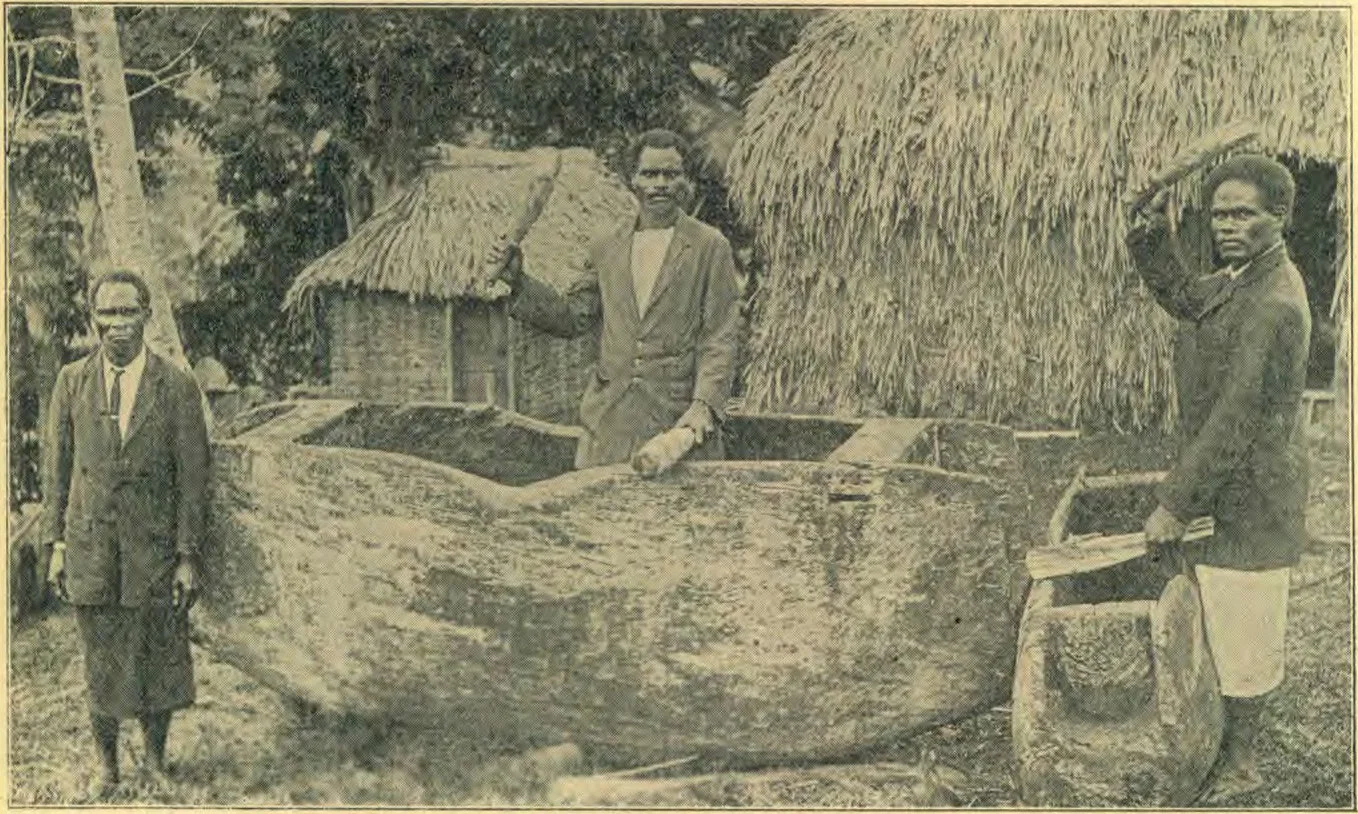
A Large Fijian Church Bell

THE FIJIAN CHURCH BELL
The lali, or Fijian drum bell, shown in our picture, is one of the very largest we have ever seen, and this particular lali is used to call the native brethren to our services in the town of Naqia, Fiji, on the beautiful Wainibuka River. Here about one hundred have accepted the last gospel message, and many seem ardent in their new-found faith. This wooden bell, made from a large log of hard wood, makes a loud, but pleasant booming sound which can be heard for many miles up and down the river, and thus it becomes a factor in sounding forth the message. Its loud-sounding tones tell far and near that the Sabbath hours are observed in this part of Fiji.
At one time in the history of Fiji, the lali was chiefly used to summon people to the cannibal feasts. It was said to be an awful sound then. Today we are glad it can be employed in the work of soul-saving.
In Naqia are a few very old men who remember the days when the lalis used to ring out the cannibal feasts. We present a group of old men, thinking a look at their old faces will interest readers of the INSTRUCTOR, especially when it is remembered that they are now Sabbath keepers.
At Naqia, at the time of our visit, twenty-four were baptized. These had been studying the truth for a time, and had been under the instruction of our native evangelist who is located in this important center. God is cutting his work short in the earth, and as it is finishing in other parts of the world, the Lord is not forgetting little Fiji, once so filled with heathen darkness.
J. E. FULTON.

Surrender

SOME time ago there came to my knowledge the case of one woman who has had a remarkable experience. For more than five years she had been demon-possessed, and at times when the trouble came on, she would almost lose her life. She told me that many times the devil had choked her until she lost consciousness.
One day our evangelist in his rounds among the gardens, called at hers. She and her husband seemed friendly, and he invited them to come to the meetings on the Sabbath. They came the next Sabbath, and listened very closely to the sermon, which was on the subject of faith and prayer. During the service the Holy Spirit impressed the woman that she could be healed, and she went home determined to try the new remedy. She did not know how to pray to God, so she simply knelt down without uttering a word.
A day or two after this the evangelist went to her place again. At this time she told him of her trouble. She said she wanted to know how to pray, and what to do in order to have the help of Shang Ti (God). The evangelist told her that she must tell God all about her sins, and ask to be forgiven. She immediately asked all the questions she could think of, and the evangelist told her of the things that she must put away. As fast as he could tell her, the earrings and rings came off, the unclean meats were thrown out, and the place for the old idol torn down. From that day to this, she has had no more of those awful struggles, and is walking in the way of the Lord. Surely, the day of God’s miracle-working power is not past. “Even the devils are subject unto us through Thy name.”
The whole neighborhood is stirred over this thing, and many are inquiring what such things mean. Brother Tsen En Fook, our evangelist there, wrote me not long ago that he was working night and day telling the people the good news.
Roy Mershon.
Borneo.

A Soldier Boy’s Letter to His Sister

[The following letter was written by a young man at Camp Lewis, Washington, to his fifteen-year-old sister. It was sent to the INSTRUCTOR by a relative who saw the letter, and thought it contained advice worthy of being passed on to the readers of the INSTRUCTOR.]
MY DEAR LITTLE SISTER:
This is after all a fine Monday morning. It started out foggy and chilly, but the sun is gradually getting the situation in hand. How are you faring on the mountain? Poor little girl, you are obliged to go to school all through these weeks of wind and rain! It doesn’t make so much difference, though, as long as it doesn’t get damp inside, sister; and I know you will smile sweetly through it all.
I wonder when I wrote you last. A very long time it must have been, for I cannot remember just when it was. Well, Alice, I beg your pardon for being so delinquent. Of course I am kept very busy. Just now I am waiting for my work, so will write to you.
We surely have some rough men in our barracks. Every evening since the camp has been in quarantine and the weather bad, they get together in groups to play cards and gamble. It is certainly disgusting the way they talk. Yet these same fellows call on some young ladies who think they are the cream of manhood. They are polished gentlemen then, of course. Too bad some of these same trustful young girls cannot see both sides of the situation; but they will some day—perhaps to their sorrow.
Mother wrote me you had not heard from me for quite a while, and she thought you did not like that very well. Perhaps I had better write oftener. How I wish I could see you and talk with you as we used to talk on our walks together. Do you remember them? If you ever have your picture taken, send me one. I’ll send you mine as soon as they are printed. They are plain, everyday, informal pictures, but I like that kind best, don’t you? This idea of togging up, and then striking that “look-pleasant, calf-smiling” pose, I do not like.
Say, sister, what studies are you taking now? And what are you studying in Bible? Be sure to find out just what God’s Word teaches, for some day you will want to know just what is truth when you meet people of other beliefs. There are so many ideas and teachings today, that it is confusing unless one goes to the Book for himself with a sincere desire and purpose to know what the Bible does teach, and with a determination to follow its teachings.
So many times I have had talks with different boys here who believe differently from what I do. Just last night I went to the bathhouse after the lights were out to see if my clothes were dry, and one of my friends was there, with another boy belonging to his church. We got to talking about the Sabbath and other Bible doctrines. The more I talk with these boys the gladder I am for the Bible lessons I learned in school. I only wish I had studied them harder. I have time now on Sabbaths, and sometimes between, to read and study.
You are a little girl yet, aren’t you, sister? But I think you will understand what your big brother has written. One of the boys and I talked until nearly midnight last night. John is a good Christian boy,—always working and smiling. Many evenings I find him at work in the bathhouse washing the other boys’ clothes, and he spends the few cents he gets for it buying tracts from his church publishing company to give to any who will read. He has lent some to me, but I have told John I could not accept their teaching because, in many instances, these books teach falsehoods, and twist the Scriptures to mean what they do not. He wants me to believe that the Sabbath is done away, that Sunday is now the Lord’s day, that men’s souls live after their bodies die, and that the wicked will suffer eternal misery in a lake of fire.
So, Alice, in your Bible study do not be satisfied to squeeze through your recitations and examinations with “Yes” to this question, and “No” to the next, but study until you understand the subject and it becomes real to you, so you can tell anybody who asks, the reason you believe as you do. This old world of ours will not last much longer. It is not becoming a heaven very fast, and we cannot expect to enjoy the pleasures the old world still affords unless we choose to pay the price.
Now about Leon Bowen. I do not believe I remember him. I am glad, however, that you came to your big brother for advice. Let me say I think you will do well to let every boy know that you do not covet his attentions, and that the best thing for him to do is to mind his little-boy’s business.
If you can avoid the pitfalls that many a well-meaning girl falls into by being a free-and-easy chum to every boy, or any boy, I shall be very happy, because I know you will grow up into a real woman without any wilted or spotted petals. You will be happy then as you could not be otherwise. Remember the story of the rose, sister? Wait for the right time, and till you are old enough to look at both sides of a young man’s life (if he has two sides), before you allow yourself to think more of any young man than simply as a friend.
I have had enough experience and observation, and I hope also a little sense, to know that this is the best way to avoid the things that are the regrets of after-life, and also to strive for the things we shall be happy some day that we waited and worked for.
I should say you have at least four or five years yet before it would be best even to think about the attentions or special friendship of any young man. Do you think your soldier brother is just lecturing a little, as you perhaps used to think? I’ll tell you, Alice, I mean every word I have written, and I write it because I love you as my dear little sister. I want you to escape what thousands of careless, ignorant little girls experience, and I do not want you to miss the happiness and usefulness of being a pure, true woman.
You have a mind of your own, Alice, haven’t you? Read such books as will give the best ideals to follow, and I have found the Book of God is the best book for this. Other books are only echoes or elaborations of what is so simply and beautifully told there. Choose such friends as will be a help to you in following your ideals, and you should be a help to them, too. We must at times use our minds to the limit, not only that part of the mind used in study, but also that part we call the will. One’s success in life, now and forever, depends on to what and to whom one says “I will” or “I will not.” It is a wonderful faculty our Creator has given us,—the power of choice. Even he will not tamper or interfere with that.
When I say you have a mind of your own, I mean that you have the faculties of mind to learn the teachings of life and its experiences, to choose the life you desire to be forever yours, and then to will to do as you have chosen. We have only to use the minds God has given us, and then he does for us what we cannot do for ourselves. Sister, you understand what your big brother means, don’t you? We have talked a little of this before. But since you have written me once or twice asking my advice, I am only too glad to write what I wish and pray for my dear little sister. Perhaps I should not call you “little” if I could see you now. I wonder if I should.
A long letter, this, for me to write, isn’t it? But I think you will not care this time, since I have not written for quite a while. I am having it easy this morning, don’t you think? Nothing yet to do, but some days I get enough to make up for it.
Write often, Alice dear. I am always glad to get your cheery letters, and will attempt to be more prompt in replying.
Your loving soldier brother,
CLARENCE.

The Heartening Courtesy

THE front door of the street car opened, and a kind voice quietly said: “This is where you change for Forest Glen,” apparently to a travel-stained young seaman. “Didn’t you want to go to the Walter Reed Hospital?” to a little, old man, who hastily caught up a worn satchel and left the car. The conductor, whose duty it was to care for his passengers, seemed oblivious to the courtesy of his partner.
I was impressed by the natural kindness of one upon whom it did not devolve as a part of his job to be kind; and my step was lighter and my heart kindlier all the day through.
The stranger within our gates is our guest whether we make him so or not. The privileges of hospitality we have today may not be ours tomorrow. The warm glow of our cordiality is felt by another and yet another, and the world is gladder because we are a part of it.
“I expect to pass through this world but once; if therefore there be any kindness I can show, or any good deed that I can do to a fellow human being, let me do it now; let me not defer it, nor neglect it, for I shall not pass this way again.”
MARY ROBERT.

Presenting Truth to Win Souls to God

“Too often we present gospel truth to others for the reason we would be clear of their loss rather than to win souls to God.”

Be Careful in Choosing Friends

ONE day a class in psychology asked their professor to define character, and this is his answer: “I cannot define it, but I can tell you of what it consists. Character is made up of little bits of the character of every person with whom you come in contact in your daily lives. And your character will be continually added to from the personalities you are to meet in future years.”
In other words, you will be getting a little knowledge from this friend and that friend, and the sum total of all this will make up your personality.
And, as you can see, the person or persons you meet most often will contribute to your character in greater proportion than those met only occasionally.
It isn’t so important to choose your general friends as it is to choose those that are going to be closest to you.
Also, don’t forget you are giving a part of your personality to each person as a section of his character.—Washington Herald.
Continue reading: Part I