The Youth’s Instructor, Vol. 67, No. 16.

The Menace
Earlier text: Part I

Exchange of Ideas in the Missionary Volunteer Department

YOU have a dollar, I have a dollar. You give me your dollar. I give you my dollar. We still have a dollar each. You have an idea, I have an idea. We exchange ideas. You have two ideas and I have two ideas. That's the difference."
This department of the INSTRUCTOR is for an exchange of ideas. Let those who have ideas, or questions to ask, be free to write the Missionary Volunteer Department. Many have expressed their interest in the Counsel Corner, but the mill cannot grind without grist. M. E. K.

Graduation Exercises on the Sabbath

FROM time to time I have been helped by Our Counsel Corner, and now I want to ask your advice. This spring I shall be graduated from high school. The graduation exercises will be held Friday evening. Some Seventh-day Adventist girls have gone to them, but to me it does not seem right. There are two of us who are in the same class. The board of education always has refused to change the time. Please give me your advice as soon as possible. My friend and I have been praying about it, and trust that the Lord will give us strength to truly represent him in this matter. K. M.
I am pleased to know that this is a matter of conscience with you. It seems to me that we cannot attend graduation exercises, or other secular meetings, on the Sabbath. Surely this would be “doing thy pleasure on my holy day.”
I knew a young woman a few years ago in the same situation exactly as you are. The principal felt that he could not change the evening for the exercises, and the girls of the class did their utmost to persuade our sister to be present. Their last effort was on Friday afternoon. After all the decorating was finished, they went to her home and took her to the schoolhouse to show her the decorations and how the seating was to be arranged, and that there would be a vacant seat if she was not there; but Sabbath evening found her at home with her mother, studying her Sabbath school lesson.
I knew of another case where a young woman had been selected to take part in a speaking contest. It was generally recognized that she could easily win the prize; but it was to be held on Friday night and she refused to go. It came to the attention of the principal and was the talk of the town. The fact that a young woman would sacrifice so much for principle was a matter of note.
First of all we want to be true to God because it is right; and then it is well to remember that in thus witnessing for Christ we bring the truth to the attention of others. I believe there are many good people in the world who will be attracted to this truth when they see that those who believe it are willing to suffer for it. I believe that those who are going through to the end will be individuals of principle who will “stand for the right though the heavens fall.” Let us be true to the words which we often sing:
“Our fathers, chained in prisons dark, Were still in heart and conscience free: How sweet would be their children’s fate If they, like them, could die for Thee! “Faith of our fathers! holy faith! We will be true to thee till death!”
God will give you and your friend strength, for there is no need that he cannot fill. M. E. K.

V — Justification by Faith

(May 3)
GOLDEN TEXT: “Who is a God like unto thee, that pardoneth iniquity, and passeth by the transgression of the remnant of his heritage? he retaineth not his anger forever, because he delighteth in mercy.” Micah 7: 18.
STUDY HELP: “Steps to Christ,” chapter “The Test of Discipleship.”

Questions

1. Under the law of Moses, how was a righteous man justified? Deut. 25: 1. Note 1.
2. Could a sinner be justified by the law of Moses? How alone can a sinner be justified? In what must the sinner believe if he is justified by Christ? Acts 13: 38, 39.
3. What becomes of the sins of the justified one? Micah 7: 18, 19.
4. What part does Jesus act in our justification? What part does God act? Rom. 8: 33, 34.
5. Whose righteousness does the justified one have? What sins are thus done away? Rom. 3: 25.
6. How can the sinner claim the righteousness of Christ? Rom. 5: 17; 2 Cor. 5: 21.
7. When the sinner is justified, what is Jesus made to us? 1 Cor. 1: 30.
8. When Christ’s righteous life is imputed to the sinner, what relationship is established that was broken by sin? James 2: 23.
9. By what can no one be justified? How only can one be justified? Gal. 2: 16; Rom. 4: 5.
10. What prompted Jesus to secure our justification through the means of redemption? Rom. 3: 24. Note 2.
11. How may others know that we have been justified by Christ? James 2: 18-22. Note 3.
12. What blessed experience follows justification? Rom. 5: 1; 1 John 2: 1, first part.
13. Since the peace of God is promised to the repentant sinner, why are we so often overwhelmed with a sense of our own imperfections? 1 John 2: 1, last part. Note 4.

Notes

1. There was provision under the old, or ceremonial, law for the pardon of the transgressor who confessed his sin and showed faith in the promised Saviour by bringing a sin offering; but under that system only the man who was right, or just in a civil sense, was justified by the decision of the civil judge, whose duty it was to adjust differences arising among the people. But he who accepts Christ is justified by the great Judge of all, not because he is shown to be right in himself, but because of the merit of Christ whom he has accepted as his Saviour, and whose righteousness he now claims by faith. This is not, however, without a contest, for over every person who desires to become a child of God, Satan renews his controversy with Jesus. He claims that the sinner belongs to him; and if there were no escape from sin, Satan’s claim could not be disputed. But when “they come unto judgment, that the judges may judge them,” the Judge sees only the perfect life of Jesus which the sinner has accepted, the sins are gone, and his verdict is, “The sinner is justified; he is exactly right; he is the purchase of infinite sacrifice; he no longer belongs to Satan; he is the property of the Redeemer.”
Justification means the act of making just or right. A printer justifies his type by spacing it so that each line is even and true and exactly fills its allotted measure. If the line is a little too long, something must be removed; if too short, a “space” must be inserted. Sometimes only the thickness of a sheet of thin paper is needed. But when fully justified the line is exactly right. So in our Christian experience, Jesus becomes our justification. His life adjusts all our irregularities and shortcomings. But he does it, not by patching up our sin-marred lives, but by forgiving our sins, and counting his own perfect life as belonging to us. Thus our past lives are made exactly right, or just.
2. Grace freely given. Grace is unmerited mercy, kindness, or favor shown those who do not deserve it. One who is merciful has no desire to see a sinner punished. He feels sorry for the weakness that the sinner has manifested under temptation, and his only feeling is one of sympathy and forgiveness. Grace cannot be given grudgingly or of necessity; it must be given cheerfully, fully, freely. This is the disposition of Jesus toward the sinner, and it was this divine attribute, or trait of character, that led him to give his life to save us.
3. “Christ said to Nicodemus, ‘The wind bloweth where it listeth, and thou hearest the sound thereof, but canst not tell whence it cometh, and whither it goeth: so is every one that is born of the Spirit.’ Like the wind, which is invisible, yet the effects of which are plainly seen and felt, is the Spirit of God in its work upon the human heart. . . . While the work of the Spirit is silent and imperceptible, its effects are manifest. If the heart has been renewed by the Spirit of God, the life will bear witness to the fact. While we cannot do anything to change our hearts, or to bring ourselves into harmony with God; while we must not trust at all to ourselves or our good works, our lives will reveal whether the grace of God is dwelling within us. A change will be seen in the character, the habits, the pursuits. The contrast will be clear and decided between what they have been and what they are. The character is revealed, not by occasional good deeds and occasional misdeeds, but by the tendency of the habitual words and acts.”
“It is true that there may be an outward correctness of deportment without the renewing power of Christ. The love of influence and the desire for the esteem of others may produce a well-ordered life. Self-respect may lead us to avoid the appearance of evil. A selfish heart may perform generous actions. By what means, then, shall we determine whose side we are on? . . .”
“If we are Christ’s, our thoughts are with him, and our sweetest thoughts are of him. All that we have and are is consecrated to him. We long to bear his image, breathe his spirit, do his will, and please him in all things.”
“Those who become new creatures in Christ Jesus will bring forth the fruits of the Spirit, ‘love, joy, peace, long-suffering, gentleness, goodness, faith, meekness, temperance.’ . . . The things they once hated, they now love; and the things they once loved, they hate. The proud and self-assertive become meek and lowly in heart. The vain and supercilious become serious and unobtrusive. The drunken become sober, and the profligate pure. The vain customs and fashions of the world are laid aside. Christians will seek not the ‘outward adorning,’ but ‘the hidden man of the heart, in that which is not corruptible, even the ornament of a meek and quiet spirit.’”—“Steps to Christ,” pp. 61-63.
4. “The closer you come to Jesus, the more faulty you will appear in your own eyes; for your vision will be clearer, and your imperfections will be seen in broad and distinct contrast to his perfect nature. This is evidence that Satan’s delusions have lost their power; that the vivifying influence of the Spirit of God is arousing you.
“No deep-seated love for Jesus can dwell in the heart that does not realize its own sinfulness. The soul that is transformed by the grace of Christ will admire his divine character; but if we do not see our own moral deformity, it is unmistakable evidence that we have not had a view of the beauty and excellence of Christ.
“The less we see to esteem in ourselves, the more we shall see to esteem in the infinite purity and loveliness of our Saviour. A view of our sinfulness drives us to him who can pardon; and when the soul, realizing its helplessness, reaches out after Christ, he will reveal himself in power. The more our sense of need drives us to him and to the Word of God, the more exalted views we shall have of his character, and the more fully we shall reflect his image.”—Id., p. 70.

Intermediate Lesson

V — Saul Rejected; David Chosen King

(May 3)
LESSON SCRIPTURE: 1 Samuel 15; 16.
MEMORY VERSE: “The Lord seeth not as man seeth; for man looketh on the outward appearance, but the Lord looketh on the heart.” 1 Sam. 16: 7.
STUDY HELPS: “Patriarchs and Prophets,” pp. 627-642; “Bible Lessons,” McKibbin, Book Two, pp. 58-62.
“Honor and shame from no condition rise; Act well your part, there all the honor lies.”

Questions

1. Although Saul had failed in the test of obedience given to him, how did the Lord mercifully give him another trial? 1 Sam. 15: 1-3.
2. How did he endure this second test? Verses 7-9. Note .
3. What word from the Lord came to Samuel? How did Samuel receive this? Verse 11. Note .
4. When Samuel and Saul met, what did the king say? With what pointed question did Samuel answer Saul? What excuse did Saul make for his disobedience? Verses 13-15.
5. What did Samuel say was better than sacrifice? With what other sins did he class rebellion and stubbornness? What was the direct result of his rejection of the word of the Lord? Verses 22, 23.
6. What did this fearful sentence cause the king to say? Verse 24. Note .
7. What request did the king make of Samuel? How did Samuel reply? How did Saul try to detain the prophet? With what result? Of what was the torn garment a symbol? Verses 25-29.
8. Since Saul would not obey the Lord, what was Samuel obliged to do? Where did Samuel go? What did the prophet henceforth cease to do? Yet how did he feel toward Saul? Verses 32-35.
9. What direction did the Lord give Samuel? Why was this mission a dangerous one? What precaution was he to take? 1 Sam. 16: 1-3. Note .
10. How did the coming of Samuel to Bethlehem affect the elders of the town? What did they ask? How did Samuel reply? Verses 4, 5.
11. When Jesse and his sons had come, what did Samuel say to himself about Eliab? How did this agree with the Lord’s thoughts concerning him? Verses 6, 7.
12. How many sons did Jesse cause to pass before Samuel? What did the Lord say of each? What question did Samuel then ask? How did Jesse reply? How did the youngest son appear? What did the Lord say of him? Verses 8-12.
13. What did Samuel then do? What did the Lord cause to come upon David? Verse 13. Note .
14. What change took place in Saul? What did Saul’s servants advise? Who was mentioned to him? Name the different things for which David was recommended. Verses 14-18. Note .
15. What was the result of these good words spoken for David? What shows that Saul was not disappointed when David came? Verses 19-23.

Can You Tell

What was the very best thing said of David in the whole story?
Why the arrangement by which David came to live at the royal court seems providential?
Why was it of great advantage to this shepherd lad?
Where we have a collection of David’s songs?
By what beautiful name David is spoken of? 2 Sam. 23: 1.
Which is your favorite psalm?

Notes

The Wind and the Rose

A LITTLE red rose bloomed all alone In a hedge by the highway side; And the wind came by with a pitying moan, And thus to the floweret cried:
“You are choked with dust from the sandy ledge; Now see what a friend can do! — I will pierce a hole in the tangled hedge, And let the breeze come through.”
“Nay, let me be — I am well enough,” Said the rose in deep dismay. But the wind is always rude and rough, And of course he had his way.
And the breeze blew soft on the little red rose, But now she was sore afraid; For the naughty boys — her ancient foes — Came through where the gap was made.
“I see,” said the wind, when he came again, And looked at the trembling flower, “You are out of place; it is very plain You are meant for a lady’s bower!”
“Nay, let me be!” said the shuddering rose; “No sorrow I ever had known Till you came here to break my repose; Now, please to let me alone!”
But the will of the wind is strong as death; And little he recked her cries; He plucked her up with his mighty breath, And away to the town he flies.
Oh, all too rough was the windy ride For a rose so weak and small; And soon her leaves on every side Began to scatter and fall.
“Now, what is this?” said the wondering wind, As the rose in fragments fell; “This paltry stem is all I find — I am sure I meant it well!”
“It meant just this, that a meddling friend,” Said the dying stalk, “is sure To mar the matter he aimed to mend, And kill where he meant to cure.” —John G. Saxe.
“WHERE self-restraint is lacking, order ceases: A hoopless barrel tumbles all to pieces.”

The Attraction of Earth

SIR ROBERT BALL, the great astronomer, said that a man who carries a sack of corn on earth could as easily carry six sacks of corn on a globe the size of the moon. But in a world as vast as the sun, even to pull out a watch from the pocket would be to tug at a weight of five or six pounds. It would be impossible to lift an arm, and if once a man were to lie down there, he could never get up again. So, in the spiritual realm, the weight of our burdens depends upon the attraction of earth. If the world is all to us, alas! how true it is that its burdens crush and overwhelm us.—Sunday at Home.

Why the Frost?

A YOUNG man had worked for years to establish himself as a peach grower, and had invested his all in a small peach orchard which bloomed bounteously—then came the frost. He did not go to church the next Sunday, nor the next, nor the next. His minister went to hunt him up, and inquired the reason. The discouraged young fellow exclaimed: “No, and what is more, I’m not coming any more. Do you think I can worship a God who loves me so little that he will let a frost kill all my peaches?” The old minister looked at him a moment in silence, and then replied kindly: “Young man, God loves you better than he does your peaches. He knows that while peaches do better without frosts, it is impossible to grow the best of men without frosts. His object is to grow the best men, not peaches.”—Rev. J. F. Cowan, in Herald and Presbyter.

Homesick for the Heavenly Home

Homesick.

“’Mid pleasures and palaces though we may roam, Be it ever so humble, there's no place like home.”
ARE you homesick? Do not these words bring to your mind the happy moments spent in the dear place that you will always remember as the best place on earth, “home”? Certainly they do. And strange it would be if they did not.
But, reader, is there not something lacking even in the best home that you ever saw, is there not something that you are looking for and that your heart aches for, that you have not yet found, that the rest of the verse takes up?
“A charm from the skies seems to hallow us there, Which, seek through the world, is ne’er met with elsewhere.”
Yes, that is it, we are homesick for the home that will be ours some future day,—the one where sorrows and disappointments will never come to us to mar the happiness of the scene. Let us prepare for that home. Christ has gone to prepare a place for us, says John; shall we not do our bit and prepare ourselves for that home? And not only ourselves, but we should be so happy at the thought that we will tell others. Christ not only died for you, but for all sinners who are willing to come to him. While working for others, we shall forget our misery in our effort to help them forget theirs. So when you think of or hear—
“Home, home, sweet, sweet home; Be it ever so humble, there's no place like home,”
let it spur you on to greater efforts to spread the good news of the heavenly home that is now being prepared for us.
LEROY R. BEDDOE.

How Long to Work

THE Youth's Companion in a recent issue gives a worthy comment on present-day methods and aspirations of labor unions. The writer says:
“How many hours a day should a man or a woman work? Almost every one will say at once that the question is absurd, for there is no rule that can be applied generally either to men or to women.
“Nevertheless, it is easy to see that the trade unions think otherwise; for no matter what union it is, it fixes upon a certain number of hours as the maximum for those who belong to it. There is no elasticity; no liberty for those who are strong and capable to exceed the limit, which in many cases is fixed below the capacity of the weakest and the most inefficient.
“At the present time there are movements in many countries to shorten the hours of labor. An eight-hour day is beginning to look conservative. Even before it has been attained, some of the trades are demanding a forty-four-hour week, and the more radical labor men are talking about a working time of six hours a day for five days in the week—a thirty-hour week.
“Men who are dissatisfied with their lot, and who yet suffer themselves to be bound by rules that forbid them to work more than a certain number of hours a day, might ask themselves if they know or ever heard of a man who limited himself by such a rule and yet rose out of his condition and gained wealth. The careers of many successful men show that the contrary is true. Would those men, or would any of the lesser men who have raised themselves out of poverty, have succeeded if they had intrusted to others the right to tell them to stop work when others stopped?
“Reducing the hours of labor has been greatly beneficial. But making it compulsory for every man to limit the time that he may work is not beneficial to all. So far as it induces indolence on the part of those who are capable of rising, and so far as it stifles proper ambition, it is harmful.”

How Prohibition Affects Montana

WITH the county jail empty in Lewistown, arrests falling off nearly 90 per cent in Billings and Great Falls, no violent crimes in Butte, it would almost seem that the water wagon was the safest old vehicle ever known in these regions. Dry Butte is a much better city than Butte with saloons. Arrests fell off 60 per cent during the first month of prohibition. In dry January there were only 375 arrests as compared with 881 in wet December. Not a single murder, hold-up, or assault was reported during January. This is a remarkable record for Butte, where during the past two years 31 murders were committed. In Great Falls, Billings, Lewistown, and Butte the buildings made empty by passing of the saloon are now being used for other trades and industries employing far more help. Both the Butte Brewing Company and the Centennial Brewing Company are busy changing their plants into factories for better and more wholesome products.—The Messenger.

Good Manners Are Made Up of Petty Sacrifices
Good manners are made up of petty sacrifices.— Emerson.
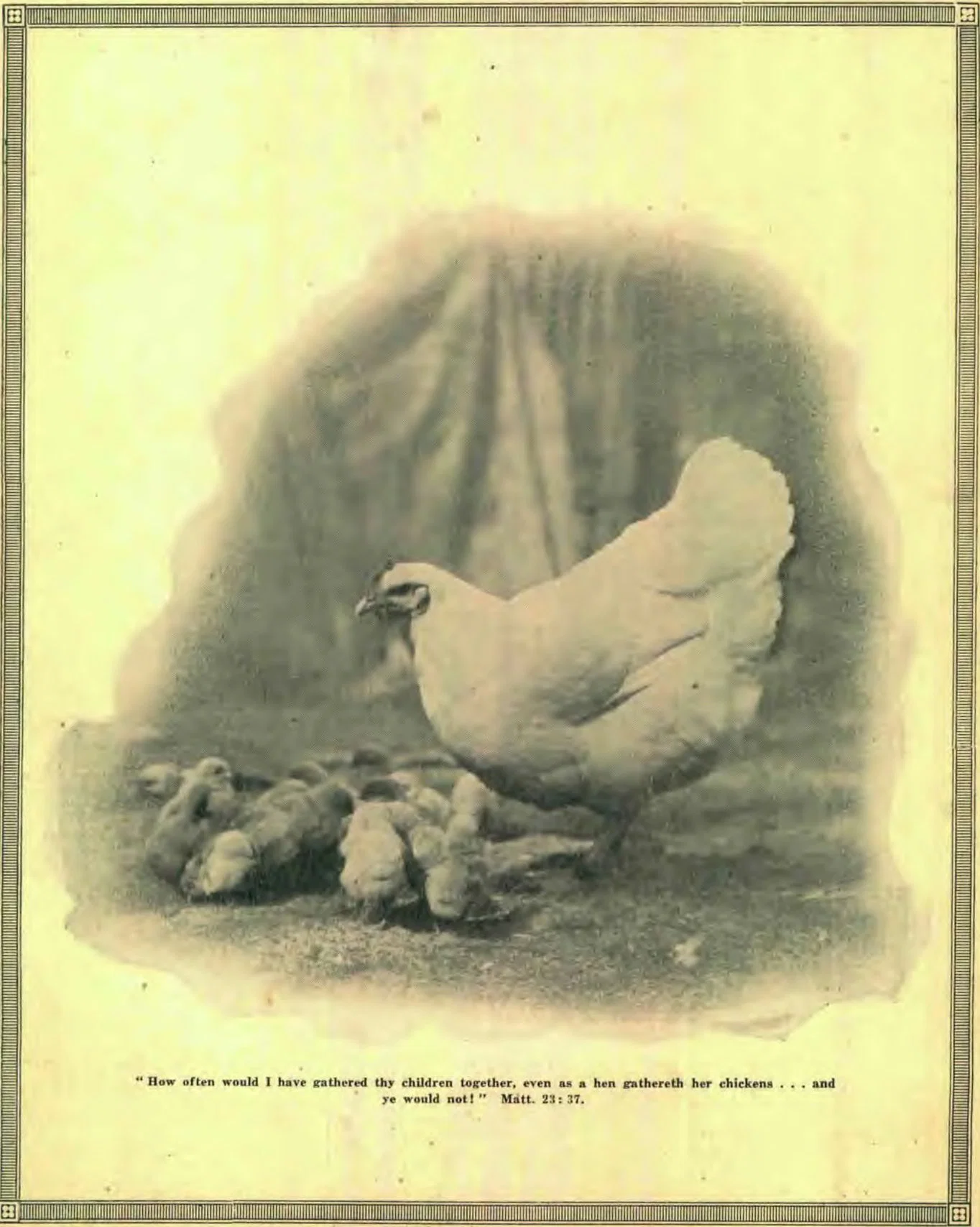
“How often would I have gathered thy children together, even as a hen gathereth her chickens . . . and ye would not!” Matt. 23: 37.

You have reached the end of this edition.

The Youth’s Instructor · Apr 22, 1919