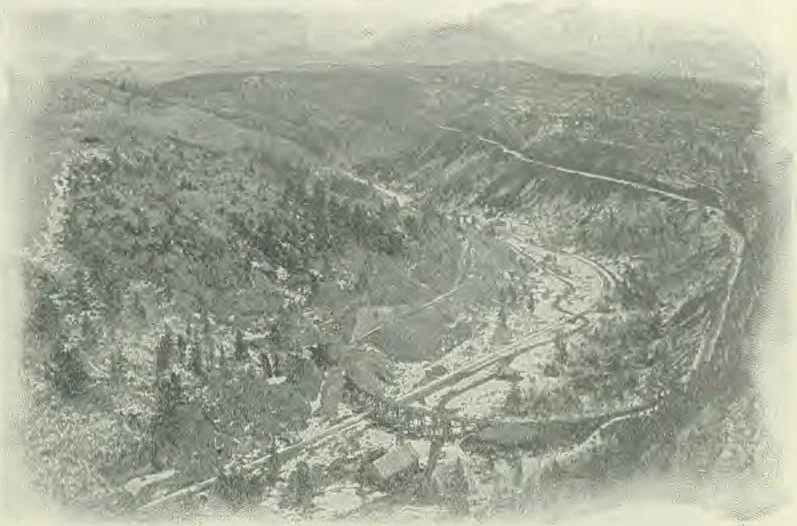
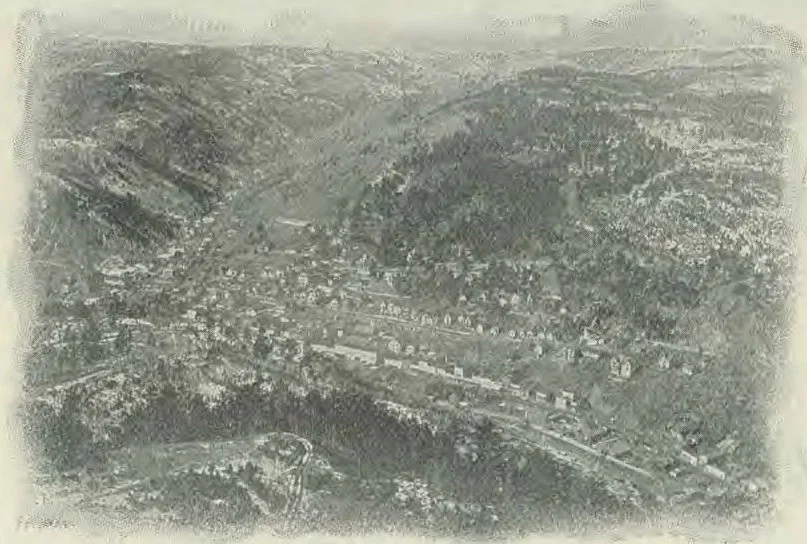
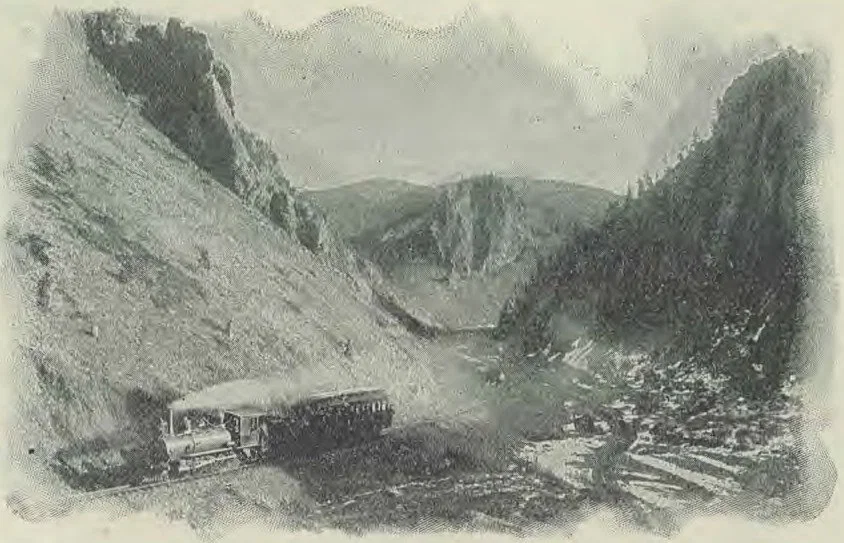
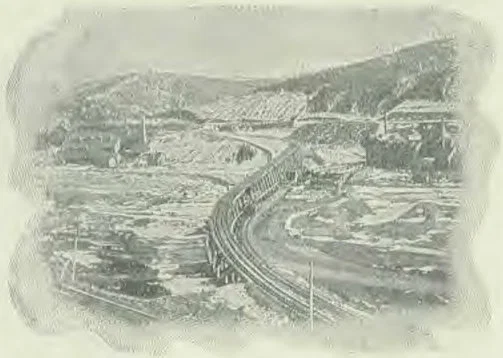
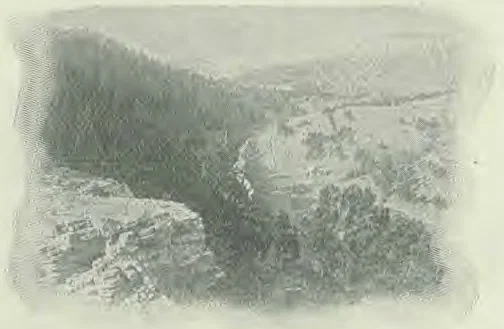
Leaving Hot Springs, South Dakota, in the morning, we go rushing up the valley, and are soon winding around the hills. As we proceed, they become higher and more rugged, and the scenery more wild and grand. Passing still farther on, the railroad runs between solid walls of stone, turning and twisting like a serpent, sometimes turning a curve as if disgusted with the hills, and determined to seek the open country; then, doubling again, it goes dashing down the canons, through several long, dark tunnels, over the brawling mountain streams, past the tall spruce- and pine-trees, with now and then a miner’s log cabin in sight. Soon we reach Deadwood, a town of about twelve thousand inhabitants.
DEADWOOD, S. DAK.
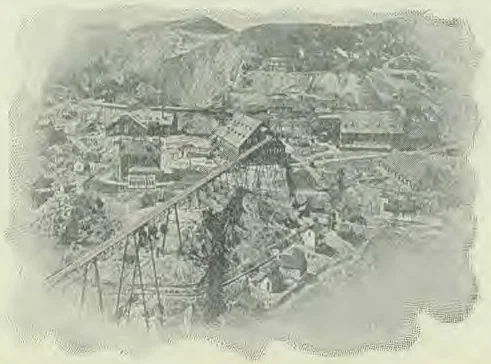
This is one of the centers of the gold-mining industry; here is located a great smelting-plant, where the ore is reduced. Lead City, four miles to the northwest, is in the free-milling belt. Here are situated the “Great Homestake” Mills. The town is nearly as large as Deadwood, and is built along the “gulch” and on the hillsides.
The hills are honeycombed with the shafts and tunnels with which man has pierced them in his eager search for the precious metal. Thousands of men are employed, working in shifts, day and night. Great buildings have been erected, and the best engines and machinery are used to hasten the work. Let us watch the operation for a little while. The men sink a shaft until they find the vein of ore, and then follow the vein, using huge timbers to keep the earth from caving in upon them. The ore683is so hard that it must be broken up with dynamite. It is then loaded on small cars, which run on a narrow track to the shaft, whence they are hoisted to the surface, run to the “crusher,” and emptied. As the ore is dumped from the cars in large lumps, the attendant forces them into the crusher, and in a few moments it breaks them into pieces about the size of hickory-nuts. In this form the ore drops through the crusher into small cars below, and is then run to the stamp-mill.
We will follow it. As we enter the huge building, we are almost deafened by the noise of the stamps, one hundred in number, which are reducing the ore to fine sand. The stamps are made of iron, and are about ten feet long, and four inches in diameter, with heavy steel heads fitted to the lower end; they are coupled on an eccentric in sets of ten each, and arranged so that no two of them will strike at once. The ore is run into hoppers, and fed to the stamps, in much the same way that wheat is fed to the rolls in flouring mills. A small stream of water constantly plays upon the ore under each stamp. This washes the sand from under the stamp as fast as the ore is reduced, and carries it over a screen and into a drain-box; here it is mixed with a preparation of quicksilver, which catches and holds the grains of gold, while the water carries off the sand.
DEADWOOD GULCH.
Twice a month the men “clean up;” that is, they gather the gold and quicksilver in balls, and put it through a process of heating that separates the quicksilver from the gold. The quicksilver is then used again as before, and the gold is sent East for refining, after which it is ready for coining or other purposes. This is called “free-milling” gold, as it is found in small nuggets, and grains like sand.
Gold is also found in the rock, but it must be reduced by heat and the aid of chemicals before it can be separated.
The Homestake Mills have been shut down but once in fifteen years, and then only for a short time, on account of fire. If the whole plant should stop at once, it would cost about fifteen hundred dollars to start it going again. Nearly two hundred thousand dollars’ worth of gold is taken out at each “clean up.”
New mines are being opened, and new facilities employed to hasten and cheapen the work. A mine has been found in this locality which has yielded over two thousand dollars a ton.
Many interesting and valuable lessons may be684learned in watching the different steps by which the rocks and hills are made to bring forth the precious metal for which men so freely risk life and limb; but among them all, this thought was impressed forcibly upon my mind: As men look upon those hills and examine the ores, they see a value in them that is not noticed by the casual observer. This makes them willing to toil, and suffer hardships, and the loss of property and friends, and even of life itself if they may obtain a share of the treasure. So God, as he looks upon his people, sees a value in them that is unseen by us.
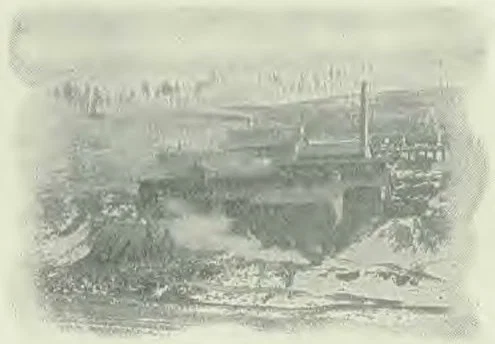
DEADWOOD CHLORINATION WORKS.
RED CANYON, HOT SPRINGS.
THE GREAT HOMESTAKE MINE, LEAD, S. DAK.
DEADWOOD & DELAWARE SMELTER.
Shall we not, then, as young Christians, submit ourselves to the Lord, let him sink the shaft of truth deep into our hearts, break our strong hearts with his love, wash us in the cleansing fountain of the blood of his dear Son, and burn away all the dross, that at last we may be permitted to shine in the kingdom of the Father?
J. W. BOYNTON.
A GREAT SINGER.
TRULY the lark is a great singer, and in many ways marvelously excels the most famous of human singers. Rev. J. G. Wood, the well-known naturalist, in a recent article entitled, “The Wonders of the Spring,” gives this interesting information regarding the lark as a singer:—
“The lark ascends until it looks no larger than a midge, and can with difficulty be seen by the unaided eye, yet every note will be clearly audible to persons who are fully half a mile from the nest over which the bird utters its song. Moreover, it never ceases to sing for a moment, a feat which seems wonderful to us human beings, who find that a song of six or seven minutes in length, though interspersed with rests and pauses, is more than trying. Even a practised public speaker, though he can pause at the end of each sentence, finds the applause of the audience a very welcome relief. Moreover, the singer and the speaker need to use no exertion save exercising their voices. Yet the bird will pour out a continuous song of nearly twenty minutes in length, and all the time has to support itself in the air by the constant use of its wings.”
The Habitually Gloomy Man
The habitually gloomy man is never wanted down in the valley land, and he is of no good on the hilltop; for there is no light in him wherever he is.
TAKE HEED HOW YOU HEAR.
By Ellen G. White
It is essential for the students of our schools to have a penetrating spirit in searching the word of God. You need, dear youth, to study most diligently, that you may understand the truths there revealed. You must bear in mind that your education is not a matter of merely human knowledge. Impressions must be made upon the mind and heart by the Spirit of God. The truth addresses itself to the heart and to the conscience. There must be a drawing nigh to the light of Christ, that you may catch his heavenly beams.
The truths for these times claim our especial attention; therefore take heed how you hear. You can not afford to be dull scholars in the study of the greatest and most important truths that have ever been presented to human understanding. The heart must be diligently guarded. When the precious opportunities presented to you in your school life end, you will be exposed to temptations from which you are now very largely excluded. Therefore a surface work in searching the Scriptures can be of no value to you.
Satan will put everything possible in operation to divert the mind, and occupy it with erring thoughts; but if your hearts are cleansed from all defilement, the word you hear will be mixed with faith. “Let us therefore fear, lest, a promise being left us of entering into his rest, any of you should seem to come short of it. For unto us was the gospel preached, as well as unto them: but the word preached did not profit them, not being mixed with faith in them that heard it.” “Let us labor therefore to enter into that rest, lest any man fall after the same example of unbelief. For the word of God is quick, and powerful, and sharper than any two-edged sword, piercing even to the dividing asunder of soul and spirit, and of the joints and marrow, and is a discerner of the thoughts and intents of the heart. Neither is there any creature that is not manifest in his sight: but all things are naked and opened unto the eyes of him with whom we have to do. Seeing then that we have a great high priest, that is passed into the heavens, Jesus the Son of God, let us hold fast our profession. For we have not an high priest which can not be touched with the feeling of our infirmities; but was in all points tempted like as we are, yet without sin. Let us therefore come boldly unto the throne of grace, that we may obtain mercy, and find grace to help in time of need.”
Students, you can not serve God, and yet retain your selfishness, your own ways, and your ambitious projects. Your ways must change, and God’s ways must become your choice. You must fall upon the Rock and be broken, or the Rock will fall upon you, and grind you to powder. Self can not have the supremacy. You have been bought with a price. Will you search diligently the word of God, to see if you are indeed receiving Christ? “As many as received him, to them gave he power to become the sons of God, even to them that believe on his name.” All who have this genuine faith will practise the works of Christ, will reveal his Spirit.
The Lord would have the students who attend our schools influenced by the truth that is kept before them. He would have them make a most diligent use of the light that shines from his word to them, and pursue no half-way course. Come out of self, away from self, and accept Jesus Christ. Be decided, be firm, be whole-hearted.686Life and death are before you. Which will you choose? This matter calls for prompt and decided action. There should be no delay; for on this question, delays are dangerous.
“The law of the Lord is perfect, converting the soul.” That law aims to convert mind and heart to correct principles of action. It will give reality to your works by making Christ your Redeemer, your stronghold. You will lay hold of his righteousness because he died to give you all the power and riches of his grace, that your practise might show your conversion. Believe in Jesus Christ as your complete Saviour. Change your way to God’s way. Choose the new path, the narrow path of holiness, which will lead to perfect freedom in Christ. You may follow the Lamb whithersoever he goeth.
As line upon line and precept upon precept of the divine Word are opened before you, take heed how you hear. If the principles of our faith are accepted, new impressions will be made, new lines of work will be seen in our practise. If we give to the searching of the Scriptures a divided heart, we shall receive superficial impressions, which will quickly pass away. If we listen to the Word without giving it entrance to the heart, we shall be classed among the forgetful hearers. Only he remembers to do God’s will who makes a decided confession of faith, showing to all that his faith is an active, working agency,—a faith that works by love and purifies the soul.
Students, take heed how you hear. The messages of God’s word will not return to him void. They are to each a savor of life unto life or of death unto death. After hearing the word, we are no longer in the same position before God as before the light came. If we receive the light, and act upon it, we shall understand the scripture: “I know thy works: behold, I have set before thee an open door, and no man can shut it: for thou hast a little strength, and hast kept my word, and hast not denied my name.”
There are those who will go forth from the place of opportunity and privilege, having heard to a purpose. Some eagerly gather up the precious gems of truth; and as they gather, their souls long for more. These will continually dig for the truth as for hidden treasure. They have anointed eyes to see, and sanctified ears to hear. They have not closed their eyes, lest they should see, nor their ears, lest they should hear. They have not barred the door of the heart, lest Jesus should find entrance. They have not stifled the conscience, nor prevented the work of the Holy Spirit upon the soul.
Now is the time when all should choose whom they will serve. You have been instructed abundantly in the truth: and if you now follow your own natural inclinations, it is because you reject light, and truth, and evidence. In refusing to be transformed and sanctified through the truth, you add to your past transgressions. After these opportunities and privileges, in having the truth kept before you day after day, after you have come in contact with truth and evidence and yet have made no change, your condemnation will stand written in the books of heaven. Your punishment will be just in proportion to the light you have slighted. How shall you escape if you neglect so great salvation? It would have been better for you to have been left in midnight darkness than to have had all the privileges and benefits you have received, and yet refuse to be obedient to the light given, refuse to be brought to the feet of Jesus to receive his pardon, and become witnesses for him. MRS. E. G. WHITE.
UPWARD I lift my wistful eyes
When burdens press me sore;
When griefs fill all my heart within,
With faith I wait before
The everlasting hills of God,
Whence cometh all my aid;
My help is from the Lord on high,
By whom all things were made.
He slumbers not, and never tires;
In love he shields me well;
With sleepless eye he watcheth o'er
The fold of Israel;
How tenderly he cares for me,
And foils the tempter bold!
The ransomed of his “little flock”
He guards as treasured gold.
The sun, though fierce with scorching rays,
By day shall smite me not;
The moon by night, in silver sheen,
Shall leave no taint nor spot.
The Lord of hosts my keeper is,
The Lord of hosts, my shade;
My hand he holds within his own —
How can I be dismayed?
From every evil me he keeps,
My soul he doth preserve;
My “going out” is known to him,
His care will never swerve;
My “coming in” he also knows,
And feeds me from his store;
His boundless love will follow me
Even forevermore.
— Geo. E. Pooler.
THE NOBLE IDEAL.
By Louis Albert Banks
Not only does the noble ideal reflect its glory on the person yielding it reverence, but it throws its romantic splendor over all common, prosaic things. Joaquin Miller, the Poet of the Sierras, once strolled through a miserable Mexican village. The shadows were creeping over the cabins where weary women came and went in silence, and ragged, lazy men sat smoking at the cabin doors, while children played in swarms by the water. The air was like a breath of God, and all nature seemed as sacred as rest to a tired man.
A black, bent, old negro woman, all patches from head to foot, frosty-headed and half-blind, came crooning forth with a broken crock tied together with a rawhide string, in which she had planted a flower to grow by her door. He stopped, watched her set it down and arrange it; and then, not wishing to stare rudely at the bent old creature, he said, “Good evening, auntie; it’s a pretty evening.” She slowly straightened up, looked at him, then looked away at the fading sunlight on the hills, and said, softly, “O, it’s a pretty world, massa!”
That old woman was a poetess—a prophetess. She had a soul to see the beauty, the poetry, about her. “O, it’s a pretty world, massa!” She had no other form of expression, but that was enough. Hers was the password to nature.—Louis Albert Banks.
LOVED BY THE JACK TARS.
By B.
The great are the loving. For this reason, Jesus of Nazareth was beyond all question the greatest being who ever mingled with men; for he so loved man that he gave his own precious life a ransom for many. As the Saviour’s surpassing love is what made him pre-eminently great, so also love—the true Christ-love—is the only thing that can ever make any human being truly great. Of just such greatness was John M. Wood a partaker during the later years of his life, after he had formed a personal acquaintance with the Lord Jesus. This earnest Christian worker died last month, and no doubt his death was more widely mourned by the Jack tars than has been that of any other New Yorker for many years; for through his love-inspired efforts, thousands of seamen have been brought to the ever-loving Lamb of God, “which taketh away the sins of the world.” Through his efforts, Christian Endeavor societies were organized on each war-ship of the White Squadron.
All INSTRUCTOR readers will be greatly interested in the account of Chaplain Wood’s wonderful experience, as told by the Christian Herald:—
“Mr. Wood came into the old Jerry McAuley Water Street Mission on Oct. 20, 1890. He was crazed with drink, and was on his way to East River to end his unhappy life. He had been in the United States navy for thirteen years, and had finally been discharged. Across his discharge papers these words were written: ‘Discharged for chronic alcoholism.’ He had been all around the world, wherever a war-vessel could stop, and had been ‘drunk in every seaport on the globe.’ He had been paid off, receiving four hundred dollars, and had come over to the Bowery on a wild debauch. Fortunately, his steps were directed to the mission. At the corner of the street he heard the notes of a gospel song issuing from the mission, and he remembered that his dear old mother used to sing the same strain when he was a happy boy:—
“‘There is a fountain filled with blood,
Drawn from Immanuel’s veins,
And sinners plunged beneath that flood,
Lose all their guilty stains.’”
“He came in and took a seat in the rear of the hall. When the invitation was given, he came tremblingly up to the ‘mercy-seat,’ and there he poured out his sorrows and obtained relief in salvation. Shortly afterward, Brother Wood went back to the navy-yard to tell the good news to his companions. He began to hold meetings on board the ships in the harbor. Subsequently, he received a call to become a chaplain in the navy-yard.
“Mr. Wood married an excellent Christian woman, who aided him greatly in his work at the navy-yard meetings. His wife and one child survive him. In one of his testimonies at the Water Street Mission, speaking of his first visit to the mission, he said: ‘It was the first time in twenty years I had been in the house of God; but as I listened to the wonderful testimonies of redeemed men, God’s love and mercy pierced my heart, and when the invitation was given to sinners, my trembling arm was uplifted, and then I met Jesus of Nazareth, who has been my guide ever since. The rags have disappeared, the chains that bound me have been broken, the remorse and awful thirst for liquor, and all the vile, sinful passions of my nature have been buried in the sea of God’s forgetfulness. I have not wanted a drink since that night, and there is not money enough in America to induce me to. I am bound to fight the accursed stuff that robbed me of a home of luxury and a son’s patrimony, driving my poor, gray-haired old mother in sorrow to the grave, and made me a homeless outcast, a bundle of rags and vermin, a bloated, sin-disfigured, human shipwreck.’”
May the perusal of this experience lead all our young readers ever to avoid the demon monster688of Mr. Wood’s early life’s deep sea of woe, King Alcohol; promptly to accept the gospel invitation, Come unto Me, and live, just as he did; and then faithfully to devote their lives wholly to the blessed Master, in loving service for those for whom he died.
B.
IN THE NAME OF THE LORD.
By Susan Coolidge
Who is this that cometh in the Lord’s dear name?
Wan and drooping on his road, very faint and lame;
Pale brow overshadowed, eyes all quenched and dim —
Is it Pain who cometh? Did the Lord send him?
Who is this that cometh in the Lord’s dear name?
Meeting never praises, only tears and blame;
Mourning veil to hide him, eyes which tears o’erbrim —
Is it Grief who cometh? Did the Lord send him?
Who is this that cometh in the Lord’s dear name?
In his strange and searching gaze burns a pallid flame;
Mournful flowers crown his head, terrible and grim —
Is it Death who cometh? Did the Lord send him?
Never messenger shall come if he be not sent;
We will welcome one and all, since the Lord so meant;
Welcome Pain or Grief or Death, saying, with glad acclaim:
“Blessed be all who come to us in the Lord’s dear name!”
— Susan Coolidge.
EVERY-DAY MARTYRS.
By Mrs. L. D. Avery-Stuttle
“Why! I thought the martyrs were all dead long ago. I supposed they were all burned at the stake, or tortured to death on the rack. I thought the Inquisition had made an end of them. ‘Every-day martyrs!’ I don’t believe I ever saw any.”
Don’t you? I assure you they are not all dead yet. I have seen many in my life.
When I was a child, my parents used frequently to entertain that kind old man, Elder Joseph Bates. How I used to anticipate his visits; for many were the wonderful stories with which he delighted my childish heart. He was always very kind to me, and sometimes when he was going to make a call on the neighbors, we would walk over the dewy country road together, hand in hand.
I remember once we were talking about the martyrs,—how they endured torture and cruel death for the sake of the truth they loved. O how brave I felt, as I hastened to assure the good old man that I, too, felt certain that I would willingly be burned at the stake rather than yield the precious faith which, even as a child, I dearly loved! The kind old man did not chide me for my enthusiasm, though I doubt not he thought how much easier it is to boast before entering the battle than afterward.689
As the years roll by, and I note my own liability to shrink from the least hardship for the sake of the Master, I often think of my childish expressions of loyalty to the cause of right. Are you, too, not apt to think that if you only had the opportunity, you would prove yourselves heroes? So, girls and boys, I know exactly how you feel at times; but it is just as I told you last week,—it takes more real courage to say “No,” and say it as if you meant it, than it does to fight a battle. The one demands physical courage; the other, something which is much rarer,—moral courage.
There are a great many martyrs in the world to-day. That patient invalid over the way, who suffers the tortures of nervous prostration, and yet is kind and forbearing with Johnny when he comes into the room with that ear-splitting whistle, forgetting that auntie is sick and baby is asleep, is a martyr. So is that lame old man who lives in the little shanty on Blank street. Why?—Because he endures patiently the rough joking of thoughtless boys and girls, though it pains his kind, sensitive heart more than they can know.
The other day I read of a poor woman who lives in Chicago. Day after day her husband would come home to her terribly intoxicated. Nothing but blows and cruelty awaited her. She had learned to shrink from his presence, who had once been a kind husband, and hide herself as her only protection. But O how kindly she treated him! How tenderly she pleaded with him to quit the deadly drink, which was so fast transforming him into a demon and his home into a forsaken plague-spot. At last he died,—a poor, bloated wretch. The world could see nothing good about him,—nothing to praise. Not so the faithful woman, who never forgot for one moment her promise to cling to him, though all others should forsake. She alone remembered only the good and forgot the evil. She thought only of the days when the sacred light of love shone in his eyes. She told the neighbors, over and over again, how good John had been to her, and carefully pulled the poor rags over her shoulders, lest they see the cruel marks where he had beaten her. In his life and in his death, she was the same,—patient, kind, forbearing, loving,—a martyr.
How many times we have read of the little boy whom his playmates tried to force to steal, and afterward to lie,—how they coaxed him, and ridiculed him, and threatened him, and tortured him, but all in vain. The little hero refused to do what he knew was wrong. Finally they held him under water. He was not afraid to die, but he was afraid to offend God. He was a hero—a martyr.
Where are the boys and girls who can brave ridicule and never flinch, who stand firm as a rock for principle, who will not even shrink from being cowards? Show me these boys and girls, and I will show you a group of heroes! Thank God, there are some of these heroes in the world yet.
But a real hero never boasts of his heroism; he is modest and unassuming. A real martyr is an unconscious one. Nobody could even imagine a vain, self-satisfied martyr, proud of his “amiability,” glorying in, and boastful of, his wonderful “meekness.”
The boys and girls who do right against all odds, because it is right; who humbly plod along day after day, whether they receive praise or blame, caring most of all for the approbation of God, will have that which is worth more than anything else,—a clear conscience and the smiles of Heaven. MRS. L. D. AVERY-STUTTLE.
HE STOPPED THE TRAIN.
TRAIN No. 20, on the Indianapolis and Vincennes Railroad, in charge of Conductor F. W. Russe, of Indianapolis, was tearing along toward Indianapolis the other evening at the rate of fifty miles an hour. The train was loaded with passengers, and was behind time. East of Edwardsport, Engineer Dorsey saw on the track far ahead a dog that was jumping about and acting in a peculiar manner. The dog’s actions looked suspicious, and, as a measure of caution, Dorsey shut off the steam, so as to have his train under control. When the train reached a nearer point, the dog stood and barked at it, and then, with a yelp, started for the woods.
Then it was that Dorsey saw that there was something red between the rails, and he threw on the emergency brakes and opened the sand-box. The train came to a standstill within ten feet of a pretty flaxen-haired baby in a red frock. The child was about two years old, and had been playing with the dog. The train crew ran forward, and baggageman Franklin picked up the child, which laughed and crowed and patted his face in glee.
About eight hundred yards distant was a farm-house, and toward it Franklin started with the baby, to meet a man running toward him like an insane person. It was the child’s father, who had missed the baby just as the train stopped, and supposed that the little one had been killed. How it got so far away from home and into such a dangerous place no one could understand.
The passengers were considerably jolted by the sudden stopping of the train, but no one was hurt; and when they learned the cause of it, they clustered about Engineer Dorsey, and congratulated him on his caution.—Philadelphia Times.
Overcoming the World and Its Anxiety
OVERCOMING the world implies overcoming a state of worldly anxiety. Worldly men are almost incessantly in a fever of anxiety lest their worldly schemes should fail. But the man who gets above the world gets above this state of ceaseless and corroding anxiety.—Selected.
SUMMER CLOUDS.
By Viola E. Smith
Across the tranquil summer sky,
Clouds, like white ships, drift slowly by;
All through the long, reposeful day,
They float, and never anchor weigh,
Nor ever enter port.
No sailor's loud, commanding word
From that fair fleet is ever heard;
No ripple seems to break the sleep
Of that aerial upper deep,
O'er which, serene, it glides.
I almost fancy it was sent
From some far haven of content,—
Some lovely, peace-begirdled isle,
Untouched by earthly sin or guile,
Whose people dwell secure;
That all the crews are angel bands,
Sent by the Father's own commands,
To watch above this world's dark night,
And sometimes, from that peaceful height,
Drop messages of cheer.
VIOLA E. SMITH.
LITTLE THINGS.
A GOOD-BY kiss is a little thing,
With your hand on the door to go;
But it takes the venom out of the sting
Of a thoughtless word or a cruel fling
That you made an hour ago.
A kiss of greeting is sweet and rare
After the toil of the day,
And it smoothes the furrows plowed by care,
The lines of the forehead you once called fair,
In the years that have flown away.
'T is a little thing to say, “You are kind,”
“I love you, my dear,” each night;
But it sends a thrill through the heart, I find,—
For love is tender, as love is blind,—
As we climb life's rugged height.
We starve each other for love's caress;
We take, but we do not give;
It seems so easy some soul to bless,
But we dole the love grudgingly, less and less,
Till 't is bitter and hard to live.
—Selected
THE CALLER.
She couldn't stay but a minute,
And she wouldn't sit down,—O, no!
But she kept our dinner waiting
A long half-hour or so.
—Chicago Record.