Not even the criminal comes to greater unhappiness in the end than the man whose thoughts and feelings are centered on self. Concentration of effort is praiseworthy, but when the object of effort is thus unworthy, the greater a man’s capacity, industry, and persistence, and the greater his success, the farther he is from attaining to that which is any real advantage to himself, or even to others. If by chance that which he accomplishes does prove profitable to the world, it is because of an overruling Providence, which will not permit such an abundance of its good gifts to be entirely wasted. This is well; for should such men succeed entirely, their success would result in the separation of themselves and all the fruits of their labors from their fellow men forever, and at length a few of these men would monopolize the earth, and control everything but its air, its sunshine, and its rain.
Perhaps our greatest and most prominent object-lesson in beneficent blessing to mankind is the sun. But the sun does not hoard its light and heat; it diffuses them for the benefit of all—the rich and the poor, the just and the unjust. Then by the strange working of that promise, “Give and it shall be given unto you,” etc., where the most is given, as from the sun, there the most is always found. A self-centered and miserly sun would be a sad curse to a universe; so everywhere a self-centered and selfish man is a blight to a community, and brings eventual destruction to himself and all within his influence.
M.
TOBACCO OR LIFE.
RECENTLY a minister of the gospel related an incident which made a deep impression on the mind of the writer. In the neighborhood where he had been, a prominent citizen, in the very prime of life, had died very suddenly, apparently of heart failure. Yes, it was heart failure, but the death of the man was no fault of his poor overburdened, overworked heart. The fact was that he had been an inveterate user of tobacco all his life, and had acquired what is known as “tobacco-heart.”
A short time after the man’s untimely death the clergyman had this conversation with a gentleman who had been the family physician of the deceased:—
“Were you surprised when you heard of his death?”
“Not at all. Several weeks ago he had a severe attack and experienced great difficulty in breathing. I was called, and made thorough examination, and found that he was suffering from ‘tobacco-heart.’ I asked him at once if he wanted to live. He assured me that he did. I then informed him that he must make an immediate choice between tobacco and his life. He agreed that possibly he had used too much tobacco, but he seemed unwilling to give up the filthy weed. The result was just as I predicted.”
Every boy and young man who is tempted to smoke his first cigarette or cigar should ponder well the lesson taught by this man’s life and untimely death. When thus tempted, the question is tobacco or life. To choose the former often means a shortened earthly career, and, as a rule, a failure to attain to the glorious life of the world eternal.
A PLACE TO AVOID.
By M.
THERE was a time when there was but one place in this world to be avoided,—the spot in Eden where grew the tree of the knowledge of good and evil, and scattered its fruit about. The experience which befell our first parents when they disobeyed God, sought the forbidden place, and ate the forbidden fruit, resulted in the distribution of evil and the establishment everywhere of places that should be avoided. In many cities almost every block contains places where the knowledge of good and evil may be had. But the knowledge of the good is obtained through the realization of its loss, and the undesirable ability to appreciate it only through comparison with sin and wickedness understood by sad experience. So every place where this kind of knowledge is to be gained should be avoided. No one needs to know evil, in order that he may understand the good by contrast. It is sufficient to know the good. If we know all the good in the world, we shall be sufficiently learned. Even the appearance of evil is to be avoided; so it is not too much to say that those places which only appear to be evil should be shunned, lest they should prove to be places where evil is taught. Then let young people avoid every place where a knowledge of evil may be gained. The more intimate is one’s acquaintance691with all things good, and the more ignorant of all things evil, the nearer he is to the happy condition in which Adam and Eve were before they gained a knowledge of evil. M.
Weighed and Wanting.
By B.
Many ambitious young men who offered themselves for service in the recent war with Spain were rejected because of physical unfitness. To them were the words, once addressed to Belshazzar, applicable: “Thou art weighed in the balances, and art found wanting.” During the excitement incident to the breaking out of the war, thousands of young men in our large cities applied for membership in the different military companies being organized, but only a small percentage were accepted. This sad condition of affairs is certainly an ill omen for the future of our country, and justifies the serious consideration of the question, What is the matter?
The trouble is that the average young man has very little, if any, appreciation of the sacredness of the soul-temple in which he lives; treats it most shamefully, through one excess or another; and gives scarcely any heed to the God-given laws of his own being. An exchange well states the case thus: “For some reason it is difficult for young people to be conscientious in the treatment of their bodies. The earnest student finds it alarmingly easy to sit up till the small hours over a puzzling problem in higher mathematics. The boy who is interested in athletics will strain his powers to the point of exhaustion, and never stop to think of the results of this overtaxing. Young folks who love pleasure will sometimes seek it with an immoderation which endangers their health and usefulness.”
Another writer, commenting on this subject, says:—
“I have heard of several young men who were rejected because they had the all too common ‘bicycle stoop.’ Others have been rejected because of overexercise in the gymnasium, producing permanent injury to the vital organs. Many young men are discovering that athletics may be a thing of evil when not tempered with wisdom. But this physical disability on the part of disappointed volunteers was not all due to overexercise on the bicycle or in the gymnasium or on the ball-ground. By far the greater part of the volunteers have been rejected because of physical disability caused by setting at naught the commonly accepted laws of health. Late hours, ungoverned desires, dissipation of all sorts, a lack of sobriety and moderation,—these are the causes of the low average of physical power among so many young men of to-day. It is certain that there must be a lack of moral force when there is so much physical disability caused by wrong living, and indeed this is the most sorrowful part of it all.”
If these young men were not qualified to become good soldiers, they certainly are not qualified to be good citizens and up-to-grade members of society. They must be classed as defectives—weighed and wanting.
Many young people, and some older ones as well, mistakenly think that they can violate the laws of health with impunity, if only they are engaged in some useful and noble work. Except under the most imperative urgency, no person has a right to rob his body of needed rest and sleep, however high his purpose, or however worthy the cause in which he may labor. The laws of nature, like all the laws of God, are inexorable, and are of universal application. He who disobeys them, whether ignorantly or wilfully, must, sooner or later, pay the penalty. The disobedient, one and all, will sometime be weighed in the balances, and be found wanting. B.
SILENT WITNESSES.
By M.
No one is ever all alone. He may think himself so, but he deceives himself. In the privacy of his own home, and without human companionship, he is surrounded by the walls of his room and the articles with which it is furnished. But these are inanimate objects, they do not hear, and they can not speak. But stop! Is it well to be so sure? You have seen a phonograph. It is an inanimate object. But can it not hear? and does it not speak? You can not be sure, then, that the four walls of your room, silent witnesses of your acts and words, have not the power to store up, like the cylinder of the phonograph, all that they hear, or receive the impression of all that they see, and repeat them all again, as the phonograph repeats your words, or the kinematograph makes a living picture of your movements. You do not know but that all God's created things are silent witnesses to him of your obedience or disobedience. May it not be that the time when they speak will be the time when those things that were supposed to be hidden will be shouted from the housetop? We shall do well to have respect for our silent witnesses. M.
THE JEWS’ WAILING-PLACE.
By B.
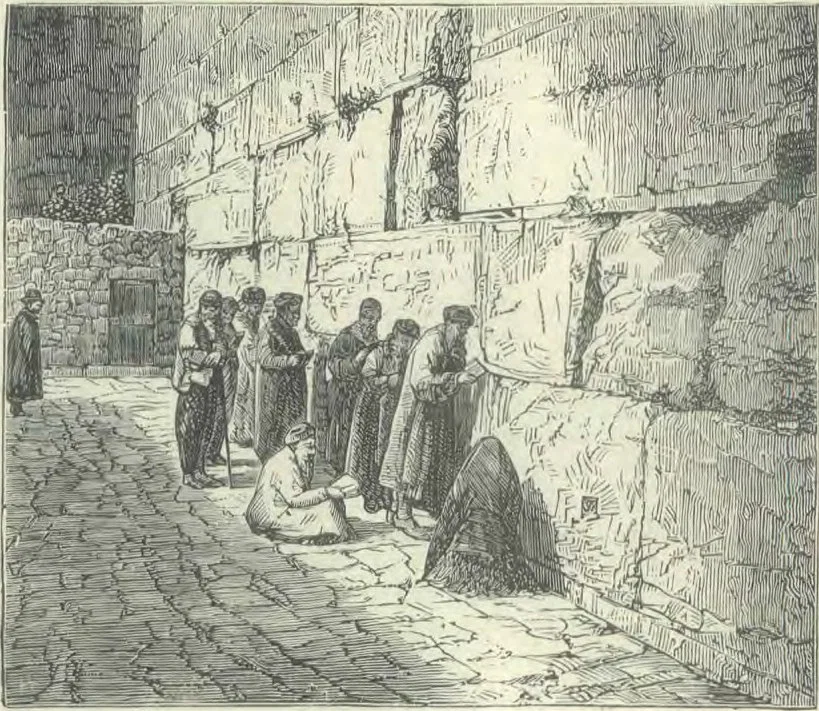
Without doubt one of the most melancholy spectacles to be seen anywhere in the world is that of the Jews at their wailing-place in Jerusalem, outside the Mosque of Omar, which stands on the site of Solomon’s temple. There they assemble every Friday to bemoan the desolation of Jerusalem, and to implore God for its early restoration. A letter from an American traveler who beheld this sad scene thus describes it: “In a narrow alley, surrounded by miserable houses; on stone flags, which have been worn by the bare feet of thousands of Jews; against a wall of great blocks of marble, which reached for fifty feet or more above them, a long line of men in long gowns, and of women with shawls over their heads, bowed, praying and weeping. Many of the men had white beards, and long, curly locks of silver. Others were in their prime; and I could not but wonder, when I saw the forms of these, at times almost convulsed with emotion. Each had a well-thumbed Hebrew Bible in his hand; and from time to time the party broke out into a kind of chant, an old, gray-haired man acting as leader, and the rest coming in on the refrain. The chant was in a strange tongue, but is translated as follows:—
“Leader.— ‘For the palace that lies desolate—’
“Response.— ‘We sit in solitude and mourn.’
“L.— ‘For the walls that are destroyed—’
“R.— ‘We sit in solitude and mourn.’
“L.— ‘For our majesty that is departed—’
“R.— ‘We sit in solitude and mourn.’
“L.— ‘For our great men who lie dead—’
“R.— ‘We sit in solitude and mourn.’
“L.— ‘For our priests who have stumbled—’
“R.— ‘We sit in solitude and mourn.’
“L.— ‘For our kings who have despised Him—’
“R.— ‘We sit in solitude and mourn.’
“The effect of this chant can not be appreciated without hearing it. The old men and weeping women, who kiss the stones of the wall that separates them from what was once the site of Solomon’s temple, and which is even now the holiest part of the earth to the Jews; the genuine feeling expressed by all; and the faith they show in thus coming here, week after week, and year after year, are wonderfully impressive. It is indeed one of the strange sights of this strangest of cities.”
Another writer thus describes what he saw and heard on a similar occasion:— “Being Friday afternoon, the time when many Jews assemble for prayer at the wall of the ancient temple, I joined their company. It was indeed a memorable sight. Here were Jews from among all nations, in their peculiar oriental costumes, some dressed in their tallith (praying-garments). As loud as they possibly could, they read the twenty-second psalm. Women cried aloud, with great earnestness, ‘My God, my God, why hast thou forsaken me? why art thou so far from helping me, and from the words of my roaring? O my God, I cry in the daytime, but thou hearest not; and in the night season, and am not silent.’ The men also were weeping and rehearsing psalms, litanies, and prayers. Most of these earnestly pressed their lips against the stones and kissed them. As I listened to their pathetic prayers, I remembered what the rabbis have said in the693Talmud,—that ‘since the destruction of the temple, the gates of prayer have been closed, and only the gates of tears are open.’
“The most touching wailing over Jerusalem is also to be witnessed in the homes of the pious Jews. At midnight they wrap themselves in their prayer-garments, put ashes on their heads, and prostrate themselves on the ground. Then, in melancholy terms, they rehearse:—
‘A voice of woe from Ramah’s hoary tower,
A voice of wail from Zion’s sainted hill;
Alas! my diadem and queenly dower,
The youthful honors I remember still.
Dark is to me the solitary bower
Who did of old a throne of splendor fill.
‘I was surnamed Jehovah’s fairest bride;
But now am forced, forlorn, disconsolate,
His heavy wrath and vengeance to abide;
My joys are flown, my heart is desolate.
Come, weep, ye daughters, at my faltering side;
For none draws near my sorrows to abate.
‘Degraded from a peerless eminence,
Victim of pride and wanton vanity,
My beating heart, in trembling violence,
Strikes at her cage of hopeless misery
Judah laments in tearful penitence,
A widow mourning in captivity.
‘I was in Solyma a radiant queen;
A golden cloud was I, the mount of God;
But now by infidels despoiled, I ween
No poorer pilgrim o’er the desert trod.
Wrenched from the bosom all my babes have been;
The elders, murdered, steeped the soil in blood.
‘Doth no one lay my wretchedness to heart?
And no one check the swiftly rolling tear?
And no one soothe the soul-empiercing smart?
And no one say, “The heathen shall not dare
Call him my husband?” O, the poisoned dart,
The cruel mockings I am bound to bear!
‘Father of mercies, come! return with grace
To Zion’s dwelling, beautified again;
Let Israel’s eye behold thy dwelling-place
Restored; then list the hallelujah’s strain,
The hymning voices of a ransomed race,
Greeting the rising wall of that eternal fane.’
“After this several psalms are read, and prayers offered. When rising from the ground, they say, ‘Shake thyself from the dust; arise, and sit down, O Jerusalem: loose thyself from the bands of thy neck, O captive daughter of Zion.’
“A remarkable prayer offered on these occasions, and having reference no doubt to Isa. 7:14, is as follows:—
‘In mercy, Lord, thy people’s prayer attend:
Grant his desire to mourning Israel,
O shield of Abraham! our Redeemer send,
And call his glorious name Immanuel.’
B.
OUT OF CHAOS.
By Sarah M. I. Henry
Chapter XII.
THE next morning, when Joe came, Aunt Lizbeth went, armed with brushes, cloths, a big apron, a pail, scouring-soap, a basket of lunch, and some loose change in her pocket.
“I’ve left things all set out,” she said as she passed the wheel-chair, “where you ’n’ Joe can help yourselves to enough so you won’t starve.”
“I’ll get along most any way,” said Uncle Zeph. “Going to make atonement, Lizbeth?”
“I’m going to make my peace with God,” she almost snapped. “I could hardly wait for mornin’, to say nothin’ of Joe. I never left you this way before, Zeph, but—”694
“It’s all right, dearie; you run on, ’n’ never mind me. I’ll have to wait till the morning that’s coming by and by, or I’d get up and go with you. The best that I can do, and the most, too, for that matter, is to sit still and get along with little Joe. Good-by, and the good angels go with you.”
“I doubt if they go with me; but I expect to find some waitin’ when I git there, and maybe some little one will be let to come home with me.”
It was a long morning. Uncle Zeph gave Joe a reading and spelling lesson out of the Bible, set him a copy for a writing lesson on the same old slate that he had used when a boy, and that John had scribbled all over and sponged off many a time; then they both fell asleep, and might have slept on if they had not been awakened by John’s merry whistle as he leaped the fence, and came noisily into the little enclosure.
“Well, well, here you are!” cried Uncle Zeph, gaily, “with your face like the morning,—as the ‘light of the morning, when the sun riseth, even a morning without clouds; as the tender grass springing out of the earth by clear shining after rain.”
“Where did you find that? You must have been dreaming of Him, I should think,” said John.
“You brought it to mind, my boy, and it means you, just as it meant him when it was first spoken. You know that every word that was ever spoken about Jesus means you, too, if you really follow, and are in the world just as he was. You’ll carry the same light in your face, the same cross on your back, and keep the same Satan under your feet, and have a taste of the same bitter and sweet all the way.
“I was dreaming, though, of you and Him. I remember it now; I thought you were both carpenters, at work at the same bench, you on one side and he on the other, so that every move you made with the planes (you were planing boards) was toward each other; and every time either of you looked up, you saw each other, and then you both smiled; and sometimes when one dropped his plane for a minute, the other picked it up and used it, so that you kept changing tools, and worked just as if one was the other, and you were both one. I can’t express it as I see it, but it was beautiful, and, O my boy,” reaching out and taking him by his hands, “I can’t tell you how glad I am!”
“And I can’t tell you how glad I am, Uncle Zeph. I ran over to tell you what seems too wonderful to be true; but it is all just as true and real as it can be. I’ll have to tell it quick; for I’m in a hurry. Aunt Lizbeth wanted to make sure that you didn’t need anything. Do you? Does Joe do?”
“Yes, yes; Joe does fine; I don’t need a thing; but what has happened?”
“Well, Uncle Zeph, we’re out!”
“Out?—out?—What do you mean?”
“Why, don’t you know?—Chaos,—what else should we be out of, but what we were in, clear up to our necks?”
“Out—of—chaos—you? so quick? How could that happen?”
“Why, I suppose just as it did in the first place, when the Spirit moved, and God spoke light. It didn’t take very long then, did it, Uncle Zeph?”
“No—o, but—that was—”
“The great big earth, and such darkness as never was, and all of God thrown in,” interrupted John. “You seem surprised, Uncle Zeph, and I don’t wonder. I should, if I hadn’t been right in it, and been a part of it. I don’t suppose chaos was surprised any to have to get out of the way when light came, nor that the earth was surprised to get out of it,—for it had never known anything else,—but I suppose the angels that were looking on were. You are the one looking on, you see. But I’ll just tell you quick what happened.”
MRS. S. M. I. HENRY.
(Concluded next week.)
AT THE SET OF THE SUN.
At the set of the sun,
When our work is done,
With all its tangled web;
When the clouds drift low,
And the stream runs slow,
And life is at its ebb;
As we near the goal
Where the golden bowl
Shall be broken at its fount,—
With what sweetest thought
Shall the hour be fraught,
What most precious shall we count?
Not the flame of the sword,
Nor the wealth we have stored
In perishable things of earth;
Not the way we have trod
With the intellect broad,
Though that were of precious worth;
Nor the gain we achieved
Through the hearts we have grieved,
And left unhelped by the way;
Nor the laurel of fame,
When, for worldly acclaim,
We toiled in the heat and the fray.
Ah, no! ’tis not these
Will give our hearts ease
When life sinks low in the west;
But the passing sweet thought
Of the good we have wrought,
The saddened lives we have blessed;
And the love we have won,
And the love beckoning on
From his islands far and dim,—
Love out of the light,
Shining into the night,—
The night which leadeth to Him.
— Boston Transcript.
Every Calling Can Be a Divine Vocation
By Arthur T. Pierson
We can serve God acceptably in any sphere; every calling may be made a divine vocation. The great mistake of many is that they feel they must leave the carpenter’s plane, give up the trowel, and enter some learned profession. God says, “What is that in thine hand?” In Moses’ hand was the shepherd’s crook, in Solomon’s the scepter, in David’s the sling or the harp, and in Dorcas’s the needle. The Bible is God’s tool-chest. It contains every kind of tool. The word of God is adapted to every purpose.— Arthur T. Pierson.
He Fails Not Who Makes Truth His Cause
By Richard Watson Gilder
He fails not who makes truth his cause,
Nor bends to win the crowd’s applause;
He fails not — he who stakes his all
Upon the right, and dares to fall.
— Richard Watson Gilder.
Providence and Bereavement: A Selected Reflection
The man who feels that it is the providence of God when some one else's dear ones are taken away, and God's cruelty and injustice when his own are taken, has not learned the first letter of religion.—Selected.
WATER ANIMALS.
By M. E. Cady
WE will now study that class of animals known as “Mollusca.” These creatures usually have a soft body, protected by a shell. We have all heard of the oyster, the clam, and the fresh-water mussel, and probably most of us have seen them. They have two shell-covers, called “valves,” which are fastened together on the back of the animal by a hinge. When seeking for food, they open the shell, and gather in their food with a long foot-like arrangement. They also use this foot in pushing their bodies along. In time of danger they close their shell-doors with strong muscles attached to the inner surface. These muscles are so powerful that all the strength of a strong man is often required to open the shell.
SNAIL.
OCTOPUS.
Clams, oysters, and other similar animals are often called “headless animals.” They have no head, but consist of a mass of soft, jelly-like material, enclosed in a shell-box, which prevents the body from getting away. While the animals just described have two shell-covers, fastened together by a hinge, many have but a single shell, often spiral-shaped. Those that have two shells are called “bivalves,” and those having but one are called “univalves.”
The shells of the mollusca are composed of limestone. No doubt many of you have seen limestone along small streams or on the shore of some lake, that was filled with the fossilized shells of the common clam. The oyster is a salt-water creature, while clams and mussels live in fresh water.
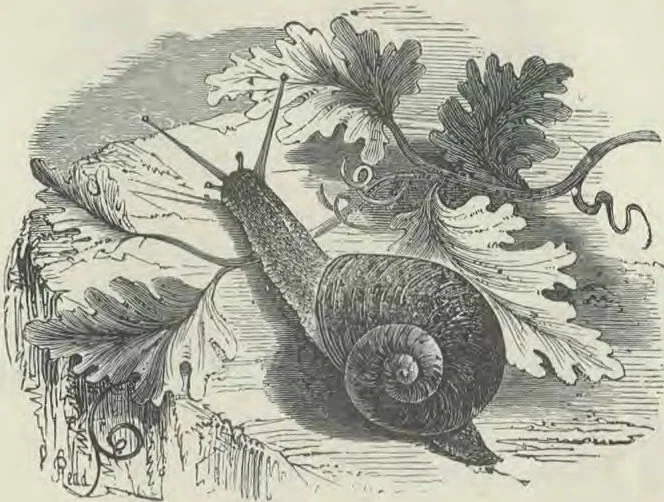
The snail is a mollusk also, but it has a head, with little horns, or feelers, on it. If you touch the feelers, the snail immediately draws itself back into its house. Snails live on land as well as in the water. Probably you have seen them crawling around on old logs and stumps, which were more or less damp. They have no feet, yet they are able to crawl slowly about. They are slow, but sure. We can learn from the snail a lesson in perseverance.
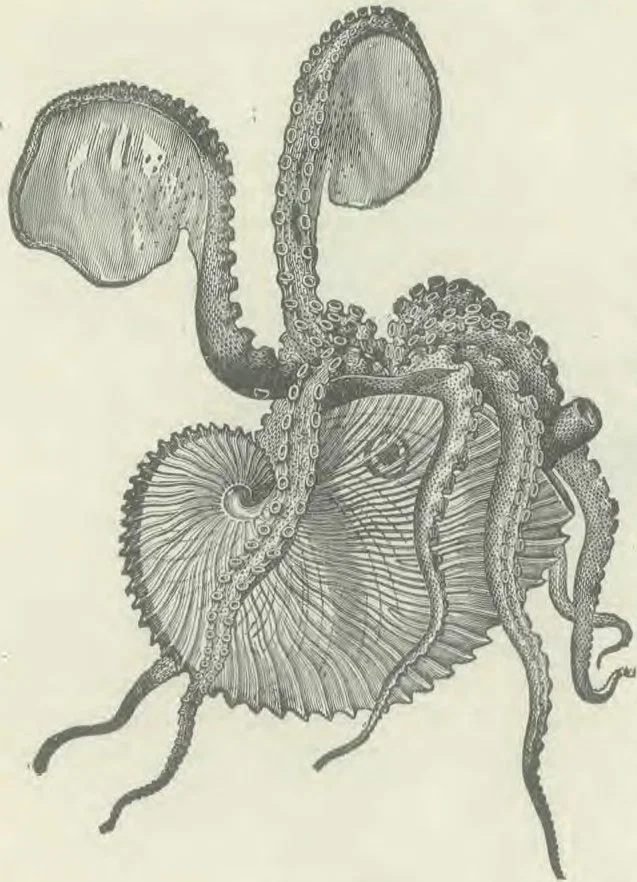
The nautilus, also a mollusk, has head and feet, which it projects from the shell when traveling or seeking food; but while resting, or in time of danger, the body is drawn into the shell-house. These soft-bodied animals are well protected by the shell which envelops their bodies.
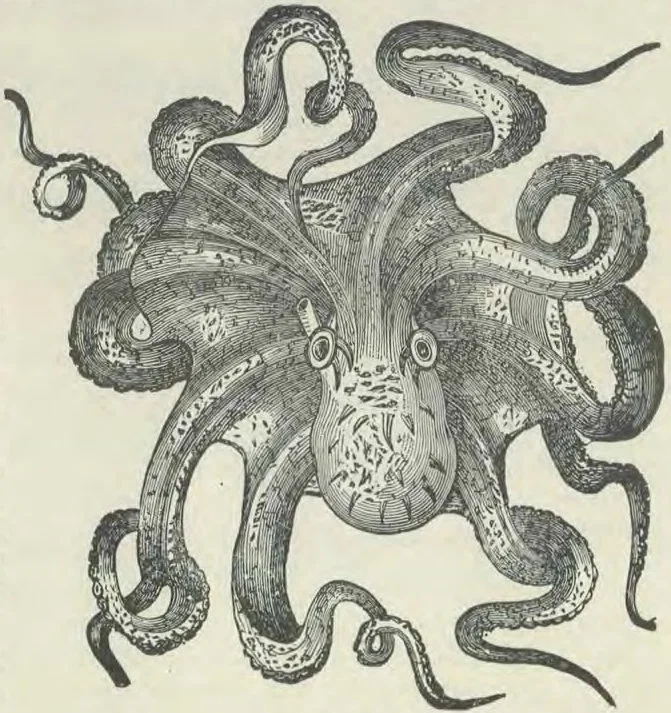
The octopus, as its name implies, is an eight-footed mollusk. Its near relatives are the cuttle-fish and squid. All these have soft bodies, and are provided with head and feet, but have no protecting shell. Their bodies being soft, they make a desirable meal for the shark or the whale; but the Creator has not left them without a means of self-defense. Just as a whale or696a shark is about to seize an octopus, expecting a delightful meal, behold! it is utter darkness all about him. What has happened? The octopus has discharged his ink from the ink-bag which he always carries with him. This has so blackened the water that his enemy is not able to see, and this gives the octopus an opportunity to escape. This ink, mixed with water, can be used in writing. M. E. CADY.
NAUTILUS.
PHYSICAL CULTURE.
By Lottie Nelson
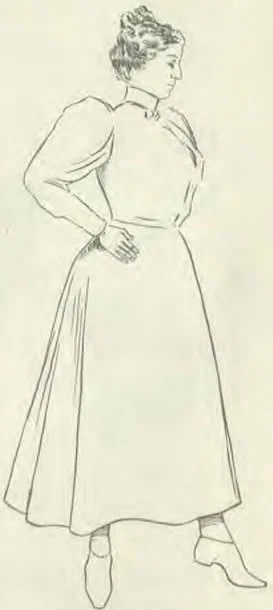
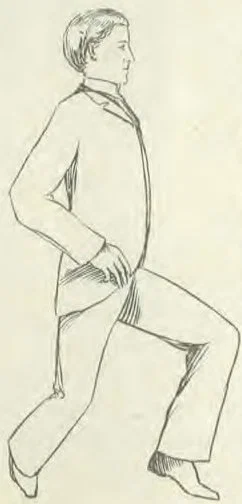
WE will now turn our attention to movements of the feet, as nothing has been said, so far, about this class of movements, and we desire a systematic development of all the muscles of the body.
A graceful carriage of the body is something we all instinctively admire; and a light, springing step is something all should cultivate. Considered alone from the standpoint of health, the whole body becomes electrified, so to speak, by taking a brisk walk, with a light, buoyant step; while, on the other hand, a person who walks with a slow, lagging gait, experiences only fatigue. In order to walk properly, the toe should always be turned outward, and the weight of the body borne on the ball of the foot.
A very pretty exercise for class drill is a stepping movement, taken in the following manner: With the position “hips-firm,” place the left foot diagonally forward, turning the toe outward, and only touching the ball of the foot to the floor. Take the movement with two counts, coming back to position on “two.” Repeat the movement several times with the left foot, then with the right, taking care to turn the toe out, and not to strike the heel on the floor at any time. Following this, take heel raising with four counts. On “one” place the left foot diagonally forward; on “two” raise high on toes of both feet; on “three” heels sink; and on “four” return to position. Repeat this movement several times with the left foot forward, then the right; then alternate.697
Again we will take heel raising with “deep-knee bend,” taken with six counts. With hips firm, keep the body erect. On “one” place the left foot forward; on “two” raise heels; on “three” bend both knees strongly; and bring back to position high on toes on the fourth count. On “five,” heels sink; and on “six” bring the foot back to position. Take care not to bend the body forward in the least as you bend the knees. This is a very good exercise for the muscles of the lower limbs. MRS. LOTTIE NELSON.
THE HUMBLEBEE.
By Ralph Waldo Emerson
BURLY, dozing humblebee!
Thou in sunny solitude,
Rover of the underwoods,
The green silence dost displace,
With thy mellow, breezy bass.
Hot midsummer’s petted drone,
Sweet to me thy drowsy tone
Tells of countless sunny hours,
Long days, and solid banks of flowers.
— Emerson.
Aspiring to Goodness Rather Than Greatness
THERE would be more truly great men in the world if more would aspire to goodness rather than greatness.