The Youth’s Instructor, Vol. 48, No. 19.

THE TIME OF THE SINGING OF BIRDS

The Youth’s Instructor

May 10, 1900

Review and Herald Publishing Company · Battle Creek, Mich. · May 10, 1900

"THE TIME OF THE SINGING OF BIRDS"

Once more we delight in days sweetened with the perfume of violets and lilies of the valley and filled with the music of bird songs. “For, lo, the winter is past; the rain is over and gone; the flowers appear on the earth; the time of the singing of birds is come, and the voice of the dove is heard in our land.” The awakening of the brown earth into life and beauty at this season brings to the thoughtful mind remembrances of bygone springtimes—and surely memory holds no fairer pictures.
I remember an evening in April long ago. The fragrance of blossoming orchards stirred through the twilight falling gently over the gray old homestead. The garden walks were just touched with green, and as I wandered down a shaded path, a fragrant, blossom-laden apple bough brushed my head. Down by the old stile in the roadside hedge, where the honeysuckle arched over, I paused. A startled rabbit scampered away in the twilight, and plunged into a tangle of bloom; a plum tree sprinkled snowy fragrance on my head; while near at hand the pink sea of a peach orchard slept as calmly as if the winds of spring had never tossed it into waves of bloom, and scattered its pink foam beneath the spreading branches.
Again: I lingered in the shadow of a few grand old pines, that gently stirred against the evening sky. What delight there was in that exquisite hour of that exquisite season! The evening was a poet’s evening, the hour a poet’s hour, fit to inspire a dull day-laborer to immortal song,— an hour to make the hardened criminal look through his prison bars, and long for his lost purity,—an hour to make even the veriest infidel bow in awe and reverence before the glory of the word and works of God.
MINNIE ROSILLA STEVENS.

BEAUTIES OF SOUTHERN CALIFORNIA

IV
THERE is no monotony in the scenery of Southern California. Looking in any direction but coastward, one sees “hills peep o’er hills, and Alps on Alps arise.” First the green carpeted elevations in the valley are seen; then the foothills, dotted with orchards and vineyards; beyond these are higher hills, bearing the sturdy oak; and in the background rise the granite cliffs of the Sierra Madre and San Bernardino mountains , whose giant pines appear as underbrush, or whose snow-capped peaks look like fleecy clouds. Mt. Lowe, Mt. Wilson, Markham’s Peak, and Mt. San Gabriel stand side by side to the northeast, while still farther eastward tower the giants of the range,—San Jacinto, San Gorgonio, and San Antonio, familiarly known as “Old Baldy.” To the inexperienced observer the mountains look like great barren hills: but on nearing them the verdure appears; and what from a distance seemed but grim shadows, open into deep, precipitous canons. From the ravines gush the cool mountain streams, which ripple down the gorges until lost to sight.
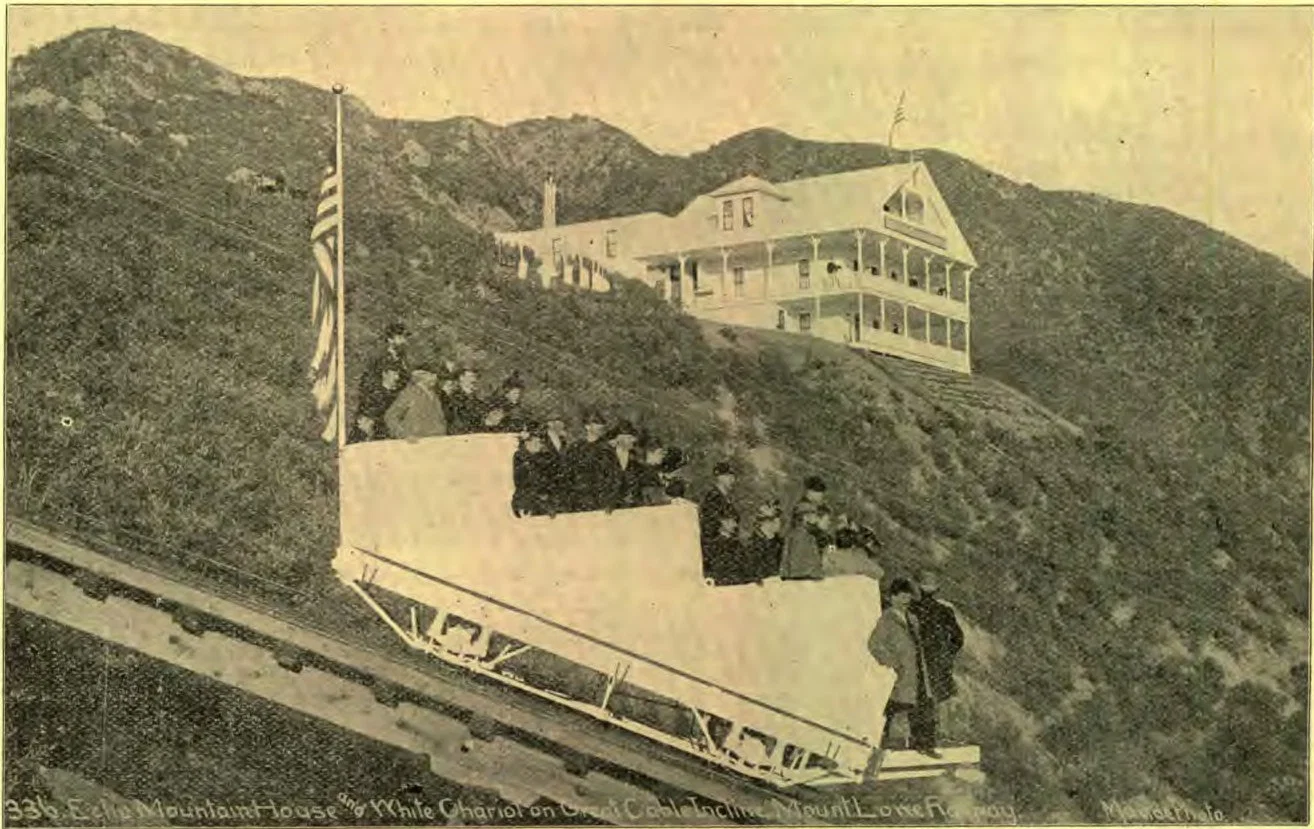
A remarkable engineering feat was the construction of the cable and electric road that winds its way up the Sierra Madre range into the pine forests at an elevation of five thousand feet. On a winter’s day one may leave Altadena fresh with the bloom of roses, and in less than an hour be roaming in snow-covered pine forests.
As I write, I hear the buzz of the electric cars loaded with merry excursionists for the summit. The circular reads, “From Pasadena to Rubio Cañon, Echo Mountain, Ye Alpine Tavern, including all points on Mt. Lowe railway, and return the same day.” Let us, in fancy, join them. We take the electric car at Pasadena, and enjoy a lovely spin, through fragrant orange groves and peach orchards in full bloom, to Altadena; here we change cars, and continue our ride, past grain fields and through acres of California poppies, to Rubio Cañon, where the great inclined railway begins. Shall we take that car with no conductor nor gripman, when directly above us we see another ready to descend on the same track? But the car is waiting; so, gaining courage from those less timid, we are soon seated, and moving slowly up a sixty-two-per-cent grade,—sixty-two feet up in the air for every hundred feet forward. I hear one whisper, “Are you frightened?” another, “It seems so sultry;” while others, enraptured with the view before them, are quite unconscious of the change in the atmosphere. Half-way up we reach a switch, and the descending car side-tracks, politely giving us the right of way.
As we reach Echo Mountain, we look about to see where we are; for it seems like a dream. Below is the fertile San Gabriel Valley; nestling among the trees we spy Pasadena; farther away is Los Angeles; and still farther, where sea and sky meet, are the islands, apparently almost submerged. Echo Mountain House, a familiar waymark, was burned only a few weeks ago, and preparations are now being made to replace it. We stop only a moment at the ruins, for again our car awaits us. This time we take the electric car, which winds out past the Observatory, around the Circular Bridge, up to a sylvan nook; and there, among the pine trees of this elevated forest, is Ye Alpine Tavern, with doors wide open to welcome us. Glancing above the large colonial fireplace that faces us as we enter, we hesitate a moment as we read the motto, “Ye Ornaments of a House are Ye Guests Who Frequent It,” lest there be some exceptions. Reluctantly we leave; but we must make our way to the summit on burros, and return to meet the home-bound car. On the heights we remain but a short time to bid “Old Sol” good night as he sinks out of sight in the wide ocean. As we return, all is wrapped in darkness, broken only by the myriad electric lights below, which seem but the reflection of the starry heavens above. Even in imagination the trip has been a pleasant one.
MRS. KATHLEEN WAGNER-GILMORE.

ALPHABETIC SCRIPTURES

Ask, and it shall be given you. Matt. 7:7.
Be not overcome of evil. Rom. 12:21.
Come unto me, all ye that labor and are heavy laden, and I will give you rest. Matt. 11:28.
Dearly beloved, avenge not yourselves, but rather give place unto wrath. Rom. 12:19.
Except a man be born again, he can not see the kingdom of God. John 3:3.
Fear God, and keep his commandments. Eccl. 12:13.
God is a Spirit: and they that worship him must worship him in spirit and in truth. John 4:24.
Herein is love, not that we loved God, but that he loved us. 1 John 4:10.
If it be possible, as much as lieth in you, live peaceably with all men. Rom. 12:18.
Jesus said unto them, I am the bread of life. John 6:35.
Keep thy heart with all diligence; for out of it are the issues of life. Prov. 4:23.
Let not your heart be troubled: ye believe in God, believe also in me. John 14:1.
My tongue shall speak thy word. Ps. 119:172.
Now ye are clean through the word which I have spoken unto you. John 15:3.
Open thou mine eyes, that I may behold wondrous things out of thy law. Ps. 119:18.
Peace I leave with you. My peace I give unto you. John 14:27.
Quicken me after thy loving kindness. Ps. 119:88.
Rejoice in the Lord, ye righteous. Ps. 97:12.
Serve the Lord with gladness. Ps. 100:2.
The works of the Lord are great. Ps. 111:2.
Unless the Lord had been my help, my soul had almost dwelt in silence. Ps. 94:17.
Vow, and pay unto the Lord your God. Ps. 76:11.
Whoso mocketh the poor reproacheth his Maker. Prov. 17:5.
Exalt the Lord our God. Ps. 99:9.
Ye that love the Lord, hate evil. Ps. 97:10.
Zion heard, and was glad. Ps. 97:8.
ARRANGED BY EVA F. DICKSON,
Aged thirteen years.

THE STUDENT’S PRIVILEGES AND RESPONSIBILITIES

II
We must put to the stretch every spiritual nerve and muscle if we would stand as Daniel stood. God spoke of Daniel as a man greatly beloved. Would we not rejoice if this could be said of us? Strive, then, to be like Daniel, affable, kind, and forbearing. Show your love for those who are striving to help you form right characters. Do all you can to help yourselves, that your intelligence may reach the highest point of excellence. God does not desire you to remain novices. He needs in his work everything that you can gain here in the lines of mental culture and clear discernment. He desires to have you reach the very highest round of the ladder, and then step off it into the kingdom of God.
The Lord desires you to understand the position you occupy as sons and daughters of the Most High, children of the heavenly King. He longs to have you live in close connection with him, so that your words may educate those around you. Cut away from everything frivolous. Do not think that you must indulge in this pleasure and that pleasure. Determine that you will be on the Lord’s side from the beginning of the term till its close. If you will stand under the blood-stained banner of Prince Immanuel, faithfully doing his service, you will never yield to temptation; for One will stand by your side who is able to keep you from falling. But God can not do this work for you unless you give him all the powers of heart and mind. Angels are watching the development of character in the school. God is weighing moral worth. He longs to see every mind used aright. He has given you the precious talent of reason, and he calls upon you to use it in the right way. He desires you to feel that you can and will acquire greater and still greater strength.
Take heed to yourselves, lest you lead others astray. If by your course of action, others are turned aside from the right way, this is recorded against you in the books of heaven. We have one great object before us—the salvation of souls. Christ left the royal courts, and came to this earth in human flesh, to show us that we may co-operate with him to save souls. After he has made this great sacrifice for us, should we deem any sacrifice too great to keep our passions, our inherited and cultivated tendencies to wrong, under control?
We are living amid the perils of the last days, and we need to receive an education as missionaries. Let each student make up his mind that he will not stand in the army of the enemy. We are working for time and for eternity, and we expect to receive light and grace from the Lord. Strive to reach all that it is possible for you to reach with the blessing of God. When you have such a helper, when angels of God are watching your every movement, when all heaven is interested in your welfare, will you not do all in your power to help yourselves? Pray for yourselves. Take firm hold of the arm of divine power, determining, as did Daniel, not to swerve from any duty. Harness your habits. Put on the bit and bridle. Use all your intelligence in God’s service.
“If ye then be risen with Christ,” the apostle writes, “seek those things which are above, where Christ sitteth on the right hand of God. Set your affection on things above, not on things on the earth. For ye are dead, and your life is hid with Christ in God. When Christ, who is our life, shall appear, then shall ye also appear with him in glory. . . . And above all these things put on charity, which is the bond of perfectness. And let the peace of God rule in your hearts. . . . Let the word of Christ dwell in you richly in all wisdom; . . . and whatsoever ye do in word or deed, do all in the name of the Lord Jesus, giving thanks to God and the Father by him.”
MRS. E. G. WHITE.

BEHOLDING THE WORKS

“Let your light so shine before men, that they may see your good works, and glorify your Father which is in heaven.”
We are known by our works. Our works constitute our light. “Let your light so shine” is equivalent to saying, “Let your works so shine.” Our works outlast our lives. You will also notice that the attention of men is directed to the works, rather than to the person: the individual is in a measure lost sight of by those who behold his works.
This is a valuable point in greatness and humility. Great men are truly humble men. They have some noble purpose ahead, and lose sight of themselves in the working out of that purpose. Not to do some great thing to get a great name, but to keep filling the life record with good deeds, is their object, because good deeds possess the seed of true greatness in themselves. Eternity is given for the purpose of permitting these good seeds of right-doing to grow in the lives of others. Jesus went about “doing good;” and God raised him to life so he could continue “doing good.”
Notice, it is the works we do that are seen by others,—not the things we plan to do, or the many things begun, but never finished. “All thy works shall praise thee, O Lord.” His works are perfect, and finished. “Well done,” is said to those who have done something,—begun it well, and finished it.
We are exhorted to turn all our works over to the Lord. “Commit thy works unto the Lord, and thy thoughts shall be established.” God will examine them. He says, “I know thy works.” Again, of some he says, “Be watchful, and strengthen the things which remain . . . for I have not found thy works perfect before God.”
The importance of what we do, how we do it, and the motive actuating us in the doing of it, not only determines our usefulness in this life, but it also determines our eternal destiny. “For we must all appear before the judgment seat of Christ; that every one may receive the things done in his body, according to that he hath done, whether it be good or bad.” What is the character of the works that others behold in your life? T. E. BOWEN.

ONE DAY AT A TIME

One day at a time! That's all it can be; No faster than that is the hardest fate; And days have their limits, however we Begin them too early and stretch them too late. One day at a time! 'T is a wholesome rhyme, A good one to live by— A day at a time.
One day at a time! Every heart that aches Knows only too well how long that can seem; But 't is never to-day which the spirit breaks: 'T is the darkened future without a gleam. One day at a time! 'T is a wholesome rhyme, A good one to live by— A day at a time.
One day at a time! When joy's at its height,— Such joy as the heart can never forget,— And pulses are throbbing with wild delight, How hard to remember that suns must set! One day at a time! 'T is a wholesome rhyme, A good one to live by— A day at a time.
One day at a time—but a single day, Whatever its load, whatever its length; And there's a bit of precious Scripture to say, That according to each shall be our strength. One day at a time! 'T is a wholesome rhyme, A good one to live by— A day at a time.
—Helen Hunt Jackson.

TENDERNESS WINS

It is useless to try to tell people that God loves them, unless we show them that we love them. “No one,” says an exchange, “thinks of defending himself on the side of tenderness, for the assault is almost never made there. This is our postern gate, and we may drive in and take the fort.”
“‘Will you send these goods up to-day?’ asked a lady of a shopgirl of whom she had made some purchases, and whose spiritual history she well knew.
“‘Yes, ma’am.’
“‘Are you sure, my dear, that you will not wear them out first?’
“‘Why, what do you mean, madam? You do not know this house when you talk that way!’ Her guards were all up instantly, and her spirit was up, too.
“‘But, my dear,’ went on the lady, ‘Jesus bought you, and paid for you with his own precious blood, and here you are wearing yourself out before you take yourself to him.’
“‘That was the battering-ram against the postern gate. It was driven in. The young girl sobbed aloud: ‘No one has spoken to me like that since mother died.’
“‘This world is full of people out of whose experience tenderness died when mother was laid under the sod. They were children then, they are men and women now. They know by bitter experience that this is no mother-hearted world. They are dying for a touch of the mother-heart.”

Nature's Garden

II—DUTCHMAN'S BREECHES

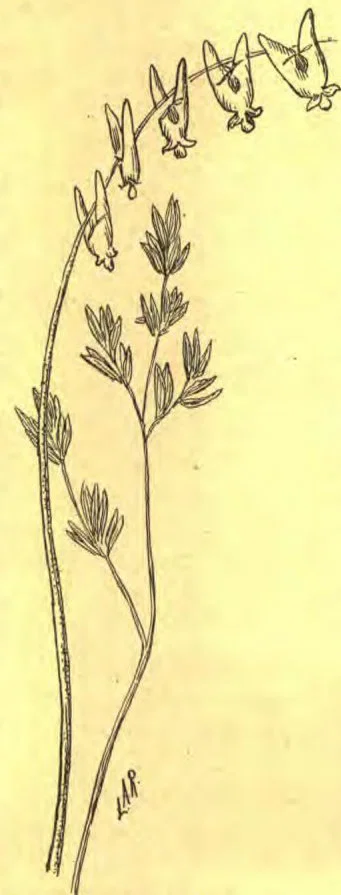
This little plant is always dear to the heart of a child. The quaintly shaped blossoms are such a departure from the many other flowers appearing in early spring that we give them our special regard and attention. These blossoms serve to teach us that God loves variety, and that our distaste for uniformity and monotonous sameness is but an echo from the great heart of the Creator.
If you carefully pull this plant out of the ground, you will observe that it grows from a scaly bulb, composed of grain-like tubers. The peculiarly shaped flowers grow in a raceme on a leafless flower-stem. The leaves grow on slender petioles from the rootstock. You will notice that the leaves are in sets of threes, and that each of these sets is made up of three tiny leaflets. This arrangement is called “thrice-compound.”
The flowers are white, tipped with yellow. The plant is to be found in the leaf mold of thin woods. It blooms in April and May.
The bleeding-heart of our gardens is a near relative of this flower; but the flowers of the bleeding-heart are blood-red and white, spurred, and heart-shaped.
The early flowers of spring are almost wholly fragile and delicate, and this specimen is no exception to the rule. If the frail, withering flowers are types of the light, transient things of earth, surely in some of these spring flowers we have unceasing reminders of the fact that the grass withers, and the flower thereof f falleth away; but let us not forget that the word of our God abides forever. L. A. REED.

HOUSE PLANTS IN SUMMER

WHAT to do with the house plants during the summer, is a perplexing question with many. To keep them in their pots at the windows is seldom convenient, nor are they then attractive in appearance, nor will they often remain in a healthy condition. To prepare a place for them outdoors, where they can be “stored” and looked after, is seldom possible for the amateur. To remove them from the pots, and plant them in the summer flower beds is objectionable, because the roots spread out beyond reasonable bounds; and in the fall, when the plants are lifted and potted, nearly all the “feeding roots” are bruised, torn, or destroyed. The result is that the vitality of the plant is so lowered by the shock, and the after-growth is so slow, that the winter is nearly passed before the plant begins to bloom. To set the pot in the flower bed is an unsatisfactory method (though preferable to removal from the pot), because it is not an easy matter to water the plant sufficiently to keep it in a healthy, growing condition, as the water will not filter through the pot from the surrounding soil in sufficient quantities for the necessities of the lower roots, and yet the surface soil will give the appearance of a depth of moisture. It is seldom that a plant in a plunged pot obtains water enough to keep all its feeding roots in health. What, then, can be done?
All will admit that the summer flower bed is the place for the majority of winter-blooming plants, provided the roots can receive sufficient food and water, and yet sustain no injury, and the growth of the plant remain unchecked when the transfer is again made to pots in the fall. This can be accomplished in a most satisfactory manner, and with little trouble or expense.
First make a list of the plants you intend to set out in the beds, and opposite the name of each, note the size pot that you intend the plant to occupy next winter. Be sure to keep this paper where it can be easily found when wanted. Next provide empty pots of all the sizes you intend to use in the fall for repotting,—one of each size. Count the number of plants that are to be placed in the flower beds, and those occupying pots six inches or less in diameter, multiply by two, larger ones in proportion. The sum total will be the number of roof shingles you will require. Procure these,—the longest you can find,—and saw in half, through the center. Split these halves into pieces not wider than two inches. You will then have pieces varying from one to two inches in width, and somewhat longer than the height of a seven-inch pot.
Now suppose you have a plant occupying a five-inch pot, and you intend to put it into a six-inch pot in the fall; mark its place in the flower bed on the list you have made, and carry the plant, with a six-inch empty pot and a handful of the split shingles, to the spot the plant is to occupy. Make a hole the depth and width of the six-inch empty pot, and place the pot into it, packing the dirt firmly around it. Carefully withdraw the empty pot, and drive the shingles in its place, giving them the exact slant of the pot, until their tops are from one to two inches below the level of the surface of the bed. If you have gravel or pebbles handy, throw in a small handful, or put a piece of wood on the bottom of the hole, to prevent the roots working down too deeply. Then put in the plant, and sift dirt around the edges to fill. □ Such an arrangement will allow the plant ample room for growth; the shingles will be out of the way of the rake or hoe in working among the flowers; all the needed moisture will percolate between the shingles; and the roots will be kept within proper bounds. When the plant is lifted in the fall, it will fit nicely into the pot selected, leaving a sufficient margin in which to pack fresh soil.
To lift the plant in the fall, run a trowel completely around the outside of the shingles, and on opposite sides throw off sufficient of the dirt to allow the placing of the hands half-way down the length of the shingles. Grasp the shingles firmly, spreading the hands over as many as possible, the hands being opposite each other (if the plant is large, first tie a string around the shingles, in about the center), and gently rock the plant north, south, east, west; then, pressing firmly and evenly, raise the whole slowly. When clear, lay on its side, carefully removing the upper shingles. Place the left hand where the removed shingles were, letting the fingers cover the bottom of the plant, and with the right hand carefully turn the plant over into the hand, and you have it ready and safe to repot.
Sometimes the shingles will be found driven too firmly into the ground to yield readily to the pressure of the hands. Never pull them out. Dig around them until you can get the end of a spade or trowel under them, and gently force them upward. Do this slowly and carefully, so that the fine roots lying against the inner surface will not be torn. If the whole operation is a success, the plant, if repotted and left for a few days in the hole it occupied in the bed, will never notice the change in any way. W. S. CHAPMAN.

THE CRITICAL HABIT

“Do not drift into the critical habit,” wrote Ruth Ashmore. “Have an opinion, and a sensible one, about everything; but when you come to judge people, remember that you see very little of what they really are, unless you winter and summer with them. Find the kindly, lovable nature of the man who knows little of books; look for the beautiful self-sacrifice made daily by some woman who knows nothing about pictures; and teach yourself, day in and day out, to look for the best in everything. It is the everyday joys and sorrows, my dear girl, that go to make up life. It is not the one great sorrow, nor the one intense joy, that constitutes living. It is the accumulation of the little joys and sorrows. Do not be critical of the little faults, and do be quick to find the little virtues and to praise them. So much that is good in people dies for want of encouragement. As I said before, Have an opinion, and a well-thought-out one, about everything that comes into your life; but do not have too many opinions about people. Their hearts are not open books; and as you must be judged yourself some day, give them the kindest judgment now.”

A WORSE THING

SHALL I give you a parable? Once upon a time there was a man walking on the highway, and he fell. No doubt it was partly his own carelessness. He, however, insisted that it was an accident. But the trouble was, that when he was down, he stayed there, and spent all his time in telling everybody who would listen how it happened. Some shook their heads doubtfully, and that made him angry. Some sympathized with him, and that made him sad. At last there came a simple man who asked, “How long have you been here?” It was ten, twelve, fifteen years or more. The simple man shook his head. “I am sorry, very sorry.”
“Yes,” said he who was down, “it is a terrible thing to tumble down.”
“That may be,” said the simple man, “but there’s something a thousand times worse.”
“What is that?”
“Why, not getting up again.”—Mark Guy Pearse.

TALKING IN THEIR SLEEP

“You think I’m dead,” The apple tree said; “Because I have never a leaf to show; Because I stoop, And my branches droop, And the dull gray mosses over me grow! But I’m all alive in trunk and shoot; The buds of May I fold away,— But I pity the withered grass at my root.”
“You think I’m dead,” The quick grass said; “Because I have parted with stem and blade! But under the ground I am safe and sound, With the snow’s thick blanket over me laid; I’m all alive and ready to shoot Should the spring of the year Come dancing here,— But I pity the flowers without branch or root.”
“You think I’m dead,” A soft voice said; “Because not a branch or root I own! I never have died, But close I hide In a plumy seed that the wind has sown; Patiently I wait through the long winter hours; You will see me again— I shall laugh at you then Out of the eyes of a hundred flowers.”
—Edith M. Thomas, in St. Nicholas.

CORRECTING MISTAKES

Many of the mistakes made by beginners in photography are fatal; but some can, in a measure, be corrected. Of course it is best to avoid mistakes; and if you learn from each spoiled negative how to avoid a similar failure in the future, you will soon be making negatives that will need no “doctoring.” When you have made a failure, the most important thing is to learn the cause. The improvement of that particular negative is of secondary importance.
Over- and underexposure are among the most common causes of failure. I have already told you how to detect these mistakes during development; but if they escape your attention then, there is a still more simple way by which they may be recognized after the negative is dry. Hold a black cloth or paper behind the negative, and look at it by reflected light. If it shows a positive on the film side only, the negative has been undertimed. When only the glass side shows a positive, it has been overtimed. But if a positive can be seen on neither side or on both sides, the exposure has been about right.
If a plate is known to be undertimed before development begins, the normal developer should be diluted with an equal quantity of water. This will greatly lengthen the time of development; but it will soften the contrast, and bring out more detail in the shadows. Under this treatment an underexposure will come out better than when treated with normal developer; but, generally speaking, the mistake is a fatal one.
When the plate is known to be overtimed, the developer should be concentrated. Equal parts of our “standard” developing solution and water, with the addition of four drops of a ten-per-cent solution of bromide of potassium, or of a fifteen-per-cent solution of chloride of sodium (common salt), to each ounce of developer will compensate for a pretty bad overexposure. After an overtimed plate has been developed, it is past all hope of improvement.
When a negative is thin and weak, but full of detail in both high-lights and shadows, it is underdeveloped. This fault may be corrected by intensification. Intensifiers may be bought at any stock house, and some manufacturers send out intensifier formulas with their plates; but about the best one, and that most used, is the mercuric bath given below:—
Bichloride of mercury, 1 dram Bromide of potassium, ½ ounce Water, 4 ounces
Mercury dissolves slowly, so it is best to keep this solution on hand. However, you should keep it out of the way; for bichloride of mercury is another name for corrosive sublimate,—a deadly poison.
The negatives to be intensified should be placed in the miscellaneous tray, and the mercuric solution poured over them. A white deposit will at once begin to appear on the surface of the film. If the negatives require much intensification, they should be left in the solution until this action ceases. Then pour off the intensifier, and pour over the plates a few ounces of a ten-per-cent solution of sulphite of soda. This will blacken the white mercuric deposit, after which the plates may be washed and dried just as after fixing.
Sometimes a negative will be so dense that in all but a strong transmitted light it will appear quite black, even in the shadows. This is caused by overdevelopment, and may be corrected by reduction.
Ferricyanide of potassium, ¼ ounce Water, 4 ounces
This solution also is poison, and the bottle should be so labeled. Light has a tendency to decompose this solution, so it is well to keep the bottle wrapped in black or dark-brown paper. To make a reducer, add one-half dram of this solution, and a lump of hypo. about twice the size of a pea, to eight ounces of water. Watch the plate closely, or you may get it too thin. When sufficiently reduced, remove the negative, and wash it as you would after fixing.
Sometimes you will see dark streaks radiating from one corner or edge of the plate, and extending across its entire surface. Such plates have been “light-struck,” and nothing can be done to improve them. In some way a ray of light has reached the plate without coming through the lens at the time of exposure. The trouble is generally caused by a leaky plate-holder.
When there is a leak in the plate-holder, so situated that diffused instead of direct light reaches the plate, it will “fog” the negative. Then the entire image will be veiled and indistinct, just as the subject would appear on a foggy day. An unsuitable developing light, or a developer containing too much alkali, may also cause fog.
“Pin holes”—little spots of clear glass—are usually caused by specks of dust on the plate during exposure. To avoid them, the plate should be carefully dusted when the holders are loaded. Pin holes may be spotted out with some opaque water-color carried on a fine-pointed brush. If the spots are small, and you are deft-fingered, they may be lightly touched with pen and ink, but the water-color is better.
When a negative shows too much contrast,—black high-lights and shadows of clear glass,—the trouble may have been caused either by underexposure or by too many contrasting lights on your subject. When it is necessary to photograph anything in contrasting lights, it is advisable to overtime the plate, and develop with normal developer. This plan will reduce the contrast, and often yields good results where a normal exposure will fail.
In photography it is easier and better to avoid mistakes than to correct them. So in our Christian experience. If we make a mistake or commit a sin, it may be rectified or forgiven; but how much better not to sin! “My little children, these things write I unto you, that ye sin not. And if any man sin, we have an Advocate with the Father, Jesus Christ the righteous.” Oh, wonderful love! A power has been provided to keep us from sin; but if we let go that power, and fall, an Advocate stands ready to plead our cause, and bear our sins himself. J. EDGAR ROSS.

Civility Costs Nothing and Buys Everything

CIVILITY costs nothing and buys everything.

CROCUS

The crocus peeps through mossy heaps To don her snow-white bonnet: Then far and wide with modest pride She shakes the white plumes on it, And laughs with glee to think that she The earliest flower of spring should be. — Selected.

“LO, I AM WITH YOU ALWAY”

A BUSY woman entered her room hastily as twilight was falling, went directly to her desk, turned on the gas, and began to write. Page after page she wrote. The solitude became oppressive. She wheeled her chair around, and, with a shock of joyful surprise, looked squarely into the smiling face of her dearest friend, lying on the lounge by her side. “Why, I didn’t know you were here!” she cried. “Why didn’t you speak to me?”
“Because you were so busy. You didn’t speak to me.”
So with Jesus—here all the time. The room is full of him, always ready to greet us with a smile—but we are so busy! But when the solitude grows oppressive, we suddenly turn, and lo! he is at our side. We speak to him, and he speaks to us; and the soul’s deepest yearnings are completely satisfied.—Selected.
Continue reading: The Sunbeam