A SLENDER morning shaft, it cut the gloom,
And touched my eyes to see, as in a dream,
A million rainbow motes athwart the room
Swim down its slanting stream.
God shine upon our days of common dust,
And smite the eyes that Wont and Custom seal!
Then shall the meanest mote of all, we trust,
Its blues and reds reveal.
— Alice Lena Cole.
THE BABY QUEEN
SHE was born, once on a time, in a palace swarming with busy folks — or anyway, some of them were busy, though I’m sorry to say a few were very lazy indeed, and made the others do all the work.
She was such a queer little baby, lying very still in her fuzzy white dress. Her mother was altogether too busy to take care of her and the other babies; for, you see, she had a great many tiny sisters and brothers.
If it had n’t been for their many kind nurses, I am afraid they would never have grown up at all. But the nurses watched over them very tenderly and carefully, and fed them on bread and milk all day long.
They never had to wait for something to eat. The nurses fed them “between meals” and at all times, and so they grew ever so fast. Why, some of them doubled in size in only half a day!
I think the nurses must have loved this one special baby I am talking about more than the rest. Anyway, they soon began to give her better food than the other babies. She had rich “royal jelly” to eat; while they had only coarse yellow “bread,” mixed with a tiny drop of honey
After all, the queerest thing about this queer little queen was what made her a queen—the royal food she ate! It wasn’t because she was first heir to the throne, but just and solely because she had “royal jelly” for dinner, and the other babies didn’t! Who ever heard of any other queen who owed her crown to her dinner?
She had a tiny room all to herself—and so did most of the others, for that matter. It was a cozy little room with six walls, and the door was always open till the queen-baby was about nine days old. Then, after they had given her a big meal of “royal jelly,” the nurses shut the door tight, and locked it. For twelve long days the baby lived all alone in her little locked-up room. Nobody came to see her, or took any notice of her.
“I’VE HAD A DREAM”
At first she seemed to enjoy being alone, and never thought of wondering why the nurses did not bring her some dinner or supper. To tell the truth, she was very busy growing, and putting on a suit of beautiful new clothes. As the door was locked so tight, nobody could look in to see how the new suit was made, or how the wee baby put it on all by herself.
By and by, when the dress was all donned, the royal baby—though she was n’t much of a baby then—concluded she did not care to live alone any longer; besides, she was hungry. So she began to turn slowly round and round, and cut a small, round hole in her door with her strong little “teeth”—for she had cut all her teeth by that time! When the circle was nearly completed—pop! the bit of a round door flew open like the lid of a coffee-pot! The little queen poked out her head, and surveyed things with a good deal of curiosity.
I wonder what she thought of it all,—the long rows of little six-walled rooms; the crowds of busy workers bustling about, bringing in new supplies of food, and piling them into the rooms; and the lazy loungers here and there, doing nothing at all.
It must have surprised her; but if it did, she did not let any one know it: she was too dignified for that. Indeed, she was a very quiet little lady, and only called out something that sounded like “zeep, zeep, zeep,” once in a while.
She popped her head down again, and went back into her own little room to rest, and think about it, maybe.
After that she peeped out of the door several times, and finally boldly walked out.
She was too hungry just then to wait for ceremony; so she walked about among the little food-rooms, helping herself.
Nobody objected at all. They all knew it was the young queen, and of course the queen could do as she pleased. From that time she was perfectly at home in the busy palace, and began her reign with a good deal of quiet dignity. I wish I could say she was always quiet and good, but she had one great fault,—she was very jealous of the other young queens; and—oh dear! I’m afraid she had a fight with them, and drove them all away.
Have n’t you guessed who the little queen was? Why, she is alive this minute, and lives in the tiny white house under the apple-tree in our own back yard.—Selected.
MARCH, APRIL, MAY
By Elizabeth Rosser
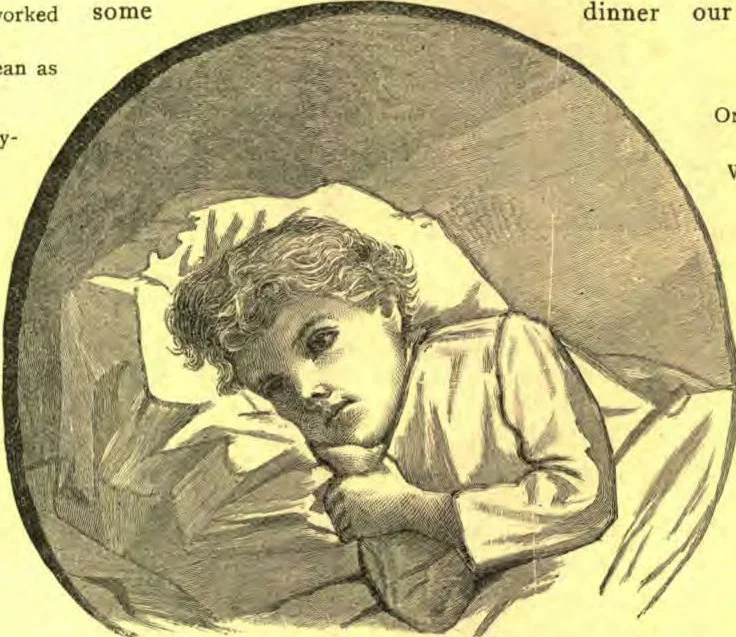
I'VE had a dream, O dear mama, and such a pretty one!—
I saw a lively, red-cheeked lad, his blue eyes full of fun.
Come, whistling and dancing, into a littered room,
And set to work right cheerily, with duster and with broom.
There were strings and bits of paper and wisps of hay, and leaves,
And scattered straws that had been lost from out the harvest sheaves.
He drove them all before his broom, so busily worked he;
And when he went, that littered room was clean as clean could be.
And then his little sister came, a winsome gray-eyed girl.
More quiet than her brother was, she did not make things whirl;
But, armed with mops and water-pails and scrubbing-rags and brush,
She washed things down till I could hear the water foam and rush.
With sleeves tucked to her elbows, and skirts up to her knees,
She splashed about in all that slop as happy as you please;
And when no other speck of dust the little girl could find,
She left the room all sweet and clean and rainbow-wreathed behind.
Then, oh! the darling little lass that, smiling, tripped along!
Her eyes were bright with goodness, and her lips were sweet with song.
Upon the bare, dull-colored floor a carpet green she spread,
Tacked down with yellow buttercups, and daisies white and red;
A garland of young maple leaves she looped about the room,
And curtained all the windows with lace of apple-bloom;
The ceiling then she overspread with gold-embroidered blue,—
Now dress me, please, and I will go and see if it is true.
ELIZABETH ROSSER.
THE NAUGHTY PARROT
Once there was a little girl who spent the summer days
With sheep and cows and pigeons, and horses out to graze,
And other gentle comrades. They all had pleasant ways,
Except a horrid parrot with a very brilliant head,
Who never made polite remarks, but always moaned, instead,
“Oh, ah, wah! Ah, hoop-bah! I—don't—want to go to bed!”
Now all these other animals were very, very good;
They neighed or they brayed, or they crowed or purred or mooed;
They barked or they bleated, or they quacked or clucked or cooed,
But still that hateful parrot, he drooped his gaudy head,
And with a twinkle in his eye he dolorously said,
“Oh, ah, wah! Ah, hoop-bah! I—don't—want to go to bed!”
— Youth’s Companion.
WHAT GOD SAYS TO THE CHILDREN
Our loving Heavenly Father never forgets the little ones. Here are some of the texts that have been written in his word especially for them:—
“Suffer the little children to come unto me, and forbid them not: for of such is the kingdom of God.”
“Honor thy father and thy mother: that thy days may be long upon the land which the Lord thy God giveth thee.”
“Children, obey your parents in the Lord; for this is right. Honor thy father and thy mother; which is the first commandment with promise; that it may be well with thee, and thou mayest live long on the earth.”
“Remember now thy Creator in the days of thy youth, while the evil days come not, nor the years draw nigh, when thou shalt say, I have no pleasure in them.”
“Even a child is known by his doings, whether his work be pure, and whether it be right.”
MAY STUDY OF THE FIELD
PART III: MEXICO; ITS GROWTH AND DEVELOPMENT
(May 13-19)
1. Rapid Development of Mexico.—No country in the world has made such immense strides during the last ten years as has Mexico. A little more than twenty years ago it was centuries behind Europe. Until 1873, the chief, and almost the only, means for traveling was a few wagon-roads and bridle-paths. Of these a Mexican merchant writes: “The national and neighborhood highways do not merit the name. The principal road from Oaxaca to Costa Chica is a bridle-path; and in some parts it is so narrow that last year when I, being sick, had to be carried on a bed to Oaxaca, the servants who carried me had to abandon the road, and cross through the woods, as two men abreast could not walk in it. If the national roads are thus, one can imagine what the neighborhood roads might be.”
2. Agriculture.—One writer says that “the Mexicans have cultivated almost everything more than their soil; hence they have no system of agriculture.” The plow is the same as that used two thousand years ago,—simply a wooden wedge, sometimes without a particle of iron; the yoke being lashed with rawhide thongs to the horns of the oxen that draw the prehistoric implement. The ox is the only animal used in plowing, although the planter may have thousands of horses and mules. American plows are now being introduced to a considerable extent; but the Mexican peasant, on coming into possession of one, generally cuts off one handle, in order to make it conform, as far as he can, to his ancient implement. In recognition of this fact, an Illinois firm has recently introduced a form of plow with one handle. A bundle of brush constitutes the harrow. The hoe is frequently a wooden strap with an iron spike in the end. The sickle is of ancient type; but instead of having a sharp edge, it is provided with saw-teeth, and is used in gathering small grain, the employment of a cradle for such a purpose being unknown. With the exception of a few districts, all grain is thrashed by the feet of horses or mules, which are driven around in a ring, the straw being first spread on the ground. The grain is separated from the chaff by the action of the wind. One objection urged by Mexicans to thrashing-machines is that they leave the straw whole, while by the use of horses it is, by the constant trampling, cut as fine as if run through a feed-cutter. As this straw is universally used as feed, any further preparation is obviated.
3. Mines.—The mineral wealth of Mexico is very great. Her mountains contain almost every mineral in use in agriculture, manufactures, and the fine arts. But the mines of iron and lead have been almost wholly neglected, while those of silver and gold have been quite thoroughly worked. Copper is found in considerable quantities, and tin is abundant. Extensive iron mines exist in some provinces, but coal is very rare. A few precious stones are also found. Mexican gold is for the most part obtained from alluvial grounds, by means of washing. Grains of gold equivalent in value to more than one thousand dollars have been found in some places. In some mines the clayey soil with which the veins are filled contains so great a quantity of gold disseminated in impalpable particles, that the miners are compelled when they leave the mine, nearly naked, to bathe in large vessels, to prevent any of the auriferous clay from being carried off by them on their bodies.
4. Mexico's Railroads.—It is said that Mexico is a bad railroad country, because “so much of her is standing on edge;” yet there were, in November, 1899, 12,999 miles of track laid, counting the mileage of the tram-ways and the private roads, and much more was then under construction. Half of this has been laid since 1890. The building and operation of railroads have pushed Mexico forward very fast. The railroads have doubled their freight and passenger receipts during the last ten years.
5. Education.—A short time ago scarcely one third of the entire population of Mexico could read. But with compulsory education, a gradual change is coming over the people, and there are to-day at least one million children in the primary schools supported by the federal government and the states. One evidence of the progress in educational lines is the newspaper. Where a few years ago one could scarcely be purchased, there are to-day as many as four hundred. Twelve of these are published in English, and several in other languages; forty-four of the number are dailies. Can we not see a significance in this fact, when we remember that to many the third angel's message will go through the printed page?
6. A View of the Common People.—Bancroft, who has written a history of Mexico, says of the present condition: “As we penetrate the country, we are more and more struck with the phenomenon of a republic without a people. There is here no mediate class. The aristocracy is the nation. The low are very low; they are poor, ignorant, servile, and debased, with neither the heart nor the hope ever to attempt to better their condition. I had never before witnessed such squalid misery and so much of it; and yet the people do not know they are miserable. Sit at the door of your hotel, and you will see pass, as a procession of the accursed, the withered, the deformed, the lame, and the blind,—little filthy mothers with little filthy babies, the former but fourteen years old; and grizzly men and women with tanned and wrinkled skins, bent double and hobbling on canes and crutches.” Chaplain C. C. McCabe, after laboring in Mexico, writes: “This is an accurate description. It is a faithful picture,—and this after three centuries and a half of the Church of Rome! But with the entrance of the gospel the scene is changing. The procession Bancroft watched still goes by; but another is coming after it,—well-dressed, well-fed, intelligent, and happy, and it is because of the good news of salvation.” Will we share in this transformation?
THE NEW EARTH
By M. E. Cady
It was some time ago, you will remember, that we began our study of God’s wonderful creation, using as a foundation the simple story recorded in the first chapter of Genesis. Here we learned that God created the heaven and the earth, and that he spent six days in beautifying the earth, and making it a fit dwelling-place for man. God created light, heat, air, water, dry land, plants, sun, moon, stars, water animals, air animals, and last of all, man, who was to have dominion over the earth. We have studied all these subjects, and learned something about the wisdom, love, and power of God, as revealed in these wonderful creations. On the seventh day God rested from his work, and was refreshed as he looked upon it in all its beauty and perfection. Then he set apart every seventh day as a time when man should meditate upon his wonderful works.
Satan stepped in, and the results of his working have been seen in the history of our earth during the last six thousand years. The Lord has allowed sin to run its course, and the true character of Satan as a deceiver has been laid bare before the universe. We have seen how terrible are the results of sin upon man and the lower animals, and also upon the plant creation. The entire creation of God is groaning under the weight of sin; but Satan’s works will soon be destroyed, and a glorious victory be won for God and his faithful children. We are living in the time when the last warning message, the third angel’s message, is going to the world to save a people from the final destruction of the earth by fire. How many of us are going to have a part in the victory, and share in the reward of the saints in the earth made new?
There are many things in this world that give us some idea how the new earth will look. There will be plants in the new earth; but “instead of the thorn shall come up the fir tree, and instead of the brier shall come up the myrtle tree.” “The wilderness and the solitary place shall be glad for them; and the desert shall rejoice, and blossom as the rose. It shall blossom abundantly, and rejoice even with joy and singing.”
There will be animals in the new earth; but the spirit of antagonism, of quarreling and fighting, will be entirely absent. “The wolf and the lamb shall feed together, and the lion shall eat straw like the bullock.” “The wolf also shall dwell with the lamb, and the leopard shall lie down with the kid; and the calf and the young lion and the fatling together; and a little child shall lead them. And the cow and the bear shall feed; their young ones shall lie down together: and the lion shall eat straw like the ox. And the sucking child shall play on the hole of the asp, and the weaned child shall put his hand on the cockatrice’ den.”
Man in the new earth will be strong, and the glow of health will be on his cheek; for “the inhabitants shall not say, I am sick: the people that dwell therein shall be forgiven their iniquity.” They will spend their time in profitable employment. “They shall build houses, and inhabit them; and they shall plant vineyards, and eat the fruit of them.” There will be no such thing as failure, but success will crown all their efforts. “They shall not build, and another inhabit; they shall not plant, and151another eat: for as the days of a tree are the days of my people, and mine elect shall long enjoy the work of their hands.”
When the earth is renewed, the scripture will be fulfilled that says, “Behold, I make all things new. . . . He that overcometh shall inherit all things; and I will be his God, and he shall be my son.” “The great controversy is ended. Sin and sinners are no more. The entire universe is clean. One pulse of harmony and gladness beats through the vast creation. From him who created all, flows light, and love, and gladness, throughout the realms of illimitable space. From the minutest atom to the greatest world, all things, animate and inanimate, in their unshadowed and perfect joy declare that God is love.”
In all our study we have been considering the two great themes that will engage the minds of the redeemed throughout eternity—creation and redemption. Let us think of these things now, that we may be able to enter into the spirit of the wonderful plans of God when we are permitted to have a home in the earth made new. M. E. CADY.
A Soul Awakened by Christ's Hidden Grace
“A soul, slept under
A plain, rough face,
Till Christ awakened
Its hidden grace;
And lo! it blossomed, till all the earth,
Marveled its beauty and praised its worth.”
Time: A. D. 31. Place: Jerusalem. Persons: Disciples, multitude of Jews and strangers.
QUESTIONS
1. How many disciples met together to seek for the blessing of the Holy Spirit? Acts 1:15. How long did they seek before the blessing came? Acts 2:1; .
2. In what manner and in what form did the Spirit descend? Vs. 2, 3. What was the result to the praying company? V. 4; .
3. What special ones were at this time staying at Jerusalem? V. 5. When these heard of what had occurred, how were they affected? Why? V. 6. In amazement, what did they ask and say? Vs. 7, 8, 11–13. What nationalities were present? Vs. 9–11; .
4. In reply to the charge that the disciples were drunk, what did Peter first say? Vs. 14, 15; . Continuing, of what did he say the occurrence was a fulfillment? Vs. 16–20. What precious promise found in the prophecy did he then quote? V. 21.
5. In what forcible words did Peter present before his hearers the rejection of Christ Jesus? Vs. 22, 23. Although Jesus had been crucified, what had taken place? V. 24. What prophecy had foretold the resurrection of Jesus? Vs. 25–28.
6. To make plain that David had not spoken of himself, what did the apostle say concerning the prophet? V. 29. What conclusion did he then draw? Vs. 30, 31.
7. What connection did Peter then make between Jesus’ resurrection and the giving of the Holy Spirit? Vs. 32–36; . What was the effect of Peter’s discourse upon the multitude? What did many say? V. 37; .
8. What were the convicted ones admonished to do? Vs. 38–40. What assurance was given them? Id. How did the people respond? How many took a stand? V. 41. What was the experience of those who thus joined themselves to Christ? V. 42.
Northwestern Hide and Fur Co.,
$1,000 PICTURE FOR 20c.
We have produced at an enormous expense a beautiful color-type of forty-six wild, fur-bearing animals in their natural color. The reproduction is just the thing for a boy to have in his room, and is the best guide to knowledge of wild, fur-bearing animals. The price we ask for this beautiful picture only helps to cover the cost of printing and postage. Send twenty cents in stamps, to-day, and you will receive the same, postpaid.
Northwestern Hide and Fur Co.,
411 Main St., Minneapolis, Minn.
To Reach BATTLE CREEK
FROM
CHICAGO, BUFFALO, DETROIT, OR TOLEDO.
Purchase Tickets Reading over the MICHIGAN CENTRAL
“The Niagara Falls Route.”
A First-class Line for First-class Travel between Chicago and New York and Boston. Elegantly equipped through trains pass Battle Creek in each direction daily.
R. N. R. WHEELER, O. W. RUGGLES,
Ticket Agent, Battle Creek. Gen’l P. and T. Agt., Chicago, Ill.
TAKE THE Canadian Pacific Railway
for . . . CHATHAM, OTTAWA, MONTREAL, LONDON, GALT, QUEBEC, WOODSTOCK, TORONTO, BOSTON, PORTLAND, and
All points in New England, the Maritime Provinces, Great Britain, and the Continent.
Illustrated literature, time-tables, and full particulars, upon application to—
J. FRANCIS LEE, GEN. AGENT,
Passenger Dep't. 228 SOUTH CLARK ST., CHICAGO
Branch Offices: 76 Ottawa St., Grand Rapids, Mich.; Room D, Chamber of Commerce, Cincinnati, Ohio; 315 Chestnut St., St. Louis, Mo.
Cincinnati Northern Railroad Co.
TIME TABLE NO. 3.
IN EFFECT SEPT. 24, 1899.
Trains Pass Battle Creek, as follows:
WEST-BOUND.
No. 21, Mail and Express ........................ 6.58 P. M.
No. 23, Accommodation ........................... 2.07 P. M.
No. 27, Local Freight .......................... 8.25 A. M.
EAST-BOUND.
No. 22, Mail and Express ........................ 8.25 A. M.
No. 24, Accommodation ........................... 1.45 P. M.
No. 28, Local Freight .......................... 5.30 P. M.
Direct connections are made at Toledo with all roads diverging. Close connections for Detroit and Cincinnati.
J. L. READE,
Ticket Agt., Battle Creek.
E. R. SMITH, City Pass. Agt., 6 West Main St.
CHICAGO & GRAND TRUNK R'Y
E. W. Meddaugh and Henry B. Joy, Receivers.
CHICAGO & GRAND TRUNK R'Y.
Trains arrive and leave Battle Creek.
WEST-BOUND FROM BATTLE CREEK.
No. 9, Mail and Express, to Chicago — 12.15 P. M.
No. 1, Chicago Express, to Chicago — 9.00 A. M.
No. 3, Lehigh Valley Express, to Chicago — 3.40 P. M.
No. 5, Pacific Express, to Chicago, with sleeper — 1.10 A. M.
No. 75, Mixed, to South Bend — 8.20 A. M.
Nos. 9 and 75, daily, except Sunday.
Nos. 1, 3, and 5, daily.
EAST-BOUND FROM BATTLE CREEK.
No. 8, Mail and Express, to Pt. Huron, East, and Detroit — 3.45 P. M.
No. 4, Lehigh Express, to Port Huron, and East — 8.27 P. M.
No. 6, Atlantic Express, to Port Huron, East, and Detroit — 2.25 A. M.
No. 2, Leh. Exp., to Saginaw, Bay City, Pt. Huron, and East — 6.50 A. M.
No. 74, Mixed, to Durand (starts at Nichols) — 7.15 A. M.
Nos. 8 and 74, daily, except Sunday.
Nos. 4, 6, and 2, daily.
A. S. PARKER, Ticket Agent, Battle Creek.
BIBLE NATURE STUDIES
By M. E. Cady
DURING the last two years the INSTRUCTOR has been furnished, at varying intervals, with articles on the study of nature, written by Prof. M. E. Cady, now in charge of the work at Healdsburg College. The articles in this series, the concluding number of which is given in this issue, have appeared under various general headings; such as, “God’s Handiwork,” “The Realm of Nature,” “Nature Study,” etc. The casual reader may not have noticed any logical connection between the articles; but those who have studied them more closely have seen that the entire series, has been developed according to a plan, and based upon God’s word.
The first chapter of Genesis contains the story of creation, and furnishes subject-matter for the study of the entire field of nature. In order to bring the matter clearly before the mind, we will review briefly. The articles have appeared under the following subheadings:—
By studying this outline, it will be readily seen that it includes every phase of nature study. Even the studies carried on in high schools, colleges, and universities are all based upon the things that God has made. In studying light, heat, air, and sound, we are studying physics, or natural philosophy. If we study the distribution of land and water, we are studying geography. If we study air, water, and the solid portions of the earth as to their composition, we are studying chemistry. If we study minerals, we are studying mineralogy. In the study of plants we enter the field of botany. In the study of sun, moon, and stars we enter the realm of astronomy. In the study of water animals, air animals, and land animals we consider the subject of zoology. In the study of fish we study ichthyology. The birds of the air introduce us to the subject of ornithology. The study of man, his physical being, is the study of physiology. In the study of man we are introduced to a large number of subjects that treat of man in his various relations to nature, to his fellow beings, and to God. The record of man’s life, written up to the present, is termed history. The ability that man possesses to communicate with his fellow beings and his Creator gives us the study of language. The social condition of mankind develops the study of sociology; the study of the races of men, ethnology; the study of man’s intellectual powers, mental science; and the study of man’s obligation to his fellow man and to his Creator, moral science. The study of the forms of government which men have devised is called civics, and the study of all that man has made is known as art.
We might go on indefinitely; but what has been given illustrates how the whole field of nature is comprised in the study of God’s creation, as recorded in the first chapter of Genesis. God set apart one day in every seven for man to devote especially to the study of his wonderful creation; this day he calls the Sabbath. The study of the fall of man, the flood, the destruction of the earth by fire, and the new earth brings to view the results of sin, and the plan devised to restore the earth to its Edenic beauty.
Thus we see that this series of articles has covered, under the first twelve subjects, the work of creation, the remaining four subjects treating of the work of redemption. Creation and redemption are the two great themes for the student. He should begin the study of these now, that he may be permitted to continue their study throughout all eternity.
Though this field of study has been meagerly covered in the INSTRUCTOR, it is the hope of the author that some hearts have been thereby awakened to a more thoughtful contemplation of God’s handiwork.
FOR EVERY DAY OF THE WEEK
Sunday:
“The shorter the day, the greater the blessing of sunshine.”
Monday:
Father, give me the power to labor for mankind;
Make me the mouth of such as can not speak;
Eyes let me be to groping men and blind;
A conscience to the base; and to the weak
Let me be hands and feet; unto the foolish, mind;
And lead still farther on such as thy kingdom seek.
— Selected.
Tuesday:
Tribulation can not separate you from the love of God, which is in Christ Jesus our Lord. But the love of God will, in the end, separate you from tribulation, and bring you out of it, and give you fullness of joy.—J. Hewitson.
Wednesday:
To be worth anything, character must be capable of standing firm upon its feet in the world of daily work, temptation, and trial, and able to bear the wear and tear of actual life. Cloistered virtues do not count for much.—Smiles.
Thursday:
“To be resigned when ills betide,
Patient when favors are denied,
And pleased with favors given,—
This is wisdom’s part;
This is the incense of the heart,
Whose fragrance smells to heaven.”
Friday:
We must put the glory of love, of best effort, of sacrifice, of prayer, of upward looking and heavenward reaching, into the routine of our life’s every day, and then the most burdensome and uneventful life will be made splendid with the glory of God.—J. R. Miller.
Sabbath:
“It is of the Lord’s mercies that we are not consumed, because his compassions fail not. They are new every morning.”
By a vote of the General Conference Committee at its annual spring session it was decided to omit the Berean Library studies during the summer, and to resume the work about the first of October. The notes for Lesson 23, the last of the study of the book of Daniel, were given in last week’s INSTRUCTOR. The vacation time will be well improved if some time is devoted to a thorough review.