Your ShelfYour Projects

The Youth’s Instructor, Vol. 28, No. 35.

SILVER SMELTING

The Youth’s Instructor

Aug 25, 1880

S. D. A. Publishing Association · Battle Creek, Mich. · Aug 25, 1880
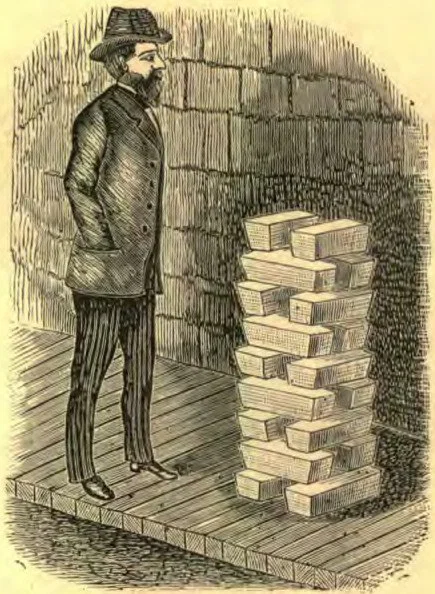
SILVER SMELTING.

As the reader looks at the picture on this page, he will, no doubt, ask, “What is this man looking at that seems to interest him so much?” It is a ton of pure silver just as it comes from the mill where it is separated from the ore. Do you know the process by which it is extracted? If not, I will tell you.
There are several methods by which this work is done, but the only one that we will attempt to describe in this article is what is known as the chlorodizing process,—by roasting and amalgamation. The ore, which to the unpracticed eye appears only as pieces of blasted rock from the size of a hen’s egg to that of a man’s head, is placed in large iron mortars, where it is crushed to powder by heavy iron or steel stamps worked by steam or water power.
In the roasting-room are large iron cylinders which revolve at the rate of one revolution in two minutes, and under which hot fires are kept constantly burning. The pulverized ore from the stamps is placed in these heated revolving cylinders for four hours, then from six to eight pounds of salt for every one hundred pounds of ore is added; after this the ore is roasted from four to six hours longer, when it is taken out and spread upon the floor of a large pit to cool.
At the proper time this roasted ore is put into the amalgamating pans, which, in size and shape, are similar to the case around a miller’s stone for grinding corn. In these pans are mullers, or stones, between which the ore is ground for an hour or two, when about one-eighth as much quicksilver as there is silver is added, and the whole is ground about ten hours longer.
In this operation the quicksilver attracts the silver and amalgamates with it. The pulp is then thinned with water, causing the quicksilver, with the silver adhering to it, to settle to the bottom of the pans. The pulp, or dirt, is allowed to pass off with the water. The silver is then taken out and conveyed to the next room, where the quicksilver is removed from it. It is then placed in the retort, melted, and run into bricks, or bars, as you see in the picture. Each one of these bars is valued at from $1,500 to $1,800. By counting the bars we find that there are eighteen, so that a pile of silver of this size would be valued at about $30,000.
But after passing through all these operations, the silver still has particles of the native element in it, and so must be refined. It is, therefore, shipped to different points in the East, where such work is done, and is there fitted for the mint. From the mint it comes forth to enrich and bless its possessor.
The prophet Malachi uses this illustration, the refining of silver, when speaking of the fitness required of those who shall abide the coming of the Lord, and stand before him at his appearing. He says that the Lord “shall sit as a refiner and purifier of silver; and he shall purify the sons of Levi, and purge them as gold and silver, that they may offer unto the Lord an offering in righteousness.” Mal. 3:3.
As silver is purified in the furnace from all its dross before it is fit for use, so we, before we can stand before the Lord in righteousness, must be purified in the furnace of trial, and sometimes of affliction. By this process, a character is gained, a character like that of our dear Saviour, pure and spotless. Only those who have such a character will finally dwell with him forever in the realms of light.
J. O. CORLISS.

SHADE AND SUNSHINE.

INTO all lives some rain must fall, Into all eyes some tear-drops start, Whether they fall as a gentle shower, Or fall like fire from an aching heart. Into all hearts must sorrow creep, Into all souls some doubting come, Lashing the waves of life's great deep From dimpling waters to seething foam.
Over all paths some clouds must lower, Under all feet some sharp thorns spring, Tearing the flesh to cruel wounds, Or pierce the heart with their bitter sting. Upon all brows rough winds must blow, Over all shoulders a cross be lain, Bowing the form in its lofty height Down to the dust in bitter pain.
Into all hands some duty's thrust, Unto all arms some burden's given, Crushing the heart with its dreary weight, Or lifting the soul from earth to Heaven.
Into all hearts and homes and lives God's dear sunlight comes streaming down, Gilding the ruins of life's great plain,— Weaving for all a golden crown.
—The Presbyterian.

SPEAK KINDLY.

KIND words are to the human heart what dew-drops are to flowers. They refresh, beautify, and awaken to new life and energy. Then use them freely, spare them not. They cost but little effort to the bestower, yet are of priceless value to the recipient.
Speak kindly to the aged man whose steps are swiftly hastening to the tomb. Cheer his sunset hours by kindly tones and words of sympathy.
Speak kindly to the little child. Mar not the happiness of its innocency by harsh and sullen tones.
Speak kindly to the mourner who feels bereft of every friend, of every joy. Seek to ameliorate the sorrow and lighten the burdens by kind words.
MIRA H. CARTWRIGHT.

FIRST NIGHT ON SHIPBOARD.

A BEDROOM on a steam-ship does not look much like one in a house. Our state-room is on the south or right-hand side of the ship, as its bow is toward the Old World. Going from the dining-saloon, we leave the passage-way by a door opening into our state-room. This door is furnished with a nice white porcelain knob and bright brass lock, and looks much like a bedroom door at home, but on opening the door the homelike look disappears. The room is small, about seven feet long and seven feet wide. On the right hand are two shelves with beds on them. These are placed one above the other, with curtains in front of each, and are just wide enough to accommodate one person. They are called “the berths of the state-room.”
On the left side of the room, extending its whole length, is a settee nicely fitted up with cushions and securely fastened to the wall. Directly in front of us is a mirror, also fastened to the side of the room. Under this, on a commode, are wash-bowl, tumblers, water-bottles, etc., either made fast to the commode, or secured in tightly fitting sockets so as not to be broken by the rocking and pitching of the ship.
Over the settee is a curiously constructed window for the admission of light to the room. This window is in the side of the ship, as the promenade-deck is directly over us. This strong window is really a round hole about one foot in diameter. It is composed of a thick piece of glass set in an iron frame, opening inward on massive hinges. On the side of this frame, opposite the hinges, are a strong clamp and screw by means of which the frame can be screwed up very tight, thus excluding the water in time of heavy seas.
By the side of the door there is a curiously constructed lamp-case, with ground glass on the state-room side and a small door opening into the passage-way. In this they put a small lamp which is left to burn and light the state-room until eleven o’clock at night, when the night-watch puts it out.
After putting our luggage under the settee, and praying the Lord to protect us in our passage over the mighty deep, we retire to our berths. All is new and strange, which, with the noise of the engines, the half-hourly striking of the bells, and the tread of the watchmen on the quarter-deck directly over our heads, prevents us from sleeping very soundly this first night. We shall soon, however, get accustomed to these noises, and shall not be disturbed by them.
At four A. M., as the bell strikes eight, there is a great bustle on deck. All the “day hands” have turned out of their “bunks,” and their first duty is to wash the decks of the ship. For this purpose hose are fastened to the pipes, and by means of force pumps worked by the ship’s engine, water from the sea is thrown over the ship. And for about an hour it is one continuous sound of splashing and scrubbing. They do this not only for neatness, but for the health of the ship’s passengers and crew.
With the dawning of the day we go up on the promenade-deck for a walk. We can see nothing but the broad, blue sea, and the sea-gulls which are still following us, seemingly unwearied with their long flight. We are all anxious to know how much progress we have made, but must be content to wait until noon, when the captain takes his observations, and places the result on a printed map which is kept in the upper saloon. We can thus see, each day, where we are on the trackless ocean.
The weather is quite good so far, except that the breeze grows stronger, and occasionally a “white cap” breaks over the top of a wave. If we have nothing worse than this, it will be a tranquil trip.
J. N. L.

OUR WORDS.

“By thy words thou shalt be justified, and by thy words thou shalt be condemned.” Generally speaking, words are an index to the heart; but sometimes the true feelings of the heart are concealed by hollow words, or words are inadequate to express the feelings of the heart. Again, there are those whose temperament is such that they may feel intensely, yet say but little. But, to repeat, generally speaking the words show the true condition of the heart; consequently, the inspired writer said, “By thy words thou shalt be justified, and by thy words thou shalt be condemned.”
In view of this, how closely we should watch our words that we may know the true condition of our hearts! Our words should not be unkind, impatient, vain, or unbecoming in any way, but should be “seasoned with grace.” We should “open our mouths with wisdom, and the law of kindness should be in our tongues.”
Again, how many words are spoken which seem to do no real harm, but yet they do no good. They are not ennobling, edifying, or comforting, but are “like water spilt upon the ground, which cannot be gathered up,” and like the bubble which explodes as soon as it reaches the surface.
My spirit burns within me at times, to speak to some of the youth of our day, and ask them not to say so many little nothings. I hope that if any of the INSTRUCTOR family have contracted this habit, they will at once seek to reform. Suppress the words, crowd back the thoughts, settle them deeper and deeper, examine them closely, and judge for yourselves whether by them you will be justified or condemned. “He that keepeth his mouth, keepeth his life; but he that openeth wide his lips shall have destruction.”
C. M. C. WHITNEY.

Due Respect for Personal Appearance

EVERY person should pay due respect to his personal appearance; to do more than this would be as irrational as to eat to excess.

FAME AND DUTY.

“WHAT shall I do, lest life in silence pass?” “And if it do, And never prompt the bray of noisy brass, What need’st thou rue? Remember, aye, the ocean deeps are mute; The shallows roar; Worth is the ocean, fame is but the bruit Along the shore.”
“What shall I do to be forever known?” “Thy duty ever.” “This did full many who yet sleep unknown.” “Oh, never, never! Think’st thou perchance that they remain unknown Whom thou know’st not? By angel trumps in Heaven their praise is blown;— Divine their lot.”
“What shall I do to gain eternal life?” “Discharge aright The simple duties with which each day is rife, Yea, with thy might. Ere perfect scene of action thou devise, Will life be fled, While he who ever acts as conscience cries, Shall live, though dead.”
—Arthur Hugh Clough.

GIVEN IN LOVE.

We must not only give to the work of God, but give in love, and give cheerfully. God gave his Son, his only Son. The sacred word says that “greater love hath no man than this, that a man lay down his life for his friends.” But Christ died for us while we were yet sinners,—yes, gave his life in love.
About two years ago we read of a little girl who, lying upon her dying bed, asked for the pastor. He was sent for. When he came, she asked her mamma to give him her savings-bank. “Open it,” said she. He did so, and found four dollars and a few cents.
“Take it,” said the child, “and build a free church for poor people. Remember, they must not pay for anything. I want all the seats to be free.”
The clergyman took the money, promising that with God’s help it should be done.
After the child’s death, he placed her bank with its small amount of money to build a church, upon the pulpit, and told her story. “This is given in love, love of the Master,” said he. “What shall be done?”
All were affected. Tears were in many eyes. “It shall be done,” was the answer. Then they commenced to give. From the wealthiest, down to the widow who could only give a “mite,” the offerings came, and were “given in love.”
We heard, recently, that this church has been finished, and dedicated to the service of God; that the seats are free to all,—that the poor have the gospel preached to them.
Give in love, and then God will bless the gift; and if he bless it, it will never fail to do the good intended.
V. A. M.

LESSONS FOR CHILDREN.

LESSON LXXXVII.—THE FIERY FURNACE.

After Daniel had related the dream, he told Nebuchadnezzar what it meant. He said that the great image represented four great kingdoms that were to come up one after another, and have power to rule the whole earth. The head of gold represented Babylon, the kingdom over which Nebuchadnezzar then reigned. The other three kingdoms, represented by the silver, the brass, and the iron, of the image were not named at this time; but it was shown that the fourth kingdom would be very strong, that it would be divided into ten kingdoms; and that in the days of the kings that should rule over these ten kingdoms, the God of Heaven would set up a kingdom that should destroy all the others and stand forever. This fifth kingdom—the kingdom of God—was represented by the stone that smote the image on the feet.
Some time after this, Nebuchadnezzar made a monstrous image of gold, and set it up on the plain of Dura. The image was more than ten feet across, and so tall that its head was more than a hundred feet from the ground. It probably stood on a very high pedestal. Then Nebuchadnezzar sent throughout all his vast empire, and called in all the governors of provinces, and all the other chief men of his realm, to be present at the dedication of the image which he had made.
When they had all come together, a herald cried aloud: “To you it is commanded, O people, nations, and languages, that at what time ye hear the sound of the cornet, flute, harp, sackbut, psaltery, dulcimer, and all kinds of music, ye fall down and worship the golden image that Nebuchadnezzar the king hath set up; and whoso falleth not down and worshipeth shall the same hour be cast into the midst of a burning fiery furnace.” Then all the people, except the Jews, did as the king had commanded, falling down before the image and worshiping it whenever they heard the sound of the music. But “certain of the Chaldeans” came to the king, and accused the Jews of disobeying his orders. They made a special charge against Shadrach, Meshach, and Abed-nego, who had been set over the affairs of the province of Babylon; and for the king’s officers to treat his orders with contempt would cast a worse influence than for any of the common people to do so.
Then Nebuchadnezzar was very angry, and threatened Shadrach, Meshach, and Abed-nego, saying that if they would fall down and worship the image, it would be well with them; but if they would not, they should be cast into the furnace of fire. To make them still more afraid, he said, “And who is that God that shall deliver you out of my hands?” In reply, these faithful men told him that their God was able to deliver them if he thought best; but whether he did or not, they would never worship the image, or any other god but the God of Heaven.
“Then was Nebuchadnezzar full of fury, . . . and he commanded the most mighty men that were in his army to bind Shadrach, Meshach, and Abed-nego, and to cast them into the burning fiery furnace,” which he had heated seven times hotter than usual. The soldiers obeyed the command of the king, but in coming to the mouth of the furnace to throw in their victims, they were themselves slain, so great was the heat of the furnace.
Nebuchadnezzar expected to see these Hebrews destroyed almost in an instant; but to his astonishment he saw them walking unharmed in the midst of the fire, and with them a fourth, whose form was so glorious that Nebuchadnezzar said it was like the Son of God. Then the king told them to come forth, and when they had done so, “The princes, governors, and captains, and the king’s counselors, being gathered together, saw these men, upon whose bodies the fire had no power, nor was a hair of their head singed, neither were their coats changed, nor the smell of fire had passed on them.”

QUESTIONS.

  1. What did Daniel do after having related Nebuchadnezzar’s dream to him? Dan. 2:36, etc.
  2. What did he say the great image denoted?
  3. What kingdom was represented by the head of gold?
  4. What parts of the image represented the other three kingdoms?
  5. Were these kingdoms named at this time?
  6. What was shown in regard to the fourth kingdom?
  7. What is to take place in the days of the ten kings that rule over the ten kingdoms into which the fourth great kingdom is divided?
  8. Describe this fifth kingdom.
  9. By what symbol was it represented in the dream?
  10. What did Nebuchadnezzar make, some time after this? Chap. 3:1.
  11. Where did he set up the image?
  12. How large was it?
  13. Whom did the king invite to attend the dedication of the image?
  14. What command was given in regard to the worship of the image?
  15. How was this command made known to the people?
  16. Who were the only people that did not worship the image? Verses 8–12.
  17. Who among the Jews were represented to the king as being especially guilty?
  18. What effect did it have upon Nebuchadnezzar to hear that these men refused to obey him?
  19. What did he say to them when they had been brought before him?
  20. How did he try to make them still more afraid?
  21. What did they say to him about the ability of their God to save them? Verses 16, 17.
  22. What did they say about worshiping the image? Verse 18.
  23. What effect did this decision have upon the feelings of the king?
  24. What order did he issue?
  25. On whom did he call to execute this order?
  26. To what degree was the furnace heated?
  27. What happened to the men that cast the Jews into the furnace? Verse 22.
  28. What did Nebuchadnezzar expect to see when the men were cast into the flames?
  29. What astonished him?
  30. What did he say about the being that he saw in the furnace with these men? Verse 25.
  31. When the king had called these men out of the furnace, what effect of fire was seen upon them?
  32. Who were witnesses of this?

BIBLE LESSONS FOR YOUTH.

LESSON CXIII.—THE BIRTH OF JOHN THE BAPTIST.

We have seen that the temple built by Herod was, in about ten years, so far completed as to be opened for worship. Soon after services began in this temple, Gabriel, the angel who had, more than five hundred years before, held so many communications with Daniel, appeared to Zacharias as he was offering incense before the altar, while all the people stood without, praying. Zacharias was an aged priest, of the course of Abia; “and his wife was of the daughters of Aaron, and her name was Elizabeth.”
Now when Zacharias saw the angel, “he was troubled, and fear fell upon him; but the angel said unto him, Fear not, Zacharias; for thy prayer is heard; and thy wife Elizabeth shall bear thee a son, and thou shalt call his name John. And thou shalt have joy and gladness; and many shall rejoice at his birth; for he shall be great in the sight of the Lord, and shall drink neither wine nor strong drink; and he shall be filled with the Holy Ghost. . . . ; and many of the children of Israel shall he turn to the Lord their God. And he shall go before him [Christ] in the spirit and power of Elias [Elijah], to turn the hearts of the fathers to the children, and the disobedient to the wisdom of the just; to make ready a people prepared for the Lord.”
By this we see that John, the promised son of Zacharias, was to prepare the minds of the people to receive Christ when he should appear.
Zacharias could not believe that what the angel said would come to pass, and said, “Whereby shall I know this?” “And the angel answering said unto him, I am Gabriel, that stand in the presence of God, and am sent to speak unto thee, and to show thee these glad tidings; and, behold, thou shalt be dumb and not able to speak, until the day that these things shall be performed, because thou believest not my words, which shall be fulfilled in their season. And the people waited for Zacharias, and marvelled that he tarried so long in the temple. And when he came out, he could not speak unto them; and they perceived that he had seen a vision in the temple; for he beckoned unto them, and remained speechless.”
About six months after Gabriel talked with Zacharias in the temple, he “was sent from God unto a city of Galilee, named Nazareth, to a virgin espoused to a man whose name was Joseph.” The virgin’s name was Mary; and both she and Joseph were of the lineage of David. The angel told Mary that God would in a miraculous manner give her a son, and that she must call him Jesus, which means saviour. Of Jesus the angel said, “He shall be great, and shall be called the Son of the Highest; and the Lord God shall give unto him the throne of his father David; and he shall reign over the house of Jacob forever; and of his kingdom there shall be no end.” Gabriel also told Mary what promise had been made to Zacharias and Elizabeth, and since Elizabeth was her cousin, Mary went to visit her, at her home in the hill country of Judea.
As these two holy women talked together of the kind dealings of God toward them, and of the honors which he was about to bestow upon them, the Holy Spirit came upon them, and they praised God that the Saviour of the world, for whom all had been so anxiously looking, was about to appear.
When John was born, the tongue of Zacharias was loosed, and he began at once to praise God and to prophesy. Of his infant son he said, “And thou, child, shalt be called the prophet of the Highest; for thou shalt go before the face of the Lord to prepare his ways, to give knowledge of salvation unto his people by the remission of their sins through the tender mercy of our God; whereby the dayspring from on high hath visited us, to give light to them that sit in darkness and in the shadow of death, to guide our feet into the way of peace.”
NOTE.—The dayspring properly signifies the day dawn; and the introduction of the gospel dispensation is compared to the opening of a new day, the increasing light of which gradually dispels the shadows of the night, which have brooded over the earth.

QUESTIONS.

  1. By whom was the first temple built at Jerusalem?
  2. How was it destroyed?
  3. When and by whom was it rebuilt?
  4. How long did this second temple stand?
  5. By whom was it rebuilt?
  6. In how many years was it so far completed as to be open for worship?
  7. To whom was a heavenly messenger sent soon after services began in this temple? Luke 1.
  8. With whom had this angel held communication many years before? Dan. 8:16, 17.
  9. What were the feelings of Zacharias when the angel appeared to him?
  10. How did Gabriel quiet his fears?
  11. What promise did he make him?
  12. What was to be the name of this son?
  13. How does Gabriel portray the excellent character which he was to possess?
  14. What work did he say John would perform for the children of Israel?
  15. What special mission was he to fulfill?
  16. How did Zacharias manifest his want of confidence in the fulfillment of these predictions?
  17. How did Gabriel speak of his own standing and of the authority of his message?
  1. By what miracle was Zacharias at once punished for his unbelief, and assured of the divine origin of the angel’s message?
  2. What caused the people to marvel that waited outside the temple?
  3. When Zacharias came out, how did they know that he had seen a vision?
  4. To whom was Gabriel sent about six months after his visit to Zacharias? Luke 1:26.
  5. To whom was she espoused?
  6. Of what lineage were they both?
  7. What announcement did the angel make?
  8. What did he say of the rank and character of Jesus?
  9. What title was to be given him?
  10. What did he say the Lord would give him?
  11. What prediction was made in regard to the length of his reign, and what in regard to his kingdom?
  12. What else did Gabriel tell Mary?
  13. What visit did she make?
  14. Of what did these holy women talk?
  15. For what did they praise God?
  16. When was the tongue of Zacharias loosed?
  17. What did he begin at once to do?
  18. What title of honor did he say should be applied to the infant John?
  19. What was to be his mission?
  20. Of what was he to give knowledge?
  21. What is meant by the dayspring?
  22. What was the dayspring to accomplish for mankind? G. H. BELL.

JERUSALEM IN THE TIME OF HEROD.
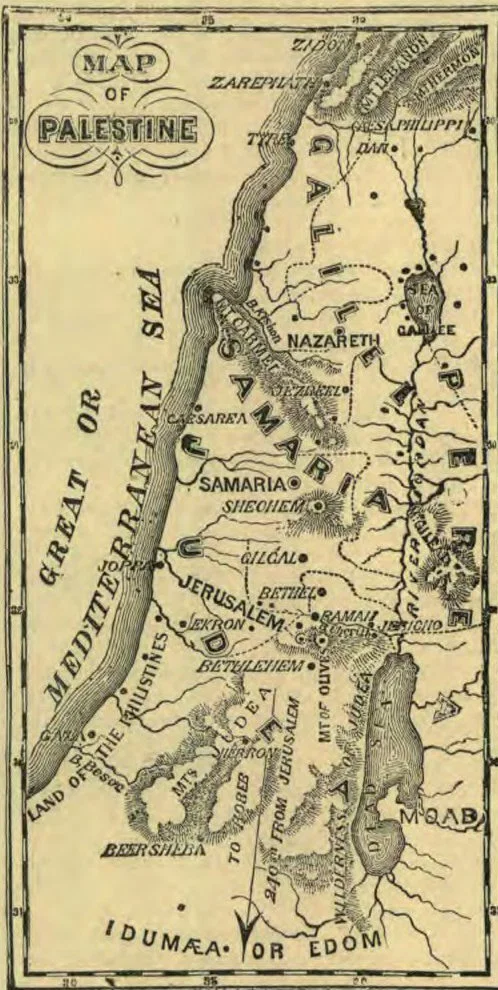
THE following from the pen of an eminent Bible historian gives quite a vivid picture of Jerusalem at the time of the advent of our Lord:—
“A thoughtful, venerable man might be seen riding slowly along the road from Hebron to Jerusalem, and at last entering the holy city. It is the aged Zacharias, a priest of the course of Abia; it has come to his turn to serve his week at the temple,—for the priests of each of the twenty-four orders have to attend in succession a week at a time.
“Jerusalem is not like the Jerusalem of former times. As he passes Mount Zion, on his way to the temple, he gazes with a mournful feeling on the palace of Herod, surmounting the height where of old King David dwelt. A heavy sigh escapes him as he makes obeisance to the king, rolling in his Roman chariot; for in place of the gentle piety and fatherly benevolence of a David or a Josiah, he can read in that old wrinkled face nothing but the cruelty of an Idumæan, and the stern shrewdness of a Roman governor. Jerusalem has been greatly improved of late, and each time that Zacharias visits it he finds some new building to admire. But in no case is his admiration unmingled with pain.
“There, along the northern brow of Zion, are the towers of Hippicus, Phasaelus, and Mariamne, all built by Herod,—the last recalling the memory of the beautiful but ill-fated daughter of the Maccabees, and the tragic end of the second dynasty of Jewish kings. There, guarding the temple, is the fortress of Antonia; it has lately got that name from Herod’s friend and patron, Mark Antony; but how can Zacharias look on it without remembering the guilty life and sad death both of the Roman triumvir and his beautiful paramour, Cleopatra? There, near the base of Mount Zion, is the circus or hippodrome, erected, in Roman fashion, for horse and chariot racing; and yonder, in the plain to the north, are two stupendous buildings, the theatre and the amphitheatre, where Herod has begun to introduce the gladiatorial fights and other savage sports of Rome. Everything about Jerusalem has a half-foreign air. The very language is not the language of Abraham and David; the Hebrews speak a sort of mixture of Syriac and Chaldee; others talk in Greek; and the strong-built military men, with the stern, determined countenances, speak the language of distant Rome. It gives little comfort to Zacharias to receive the salutations of the precise, formal men, with the broad phylacteries, who are making long prayers at the corners of the streets, or carrying across the stately bridge that joins Zion to the temple their tithes of anise, mint, and cummin. The Sanhedrin still has control over matters of religion, and there is something imposing in the appearance of that fine hall, reared aloft on piers and arches close to the temple, where the council meets; but Zacharias cannot have much sympathy with the Hillels, and Shammais, and other great rabbins, who seem to love their own traditions so much, and the word of God so little. The temple is no doubt much improved, and these long colonnades, supported by Corinthian columns of purest marble, form noble coverings for its courts; but are not the money-changers and sellers of doves usurping a more prominent place than they ought to have in them, and giving a too mercantile aspect to the house of prayer? And where is the spirit of former times? Has the glorious old line of kings and prophets come to an end? Where is the Branch of Jesse that was to bud forth in latter days? Does not communication with Heaven now seem to be entirely broken off? Shade of Ichabod! may not thy name be seen on each stone of these proud walls?”

THE USE OF MAPS IN SABBATH-SCHOOLS.

That maps are an important help in teaching the narrative parts of the Bible is now quite generally understood and appreciated; but the question of how they can be used to the best advantage has not been fully settled. Many schools are well provided with maps, which are of very little use to them simply because they are not judiciously used, or perhaps not used at all.
The object of using the map is to aid the imagination, and thus make events appear more real; but a dot does not necessarily create a conception of a city; a crooked line may appear to be merely a crooked line, and not a river at all; and so with the marks representing other things.
Now the best way to use the map is not merely to point to the places, and say, “This is Jerusalem; this is Samaria; this is Hebron;” but to talk about the place before turning to the map, and when you have made as good a word-picture as possible, and have come to the very point where the narrative connects with the place, then point out the locality, continuing to talk about it, as before, till your narrative is finished.
It is not our business to teach the map, but the map is to help us to teach something else,—to aid us in forming pictures, or rather real images, in the child's imagination. We want the map always by us, just as we want a pocket-knife, to be employed whenever circumstances call for its use.
Sometimes, however, it may be well to take a portion of time for the express purpose of describing a part of the country. Of course the map cannot help us much in the description, but it helps in showing the relative position of places, and in giving an idea of the general contour of the country.
But the question arises, “Who shall give this instruction? shall it be given by the teachers, or by the Superintendent?” If the Superintendent does it, he will have to use the time for general exercises; and this will interfere with reviews and general questions. If the teachers do it, several maps will be needed, and all the teachers will have to be thoroughly acquainted with Bible geography. It is probably best that it should be done partly by the teachers and partly by the Superintendent. In this case, one large map of each kind should be procured for the Superintendent to use before the whole school, and several small ones for the use of the teachers.
The Superintendent may occasionally take the time of general exercises for a lesson on Bible geography. It is probably best to begin by noticing the general features of the entire country,—mountain ranges and plains, valleys and streams, etc. This will certainly be enough for one lesson. Time should be saved at the close of the exercise to question thoroughly on what has been taught, and the whole should wind up with a recapitulation of what has been taught. It will be readily seen, then, that not very much should be undertaken at one lesson. At each new lesson, questions should be asked on the former lesson, and the portions that have been forgotten should be repeated.
But the Superintendent should work mainly through the teachers. As a rule, a lesson on Bible geography should be given at every teachers' meeting; not, however, to the neglect of the regular Bible Lesson of the week.
Again: the teachers should be encouraged to read; and steps should be taken to procure books, so that the teachers may have the means of informing themselves. Maps of Bible lands, without books on Bible geography, are next to worthless.
Books of travel should be read, and Sabbath-school workers should never rest satisfied till they can see, in imagination, every part of the Holy Land, as they can in memory see every part of a country over which they have so frequently traveled that it has become wholly familiar.
Let no one be disheartened by the magnitude of the work, nor by the slow progress which he must necessarily make at first. What is never begun will never be finished; and what is once thoroughly begun, will, if continued long enough, certainly reach completion. Of one thing, however, we may rest assured,—it will be of very little use to buy maps, and hang them up to ornament the walls, while the officers and teachers are comparatively ignorant of the countries they represent. Sabbath-school workers must become intelligent and well-informed, not only on Bible doctrines, but on Bible precepts, Bible history, and Bible lands. G. H. BELL.

Why Every Believer Should Attend Sabbath School

THERE is no one, I think, too old to be a regular student in the Sabbath-school. When a person is so old that he knows everything about the Bible, I do not think he ought to go to the Sabbath-school any more,—I think that he ought to go to Heaven. When we have our new fashions up to the old fashions, we shall have all the people interested in the study of the word of God, that in all wisdom we may teach and admonish one another.—Vincent.
Continue reading: WORDS FROM WORKERS