Your ShelfYour Projects

The Youth’s Instructor, Vol. 28, No. 35.

SILVER SMELTING
Earlier text: WORDS FROM WORKERS

Report of Kansas S. S. Association.

Names of Schools Names of Superintendents Membership Aver. Attendance Deep Conversions Amount State Association
Amity S. Alberty 37 27 yes
Belvoir Geo. Kennedy 25 18 “
Bennington L. H. Caton 25 17 “ 15
Bethany Levi Crawford 33 21 “
Big Timber J. R. Lowry 30 15 “
Bull City J. B. Carpenter 22 22 “
Centerville F. H. Morrison 42 28 “ 3
Clarion H. C. Main 19 18 “
Coopersburgh J. V. Mack 24 15 “ 18
Canton — 18 12 “ 3
Elivon J. F. Mullikin 24 16 “
Emporia M. M. Snow 26 14 “
Grenola Rue Hill 26 15 “
Hanover B. F. Truex 26 18 “
Harrisonville Ira J. Andrews 16 9 “
Lena Valley Mrs. R. E. Kellogg 10 10 no
Leona A. L. Curl 21 14 yes
Limestone T. F. Graham 9 8 “
Moline Mrs. M. E. Symms 30 19 “
Marsh Creek Sidney Thorpe 20 12 “
Noble Thomas Blake 34 30 “
Osage City Eva E. Kibbe 16 14 “
Osawkee J. M. Adams 46 33 “ 16
Oswego James M. Santee 29 20 “
Palermo Peter Mohr 34 27 “
Pleasant View J. H. Coffman 26 20 “
Pontiac M. J. Pierce 13 10 “ 10
Redden A. Saunders 25 13 “
Racelburg W. Everhart 21 16 “
Richland A. G. Miller 48 33 “ 7
Rock Creek Jonas DeVilbiss 32 30 “ 20
Salem M. E. George 37 18 “
South Mound Robert Aitken 18 13 “
Sterling E. E. Martin 31 25 “
Spring Creek A. C. Jones 21 20 “
Timber Hill Owen Boyle 14 13 no 15
No. Schools, 36 Totals 925 663 34 $1 07
A school is reported at Beloit, but no particulars given.
Names of Schools that failed to report:— Morton, Peru, Ward, Leota, Marsh Creek, Elm Creek.
Mrs. Ada A. Dawson, Sec.

Report of Maine S. S. Association.

Allen's Corner | Wm. Dunscomb... | 31 | 2 | | yes | no | $ 50 Burnham... | Warren Hezeltine... | 30 | 25 | | " | " | Brunswick... | Geo. W. Witham... | 25 | 22 | | " | " | Cornville... | Thos. B. Emery... | 20 | 19 | | " | " | Hartland... | Jas. F. Gifford... | 36 | 23 | | " | " | Norridgewock... | F. J. Kilgore... | 42 | 35 | | " | " | Richmond... | V. B. Patterson... | 23 | 16 | | " | " | Somerset Mills... | A. Gifford... | 24 | 22 | | " | " | No. Schools, 8 | Totals... | 231 | 183 | | 8 | | $ 50
All the schools in Aroostook County failed to report.
The superintendents of those schools that failed to report are requested to send me their names, also the names of their secretaries, at once. The treasury is short of funds and the tithes would be very acceptable. Do not refrain from sending because the amount is small.
ISADORE A. BAKER, Sec. So. Norridgewock, Me.

Report of Pennsylvania S. S. Association.

Blockville ........ H. M. Carpenter ... 29 12 20 Cottage ............ Daniel Newcomb ... 6 6 5 yes $20 Corydon ............ W. B. Knapp ... 11 10 4 " " $17 Catlin ............. James Backer ... 20 13 14 " " 10 Lindley ............ Judson Marsh ... 31 26 " Mathew’s Run ....... Wm. Wickham ... 7 7 5 " Millport ........... John J. Kenyon ... 21 4 " 13 Niles Hill .......... Elias Wyckoff ... 2 11 12 " yes 06 Portville .......... D. B. Welch ... 18 9 5 " " 13 Port Allegheny ... Wm. Wetmore ... 31 12 16 " " Randolph ........... F. Bowen ... 9 6 " no Russell ............ A. Clark ... 9 8 " Raymond ............ Benjamin Green ... 23 17 17 " yes 17 Sinclairville ...... Orrin Torry ... 29 " 30 Sabinsville ........ Mrs. N. S. Wilcox ... 16 7 5 " 25 Sunderlinville ..... C. D. Tubbs ... 35 26 20 " " 08 Smethport .......... G. H. Toles ... 16 10 8 " " 09 Wheeler ............ N. S. Raymond ... 17 10 " Wellsville ......... Wm. Simkin ... 28 22 17 " " 45 West Pike .......... B. Wetmore ... 12 8 " Coudersport ...... Mrs. H. F. Dingee Freehold ......... C. W. Smith Spring Mills ..... G. F. Evans ... 8 No. Schools, Totals ... 388 218 154 19 7 $2 13 Mrs. F. C. Oviatt, Sec.

Miscellaneous Reports.

Boulder, Col..... H. H. Pierce..... 40 33  yes
Longmont, “ C. F. W. Beeler.... 11 9  “
Reno, Nev., W. E. Fricke..... 19 17 7 “ no
Soliloquy, Va., G. W. Woods...... 32 22 9 “
Mt. Zion, “ J. Purdham........ 20 10 10 “
No. Schools, 5 Totals............. 122 91 26 5

THE WILLFUL BOY.

Phil sat by the cottage window with his lips in a terrible pout. What could be the matter? Why, his mother had gone down the street to see a neighbor, and had left him to take care of his baby sister. Now, Phil meant to have sailed his little boat on the pond just below the garden, and he was very angry to think that his sport was spoiled. He was not willing to give up anything for the dear mother who had done so much for him.
“I won’t take care of her, any way,” muttered Phil to himself. “If I can’t sail my boat, I’ll read my new book.” So the naughty boy took his book, and soon forgot all about his sister.
She came and climbed up by his knee, but he pushed her off rudely. She stared at him with grieved, wondering eyes, and then went away.
Presently, with short, uncertain steps, she tottered to the door. She could just walk alone. Slowly she crept out and down the steps into the garden. Through the garden she toddled, her little feet seeming to carry her straight to the pond. Oh, will not Phil look up? No; he is too much engaged with his book to pay her any attention. Then she came to the very edge of the water, and looking in saw a pleasant, round face, encircled with little rings of light hair.
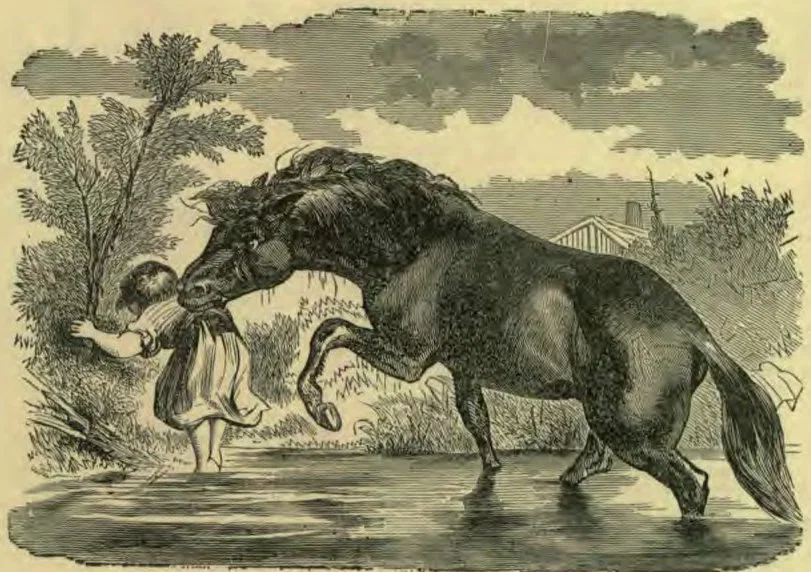
Pretty baby! Carrie stretched out her hands. Alas! alas! there was a quick splash and a scream! But help is near; not brother Phil, but the old family horse, Prince. See how carefully he takes her up by her clothes and carries her out.
Our artist has given us a very good picture of the sight that met the eyes of mamma, who was just returning home, and of Phil, who, having heard Carrie scream, rushed out to see what was the matter.
As mamma clasped her baby in her arms, oh, how thankful she felt to the faithful old horse! But I cannot tell you how bad she felt, to think that her little boy had been so naughty. Phil was truly sorry, and deeply repented, asking God’s forgiveness. He never forgets that through his disobedience his little sister nearly lost her life, and that to the faithful old Prince he owes a debt of gratitude. *

LETTER BUDGET.

We must try, although it is hot August weather, to “catch up” with the letters, for the pile grows larger instead of smaller, and we do want to be “polite” to our little letter-writers.
Emma Stout writes us, and speaks very highly of the INSTRUCTOR. She says that she has always lived in Bloomington, Illinois, and thinks it a very nice place.
Bertha Thayer, of Georgetown, Colorado, writes a good letter. She attends church and Sabbath-school on the Sabbath, and prayer-meeting on Friday evening. She likes the INSTRUCTOR, and after she has read them gives them to her little friends.
Frankie Kinne says that he attends Sabbath-school, and is trying to be a good boy. He wants the INSTRUCTOR family to pray for him.
Willie J. Griffith has been a reader of the INSTRUCTOR for three years. He lives twenty-four miles from any meeting. In answering the question in the article “A Visit to the Capital,” he has the years right, but not the weeks. Try again, Willie.
Rosa C. Dibble writes for the first time to the INSTRUCTOR. She has to go a mile and a half to Sabbath-school. She is having the whooping-cough, so can’t write much.
Flora McFeely writes us of the excellent Sabbath-school that they have at St. Helena, California.

RESULTS OF ACCIDENTS.

Many of the most important discoveries in the field of science have been the result of accident, and a large book might be written on these happy accidents that have brought either fame or fortune to some one.
Two little boys of a spectacle-maker, in Holland, while their father was at dinner, chanced to look at a distant steeple through two eye-glasses placed one before the other, and found that the steeple was brought much nearer the shop windows. They told their father on his return, and the circumstance led him to a course of experiments which ended in the telescope.
Some shipwrecked sailors once collected a pile of sea-weeds on the sand, and made a fire to warm their benumbed fingers and to cook their scanty meal. When the fire went out, they found that the alkali of the sea-weed had combined with the sand and formed glass.
In the days when every astrologer and every chemist was seeking after the philosopher's stone, some monks, carelessly making up their materials, by accident invented gunpowder, which has done much to diminish the barbarities of war.
Sir Isaac Newton's most important discoveries concerning light and gravitation were the result of accident. His theory and experiments on light were suggested by the soap-bubbles of a child; and on gravitation, by the fall of an apple as he sat in the orchard. It was by hastily scratching on a stone a memorandum of some articles brought him from the washerwoman's, that the idea of lithography first presented itself to the mind of Senefelder.
Blue-tinted writing paper arose from the carelessness of a woman. Mrs. East, the wife of an English paper-maker, going among the vats while the workmen were at dinner, let a blue-bag fall into one of them. Horrified at the mischief that she had done, she said not a word about the matter. The spoiled paper was hidden away in his warehouse by the angry paper-maker for four years; then he sent it to his London agent, to be sold for what it would fetch. The novelty was admired, and the agent not only sold the whole stock of blue paper at a high price, but asked for more.
Middle-aged persons remember when the fourth page of a letter sheet was left blank, so that it might be folded outside, and the address written upon it. Now, envelopes are necessary utilities; but their origin was due more to accident than design.
A Brighton stationer took a fancy for dressing his window with piles of writing paper, rising gradually from the largest to the smallest size in use, and to finish his pyramids off nicely, he cut cards to bring them to a point. Taking these cards for diminutive note-paper, lady customers were continually wanting some of that “little paper,” and the stationer found it advantageous to cut paper to the desired pattern. As there was no space for addressing the notelets after they were folded, he, after much thought, invented the envelope, which he cut by the aid of metal plates, made for the purpose.

You have reached the end of this edition.

The Youth’s Instructor · Aug 25, 1880