THE day our last meeting in Russia closed, Oct. 31, 1909, Dr. F. W. Vasenius and wife and myself departed on the steamer “Tschischatschow” for Alexandria. Dr. Vahon Pampaian went with us also as far as Constantinople, at which place we did not arrive until Monday evening, for our third-class passengers had to go ashore as we entered the Bosporus, to pass the quarantine. Several brethren called on us in the evening. Next morning we went ashore; and, so different from former days, no official troubled us about passports or anything else. When we reached the house of Elder Z. G. Baharian, we found quite a company gathered awaiting us. Brethren E. Frauchiger, Guy Dail, Baharian, R. S. Greaves from Smyrna, Onik from Nicomedia, F. Scior, and C. Voigt, who had lately arrived from Germany, were present at the council; Dr. Pampaian, and later Elder H. F. Schuberth and Dr. E. Meyer, from Germany, joined us. The presence of a number of new workers seemed to indicate that a new era was dawning upon our work in the Turkish field. While in the past we have gained some foothold and have about two hundred thirty members, yet of late years the progress has been very slow. There have been many reasons for this,—plenty of obstacles, much sickness, and troubles from within and without; but now, in God's providence, the doors have been opened wide. The time has indeed come for broader and more progressive plans.
But while it is necessary to plan well, yet great success in the saving of souls, of whom millions are about us who know nothing of the precious truths God has entrusted to our care, is assured only by earnest, hard work. Accordingly, the council decided that Brethren Frauchiger, Scior, and Baharian should labor for the present among the million people in the great capital itself; Elder Greaves, in Smyrna and Albania; Dr. Pampaian and Elder Buzugherian in southern Asia Minor. Considerable attention was also given to the matter of securing more literature in the Turkish, Greek, and Armenian languages; and as Brother Voigt, who has gained considerable experience in the Hamburg House, has gone to Constantinople to establish not only a branch, but also to look after the circulation of literature, we hope for greater results in this direction.
On the morning of November 4, our steamer pulled out again, Elder Greaves going with us as far as Smyrna, where we called next day on Mrs. Greaves and some Greek Sabbath-keepers. After a short stop at Piraeus, where the presence of several foreign men-of-war was evidence of the insurrection which had recently occurred in the small Greek navy, our steamer arrived at Alexandria, November 8, and by evening we had reached Cairo. As Brethren G. Keough and Awada were conducting a series of meetings at Luxor, we met only Mrs. Keough, and Brother E. Hartmann who had lately come to this field from Germany, and Brother Bezirdjian. While the work has moved slowly in the Turkish field, this is still more the case in the Arabic field, both in Egypt and in Syria. For years we have tried to secure workers who would stick to the field,—become real “apostles” to it, learning to know not only the Arabic language but also the people,—but sickness and a number of other difficulties have defeated our attempts. We now hope that brighter days are also before us here. As there are millions of souls everywhere, and many Europeans as well as natives, there is no reason why earnest efforts should not assure success. But workers are needed who will stick,—persevere,—and have that overcoming faith which, by the power of God and his truth, conquers every obstacle.
Early on the tenth we left Cairo for Suez. One of our Armenian sisters, with her three children, went with us, to join her husband at Port Sudan. After various vexations — necessary accompaniments of Oriental travel — we boarded our steamer “Prince Abbas,” one of the Khedivial line, and at 5 P. M. pulled out into the Red Sea. Quite a change had taken place in the temperature, and the heat became more and more oppressive as we neared the Sudan. On Sabbath, November 13, early, our steamer entered its chief port, Port Sudan, where a fine express-train awaited12the passengers at the docks, to take them in twenty-four hours, through mountains and desert, to Khartum, Sudan's noted capital. What great changes have been wrought in this region, especially during the last twenty-five years! Up to the nineteenth century, there was no permanent connection between Egypt and the Sudan. About two hundred miles of desert and the Nile cataracts were effective barriers, behind which Ethiopia extended, a land almost unknown. The noted Mohammed Ali broke the spell, however, conquering, between the years 1819-38, the provinces of Dongola, Berber, Kassala, Sennaar, and Kordofan, founding Khartum as its capital. The Turkish sultan conveyed this territory to the viceroy as the “Egyptian Sudan.” Mohammed Ali sent three expeditions to find the sources of the Nile, but not until 1860 could Speke and Grant notify the world, “The Nile is settled.” About the same time Sir S.
Baker created another self-governing province between 2° and 6° north latitude, called the “Equatorial.” To this, in 1874, the province of Darfur was added. But Egyptian rule proved a failure; the twelve hundred seventy miles between Cairo and Khartum, with no proper means of connection, gave too much freedom to the local governors, who so pressed the Sudan with taxes that the Sudanese called the Egyptians “devils covered with men's skins.”
About 1840 a common ship carpenter at Dongola had a son born to him called Mohammed Ahmed. He not only committed the Koran to heart, but passed with success the theological schools at Berber and Khartum, became a wandering monk, and finally settled on an island in the Nile, where many pilgrims flocked to this “saint,” and quite a settlement sprang up. The government summoned him to Khartum, but he refused to go, and withdrew to the mountains. Expedition after expedition was sent there from 1880-83, but all in vain, and the provinces became the spoil of this so-called Mahdi. Khartum itself was threatened, and General Gordon was sent to remove the seat of government. But he chose to remain there; and after a noble defense Khartum became the prey of the Mahdi, January, 1885, and Gordon was killed.
Two months later the Mahdi died, and Calif Abdullah succeeded. He conquered Sennaar and Kassala shortly after, and in 1888, advanced into the very heart of Abyssinia. He now threatened Egypt, but sixteen thousand dervishes perished in the battle of Toski to save their country; however, the Equatorial province became his prey. Meanwhile the English invited the Italians to occupy Eritrea, and their army defeated the dervishes, and took Kassala in 1894. France also advanced to the Upper Nile, and Captain Marchand planted the tricolour at Fashoda, July 10, 1898. To check this advance of France, England, who had built a railway some two hundred twenty miles long, through the desert, sent General Kitchener, with twenty thousand men and much artillery, to take the new capital of the Mahdi, Omdurman. Sept. 1, 1898, the dervishes suffered a dreadful defeat, and by September 19, five English gunboats appeared before Fashoda, and the French flag had to recede from the Nile. But not until 1899 was this Mahdi finally defeated and killed.
VIEW OF SUAKIN
England and Egypt now rule over the vast Sudan, the flags of both countries are on all public buildings, but naturally England rules, and Egypt provides most of the men and money. The railway is now being pushed from Khartum up the Nile; steamers ply clear to Gondokoro in Uganda, and all this vast country is opening up to missions. A number of Catholic missionaries, who work in the upper Nile region, went with us. One of them had been laboring here for twenty-one years, in spite of heat and fever. Thus far there are only a few Protestant mission stations in the Sudan. When will Seventh-day Adventist missionaries enter this vast open field? These thoughts filled our minds as a few of us called on Mr. Tommian, and then in his house had a little Sabbath prayer-meeting, the first, undoubtedly, held in the Sudan. There is one Sabbath-keeper here, at least, to witness for the truth.
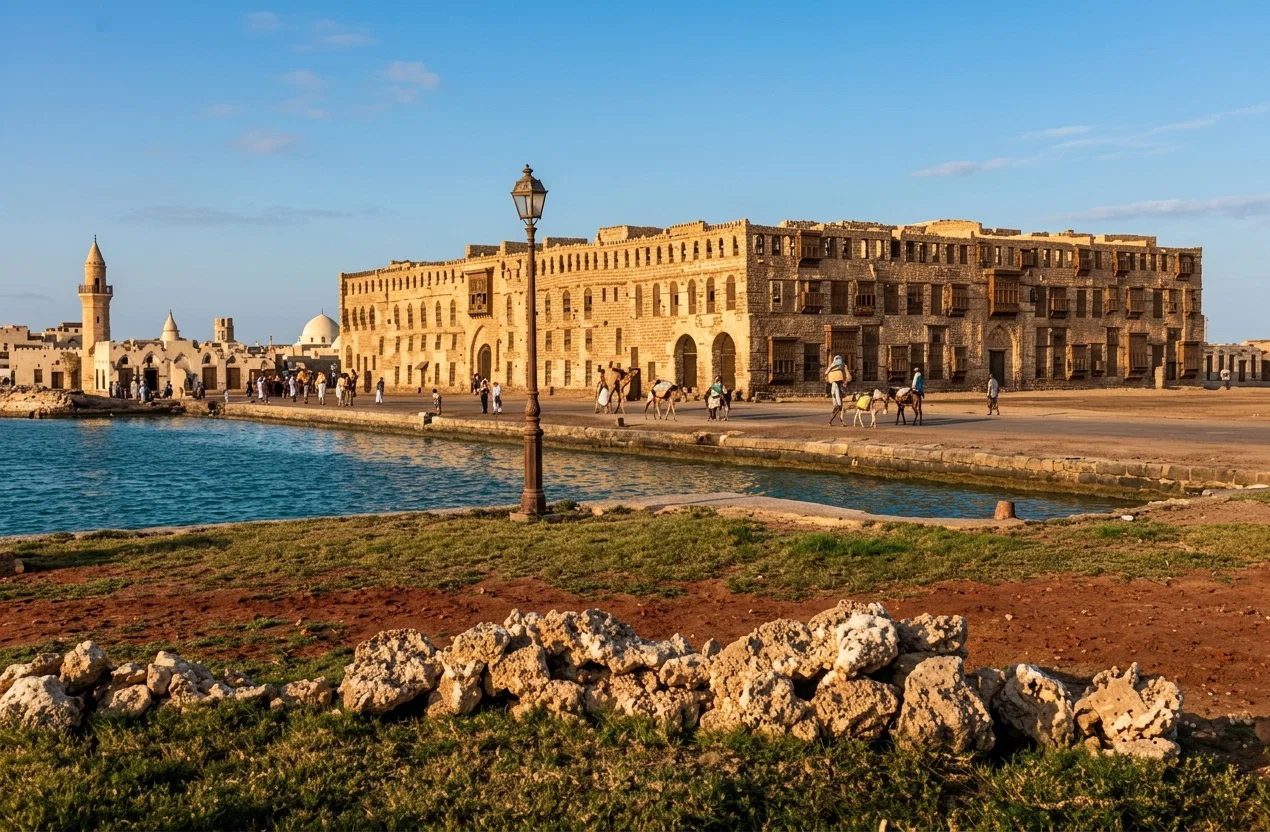
Port Sudan is a modern town and port, of easy access, with harbor spacious enough to shelter quite a fleet. Sunday morning the freight steamer “Mahalla,” of the same line as ours, entered the port, coming from Jiddah, the entrance port for Mecca. With it came Brother Toppenberg, who had traveled in a German East African liner with our East African missionaries as far as Suez, and left there on November 8. The same afternoon we went to Suakin, the ancient port of the Sudan, connected now also by rail with Port Sudan. The walls and fortifications are still there—evidences of the conflict with the Mahdi, at which time this port played an important part. As the port is small, and the town lies low on an island, and there are sand-banks at the entrance to the harbor, it has cost a great deal of money to create Port Sudan. Here we transferred from our mail-steamer, which ends its journey there, to the “Mahalla,” as ancient a steamer as I have ever traveled on — about sixty years old.
Early November 15, we left Suakin, and on the sixteenth the high mountains of Abyssinia greeted us; by noon our steamer was safely anchored at Massawa, the port of entrance for northern Abyssinia. We were now in the Italian colony of Eritrea. Brother Lindegren had been waiting for us some days, and after patiently toiling to have our goods pass the custom-house, he took us to a lodging-house near the landing. Sixteen days on the Black Sea, the Mediterranean, and the Red Sea had taken us from the great Northern Empire to Ethiopia. We had touched ports in Turkey, Asia Minor, and Greece, traversed the delta of Egypt, been in the Sudan, and now set foot on ancient Ethiopia. Suakin and Massawa are both noted for their pearl fisheries. We had brought pearls of inestimable value—would they be appreciated and accepted?
Hamburg, Germany.
Put Yourself Into Your Gift
CYRUS gave up a cup of gold to Artabazus, the courtier, while to Chrysanthis, his favorite, he gave only a kiss. Thereupon the courtier demurred: “Sire, the cup you gave me was not so good as the kiss you gave Chrysanthis.”
Many hearts are hungry, vacant, aching, after receiving costly Christmas gifts, because the giver is not in the gift. The precious gold, frankincense, and myrrh laid by the three kings at the feet of the Christ-child would have been shorn of their value had not the offerings been accompanied by the hearts of the givers. Who gives of himself gives that which is above rubies, that which alone can satisfy and uplift humanity—love, “the greatest thing in the world.”—Success.
The Cape Colored People
By D. C. Theunissen
D. C. THEUNISSEN
THIS term is used to designate a race of people distinct from the white man and the original natives of Cape Colony — a mixture of these two, but more especially of the white settlers and the Hottentots.
In former years they were in slavery to the Dutch. But in 1834 they were liberated by the English, who bought their freedom for three million pounds. This act naturally created a warm feeling toward the English; and in their many wars against the Kafirs, the Cape colored people were always ready to help them, until these tribes were subdued. As a reward, they received tracts of land free from taxes, where are now found some settlements, the franchise also being granted them in a limited sense. At present they number between fifty thousand and sixty thousand. The Cape Dutch language is used; but a great many, having been employed by the English as servants, or having received some education, can speak English fairly well.
But, generally speaking, notwithstanding they were freed from slavery nearly thirty years before the American colored people of the South, yet their condition is in many respects similar to-day to that of the American Negro. Drink, the curse of the age, although kept away by law from the raw native, has done its deadly work among them, and disease13and vice have helped to carry hundreds to an untimely grave, with no hope beyond. However, through the self-sacrificing efforts of the white missionaries who have labored among them, thousands are now respectable members of the church, and are able to read and write, and not a few have learned trades, and have property and business of their own.
In the providence of God, the writer was one of the first, if not the first, among them to receive the present truth, now over seventeen years ago. And, with a very limited education and but little training, he offered himself to the conference to labor for his own people, and was accepted.
His work for a number of years has been in the city of Cape Town and its suburbs, and with the blessing of God a goodly number have accepted present truth. At the beginning of the year 1909 one little church was organized at Salt River, another at Paron, while another company worships at our city church in Roeland Street [Cape Town].
The believers in our Cape Colony Conference now number over sixty adults. Poor in this world's goods (there are scarcely any who own any property), yet they are faithful to God in their service to him, and I believe there could not be found anywhere a people more stanch to the truth and more willing to sacrifice in its cause.
At our last conference a resolution was passed that a ward for the colored people be built to our sanitarium at Plumstead as soon as means could be obtained. This building is well under way, I understand, and before this appears in print, it may be completed. In Dr. Geo. Thomason the colored man has a friend in the best sense of the word. He has been faithful in relieving their sick and giving of his means toward the erection of the above-mentioned building, to the end that the sick may be under his immediate attention.
I might add that these people are scattered all over the colony. The women are employed as domestics, and the men on the farms, etc. Much work is to be done to reach them all with the truth; but I pray that the Father may raise some from among them to come to my help. I am now laboring at Worcester, about one hundred ten miles from Cape Town. A few thousand are living here. My knowledge of our health principles has been a great help, this being indeed the “right arm” to open doors that otherwise would have been shut. The prospects are encouraging. One intelligent young woman has already yielded to the truth, and I trust others will follow her example. Pray for the effort among the Cape colored people.
Worcester.
A West Indian Experience
By E. W. Webster
E. W. WEBSTER
I REMEMBER that while laboring in the West Indies years ago, we had a poor blind sister who was dependent upon the church. Its members furnished her a room in which to live, and carried her food by turns, or gave her a penny as they could spare it. Sister B. was happy in her Father's love, and trusted him and the church.
One day the deacon’s wife called to sell Mrs. Webster some fruit.
Mrs. Webster said, “Well, Sister M., how are you this morning? and how is Brother M.?”
She replied, “I am well; and my husband is tolerably well, only this was his day to give Sister B. her portion, and as he had only a threepence this morning, he just sent it to Sister B., and went to his work without his breakfast. But he is well, praise the Lord, and happy.”
At another time we were raising a fund with which to get some tracts for the church to use in missionary work in the city. All were anxious to do something. Even the children caught the enthusiasm. Some gave a shilling, some more, some less. What one little girl of eight said when she brought her offering is only a sample of what many others did:—
Elder: “How did you get so much money? Did it not take you a long time to earn all this?”
Girl: “You see, elder, I worked for mama, and she gave me some pennies. Sometimes I sold some sweets, or some tracts and papers, and sometimes I said to mama, ‘Mama, give me my penny for my breakfast this morning [they often gave them a penny and let them go out and buy their food]; I want to take it for my pledge to the tract fund. I will go without eating to-day.’”
This spirit prevailed largely in the church at that time, and a good harvest was gathered from the effort a few weeks later. Do you wonder?
Tampa, Fla.
How a Heathen Read the Bible
By W. C. Hankins
W. C. HANKINS
A FEW days ago we received a letter from a heathen druggist asking us to come and start work in his city. Elder N. P. Keh went to see him, and last evening gave this account of his trip:—
The first day he did not go directly to the man's house, but spent the day in inquiring among his acquaintances as to what kind of man he was. He found that he was a man of good reputation and was well thought of by both heathen and Christians.
The next day he went to see the man, and stayed with him several days, studying the Bible with him and answering his questions. The man had quite a number of Christian friends who had given him literature and tried to persuade him to go to church with them; but he would never go. He read the books they gave him, and also read the Bible; but in the meantime he watched the Christians and studied their lives, with the result that he saw so great a difference between their lives and the teachings of the Bible that he would never go to their churches.
One of the greatest inconsistencies that he observed was that they kept the first day of the week instead of the seventh; for it seemed to him that the Bible very plainly said that the seventh day is the Sabbath. Finally he learned from a young preacher of one of the other missions, who was himself interested in the truth, that there was a people who kept the seventh day as the Sabbath, and he was so anxious to know more that he wrote asking us to come to see him.
Elder Keh says that the man was planning to keep the Sabbath, and that there are a number in the same section who are going to keep it with him, some from among the heathen, and some from the other churches. The young preacher, mentioned above, has been studying the truth for about a year and has quietly sown much seed, especially among the heathen. He himself has fully accepted the truth and has been baptized, and is now working—without pay—to help one of our evangelists organize the work in that section.
God is opening the doors before us almost faster than we can enter them. The interest in the Kityang district, near Swatow, is steadily increasing, as is the interest throughout that whole country around Chow Chow Fu and Swatow. But every one of these openings calls for a greater consecration on the part of God's people, both here in the field and in the home land. We must have more men, more means, more prayer.
We earnestly ask you to pray for this needy field, and would like to suggest that as many as can do so will consecrate a few minutes during the noon hour to offer special prayer for God's blessing upon the work in this dark land.
Amoy.
Three Hundred Thousand Dollar Fund
Statement to February 1, 1910
Atlantic Union Conference
Central New England ........ $ 45.40
Greater New York ............ 8.71
Total ....................... 54.11
Central Union Conference
North Missouri .............. 101.82
West Colorado ................. 1.00
Wyoming ...................... 274.15
Total ........................ 466.97
Lake Union Conference
Indiana ....................... 75.16
Northern Union Conference
Minnesota ................... 2660.10
North Pacific Union Conference
Western Oregon ................ 10.00
Southern Union Conference
Florida ....................... 94.50
North Carolina ................ 5.00
Total ........................ 99.50
Miscellaneous
New Zealand .................. 102.27
England ...................... 490.00
India ......................... 15.00
Total ........................ 607.27
Grand total ................ $3,973.11
British Columbia Conference
By H. S. Shaw
THE ninth annual session of the British Columbia Conference of Seventh-day Adventists convened in the chapel of their commodious school building, at Pitt Meadows, January 20-23. There was practically a full delegation present. It was a pleasure to meet these brethren and sisters from the different churches in British Columbia, and to see their love and zeal for the Master's work.
The report of the conference president in his address to the delegates showed a gain of twenty-five per cent in the membership during the past year, a portion of this number having moved in from other parts of the field. Two new church buildings were erected in the conference during 1909. The tithe shows a gain of about eighteen per cent over the previous year.
The Sabbath-school work is prospering. More interest has been taken in the study of the lessons, and the donations have increased. One feature of interest was that all the Sabbath-school donations went to the support of foreign missions.
The school work is receiving due attention. The Manson Academy has an enrolment of between thirty and forty students. This good school has been struggling under some difficulties, but circumstances are beginning to brighten, and those in charge are much encouraged. Brother Kenneth R. Haughey is principal of the school, and is giving good satisfaction.
The book work has not been so prosperous as was hoped, owing to certain reverses which it suffered, but the prospect is good for a prosperous year in 1910. A competent man has been secured to take charge of this work in the conference, which will add strength and courage to the canvassers.
A good interest has been taken in the matter of donations to missions. More than ten cents a week for each member in the conference has been raised during the year. This is a considerable gain over the year 1908. The conference also voted to raise its part of the $300,000 Fund to be given by our people in North America during the next three years, for the great work to be hastened on in China and the Orient. It was also voted to continue the ten-cent-a-week plan for the support of the missionaries already in the field.
Elder John G. Walker was elected president of the conference, and Sister Bertha Lofstad secretary and treasurer. Brother E. R. Potter was elected to take charge of the canvassing work. Elder W. M. Adams plans to take a much-needed rest, and had requested to be released at this time. Elder Walker is a man of experience in official work, having served as president of the North Dakota Conference a number of years. The brethren in British Columbia have given him a warm welcome. While we regret to see Elder Adams leave Canada, yet he feels that it is best to take a vacation, and we wish him much of the Lord's blessing.
Everything considered, I believe this, though not so large as some, was one of the best conferences I have ever attended. The Lord was present to help us in a special manner, as was manifest to all who were there. Our brethren and sisters returned to their homes full of courage and hope, and with a determination to be loyal to the cause of truth so dear to this people in all the world. May the Lord bless these faithful servants as they labor to hold up the light in the British Columbia Conference.
H. S. SHAW.
North Carolina
By W. L. Killen
HIGH POINT AND LEXINGTON.—Last November, under the direction of our conference committee, I began work in High Point, a thriving little city of about eight thousand inhabitants.
My first work was from house to house, with the Family Bible Teacher. I soon found one hundred families who were glad to take a full set of the readings, each family paying me twenty-five cents a set, two readings to be delivered weekly, Mondays and Fridays.
This plan worked well. I had never heard of its being tried, but desired to do away with those little troubles which are continually arising under the old plan; namely, losing the readings, handling soiled and crumpled leaflets, losing time waiting for some one to find the reading, and many other annoyances.
My readers are the leading families in the city, and all have enjoyed the lessons. I keep close watch of each family, and know whether they are reading or not. Sometimes they are away when I deliver. I ask such questions as, What number did I deliver to you last? What lesson has especially impressed you? Sometimes they lose a number; I always replace it, impressing from the very first the importance of preserving and rereading the leaflets. Many are sewing them together.
I have many blessed experiences with the people. I never enjoyed a work more in all my life.
I have also about twenty-five families, each paying fifteen cents a month for the weekly Signs. I deliver these also.
When I find one especially interested in any one subject, I take him additional helps. I have sold “Daniel and the Revelation,” “Coming King,” and other books to my readers. I can not tell yet what the visible results will be, but I do know that many precious souls are reading present truth; and as long as they will read, I will see to it that they get reading-matter. I am sure that this is the Lord’s means in warning the world.
Besides my regular readers I am visiting scores of homes, placing in them the good papers and tracts our brethren are sending me for free distribution. We are very thankful for this literature, and as soon as I get these papers and tracts from the post-office, I put them in the homes where they are read.
In Lexington we have a small company of believers as the result of our camp-meeting there, and the faithful labors of Elder T. H. Jeys two years ago. I visit this company twice a month. The interest is good, and we hope soon to have a protracted meeting for the upbuilding of the work. Pray for the work in these places.
W. L. KILLEN.
British Central Africa
By S. M. Konigmacher
MATANDANE MISSION, NYASSALAND.—Last Sabbath we had one hundred at service and Sabbath-school. After service I went to six villages and talked to the people there,—one hundred twenty-five,—and my house boy went in the opposite direction to three villages, and found sixty-eight. Thus nearly two hundred more heard the blessed word. We are grateful for any sign of progress. The people come to the house of God with nice, clean clothes, and some have on new white sheets. And they are more orderly in God's house than many of our people at home. When they come, even in school, they sit down and bow the head, and will then rise if the congregation is standing.
We have nearly eighty in our school. The little ones are memorizing the law of God. The older ones have just finished 1 Corinthians 13, and they have a great deal of charity for their people, and will divide with one another. We have two teachers. The head teacher lost his two-days'-old baby. We did all we could to save it. Early Sabbath morning we buried it. Mrs. Konigmacher found a few wild sweet peas, and gave them some nice new white cloth to wrap the little one in. I placed grass in the bottom of the grave, and after they put the baby in, I covered it with more grass. I then read 1 Thess. 4: 13-18, sang two songs, and said a few words. One of the boys prayed. It was a Christian burial, conducted in the native language; and, although the time was early, some were at the grave.
We are getting hold of the language, and find that when able to speak to the people in their own tongue, we can reach them much better. On Sabbath I tried my first sermon. Mrs. Konigmacher helped some; and also the boys, who understand the way the white man speaks, can put one right if he makes a mistake. With every effort comes more15strength. It is absolutely necessary to get the language. On going to a new country, do not surround yourself with English-speaking natives. Get the raw native, and you will get the language much more quickly.
I visited some of the missions farther up country, and learned many helpful things. Most are industrial, and are surrounded by fine plantations. Before the people go to work in the morning, there are sometimes three hundred on some of the plantations. The missionary has worship with them all. Thus many hear the word who would not come for any other reason than to earn money. The natives are also surrounded by the Christian influence of the mission. There are many out-schools, with a white teacher to supervise them. Some stations have a number of cattle, goats, and sheep. A good work is being done. After the morning labors, all the younger children come to school.
I also visited the Catholic mission. They are putting up a fine church. As I passed through the villages, I saw the beads hanging from the necks of the poor people.
We are very anxious to enter Portuguese territory. It is a difficult place to get into, but God will open the way. One wrote and asked what is needed in a mission field. It is all summed up in this: “a close connection with God.” Unless God is with us, and works through us, our efforts will not be successful. It is impossible to teach darkened hearts like these without the power of God. We must live the truth before them. S. M. KONIGMACHER.
Be Strong
Be strong!
We are not here to play, to dream, to
drift.
We have hard work to do and loads to
lift.
Shun not the struggle; face it; ’tis God’s
gift.
Be strong!
Say not the days are evil — who’s to
blame? —
And fold the hands and acquiesce — O
shame!
Stand up, speak out, and in God’s name.
Be strong!
It matters not how deep entrenched the
wrong,
How hard the battle goes, the day how
long.
Faint not, fight on! To-morrow comes
the song.
— Selected.
The Book Work in Florida
By E. R. Button
THERE seems to be a revival in the book work in Florida, and whereas there was but one canvasser in the field the twentieth of last October, and he had to go home to care for his orange crop, there are now twenty-six, fifteen of whom are devoting all their time to the work; the others are women who have home duties, but who find time every week to devote several hours to this blessed work. It is the little streams that swell the current.
For the month of January (and, by the way, January is always considered the dull month of the year) the book sales in Florida, not counting the time devoted to delivery, will aggregate a sum beyond the thousand-dollar mark, with the tendency still upward. The second week in February our King's Messengers plan to take one thousand dollars' worth of orders, and even more if within the range of possibility. I shall let the readers of the REVIEW AND HERALD know the result of that one week's work.
A brother from Memphis, Tenn., who recently accepted the truth, came to Florida last week to take up the canvassing work, and after five-hours' work from house to house with the State agent, during which time he took notes, he started out, and his orders the first day of seven hours amounted to $27.15. And they were all good orders, too, for they were taken on Terra Ceia Island, the garden spot of Florida.
E. R. BUTTON, Field Agent.
Florida Conference and Camp-Meeting
By R. T. Dowsett
Through an oversight a report of this meeting has not been given through the columns of the Review, but we believe many who are interested in the progress of the work in Florida will be glad to have the details of this meeting even at this late date.
The camp was pitched on a commodious lot in the center of the city of Orlando. The Florida Conference did everything in its power to make the campers comfortable, and the meeting was a most pleasant one, as well as very profitable. It was the opinion of many that it was the best meeting that the Florida Conference had ever held. The laborers from abroad were Elders A. G. Daniells, W. A. Westworth, C. B. Stephenson, Brother V. O. Cole, and the writer.
The conference was held two days before the camp-meeting proper began. Nearly all the churches in the conference were well represented, and the business passed off very harmoniously. Elder R. W. Parmele was re-elected president, with a strong committee to sustain him in his administration. Mrs. R. G. Stringer was re-elected secretary and treasurer. Brother E. R. Button, who had recently entered the State, was elected field missionary agent.
During the year there was a gain in membership of about one hundred persons, and three new churches had been organized. There was a gain of over two thousand dollars in the tithe receipts, and a substantial gain in the amount of offerings contributed to missions, so that Florida will average twelve cents a week a member for 1909, while in 1908 the average was but five cents a week a member. There was an encouraging increase in the number of books sold during the year. Florida starts out with good prospects of doing some real aggressive work for the current conference year.
Elder Daniells's labor was very much appreciated by the brethren and sisters in attendance. The meeting throughout was a most excellent one. The preaching services were very practical, the evening services being devoted to the outside interest. Elder Parmele, with several of the Florida workers, had held meetings for a few weeks preceding the camp-meeting. We had the pleasure of seeing some take their stand for the truth as the camp-meeting progressed.
The brethren gave in cash and pledges nearly seven hundred dollars for the work in the local and union conferences; and nine hundred dollars was given toward missions. The conference also voted to appropriate two hundred fifty dollars of its tithe to the General Conference. We believe this is the first conference in the South to make a move in this direction, and we are glad to see the cause rising in the great Southland.
The Florida Sanitarium has enjoyed a good patronage for the first year of its existence. The force of workers has been small, but excellent work has been done, and a number of patients have been greatly benefited. There is a bright prospect for the Orlando Sanitarium. Its location is ideal; and with so many natural advantages, the institution is placed where it can be a great blessing to suffering humanity.
The brethren in attendance at the meeting returned home with greatly renewed courage and a determination to do more in the future than has been done in the past.
R. T. DOWSETT.
RUFUS C. WANGERIN
By Rufus C. Wangerin
Korea
SEOUL.— We foreigners have just had our good prayer-meeting, and the Spirit of God was present in abundant measure. Our hearts were lifted up in behalf of our mission and of the whole world—for our dear people in the home land, and for our brethren at the head of this great work. And how grateful we feel for the assurance that earnest prayers are ascending to the throne of God for us.
We are indeed thankful for the privilege of being in Korea. And now that we have come, and that for a purpose, we desire, above all things, to be of service to these people. Our hearts go out in love and sympathy to them. O, if we were only able to administer to their needs! Yet we are studying hard day by day to master the language; we can not do much else. We believe that God is blessing us in acquiring it. We have been in the field now just a little over two months. Twice I have spoken at Sabbath services through an interpreter. How these hungry souls gaze, and grasp every word, both from the speaker and from the interpreter, as only a very hungry man can act at a meal. And what a truth we have, what a message of hope to these poor Koreans!
RUFUS C. WANGERIN
South Carolina
By Mrs. J. F. Crichlow
GREENVILLE.—I am glad of the opportunity to write concerning the school here, which I opened Oct. 4, 1909, with six pupils. Although there were many discouragements, we feel grateful to the Lord for his goodness to us. From the enrolment of six the school has gradually increased to thirty-one.
The school has made a very deep impression upon the community, insomuch that children have been withdrawn from public schools and sent to our school. Our school room is very limited, otherwise I could take more children, though it would tax me to do justice to a larger number.
From daily Bible talks to the children, they have become deeply interested, and sometimes they ask me to continue the study longer. One of the leading men of this city told me that our mission school here is doing much good.
There is nothing like Christian education. The third angel’s message is the life of the world in all of its phases. Surely our work is a progressive work.
We would be glad to have a few Bibles and song-books for the use of the school; may the Lord impress some one to send us the help we need. My address is 601 Green Ave., Greenville, S. C. By way of industry, I am teaching sewing.