The Era of Religious Legislation Followed by the Dark Ages
unch
ANCIENT Israel furnishes the only example of a true theocracy in the history of the world. The Lord Himself ruled the nation, directing in all the affairs of government. The laws were of divine origin, and judgment was executed under God's direction.
Jehovah being infinite in wisdom, and infallible in judgment, all will concede that a government under His direct supervision would be ideal. But Israel became dissatisfied with the Lord as ruler, and wanted to take the government into their own hands. They clamored for a king to rule over them, and the request was finally granted, after they had been warned of the results of their evil course.
All went well so long as their king obeyed the Lord; but when he began to walk in his own ways, and listen to the voice of the people instead of the voice of God, Israel was led into no end of trouble.
He Separated Church from State
WHEN the Lord was no longer permitted to have full control of all the affairs of government, He did the only thing He could do under the circumstances — made a separation of church and state; for He alone can rule the two together. Since a king was given to rule ancient Israel, there has never been a true theocracy on earth, and there never can be one so long as sin abounds and present conditions prevail.
As civil governments have become corrupt, so-called "reformers" have from time to time endeavored to reform them by uniting church and state, having the church dictate the rules to govern the state, and the state enforce the dogmas of the church. Such a union, made and controlled by man, is a false theocracy, and has always proved disastrous to both the church and the state.
The Most Notable in History
THE most notable example in history of the results of a false theocracy is found in Rome. When increasing wealth, pleasure, and idleness, and other elements of national destruction, were causing the rapid decline of the iron monarchy of Rome, certain "reformers," aware of the corrupt condition of the civil government, and realizing that the Christian religion is the only power that can truly reform, began to urge that the two be united, and that Christianity be enforced upon the citizens of the state.
The results of such a scheme would not have been so bad had the church been in the condition it was in immediately following Pentecost, when the members were all filled with and led by the Holy Spirit. But with the power of the Holy Spirit, the church does not need, and has never called for, the power of civil enactments. When a church clamors for state laws to enforce a religious duty, that is an acknowledgment of a loss of the greatest reforming agency in the universe, the power of the Holy Spirit.
Not long after Pentecost, there came a "falling away," and the early church lost both the Holy Spirit and its "first love," without which the Christian religion is powerless to reform the human heart.
It was this Spiritless, backslidden church that began to seek the power of the state to enforce her man-made creeds, and with which it was planned to reform the government by uniting the two. A backslidden church united with a corrupt state is a bad combination, and the offspring of such a union has always been persecution.
A Sunday Law in the Lead
THE first religious law enacted under this false theocracy was a Sunday law, or a one-day-of-rest-in-seven act. This law was made by the emperor Constantine, A. D. 321, for the protection of Sunday as a day of worship. It was mild in character, containing exemption clauses for certain classes; but it gave these "reformers" a thirst for political power, and more stringent laws quickly followed. All places of business and pleasure were closed on Sunday, and there was no stopping place until every doctrine of the established church was legislated into law and enforced by the state.
The result was not a reformation, but the Dark Ages, during which Europe's soil was drenched with the blood of a hundred million martyrs. And all because of an attempt to "reform" the state and to protect religious institutions and enforce religious duties by civil law.
History repeats itself. Patrick Henry said, "I know of no way to judge the future but by the past." The history and results of religious legislation were repeated in the early days of this country, when the Baptists and the Quakers were persecuted because they were in the minority, and could not see their way clear to fall in with the majority and worship God contrary to the dictates of conscience. Most of these religious laws were for the protection of Sunday as a day of worship, and these one-day-of-rest-in-seven acts became so stringent that all the people were compelled to attend church and pay tithe, whether church members or not. Even the death sentence was imposed upon violators. The stocks and the whipping posts were in front of the churches.
Good Religion Can Care for Itself
THE examples of the past should serve as fearful warnings to American citizens, and especially to National Reformers, who, recognizing the condition of the state, are endeavoring to bring about a sweeping reformation by a union of church and state. But even though it were God's plan to form a theocracy, is the church to-day in a condition to reform the state by such a union? Are the majority of its members filled with and controlled by the Holy Spirit? If they were, they would not be clamoring for civil legislation to protect their religious institutions. Franklin said: "When a religion is good, it will take care of itself; when it is not able to take care of itself, and God does not see fit to take care of it, so that it has to appeal to the civil power for support, it is evidence to my mind that its cause is a bad one."
If the schemes of the National Reformers are carried out, another false theocracy will be formed, as dangerous as the ones in Rome and in the early days of this country, and religious legislation will be carried to the same bitter end.
Persecuting Threats
THE Rev. M. A. Galt, at one time a prominent National Reform worker, stated the purpose of the organization in the following: "Our remedy for all these malefic influences is to have the government simply set up the moral law, and recognize God's authority behind it, and lay its hands on any religion that does not conform to it."
Dr. David McAllister, one of the presidents of the National Reform Association, said: “Those who oppose this work now, will discover, when the religious amendment is made to the constitution, that if they do not see fit to fall in with the majority, they must abide the consequences, or seek some more congenial clime.” This is exactly what was done in Rome and during colonial days. Do we want their history repeated?9All over this country, men are demanding of Congress and state legislatures laws for the protection of Sunday as a religious institution. Exemption clauses and deceptive titles fail to disguise the fact that these are religious measures, designed to protect and enforce religious dogmas, and are un-American, uncivil, unconstitutional, unchristian.
The citizens of Oregon who understand the danger of religious laws will on November 7 vote to repeal the only Sunday law on the statute books, and place Oregon in harmony with the state and national constitutions, which guarantee not merely toleration, but absolute religious liberty, to its citizens.
The Bigot's Creed
The Bigot's Creed
"BELIEVE as I believe — no more, no less;
That I am right, and no one else, confess;
Feel as I feel, think only as I think,
Eat what I eat, and drink what I drink,
Look as I look, do always as I do;
And then, and only then, I'll fellowship with you.
"That I am right, and always right, I know,
Because my own convictions tell me so;
And to be right is simply this: to be,
Entirely and in all respects, like me.
To deviate a jot, or to begin
To question, doubt, or hesitate, is sin.
"Let sink the drowning man, if he'll not swim
Upon the plank that I throw out to him;
Let starve the famishing, if he'll not eat
My kind and quantity of bread and meat;
Let freeze the naked, too, if he'll not be
Supplied with garments such as made for me.
"Twere better that the sick should die than live,
Unless they take the medicine I give;
Twere better that sinners perish than refuse
To be conformed to my particular views;
Twere better that the world stood still than move
In any other way than that which I approve."
Christian Savages and Savage Christians
By P. T. M.
"While his conduct might seem strange to them, nevertheless it seemed more comfortable to his body and healthful to his soul to dwell among 'the Christian savages of Narragansett than among the savage Christians of Massachusetts.'"
OUR Puritan ancestors were a religious sect of English Protestants. They first arose during the reign of the great Queen Elizabeth. They came into being after the days of the mighty Reformation of the sixteenth century. The name "Puritan" is derived from the Latin word purus, meaning pure. The Puritans never designed to purify the world, neither had they any desire to purify the Church of Rome; but the task they assigned themselves was that of purifying the Reformation. As Archdeacon Hessey expressed it in his Bampton lectures, delivered before the University of Oxford, "They were determined to carry the Reformation further," that is, to reform the Reformation.
"Continental Sunday" and "Book of Sports"
RELIGIOUS liberty — the doctrine of the sacred right of conscience — was one of the cardinal tenets of Martin Luther, Melanchthon, and their colaborers. The monk of Wittenberg, especially, cared nothing for the observance, as a sacred rite, of the first day of the week. He considered dancing and the playing of games upon that day as legitimate as upon any other. It was his influence in the matter that gave birth to the institution known as the "continental Sunday."
This laxity of Sunday observance soon spread to England. King James issued his famous decree, or statute, "The Book of Sports," which permitted his subjects to indulge in amusements, pastimes, and sports, to their hearts' content, upon the first day of the week. This greatly angered the Puritans. They immediately began to demand that he at once repeal the provisions of "The Book of Sports," and enact all the laws of Moses into the civil code. This his majesty refused to do. Then the Puritans threatened his crown and kingdom, and began an attempt to overthrow his dynasty.
The monarch retaliated by persecuting the Puritans. He told them they must cease their conspiracies and seditions against his government. They did not do this, and so were driven from the realm of England.
Theocracy or Sunday Law Not Needed
THEY went to Holland, and there proposed to the Staats Generale — the legislative body of that little land — that they entirely change their form of government, and convert it into a religious theocracy. They proposed that the Ten Commandments be translated into the civil statutes, along with all the laws of Moses. And they further demanded that Sunday observance be enforced by civil law.
The Staats Generale referred their memorial to "the learned universities," who, after giving it careful and diligent consideration, returned answer to the legislature that they found no authority in the word of God for the setting up of a theocracy, or for the keeping of Sunday, the first day of the week.
This setback discouraged the Puritans. They had failed to get either England or Holland to adopt their ideas of government and of Sunday keeping. Then it was that they decided to go to a new land across the ocean, where they would be free to set up a theocratic form of government, and enforce the observance of the first day of the week. One of their most noted members has left on record a truly remarkable exposition of this scheme — published in a book bearing the unique title, "The New Canaan."
This instructive treatise set forth the fundamental theory of their governmental views. According to it, England was the land of Egypt; the Atlantic Ocean represented the Red Sea; the Puritans were the people of Israel; New England was New Canaan; and the Indian tribes — Pequots, Narragansetts, et al — took the place of the Canaanites, the Hittites, the Perizzites, etc. As God in the ancient days had appointed the heathen tribes of the land to destruction, the Puritans considered it perfectly proper for them to devote to death the Indians who surrounded them. They held that this was only carrying out the principle of the Scriptures. Hence they have been dubbed "those pious men who first fell upon their knees, and then fell upon the aborigines." It followed, too, that they had a right to seize the lands of the Indians without compensating them, for God had not given compensation to the Canaanites.
To the shores of this "New Canaan" there came a doughty little Welshman — Roger Williams by name. His ideas on religious liberty soon brought him into conflict with the prevailing notions of the theocracy. Roger was not slow to teach that to inflict penalties upon a man simply because of his religious views was persecution. This raised a storm. The Puritan divines rejoined that to inflict pains and penalties upon a man for not yielding to the claims of a false religion was surely a wicked act of persecution; but that to enforce a right religion by the power of the civil arm was not persecution, but the lawful province of God's church.
Williams, Cotton, and the Bloody Tenet
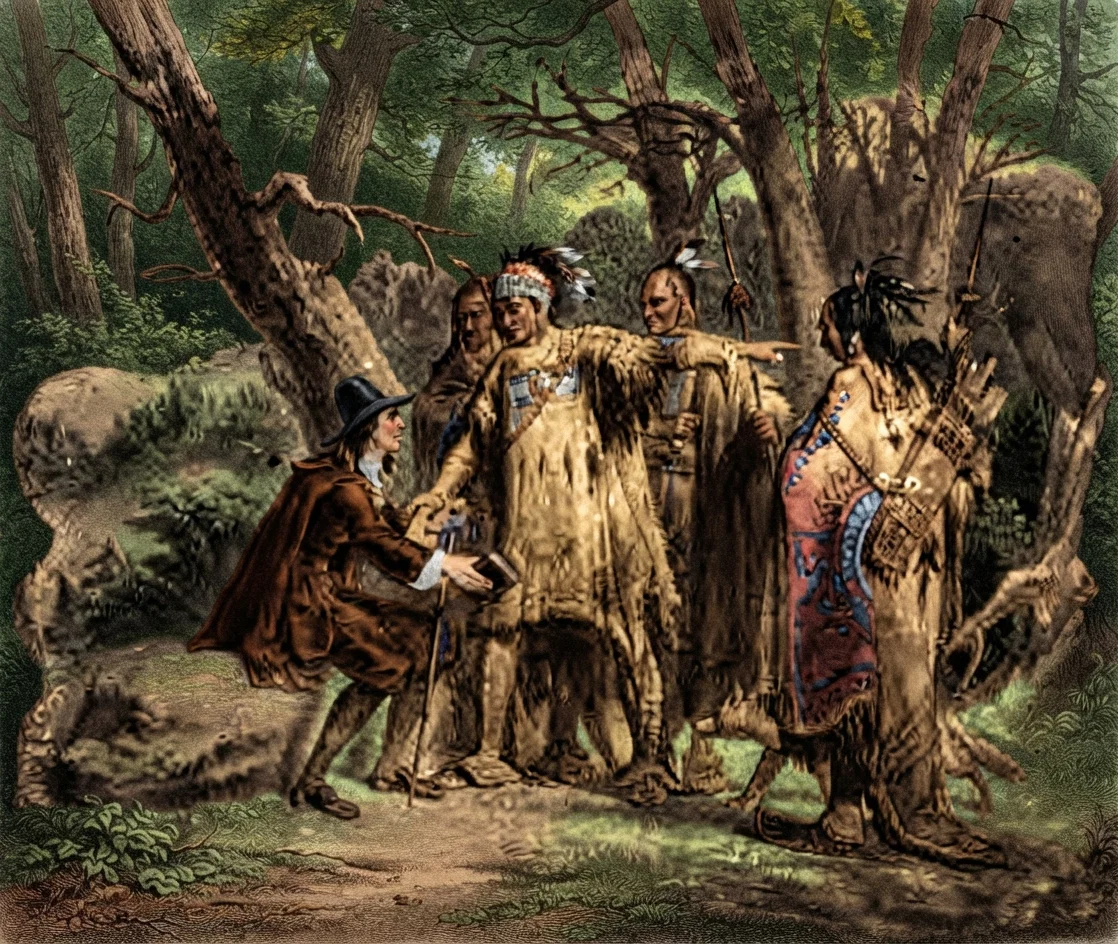
ALL of this led to a most heated discussion between Roger Williams and a noted Puritan divine named John Cotton. In the course of the controversy, John Cotton wrote a book defending the Puritan position, and gave it the following title: "The Bloody (bloody) Tenent (tenet) of Persecution Washed White in the Bloud (blood) of the Lamb." This at once drew the fire of the pugnacious little Welshman, who published a work in reply, to which he gave title as follows: "The Bloody (bloody) Tenent (tenet) of Persecution, Made More Bloody (bloody) by the Attempt of John Cotton to Wash It White in the Bloud (blood) of the Lamb." The Puritan preachers determined to make Williams smart for his heresy. But he, hearing that they were coming to seize him, fled in the deep snows of a bitter night, and took refuge with the Indians of Narragansett.
Baffled in their attempt to lay hold upon Roger's body, his Puritan brethren wrote him a letter in which they set forth that it seemed very strange to them that he should prefer to dwell among the savages of Narragansett rather than the Christians of Massachusetts. Roger wrote a letter answering this, in which he set forth that while his conduct might seem strange to them, nevertheless it seemed more comfortable to his body and healthful to his soul to dwell among "the Christian savages of Narragansett than among the savage Christians of Massachusetts."
SHELTERED BY THE NARRAGANSETTS
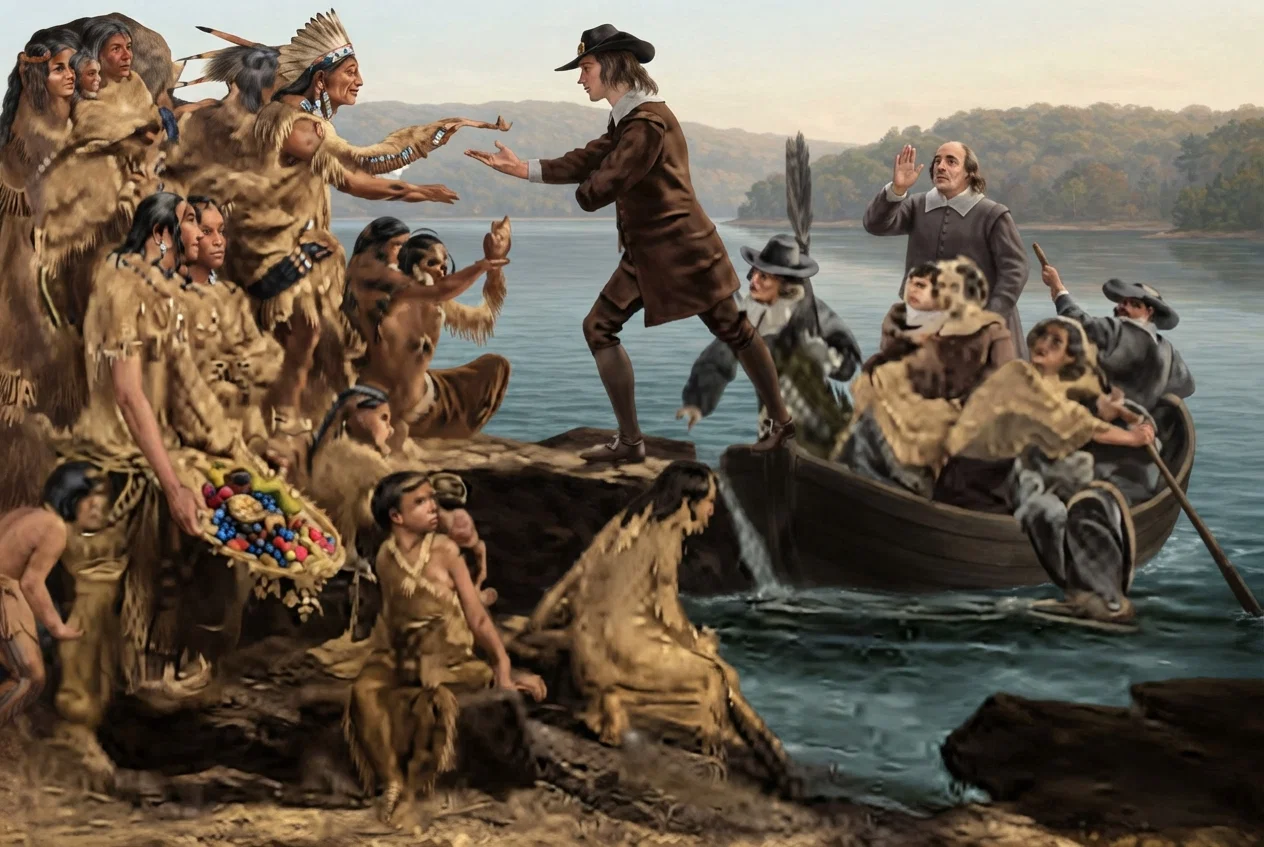
And there he remained, and founded Providence, and the colony of Rhode Island, the cradle of the true principles of religious liberty on the North American continent. P. T. M.
WELCOMED BY THE CHRISTIAN SAVAGES
TO OUR READERS
By Editor
All reasonable effort will be made to preserve accuracy of statement, and to verify all authorities quoted.
Scripture quotations, when not from the Authorized Version, are taken from the American Standard Revised, unless otherwise stated.
Persons receiving copies of this paper without ordering them are not indebted to this office. Such papers are paid for by others.
Manuscripts should be addressed to the editor. Address all business and make all money orders, etc., payable to the SIGNS OF THE TIMES, Mountain View, California.
A Dragon in Lamb's Clothing
By Albert M. Dart
A World-Wide Religious Despotism Coming — Persecution to Be Revived
By Albert M. Dart
O VER and over again, the Bible points out the fact that the last days of this world's history will be days of peril. So strong an expression as this is used: "A time of trouble, such as never was since there was a nation." The Saviour, speaking of the last days, says that men's hearts will fail them "for fear, and for looking after those things which are coming on the earth."
This awful condition comes as the result of rejecting the word of God; because in the rejection of the Word, men are left in the hands of Satan, the destroyer.
The worst conditions known to history are those brought about by an attempt on the part of man to coerce his fellow man in matters religious. Of the Dark Ages, the Saviour says, "Except those days [of persecution] should be shortened, there should no flesh be saved." Matt. 24: 22. This is a strong statement, and shows the awful character of religious tyranny.
World-Wide Despotism Coming
THE Bible predicts a religious despotism in the last days, world-wide in its influence. Its attendant persecutions will not be lacking; and under these conditions, the inhabitants of the world will make their choice for or against Christ. The faithful in Christ, those accepted of Him and taken home with Him at His appearing, will have heralded the last warning message to the world in the face of this despotic, tyrannical condition, and tasted the persecutions that ever have attended and ever will attend that false system.
"And it shall come to pass in that day, that the great trumpet shall be blown [see 1 Thess. 4: 16], and they shall come which were ready to perish [objects of persecution] in the land of Assyria [the oppressor, the persecutor], . . . and shall worship the Lord in the holy mount at Jerusalem." Isa. 27: 13.
This despotic system that will work such havoc with the human race is brought to view in Revelation 13, and in other places in the same book.
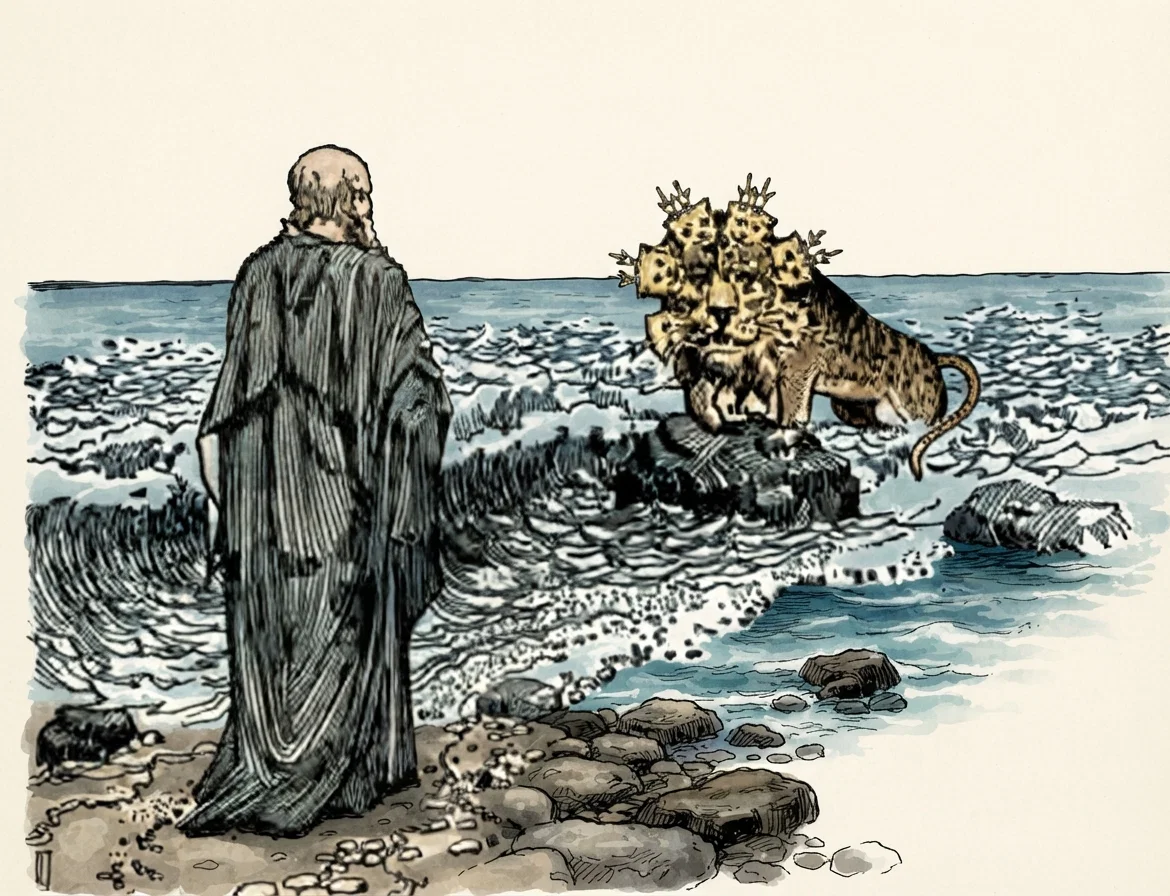
In the thirteenth chapter, the prophet sees "a beast rise up out of the sea, having seven heads and ten horns, and upon his horns ten crowns, and upon his heads the name of blasphemy." Verse 1. That the beast represents a religious system is seen from the fact that "they worshiped the beast" (verse 4); and again in verse 8, "All that dwell upon the earth shall worship him, whose names are not written in the book of life of the Lamb slain from the foundation of the world." This last statement shows the beast to represent an apostate religious system, for the true people of God do not worship it.
Whenever the people of God apostatize from Him, they seek other power than that of God to carry forward His work. The civil power is used to enforce religious observances upon the people. Hence there is persecution. The beast system here considered does just that; for "it was given unto him to make war with the saints, and to overcome them; and power was given him over all kindreds, and tongues, and nations." Verse 7. It was world-wide, you see — a world-wide, despotic, religious system, with its ever present persecutions of those who are loyal to the principles of God's government.
A Lamb Changes to a Dragon
THIS system is further revealed in the appearance, before the prophetic eye of the persecuted seer of Patmos, of "another beast coming up out of the earth; and he had two horns like a lamb, and he spake as a dragon." Verse 11. "The dragon" is prominent in this system. He is the leader of it. The dragon represents Satan (Rev. 12: 9), and the agents he uses in carrying on his work of deception in the world. He gave to the first beast "his power, and his seat, and great authority." Rev. 13: 2.
The character of the two-horned beast changes from lamblike to satan-like; for he finally speaks as a dragon. "And he exerciseth all the power of the first beast before him." Verse 12. That was despotic power, persecuting power. Then the further unfolding of this despotic beast system under the symbol of the two-horned beast reveals the startling fact that the work of Satan is carried on under a lamblike garb — a wolf in sheep's clothing. This is no new thing, however, for it has ever been Satan's method of procedure; but we seem to forget this fact sometimes, and judge the value of a movement by its appearance rather than its merits.
A Twentieth Century Tyranny
BUT is this religious despotism, which is so clearly pointed out in this prophecy, a thing of the past, or will its tyrannical head be seen even in our twentieth century civilization and enlightenment? The answer is not difficult to find. The last generation is warned against this system. The wrath of God is to be poured out upon all connected with it. See Rev. 14: 9-12.
Christ comes in the midst of these scenes. "And I looked, and behold a white cloud, and upon the cloud One sat like unto the Son of man." Verse 14. And those whose names were found in the book of life were seen on the sea of glass, with harps in their hands, having gained the victory over Satan in his last-day, world-wide, despotic sway, in which he deceives the inhabitants of the world — every one whose name is not written in the book of life. See Rev. 15: 1-3.
A beast rising up out of the sea.
The pen refuses to depict the havoc wrought to the human family under this last-day tyranny. Do you want a part in bringing it about? The system pointed out in prophecy is one in which the civil power is used to enforce religious dogmas.
Drunken with Martyrs' Blood
THIS fact is further seen in Rev. 17: 3-5, where the apostate church is brought to view under the symbol of a woman seated upon a scarlet-colored beast. The woman is beautifully arrayed, and has a golden cup in her hand; but the cup is "full of abominations and filthiness of her fornication." Here is the despotism of which we write. The church is united to the state represented by the beast upon which the woman is seated, and which she directs. This is illicit relation — fornication; and the result of this union is seen in verse 6: "And I saw the woman drunken with the blood of the saints, and with the blood of the martyrs of Jesus."
The use of political power to further religious ends is the sum of this system.
If we are using our energies to advance such a system, it matters not who we are or what our religious belief, we are helping to bring ruin to the human family; and I see no harp in our hands on the blissful sea of glass in the glad day when despotism and tyranny shall be broken by the wielding of the scepter that was not to depart from Judah till Shiloh come.
Future days are dark; but the rays of light from the prophetic page pierce the gloom, and the glory of Prince Immanuel lightens the path of the just, even to the heavenly portals, which will soon swing open for the redeemed host. Shall we enter?
“Another beast coming up out of the earth.”
Religious Legislation and Religious Liberty
"WE are asked to-day, by those who have forgotten — or have never known — the lesson of the past, to encourage the enactment of laws by the state which will deal with the religious affairs and the consciences of men. The church importunes the state to make certain religious requirements a part of the fundamental law of the nation. She asks that the God of the Bible be made the god of the republic by having His name engrossed upon the constitution of the nation. Rome had its many national gods; America would then have its one. Rome legislated for the protection of its gods and the institutions sacred to them; America would then do the same. Rome banished and imprisoned and put to death men whose only offense was their religious belief, and their mode of practicing it. Will America follow to the logical result the career of the ancient republic?"
Less Piety, More Politics
“THE less piety, the more politics; the less love, the more legislation; the less faith, the more force.”