The Youth’s Instructor, Vol. 47, No. 33.

A CHINESE COOK

The Youth’s Instructor

Aug 17, 1899

Review and Herald Publishing Company · Battle Creek, Mich. · Aug 17, 1899

A CHINESE COOK.
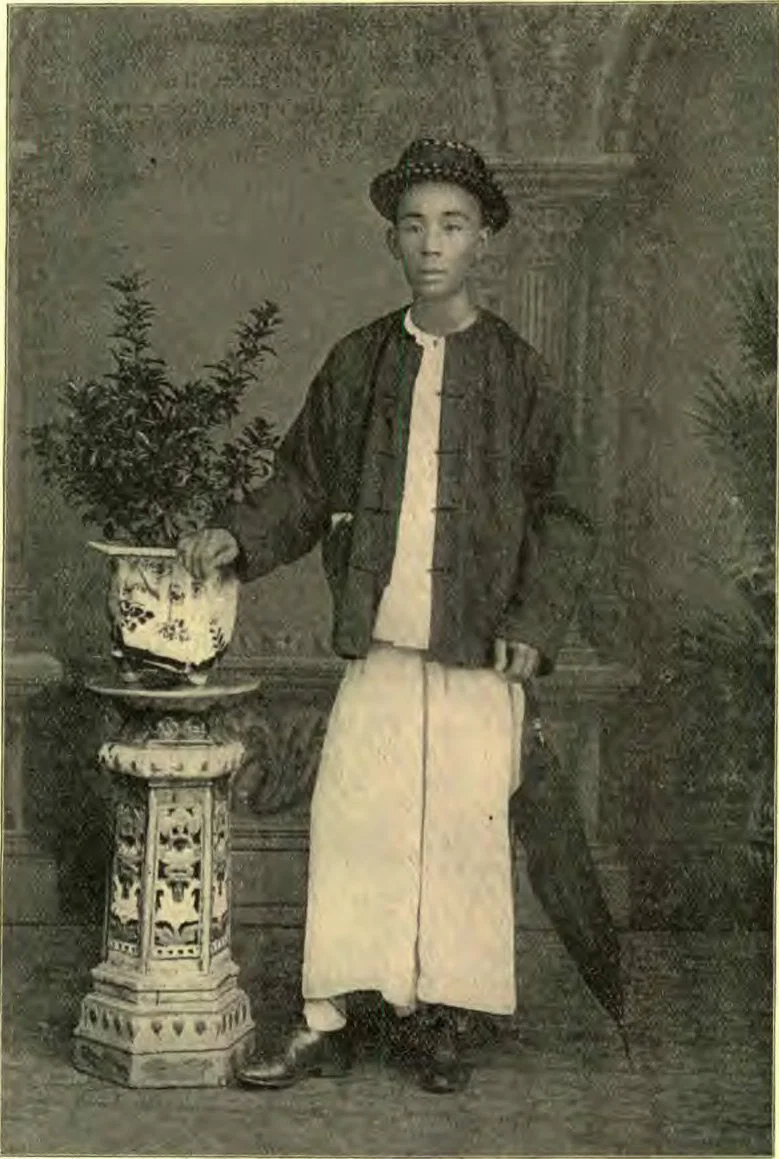
TO MOST people who have not resided in the Orient, it sounds like luxury to hear the missionaries talk of the servants they employ; but there never was a greater illusion, as those who have had experience can testify; for a cook in India, Malaysia, or China is just as much a necessity as the food that he spoils in the process of preparing it for the table.
WEE TOW GEE.
WEE TOW GEE.
The man who confronts us in this picture appears to be quite a “swell.” You will observe that he is dressed in a semi-occidental, semi-oriental garb. His extremities are European in their attire, while that which comes between is a modified form of the Chinese dress. He carries also a European umbrella; and although the artist who has taken his picture is a Chinaman, as the flower-stand and vase testify, he has used some European scenery for the background. This young man bore the euphonious cognomen of Wee Tow Gee. He was our cook on our return in 1893. He called himself a Christian, and attended the Christian services at our Chinese church; but the surreptitious way in which our provisions disappeared, and the unblushing manner in which he would charge us twice and three times what things actually cost in the market, led us to heavily discount his piety. But as Chinese cooks go, he was a very decent fellow. He moderated his thieving to a degree that made it possible to bear it patiently, and really seemed to try to cook our food without killing us altogether, and succeeded to our tolerable satisfaction.
Chinese cooks do some strange things when you are not watching them, and Tow Gee was no exception. By way of illustration, he persisted in washing the dishes in cold water, and wiping them on an incomparably dirty towel, although hot water was available, and clean dish-towels were furnished. He had a kitchen table, but he preferred to mince the meat and prepare the vegetables on a board placed on the kitchen floor. We could have borne this digression from the standard ethics of culinary art if the floor had been like the average floors in this country. But such was not the case; it was a tile floor, and was very, very dirty.
One day Mrs. Munson, after having for the fortieth time told the fellow to prepare the food on the table, descended rather abruptly into the kitchen, and at a distance saw him squatting on the floor with a molding-board, preparing some dough for a chicken-pie. He glanced up in time to see her before she turned the corner to enter the cook-room, and slowly arose and placed the molding-board and the dishes he was using on the table. My wife scolded him, but she knew it was of no use. One of our neighbors, Mrs. Benjafield, also had a Chinese cook; and she was in the habit, as some foolish women are in the East, of invading the precincts of the cook-room. She entered the place one day unexpectedly, and beheld the cook moistening the top crust of a meat-pie, which he had just rolled out, with a mouthful of water, which he squirted through his teeth. Mrs. Benjafield was a woman of some temper (in the right sense), and there was a very interesting time in that cook-room for about five minutes. But as she could not speak Chinese, and the cook did not know English, and as neither of them knew much Malay, the poor woman derived little satisfaction beyond seeing that the pie had a fresh crust, that was not inoculated with germs from the cook’s mouth.
In Singapore, or any other Eastern port, if one keeps one eye half open, he will see a great many things that will spoil his appetite, and tempt him to embark on the first steamer for a more civilized quarter of the globe. The Chinaman himself scruples not to eat anything that has life; and he can not understand why the Orang puteh (white man) is so particular about his food. In Sumatra some years ago, a number of Dutchmen living on the tobacco plantations arranged for a feast, an important feature of which was a boiled imported ham. The servants were Malays, and consequently Mohammedans. The Mohammedan hates swine as a Christian is supposed to hate the devil; but the poor fellows had to prepare and cook the ham. The dinner hour arrived, but the ham did not. Wondering at the delay, one of the young men ran down to the cook-room to hurry up the servants. In passing the window of the room, unobserved by the servants, he saw them all squatting in the middle of the floor, with the ham upon a trencher in their midst. While they were wrangling with one another, and disputing as to which of them should carry the vile and hateful thing into the dining-room, they punctuated their compliments by spitting upon the ham, as an expression of their disgust. The young Dutchman retreated unseen, and related what he had just witnessed. The half-dozen Hollanders descended upon the cook-room, seized the unsuspecting followers of the false prophet, and locked them up in a strong room. They then placed the ham within, and notified them that they would never get out until they had eaten it—and they kept their word.
An incident occurred in Singapore, on one of the small roads along the seashore, which will illustrate the aversion with which the Malay regards pork. The principal means of locomotion is the jinrikisha, about which I have already written. These vehicles are invariably drawn by Chinese coolies, who solicit every foot-passenger they meet for hire. Two Malays had taken a jinrickisha, and had gone out four miles from town and dismounted, and were about to depart without paying their fare,—a common occurrence in Singapore,—when the Chinaman laid violent hands upon them to restrain them. The result was an assault upon the poor coolie, and a good drubbing, administered by the Malays with their walking-sticks. He took to his heels, but was pursued by an angry crowd of Malays, who, by this time, had their blood up, and were determined to wreak vengeance upon this swine-eating Chinaman. There was a lively foot-race for the best part of a quarter of a mile, until the Chinaman met one of his countrymen, who was an itinerant pork-vender. The ’rickisha coolie was no raw recruit, or he would not have known how to meet his pursuers. But he had lived long enough in Singapore to learn the prejudices of the Malays, so he seized a long strip of fat pork about as wide as a man’s hand, and perhaps an inch and a half in thickness, and turning upon them, began to swing it about his head and to run upon them. The result was a stampede, and the Malays made back-tracks much faster than they had come; for no amount of money could induce them to come in contact with that unclean and abominable thing.
But I have digressed. The Chinese cook is really a very useful fellow, if you are fortunate enough to get one who is not addicted to the use of opium, and who is moderate in his gambling propensities. It is really surprising what execution they are capable of with the simplest and most primitive appliances. The more skilful of them earn twenty-five or thirty dollars a month, and can prepare any dish that you may choose to name, either French or English, and prepare it well. The missionaries had to be content with a four-dollar (in gold) cook, who as a rule, had very little, if any, experience. If we were fortunate enough to secure a tolerably honest man with no bad habits, we were equally certain to get one who would smoke our tea-water, burn our steak, and spoil nearly everything given him to cook. All that he knew that was worth knowing about cooking we had to teach him; and when he became fairly skilful, he was certain to seek a better situation. If we were lucky enough to get a man who could cook well, we were sure to get a thief, an opium-smoker, or a black-guard of some kind, whom it was impossible to keep for any length of time.
From all this it will be readily seen that the poor missionary’s wife, who has to endure the petty and persistent worries incident to the management of such servants, is certainly no object of envy; and when we remember that there are from three to half a dozen servants, all possessing more or less of these same general characteristics as the one described, it will be seen that her burden is heavy indeed. No; servants in the East are anything but a luxury, and happy would be the missionary who could dispense with them altogether.
R. W. MUNSON.

THE COMING OF THE MONSOON.

We have been having occasional rains for a fortnight, but yesterday there came a downpour that was different. There was no uncertainty about it; the water came down as if dropping right from the top of the sky. People looked cheerfully out at it, and ventured to say that at last the monsoon had come.
The monsoon is a great thing in India. Its failure to come means famine. We hear much about it before it arrives. Late in April the weather bureau begins to look for definite signs of its gathering in the far southwest. For six weeks the papers print telegrams, showing how the wind currents are running. They report that at Mauritius and the Seychelles Islands, off the African coast, and even at far-away Cape Town, the trade-winds are beginning to come Indiaward with a steady pressure. As the current draws nearer, the observatories watch the conditions over India, also, as any pressure of heavy weather from the Himalayas, and India generally, may hold back the progress of the monsoon, and if persisted in, may drive it back altogether.
It is a good sign when coasters report the Western Ghats, or hills, assuming a bright green from the moisture in the air. Then ships begin to report monsoon weather in the Arabian Sea; telegrams from Ceylon and Cochin, on the Malabar coast, say that the waves are rolling in, strong and high; and the wise weather clerks begin to guess about the time when it will break over India. Then come the telegrams from Ceylon and the southwest coast, saying that the monsoon has broken, and in a week or two it is expected to make its way over India.
The thoughtless often think of the wind as wandering aimlessly over the world, undirected by any intelligence. But God “directeth it under the whole heaven.” He knows the balancing of the clouds, and the pressure of air-currents; and it is good to know that he guides the monsoon winds from far-off southern seas to pour out his life-giving rain upon the parched plains of India. It is the “latter rain” for India, on which the harvest depends. We expect more or less rain now throughout July, August, and September. W. A. SPICER.

SELF-CULTURE

A CHARACTER formed after the divine likeness is the only treasure that a man can take from this world to the next. I would urge the youth to regard every moment of time as golden. Do not waste it in indolence, do not spend it in folly, but use it in grasping higher treasures. Cultivate the thoughts and expand the soul by refusing to allow the mind to be filled with unimportant matters. Secure every advantage within your reach for strengthening the intellect. Do not rest satisfied with a low standard. Be not content until, by faithful endeavor, watchfulness, and earnest prayer, you have secured the wisdom that is from above. Thus you may gain an influence over other minds, which will enable you to lead them in the path of uprightness and holiness. This is your privilege.
Cherish every ray of light you can obtain by searching the word of God. Take up your God-given work to-day, and see how much good you can accomplish in the strength of Christ. Make God your counselor. Discipline and control the mental faculties. Self-control is a power which all may possess. It is gained by placing the will wholly on the side of God, taking the divine will for your will.
Christ remembered our nature in the requirements he made. He took our nature upon himself, and brought to man moral power to combine with human effort. He would conform us to his authority, that we may know his will. He can and will, if we submit to him, fill the chambers of the mind and the recesses of the soul with his Spirit. Then our will is in perfect harmony with the divine will. Our spirit may be so identified with his Spirit that in thought and aim we shall be one with him. Then Satan will no longer control us. Christ is our Leader, and his true followers like to keep in step with him. He speaks, and they obey his voice. His people are made willing in the day of his power.
The Lord's claims extend to our words and actions. Even the thoughts must be brought into captivity to Christ. Then the whole life is a witness for the right. God's true servants subordinate every act to the universal law of obedience. “Lord, what wilt thou have me to do?” is the inquiry of the soul. They keep their eyes directed heavenward, that they may be approved of God, workmen that need not to be ashamed. They maintain a watching, praying attitude. They remember the words, “Ye are not your own; for ye are bought with a price: therefore glorify God in your body, and in your spirit, which are God's.” Thus Enoch walked with God, constantly realizing his accountability.
The intellectual, moral, and physical faculties are to be equally cultivated and improved, that we may reach the highest standard in the attainment of knowledge. Education is one-sided unless the whole of the human machinery is used. Those who are fitting themselves for ministers or teachers need to combine physical and mental labor. The intellect must not be allowed to become inactive. The mind must work, else it will become feeble, and will lose the power to think. It is not the length of time spent in acquiring an education that fits a man for a position of influence and responsibility. It is working with earnest effort to cultivate the talents, to wrestle with new problems. God has given us our reasoning powers for a high and holy purpose,—that we may grow in grace and in the knowledge of our Lord and Saviour Jesus Christ. Our faculties were given us to be improved, not to remain unused. He who knows of the goodness and mercy and love of Jesus Christ should make them known to his fellow men; for this knowledge is given to be imparted. The mental faculties are to be aroused to earnest activity. God designs that the youth shall consecrate all their gifts to their Creator. By a right use of their talents they may link themselves by a golden chain to the higher world. They may become partakers of the divine nature.
Daniel of sacred history was but a youth when with his friends he was taken captive to Babylon. But he stands before the heavenly universe, before the worlds unfallen, and before a rebellious world, as a bright example of what the grace of God can do for man. The Lord purposed what Daniel should do; and Daniel gave himself up, with all his energies, to carry out the plan of his Creator. It was not his choice to be exposed to the profligacy, the gluttony, and the spendthrift habits of that heathen nation. But he set his heart, while there, to serve the Lord. He co-operated with God. He stood under Christ's banner as a loyal subject of the heavenly King. As he educated himself to reach the highest standard, he carried with him the fragrance of Christ's righteousness. He was kind and submissive, he made friends with those who had charge over him; yet he would not swerve one inch from pure, true, righteous principles. He was willing to meet all the requirements of those who had rule over him, when he could do this consistently; but all the kings of the earth, all the nobles, all those in power, could not lead him to do one act that would mar his character. He was determined to be true to his God, and God calls him “a man greatly beloved.”
To every human being, life should be a serious problem. The character formed in this world determines the destiny for eternity. The element of value in the life in this world will be of value in the world to come. Our future is determined by the way in which we now allow ourselves to be influenced. If we cherish hereditary and cultivated tendencies to wrong, indulging appetite and passion, we can never enter the kingdom of God. But if we strive to repress evil inclinations, if we are willing to be governed by the Spirit of Christ, we are transformed. We take Christ's yoke upon us, and learn his way. Thus we become strengthened, as were Joseph, Samuel, and Daniel. We show that we are God's husbandry, God's building, and that we are using only solid timbers in our character-building.
MRS. E. G. WHITE.

The Hope That Waits

“THE hope that wins is the hope that waits. The wise person knows that he can afford to be patient in awaiting the fulfilment of his purposes. Everything worth wishing for is worth waiting for.”

A RECIPE.

WOULDST thou be wretched? ’T is an easy way: Think but of self, and self alone, all day; Think of thy pain, thy grief, thy loss, thy care,— All that thou hast to do, or feel, or bear. Think of thy good, thy pleasure, or thy gain, Think only of thyself,—’t will not be vain.
Wouldst thou be happy? Take an easy way: Think of those round thee,—live for them all day. Think of their pain, their loss, their grief, their care, All that they have to do, or feel, or bear. Think of their pleasure, of their good, their gain; Think of those round thee,—it will not be vain.
—Selected.

ANCIENT BOOKMAKING.

Writing Materials.
No doubt the substance first used to record the thoughts of men was stone. The first memorials were simple piles of stone, mere posts about which to weave the fabric of tradition. Such a monument was the altar of Bethel, such was the pile that commemorated the covenant between Jacob and his father-in-law. The next step was to adorn these pillars of stone with pictures of the scenes they commemorated, then with picture-writing. Next came, no doubt, small tokens, memoranda of every-day transactions,—buying and selling, owing and paying. It may be that the earliest material used for such writing was the tough leaves of tropical plants.
We know something about the early history of carving on stone; for we still have the monuments to study; but about the early history of ordinary writing we can only guess. Whichever may have been first in the field, however, very early specimens of writing have been found on clay, bark, skins, and wooden or metal tablets.
Clay was used chiefly by the Assyrians and Babylonians. The greater part of all their writing was done on clay; the shape of the letters they used was due to the material on which they wrote. The clay was made into rolls shaped something like a pillow; the writing was then impressed upon them with the corner of a strip of metal, so that the letters were made up of small triangles. If the document was a will, deed, or mortgage, a second coat of clay was given, and the writing repeated. The whole was then baked into brick. If the outer record ever became injured, the shell could be broken, and the inner writing revealed.
The surface of the unglazed pottery of ancient times was often used, especially in Egypt, to receive such commonplace documents as receipts, bills, and brief messages and memoranda. Broken pieces of crockery, on which writing was easily scratched with a point, or daubed with reed and ink, were always lying about and ready to hand. In Greece potsherds, ostraka, were used in casting the vote of ostracism, whence the word.
In Europe the substance most used in early writings was the inner bark of the lime-tree, which was written on, of course, with ink. The Latin word for book, liber, means simply “bark.” This word is preserved to us in “library;” so that when we speak of a library, we unconsciously recall the time when books were mere rolls of bark.
Other substances were used, also, among which were skins, wooden slabs, linen cloth, and sheets of lead and bronze. These were not much used, however, for books. Wooden tablets were used for notes and letters. They were either painted and written on with ink or covered with wax. Waxen tablets were used among the Greeks and Romans more than any other material for messages, letters, notes, documents, and, in short, almost anything but books. They had a raised rim about the edge; the rest of the surface was covered with black wax, which was scratched through with a sharp-pointed instrument called a “stylus,” usually of metal. The rim was punched with holes, so that the tablets could be hinged together with strings. Every Roman gentleman carried a stilus and a bundle of these tablets, or tabellae, at his girdle; the stilus was often large enough to do service as a weapon in case of need. When he had written a letter, he placed the written surfaces next to each other, passed a string through the holes, tied them, covered the knots with wax, and sealed them with his ring. When he received one, he cut the strings, read the message, smoothed down the wax with the handle of his stylus, wrote the answer, and after sealing it, sent it back.
Bronze was, of course, used for important inscriptions, as it is to-day; but this is monumental engraving, not ordinary writing. The only use of bronze as a material for writing on was in the case of the Roman military diplomas, which were given to veterans, and which gave them certain rights and privileges anywhere in the Roman world. Lead was sometimes written on, even in the Middle Ages; one or two books written on lead are in existence. Usually lead was used to receive curses, charms intended to bring harm to their possessor, and magical formulas.
By far the most important material used among the Greeks and Romans to receive writing was papyrus. All books and epistles were written upon it, though short messages to persons about town were more often written on tablets. Papyrus was prepared from a reed-like plant that grew in the delta of the Nile and in some other places. It has now disappeared from Egypt, but is still found in Abyssinia. This plant was as variously useful as the palm-tree: from its heavy roots, utensils were made; its plume-like blossom was made into garlands for the temples of the gods; it furnished material for calking yarn, for rigging for ships, for shoes, and even for canoes. The pith of the stem was eaten. A coarse papyrus, for wrapping purposes, was also made from this plant.
The finer papyrus was made from the best stalks. They were first cut into long strips with a needle; these strips were laid side by side, and the edges carefully matched. Shorter strips were then laid crosswise on the long ones. These may have been woven together in basket fashion. Water was used to dissolve the gluey sap of the reeds, and fasten them together; or it may be that a paste was used for this purpose. The papyrus was then dried in the sun, rough places were rubbed down with ivory, and the sheets were usually fastened together into a roll,—twenty sheets to the roll. These sheets were nearly the size of ordinary letter-paper, and two sheets were sold for about twenty-five cents.
Papyrus was also called byblos by the Greeks. The Latin name for it was charta. A book was called by the Greeks biblos; a small book, biblion. The plural of this word was applied to the Sacred Scriptures,—biblia, “the books;” from this comes our word Bible. The Latin name for manufactured papyrus, charta, comes to us in “chart” and “card.”
Vellum, or parchment (the former is the modern term), displaced papyrus, as papyrus took the place of bark. It was first made in Pergamum; this fact gave it the name which has come to us as “parchment.” “Vellum,” like “veal,” comes from the Latin word for calf; vellum was first calf-skin; but now all writing-skins are called vellum.
Papyrus was written on with a reed, or calamus; the penna, or quill, could not be used on its delicate surface. The first mention we have of the pen is connected with Theodoric, the Ostrogoth, one of the destroyers of the Roman Empire, who, unable to write, learned to trace the first four letters of his name through a stencil, using a pen to do so. This was in the fifth century. The pen was used to write upon vellum, as the reed had been used upon parchment.
Ink (incaustum) was made at various times, and in different places, from soot and gum, from nut-galls and copperas or blue vitriol, and from the pigment of the cuttle-fish, called sepia. Colored inks were also used, especially red, generally for purposes of ornament. Inks of gold and silver, upon a background of purple vellum, were used in rare cases, as for books to be presented to the emperor.
Paper was introduced by the Arabs; but as it did not come into general use till the close of the Middle Ages, it is hardly to be reckoned among ancient writing materials.
C. B. MORRILL.

Peculiar Appearance of the Shark's Egg

“A SHARK’s egg is one of the oddest-looking things imaginable. It is unprovided with shell; but the contents are protected by a thick, leathery covering, almost as elastic as India-rubber. The average size of one of these eggs is two by two and three fourths inches, and the color is almost dead black.”

ORGANS OF DIGESTION.

DIGESTION is the process by which food is made ready for absorption into the body. This process occurs chiefly in the alimentary canal, which is from twenty-five to thirty feet long. The organs of digestion are the mouth, teeth, tongue, salivary glands, esophagus, stomach, colon, or large intestine, small intestine, liver, and pancreas.
Digestion begins in the mouth. This is due to the action of the saliva, which is formed in glands in front of the ear (the parotid glands), under the jaw (submaxillary), and under the tongue (sublingual). There are three pairs of salivary glands, which empty the saliva into the mouth through small ducts. In the back of the mouth, on each side of the tonsils, are other glands which help form the saliva. The active principle in saliva is called ptyalin. Its function is to convert starch into sugar. For two reasons, it is very necessary that food be well masticated: First, that the particles of food may be reduced to a pulp, so as to pass easily through the esophagus into the stomach; and second, that the saliva may be thoroughly mixed with the food, and thus begin the process of digestion. Too many cases of indigestion are due to hasty eating.
The teeth should receive the most careful attention. The “first teeth,” twenty in number, are temporary. The permanent teeth number thirty-two, and the set is complete at the age of from seventeen to twenty. The teeth should be thoroughly brushed on rising in the morning, and after each meal. A good toothbrush, water, and a little prepared chalk will keep the teeth clean. The chalk need be applied only twice a week if brush and water are freely used. An excellent germicide for the mouth is made by adding a few drops of oil of cinnamon to a glass of water. Gargle the throat well with it, if exposed to contagious diseases. The solution may be made quite strong when used as a gargle. Avoid sweets, and the teeth will remain free from decay, if other precautions are adopted. Run a strong waxed silk thread between each tooth, to remove particles of food. If the teeth show signs of decay, consult a good dentist, and keep the mouth pure and wholesome. By neglecting these precautions, quantities of germs are taken into the stomach, and serious results are sure to follow. No one can neglect the care of the body without reaping a most undesirable harvest.
MRS. M. D. Mc KEE.
Continue reading: Chapter X