The Youth’s Instructor, Vol. 47, No. 33.

A CHINESE COOK
Earlier text: A CHINESE COOK

Chapter X

From Sinai to Olivet

Chapter X.
The conductor looked at her kindly as he took her ticket. He was an elderly man, with daughters of his own, and a young girl’s face always interested him with a tender, fatherly interest; and there was something about this one, with the atmosphere in which it floated like a star, that moved him deeply. He stood an instant as he punched the ticket, and shuffled it with others in his hand, held by, he knew not what; but Shirley was oblivious. Men had no attraction for her, just now at least; she did not think even kindly of any whom she knew, unless it might be Uncle Will, and of him she scarcely thought at all, only once to wonder if he would follow her. This caused her teeth to set, and her chin to show its corners; so the conductor was not rewarded by so much as a glance for his interest.
So absorbing had been her new experience, that Shirley had not begun to think of the close of her journey, and what she should do directly, until it was ended, and the brakeman’s sonorous cry of “Union Depot, Chicago!” startled her as from a dream.
She arose mechanically, and following the crowd, soon found herself at the head of the stairway that opens on the street, in the midst of the city’s rush and roar. She had no alloy of timidity in her nature; and now, keyed up as she was to the utmost of her capability, she had the appearance of a thoroughly self-poised young woman, who knew just where she was going, and what she intended to do when she got there. Entirely at ease, she stood a few moments, a pretty, happy girl, looking about her, perfectly protected by her self-possession, from even Martin McCarty’s intrusive designs.
She was not, however, quite so sure as to just what she intended to do as she appeared. She was not so calm as she looked. She realized the strangeness of her position, and that she must make up her mind quickly what to do first; and this was not easy.
She had a box of lunch in her bag,—Aunt Nell’s kindly forethought,—but had been too excited even to think of it. Now, however, nature brought it to mind; and she determined to find the waiting-room, and break her fast while she laid out some plan of operation.
She had been to the city often enough with her father to know something about how to strike her course, and easily found her way to the ladies’ room, where she made herself comfortable, ate her lunch, and thought out exactly what she would do; so it was with a strong sense of independence and security that she touched her lips daintily with the corner of her napkin, folded and replaced it in the box, tied it all up neatly, for it was still worth carrying, arose, shook her borrowed plumage a little, with a smiling satisfaction in the soft rustle of Aunt Nell’s pretty garments, and started out.
There had always been a peculiar attraction for Shirley in a certain great down-town store, where the family buying was done. She had followed her father about on two or three occasions, and stood by while he fingered dress-goods for herself and her mother; and now this store loomed up before her in all its magnificent proportions, and she decided that the very first thing she would do would be to find it, and see just how it would seem to walk those crowded aisles alone, with money in her purse, that she could spend just as she pleased. Of course she must not spend it—not one penny—until she had found work; but she could afford to take one day to look about, and she would indulge herself.
She remembered the young girls in the store. They had been so busy, alert, and competent, so independent. She had often dreamed of them and the lives they lived. She recalled one especially, with whom she had exchanged smiles more than once,—a saleslady in the notions department. She would find her out. She would be sure to learn from her something about work and a cheap lodging. She would get her bag checked at the parcel-room, as her father had done, and so go hand free.
She had a good “bump of location,” and had no trouble in finding her way; in fact, her way seemed to find her; everything came right along just as she remembered it, as she walked without a care in the midst of the most bewildering delights, feasting her eyes on the spring-time beauty, of which the shop-windows were full, while sensations new and marvelous filled her being as she drank her fill of that cup of liberty for which nations have gone to war, and men have dared and died.
That day would live in her memory forever,—the entrancing prelude to a harmony, lacking which even the song of love were sadder than a funeral march, and life must be a living discord. Just once to know what freedom was, and how she, left all alone with it, could use her liberty,—oh, it was such joy! It filled her so full that she never once thought of the sad and troubled hearts that she had left behind her. For the time being she was a girl without a past. The present was so large that it covered all of consciousness.
She went on along State Street down to Washington, and in with the crowd to the great temple of trade. Ridding herself of her bag, she mingled with the throng,—a fair, sweet creature, fresh as the spring daisies in the home meadows, glad and care-free as the songsters that flashed their wings in the sunlight out and in among the homestead trees and vines, just bursting into bud; all of which, however, she had for the time forgotten. But God would not forget that the time would come when she would need to remember them; and not only to remember them as of the past, but to reach out, and take hold of, and fill up, some new present with them again.
If Shirley Goss could have carried into the home circle that day the face and air with which she went from counter to counter, gathering delights for sight and touch, as a honey-bee flits from flower to flower, she would have been the messenger of more comfort than she had ever given in her life. If she could have worn that face always, it is safe to say that she would have met few frowns, even from her exacting father.
Not hastily, but in good time, she found her way to the place where the same sweet, patient-faced girl was occupied with customers among the “notions.” Shirley’s smile brought another in quick return, as she stood waiting for a chance to speak to the busy little saleslady, who, with her piquant, responsive face, pleasant voice, and bird-like motions, was evidently a favorite; and as she stood watching, she thought that this must be a very charming way to independence,—handling such a variety of dainty things, and making so many happy by giving good measure and good bargains.
Shirley felt that she had no right to call the attention of the saleslady, since she was not a customer; and when she came toward her, indicating that it was her “turn” now, Shirley said: “I don’t wish to buy anything. I am only waiting to speak to you when you have time.”
“All right,” was the cordial reply; and after that every little while a bright look was flashed back and forth between them, until at last there came a little lull in the rush, the counter was cleared, and they came toward each other.
“Well,” began the saleslady, “what can I do for you?”
“Oh, lots,” said Shirley. “You see I somehow felt acquainted with you; for I’ve seen you when I came here before; and now I’m here alone, and——”
“Yes,” with a nod of encouragement, “just a moment, please;” for a customer had sailed up to the pins and needles, and before she was served, Shirley found herself pushed back and away, farther and farther, by a new rush of women and children, who filled all the space, and kept the little clerk’s hands and feet flying. She looked over at Shirley several times, and smiled, as much as to say, “You see how ’tis;” and once, as she came near her for something, she said, “Is it anything special?”
“Yes, rather,” said Shirley.
“Well, I’ll have a minute by ’n’ by.”
But time passed. The day’s rush was on, and Shirley began to feel that she was in the way. Once or twice a fussy little man with a bald head, who seemed very officious among the clerks and cash-boys, stopped and looked sharply at her, in a way that made her ears tingle, and that reacted upon her in a strange sense of depression and weariness. The air in the store was close and warm; so she concluded not to wait for the chance of a word, that might, after all, bring nothing to her real advantage, but start out by herself at once in search of work. So she moved slowly away, wondering where she had better go, when she met a floor-walker,—a young man of stylish appearance, who, noticing her inquiring look, came toward her with his most inviting expression, inclining his ear as if to catch her question.
“Will you please tell me how one goes to work to get a situation in this store?” asked Shirley.
The man lifted his head quickly, looked at her sharply, laughed a little low laugh, and replied, with an unpleasant sneer: “Oh, you just jump into the hopper, go through with the grist, and come out a——”
The rest of it was left unsaid because of a lady in silk and lace, who had fluttered up, asking to be directed to some remote department, and poor Shirley was left burning from crown to toe under the scorching sarcasm of her first rebuff. Her hot face called for tears to cool it; but these she forced back by sheer force of will, and gathering all her latent self-possession, she walked proudly out of the store, hating its very atmosphere, because of the poison breathed into it by the man who had so shamefully failed to be manly.
MRS. S. M. I. HENRY.
(To be continued.)

THE LIGHT OF THE WORLD.

THERE is an inspiration in that Life, Easing the pangs to suffering mortals given, Lifting the soul from out this earthly strife, Into the air of heaven.
There is a pleading pathos in that death On Calvary's cross, which not the flood of years Has borne away; which stops and stills the breath, And melts the soul to tears.
There is a hope, a glad and glorious hope,— Our blessed Lord has risen from the tomb! We need not down to death in darkness grope: God's love has rent the gloom.
WILLIAM ARCHER WRIGHT.

MEASURING

“I DON’T believe you care as much for me as I do for you,” says a girlish voice, reproachfully, as two school friends pass by.
“Don’t do that, little girl; throw away your measure!” we long to call to her, in warning. There are some things that can neither be weighed nor measured, and chief among these are love and friendship. They must be given freely, with no jealous question of measure for measure, or their very essence is lost. Just as soon as we begin to grow suspicious of being defrauded, watchful for a full return for all we give, demanding so much for so much, and feeling hurt and aggrieved if we do not receive payment in full, then love has been dragged from its high place, and degraded to a matter of barter.
Love your friend because she is lovable, but let your affection be like sunshine that falls freely round her way, and brightens it; not like a mortgage upon her life, which leaves her constantly burdened with a sense of indebtedness. Friendship that is worth anything is trustful. It gives all it has to give of help and tenderness, interest and sympathy; but gives it gladly for love’s own sake.
“Love that giveth in full store, Aye receives as much and more; Love, compelling Love to pay, Finds him bankrupt every day.”
— Wellspring.

HEAT

Now, while these long sunny days are here, and you can watch and see so plainly the effects of the sun’s heat upon the earth, it will be a good time for us to talk a little while about heat and moisture.
The earth would soon be destroyed by the burning rays of the sun, were it not for the moisture that God sends in the rain to keep it from getting parched and burned up.
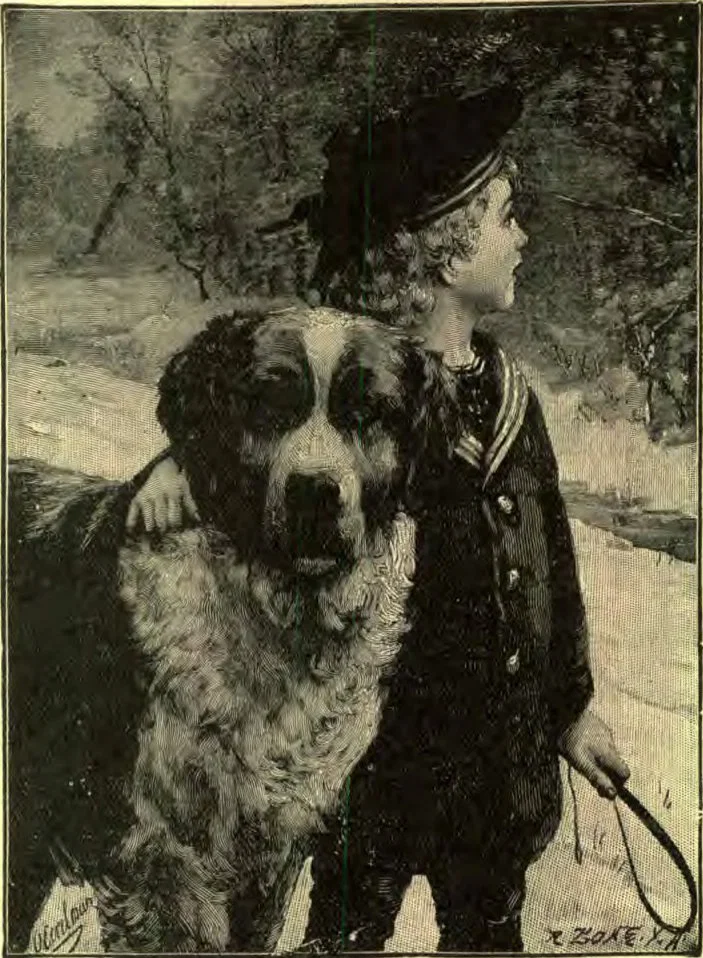
COMRADES.
COMRADES.
Through these two things,—heat, or fire, and moisture, or water,—God is working out his great purposes in the earth. These good gifts come down to us from above. Light and heat God gives us through the sun, and water through the clouds. But the sun and clouds are only the channels through which he is giving himself to us.
Perhaps you have read in the book of Revelation about “the sea of glass mingled with fire,” that is before the throne of God,—water flowing forth from his throne so pure and clear and transparent that it looks like glass, and mingled with it the fire of God’s glory, which lights and warms the universe.
Fire and water, then, though they appear to us so opposite, are really but different forms of the life of God, coming forth from him to warm and bless and refresh us and all the earth.
All the heat that we get anywhere in this world comes to us through the sun. You may wonder if this can be true of the fires that are lighted to warm you in the winter, when the sun’s rays are so feeble. Yes, even the cheerful, blazing fires in our grates are really the summer sunbeams that have been stored up in the trees, and are now let out to help us in our need. Some of the trees were buried in the earth, and after many, many years, hardened, and changed to coal. To look at the black lumps, you would not think there was much sunshine there, would you? But when they are put where they can get to the right heat, the light will burst forth, and the heat will come out from the sunshine that was stored up there ages ago.
How lovingly our Heavenly Father has provided for our needs in preparing for us this wonderful supply of stored-up sunshine, to keep us warm in the cold weather, to cook our food, and to help us in so many ways!
All fire is the stored-up rays of the sun, which is the glory of the Lord. When the sun has set in the evening, and no longer lights us with its direct rays, we use what we call “artificial” light. We light up our candles, lamps, or gas. But in these, as in the wood and coal, we are only using the sunlight stored up in these things, and it is still really the glory of God that is giving us light.
If, during these sunny days, you feel a little too warm, or even uncomfortably hot, think of the wonderful work of the sunshine, and how everything in the earth is storing it up for our future use,—the trees for our comfort and warmth, the fruits and vegetables and grains for our food, and even the ground itself to keep us warm in the winter. Then I am sure you will not complain of the heat, but will thank God that he causes the light of his face to shine upon us and bless us.
E. E. ADAMS.

THINGS THAT ARE LOVELY.

SOME earnest young Christians make a mistake in putting too light a value upon those graces of manner and little courtesies of speech and conduct that might commend their excellent qualities to others, and give them the vantage-ground of personal influence. If a merchant has diamonds to sell, he does not shut them up in a drawer nor display them in a rough box. He does not say: “Nothing can add to the value of a diamond, and I will not condescend to any tricks to catch admiration or draw customers. If a man really wishes to buy, he will come to me.”
What he does is to put his jewels upon beds of satin, in cases of velvet, using every art to display their beauty. He knows very well that people who have never thought seriously of buying may be attracted by the beauty that catches the eye and arrests the attention.
Your Christian principles ought to be rendered so attractive by your personality that those who know you will associate goodness with graciousness.
Neatness and taste in dress, careful avoidance of all rude and disagreeable habits, conformity to the customs of good society,—these are by no means trifles to be ignored by those who claim to belong to the highest court of honor. You do not properly represent your Sovereign unless you are not only a patriot but a gentleman.
The great majority of those with whom we come in contact must judge us by externals; and if we covet that most precious power of influence, we must see to it that we do not so repel them by the prickly outside that they will never care to go deeper. We are, indeed, to think upon the things that are true and pure, but not less upon those that are lovely and of good report.—Emily Huntington Miller.

A FUNNY FELLOW.

A GREAT many queer things happen in this world, and this morning I saw one of them. We have a little aquarium,—just a long glass box, with some stones arranged in it to form a pretty little rockwork, and plenty of bladderwort for the fish to feed on.
We have a good many fish,—three sticklebacks, several pretty silver dace, some minnows, and a crawfish,—but the pride of the aquarium is the newt.
Did you ever see a newt? He is a little creature, like a lizard, about two inches long; in color, light-brown, with black spots. He is quite tame, and not in the least afraid of us. Well, yesterday morning I was watching the fish, and seeing that the greedy ones did not get more than their share of breakfast, when Master Newt came up out of the water, and seated himself on the top of the rockwork, which projects an inch or two above the surface.
He sat quite still for a few minutes, and I made no motion, thinking he had come to take a look at the upper world, and would prefer to be left to himself.
Presently he began to move his little paws about (they are just like tiny hands, with long, thin fingers), and to rub himself, and wriggle about in a very queer way. I had watched him for some minutes before I realized what he was doing, but suddenly it flashed upon me that he was going to change his skin. I knew that newts often change their skins, but I never expected to see one do it.
Presently it was loose enough, and my little friend began to draw it off, slowly, beginning with the paws. The skin came off in perfect shape, and in a moment there was a pair of fairy gloves floating in the water, the prettiest things that ever were seen.
Next Master Newt began to unbutton his waistcoat, so to speak, and then to take off his coat, waistcoat, breeches, and all. He did look very fine in his new suit, which shone with lovely colors, and was as soft and smooth as gossamer.
But what was he going to do with his old clothes? There were no closets in the aquarium; no clothes-bags; no obliging old-clothes-fish, who would take it off his hands, and give him a trifle for it. What would he do with the old suit?
I was soon to see. Master Newt sat still for a few minutes after his great feat, seeming to enjoy the change, waving his delicate crest with evident satisfaction; then he took up the old suit of skin, which lay on the rock beside him. And then—who can guess what he did next?
Mind, I saw this with my own two eyes, the very ones that are looking down on this paper as I write. Why, he rolled it up carefully, made a ball of it, and then—ate it up!—Laura E. Richards in Youth’s Companion.

Better Plucky Than Rich

It is better to be born plucky than rich.

BABY CORN.

A HAPPY Mother Stalk of corn Held close a baby ear, And whispered: “Cuddle up to me; I’ll keep you warm, my dear. I’ll give you petticoats of green, With many a tuck and fold To let out daily, as you grow; For you will soon be old.”
A funny little baby that; For though it had no eye, It had a hundred mouths; ’t was well It did not want to cry. The mother put in each small mouth A hollow thread of silk, Through which the sun and rain and air Provided baby’s milk.
The petticoats were gathered close Where all the threadlets hung; And still as summer days went on, To Mother Stalk it clung: And all the time it grew and grew; Each kernel drank the milk By day, by night, in shade, in sun, From its own thread of silk.
And each grew strong, and full, and round, And each was shining white; The gores and seams were all let out, The green skirts fitted tight; The ear stood straight and large and tall, And when it saw the sun, Held up its emerald satin gown To say: “Your work is done.”
“You’re large enough,” said Mother Stalk, “And now there’s no more room For you to grow.” She tied the threads Into a soft brown plume. It floated out upon the breeze To greet the dewy morn; And then the baby said: “Now I’m A full-grown ear of corn.”
— The Independent.

A Water Tricycle

A tricycle for use on the water has been invented by an ingenious Frenchman. The rubber tires are nearly four feet in diameter, and, when inflated, buoy the machine up so that, even with the rider in position, the wheels dip hardly more than a foot beneath the surface. The apparatus weighs less than seventy pounds, and can therefore be ridden on land if necessary.

A Costly Dog-Kennel

An Eastern millionaire has lately built, at his home on the Hudson, a sixty-thousand-dollar colonial-cottage dog-kennel, beautifully finished in hardwood, and provided with a folding-bed for each member of the dog household. The dogs that live in this dog-palace are valued all the way from twenty-five hundred to five thousand dollars, and are carefully fed and watched over. One can not but think of the many children, homeless or worse than homeless, in the large cities, without a pang of regret that they, whose souls are regarded as beyond price in the kingdom of heaven, should be left to suffer and die, or grow up in sin, in the kingdom of earth; while these dogs are so foolishly pampered.

The World's Great Forests

According to Science, Canada leads all other countries in the extent of her forests. She possesses 799,230,720 acres of forest-covered land, as against 450,000,000 acres in the United States. Russia is credited with 498,240,000 acres, about 48,000,000 more than the United States. India comes next, with 140,000,000 acres. Germany has 34,347,000 acres, France 23,466,450, and the British Islands only 2,695,000. The table does not include Africa or South America, both of which contain immense forests. It may surprise some readers to learn that the percentage of forest-covered land is larger in several European countries, Germany for instance, than in the United States.

Where It Is Cooler

Werchojansk, Siberia, which has a record of 90.4° below zero, is thought by many to be the coldest inhabited spot in the world. In the winter of 1885 the temperature fell to 84.3° below zero in February, to 74.4° below in March, and to 78.2° below in December. Weather observations taken in the Yukon a few years ago, showed an average of 11° below zero in December, of 17° below in January, and of 15° below in February. For five days in February the average temperature was 47° below zero. In a land where, in midwinter, there are only four hours of daylight to twenty hours of darkness, such cold is most depressing. “One of the coldest and windiest places in the United States is the summit of Mt. Washington, in New Hampshire. The government observatory there has some startling records: In November, 1884, the wind blew one hundred and twenty-eight miles an hour. Dec. 19, 1884, with the temperature 42.2° below zero, the wind blew ninety-six miles an hour. January, 1885, with the temperature 50° below, it blew one hundred and ten miles an hour, when frost stopped the wind-gauge. In March, 1881, the wind attained a velocity of one hundred and thirty-two miles an hour; and in December, the same year, of one hundred and seventy miles an hour.”

RETURNING FROM CAPTIVITY

INTERNATIONAL LESSON.—NO. 9.
(August 27, 1899.)

RETURNING FROM CAPTIVITY.

Lesson Scripture.—Ezra 1.
Golden Text.—Ps. 126: 3.

QUESTIONS.

What had led to the captivity? Who had predicted it? What had it accomplished for Israel? Who dwelt in the land of Israel during the captivity? Who issued the edict permitting the return? When was it issued? Give the contemporaneous history. What is said of Ezra? Who was Cyrus? What had Jeremiah foretold? What proclamation did Cyrus issue? To whom was it directed? What had he been charged to do? By whom? What did he call on the people to do? Who responded to the call of the king for volunteers? Who was the great leader in the return from captivity? What assistance was afforded by those who did not return? What vessels are referred to? By whom had they been taken? When? Where had they been kept? What was the purpose for which these vessels were used? Who had them in charge? What number is mentioned? What was done when they were turned over to the returning captives?

NOTES.

1. The captivity, lasting for seventy years, was the result of Israel's iniquity and idolatry, vividly portrayed by Jeremiah. Jer. 9: 1-16. In this chapter he calls upon the nation to mourn for their sin, and to glory in nothing save the knowledge of God, who delights in mercy. He foretells the length of the captivity (Jer. 29: 10), unfolds the course that God would have them pursue in Babylon (vs. 4-8), and is a mouthpiece for words of wonderful comfort to the captives; for though in bondage, God looked in pity upon them, saying: “I know the thoughts that I think toward you, saith the Lord, thoughts of peace, and not of evil, to give you an expected end. Then shall ye call upon me, . . . and find me when ye shall search for me with all your heart. . . . And I will turn away your captivity, . . . and I will bring you again into the place whence I caused you to be carried away captive.”
2. “The period of the seventy years’ captivity was nearing its close. The discipline needed by the Israelites had proved effective. What the temple, priests, prophets, and judgments had failed to effect, was accomplished by the long exile in Mesopotamia. There, under the instruction of such prophets as Daniel and Ezekiel, they abandoned idol-worship forever, and learned to hate it with the intensest hatred. After the return, . . . we hear no more of the worship of Baal or other idol gods.”
3. At the edict of Cyrus, recorded by Ezra, Jerusalem lay in heaps, as Jeremiah had said it would. The temple of Solomon had been utterly destroyed. Those who were living in Judah were mainly Edomites and Arabians. The Jews were principally in Mesopotamia. They were to return to Judea, to rebuild Jerusalem and restore the temple. The history of the nation begins a second time from this period. Their first national history began when Moses led them out of Egyptian bondage.
4. The edict of Cyrus was probably issued from Babylon, B. C. 536. In taking this step, Cyrus (who had been surnamed of the Lord about one hundred and fourteen years before his birth) was fulfilling the word of the Lord, “that saith of Cyrus, He is my shepherd, and shall perform all my pleasure: even saying to Jerusalem, Thou shalt be built; and to the temple, Thy foundation shall be laid.” “I have raised him up in righteousness, and I will direct all his ways: he shall build my city, and he shall let go my captives.”
5. This decree of Cyrus was proclaimed “throughout his kingdom,” and was put also in writing, and was deposited among the archives of the kingdom in the palace of Ecbatana, the capital of Media. And under the proclamation, about fifty thousand people assembled to return from their captivity unto Jerusalem.—“The Great Empires of Prophecy,” page 56.
6. “The Medo-Persian Empire, under Cyrus the Great, the Persian, occupied all western Asia. The era at Athens was that of Solon and Pisistratus. The city of Rome was yet an unknown Latin city on the banks of the Tiber, but was about two hundred years old.”
7. “Ezra, the author of the book that bears his name, was a Jewish priest, born in exile, who returned to Israel about eighty years after the exodus of the first exiles from Babylon. He was probably not born until many years after the edict of Cyrus. He was a man of intense devotion to the law, a great organizer; and to him is due, to a great extent, the form taken by Judaism after the Captivity.”
8. “Whose spirit God had raised.” The undertaking was a great one. Jerusalem was at a great distance, and almost impassable deserts lay between. Enemies had occupied Palestine, who would hinder the work. The Jews had long been a captive people, and were feeble in their resources. . . . They were led by Zerubbabel, a descendant of the royal line of David, and an ancestor of Jesus.—Johnson.
9. King Cyrus not only aided himself, but directed the men of every place “to help.” . . . The spoils of the Egyptians helped to furnish means to build the tabernacle. . . . God uses the whole world for his purposes, and makes even heathen kings his ministering servants.—Bible Commentary.
10. This return from Babylonian captivity to build the temple is of significance to every soul to-day. Spiritually, God calls his people to come out of Babylon, and set their faces steadfastly toward the New Jerusalem. That we have been tried, tempted, chastened, is for the same end that Israel of old were tried,—to give us an “expected end.” God is greater than the kings of earth, stronger than the bands of tyrants, able to overthrow our enemies; and as we have come to the time of the proclamation, let us arise and go up and build, even at Jerusalem.

BLASPHEMY OF THE PHARISEES

THE SABBATH-SCHOOL LESSON.—NO. 9.
(August 26, 1899.)

BLASPHEMY OF THE PHARISEES.

Lesson Scripture.—Luke 12: 1-46.
Memory Verse.—V. 37.
TIME: A. D. 30. PLACE: Judea. PERSONS: Multitude, disciples, Jesus.

QUESTIONS.

1. As the multitude thronged Jesus, with what words did he admonish his followers? Luke 12: 1. What reasons did he give for cautioning them? Vs. 2, 3. Whom did he say we need not fear? Why not? V. 4. Whom should we fear? V. 5. With what words does he encourage us to trust God? Vs. 6, 7. How much depends upon our confession or denial of Jesus? Vs. 8, 9; note 1. What sins may, and what may not, be forgiven? V. 10. Under what circumstances are God's people promised the special help of the Holy Spirit? Vs. 11, 12; note 2.
2. Who now spoke to Jesus? What was his request? V. 13. What answer did Jesus make? V. 14. What lesson did he then set before the people? V. 15. Relate the parable which Jesus gave to enforce the lesson. Vs. 16-20. With what statement did he seal the thought? V. 21.
3. In the same line of truth, what did Jesus say to his disciples? Vs. 22, 23. To lead us to trust God for all temporal needs, what facts does he ask us to consider? Vs. 24, 27, 28. What one impossible thing should cause us to dismiss our care? Vs. 25, 26. What is the one reason why we should not live in careful suspense? Vs. 29 (margin), 30.
4. What encouragement is given to seek first the kingdom of God? Vs. 31, 32. Instead of seeking to lay up wealth, what should we always do, and why? Vs. 33, 34. What must be the attitude of God's people? Vs. 35, 36. What promise is left to all who are thus prepared? Vs. 37, 38. To show the need of constant watchfulness, what illustration does Jesus give? V. 39. What is the conclusion drawn? V. 40.
5. Who then spoke, and what did he say? V. 41. To show that the blessings are for all, what did Jesus say? Vs. 42, 44. What course of life does Jesus place in contrast with that of watching? V. 45; note 3. What will then be done with him who now lives such a life? V. 46.

NOTES.

1. From the character of the lesson given in connection with the caution, “Beware of the leaven of the Pharisees,” it seems plain that the leaven of hypocrisy here brought to view is a fear to acknowledge what one knows to be true. It is certain that many of the rulers believed (John 12:42), but they feared men,—they feared the reproach and scorn that would come if they openly acknowledged Jesus. They therefore covered their real feelings, and acted contrary to what they knew was right. This is hypocrisy as truly as if one professes to believe when he does not. Seeing such ones before him, Jesus sought to have them fear God and not man (Luke 12: 4, 5); to trust him because of his infinite care (vs. 6, 7); to make open confession of their belief (vs. 8, 9); and to keep nothing covered, which for their own good should be revealed. Vs. 2, 3. Let us be careful never to hide away from men our love for Jesus and his truth; but, rather, boldly make known what God in mercy reveals to our darkened minds.
2. The servants of Christ were to prepare no set speech to present when brought to trial. Their preparation was to be made day by day in treasuring up the precious truths of God's word, and through prayer strengthening their faith. When they were brought into trial, the Holy Spirit would bring to their remembrance the very truths that would be needed. A daily, earnest striving to know God, and Jesus Christ whom he has sent, would bring power and efficiency to the soul. The knowledge obtained by diligent searching of the Scriptures, would be flashed into the memory at the right time. But if any had neglected to acquaint themselves with the words of Christ, if they had never tested the grace of his power in trial, they could not expect that the Holy Spirit would bring his words to their remembrance.—“The Desire of Ages,” page 355.
3. He who truly watches is one who relates every fact of his life to the thought that his Lord will soon return. He watches not in theory but in practise,—in the shop, on the farm, at the hearthstone, in whatever place the providence of God stations him. Therefore he who beats his men servants, and eats and drinks with the drunken,—in other words, who does not practise his profession,—is placed among the ungodly. His actions, though perhaps not his words, say, “My Lord delayeth his coming.”

Notes and Comments

Continue reading: INTO THE LIGHT