It is only doubtful things that need to be labeled. We carefully mark the packet of seeds we put away; but when they have been put in the ground, and have blossomed into sweet peas and morning-glories, we do not need to tie a name to them; they show what they are.
The same is true of the moral garden plot—it is only the virtues that have not blossomed into action that are constantly needing to be labeled. If we find it necessary to assure and reassure our friends that we can be depended upon to keep an appointment, that we will not forget a promise, that we will do as we have said, we may be sure that our reliability has attained but very doubtful growth.
The honesty that requires expatiating upon has not reached the point where it can be known by its deeds, and the goodness that is always asserting itself to be “as good as anybody else” has failed to make itself recognizable by its life. Honesty, reliability, and goodness, that have blossomed into daily living, into habit, need no labeling: everybody knows them.—Selected.
OUR NEIGHBOR
Somebody near you is struggling alone
Over life's desert sand;
Faith, hope, and courage together are gone,—
Reach him a helping hand;
Turn on his darkness a beam of your light;
Kindle, to guide him, a beacon-fire bright;
Cheer his discouragement, soothe his affright,
Lovingly help him to stand.
Somebody near you is hungry and cold—
Send him some aid to-day;
Somebody near you is feeble and old,
Left without human stay.
Under his burden put hands kind and strong;
Speak to him tenderly, sing him a song;
Haste to do something to help him along
Over his weary way.
Who are our neighbors? Look up, and behold,
Pressing on every hand,
Little ones, lonely ones, sad ones, and old,
Everywhere see them stand.
He is our neighbor whom we may befriend;
He to whom comfort or aid we may lend;
He whose slow footsteps we may cause to wend
On toward the heavenly land.
Dear one, be busy, for time fleeth fast;
Soon it will all be gone.
Soon will our season of service be past;
Soon will our day be done.
Somebody near you needs now a kind word,
Some one needs help such as you can afford;
Haste to assist, in the name of the Lord:
Who knows but a soul may be won?
—Lutheran Observer.
Ralph’s Account-Book
By Frank Walcott Hutt
Ralph Cross tried to be a good boy, but sometimes he failed; so his mother asked him once to try the experiment of making a mark in a little blank book every time he said a naughty word, or did anything that wasn’t just what a little Christian ought to do. Every time Ralph thought of it, he put down a mark in the book. Once when he looked at the list, his heart failed him, and he felt discouraged to see how often he had failed.
Mrs. Cross had never asked to look at the book, but after a few weeks, Ralph could stand it no longer. So he put on a brave face, and went to his mother.
“Mama,” he said, “I’m tired making marks in my book.”
“Has the little boy made so many marks that he is ashamed of them?”
“I don’t know, mama, but I guess I must be a pretty bad boy.”
“Well, Ralph, suppose we try another plan.”
“Another plan, mama?”
“Yes. Suppose you get a new book, and write in it about the kind things you may do and say. If you will let me look at it at the end of a week, I’m sure I shall find it excellent reading.”
“Why, mama, it seems to me that would be about as hard as putting down the bad marks. Just think—to let everybody know how good I am!”
“Oh, no, Ralph! that is to be between just you and me. I know it will help you, and it is sure to help and interest me, too.”
“Well, if you say so, mama, I’ll give it a try.”
And Ralph did “give it a try.” At the end of the week the little book had several pages filled with the pleasant things that Ralph had done; and they were well worth reading, too, because Ralph never did anything by halves. These were some of the things Mrs. Cross read:—
“SUNDAY: Helped mama take care of little Jennie, and read to grandma one hour.
“MONDAY: Gave one of my nice story-books to a boy who said he liked dime-novels better. I guess he liked my book, because he said he wished he had more of them.
“TUESDAY: Took some flowers from my garden to Teddy Jones, who is in bed with a broken leg.
“WEDNESDAY: Told Annie Mailman I was sorry I scared her last week by hollering at her.
“THURSDAY: Studied harder than ever to-day, and didn’t miss. Will try not to miss again.
“FRIDAY: Bobby Allen never has anything. I know mama won’t mind if I give him my five cents to-day.
“SABBATH: Coaxed Billy Downs to go to Sabbath-school with me. He said he was too old to go to Sabbath-school now, but I got him in a class of boys of his own age. He said afterward that he was coming again.”
Ralph is willing every boy and girl shall follow his account-book plan.
Frank Walcott Hutt.
ONE KIND OF BOY
By The Watchman
“Watch that boy, now,” said Phil.
“Which boy?” said Ned.
“That boy who was at play with us down on the sand. His name is Will. He knows how to look out for himself, does n't he?”
Phil and Ned, with their parents, had been spending some time at the seaside. Will was a boy who had come to pass the evening in the parlor of the boarding-house. Here it was that Phil and Ned saw Will taking a great deal of pains to find a good place.
First, he had noticed a large book full of pictures on the table. After looking at it for a few moments, he had hunted out a large easy chair, and was tugging at it to get it to the table.
“There! He's got it squared round just to suit him,” laughed Ned.
“Now he's moving the large lamp nearer it,” said Phil.
“And — well, if I ever! If he is n't putting a footstool before it. I suppose he's all ready to enjoy it.”
It was plain that Will was. With a pleased look he gazed around the room until he caught sight of a lady who was standing. He darted quickly toward her, and said: “Come, mama, I have a nice place for you.”
He led her to the chair, and settled the stool at her feet as she sat down.
Phil and Ned looked a little foolish. Presently Phil sprang out of his chair as his mother came near.
“Mama, take my chair,” he said.
Ned stepped quickly to pick up a handkerchief which a lady had dropped, and returned it with a bow.
They are wise boys who profit by a graceful lesson given by a true gentleman.—The Watchman.
The Acrobat
By Aunt Betty
The tight-rope walker has come to town,
All dressed in a suit of dusty brown;
His rope from the finest silk he spins,
Makes fast the end,—and the show begins.
He drops from a perch at a dizzy height,
And fills our hearts with a thrill of fright;
But he clings to his rope with foot and hand:
His life is safe on that silken strand.
Again the rope he firmly ties;
Then back and forth he swiftly hies,
Till a fairy wheel swings in the breeze,
Beneath the laden apple-trees.
He views his work with honest pride,
Then sits him down his wheel beside,
To watch the crowd of passers-by,
And snare, perchance, a careless fly.
AUNT BETTY.
JAMIE'S REPLY
By Mrs. E. M. Patton
MAMA and the children were going to clean up the back porch, where the children had their playhouse; and mama had told Jamie that she would make some changes, and fix the playhouse so it would be much better than before. There were four children to play in it,—three little girls, and Jamie,—and sometimes things would get pretty badly mussed up. Jamie was the eldest, and it generally fell to his lot to do most of the picking up at night, when they were through play. That was one reason why mama suggested fixing over the playhouse, so it would not be so easy for everything to get untidy. You see she was anxious for her little folks to learn to keep things neat, even when they were at play.
“Mama,” said Jamie, as she was ready at last to begin work with him in the playhouse, “I want you to fix things up, now, just as I want them.”
“Well, I don’t know about that,” replied mama, in a gentle tone of reproof; “I think perhaps mama will arrange things as she thinks best.”
“Oh, yes, mama,” the cheerful little fellow answered quickly, “that is the way I mean; the way you think best is just the way I want.”
And afterward, when thinking of Jamie’s reply, I wondered how many of us are as willing that the way father or mother thinks best should be our way—how many are willing to let the things our Father in heaven wants us to do be just the things we want to do. MRS. E. M. PATTON.
A Little Patience Brings the Sunshine
“A LITTLE bit of patience often makes the sunshine come.”
LIKE GRANDMA
By Elizabeth Rosser
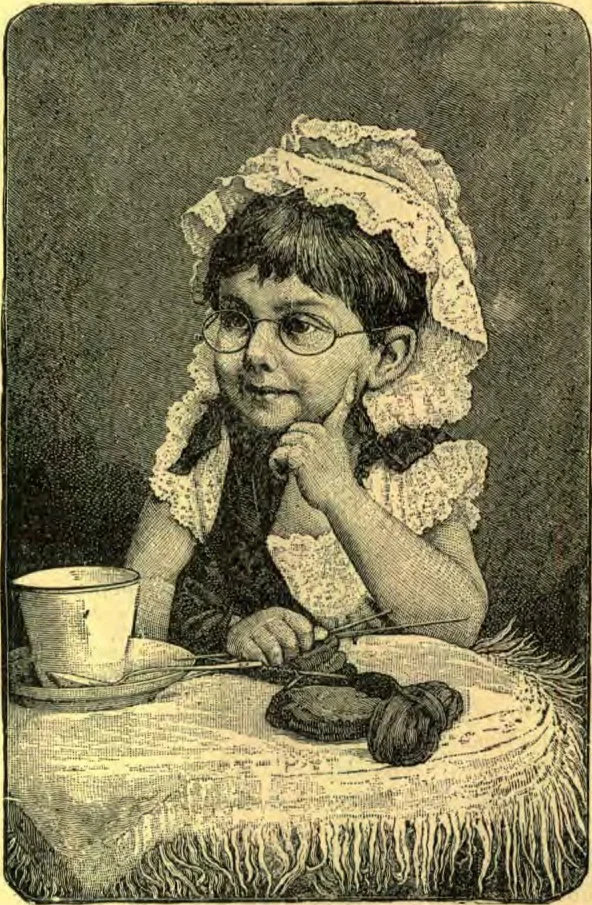
When grandma goes to take a nap,
I climb up in her chair,
And put her glasses on my nose,
Her cap upon my hair.
I gather up her knitting-work,
And hold the needles — so;
But though I've tried, I find that I
Can't make the stocking grow.
Once, when my grandma didn't see,
I thought that I'd pretend;
But all those funny little loops
Ran off the needle's end.
My grandma knits so easily,
Her fingers move so quick;
I like to hear her needles say,
“Clickity, click-click, click.”
And while she knits, my grandma tells
So many wondrous tales —
About the big ship Noah built,
Which had no masts nor sails;
How Daniel spent a whole, long night
Down in a lions' den.
And Joseph was to bondage sold
By his bad brothers ten.
And best of all, my grandma says
That every one is true.
I've heard them told so many times
That I could tell them, too.
So when, with cap and glasses on,
In her arm-chair I sit,
I'd be just like my grandma dear,
If I could only knit.
Review this chapter carefully from the beginning before studying the present lesson. Repeat the first two chapters several times each week. Recall the truths and lessons already learned; and by all means keep the mind and heart open to receive new lessons and truths every time you review.
QUESTIONS
1. What experience comes to those who are of faith? With whom are they blessed? What brought this blessing to Abraham? Verse 9; note 1.
2. Who are cursed? For what reason? V. 10.
3. How is no man justified? V. 11. Why is this so evident? Rom. 3:10-12. How do the just live? Gal. 3:11. What Old Testament scripture does Paul here quote? Hab. 2:4; note 2.
4. What is said of the relation between the law and faith? How only can life be obtained from the law? V. 12; note 3.
5. From what has Christ redeemed us? What was he made for us? What scripture shows that he was made a curse for us? V. 13. How has Christ redeemed us from the curse of the law? Note 4.
6. Why did Christ redeem us from the curse? Through whom does this blessing come? What else besides the blessing of Abraham do we receive? V. 14. What have we found the blessing of Abraham to be?
NOTES
1. “Faithful Abraham” the Scriptures call him. Very commonly this word “faithful” is used in the sense of being “constant in the performance of duties, or services; exact in attending to commands.” In this sense Abraham was faithful when he offered up Isaac in obedience to God’s command. But what was the secret of his implicit obedience? “Abraham believed God.” He was faithful in that he was full of faith. And true faith always works by love, and purifies the heart.
2. Paul preached the gospel from the Old Testament. The Lord has but one plan of salvation, and that runs through all the Scriptures. Salvation was never offered through works, but always by faith.
3. The law as the rule of action requires perfect obedience. And it justifies perfectly the one who observes it, and condemns the one who fails so to do. But since none have ever kept the law perfectly, it can never give life to any man. It always condemns the sinner to death.
4. Christ redeemed us from the curse of the law when he hung upon the cross; for then, according to the Scriptures, he was made a curse for us. A curse is pronounced upon the disobedient.311See Deut. 28:15-68. It is this curse of disobedience that makes the way of transgressors hard. See Prov. 13:15. The final curse of the law is death; for “sin is the transgression of the law” (1 John 3:4), and “the wages of sin is death.” Rom. 6:23. But Jesus bore all this curse for us; for “he was numbered with the transgressors” (Isa. 53:12), and was made sin for us (2 Cor. 5:21); so in dying he bore the final curse of the law. And this he has done for every one of us. Will we accept the offering, be free from the curse, and enjoy the blessing?
THE MOLE
IN appearance the mole is merely a flattened, oblong ball of very fine and soft, shimmering gray fur, pointed and footed at both ends. St. Nicholas gives an interesting account of this curious little animal. From the end of his nose to the insertion of his tail, he measures six and one-fourth inches, and his little pinky-white tail looks like an angleworm one and three-fourths inches long. His nose projects half an inch beyond his mouth, and feels as hard as if it had a bone in it. It terminates in a broad, flattened point, shaped for all the world like a rock-drill—and the way in which it can bore through the earth is astonishing. But his forefeet! They are three quarters of an inch wide, but less than one inch in length, including the claws, the longest of which measures nearly half an inch. Each foot is a miniature spade, armed with very sharp and powerful claws, formed like chisels, for cutting earth. The forelegs have no length whatever, the feet being set on to the body edgewise, close beside the jaws, with the soles outward. The ends of the claws point as far forward as the nose.
The instant the mole touches the earth, down goes his nose, feeling nervously here and there for a place to start his drill. In about one second he has found a suitable spot. His nose sinks into the soil as if it were a bradawl, with a half-boring, half-pushing motion, and in an instant half his head is buried from view. Now watch sharply, or he will be out of sight before you see how he does it. Up comes his powerful right foot, sliding close along the side of his head, straight forward, edgewise, to the end of his nose. His five-pointed chisel cuts the earth vertically until it reaches as far forward as his short reach will let it go; then, with a quick motion, he pries the earth sidewise from his nose, and so makes quite an opening. Instantly the left foot does the same thing on the other side, and meanwhile the gimlet-pointed nose has gone right on boring. In five seconds, by the watch, his body is entirely out of sight.
SAVED HIS MASTER'S LIFE
In “Wild Animals I Have Known,” Mr. Ernest Seton Thompson relates an exciting experience. He had gone out alone to a remote district on his pony to inspect some wolf-traps. In one of them he found a wolf; and, having killed it, was engaged in resetting the trap, when inadvertently he sprung the next one, and his hand was caught in the massive steel jaws.
“I lay on my face,” he says, “and stretched out my toes, hoping to draw within reach the trap-wrench, which I had thrown down a few feet away. Wolf-traps are set in fours around a buried bait, and are covered with cotton and fine sand, so as to be quite invisible.
“Intent on securing the wrench, I swung about my anchor, stretching and reaching to the utmost, unable to see just where it lay, but trusting to the sense of touch to find it. A moment later there was a sharp ‘clank,’ and the iron jaws of trap No. 3 closed on my left foot!
“Struggle as I would, I could not move either trap; and there I lay stretched out, and securely staked to the ground. No one knew where I had gone, and there was slight prospect of any one's coming to the place for weeks. The full horror of my situation was upon me—to be devoured by wolves, or die of cold and starvation. My pony, meantime, stood patiently waiting to take me home.
“The afternoon waned, and night came on,—a night of horror! Wolves howled in the distance, and then drew nearer and nearer. They seized upon and devoured the carcass of the one I had slaughtered; and one of them, growing bolder, came up and snarled in my face. Then there was a sudden rush, and a fight among the wolves.
“I could not see well, and for an instant I thought my time had come, when a big fellow dashed upon me! But it was Bingo,—my noble dog,—who rubbed his shaggy, panting sides against me, and licked my face. He had scattered the wolves, and killed one, as I afterward learned.
“‘Bingo! Bingo, old boy! fetch me the trap-wrench!’
“Away he went, and came dragging my rifle, for he knew only that I wanted something.
“‘No, Bingo—the trap-wrench!’
“This time it was my sash; but at last he brought the wrench, and wagged his tail in joy that it was right. With difficulty, reaching out with my free hand, I unscrewed the pillar nut. The trap fell apart, my hand was released, and a moment later I was free.
“Bingo brought up my pony, which had fled at the approach of the wolves; and soon we were on the way home, with the dog as herald, leaping and barking for joy.”
ANIMAL CUNNING
By Edison J. Driver
As I was walking through an orchard the other day, I chanced upon a flock of young quail among the tall grass. The whir-r-r of the old bird first attracted my attention, as she flew into a tree, and began to call a lively “quit-quit-quit!” to the little ones. This “quit,” you know, when uttered in a sharp, quick tone, is quail-talk for “hide for your life!” or “danger!”
But I was there before the little yellow, fluffy balls had a chance to scatter far, and began to chase three of them through the grass. Suddenly two disappeared. They had sunk quietly on some dead leaves, and my sight was not keen enough to detect them. In fact, when nature thus hides her helpless children, the keen eyes of the fox will pass them unnoticed.
I kept after the other little fellow, and chased him thirty or forty feet before I lost him. Then I tried to scare up another; but no, all my noise and walking could not make one stir. They had orders to keep still; and no matter what came,—even a heavy foot to crush them,—there they would stay, motionless.
But all animals are not eluded so easily as that bungling creature, man. Those which “follow their noses,” so to speak, must be dealt with in a different way.
One day this summer I was working in a vineyard. Near by among the vines a flock of quail—father, mother, and children—were breakfasting on bugs and worms. Little attention they paid to me, instinct seeming to tell them that I was preoccupied, and harmless anyhow in a thick vineyard. But presently I heard a quick “quit-quit!” and the “whir-r-r, whir-r-r” of a quail. Looking up, I saw a large gray cat chasing an apparently wounded bird. The mother quail, for she it was, fluttered painfully just ahead of anxious puss, till she had led him a safe distance from her young; then, with a quick whir-r-r, she was far away. Meanwhile the father quail had led the little flock away through the vineyard in the opposite direction, out of the reach of harm.
EDISON J. DRIVER.
BOB WHITE
By George Cooper
There’s a plump little chap in a speckled coat,
And he sits on the zigzag rails remote,
Where he whistles at breezy, bracing morn,
When the buckwheat is ripe, and stacked the corn:
“Bob White! Bob White! Bob White!”
Is he hailing some comrade as blithe as he?
Now I wonder where Robert White can be!
O’er the billows of gold and amber grain
There is no one in sight—but hark again:
“Bob White! Bob White! Bob White!”
Ah! I see why he calls. In the stubble there
Hide his plump little wife and babies fair!
So contented is he, and so proud of the same,
That he wants all the world to know his name:
“Bob White! Bob White! Bob White!”—George Cooper.
Happiness in the Common Gifts of Life
“Happiness,” says one writer, “depends more upon those things that are common to all than upon those which are the rare and signal property of the few. Those matters in which men differ from one another in the scale of social condition are not half so important or valuable as those in which they agree.” Mindfulness of this fact would repress many an envious sigh, silence many a complaint, and lead to glad and thankful recognition of the largeness of God’s gifts to all. The fact is that the substances of life are bestowed with generous hand. Life’s best things, its largest resources and privileges, are part of the common lot. A man may live in a lowly house or in an obscure room; but if he has a heart in him, he may have friendships as cordial, and love as deep and sincere, as the prince who dwells in a palace. There may be no paintings upon the walls of his poorly furnished room; but he has just as true a possession of the pictures that the hand of the great Creator tints and frames, in the flaming splendor of the sunset, the pomp of fleecy clouds, and the varied beauty of nature. The roof of a cabin is as near heaven as the dome of a cathedral or the turret of a stately mansion. The power of worship, the mystery of the divine presence, the breath of the ineffable love, are as close to the dweller in a tenement as they were to David in his palace or to a Bernard in his cloister.—Baptist Union.
Do You Want Relief
From that ever-troublesome catarrh? If so, send us one dollar, and we will mail you, on ten days’ trial, subject to return of money if unsatisfactory,—
THE MAGIC POCKET VAPORIZER,
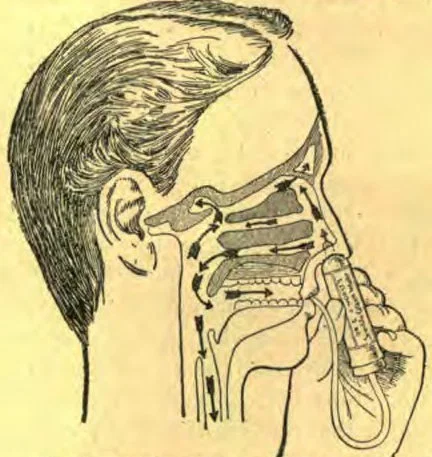
The Throat.
As it Appears when in use in Treating Catarrh of
The Nose.
An instrument so simple in construction that the germ-destroying oils may be applied to the affected parts while you go about your everyday labors.
The many unsolicited testimonials which we have received from our gratified patrons from Maine to California, are a sufficient guarantee of its effectiveness.
Our booklet, “Hygiene and Cure of Nasal Catarrh,” free on application.
Modern Medicine Co.,
25 Washington Ave., N. BATTLE CREEK, MICH.
Destroy the Germs; Cure the Disease!
By E. J. Worst
The above illustration shows how the E.I.
The above illustration shows how the E. J. Worst Scientific Catarrh Inhaler sends the medicated air into every air passage of the head. Nothing but air can penetrate these fine air cells and reach the homes of the living germs that cause disease.
No snuff, powders, douche or spray can possibly reach them. Don't be deceived—make no mistake—apply common sense, and you will find that
E. J. Worst's Catarrh Inhaler
is the only instrument that will give you quick return for a small outlay, and perfect satisfaction as a Cure for Catarrh, Colds, Pains and Roaring in the Head, Bronchitis, Sore Throat, Headache, Partial Deafness, and all Diseases of the Air Passages.
SPECIAL OFFER.
For a short time I will mail to any reader, naming this paper, one of my new Scientific Catarrh Inhalers, with medicine for one year on three days' trial, free. If it gives satisfaction, send me $1.00; if not, return it after three days' trial. Could any proposition be fairer?
E. J. WORST, 421 Main Street, ASHLAND, O.
Not Sold by Druggists. AGENTS WANTED.
GARLAND STOVES AND RANGES
One thousand styles and sizes. For cooking and heating. Prices from $5 to $50.
Steel Ranges
Cast Ranges
GARLAND STOVES AND RANGES
The World's Best
The genuine all bear the above Trade-Mark and are sold with a written guarantee. Awarded First Prize Paris Exposition 1900. OVER ALL THE WORLD. Sold by First-Class Stove Merchants everywhere. Made only by The Michigan Stove Company, Largest Makers of Stoves and Ranges in the World.
Base-Burners
Oak Stoves
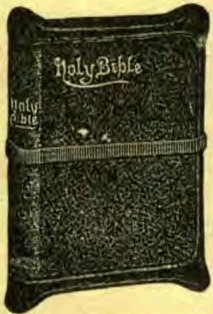
Self-Pronouncing S. S. Teachers' Reference Bible.
CONTAINS the celebrated _Teachers' Helps,_ comprising nearly 400 pages. Also a complete series of fifteen new maps.
_Description._ — Imperial Seal Binding, Tuck Edges, known as “Divinity Circuit,” Rounded Corners, Full Red under Gilt Edges.
We offer this Bible, post-paid, for only _SIX NEW YEARLY SUBSCRIPTIONS_ at 75 cents; or _TWELVE NEW SIX MONTHS' SUBSCRIPTIONS_ at 40 cents.
We will also send it, post-paid, with the INSTRUCTOR one year for $2.25. For 20 cents extra we will stamp your name in gold upon the cover.
To Reach BATTLE CREEK
FROM
CHICAGO, BUFFALO, DETROIT, OR TOLEDO,
Purchase Tickets Reading over the MICHIGAN CENTRAL
“The Niagara Falls Route.”
A First-class Line for First-class Travel between Chicago and New York and Boston. Elegantly equipped through trains pass Battle Creek in each direction daily.
R. N. R. WHEELER, Ticket Agent, Battle Creek.
O. W. RUGGLES, Gen'l P. and T. Agt., Chicago, Ill.