IT is very generally accepted among the masses of Christian people at the present time that when Christ came to this world one feature of His mission was to fulfil the law, in the sense of bringing it to an end and to introduce a new era, known as the reign of grace. Many passages of scripture are misused to show that this is the purpose of the Gospel and the personal appearing of Christ. But if the believer in such teaching would stop long enough to consider what is involved in such an idea, its bearing in general upon the law of Jehovah, its relation to the real purpose of Christ’s coming, and its meaning to the Jewish people to whom Christ came in fulfilment of the Scriptures, it would be apparent that its tendency is to destroy faith in God, in His law, and in the mission and salvation of Jesus Christ. John 5:39, 45-47.
Why the Saviour Appeared.
The mission of the Saviour had been predicted all through the ages by the different prophets. Luke 24:27, 44. When the fulness of the time had come, however, God sent forth His Son into this world. Gal. 4:4. As He was about to appear, there came from heaven these testimonies by the angel Gabriel, “The Holy Ghost shall come upon thee, and the power of the Highest shall overshadow thee; therefore also that holy Thing which shall be born of thee shall be called the Son of God.” Luke 1:35. “And the angel said unto them, Fear not; for, behold, I bring you good tidings of great joy, which shall be to all people. For unto you is born this day in the city of David a Saviour, which is Christ the Lord.” Luke 2:10, 11. “And she shall bring forth a Son, and thou shalt call His name JESUS; for He shall save His people from their sins.” Matt. 1:21.
One feature, therefore, of the coming of Jesus was to save His people from their sins. But we learn from the Word of God that “sin is the transgression of the law.” While it is generally conceded and believed that the mission of the Saviour was to save the whole world, it is also recognized that at His coming He came to His own, and His own received Him not. He said Himself that He was not sent but to the lost sheep of the house of Israel; and He exhorted His disciples not to go in the way of the Gentiles, but to rather go to the lost sheep of the house of Israel. 1 John 3:4; John 3:16; 1:11; Matt. 15:24; 10:5, 6.
NOT GOD'S FAULT.
God will always reveal the absolute truth as to present duty to one who seeks Him in accordance with His expressed will. We have God's promise as to this. One reason why there is such a wide divergence of views among good men as to truth, is that good men so often undertake to get at the truth of matters which have nothing to do with their present duty, and concerning which God has never promised to reveal the truth.
There are other factors in the situation, also, prominent among them being the arch-enemy of all truth, the father of lies, whose business it is to swerve good men just a little from living7in accordance with God's will, knowing that he is thereby effectually blocking them in their endeavor to see the truth. But it is eternally true that whatsoever a child of God needs to know, and earnestly seeks to know, turning to God the Father only as the ultimate appeal in all truth-seeking, that child of God will be shown by God the Father. If we can not believe that, the universe is a blind, groping chaos.
To say that because good men differ in their theological or religious beliefs, therefore God either can not or will not reveal needed truth to a child of His own creating, is an argument that will not appeal to any one who has tested and experienced God's abundant, truth-revealing bounty. Whatever failure exists among Christian men to arrive at a common understanding of needed truth is whose fault, God's, or men's?—Sunday-School Times.
The Law and the Gospel.
By F. C. Gilbert
The law is the Gospel infolded; the Gospel is the law unfolded.
The law is the Gospel inclosed; the Gospel is the law disclosed.
The law is the Gospel concealed; the Gospel is the law revealed.
The law is the Gospel-fulness delayed; the Gospel is the law-fulness portrayed.
The law is the Gospel in minimum; the Gospel is the law in maximum.
The law is the Gospel contained; the Gospel is the law maintained.
The law is the Gospel sighted; the Gospel is the law lighted.
The law is Christ designed; the Gospel is Christ enshrined.
F. C. GILBERT.
HIGHLY EXALTED WITH CHRIST.
By H. A. St. John
"Him hath God exalted with His right hand to be a Prince and a Saviour, for to give repentance to Israel, and forgiveness of sins." Acts 5:31. "But we see Jesus, who was made a little lower than the angels for the suffering of death, crowned with glory and honor; that He by the grace of God should taste death for every man." Heb. 2:9.
TRULY the Father hath highly exalted Him to a place at His right hand, to a seat upon His throne, and there is no exaltation above this in all the universe. The human mind can not conceive of the glor, honor, power, and exaltation conferred upon the Lord Jesus by our Father in heaven. And when we remember that this exalted One is our Prince and our Saviour, having an interest in our present and eternal welfare and happiness, measured only by His infinite capacity to love, wisdom to devise, and power to execute, it is then that we may feel to implicitly trust Him for time and eternity.
"Humble yourselves therefore under the might hand of God, that He may exalt you in due time." 1 Peter 5:6. "For whosoever exalteth himself shall be abased; and he that humbleth himself shal be exalted." Luke 14:11. So we see that an exaltation is promised the humble; and such an exaltation as can alone be conferred by Him who has Himself been exalted above every other creature in the universe. The humblest and most lowly of all the sons of God wil have the right and privilege of sitting with Jesus upon His own throne of glory.
And the best of all is it is not a transient ifting up, to be followed again by a fal, or humiliation; but it is an exaltation to be perpetuated throughout eternity. Happy, eternally happy, is the man whom God shall crown with glory and honor, and exalt to reign with His beloved Son in that kingdom of glory which He shal give Him in that day when the King of Kings and the Lord God Omnipotent shall reign, and opposing rulers be cast down.
Given a New Name.
"God also hath highly exalted Him, and given Him a name which is above every name." Phil. 2:9. "Being made so much beter than the angels, as He hath by inheritance obtained a more excelent name than they. For unto which of the angels said He at any time, Thou art My Son, this day have I begoted Thee? And again, I wil be to Him a Father, and He shal be to Me a Son?" Heb. 1:4, 5. We have never heard of a person who has received so many names and titles as Jesus; and al of these are honorable, praiseworthy, and precious in their signification to the sons of God. What is to be the new name of Christ, we may only conjecture, perhaps, until our heavenly Father chooses to reveal it. If Jer. 23:6 answers our question, and gives us the new name of Christ, it is certainly one entirely worthy to be used by the redeemed in this world and throughout eternity in the world to come. Thus it reads: "In His days Judah shal be saved, and Israel shal dwell safely; and this is His name whereby He shal be called, THE LORD OUR RIGHTEOUSNESE."
It wil be proper and true and met for the sons of God to cal Jesus their righteousness, for such He truly wil ever be to them. Hence this name is an exceeding appropriate one, and would be a constant reminder of al that Jesus had done for them.
Even now siners may come to Jesus and exchange their filthy garments of sin, their rags of self-righteousnes, for the beautiful robe of Christ's righteousness; and they may wear it in this life. Al the sons of God wil wear the wedding garment furnished by the Master of the marriage feast. They wil have on white robes, washed and made white in the blood of the Lamb, to go to heaven in. These robes of righteousness, in which the saints wil be arayd, wil even add to the brilancy and glory of the city of God, which is in itself "the perfection of beauty." The inspired penman says that the holy city wil be adorned by the shining ones.
And the sons of God, too, wil each receive a new name. Thus saith the Lord: "He that hath an ear, let him hear what the Spirit saith unto the churches: To him that overcometh wil I give to eat of the hiden mana, and wil give him a white stone, and in the stone a new name writen, which no man knoweth saving he that receiveth it." Rev. 2:17. This new name wil not be known by the receiver until the promise is fulfiled. But when siners are made new creatures in Christ Jesus they are called to a new name, to be the children of God, the sons and daughters of the Almighty.
But when at last, as saints, they are made new creatures by having their vile bodies changed and fashioned like unto Christ's glorious body, and they go to inherit al things made new, they wil receive in ful that new name, apropriate and befitting their new relations and surroundings. When Jesus apears the second time, having on His head many crowns, He will bear His new name which no man knoweth but He Himself. Again we see how the sons of God folow the Son of God, even in al His steps of honor, exaltation, and glory in the glory life beyond.
H. A. ST. JOHN.
WORK FOR SOULS.
By H. W. Beecher
Go to work! Nothing is more salutary to the human soul than the direct work of saving men. There is a basis of fact. There is the next ground for action. Whatever your theory may be of this or that doctrine, there is a man dying in his need, and there is a power which you may apply for his transformation. Therefore go to work upon men, and with men.
And let me tell you, there is nothing you can do that would be more satisfactory to your own soul. I speak what I do know when I say there is nothing which brings men back from the desert of sandy and arid speculation, nothing which brings a man in again to the shore from the cheerless ocean of doubt, nothing which gives us such faith and certainty, as laying aside all reasoning and engaging in the practical work of the Gospel.
I know that there is restorative influence in that work. I know that, whatever doubts I may have, once let my heart and hand join together in working with men for their salvation, and my doubts disappear; I know in whom I believe; I know the work to which I am appointed; and the sweetest that I ever had of God came to me in the act of laboring for my fellow men. The most glorious views I ever had of man's interior life and of essential, divine truths were ministered to me when I was working for the salvation of others.—H. W. Beecher.
The Six and Eight Days
#
[Mrs. Ghosn-el-Howie, a resident of Syria, in S. S. Times.]
" AND it came to pass about eight days after these sayings." Luke 9:28. In Mark 9 it says, "After six days," that is, after the happenings described in Matthew 16:13–28. The Latin New-year's day is thirteen days earlier¹ than the Greeks', and the Syrians date their letters, documents, etc., in accordance with either reckoning; but the major part of the people do not wait to think, and can give you no exact answer as to how the thirteen days are to be reckoned, and yet the matter gives them no trouble. A friend left us on Sunday, and said he would return "after three days." This may mean that he would return on Thursday after an absence of three clear days, but he may return on Tuesday. In that case, the day of going and the day of return would be counted to make up the three days. It would be possible to understand Mark's "six days" as clear days, while Luke adds the day on which "these sayings" finished and the day on which they started for the mount, and so he got his eight days.
WHEN JESUS COMES TO REIGN.
By Flora E. Yergin
THE years so swiftly passing;
The buds on every tree;
The mighty works of darkness;
The storms on land and sea;
The cry of "Peace and Safety,"
By Wisdom's enemies,—
All tell of Jesus coming back
to reign.
Not long shall Earth be burdened
With such a weight of sin;
Not long—till God's own chosen
A crown of life shall win;
For shall not God avenge them
Who've cried so long to Him?
Ah yes! for He is coming back
to reign.
Not as an infant stranger
In Bethlehem's manger born;
Not as a smitten outcast,
His visage marred and worn;
As Kings of Kings He's coming,
No trace of cruel thorn,
On that fair morn when Jesus
comes to reign!
FLORA E. YERGIN.
Onoway, Mich.
TEMPORAL POWER OF THE PAPACY
By C. E. Milton
CURRENT ARGUMENTS AGAINST THE RESTORATION OF THE TEMPORAL POWER.
Love of a United Italy.
THE most potent argument brought against the return of the temporal power is the one that deals with the effect that such a change would have upon the present united Italy. With the surrendering of Rome to the Papacy, and the loss of this strong capital, it is believed that the kingdom would fall to pieces again. The hope of continuing Italy as a united kingdom rests on retaining the city of Rome as the home of its central government. Therefore the Catholics who would otherwise be in favor of the return of the temporal power are unwilling to grant it at such a price. And, consequently, thus far a love for a united nation has overbalanced their desire to listen to the plea of the church for a return of the temporal power.
Then there are many that contrast the government of Rome as it exists to-day, and as it existed under the Papacy, and they are persuaded that the present aggressive government is far superior from every point of view. Under the papal government the city was neglected, the streets filthy, disease was very prevalent, and business was continually interrupted by the numerous church-days in which all business was suspended. In other words, the people are generally well satisfied that the Papacy ruled more to its own interests than to those of the people. However, the question is ever kept agitated from both sides, and there do not lack those of the clerical party who are continually sighing for the return of the temporal power, and who recall the days of yore as a golden dream of the past. Every calamity that befalls the people or the slightest difficulty that besets the city is quickly ascribed by them to the absence of the pope's blessing. For under the pontifical government the pope passed through the streets of Rome imparting his blessing to the people and the city, which is not permitted at present. The people are carefully taught by the priests that the lack of this blessing on the part of the pope causes a great curse to rest upon the city, and consequently calamities and difficulties can not be averted.
These are, and have been, in main, the arguments current for some time on the point, but of late
The Affair Has Taken on a New Form
which has tended to revolutionize the whole question. This attempt has come from within the church itself, and is very interesting as determining the present attitude of the papal government on the position taken. The new attempt at solving the question has come about largely as a result of the separation of the church from the state in France. As all of Europe has looked on with much interest and attention at what has recently been accomplished in France, many have speculated as to what would be the outcome as regards the interest of the church. Some argue that the church will lose, and others that it will gain, by the separation.
As a result of the agitation, a bishop has revived the question in Italy, in a discourse given in the large cathedral in Cremona. This address has been very extensively commented upon by the public press. He suggests that the Roman Church also in Italy would profit by a separation from the state. His ideas of the separation of church and state are well developed and define the correct position splendidly. I quote as follows from his definition of what ought to constitute a separation of church and state:
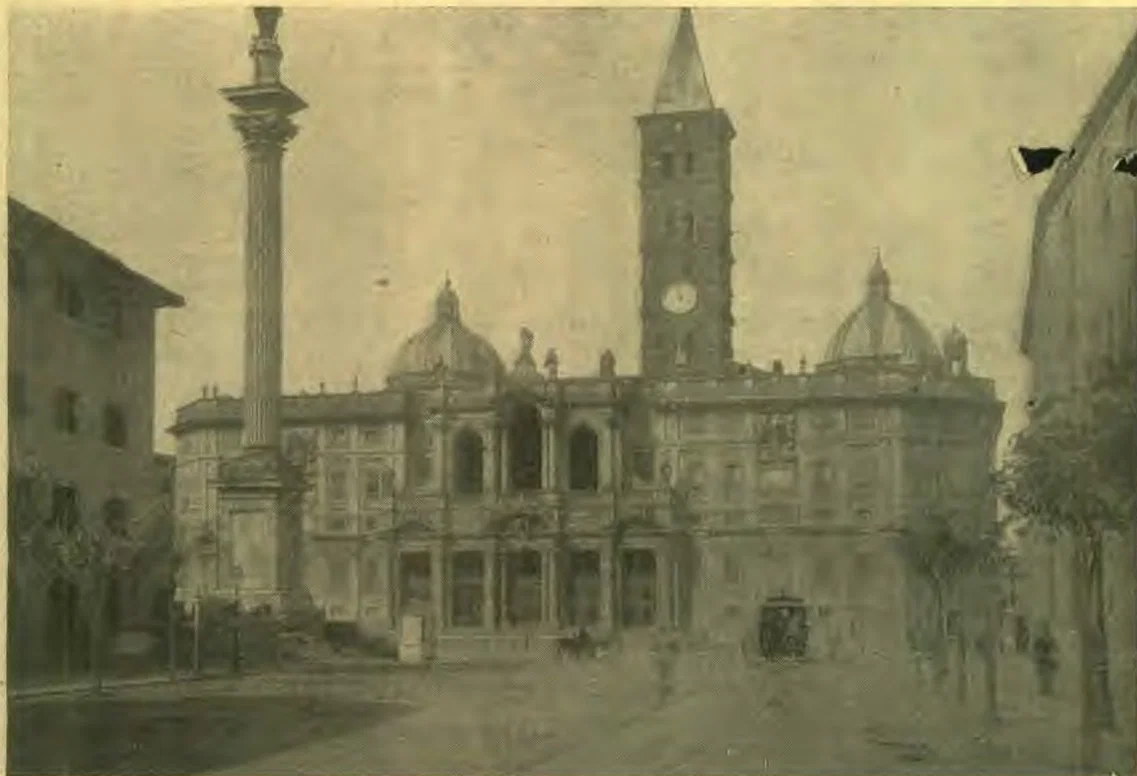
Santa Maria Maggiore, Rome.
Separation of the state from the church is the perfect indifference or entire neutrality of the state in regard to religion and worship. The state in clear terms says: I, civil society, as civil society, have not, do not wish to have, can not have, and ought not to have, any religion; however I am neither for nor against religion. The religion as religion has nothing to do with me. I do not fight it, defend it, nor judge it; if I should do so I would violate the limits assigned to me and would become a usurper. I, as state, must not favor any religion, but maintain respect for all religion without distinction; and if under certain conditions I shall wish to take part in any holiday or demonstration of a religious nature, I shall do so solely for the purpose of honoring certain individuals or celebrating certain great events that have brought glory to the country, but never for the purpose of professing any belief of which I have none. In such a case I would make use of the Catholic worship if the Catholic religion be in the majority, or the Protestant, or the Russian, or, if need be, also the Jewish, because to me they are equal, politically and patriotically considered. I ought to have but one aim, and that is, to make good laws, and govern wisely the public instruction, the public trusts, justice, the army; promote industry, commerce, agriculture, the arts; maintain public order; lead the citizens to a better condition materially and morally, and to that earthly happiness that is possible, without paying any attention as to whether they practise the Christian Catholic religion, or the Protestant, or the Turkish, or the atheistic. Religion is a matter of conscience, and pertains to the inner man and also to the outer, but in the limits fixed by the law. To me the citizens are all respectively equal, and I, the state, am duty bound to give all justice and guarantee to all their rights. The state is not the church; it has not for itself any religion. In other words, we may say that the state is atheist. The men that compose the government as citizens can have the religion that they desire, and it is well that they have it, but as to the government, it ought not to make any distinction between one and the other.
I have given this definition thus at length that we may see just in what terms the question has been put, and thus the attitude of the Papacy on this point can be better appreciated. This declaration of the relative positions that the state and church should occupy seems all that could be asked on the subject, even by the most advanced advocates of the total separation of church and state. Therefore the Papacy has had a chance to commit itself with a very clear statement of the case before it. It might be interesting to inquire if the bishop himself accepts his position as desirable for the church in Italy. In answering this query allow me to quote from his own words as follows:
Yes. The church does not demand this change and would not provoke it, as it does not wish to be the first to break with the conditions of the past; but if it comes, as everything seems to predict, the church will accept it, relying confidently upon its own forces. It seems to me that God addresses these words to the church which were spoken to Abraham, "Get thee out of thy country and from thy kindred, and come into the land which I shall show thee." Get thee out from the chains with which you are bound by those that call themselves your children; loose yourself from
The Legal Shackles Which Hinder You,
and which have made the past difficult; enter into the immense field of liberty and there, in the full light of the sun, develop all your forces, which are divine, and fear not. The victory will be yours, and those who have thought to kill you with liberty will have prepared for you the most magnificent triumph. And this advantage of the separation, I believe, will turn out more glorious for the church than otherwise.
All know and see that the other churches and religions, without exception, are not only unhealthy, also fused with the state under which they are found. It is sufficient to observe that the supreme representatives of these churches, as the Russian, the Lutheran, etc., and of those religions, as the Turkish, and Buddhist, are themselves also heads of the state; and the life and power of those churches and religions are derived from the civil power. To the unbelieving and skeptical world is reserved this flaming proof of the divine origin of the church; a9church deprived of material force, which lives under powers very diverse, and yet does not need them, and does not ask of them either a penny or a soldier. This will be a new and miraculous spectacle, and one that will gather to the church the real sympathy of all men of heart, because it will live its own free life in the midst of the people. And then, perhaps, those that rule the people will be glad to ask of her the moral help of which they shall feel the need, and she, ever generous, will be pleased to concede it.
As I have already said here, the question is well launched, and the Catholic Church has presented before it the way to a sure triumph along the right lines. In passing, we might observe that the bishop has evidently overlooked the fact that in America we have already practised these principles for many years; for we have prosperous churches that have never received a penny from the government.
C. E. MILTON.
[How the Vatican regards the separation of church and state will be considered next week.]
WILD FIRE.
SUPERSTITION is not dead in England or anywhere else in the world. At a revival in a district remote from large cities the people lost all self-control. They held a prayer meeting which began at seven o'clock in the evening and continued till eleven o'clock the following morning. During these hours remarkable scenes occurred. Men and women tore their hair, threw themselves on the ground, and prayed with intense fervor. At Carmel, a young woman, reported to be in a religious trance, was visited by hundreds of people. It is claimed for her that she is endowed with supernatural power and that she has cured several people of various diseases. The inhabitants of the village regard her with awe, and declare that she will yet raise the dead as a sign for unbelievers. These proceedings are entirely contrary to the explicit directions of Paul where he says, "God is not the author of confusion [the Greek meaning really tumult] but of peace, as in all churches of the saints." "Let all things be done decently and in order."—Christian Advocate.
FAITH.
By S. H. Carnahan
NOW this may seem an old subject, and well it is. But I want to consider some of its phases in perhaps new settings, and see if the gem does not shine more brightly than ever before.
The Creator of the heavens and earth, inspired the statement that "faith is the substance of things hoped for, the evidence of things not seen." Heb. 11:1.
Let us note the first clause, "Faith is the substance of things hoped for." The thing above all others that we hope for is eternal life. In John 3:36 we read, "He that believeth [hath faith] on the Son hath everlasting life;" but "he that believeth not [hath not faith in] the Son shall not see life;" he hath not eternal life. Hence we perceive that in this present world, faith is the substance.
Now taking up the last part of the text, with its subject (faith) and copula (is), we have, "Faith is the evidence of things not seen." So Paul affirms: "I have kept the faith; henceforth there is laid up for me a crown of righteousness, which the Lord, the righteous Judge, shall give me at that day; and not to me only, but unto all them also that love His appearing." 2 Tim. 4:7, 8. Again, in 1 John 3:2 we read, "We know that, when He [Christ] shall appear, we shall be like Him; for we shall see Him as He is." Thus we see that faith is the evidence of things not seen as yet.
Surely faith is a gem of greater brilliancy than the diamond; of deeper hue than the ruby; unaffected by climatic conditions or changes. Therefore the first, most needful thing we need is faith, without which it is impossible to please God; for we must believe that God exists, and will reward those who diligently seek Him. Heb. 11:6.
The merciful God has given to every individual the privilege of believing, and the power to believe.
The way to obtain more or greater faith is: First, by the study and doing of God's Word, as "faith cometh by hearing, and hearing by the Word of God" (Rom. 10:17); second, ask for it of its Author (Heb. 12:2), Jesus Christ, who "giveth to all men liberally, and upbraideth not." James 1:5.
Some may say that they do not understand certain portions of scripture; that they do not understand how this or that statement can be true or is just. If we take such a position we simply try to measure the infinite God by our puny, finite knowledge.
We can not explain, because we do not fully understand, the workings of the X-rays, the telephone, the phonograph, wireless telegraphy, the teleautograph, and many other things; yet we know that these things exist, and we know their use. We have to accept the word of men that such persons as George Washington, Oliver Cromwell, Julius Cæsar, Alexander the Great, and others really existed and performed the acts with which they are accredited.
The centurion, a Roman officer, who came to Christ to have Him heal his servant, in some way understood the power of God's word and said to Jesus, "Speak the word only, and my servant shall be healed." When Jesus heard it He said to them that followed Him, "I have not found so great faith, no, not in Israel." Matt. 8:8–10.
When but a boy, about thirty years ago, the writer read in a school reader about the opening and shutting of the gates at a street crossing on the railroad. It said the gates closed when the train came in sight, and opened after it passed by. The teacher did not explain how it was done, and I did not understand it; but about twelve years later, for the first time, I beheld in Spokane the operation of the gates. Instantly that which I had read in school years before came to my mind, and was understood. So time and experience will give us understanding, if faithful, of the Word of God which we now accept simply by faith.
How important, then, that we immediately adopt and "earnestly contend for the faith once delivered unto the saints," even the faith of Jesus (Jude 3); knowing that of the remnant church it is said, "Here are they that keep the commandments of God, and the faith of Jesus." Rev. 14:12.
S. H. CARNAHAN.
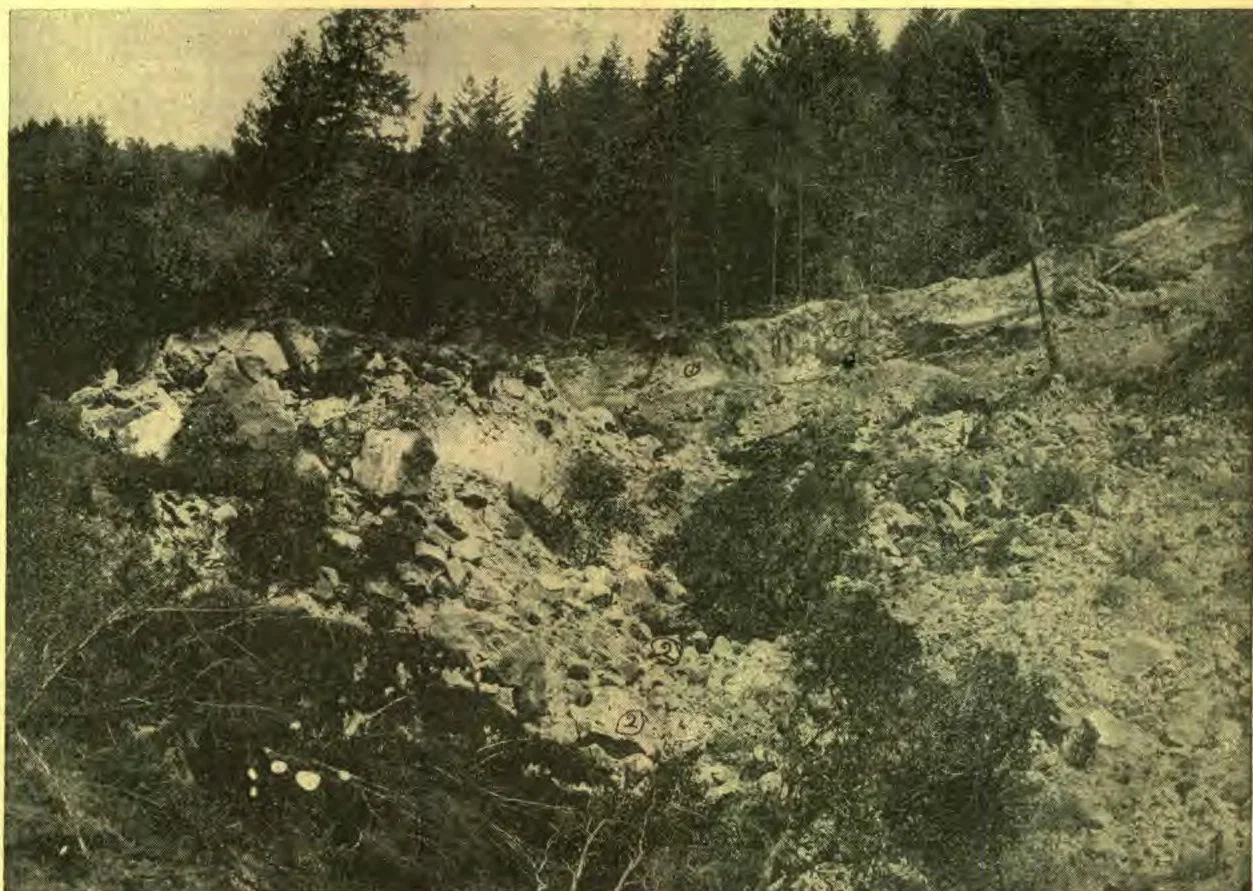
THE ERUPTION IN ALEXANDER VALLEY.
TAKE CARE OF YOUR BOYS.
PARENTAL affection is stronger than most other affection; yet too many fathers and mothers are careless about the welfare of their children; not about the inheritance which shall go to them, not about whom they shall marry, and not about their social standing; but about the formation of habits and the determination of permanent character.
In every city there are hundreds of traps for young men; and it is as dangerous for a girl to have no Christian care in a center of civilization as to be lost in an African forest. Worldliness, ambition, appetite, passion, are more destructive to the young people of our country than the wild beasts that are so rapidly disappearing.
Parents, when their boys go to school, should ask themselves the question, Is my child safe? or are they training him or her there for the theater, for the gambling-hell, for the saloon, or for the brothel?
When the parents are at church, they should ask, Where is my child? Where is he when the parent is in the parlor, or retiring? If the boy leaves the house as soon as the evening meal is eaten, where does he go, what society does he meet, and what is his employment?
While the parents should not annoy their children by frequent and unnecessary reproof, they should know what are their occupations and associates, and that they are right. If the child is unwilling to reveal these things, it indicates that his associations or pursuits are probably evil, or that his spirit is not right toward his parents. Unless curbed, the chances of such children for honor, health, and usefulness are very poor.
Is your child safe?
God has created no one too young to be good. Do not imagine that while your child is getting the upper hand of you, that you will later be able to turn him about and make him properly respectful. His habits of mind, as well as of body, will become fixed.
Train your child to religion. The command of God is in accord with nature: "These words which I command thee this day, shall be upon thy heart; and thou shalt teach them diligently unto thy children."
The commands of the Bible to religious training are emphatic and plain: "Train up a child in the way." Bring up your children in the nurture and admonition of the Lord. Tell them that God commands, "Remember now thy Creator in the days of thy youth." God says, "They that seek Me early shall find Me."
Do not imagine that the last utterance we quoted means that if you allow your child to cultivate the habits of sin, that you can the more easily win him later to the ways of righteousness.
Jesus, "looking on the young man, loved him." He said, "Suffer the little children to come unto Me." Paul wrote to Timothy that he had "known the Scriptures from his youth up." If your boy learns the language of the card table instead of the Scriptures, in later life he will probably not be willing, even if converted, to regard the words of the Scriptures as of great value. He will know better what "stand pat" means than what "Our Father" means.
Let your child start for the kingdom on high, even before he knows the way. Let your hand lead him. Let the language he hears be the language of Canaan. Let the sights he sees be those of the church. Teach him to pray before he learns to swear. Teach him the doctrines of the Gospel before he learns the duplicity of mankind. Teach him that the "Young America" idea does not produce "old fogies," because the "Young America" fellow does not live long enough to be an "old fogy;" because God has made the commandment read: "Honor thy father and thy mother, that thy days may be long." Teach your boy that long life depends on the principles imbibed in honoring a virtuous parent, that if he enters God's house he must honor his heavenly Father, God will have no one else there.
But still we know that our children may die while young. They should have learned to serve God while young; that they may be familiar with the principles of heaven before they go there. Youth is the time to serve the Lord. Youth is the morning, the springtime, the planting-time of life; the worst part of life to throw away, and the most valuable part to improve; the time to choose good or evil, life or death.
Lead your child to God while he is young. He belongs to God. Man is a child of God by right. Death entered the world because of the enemy, sin. That is an intruder. God breathed into man's nostrils the breath of life, and man became a living soul. He belongs to God. You should make your boy understand this. Do not be afraid to talk of the law of God, when "thou liest down, and when thou risest up; when thou walkest by the way, and when thou sittest in thy house." When thy boy is away from thy presence sinners will talk to him, with little hesitation, unless they know that he is fixed in the right. But if thy influence has been strong and good, thou hast made thy boy's character so clean that when he may approach a group of sinners telling each other their vulgar stories, they will hush their vile talk, just as in the presence of an honored woman or a pure girl.
Parents, take care of your boys.—Herald of Gospel Liberty.
"BESIDE THE GOLDEN GATE."
By Robert McIntyre
[Robert McIntyre, in Los Angeles Times.]
THAT fateful day the sea did take
His silver trumpet up to wake
The Mistress of the Keys,
His beauteous bride, who sleeping lay
Beside the door that guards the bay,
Amid her argosies.
And blew one long, sweet-cadence call
Far echoing from Sierra's wall:
"O Favorite of Fate!
The April dawn is in the skies,
The world hath need of thee; arise!
Beside the Golden Gate."
She rose; a song upon her lips,
And looked upon the lordly ships
Which round her lay at rest,
Which brought o'er many a thousand miles,
From far-off continents and isles,
The wealth of east and west;
And this she sang: "I take my toll;
All roads that run, all waves that roll,
Their tribute, soon or late,
Shall bring to heap around my knees
The store from all the lands and seas
Beside the Golden Gate."
Stalwart she stood, in splendid bloom,
When on her fell the stroke of doom;
Her song unfinished died.
She saw her strong foundations rent,
An earthquake, like blind Samson bent
The pillars of her pride.
Her tallest turrets rocked and reeled,
Her staggering belfries clamorous pealed,
While flames in fiendish hate
Flogged thousands with their fiery scourge,
Chanting the burning city's dirge,
Beside the Golden Gate.
But far above that fierce uproar,
From every clime, from every shore,
Rang out one clarion cry:
"Spike all the switches, spin the wheels,
Speed all the steamers, steer the keels,
Lest San Francisco die."
Loaded with friendly help, they flew
O'er tracks of steel, o'er tides of blue,
From every town and State.
She heard, and raised her bleeding head,
"Thank God for human love," she said,
Beside the Golden Gate.
A TRIUMPH OF NEWSPAPER MEDICINE.
THE medical editor of one of the New York dailies used often to say that medical journalism was played out, for a journal published only once a week or once a month could never compete with the daily papers; at best it could only republish in more elaborate, if less sensational, style what the lay press had printed days before. In view of a tremendous "beat" scored by the Sun last week, we are inclined to think the medico-lay editor was very nearly right. This enterprising journal published an interesting and circumstantial account of an operation for renal calculus, performed at one of the hospitals by a well-known surgeon of this city. All the details of the operation were graphically and, as it appeared the next day, quite accurately described. The point of special interest in the article was that the operation which it described was not performed until about twelve hours after the article had been published. "If you see it in the Sun, it's going to be so."
—The Medical Record.
WORDS SELDOM USED.
A PHILOLOGIST was talking about words. "There are over 225,000 words in the English language," he said, "but we only use a few thousand of them. The extra ones are no use to us. Any man could sit down with a dictionary and write in good English a story that no one in the world would understand. Here, for instance; can you make a word of this?"
And the philologist pattered off: "I will againbuy the atabal. Weyd you weyed? Yet this is no blushet's bobance, nor am I a cudden, either. Tho the atabal is derned, still will I againbuy it."
Then he translated: "I will recover the drum. You are amazed? Yet this is no young girl's boasting nor am I a fool, either. Tho the drum is hidden, still will I recover it."—Louisville Courier-Journal.